
It is easy to mean to thank a conference speaker after the event, then send a rushed one-line email three weeks later, or nothing at all.
Quick answer: A good thank you note for a conference speaker names their talk, mentions one specific thing they said or showed, says what it did for the audience, and closes warmly with a line about staying in touch. Two to four short paragraphs are enough. Send it within 24 to 48 hours, so the speaker can see their preparation was noticed.
What to Include in a Thank You Note for a Conference Speaker
A good thank you note for a conference speaker doesn’t need to be long, but it does need to feel like it came from a real person who paid attention. A few qualities make a note feel genuine rather than routine.
The Core Elements
Every speaker thank you note should cover these basics, whether it goes to a keynote speaker, a panelist, a workshop facilitator or a sponsored speaker:
| Element | What to write |
|---|---|
| Their name | Skip “Dear Speaker” or “To Whom It May Concern.” Use their actual name. If the relationship is professional but warm, first name is fine. |
| The specific talk or session | “Thank you for speaking at our conference” could have been written without attending at all. Mention the session title, a topic they covered, or a specific point they made. That one detail signals that your note is genuine. |
| Audience impact | Did attendees ask follow-up questions? Did the Q&A run over because engagement was so high? Did someone on your organization committee say they are already applying what they learned? Include it. Speakers rarely hear what their words actually produced. |
| Direct gratitude | No need for superlatives. “Your session on [topic] was genuinely valuable for our attendees” is honest and specific. |
| A forward-looking line | If there is any chance of working together again, say so. Even a simple “We hope to have you back” keeps the professional connection alive. |
What to Skip
Keep the note focused. You don’t need to recap their entire talk back to them, offer unsolicited critiques, or fill space with praise that doesn’t connect to anything real. Four paragraphs of vague appreciation often feel less sincere than six focused sentences.
If the speaker was paid, or was a sponsored speaker arranged through an agency, the note still matters. Don’t assume the fee covers the relationship. A personal note from the organization committee, separate from any contractual correspondence, carries its own weight.
How to Write a Thank You Note for a Conference Speaker (Step-by-Step)
Four steps get you from a blank page to a note that reads like it came from a person, not a checkbox. Each one builds on the last.

Step 1: Acknowledge the Speaker’s Time and Effort
A conference speaker invests far more time than the hour or forty-five minutes they spend on stage. There is research, slide preparation, travel, rehearsal, and often a long back-and-forth with your organization committee on logistics and content. Your note should show that you know this.
Keep it direct. Something like “I know your schedule is packed, and it meant a lot to us that you carved out time to prepare and deliver such a thoughtful session” does the job. Paid speakers and keynote speakers hear flattery constantly, so a simple, honest acknowledgment of their preparation reads more sincerely than over-the-top praise.
For a workshop facilitator, acknowledge the interactive work they put in: designing activities, adapting on the fly, managing room energy. That is a different kind of effort than a keynote, and calling it out shows you were paying attention.
Step 2: Reference a Specific Insight from Their Presentation
This step separates a genuine thank-you note from the kind that gets skimmed and forgotten. Speakers receive a lot of generic appreciation. A note that points to something from their actual presentation shows you were there and engaged.
Pull one concrete detail: a framework they introduced, a statistic they shared, a story they used to open, or a question they put to the audience. One specific reference is enough. You don’t need a paragraph summarizing the whole session.
For a virtual or online conference this matters even more. A speaker presenting from a home office into a camera, with no visible audience reaction, rarely gets specific feedback. Mentioning the moment where something clicked for you tells them the remote format worked.
Avoid vague phrases like “your insights were eye-opening.” Name the insight instead: “The way you broke down the three-stage adoption model gave our team a framework we’re already using in planning conversations.”
Step 3: Describe the Personal or Audience Impact
After you name what they said, tell them what it did. Speakers care about whether something shifted, not only whether people clapped.
If you are writing for an event or organization committee, describe what you saw in the room: conversations that kept going through the coffee break, questions that arrived after the session ended, attendees who said the talk changed how they were thinking about something. These are concrete signs that their work landed.
If you are writing as an individual attendee, focus on your own experience. “I came in skeptical about the topic and left rethinking a decision I’d already made” is honest and specific. That kind of personal connection is exactly what a speaker hopes for.
For a sponsored or paid speaker, this step also has professional weight. Knowing the session produced real engagement, not just polite applause, helps them judge the fit between their material and your audience, which matters if a return booking is on the table.
Step 4: Express Interest in Future Connection
Not every thank-you note needs to end with a pitch. But if there is a real reason to stay in touch, such as a follow-up conversation, a possible return engagement, or a resource you want to share after the conference, mention it naturally here.
Keep the language open rather than transactional. “We’d love to have you back for our spring event if your schedule allows” is low-pressure. “I’d value the chance to continue the conversation you started around X topic” suits a more personal note.
If your organization is considering the speaker for a future program, say so briefly and specifically. “Let’s stay connected” gives the speaker nothing to act on. “I’ll follow up in January when we start programming for next year” does.
For a handwritten note, keep this part short. Space is limited and the physical card already carries warmth, so one honest sentence is plenty.
Subject Lines for an Email Note
A plain, specific subject line tells the speaker this is not a mass mailing. Name the talk or the event, not just “Thank you.”
| Situation | Example subject line |
|---|---|
| Keynote speaker | Thank you for your keynote at [Conference Name] |
| Panelist | Thank you for the [topic] panel |
| Workshop facilitator | Thank you for leading [Workshop Name] |
| Note sent late | Belated thanks for your session at [Conference Name] |
Avoid openers such as “Quick note” or “Following up,” which read as routine.
What to Send Along with the Note
The note itself is the thanks. A small, useful extra shows the speaker what the talk produced, but offer only what you actually have.
- Audience feedback. One or two real comments, or a short summary from your feedback form. Quote one comment rather than a whole survey.
- A photo from the session. Send it only if the speaker is comfortable with it being shared.
- A recording link. Include it only if the session was recorded with the speaker’s agreement, and say who can view it.
- Dates for your next event. Useful when you are considering the speaker again, because it lets them check availability early.
If you want a testimonial or feedback on how the event was run, ask in a separate message a few days later, not inside the thank you.
Thanking a Speaker in Public
A thank you from the stage, in your closing remarks or in a social media post adds to the private note but does not replace it. Ask before tagging the speaker or posting their photo, because some prefer to keep their profile private.
Formal vs. Informal Tone: Which One to Use
Use a formal tone for paid, high-profile or first-contact speakers, and an informal tone for people you already know or relaxed events. A message that is too stiff feels impersonal, and one that is too casual can undercut the speaker’s professional standing.
For a formal setting, keep the language professional and the structure clean. For casual follow-up, a warmer, conversational voice fits better, and a handwritten note can do real work if the speaker traveled to be there. After a virtual event, an email thank you is entirely appropriate, as long as it is personalized and not templated.
When a Formal Tone Is the Right Call
- The speaker was paid or sponsored. A paid or sponsored speaker has a business relationship with your organization. A formal note acknowledges that respectfully.
- The event was large or high-profile. If your committee brought in a keynote speaker for an international event or a major industry gathering, the note should reflect that weight. Casual phrasing can read as dismissive of the effort involved.
- You’ve never met the speaker. With no prior relationship, default to professional. You can warm the tone a little, but let structure and courtesy anchor it.
- The speaker represents a partner organization or client. Follow-up here has relationship implications, so keep the tone aligned with how you’d write to that organization in any other exchange.
A formal thank you doesn’t mean stiff or cold. It means clear, respectful and structured. You still include a specific detail about the talk and still express real appreciation. You just leave out slang, humor and overly personal references.
When an Informal Tone Works Better
- You have an existing professional relationship. If you’ve worked with the speaker before, a note that reads like a legal brief will feel strange. Match the register you already use with them.
- The event was a small workshop or internal gathering. A facilitator leading a 15-person session in a casual setting won’t expect the tone you’d use for a keynote speaker addressing 500 attendees.
- The session was conversational and interactive. If the speaker opened with jokes and invited participation throughout, a stiff formal note creates an odd disconnect from the experience you both just shared.
- The virtual event had an informal format. Smaller, community-run online conferences often have a different energy than in-person corporate events. If the event felt relaxed, the note can too.
Informal still means thoughtful, specific and free of anything careless. It means a warmer voice and lighter structure, not a text message.
The Middle Ground Most Notes Land In
For many conferences, such as a mid-sized industry event and a speaker you’ve met once or twice, the right tone sits between stiff and casual. Write the way you would to a respected colleague you don’t know well. Use full sentences, point to something specific from their session, and be warm without being familiar. Email or handwritten, that middle register reads as confident and genuine rather than distant or overly eager.
When to Send the Thank You Note (Best Timing)
Send it within 24 to 48 hours of the event. A well-written note sent weeks late reads as an afterthought, while one sent promptly reinforces the connection while the experience is fresh for both of you.
Within 24 to 48 Hours: The Default Rule
For a keynote speaker, a workshop facilitator or a panelist, this window is the sweet spot. The speaker still remembers the audience energy, their own delivery and the conversations afterward, so your note feels like a natural continuation.
For an email, this is easy. Draft it the evening of the conference or first thing the next morning. Don’t wait until you’ve “settled back into work,” because that usually means day four or five, and the moment has passed.
Special Timing Considerations by Situation
Not every thank you note follows the same clock.
| Situation | When to send | Why |
|---|---|---|
| Virtual or online conference | Within 24 hours | Speakers on digital events feel less connected to the audience. There is no hallway conversation and no post-session handshake. A fast note closes that gap on purpose. |
| Sponsored or paid speaker | Within 24 hours, from the committee | Send a committee note separate from individual attendee notes. These speakers have professional relationships to maintain, and prompt acknowledgment shows your organization is organized and respects their time. |
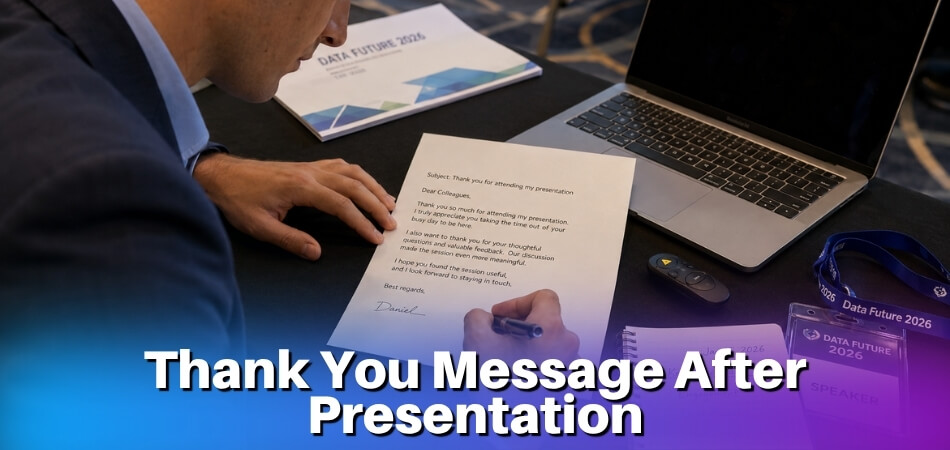
| Handwritten note | Write the day of or the day after, and post it at once | Mail takes time. Waiting a week to write means it may arrive two or three weeks after the conference, which undercuts the warmth. |
| You watched a recording | When you actually watched it | Say that you caught the recording and when. That specificity shows a deliberate effort rather than a routine note. |
What Happens When You Wait Too Long
A note sent more than a week after the event needs a brief acknowledgment of the delay. “I know it’s been a week since the conference, but I wanted to say…” works. It isn’t an apology, just an honest opening so the note doesn’t read as oddly late.
Past two weeks, the note loses most of its momentum. It can still go out, especially if you have a specific reason such as a future collaboration or a resource the speaker mentioned, but it works more as general professional outreach than as appreciation tied to the event.
Timing as Part of Your Post-Conference Process
If your organization committee hosts conferences regularly, build thank you timing into the event wrap-up checklist. Assign one person to send committee-level notes within 24 hours. Waiting for group consensus or a committee meeting to draft them is how notes end up going out two weeks late.
Individual attendees can set a simple reminder: before you close your laptop on conference day, write the note. A rough draft sent that evening beats a polished note sent on day ten.
Thank You Note Samples for Every Scenario
The right note depends on who the speaker was, what role they played, and what your relationship looks like from here. These samples cover the main speaker roles. Adapt the language to your own voice, keep the specific details your own, and include an audience reaction only if it really happened.
Standard Thank You Note for a Keynote Speaker
Start here if someone delivered the opening or closing keynote, set the tone for the day, and left the audience with something to think about.
Dear [Speaker Name],
Thank you for your keynote at [Conference Name] on [Date]. Your talk on [topic] was exactly what our audience needed to hear. The way you framed [specific point or story they shared] gave people a practical way to think about something they’d been struggling with.
We’re grateful you made time in your schedule for us. [Optional: add one real sign of engagement, such as the questions that followed your session.] That reflects how well you connected with the room.
We’d love to stay in touch and hope to have you back in a future program.
Warm regards,
[Your Name]
[Your Title, Organization]
Thank You Note for a Panelist
A panelist shares the stage and the time, so the thanks should name what they added to the conversation, not just that they showed up.
Dear [Name],
The panel on [topic] at [Conference Name] gave attendees a great deal to think about. Your answer on [specific question or point] changed the direction of the discussion, and the audience questions that followed were sharper because of it.
Thank you for preparing for a format where you had to listen as well as speak. That is harder than it looks, and it showed in how the moderator was able to build on your points.
If you’d like the session photos or the audience questions we didn’t get to, I’m happy to send them once we’ve collected everything.
With thanks,
[Your Name]
[Your Title, Organization]
Thank You Note for a Virtual / Online Conference Speaker
Speaking at a virtual or online conference takes a different kind of energy. The speaker can’t read the room the way they can in person, and that deserves acknowledgment.
Dear [Speaker Name],
Thank you so much for presenting at [Conference Name], especially given the challenges that come with a virtual format. Holding an audience’s attention through a screen is genuinely harder than it looks, and you made it seem effortless.
Your session on [topic] held the room. [Optional: add a real sign of that, such as a long Q&A or requests for your slides.]
We appreciate you working with our tech team during setup and being patient with the pre-event checks. It made a real difference in how smoothly everything ran.
Thank you again. We hope we can work together at a future event, whether virtual or in person.
Best,
[Your Name]
[Your Title, Organization]
Thank You Note on Behalf of an Organization or Committee
When the note comes from a group rather than one person, the tone stays warm but the language reflects collective appreciation. Sign it from the committee, or have a lead representative sign on everyone’s behalf.
Dear [Speaker Name],
On behalf of the entire organizing committee for [Conference Name], we want to thank you for your contribution to this year’s event. Your session was a highlight in a program we’re proud of, and the response from attendees made clear how much value you brought.
What stood out to us was [specific detail, for example the research you cited, the Q&A discussion you led, or the practical framework you introduced]. It gave our audience something concrete to take back to their work.
We’re grateful to you and hope this is the beginning of a longer relationship with our organization.
With appreciation,
[Name], on behalf of the [Conference Name] Organizing Committee
Thank You Note for a Sponsored or Paid Speaker
A paid or sponsored speaker still deserves a genuine thank you. The professional arrangement doesn’t make the contribution less real. Keep this note professional and specific, and skip anything that sounds like you’re ticking a contractual box.
Dear [Speaker Name],
Your presentation at [Conference Name] exceeded our expectations, and the audience response reflected that. We know this was a professional engagement, and we still wanted you to hear it directly from us.
The [topic] you covered filled a gap in our program that we’d been thinking about for months. Attendees came away with [specific outcome, for example a clear action plan, a new way of framing the problem, or a tool they could use immediately], and that is exactly the result we were hoping for.
We’d be glad to discuss future events where your expertise would be a strong fit. Thank you again for your professionalism and preparation. It showed throughout.
Best regards,
[Your Name]
[Your Title, Organization]
Thank You Note for an Unpaid or Volunteer Speaker
Many speakers give their time without a fee, and some cover their own travel and costs as well. Say plainly that you know it. Do not hint at payment, a reference or a future booking unless it has been agreed.
Dear [Name],
You prepared a full session for [Conference Name], took time away from your own work, and covered your own way here. We don’t take that for granted, and I wanted to say so directly.
Your talk on [topic] gave people something they could use on Monday morning. [Add one real attendee comment about your talk, if you have one.]
[Optional: If it would help, I can send a short note to your department or employer about your contribution.] Whenever you are ready to speak again, you will be welcome.
Sincerely,
[Your Name]
[Your Title, Organization]
Thank You Note for a Workshop Facilitator
A workshop facilitator manages participation, adapts in real time, and holds space for a room of people with different backgrounds. The thank you should reflect that.
Dear [Name],
Thank you for facilitating the [Workshop Name] session at [Conference Name]. Running an interactive workshop for [number] participants, with the range of experience levels in that room, is no small thing, and you handled it with a lot of skill.
The feedback we’ve collected points to [what participants actually said, for example how safe they felt to participate or what they learned]. Creating that takes real skill.
We hope you’ll consider joining us again. Your approach to [specific element, for example the group exercises, the real-time adjustments you made, or the way you handled disagreement in the room] is something our participants are still talking about.
Thank you,
[Your Name]
[Your Title, Organization]
Short Thank You Note (Card or Quick Message)
Sometimes a card, a brief email or a short message is the right move, especially for a speaker you know personally, a last-minute addition to the program, or a situation where a longer note would feel out of proportion.
For a card:
[Name], thank you for speaking at [Event]. Your session on [topic] was one of the most memorable parts of the day, and our attendees are still referencing it. We’re grateful you said yes.
[Your Name]
For a quick email or message:
Hi [Name],
Just a quick note to say thank you for your talk at [Conference Name] yesterday. The [specific thing they said or did] stayed with me, and the room was with you the whole time. It meant a lot to have you there.
[Your Name]
These shorter versions work when the speaker gave their time without being asked twice, when the event was informal, or when you already have a personal connection and a long formal note would feel stiff. Keep them specific: a brief note that names something real means more than a longer one that says nothing in particular.
From our experience at MS International: For most applicants, the route to our in-person conferences in the Greater Toronto Area is the presenting-author track: submit work for review and register after acceptance. Speakers cover their own travel, accommodation, visa, transportation and personal expenses, and an honorarium, speaker fee or travel reimbursement is not assumed unless we have agreed otherwise in writing. Keynote and invited-speaker roles are arranged separately with the organizing team. The moderator introduces each speaker. Approved speakers receive a certificate after presenting; it is a separate item and does not replace a personal message. All our conferences are held in person, so the virtual samples above are for other conference formats.
Common Mistakes to Avoid
Even well-meant notes can fall flat or feel written out of obligation. Each of these is easy to fix.

- Sending a generic message. “Thank you for speaking at our event” could have been pasted to twenty people. Reference a point they made, a question it sparked, or a moment that landed with the audience. That separates a note the speaker remembers from one they skim and delete.
- Burying the appreciation. Some notes spend three paragraphs describing the conference before getting to the thanks. Say what you’re grateful for early. The speaker doesn’t need a recap of their own presentation. They need to know what their contribution meant to you and the audience.
- Making it about the organization’s success, not the speaker’s effort. There is a difference between “the audience loved the session” and “your breakdown of that case study gave people a framework they hadn’t considered before.” The first is about attendance and applause. The second acknowledges the speaker’s actual work: their preparation, expertise and the specific value they brought.
- Over-formalizing a casual interaction. A relaxed event with an approachable speaker doesn’t call for a stiff letter. A sponsored or paid speaker representing a major institution may warrant a formal note from the committee, but a facilitator who ran an interactive session probably doesn’t need one written like a legal document.
- Ignoring the realities of virtual events. Online speakers deal with technical friction, time zone awkwardness, and the challenge of holding attention through a screen. A brief, genuine acknowledgment shows you noticed what they were managing behind the scenes.
- Using a template too literally. Templates are good starting points, but sending one unchanged is obvious. If your note reads like a form letter with their name dropped in, that’s paperwork, not appreciation. Edit enough that it sounds like someone who was in the room wrote it.
- Skipping the personal connection entirely. A single sentence such as “We’d love to stay in touch as we plan next year’s program” leaves room for the relationship to continue without pressure. And as covered in the timing section, a note sent two weeks late signals an afterthought.
Gift Ideas to Include Alongside Your Thank You Note
A thank you note on its own is always enough, but a small, thoughtful gift can make the gesture more memorable, especially for keynote speakers or facilitators who gave significant time. The key word is “thoughtful.” Generic gifts feel like an afterthought, while something tied to the speaker or their topic shows your organization paid attention.

When a Gift Makes Sense
Not every situation calls for one. A brief email to a sponsored speaker who was compensated well doesn’t need a gift. But for a keynote speaker who traveled to a multi-day conference, a facilitator who ran back-to-back sessions, or a volunteer speaker who received no fee, a gift adds real warmth.
For virtual conference speakers, a physical gift needs a mailing address, so plan that logistics in advance rather than scrambling after the event. Some employers also limit the gifts their staff may accept, so keep it modest and ask if you’re unsure.
Gift Ideas That Work Well
These options work because they are useful, personal, or tied directly to the experience:
- A personalized book or journal. A quality notebook with the conference name and dates embossed on the cover is practical and keeps the memory of the event alive. Add a handwritten note inside the front cover.
- A book relevant to their expertise. If the keynote touched on behavioral economics, a recent release in that field shows you were listening. It works best when you mention the connection in your note.
- A local experience or gift card. For speakers who traveled to your city, a gift card to a well-regarded local restaurant, a museum pass or a guided tour acknowledges the trip. It is practical and non-generic.
- A charitable donation in their name. Some speakers, particularly senior professionals, prefer this to physical gifts. Check with the speaker or the committee first, and include a short letter confirming the donation with your note.
- A framed photo or custom illustration from the event. A professional photo of the speaker at the podium, or a graphic recording of their talk if your conference used one, is something most speakers keep. It is unique to that moment.
- A curated speaker gift box. Several companies offer custom conference gift sets, such as premium tea or coffee, a candle or snacks, packaged with your event branding. They work well when you manage speaker gifts at scale across a large conference.
Pairing the Gift with Your Note
The gift and the note should refer to each other. If you send a book, say why you chose it. If it’s a donation, name the organization and why it fits their talk. A gift without context can feel disconnected, while a note that explains the choice ties everything together.
For follow-up by mail, put the note and the gift in the same package rather than sending them separately, and aim to send within five to seven business days of the event, while the conference is still fresh.
What to Skip
Branded merchandise with your organization’s logo (unless the speaker is closely affiliated with your group) often ends up unused. Alcohol is risky without knowing the speaker’s preferences. Anything overly generic, such as a standard gift basket with no link to the person or event, feels like box-ticking rather than appreciation.
The goal is a gift the speaker might actually mention or remember. That doesn’t take a large budget, only a few minutes of thought about who this person is and what might matter to them.
FAQ
Sending a note weeks after the event, thanking a paid speaker and writing about a session you did not attend are the trickier cases when thanking conference speakers.
Do I have to send a thank you note to every speaker at a conference?
No rule requires it, but send at least a brief note to each speaker. Etiquette writer Peter Post, in a 2013 Boston.com column, called a note an opportunity to keep speakers involved, even when a gift was already given. Keynote speakers and workshop facilitators deserve a more personal one.
How long should a thank you note for a conference speaker be?
Three to five sentences are enough for a short note, and two to four short paragraphs for a full one. A longer note doesn’t signal more gratitude. It often reads as padding.
Is email or a handwritten note better?
Email is faster, so use it for most speakers. A handwritten note stands out, especially for a keynote speaker or someone who traveled far, but a mailed card can take days to arrive. If you have an address, send both: email now, card later.
What if the speaker was paid? Do I still thank them?
Yes. A paid or sponsored speaker still gave their time, prepared material and engaged your audience. Compensation doesn’t replace acknowledgment, and a personal line about what the session achieved matters more than the contract does.
Can I send a thank you note weeks after the conference?
Within a week or two is fine. Past that it starts to feel like an afterthought. If time has passed, say so briefly (“I’ve been meaning to write since the conference”) and keep the rest genuine.
Should I mention audience feedback in the note?
Yes, when you have specific positive feedback. “Several attendees mentioned your session on remote team dynamics was the most useful of the day” gives the speaker something concrete and shows their effort had real impact. Quote one comment, not a whole survey.
How do I thank a speaker from a virtual or online conference?
Email works well, sent within 24 hours. Mention something specific that came through clearly even in the virtual format, since presenting to a screen is harder than presenting to a room.
What should the subject line of a thank you email say?
Name the talk or event: “Thank you for your keynote at [Conference Name]” works. A specific subject line shows the email is personal. Skip vague openers such as “Quick note.”
Is it appropriate to mention future collaboration in a thank you note?
Yes, if you keep it light. “We’d love to have you back for next year’s event” is fine. A full pitch or detailed proposal belongs in a separate message, not tucked into a thank you.
What if I didn’t personally attend the session? Can I still write the note?
Yes, as long as you gather enough detail to make it specific. Ask a colleague who attended, review the session notes, or watch the recording. A generic note that could apply to any speaker isn’t much of an acknowledgment.
Does the format change if the speaker is a personal connection versus someone new?
The tone changes, not the structure. With someone you know, a more informal thank you feels natural. With a new contact, stay professional, which leaves a better first impression for any future collaboration.
Before You Send It
A well-written thank you note does something a speaker gift or a LinkedIn mention can’t quite replicate: it tells the person their work landed. For a keynote speaker after a large annual conference or a workshop facilitator at a small event, the effort is the same. Be specific, be prompt, and mean what you write.
You don’t need to be a great writer. You need to reference something real from their session and say thank you like a human being.