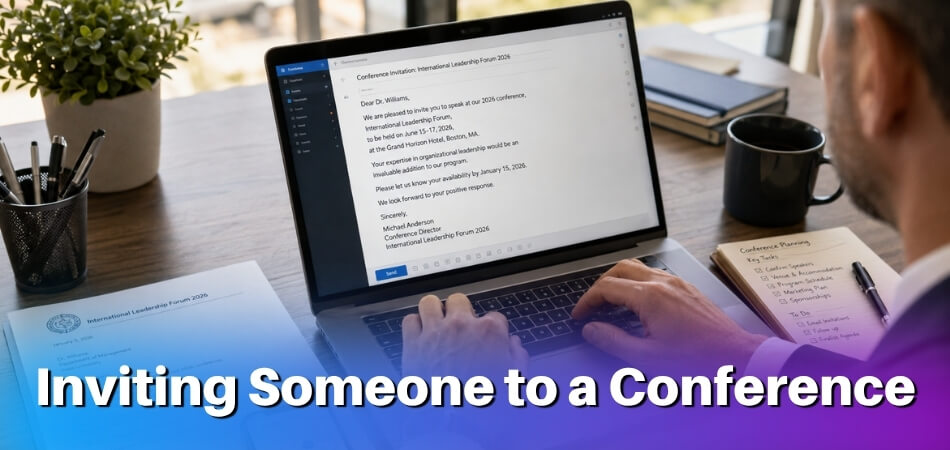
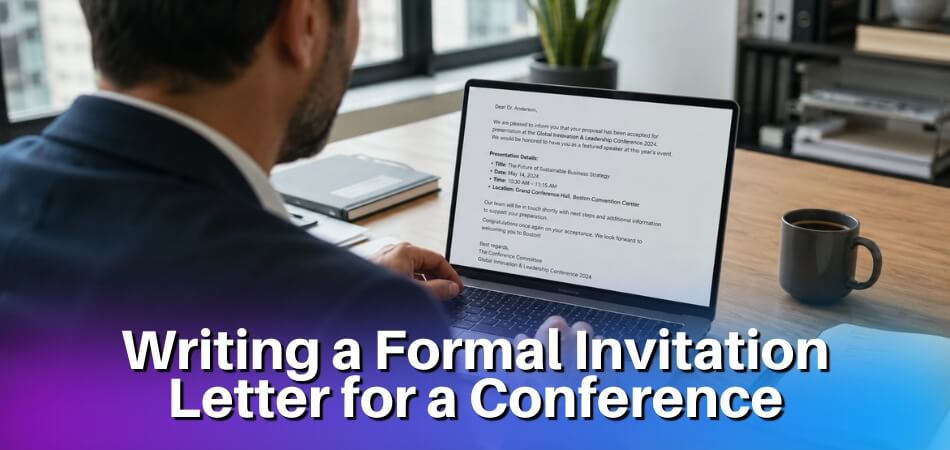
You have a conference invitation in your inbox and an organizer waiting for a reply. A short, well-built thank you letter acknowledges the invitation, tells the organizer exactly where you stand, and shows your professionalism before the event even begins. The format is simple, and this guide gives you the structure plus seven ready-to-adapt samples.
Quick answer: A good thank you letter for a conference invitation is a short reply, sent within 48 hours, that thanks the organizer by name, names the conference and your role, states plainly whether you accept, tentatively accept or decline, and closes politely. Three to six short paragraphs are enough, and every sample below follows that pattern.
What to Write in a Thank You Letter for a Conference Invitation
Include five things: a clear subject line, a salutation, a named acknowledgment of the conference, your answer, and a closing. Keep the tone warm but professional, like writing to a respected colleague.
| Element | What to do | Example |
|---|---|---|
| Subject line | Name the event and your purpose | Re: Speaking Invitation, [Conference Name] |
| Salutation | Use the organizer’s name when you have it | Dear Ms. Rodriguez |
| Acknowledgment | Name the conference in the first paragraph | Thank you for inviting me to the Annual Global Marketing Summit |
| Your answer | Confirm, confirm tentatively with a date, or decline | I’m pleased to confirm, subject to finalizing travel |
| Closing | Restate thanks, offer to help, sign with full name and title | Yours sincerely, [Full Name], [Title] |
The tone to aim for
Warm, not stiff. You are not writing to a friend, but you also do not need language that sounds like a legal document. A keynote speaker can add one line about what the session will bring, and a panelist one sentence on why the topic matters to their work. That small detail shows real engagement, so the reply feels considered rather than automatic. The salutation and the closing are where tone shows most, so get those two right.
Choosing a format
Most conferences expect a professional email. A printed letter on letterhead fits only when the invitation itself came on paper or the event is ceremonial. Either way, the structure stays the same: acknowledge, answer, close. If the organizer wrote to you by name, answer by name, and keep any attachments, such as a short bio or a headshot, to what they actually asked for.
Reply in the same thread
When you answer by email, reply inside the organizer’s original message so the subject keeps its “Re:” prefix and your reply stays attached to the invitation. Write a new subject line only when the original thread is gone, and then use one from the table below. Save a printed letter for cases where the invitation came on paper, the event is ceremonial, or the organizer asks for one.
Subject line examples by situation
| Situation | Subject line | When to send |
|---|---|---|
| Accepting as an attendee | Thank You for the Invitation to [Conference Name], Attendance Confirmed | Within 48 hours |
| Accepting as a speaker | Re: Keynote Invitation, [Conference Name], [Your Name] | Within 48 hours |
| Need more time | Thank You, Tentative Reply for [Conference Name] | Within 48 hours, then confirm by the date you gave |
| Declining | Re: Invitation to [Conference Name], With Thanks | As soon as you know |
| After the event | Thank You for [Conference Name] | Within a day or two of the event |
How to Write a Thank You Letter for a Conference Invitation
Write it in five short steps, in this order, and the whole letter stays under half a page.
Step 1: Open with specific thanks
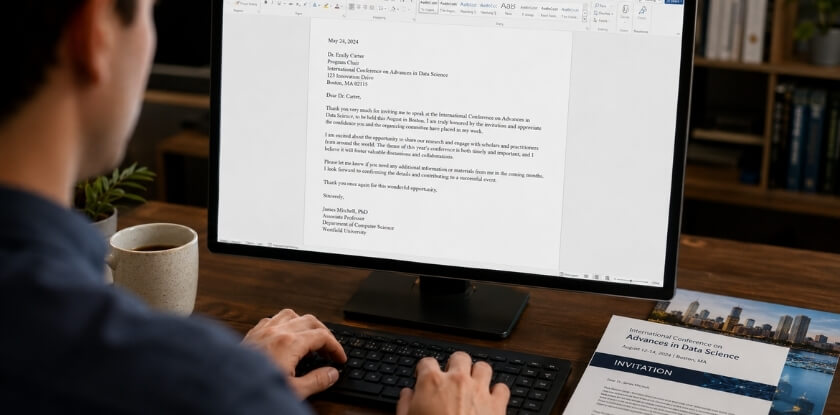
Your opening line sets the tone for the whole letter. Thank the organizer and name the conference, in two or three sentences at most. This also shows you have read the invitation properly and are not sending a recycled reply. “Thank you for inviting me to speak at the Annual Global Marketing Summit” does more than a generic “thank you for your kind invitation.”
Step 2: Reference the theme or your role
One or two sentences on the theme or the role you were invited for. This shows the organizer you understand the context, and it ties your reply to their specific event. For example: “The theme around digital commerce ethics aligns closely with work I’ve been involved in over the past two years.”
Step 3: Give a clear answer
If you can attend, say so in the first line, as you would when you accept a meeting invitation formally. If you are still checking, give a date: “I’m currently reviewing my schedule and will send a formal RSVP by [date].” Avoid “I’ll try to make it,” which reads as indifferent. If your letter replaces a formal RSVP, treat this line as your official acceptance or regret. If the invitation leaves your role unclear, such as the length of your talk, whether it is a solo talk or a panel, or who else is speaking, confirm and ask in the same reply, as Sample 2 does.
Step 4: Acknowledge the organizer’s effort
One sentence is enough: “I recognize the considerable coordination involved in an event of this scale.” It adds warmth without gushing, and it keeps the letter from feeling purely transactional.
Step 5: Close and leave the door open
Restate your thanks briefly, mention that you look forward to further details about the event, and say you are available for any details they need. Match the sign-off to the tone: “Yours sincerely” or “With warm regards” for a formal letter, “Best regards” or “Kind regards” for email.
Thank You Letter Samples
Pick the sample closest to your situation and replace the names, dates and event details before sending. Each one is a different case, so you only need one.
| Sample | Use it when |
|---|---|
| 1. General attendee | You are invited to attend and want a polished reply |
| 2. Keynote speaker or panelist | You are invited to speak and need to coordinate logistics |
| 3. Short, informal | You already know the organizer well |
| 4. Tentative confirmation | You need approval or travel clarity before committing |
| 5. Polite decline | You cannot attend but want to keep the relationship |
| 6. Thank you after attending | The event is over and you want to thank the host |
| 7. Thank you after speaking | You presented and want to thank the organizer and offer follow-up |
Sample 1: General Attendee (Formal)
This version suits a formal invitation to attend.
Subject: Thank You for the Conference Invitation – [Your Name]
Dear [Conference Organizer’s Name],
Thank you for inviting me to attend [Conference Name], scheduled for [Date] in [Location]. I’m pleased to confirm my attendance and look forward to participating in what promises to be a genuinely valuable event.
The program looks well-structured, and I’m particularly interested in the sessions covering [specific topic or track]. Please let me know if there’s anything you need from me ahead of the event, such as registration details or dietary preferences.
I appreciate the opportunity and look forward to connecting with you and the other attendees there.
Yours sincerely, [Your Full Name] [Job Title] [Organization] [Contact Information]
Sample 2: Keynote Speaker or Panelist
When you accept an invitation to speak, name the role, confirm your participation and signal that you are ready to coordinate.
Subject: Re: Keynote Invitation – [Conference Name] – [Your Name]
Dear [Organizer’s Name],
Thank you for the invitation to serve as a keynote speaker at [Conference Name] on [Date]. I’m honored to be considered for this role and happy to confirm my participation.
I’d welcome the chance to discuss the session format, expected audience, and any thematic guidelines you’d like me to follow. If there’s a speaker brief or technical requirements document, please send it over at your convenience.
I’ll make sure my presentation aligns with the event’s objectives, and I’m happy to coordinate with your team on any promotional materials or bio details you may need beforehand.
Looking forward to it.
Warm regards, [Your Full Name] [Title and Organization] [Email and Phone]
Sample 3: Short / Informal Version
If the organizer is a colleague, a shorter reply is perfectly fine.
Subject: Re: Invitation to [Conference Name]
Hi [Name],
Thanks so much for the invite, really appreciate you thinking of me. I’m planning to attend and will follow up once I’ve confirmed the travel details. Looking forward to it.
Best, [Your Name]
“Hi” works only if you would use it in any other email to that person. If in doubt, go with “Dear.”
Sample 4: Tentative Confirmation
A tentative reply beats silence. It keeps the correspondence open while you sort out scheduling or approvals.
Subject: Thank You for the Invitation – Tentative Confirmation – [Your Name]
Dear [Organizer’s Name],
Thank you for the invitation to [Conference Name] on [Date]. I’m very interested in attending and would like to tentatively confirm my participation at this stage, pending final approval from [my organization / schedule confirmation / travel arrangements].
I expect to be in a position to confirm fully by [specific date]. I’ll send an RSVP as soon as that’s resolved. In the meantime, please don’t hesitate to reach out if there’s any information you need from me.
I appreciate your understanding and hope to be there.
Kind regards, [Your Full Name] [Title and Organization] [Contact Details]
Sample 5: Polite Decline
Declining still deserves a thank you. Be clear, be brief, and leave the door open.
Subject: Re: Invitation to [Conference Name] – With Thanks
Dear [Organizer’s Name],
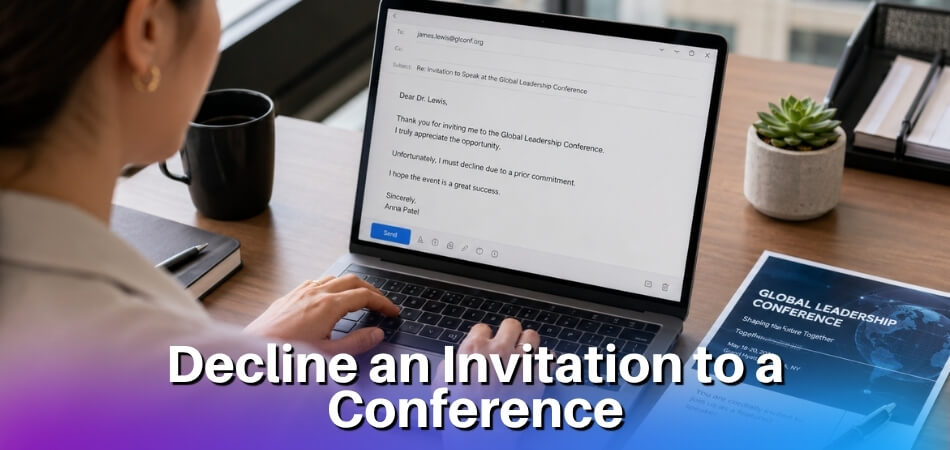
Thank you very much for inviting me to [Conference Name]. I’m grateful to be considered, and I regret that I am unable to attend because of [a prior commitment / scheduling conflict].
I hope the event goes very well, and I would be glad to hear about future editions. Please keep me in mind for next year.
With appreciation, [Your Full Name] [Title and Organization]
State plainly that you will not attend so nothing is misunderstood. If you still want to contribute, you can offer one alternative you can actually deliver, such as a short article or a recorded talk, and leave it at that.
Sample 6: Thank You After Attending
Send this within a day or two of the event. Mention one concrete thing you took away.
Subject: Thank You for [Conference Name]
Dear [Organizer’s Name],
Thank you for the invitation to [Conference Name] and for the care your team put into the event. The session on [specific topic] was especially useful, and I came away with [one concrete takeaway].
I enjoyed meeting [other attendees / speakers] and hope to stay in touch. Please pass my thanks to everyone who worked behind the scenes.
Kind regards, [Your Full Name] [Title and Organization]
Sample 7: Thank You After Speaking
For speakers, a follow-up note shows you are easy to work with and may lead to a repeat invitation.
Subject: Thank You for Hosting My Session at [Conference Name]
Dear [Organizer’s Name],
Thank you for the opportunity to speak at [Conference Name] on [Date]. It was a pleasure to present to such an engaged audience, and your team made the logistics effortless.
If it would help, I can share my slides or a short summary for your attendees. I’d be glad to take part in future editions.
Warm regards, [Your Full Name] [Title and Organization] [Email and Phone]
Phrases to use and phrases to avoid
| Instead of | Write |
|---|---|
| Thank you for your kind invitation | Thank you for inviting me to [Conference Name] |
| I hope to attend | I am pleased to confirm, or I will confirm by [date] |
| I’ll try to make it | I am reviewing my schedule and will reply by [date] |
| Dear Sir/Madam | Dear Ms. Rodriguez |
| Sorry, can’t come | I regret that I am unable to attend, and I appreciate being considered |
Common Mistakes to Avoid
Most weak replies fail on a handful of fixable points.

Sending it too late. Reply within 24 to 48 hours, even if the answer is only “tentatively yes.” Waiting longer leaves the organizer guessing about your plans.
A vague subject line. “Thank you” alone gets lost. “Re: Invitation to Speak at [Conference Name] – [Your Name]” is easy to file.
Not naming the event or role. Say whether you were invited as keynote speaker, panelist or workshop facilitator, so the organizer knows you read the invitation.
Being ambiguous. If you are not sure yet, use a tentative confirmation with a date, such as “I intend to confirm my attendance by [date].” An RSVP is expected, not optional.
Overdoing the formality. A formal letter format is appropriate, but stacked honorifics and formal phrases make a letter stiff and hard to read. Professional does not mean wooden, so write the way you would speak to a respected colleague in a business setting.
A wrong salutation. Misspelling a name, using the wrong title, or opening with “Dear Sir/Madam” when you have a name signals carelessness.
Turning it into self-promotion. The purpose is to express gratitude and confirm your interest, not to re-pitch your credentials. Mention your background briefly at most, because if the organizer has already invited you, they know who you are.
Sending an unedited template. A template with nothing specific in it reads like a form letter. Add at least one specific detail, such as the conference theme, something from the invitation itself, or why this particular event matters to you. That is what separates a genuine response from a form letter.
From our experience at MS International: If you need an invitation letter for a visa application, MS International issues it within 3 to 5 business days after payment clears, once you have registered for an eligible conference. The letter supports an application but does not guarantee a visa or entry into Canada, and our conferences are held in person in the Greater Toronto Area.
FAQ
Replying with thanks before you have even confirmed attendance? Keynote versus panelist tone, a fitting subject line, the Dear Sir/Madam opening and changing your answer later are the sticking points.
How soon should I reply to a conference invitation?
Within 48 hours if you can, and within about a week at the latest. If you still cannot decide, send the tentative reply in Sample 4 with the date you will confirm.
Do I need to send a thank you letter even if I haven’t confirmed attendance yet?
Yes. Silence leaves the organizer guessing about your plans. A brief reply that thanks the organizer, says you are reviewing your schedule and promises a firm RSVP by a set date is perfectly acceptable.
Should I send a formal letter or a professional email response?
An email is standard for most conferences, and it is faster for both sides. Use a formal letter when the invitation arrived as a printed document or the event is highly ceremonial.
What’s the right subject line for a thank you email?
Reply in the original thread so the subject keeps its “Re:” prefix, for example “Re: Invitation to [Conference Name].” For a new message, name the conference and your purpose, such as “Thank You for the Invitation to [Conference Name].”
Is the tone different for a keynote speaker versus a panelist?
No, the tone stays professional. A keynote speaker may add questions about topic scope or timing, while a panelist’s reply is usually shorter because the logistics are lighter.
How long should the thank you letter be?
Keep it under half a page: three to six short paragraphs at most, and a few sentences when you know the organizer well. Longer letters are not more polished, they only take more of the organizer’s time.
What if I need to decline the invitation?
Still send a thank you. Thank them for considering you, say clearly that you cannot attend, and say you would welcome future invitations. Sample 5 above shows the wording.
Do I need to reference the event details in the letter?
Briefly, yes. Naming the conference and its dates shows you read the invitation, and it helps the organizer match your reply to the right event when many invitations went out at once.
Is “Dear Sir/Madam” an acceptable opening salutation?
Only if you genuinely do not know the organizer’s name. With a name, “Dear Dr. Patel” or “Dear Ms. Johnson” is always better.
Should I thank the organizer again after the conference?
Yes, a short note within a day or two is a good habit. Mention one specific session or takeaway, as in Sample 6 or Sample 7 if you spoke.
Can I change my answer after I have replied?
Yes, but tell the organizer as soon as you know. Moving from yes to no is easiest early. Moving from no to yes depends on whether the organizer still has room for you, so decide carefully before the first reply.
Final Thoughts
Reply promptly, name the conference, be clear about your answer and keep it short. The organizer took the time to reach out, and a considered response reflects well on you long before the event begins.