
A reply to a meeting invitation takes a minute to write, but it still says something about you. Too casual can look careless with a client, and too stiff can feel cold with a colleague. Getting the tone right is mostly a matter of knowing what to include.
Quick answer: To accept a meeting invitation formally, reply with a short, polite message that thanks the sender, states clearly that you will attend, repeats the date, time and platform or location, and asks whether you should prepare anything. For routine internal meetings, clicking Accept in the calendar is enough. Add a written note for clients, external contacts and important meetings.
This works for business meetings, client calls, academic discussions, interviews and online meetings. It is not a reply to a conference invitation or a visa invitation letter, which are separate documents.
What a Formal Meeting Acceptance Should Accomplish
A formal acceptance does more than say yes. It confirms your attendance, shows respect for the sender’s time and lets both sides prepare without confusion.
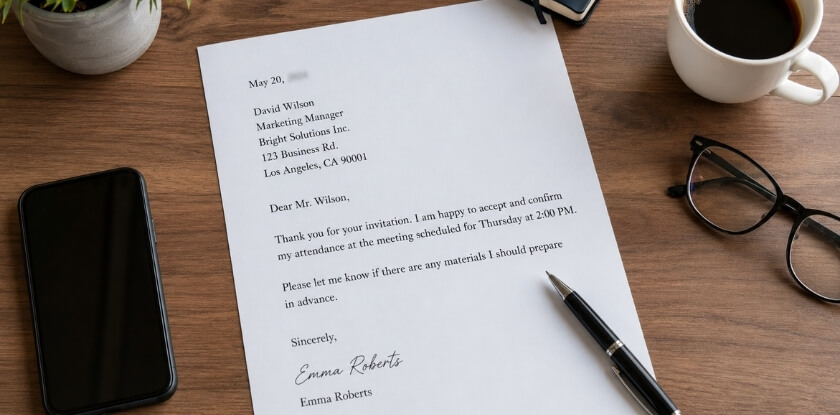
It should do four jobs in a few lines:
- Confirm attendance without ambiguity. The organizer should never have to wonder whether you are coming.
- Thank the sender briefly. One short sentence is enough.
- Repeat the key details so both sides see the same schedule.
- Sound professional. Polite and natural, with no slang or emojis when you write to clients, managers, professors, interviewers or event organizers.
The best reply is usually short. A message of two to five sentences with the right details beats a long one.
Step-by-Step Guide: How to Accept a Meeting Invitation Formally
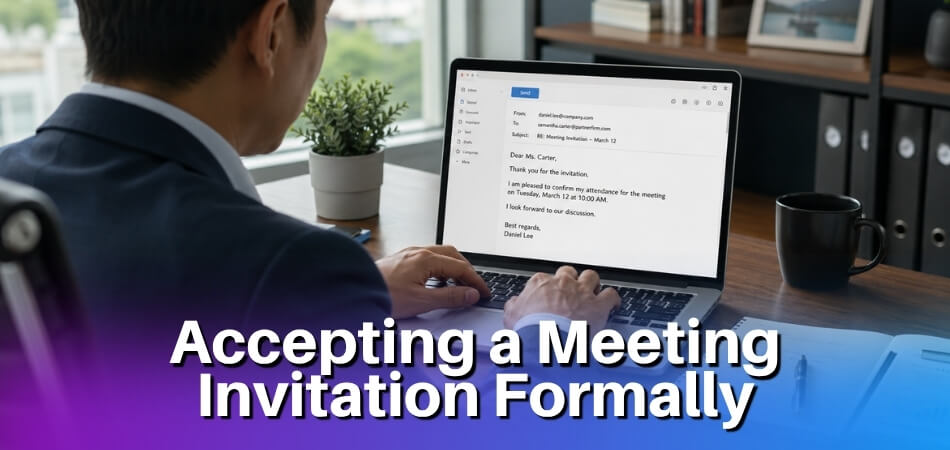
To accept a meeting invitation formally, greet the sender, thank them, confirm your attendance, repeat the meeting details, mention your role if you have one, ask about preparation, and close politely. The table shows what each part contains. The ready-made wording is in the phrase bank below.
| Step | What to include | Example |
|---|---|---|
| 1. Greeting | The recipient’s name. “Dear” for formal or first-time contact, “Hello” when you already have a professional relationship. | Dear Dr. Miller, |
| 2. Thanks | One short sentence of appreciation. | Thank you for including me in this discussion. |
| 3. Acceptance | A direct statement. Avoid uncertain wording unless you truly cannot confirm. | I am pleased to accept the invitation and confirm that I will attend as scheduled. |
| 4. Details | Date, time, time zone if needed, platform (Zoom, Google Meet, Microsoft Teams) or physical location. | I confirm the meeting on Wednesday, May 15, at 11:00 AM via Google Meet. |
| 5. Role and topic | Only if the invitation names one. A short phrase is enough, not the full agenda. | I confirm my participation as a presenter, and I look forward to discussing the project timeline. |
| 6. Preparation | Ask about agenda items, reports, slides, background documents or technical setup. | Please let me know if there are any documents I should review beforehand. |
| 7. Closing | A courteous line and a sign-off such as Best regards, Kind regards, Sincerely or Respectfully. | I look forward to speaking with you. Best regards, [Your Name] |
Check your calendar first, then reply early
Look at your calendar before you reply, so you do not have to withdraw later. Put the yes at the start of the message so the organizer does not have to hunt for it, and reply as soon as you know your answer. If you cannot confirm yet, say when you will: “I will confirm by [Date].”
Details worth repeating in step 4
Mention the date, the time, the time zone if participants are in different places, the platform (Zoom, Google Meet or Microsoft Teams) or the physical location for an in-person meeting, and the meeting topic when relevant. For example: “I confirm that I will attend the meeting on Monday, April 8, at 2:00 PM at your Toronto office.”
What you can ask about in step 6
- Agenda items and background materials
- Reports or documents to read beforehand
- Presentation slides or speaker notes, if you are presenting
- The meeting link and any technical setup
If you are unsure about your role, ask directly: “Could you please let me know if there is anything specific you would like me to prepare?”
If something is missing
If a detail is missing from the invitation, do not guess. Ask before the meeting day, for example: “Could you please confirm whether the meeting will take place online or in person?” The same goes for an invitation that has a meeting link but no start time or time zone.
Before you send, check the recipient’s name, date, time, platform and spelling.
Formal Phrases You Can Use to Accept a Meeting Invitation
The best formal phrases are clear, polite and specific. They confirm attendance while showing respect for the sender. Pick one from each row and adjust the brackets.
| Purpose | Phrases |
|---|---|
| Thanking the sender | “Thank you for the meeting invitation.” / “I appreciate your invitation to join the discussion.” / “Thank you for arranging this meeting.” / “Thank you for your kind invitation. I appreciate the opportunity to attend.” / “Thank you for including me in this meeting.” |
| Confirming attendance | “I confirm my attendance at the meeting.” / “I am happy to confirm my participation.” / “I will be available for the meeting as scheduled.” / “Please consider this email as confirmation of my attendance.” |
| Confirming date and time | “I will attend the meeting scheduled for [Date] at [Time].” / “The proposed date and time are suitable for me.” / “I confirm my availability for [Date] at [Time] via [Platform].” |
| Asking about preparation | “Please let me know if there is anything I should prepare in advance.” / “Please let me know if an agenda will be shared.” / “Could you please confirm whether I should prepare slides or supporting materials?” / “Kindly let me know if there are any technical requirements.” / “Kindly share any documents you would like me to review before the meeting.” |
| Closing | “Thank you again for the invitation.” / “I appreciate the opportunity and look forward to the discussion.” / “Please let me know if any further information is needed.” / “I look forward to attending the meeting.” |
How to Accept a Client’s Meeting Request Professionally
To accept a client’s meeting request professionally, thank the client, confirm your availability, restate the schedule, mention the meeting purpose, and ask whether anything should be prepared.
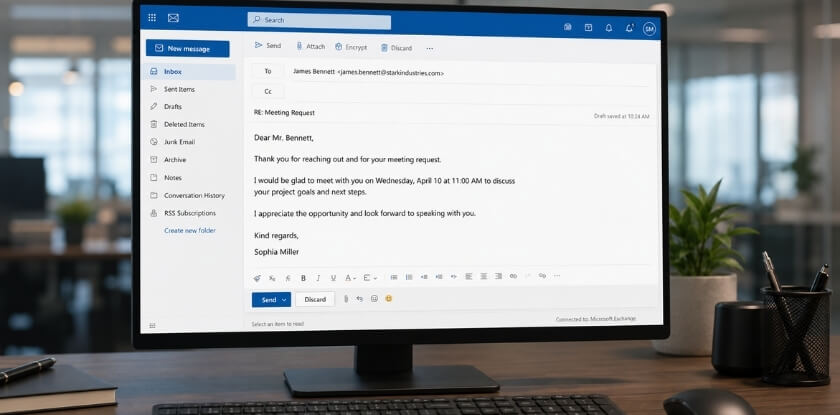
Client-facing communication should sound respectful, organized and service-focused. Your reply should show that you are reliable and ready for the discussion. Avoid a rushed “Okay, I’ll join.” Write instead: “Thank you for the invitation. I confirm my availability and look forward to speaking with you.”
Confirm the requested time
If the client offered several time options, choose one clearly so the client does not have to guess:
Thank you for sharing the available times. I confirm that [Date] at [Time] works best for me.
Reference the meeting purpose
A short phrase shows that you understand why the meeting is happening, for example “I look forward to reviewing the proposal with you” or “I will be glad to discuss the timeline, scope and next steps.”
Ask about documents or prior review
A client may expect you to read files, estimates or reports first. Ask whether there are specific points you should address, and invite them to send any questions in advance. For a proposal meeting, for example: “If there are specific questions about the proposal, please send them in advance so I can address them during the meeting.”
Complete client acceptance example
Subject: Confirmation of Meeting on [Date]
Dear [Client Name],
Thank you for your meeting request. I can meet on [Date] at [Time] via [Platform/Location]. I look forward to discussing [Meeting Topic] and reviewing the next steps with you.
Please let me know if there are any documents, agenda items or specific points you would like me to prepare in advance.
Kind regards,
[Your Name]
How to Accept a Meeting Invitation When You Need a Time Change
To accept a meeting invitation when the time does not work, confirm that you want to attend, explain the conflict briefly, suggest one or two other times, and thank the sender for their flexibility.
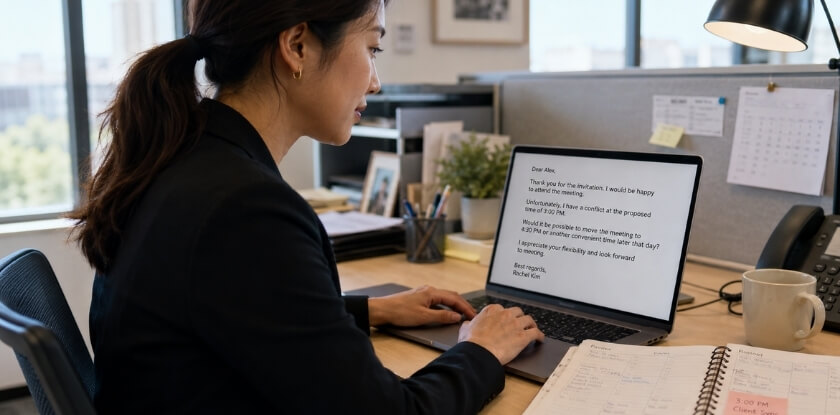
- Say yes first. Your main answer is that you want to attend, so open with that.
- Keep the reason short. “The proposed time overlaps with a prior commitment” is enough. Do not share personal details. A complete sentence can be: “The proposed time overlaps with a prior commitment, so I would like to request an alternative time if possible.”
- Offer one or two alternatives. A long list makes the reply harder to answer. Useful forms are “Would [Date] at [Time] work instead?” and “I can attend at [Time Option 1] or [Time Option 2].”
- Close with appreciation, such as “Thank you for your understanding” or “I appreciate your flexibility.” An apology such as “I apologize for any inconvenience this may cause” also fits.
Subject: Meeting Confirmation and Time Adjustment Request
Dear [Name],
Thank you for the meeting invitation. I would be pleased to attend and take part in the discussion. However, the proposed time of [Original Date/Time] overlaps with a prior commitment.
Would it be possible to move the meeting to [Alternative Date/Time]? I could also do [Second Option], if that is more convenient.
Thank you for considering this adjustment. I look forward to your confirmation.
Best regards,
[Your Name]
How to Accept Different Types of Meeting Invitations
Different invitations need slightly different replies, but the main rule is the same: confirm attendance clearly and match the tone of the invitation.
| Invitation type | Best reply |
|---|---|
| A short formal reply with the main details (see the simple template below). It suits business meetings, interviews, academic discussions and professional appointments. | |
| Calendar invitation | Click Accept for routine workplace meetings. Add a written note for formal meetings, clients or external contacts, when you need to confirm your role, or when details are missing. In Outlook, the option Do Not Send a Response accepts without telling the organizer, so the organizer may not see your answer. |
| Online meeting | Confirm the platform and link, and ask about screen sharing or slides if you are presenting. |
| Conference or speaking-related meeting | Confirm the session or event name, and offer a short bio or materials if needed. |
| Group meeting | Confirm your own attendance briefly and reply only to the organizer when many people are copied. |
Accepting a calendar invitation with a note
Use the written note when the meeting is formal, the sender is a client or external contact, you need to confirm your role, details are missing, or you want to ask about preparation. A simple note can read: I am confirming that I will attend the scheduled meeting. Please let me know if there is anything I should prepare in advance.
Accepting an online meeting invitation
Thank you for the invitation. I confirm that I will attend the meeting on [Date] at [Time] via Zoom.
If the link is missing: Could you please share the meeting link when it is available?
If you are presenting: Please let me know if screen sharing will be enabled or if I should send my slides in advance.
Accepting a conference or speaking-related meeting invitation
A conference-related meeting may need more detail because organizers may ask for speaker materials, session information or technical requirements. This is a planning meeting, not the speaker acceptance letter itself. For the acceptance, use a thank you letter for the conference invitation that names your role.
Dear [Organizer Name],
Thank you for the invitation. I am pleased to confirm my participation in the meeting regarding [Event/Session Name] on [Date] at [Time].
I look forward to discussing the session details and next steps. Please let me know if you need a short bio, presentation title, speaker materials or any other information from my side.
Best regards,
[Your Name]
Accepting a group meeting invitation
Thank you for the invitation. I confirm that I will attend the meeting as scheduled.
If you can attend only part of it: I will attend, but I may need to leave after the first 30 minutes due to a prior commitment.
If only some agenda items concern you, ask whether you can join just those parts.
Formal Meeting Acceptance Email Templates
This article has 12 templates in all. The client and time-change emails are in their own sections above, the online, conference and group replies are in the previous section, and the seven below cover the remaining situations. Edit the details before sending.
Simple formal acceptance email
Subject: Meeting Confirmation
Dear [Name],
Thank you for the meeting invitation. I am pleased to confirm that I will attend the meeting scheduled on [Date] at [Time].
I am looking forward to the discussion on [Meeting Topic]. Please let me know if there are any documents, reports or background materials I should review in advance (optional line).
Best regards,
[Your Name]
Change the subject line to match the meeting, for instance “Meeting Acceptance and Preparation Details” when you include the optional line.
Acceptance on behalf of another person
Subject: Meeting Confirmation on Behalf of [Person’s Name]
Dear [Name],
Thank you for the meeting invitation. I am writing on behalf of [Person’s Name] to confirm their attendance at the meeting scheduled for [Date] at [Time].
[Person’s Name] will be glad to take part in the discussion on [Meeting Topic]. Please let me know if any materials or agenda items should be shared in advance.
Best regards,
[Your Name]
[Your Position, if relevant]
Accepting a job interview invitation
An interview acceptance should confirm the slot, the format and the interviewer’s name, and show that you are ready.
Subject: Interview Confirmation: [Job Title], [Date]
Dear [Interviewer Name],
Thank you for inviting me to interview for the [Job Title] position. I am pleased to confirm my interview on [Date] at [Time] [at your office / via Platform].
Please let me know if I should bring any documents, such as a portfolio or references, or prepare anything specific beforehand.
I look forward to speaking with you.
Kind regards,
[Your Name]
[Phone Number]
Accepting a meeting with a senior executive
Keep it brief and precise. A senior person wants confirmation and a sign that you will use the time well, not a long thank-you.
Subject: Confirmed: Meeting on [Date] at [Time]
Dear [Mr./Ms./Dr. Last Name],
Thank you for making time to meet. I confirm the meeting on [Date] at [Time] in [Location/Platform].
I will come prepared to cover [one or two points]. If there is anything you would like me to send ahead of the meeting, I will share it by [Date].
Best regards,
[Your Name]
[Your Title]
Accepting an in-person meeting at the host’s office
For a visit, confirm the practical details that decide whether you arrive on time: the address, who meets you and what the reception desk needs.
Subject: Visit Confirmation: [Date] at [Company Name]
Dear [Name],
Thank you for the invitation to meet at your office. I confirm that I will arrive at [Address] on [Date] at [Time].
Could you let me know whom I should ask for at reception, and whether I need photo ID or a visitor pass? I would also appreciate any parking or entrance instructions.
Best regards,
[Your Name]
[Phone Number]
Accepting and proposing a short agenda
When the invitation has no agenda, offering one shows initiative and makes the meeting shorter. Keep it to three items or fewer.
Subject: Re: Meeting on [Date], Proposed Agenda
Dear [Name],
Thank you for the invitation. I confirm that I will attend on [Date] at [Time].
To make the best use of our time, I suggest the following points:
1. [Topic 1]
2. [Topic 2]
3. Next steps and responsibilitiesPlease feel free to add or change anything.
Best regards,
[Your Name]
Accepting a recurring meeting or committee seat
A standing meeting needs a different confirmation: you accept the series, not one date, and you say how you will handle sessions you cannot attend.
Subject: Acceptance: [Committee/Meeting Series Name]
Dear [Name],
Thank you for inviting me to join [Committee/Meeting Series Name]. I am glad to accept and will attend the [weekly/monthly] meetings starting on [Date].
If I ever cannot attend a session, I will let you know in advance and send any updates in writing. Please share the calendar series and any background documents I should read before the first meeting.
Best regards,
[Your Name]
Common Mistakes to Avoid When Accepting a Meeting Invitation
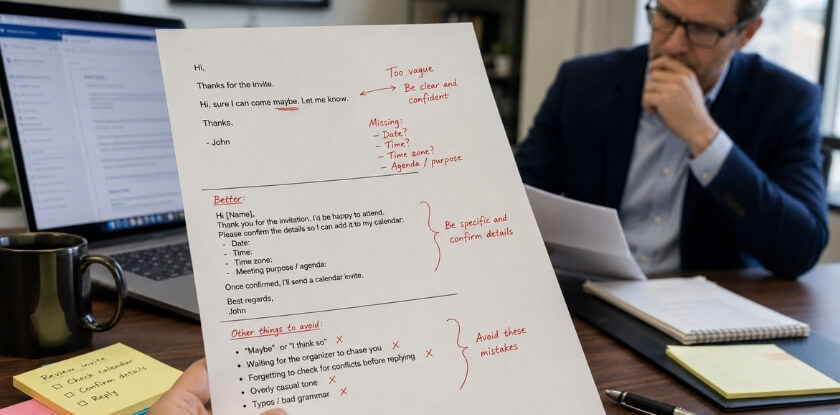
When accepting a meeting invitation formally, avoid mistakes that create confusion, sound careless or make the sender follow up.
| Mistake | Instead of | Write |
|---|---|---|
| Unclear response (organizer cannot tell whether you are coming) | “That should work.” / “I’ll try.” | I confirm that I will attend the meeting as scheduled. |
| Too casual | “Sure, see you then.” | Thank you for the invitation. I confirm my attendance and look forward to the meeting. |
| No date and time repeated | Scheduling errors go unnoticed, especially in online or international calls and interviews. | Please state [Date], [Time] and [Platform] in the reply, as in step 4. |
| Guessing missing details | Assuming the time, link or location. | Could you please confirm the meeting time? / Could you please share the meeting link? |
| Late reply without acknowledgement | Confirming as if nothing happened. A brief apology keeps the reply respectful. | Apologies for the delayed response. I confirm my attendance for [Date] at [Time]. |
From our experience at MS International: our conferences are held in person in the Greater Toronto Area, and many participants plan from other countries. When you confirm a planning call across time zones, write the time zone out (for example 10:00 AM Toronto time) so nobody has to convert it.
FAQ: Accepting a Meeting Invitation Formally
Accepting a meeting formally can be awkward when the time is missing, you can join only part of it, or you are replying on someone else’s behalf.
Can I accept a meeting invitation without sending an email?
Yes, for a routine meeting you can click Accept in your calendar tool. If you choose not to send a response, the organizer may not see your answer. For formal, client-facing or important meetings, send a short written reply.
How short can a formal meeting acceptance be?
A formal acceptance can be one or two sentences if it includes appreciation and clear confirmation. Add the date, time or a preparation question when needed.
What should I do if the meeting time is missing?
Ask before you confirm. Reply with a short question, such as “Thank you for the invitation. Could you please confirm the start time and time zone?” Do not assume either one.
Can I accept a meeting invitation for someone else?
Yes, if you have permission. State that you are replying on behalf of that person and confirm their attendance with the correct date and time. In a calendar tool, only someone with delegate access can accept for another person.
Should I include contact details in my acceptance?
Include them when replying to a new contact, client, interviewer or event organizer. For routine internal meetings, a full signature is usually not necessary.
What if I can attend only part of the meeting?
Say so clearly when accepting. State when you can join or when you must leave, or ask to join only the agenda items that concern you, so the organizer can plan.
Is it acceptable to ask questions while accepting the invitation?
Yes, relevant questions are appropriate. Ask about the agenda, documents, meeting link, location, platform or preparation while still confirming that you plan to attend.
Is a meeting invitation the same as a visa invitation letter?
No. A meeting invitation asks you to join a discussion. A visa invitation letter is a separate document, issued by the conference organizer after an eligible registration, to support a travel or visa application.
Conclusion
A formal meeting acceptance should be clear, polite and complete. Thank the sender, confirm your attendance, repeat the date, time and platform or location, and ask about preparation in the same reply.
Keep it short and direct, and avoid vague or casual wording. A thoughtful reply shows that you respect the sender’s time and are ready to take part professionally.