
A call for papers can look like a wall of dense text, and it is tempting to skim it and hope for the best. That habit is how people miss a format rule or send work to the wrong event. A careful read pays off, and this guide shows how to do it.
Quick answer: To understand a call for papers (CFP), read it in this order: theme and scope, topics of interest, deadlines (abstract, full paper, camera-ready), submission format, review process, then fees and presenter policy. Check each part against your research and your budget before you write anything. Also confirm the conference is genuine by finding named committee members and a real track record.
Last verified against official sources: October 2026.
Staring at a CFP and not sure where to start? Deadlines, topics of interest and format rules sit in dense academic language, and many researchers close the tab without acting on it. A CFP is not meant to confuse you. Once you know what each section means, it tells you whether your research fits, what format to follow, whether review is double-blind, and whether the conference looks legitimate.
What Is a CFP and Why Does It Matter?
A Call for Papers, almost always shortened to CFP, is a formal invitation from a conference organizing committee asking researchers, practitioners and academics to submit their work for consideration. Like a job listing, it describes what the organizers want and what will get a submission rejected before anyone reads it. Some journals issue CFPs too, but new researchers meet the conference version most often, tied to a specific date and venue.
Where to find a genuine one. The most reliable place is the website of the conference, society or publisher that issues the CFP. Listing sites such as WikiCFP help you discover events but do not vet them, so open the official conference site and compare the dates and details before you trust a listing. A CFP that arrives by email is a starting point for checking, not proof either way: it can be a real invitation or predatory outreach.
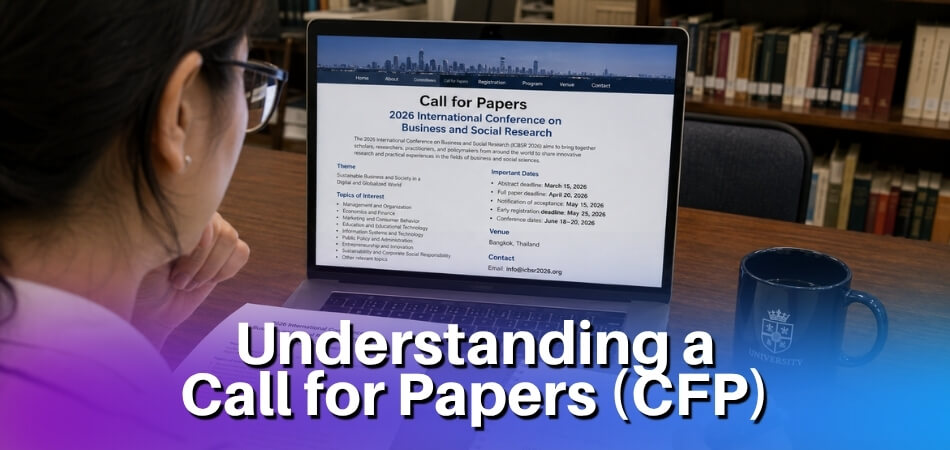
CFPs are posted on academic mailing lists, university notice boards, ResearchGate and conference websites. A CFP is also a contract of expectations. Every line shows what the organizers want, how strict they are and whether the conference is worth your time. Skipping the details is how researchers submit the wrong format, miss a deadline or send work to a predatory conference that charges steep fees and offers no real peer review.
The CFP sets out the theme, the scope, deadlines, formatting rules and what happens after you submit. That whole lifecycle, from first abstract through peer review, acceptance or rejection and the camera-ready paper, starts with reading this one document carefully.
A well-chosen conference can put your research in front of the right program committee, may lead to published conference proceedings and opens doors to collaboration. A poorly chosen one wastes months. CFPs also vary in rigor: one from an established IEEE or ACM-affiliated conference reads very differently from a cold email with vague topics and no named program committee. Learning to read a CFP for legitimacy, not just logistics, is worth building from day one.
The Anatomy of a CFP: What Every Section Actually Means
A CFP can run from one page to a long multi-section PDF, and first-timers who skim it often miss something critical. Read every part. The table below shows what each element tells you, and the sections after it explain how to read each one.
| CFP element | What it tells you | What to check |
|---|---|---|
| Theme and scope | Who the organizers want in the room and what is out of bounds | Does your paper sit inside the scope, not just the headline? |
| Topics of interest | What the committee can review competently | Does your question map to at least one bullet, even loosely? |
| Deadlines | Abstract, full paper, notification and camera-ready dates | Which are separate, and which are firm? |
| Submission format | Page limit, template, citation style, file type, blinding | Can you meet it before the deadline week? |
| Review and criteria | How papers are judged and when you hear back | Is the process described in specific terms? |
| Fees and presenter policy | Who must register and present | Can someone realistically attend and pay? |
| Submission types and presentation format | Whether abstracts, full papers or other formats are accepted, and how accepted work is presented | Does what you plan to send match what is listed? |
| Proceedings and publication details | Where accepted papers will appear and whether indexing is promised | Is it stated clearly, and can you verify any indexing claim yourself? |
| Contact and submission system | Who answers questions and which portal takes the file | Is there a named contact and a working submission page? |
Conference Theme and Scope
The theme is the big umbrella, usually a short phrase such as “Bridging AI and Human-Centered Design”. It signals who the organizers want in the room. Scope is more specific and defines what the conference will and will not discuss. If the scope covers “machine learning applications in healthcare settings” and your paper applies ML to financial markets, that is a mismatch even if the methods are identical.
Program committee reviewers are chosen based on theme and scope. A technically strong paper that is clearly out of scope can be desk-rejected before a peer reviewer reads it, so check scope before anything else.
Topics of Interest: How Strict Are They?
Most CFPs list Topics of Interest, usually as bullets. Beginners either panic (“my topic isn’t listed”) or get overconfident (“it’s vaguely related”). These lists are indicative, not exhaustive. They show what the program committee is already prepared to review. If your question maps to one bullet, even loosely, you are generally fine. If it maps to none, take that as a warning.
A practical check is to look at papers in the previous year’s proceedings, which most conferences post publicly. If the range of published work feels similar to yours, you are probably within scope. If you cannot find anything like your paper across three years of proceedings, do not assume you will be the exception.
Types of Submission Deadlines (Abstract vs. Full Paper)
A CFP usually has more than one deadline, and they mean different things.
Abstract submission is often the first gate: a short summary of your research question, method and expected contribution. Some conferences use it to filter submissions before inviting full papers; others use it only for planning. Missing the abstract deadline can lock you out of the full paper stage entirely.
Full paper submission is the main event: the complete, formatted manuscript ready for peer review. These deadlines are usually firm, and missing one by a day often means your paper does not enter the system.
A camera-ready paper deadline comes later, after acceptance and revisions. It is the final, publication-ready version, so do not confuse it with the initial deadline. Abstract deadlines normally fall well before the notification date, while full paper deadlines sit closer to it with less buffer. Extended deadlines or “rolling review” notes count only if the CFP states them, so never assume an extension because last year’s conference offered one.
Submission Format and Guidelines
Author guidelines are not optional. They set page limits, font size, margins, citation style and file format, and many conferences expect you to use a LaTeX or Word template exactly. A typical computer science CFP might say:
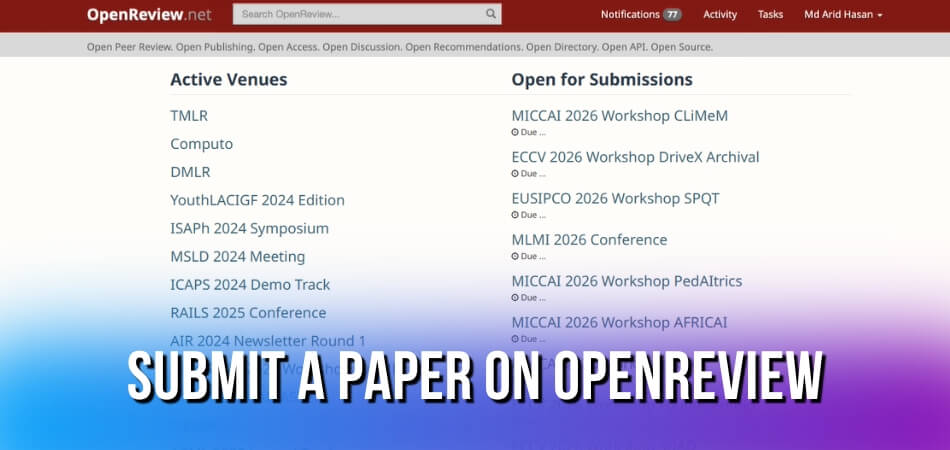
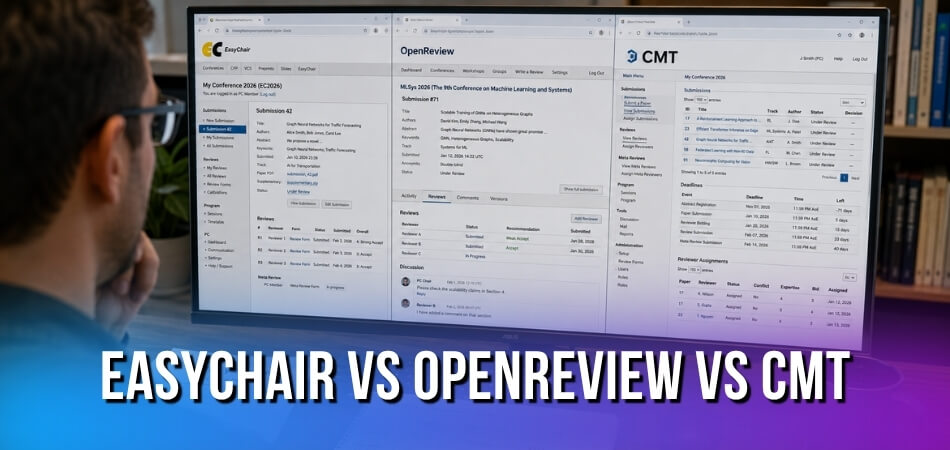
Submissions must use the IEEE two-column format, be no longer than 8 pages including references, and be submitted as a PDF via EasyChair.
Every one of those constraints matters. Violating the format is a legitimate reason for rejection before review, because committees cannot reformat every submission. A paper over the page limit can be desk-rejected, and a Word file sent to a LaTeX-only system causes problems. Download the template early. Cutting a long single-column draft down to a short double-column limit is a much bigger job than it looks, so do not leave it for the last 48 hours.
Also check whether the review is double-blind. If it is, anonymize the manuscript: no author names, no institutional affiliations, and no acknowledgments naming your institution or supervisor. Cite your own earlier work in the third person, such as “prior work [12]”, instead of “as we showed in our previous work [Author, 2022]”. Clear the author name stored in the file properties too. The HRI 2024 conference, for example, asked authors to remove identities from the cover page, the acknowledgments and the PDF metadata, to discuss their own work in the third person, and to refrain from posting the article online until the notification date. Preprint rules differ between conferences, so follow the CFP’s anonymizing instructions literally.
Registration Fee and Presenter Policy
Acceptance does not mean free attendance. At many conferences, at least one author must register, pay and present for the paper to stay in the program. Fees vary widely between regional workshops and large international conferences, and student rates are usually lower but still real money.
The presenter policy tells you whether a virtual option exists, whether a co-author can present for you, and what happens if no registered author shows up. Some conferences remove the paper from the proceedings if no author registers by a set date, so an accepted paper can go unpublished. Read this before you submit. If your travel budget is spent or your institution does not fund attendance, you need to know whether you can follow through before you invest weeks in a submission, and before you commit a co-author’s time.
Abstract-Only CFP vs. Full Paper CFP: Key Differences and Strategy
An abstract-only CFP asks for a short summary, while a full paper CFP wants the complete manuscript before telling you anything. Knowing which one you are dealing with changes your whole preparation plan.
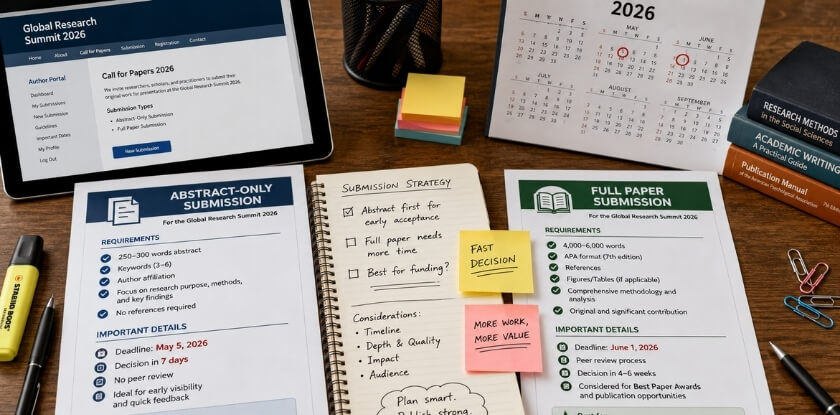
What Each Type Actually Requires
| Point | Abstract-only CFP | Full paper CFP |
|---|---|---|
| What you send | A short pitch with a word limit set by the CFP: question, why it matters, method, findings or expected findings | The complete document with references and figures, within the stated page limit |
| Who decides what | The committee filters and decides who is invited to submit a full paper or present | Peer review evaluates the whole paper |
| Risk | Low: a few hours of work | Higher: weeks of work you cannot present there if it is rejected |
| Initial screening | A promising abstract can survive vague methodology | Reviewers see how developed the work is, so weak method shows |
Some conferences run two stages: abstract first, then an invitation to submit the full paper. The stages often have separate deadlines, so read the dates carefully.
Strategy Differences
For abstract-only submissions, your job is clarity and fit. The committee scans dozens of abstracts quickly, so get your research question into the first two sentences. Match your language to the Topics of Interest by genuinely checking that your work belongs in the stated scope, not by stuffing keywords.
For full papers, start earlier and read the author guidelines before you write the final draft. Reformatting a 12-page paper to another citation style, or resizing every figure because you missed the column width, is a miserable way to spend the night before a deadline. If you are new to this, abstract-only CFPs are the better starting point: lower investment, faster feedback and a real feel for peer review before you commit months to one submission.
Watch for Hidden Requirements
Some CFPs that say “abstract submission” still require a short paper of a few pages instead of a plain text abstract. This can be buried in the formatting guidelines or the submission portal instructions, so check what the actual upload field asks for, not only the headline. Legitimate conferences are open about their review structure, so if format details or the program committee are missing from the CFP entirely, pause and run the legitimacy checks below. Getting published in a predatory venue can damage your academic reputation instead of building it.
How to Define Your Research Question Using a CFP
Use the CFP as a shaping tool before you write: its topics, theme and scope can sharpen, focus or redirect your research question. Most beginners read it backward, starting with a vague idea and hunting for a conference that might accept it. That works sometimes but leaves a lot on the table.
Read the Topics of Interest as a Signal, Not a Checklist
Do not skim the list just to see whether your topic “fits”. Ask which topics sit at the intersection of two or three bullets, because that gap is often where original questions live. If a sustainable computing conference lists “energy-efficient algorithms”, “edge computing” and “rural infrastructure” and nobody is covering all three together, that is a question waiting to happen.
The list also shows the vocabulary the committee expects. Use their language in your abstract. It is not gaming the system; it tells reviewers right away that your work belongs in the conversation. This also fixes the common beginner error of twisting a question to mimic a listed topic when the fit is awkward. Make a genuine case that your work lives in that territory.
Let the Conference Theme Sharpen Your Angle
The theme is your editorial brief. It shows which angle on your research question the committee wants emphasized. The same study on remote worker productivity could be framed as organizational behavior, technology adoption or public health, and the theme tells you which framing to lead with. If the theme is “bridging research and practice”, reviewers will look for applied implications, so make the practical stakes visible from the first sentence of your abstract.
Use the Scope Section to Test Whether Your Question Is Too Broad or Too Narrow
Write your research question in one sentence and hold it against the scope description. If it could apply equally to five different fields, it is probably too broad for this venue. If the scope describes a specific domain and your question only touches it tangentially, you are stretching. A good question for a specific CFP should feel written for that conference, because you used the scope to trim it down to the part that matters to this audience.
The Submission Deadline Forces a Useful Discipline
The deadline works as a research question filter. If it is six weeks away, your question must be answerable with data and methods you already have or can realistically reach in time. A question needing a 12-month longitudinal study is not the right question for this CFP, however interesting it is. That is calibration, not defeat: ask what you can claim and support by that date, and the constraint usually produces tighter, more honest questions.
Watch for Misalignment Before You Commit
Sometimes your topic seems to fit but something is off. The theme may lean toward policy while your work is purely theoretical, the scope may exclude your study’s region, or the acceptance criteria may require empirical data while yours is a literature review. These are not deal-breakers, but they mean the question needs adjusting before submission, not after rejection.
If the scope is vague, the fee looks unusually high and the program committee is hard to verify, run the legitimacy checks below before investing time. A predatory conference accepts almost anything, so its CFP gives you no useful signal for refining your question.
A Practical Workflow
For a concrete process, try this:
- Print or paste the full CFP into a document.
- Highlight every noun in the Topics of Interest section.
- Write your current research question underneath.
- Circle every highlighted noun that appears, explicitly or implicitly, in your question.
- If fewer than two nouns connect, rework the question until they do.
It sounds mechanical, but it forces you to state the connection between your work and this conference’s intellectual community. That connection is your research question, at least for this submission. The CFP is a brief from your future audience, so use it that way.
How to Verify a CFP’s Legitimacy: Identifying Predatory Conferences
To verify a CFP, spend about twenty minutes checking the conference history, the named committee, indexing claims, acceptance standards, fees and archiving before you write a word. Not every CFP is worth your time, and some are outright traps.
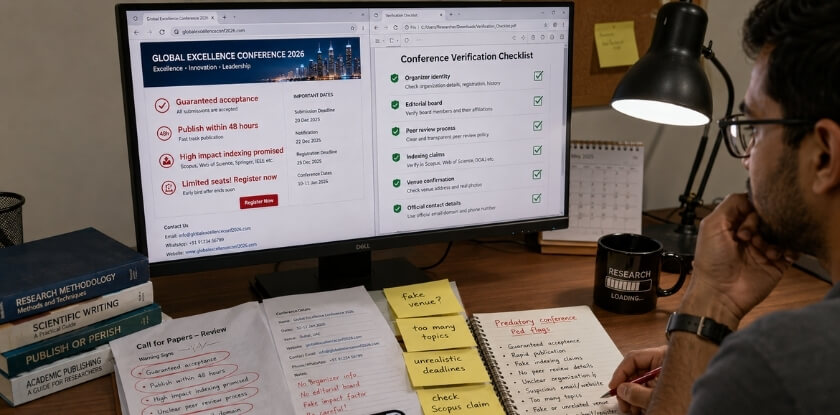
Predatory conferences collect registration fees, publish work in low-quality or non-indexed proceedings and give your CV nothing meaningful in return. Association with them can also hurt your reputation.
Start With the Basics
Search the conference name exactly as it appears in the CFP. Look for a dedicated website, not a landing page cobbled together last month. Legitimate conferences usually have past editions, archived programs and published proceedings. A site with no previous years, no named committee and no institutional affiliation is a red flag. Generic greetings, flattery and pressure to reply at once are weaker signs, but they add up with the checks below. An unsolicited email alone does not make a conference predatory.
Check the dates too. A submission deadline two weeks away for a conference three weeks from now is not a peer review process; it is a money-collection process.
Verify the Program Committee
A genuine conference names its program committee. Search for those names. Real academics have Google Scholar profiles, institutional pages or at least a traceable publication record. If the list shows generic names without affiliations, or members with no findable academic presence, stop there. Researchers also sometimes discover their names listed without consent, so a short email to one or two listed members asking about their role is not unusual.
Cross-Reference With Beall’s List and Think. Check. Attend.
Beall’s List is a widely used reference for predatory publishers and conferences. Jeffrey Beall took the original down in January 2017, and only unofficial copies remain, which he does not maintain. Being on it is not always a final verdict, since some listings are contested, but a listed conference needs a strong counter-reason before you proceed. Because the archive is old, also work through the Think. Check. Attend. checklist, introduced by Knowledge E. It asks whether you know the society behind the conference, whether the venue is clear, whether fees are transparent and whether the proceedings publisher belongs to a body such as COPE, OASPA or DOAJ. Membership is a good sign, not a guarantee.
Check Indexing Claims Carefully
Many predatory conferences claim their proceedings will be indexed in Scopus, Web of Science or similar databases. Verify this yourself by searching the Scopus source list or the Web of Science Master Journal List directly. Do not take the CFP’s word for it. Scopus says it reviews conference series on an ongoing basis, so a listing in the past is not a guarantee for the paper you submit now, and other conferences were never listed and simply say so.
Look at the Acceptance Criteria
Real conferences reject papers; that is the point of peer review. Be wary if the CFP is vague about acceptance and rejection criteria, or if you can find no evidence that any submission was ever rejected. A very high acceptance rate with a minimal review turnaround is vanity publishing with a venue attached. Acceptance within days of an abstract, with no substantive feedback, deserves the same skepticism.
Read the Registration Fee Structure Closely
Fees are normal at legitimate conferences, but structure matters. Fees that are not shown until after acceptance are a warning sign, and predatory conferences often take payment with no real review, publish no refund rules, guarantee acceptance before review, or tie camera-ready submission to fee payment with no way to withdraw gracefully. Some bury a clause charging per author instead of per paper, which can turn a reasonable fee into a much larger one. Compare the fee with what the conference offers: a very high price for a short virtual event with no traceable institutional backing deserves scrutiny.
Check Conference Proceedings Archiving
Ask where your paper will live afterward. Legitimate proceedings are archived somewhere durable, such as the ACM Digital Library, IEEE Xplore, Springer LNCS or at least an institutional repository. If the CFP is vague, ask before submitting. A paper hosted only on the organizer’s own website is not nothing, but it is far less findable than proceedings in a recognized academic database.
Run through the seven checks above before submitting anywhere. If you answer “no” or “I’m not sure” to more than two of them, do more digging before you commit work to that submission.
Common Mistakes First-Time CFP Readers Make
Most first-timer mistakes are covered in the sections where they belong: treating topics as a checklist, mixing up deadlines, leaving the format for the last day, skipping anonymizing, ignoring the presenter policy and shallow legitimacy checks. A few have not come up yet.
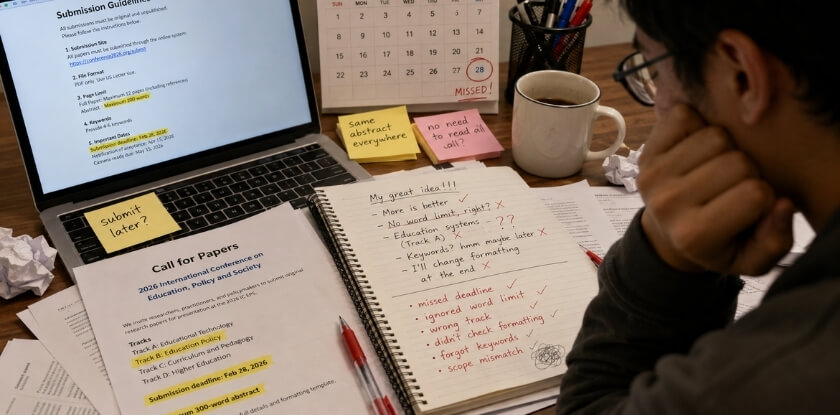
| Mistake | Why it costs you | Do this instead |
|---|---|---|
| Taking the theme too broadly | The theme is a headline written to sound wide. The scope paragraph is usually tighter, and a paper that fits the headline but misses the scope can score poorly on acceptance criteria. | Read the scope paragraph, not just the theme. |
| Treating a deadline months away as a soft horizon | Submission and camera-ready deadlines do not move, and real life compresses the window fast. | Make a plan in the week you find the CFP, not in week nine. |
| Assuming a quick web search is enough verification | Predatory conferences can run professional-looking sites with committee lists that are not real. | If a CFP arrived unsolicited, spend twenty minutes on a real check before five weeks on a paper. |
What Happens After You Submit: From Peer Review to Final Decision
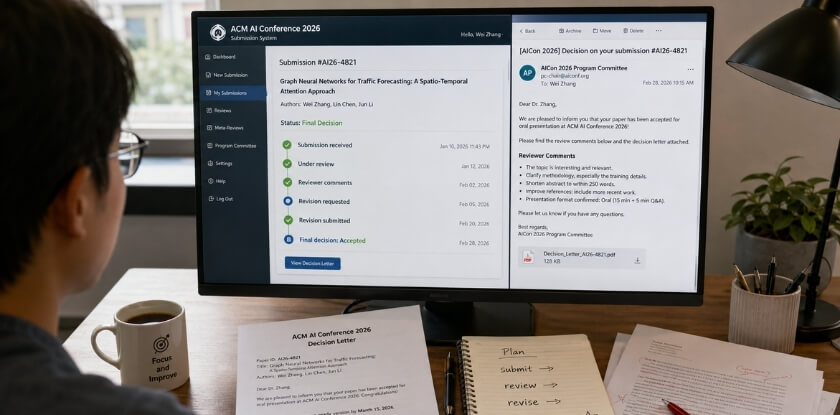
After you submit, expect weeks to months before a final decision, not a verdict the next morning. Knowing what happens in that window makes the wait less stressful and helps you respond well when the decision arrives.
The Peer Review Process
Almost every legitimate scholarly conference uses peer review. Your paper goes to subject-matter reviewers, not straight to the committee chairs. Many conferences run double-blind review, so neither side knows the other’s identity, and a paper that skips the anonymizing instructions can be desk-rejected before a reviewer opens it.
Reviewers score against the conference’s acceptance criteria: relevance to the Topics of Interest, originality, technical soundness, clarity of contribution and writing quality. Each submits an independent score and written comments, and the committee combines them. Some conferences add a meta-review, where a senior member summarizes the reviews, and you may see a “meta-reviewer comment” in your decision letter. Rejection criteria are often the mirror image: weak novelty, insufficient evaluation, out of scope, or writing so poor the work cannot be assessed. Notification dates are normally listed in the CFP. If a conference accepts in rolling batches, you may hear sooner. If all notifications go out on one date, plan your calendar around it, because the camera-ready deadline usually follows soon after an acceptance.
The Three Possible Outcomes
Accept. Read the fine print. Acceptance can come with conditions such as minor revisions, formatting fixes or a length reduction, along with reviewer comments you are expected to address in the camera-ready version, so do not ignore them.
Revise and resubmit (or major revision). Not all conferences offer this. When it exists, treat it as a real opportunity, not a consolation prize. You get a fixed window to revise, so respond to every reviewer comment point by point in a separate response document, and stay respectful even when you disagree.
Reject. It happens to everyone. Read the comments anyway, because they often reveal a fixable gap. A paper rejected at one conference, properly revised, can be accepted at another or developed into a journal submission. If you later extend it for a journal, check that journal’s policy: IEEE, for example, asks authors to disclose the conference version, cite it and explain how the journal paper differs, and the IEEE Communications Society says its policy requires substantial differences without a fixed percentage.
What to Do While You Wait
Check the conference website for timeline updates, since notification dates sometimes slip at large international conferences. If the posted date passes with no word, a brief, polite inquiry to the contact listed in the CFP is acceptable.
Use the wait to re-read the fee and presenter policy, because some conferences ask you to register soon after acceptance to secure your slot.
After Acceptance: The Camera-Ready Submission
Getting an acceptance feels like the finish line, but it is not. The camera-ready paper is the final, publication-ready version for the conference proceedings, and it is not your submitted draft cleaned up. It has strict rules on page limits, fonts, margins and reference style, and usually a required template (IEEE, ACM, Springer LNCS and similar formats are common).
Download the template the moment you are accepted, and paste your content into the provided LaTeX or Word file instead of reformatting your old document by hand. Fitting the format can reveal that you are over the page limit, which means cutting real content.
Camera-ready also means putting back what blind review hid: author names, affiliations and acknowledgments, as the conference’s instructions describe. The IEEE Author Center, for example, tells authors to remove default template text, confirm the title and author names, run the file through PDF eXpress only if the conference committee asks, and warns that further changes cannot be made once the paper is in IEEE Xplore. Some conferences also lock the author list and content after the final submission, so check the author instructions before you add or remove a name. The deadline is hard: miss it and your paper may not appear in the proceedings, so the work may be left out of the record altogether.
The Proceedings and What They Mean for Your Record
Conference proceedings are the published record of accepted papers. Depending on the conference, they may be indexed in databases such as IEEE Xplore, ACM Digital Library or Scopus, and that indexing is what makes a paper discoverable and citable. This is why checking legitimacy first matters: predatory conferences will publish your paper in “proceedings” no serious database will index, leaving you with a registration fee spent on a publication that carries no weight. Proceedings from a genuine scholarly conference show your work survived peer review and joined the formal record in your field.
From our experience at MS International: We run double-blind review and ask authors to follow APA format. Full papers normally run four to twelve pages including references, decisions usually come within about 10 working days, and the work must not be published or under review elsewhere. Accepted papers that are presented in person may be considered for conference proceedings where applicable, but acceptance, payment or presentation does not guarantee publication. Authors complete author registration after acceptance, and anyone who only wants to attend can register as a listener without a paper. Terms differ by event, so read the submission page of the specific conference.
Frequently Asked Questions (FAQ)
A CFP leaves newcomers with practical doubts: whether a draft must be finished first, how strict the deadlines are, what camera-ready means and how to spot a predatory conference from an unsolicited email.
Do I need a finished paper before responding to a CFP?
Not always. Many CFPs ask only for an abstract first, with a word limit set in the CFP, so you pitch the idea and write the full paper after acceptance. If the CFP says “abstract only”, no full paper is due by the first deadline. Check which stage is being requested.
What if my research only partly fits the Topics of Interest listed?
A partial fit is usually fine. Topics of Interest are signals about scope, not an exhaustive checklist, so work that sits at the edge of one listed topic is normally acceptable. If it connects to none of them in any meaningful way, reconsider whether this is the right venue.
How strict are submission deadlines?
Treat them as hard stops. Some conferences extend a deadline, but you cannot count on it, and a missed deadline means your work is not reviewed. Set your own internal deadline at least three days before the official one to absorb formatting panics.
What does “camera-ready paper” mean?
It is the final, publication-ready version you submit after acceptance. It includes revisions requested in peer review, restores author details hidden for blind review, and must meet exact formatting rules for margins, font, reference style and page limits. It goes straight into the proceedings, so fix everything first.
What is a double-blind review, and does it change how I write my paper?
In double-blind review, reviewers and authors do not know each other’s identities, so you must anonymize the manuscript. Remove your name, institution and acknowledgments, clear the author name in the file properties, and cite your own earlier work in the third person, for example “prior work [12]”. Follow the CFP’s exact instructions.
Is the registration fee always required even if I’m just presenting?
Usually yes. The presenter policy of many conferences says at least one author must register and pay. If nobody registers, the paper may be pulled from the proceedings even after acceptance. Costs vary widely, so check the fee before you submit.
How do I know if a conference is predatory?
Look for a real program committee of verifiable academics, a clearly described peer review process and a traceable conference history. Vague acceptance criteria, no mention of rejection and “acceptance” emails within hours of submission are red flags. Real peer review takes weeks, so a legitimate conference cannot reply that fast.
Can I submit the same paper to multiple conferences at once?
Generally no. Publisher and society policies usually bar having the same paper under review in two places, and IEEE, for example, requires authors to disclose any multiple submissions. Submitting in parallel without disclosure can count as misconduct. If the CFP is silent, email the program chairs before you submit.
What’s the difference between a conference paper and a journal paper?
A conference paper is peer reviewed, usually shorter and published in proceedings after a faster review cycle. A journal paper goes through a more rigorous, often multi-round review and appears in a journal. Some top conferences are as competitive as journals, but a CFP for a conference is not a journal submission.
Is a CFP that arrives by email a sign of a predatory conference?
No. An unsolicited email can carry a real invitation or predatory outreach, so it proves nothing either way. Find the conference on its own website, check past editions and the named committee, and compare the dates before you reply.
What if I get rejected?
Rejection happens to everyone and is not a verdict on your research. Your work may be out of scope, need a stronger method, or the conference may simply have been oversubscribed. Read the reviewer feedback, which usually says what to fix, then revise and submit to another venue.
Conclusion: A CFP Is the Gateway to Your Research, Not Something to Fear
A Call for Papers is a structured, sometimes dense document written by people who want submissions from researchers like you. The anxiety around it usually comes from unfamiliarity, not complexity. After reading a few, the pattern clicks: theme, topics, deadlines, format. The first CFP feels like a foreign language and the fifth like skimming a menu.
You do not need a perfect paper to start. You need a research question in reasonable shape and enough time before the abstract deadline to write something honest about it. Start with a CFP in your field, read every section and ask whether your question maps to its scope. If it does, write the abstract. If it does not, move on, because a CFP that does not fit is a faster path to one that does.