Want to publish in conference proceedings that Scopus covers but have no idea where to start? Many researchers, from PhD students to early-career academics and faculty in countries such as Bangladesh, know that a Scopus listing helps a CV and a citation record. The path from “I have a paper” to “it appears in Scopus” is the unclear part.
Quick answer: To publish in proceedings that Scopus covers, choose a conference whose proceedings series is already listed on the Scopus Sources page, submit through its official system, pass peer review, send the camera-ready paper and copyright form, and register so the paper is included. The paper appears in Scopus only after publication, on no fixed date.
Last verified against official sources: October 2026.
This guide follows the process in order: how to verify a conference, how to avoid predatory events, what the submission workflow looks like, and what to expect once the proceedings are out.
The Short Process of Publishing a Paper in Scopus-indexed Proceedings
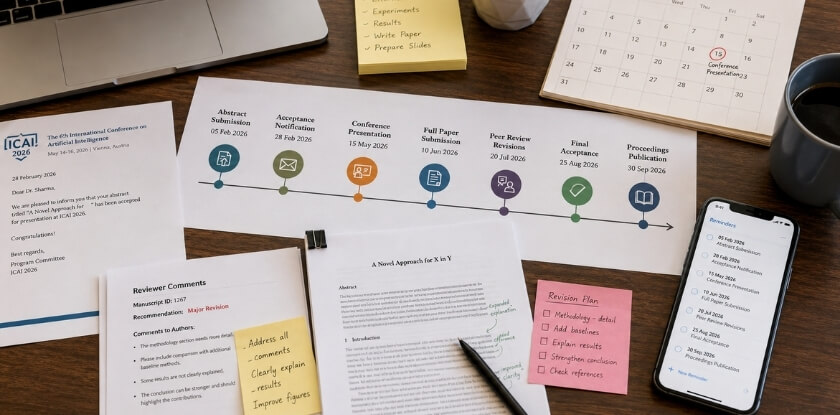
The short answer is six stages, and the order matters: verify the venue first, because no later step can fix a conference that is not covered by Scopus. The table gives the overview, and the sections below cover each stage in detail.
| Stage | What you do | Main risk |
|---|---|---|
| 1. Find the conference | Confirm the proceedings series is covered by Scopus and note its ISSN | Believing a coverage claim without proof |
| 2. Submit | Send an abstract or full paper in the conference template | Missed deadline or wrong format |
| 3. Peer review | Answer every reviewer comment | Defensive or vague replies |
| 4. Camera-ready | Final formatting and copyright form | Template errors, unsigned form |
| 5. Register | At least one author registers and presents | Paper withdrawn from the proceedings |
| 6. Wait for the paper to appear | Search Scopus for your title or DOI | Assuming it appears at once |
Step 1: Find a Legitimate Scopus-Indexed Conference
Start with the Scopus Sources page, choose the Conference Proceedings source type and search by title, ISSN or publisher. Scopus lists the proceedings series, not the individual conference, so search for the series name the organisers give, such as Lecture Notes in Computer Science, and not only the event name. Series published by IEEE, ACM and Springer’s LNCS are common starting points, especially for a PhD researcher building a first CV entry, but even these need a check, as explained below. Springer’s own LNCS page says it submits proceedings volumes to indexing services including Scopus, which is a submission and not a coverage decision.
Step 2: Submit Your Abstract or Full Paper
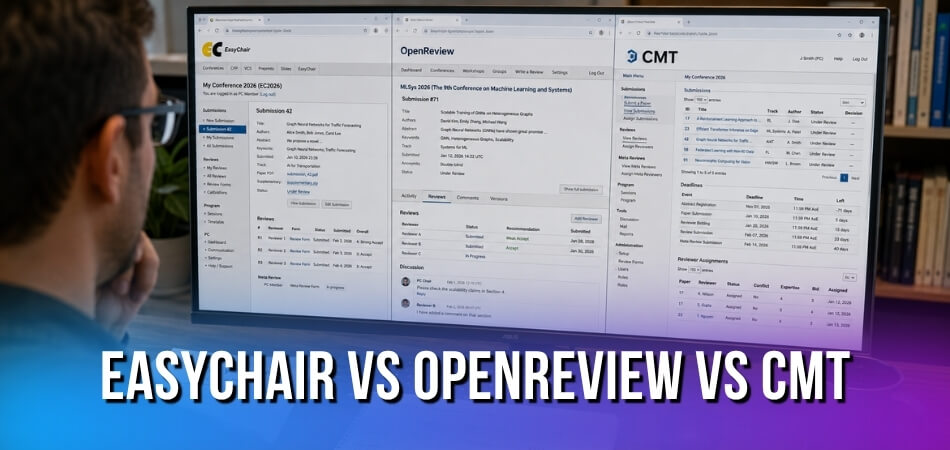
Most conferences open with an abstract phase on a portal such as EasyChair or Microsoft CMT. Some go straight to full papers. Read the call for papers first, because a missed deadline removes you from the whole review cycle. Submit the paper to one venue at a time: sending the same work to two venues at once is treated as duplicate submission in COPE’s publication ethics guidance.
Step 3: Go Through Peer Review
Reviewers assess the paper and may accept it, reject it or ask for revisions. Respond to each comment directly.
Step 4: Prepare and Submit the Camera-Ready Version
After acceptance you send the final formatted paper and sign a copyright or licence form. Both are covered in the camera-ready section below.
Step 5: Register for the Conference
Acceptance alone does not put a paper in the proceedings. Many conferences require at least one author to register and present, and a paper without a registered presenter can be withdrawn before publication.
Step 6: Wait for Proceedings Publication and Scopus Indexing
The proceedings are published first, and Scopus coverage of the paper is a separate later step. You can track it by searching your title in Scopus. A conference that says it has “applied” for Scopus is not the same as one already listed.
How to Find and Verify Scopus-Indexed Conferences
To verify a conference, look up its proceedings series on the Scopus Sources page and match the ISSN with the one on the conference website. Do not rely on a logo, an email or a colleague’s memory.
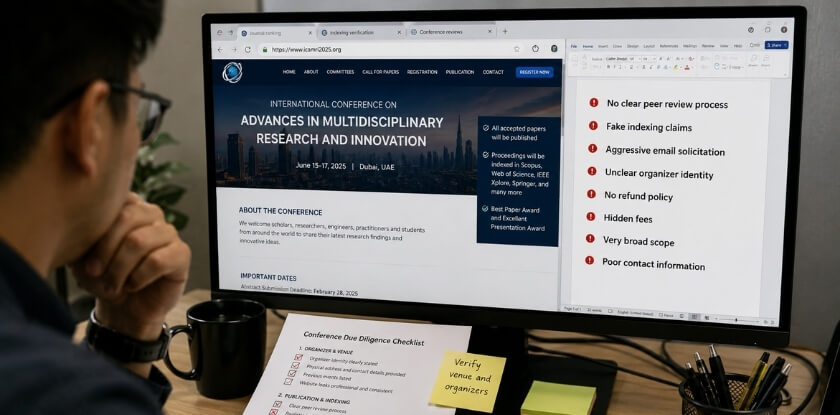
Verifying Conferences Using the Scopus Source List and ISSN
Scopus, owned by Elsevier, publishes a Sources page where you can search by title, ISSN or publisher and filter by source type, including conference proceedings. Scopus also offers a downloadable source list in Excel, which needs a Scopus login. Scopus Preview, the free version, gives access to the Sources page as well.
Scopus covers serial publications with an ISSN, which includes conference series, and some one-off conferences, which Elsevier assesses with the selection process used for Engineering Village. An international panel of subject experts, the Content Selection and Advisory Board (CSAB), decides which titles are included and keeps reviewing conference series after they are listed. That is why no organiser can guarantee indexing in advance.
To check a series on the Scopus Sources page:
- Open Sources from the Scopus home page and choose the Conference Proceedings source type.
- Search by title, ISSN or publisher and select Find Sources.
- Open the matching title to see its source details page, with the publisher and the coverage years.
- Compare the ISSN and publisher with the call for papers.
Use this checklist when you find a conference you like:
| Check | How | Good sign | Red flag |
|---|---|---|---|
| Series listed | Search title or ISSN on the Scopus Sources page | The series is listed and not marked discontinued | Not found, or only the publisher name matches |
| Coverage years | Read the coverage years on the source details page | Coverage includes the year your proceedings are published | Coverage stops before that year |
| ISSN | Compare the conference website, the Sources page and the ISSN Portal (portal.issn.org) | Same ISSN everywhere | Missing or mismatched ISSN |
| Recent content | Search Scopus for the conference name | Papers from recent years appear | Earlier editions are absent |
| Publisher | Read the call for papers | Named publisher and series | “Published in a Scopus journal” with no name |
A few things to keep in mind:
- Being published by IEEE or ACM does not automatically mean Scopus coverage. Check the specific proceedings, not just the publisher name.
- A series can be listed while a particular year is missing. Elsevier’s coverage policy says an article’s publication date has to fall within the coverage years of its source, so read them on the source details page.
- Coverage status can change. Elsevier says titles flagged for re-evaluation stop receiving new content until the CSAB finishes its review, and the downloadable source title list includes discontinued sources. The Sources pages and the list are updated monthly, so use the current Sources page, not a forum post.
If you cannot find the series, email the organisers and ask which proceedings series the accepted papers will appear in, and whether that series is currently on the Scopus Sources page. A legitimate conference answers this without hesitation. The Think. Check. Attend. checklist asks the same kind of question: is it clear where the proceedings will be published, which indexing services the conference guarantees and which it only submits to, and whether the proceedings publisher belongs to a recognised initiative such as COPE, DOAJ or OASPA.
Dear Organising Committee, before I submit, could you confirm the publisher, series name and ISSN for the accepted papers, which indexing services the volume will be submitted to, and whether the series is currently listed on the Scopus Sources page? Thank you.
How to Identify Predatory Conferences
Predatory conferences accept almost every submission, charge high fees, and either publish in non-indexed outlets or disappear after collecting money. Listing such a paper on your CV as covered by Scopus is misleading even if you did not know.
The most consistent warning signs:
Vague coverage claims. “Submitted to Scopus” or “Scopus pending” does not mean the paper will be listed. A genuinely covered proceedings series already appears on the Sources page, and the coverage decision belongs to Scopus, not the organiser.
Unsolicited mass invitations. Flattering emails about your “distinguished research profile” with a deadline next week follow a bulk-mail pattern. Genuine calls for papers circulate through societies and mailing lists.
Unusually fast peer review. Real review takes time. A promised decision within a couple of days leaves no room for meaningful review, and without review the paper has little credibility or citation value.
No verifiable program committee. Search committee members on Google Scholar or their university pages. If several return nothing or have no link to the event, the committee may be invented.
Payment with no real review. Watch for a fee taken with no visible peer review, no published refund rules, or acceptance guaranteed before anyone reads the paper.
Guaranteed acceptance. Real peer review cannot promise acceptance.
Step-by-Step Workflow from Abstract Submission to Full Paper
The workflow has three stages: an accepted abstract, a full paper that meets the template, and peer review with revisions. Read the call for papers first, since dates and tracks change by event.
Abstract Submission and Acceptance Notification
An abstract is your first contact with the programme committee, and it decides whether the full paper is invited. Length depends on the call, so follow its limit. APA Style’s default abstract limit is 250 words, a useful reference when the call gives none.
On portals like EasyChair or Microsoft CMT you create an account, enter the title, authors and keywords, and paste the abstract. Some venues ask for a topic track at this stage.
What your abstract needs to do: state the problem, describe the method briefly, and say what the results show. Committees scan many submissions, so a buried contribution gets passed over. You do not need the full paper yet, but you should have results. An abstract that only says “results will be presented” is a red flag for serious venues.
Notification dates vary, and smaller or newer conferences can take longer. Some skip the abstract stage and go straight to full papers. Check the official timeline, not external listings. The decision email carries your submission ID, track and full-paper deadline, so save it.
Format and Structure for Writing the Full Paper
Conference papers are shorter than journal articles, focus on one contribution, and must follow the template and page limit in the call.
| Template | Used for | Notes |
|---|---|---|
| IEEE conference template | IEEE-sponsored conferences | Two-column, LaTeX and Word |
| ACM template (acmart) | ACM proceedings | Most proceedings authors use the “sigconf” variant; ask the organisers if unsure |
| LNCS | Springer computer science proceedings series (LNCS, CCIS and related series) | LaTeX2e and Word proceedings templates, plus Springer’s Instructions for Authors PDF |
Download the template from the publisher or the conference site. An old or edited template can get a paper sent back before review. A tight paper beats a stretched one, so do not pad to reach the page count.
A typical structure is abstract, introduction, related work, methodology, results and discussion, conclusion and references. Some venues fold related work into the introduction. Follow the author guidelines.
- Page limits are hard limits. Going over the limit can get a paper returned before review. Cut from related work or discussion first.
- Figures and tables count toward the limit. Plan the layout early.
- Reference style must match the template. IEEE uses numbered citations in square brackets, while LNCS commonly uses numbered or author-year styles depending on the volume. If you use Zotero or Mendeley, check the exported style.
For LNCS, read Springer’s “Instructions for Authors” PDF, which is listed with the LaTeX2e and Word proceedings templates on Springer’s information page for authors and editors.
Use your full university name as it appears on official documents, with your country in the address line. If the metadata is entered wrongly at submission, institution names can be garbled in production.
The Peer Review Process and Handling Revisions
Conference reviews are single-blind or double-blind depending on the venue, and reviewers judge originality, soundness, clarity and fit. In double-blind review, remove author names, affiliations and identifying self-citations from the review version.
Review time varies by conference. Typical decisions:
- Accept, where the paper goes forward as it is.
- Accept with minor revisions, where you make small changes and resubmit.
- Major revisions, where the paper needs substantial work first.
- Reject, because the paper does not meet this venue’s standard for this cycle.
A revision request is not a bad outcome. It means reviewers took the work seriously, and a clear, respectful response letter shows you engaged with the feedback.
Reviewer 2, comment 3: The sample size is not justified.
Response: We added a power calculation in Section 3.2, paragraph 2, and report the effect of the smaller group in Table 2.
Read all the comments once before replying. Address each one specifically: say what you changed and where, or give a measured technical reason if you disagree. Program chairs read response letters, and a defensive tone can hurt even when the revisions are sound.
Keep a revision tracker listing each comment, your reply and the exact location of the change (for example “Section 3, paragraph 2”). It makes the chair’s job easier.
If the paper is rejected, check whether the conference allows a short author response before the final decision. The comments are still useful for strengthening the paper for another venue.
Preparing and Submitting Your Camera-Ready Paper
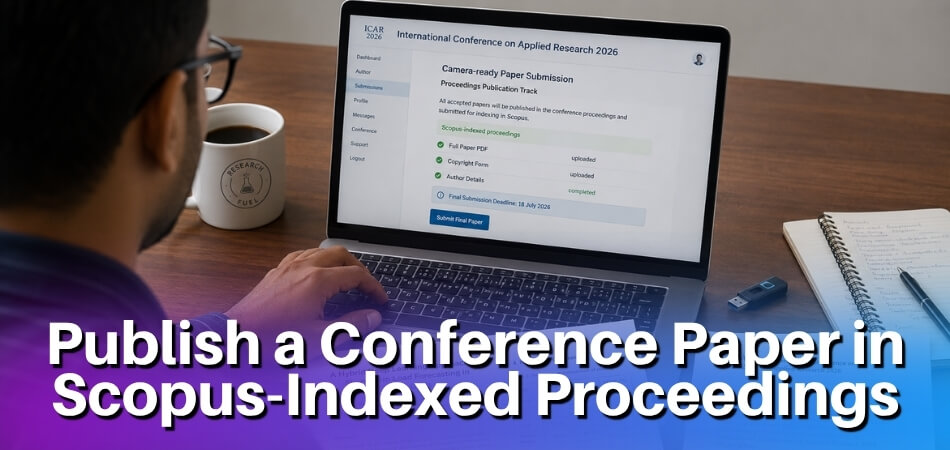
The camera-ready paper is the final version that goes to the publisher, and it must follow the mandatory template exactly. At this stage you incorporate all revisions, restore author names and affiliations removed for blind review, and send the copyright form. Common mistakes are wrong font sizes, incorrect margins and missing copyright statements. Small errors can delay publication, and missing the deadline can drop the paper from the proceedings, because publishers work to tight production schedules and do not hold the print run for late authors.
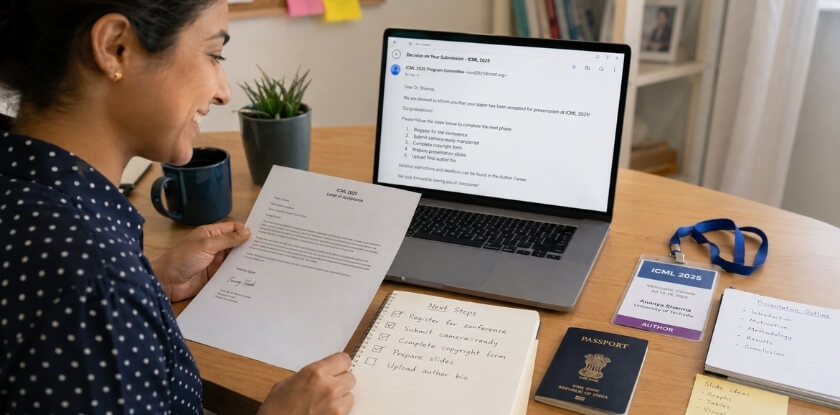
Camera-Ready Formatting Rules (LNCS, ACM, and IEEE Templates)
You do not choose the format. Use the template the conference names.
LNCS is the Springer proceedings standard. Download the LaTeX or Word package from Springer’s author resources, and keep margins and fonts as supplied, since production staff check them. Page limits are set by each volume, so follow your call.
ACM proceedings use the acmart template, available through Overleaf. ACM has updated its templates, so use the version the conference links to.
IEEE papers feed IEEE Xplore, and the template is on the IEEE Author Center. IEEE’s Xplore requirements include embedded or subset fonts, no password or security settings, no bookmarks or links, and no scanned pages. Some conferences use IEEE PDF eXpress to check the file and send authors an invitation email with a customised link, and conferences that do not can use the IEEE PDF Checker.
Practical points for any template:
- Remove page numbers unless the template includes them.
- Embed all fonts in the PDF, which IEEE lists as an Xplore requirement.
- Keep figures at a high resolution and readable in black and white, since some proceedings are printed.
- Author names, affiliations and emails must match what you entered at submission. Mismatches can cause indexing problems later.
If you submit through a national institution in Bangladesh or elsewhere, check how the affiliation appears. Scopus records affiliations, and a misspelled or inconsistent institution name can affect your author profile and your institution’s record.
Copyright Agreement and Author Rights
You must sign a copyright or licence agreement before the paper can be included. This is standard and not optional. What differs is the rights you keep.
Publishers such as IEEE, ACM and Springer use their own forms. Some are copyright transfers, some are licences, and some offer paid open access options. The rules on posting the accepted manuscript, the final PDF or a repository copy differ by publisher and by form, so read the actual agreement instead of relying on general advice. Signing without reading is how researchers later find they cannot share their own work in an institutional repository.
If open access matters to you, ask the organisers before submission whether it is offered and what it costs. List all authors correctly and in the right order, and note that co-authors may need to sign separately. Sort this out before the deadline.
Conference Registration and Participation
At many conferences whose proceedings Scopus covers, the paper is not published unless at least one author completes registration and pays the fee before the deadline. Treat registration as a publication step, not a formality.
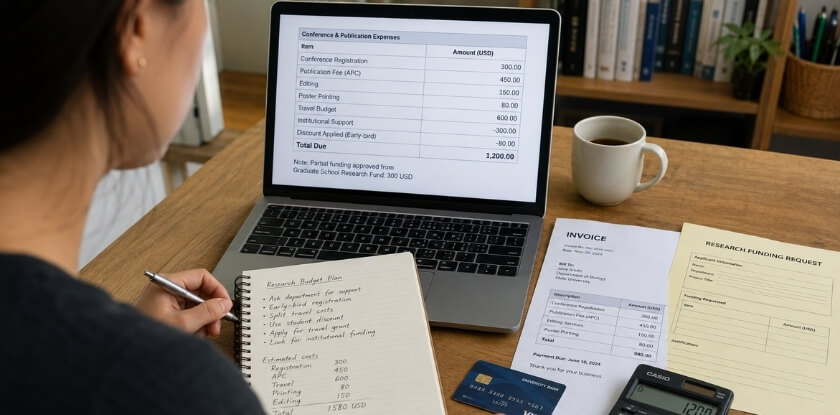
Understanding Registration Requirements
Many organisers tie publication to registration. If you miss the deadline, the paper can be pulled, and follow-up emails may not reverse that.
Check whether the conference asks for “author registration” specifically. Some separate it from standard attendee registration with different fees, and author registration is what unlocks publication.
Fees differ widely between events, so compare them before you submit. Reduced rates and waivers are covered in the section for researchers from developing countries below.
Presentation Formats
Most conferences expect accepted authors to present, either in person or online. The notification usually names the format; if not, ask the programme committee and get it in writing.
In-person presentation is one common format. Prepare slides early and confirm the time slot with the session chair.
Virtual presentation became widely accepted after 2020 and many events offer hybrid tracks. Test audio, connection and screen sharing a day before. A failed live session can lead organisers to treat the presentation as incomplete.
Poster sessions are common at larger conferences. Check the conference rules, because some treat a poster the same as an oral talk for publication and others do not.
What Happens at the Conference
Arrive at the room 15 minutes early, introduce yourself to the chair and load your slides. Chairs move quickly, and some conferences simply continue if you are absent when called.
Answer questions honestly. “That is a direction I have not explored yet” beats speculating. The Q&A is useful for PhD work, since feedback from specialists often shapes your next paper or chapter. Keep notes on the other papers in your session for your literature review and future collaborations.
After the Conference: Tracking Your Indexing
The proceedings volume is normally published some weeks or months after the event, through a platform such as IEEE Xplore, the ACM Digital Library or SpringerLink. Appearing in Scopus is a separate step that follows publication, so being published and being listed there are two different milestones. Keep the DOI and the proceedings ISSN from the volume page, because you will need them to check your status in the next section.
Scopus Indexing Timeline After Proceedings Publication
Proceedings come first and Scopus follows, with a delay that nobody can fix in advance. Elsevier gives no timeline for proceedings, and unofficial guides disagree, so treat any exact figure you read online as a rough guide only.
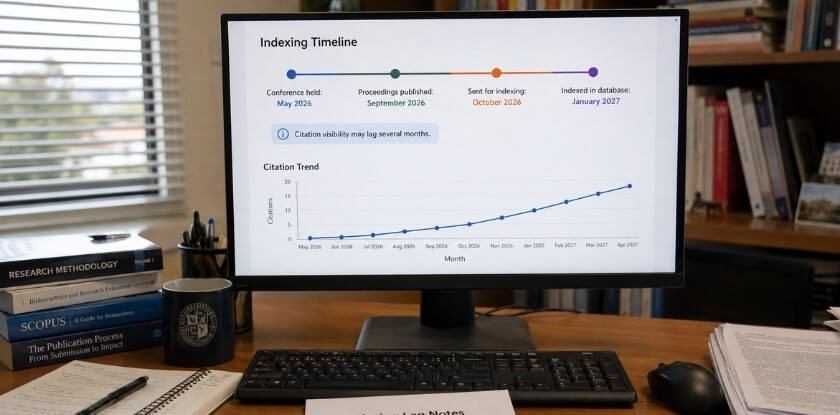
How the Indexing Process Actually Works
Scopus does not add your paper the moment the proceedings go live. The publisher or organiser has to deliver the volume, and Scopus then processes it. Your paper becomes searchable only after the volume is ingested. Elsevier’s coverage policy says an article newer than the latest content Scopus holds for its source cannot be added until the publisher releases the content to Scopus, and its support page says an article usually appears within four days of Scopus receiving it. Delivery of the volume is therefore the step to chase.
| Situation | What it means for timing |
|---|---|
| Series already on the Sources page, large publisher | The smoother route, but each new volume still has to be delivered and processed |
| Series listed, small or new organiser | Volumes may arrive late if the organiser is not routine about submissions |
| One-off conference | Enters Scopus differently from serial titles, so ask the organiser how and when |
| Series not listed | Your paper will not appear, whatever the invitation said |
Typical Timeframes to Expect
Neither Scopus nor the large publishers publish a fixed schedule. Unofficial guides quote ranges from a few months to about a year after the conference, and they split the time between publisher and Scopus differently. Use such figures only to plan expectations, never as a promise, and do not tie a deadline for a grant, defence or promotion to a specific date.
What You Can Do While Waiting
Search Scopus for your title or DOI. Scopus may list the paper under the proceedings series title, so search the series name as well, and search the conference name to see whether other papers from your volume have appeared. If others appear, yours is probably in the same batch.
If nothing appears after about six months, contact the conference organisers first. They are responsible for making sure the volume is delivered and often have a publisher contact who can confirm the status. Give them the proceedings title, ISSN, volume and DOI. Scopus cannot add a volume the publisher has not delivered, though the Scopus help desk can confirm whether a title is covered.
On your CV, once the paper has a DOI, you can list it as “published in [Proceedings Name], [Publisher], [Year]”. For grant applications while you wait, “in press / forthcoming in proceedings” is fine if you can document the acceptance, but do not say it is in Scopus until you see it there.
ISSN and Proceedings Registration
Elsevier says serial conference publications must have an ISSN registered with the ISSN International Centre. Confirm with the organisers, before you finalise the camera-ready paper, that the proceedings have a valid ISSN that matches the one on the Scopus Sources page. If they cannot name it, treat that as a red flag.
What “Indexed” Actually Means for Your Record
Once the volume is ingested, your paper’s metadata (title, authors, abstract, keywords and source) becomes part of the database, and citations start to accumulate. Scopus creates or updates your author profile, so check it. If your name appears in variant spellings, the Author Profile Wizard, which is available in Scopus Preview, lets you request corrections.
Citation, Impact, and the Value of Conference Papers for Your CV or PhD
A conference paper counts for what its venue is worth. A paper in a recognised, well-reviewed proceedings series carries real credibility, and one from an obscure or doubtful series can hurt you.
What Conference Papers Actually Count For
Papers in respected proceedings are peer reviewed, carry DOIs and can be found in Scopus. For a PhD student, one or two such papers before the defence show that the work passed scrutiny outside your own institution.
Citations and How They Accumulate
Papers in proceedings covered by Scopus can be cited and appear in Scopus, Google Scholar and reference lists of journal articles. Impact differs by field and venue, and in fast-moving fields such as computer science and engineering a conference paper can appear before the journal version. Citations to a paper listed in Scopus count toward your citation record in Scopus, and Google Scholar calculates its own metrics from papers it can find.
The CV Advantage
For early-career researchers, a conference paper listed in Scopus can be the first verifiable international publication, the difference between “research interests include X” and “published in X”.
For PhD candidates, some universities require at least one publication in an indexed database for completion. Check your own university’s rules, because requirements differ, and confirm whether conference papers qualify.
For researchers from developing countries, conference publication can be a faster route to an international profile than a journal with a long review. The timeline depends on the event and the publisher.
Limitations to Be Honest About
Not every conference paper in Scopus carries equal weight. A well-known IEEE symposium reads differently to a hiring committee than an unknown proceedings volume that only just entered Scopus.
A paper from a conference with no real peer review will hurt your credibility, especially if the source is later discontinued by Scopus.
Field matters too. In computer science and electrical engineering conference papers are standard primary publications. In life sciences or economics, journal articles dominate and conference papers may count for less.
Building a Publication Record Strategically
Treat conference papers and journals as complementary. Publish early work at a conference whose proceedings are covered while a longer journal version is in progress. When you choose that journal, check where it sits among Q1 to Q4 journals in your subject category. Some journals accept an extended version of a conference paper. COPE advises citing the earlier paper and stating the overlap, and the journal’s own prior-publication policy decides whether it is eligible, so check it and the conference’s copyright terms before reusing text or figures. Claim your Scopus author profile once papers appear. A clean profile with modest numbers presents better than an incomplete one.
Special Tips for Researchers from Bangladesh and Other Developing Countries
Publishing in proceedings covered by Scopus is achievable from Bangladesh and other developing countries, but cost, spam invitations, language and affiliation consistency need extra planning.
Registration Fees Are a Real Barrier, So Plan Around Them
Fees vary widely, and reduced rates for authors from developing nations usually have to be requested explicitly.
Look for fee waivers early. Check the conference website for financial assistance or student grants well before the camera-ready deadline.
Apply through your institution. If your university has a research or travel fund, start the application the moment your paper is accepted, since approval can take weeks.
Workshops within larger conferences sometimes have lower fees. A workshop paper can still land in indexed proceedings, but confirm the workshop proceedings’ ISSN on the Scopus Sources page before submitting.
Avoiding Predatory Conferences That Target Developing-Country Researchers
Researchers in Bangladesh and similar contexts receive many spam invitations promising Scopus coverage. The red flags are listed earlier; these checks are specific to this situation.
Verify before you submit anything. If the series is missing from the Scopus Sources page, no invitation email changes that.
Check the organiser’s history. Search the conference name and the previous year. If earlier proceedings are not in Scopus, or the event changes names and publishers every year, walk away.
A useful extra check for computer science and engineering is the CORE (ICORE) conference ranking portal at portal.core.edu.au. A CORE rank does not prove Scopus coverage, so you still need the Sources check, but a ranked venue is a better sign than an unranked one.
Writing in English When It Isn’t Your First Language
Many proceedings require clear English, and strong technical papers sometimes face reviewer pushback on language. If your department has no language support, a senior researcher or PhD colleague who publishes in English is more reliable than automated tools alone, and a grammar tool such as Grammarly can catch surface errors.
Reviewers care most about a clear abstract and methodology. If those two are precise, small grammar slips elsewhere rarely cause rejection on their own, so edit them first.
Getting an ORCID and Institutional Affiliation Right
Your affiliation should match your institutional profile exactly. Scopus tracks affiliations, and different spellings of a university name across papers split your author profile into pieces.
Create an ORCID at orcid.org, link your affiliation to it, and use it consistently when submitting through CMT, EasyChair or similar platforms. It helps build a clean, verifiable publication record.
The CV and PhD Value Is Real, But Context Matters
A paper in legitimate indexed proceedings can strengthen a PhD candidate’s record, but how it counts for promotion or degree rules depends on your university and the national criteria, so check them. In computer science and engineering the venue quality matters more than the format. One well-placed paper in a respected series does more for your profile than three in marginal or unverifiable venues.
From our experience at MS International: submissions are reviewed double-blind, papers follow APA format, and most review decisions are returned within about 10 working days, with an acceptance, revision request or rejection sent by email. Full papers normally run four to twelve pages, and work must be original and not published or under review elsewhere. Accepted papers presented in person at our conferences in the Greater Toronto Area may be considered for conference proceedings where applicable. We do not promise indexing in Scopus, Web of Science or any publisher series, so ask any organiser, including us, for the exact publisher and ISSN and check it yourself.
FAQ
Once a paper is headed for Scopus-indexed proceedings, the worries shift to indexing delays, a series dropped from Scopus, whether attendance is required and correcting a mistake after the camera-ready upload.
Does every conference paper get indexed in Scopus automatically?
No. Scopus covers proceedings series that its Content Selection and Advisory Board has accepted, not individual papers. A paper in official proceedings can still be missing if the series is not covered, its coverage years stop earlier, or the volume was never delivered.
How long does Scopus indexing take after the conference?
There is no fixed timeline. Elsevier publishes none for proceedings, and unofficial guides range from a few months to about a year after the conference. If nothing appears after about six months, ask the organisers to check with the publisher.
Can I verify a conference is Scopus-indexed before submitting?
Yes. On the Scopus Sources page, choose the Conference Proceedings source type, search the series by title or ISSN and check its coverage years. If it is not listed, do not assume it will be added later.
What happens if the conference gets removed from Scopus after my paper is published?
Content that Scopus already holds stays in the database as a matter of scientific record, Elsevier says, and is removed only in exceptional cases of proven, severe unethical publishing. No new volumes are added once a source is discontinued, so check the source details page for the final coverage point.
Are predatory conferences ever Scopus-indexed?
It can happen, and Elsevier says flagged titles are re-evaluated and can be discontinued. Check the current Sources page and the discontinued list yourself, because a claim on a conference website is not proof.
Do I need to attend the conference for my paper to be published?
Often, yes. Many conferences require at least one author to register and present, and a paper without a registered presenter can be withdrawn from the proceedings. Check the call for the exact rule.
Can a PhD student be the sole author on a Scopus-indexed conference paper?
Yes. Reviewers judge the quality of the paper, not the author’s degree status.
Does a conference paper count the same as a journal article for a PhD or CV?
Not always. Many evaluations weigh peer-reviewed journal articles higher, but a paper in a strong venue covered by Scopus is a recognised publication, particularly in computer science and engineering.
Is the peer review at conferences rigorous?
It varies by conference. Established events publish how papers are reviewed and by whom, while weak events may offer light review. Look for a named committee and a stated review process before you submit.
My camera-ready paper was submitted. What should I do if I notice an error afterward?
Contact the proceedings editor immediately. Once files are with the publisher, what can be corrected depends on the publisher’s policy, so ask before the volume is published.
Can researchers from Bangladesh or other developing countries get fee waivers?
Some conferences offer reduced fees or waivers, but you usually must ask, often with documents, and approval is not guaranteed.
Why is my paper not in Scopus when the series is listed?
The volume may not have reached Scopus yet. Elsevier says content newer than the latest held for a source is added only after the publisher releases it. Check the coverage years, search by DOI, then ask the organisers to confirm delivery with the publisher.
Can I submit the same paper to two conferences at once?
No. Submit to one venue at a time. Publication ethics guidance from COPE treats concurrent submission of the same work as duplicate submission, and many calls, including MS International’s, say work must not be under review elsewhere.
Will my Scopus-indexed conference paper improve my citation count?
It depends on the field and the visibility of the proceedings. Papers in well-known venues get cited, while an obscure volume few people read will collect very few citations regardless of being listed.
Conclusion
Publishing in proceedings that Scopus covers is a matter of verifying the venue first, then following submission, review, camera-ready and registration steps carefully. Check the Scopus Sources page and the ISSN before you submit, and coverage follows publication. The process rewards patience and attention to detail more than anything else.