Picture this: you’ve spent months writing a research paper, you’ve picked what looks like a solid journal, and you’re about to hit submit — then your supervisor glances over and asks, “Is this journal Q1 or Q2?” You freeze. You’ve never actually checked. This exact moment happens to thousands of researchers, PhD students, and early-career academics every single year, and it’s more stressful than it should be.
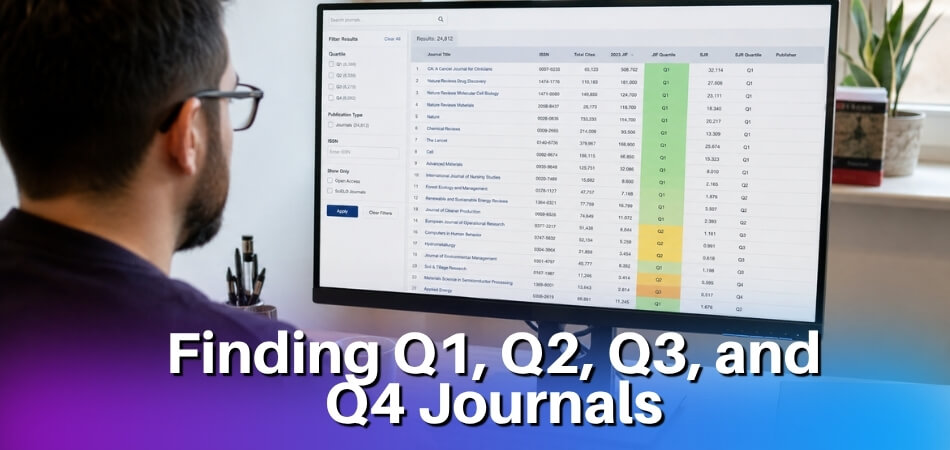
Here’s the short answer: a journal’s Q1, Q2, Q3, or Q4 quartile ranking tells you where it sits within its subject category — Q1 being the top 25% and Q4 the bottom 25% — and you can find this information through three official databases: SCImago Journal & Country Rank (SJR) at scimagojr.com, Journal Citation Reports (JCR) at jcr.clarivate.com, and Scopus at scopus.com/sources. The catch is that these databases don’t always agree, because each one uses its own methodology, citation index, and subject classification system.
That’s what makes this genuinely confusing. Most guides either explain what quartiles mean in theory or assume you already know which database your university or funding body recognizes. They skip the part where you actually open the website, type in a journal name or ISSN, and figure out what you’re looking at. Whether your institution requires a Web of Science ranking from Clarivate Analytics, a CiteScore from Elsevier’s Scopus, or an SJR percentile rank for academic funding criteria or university promotion criteria, the lookup process is different each time.
This guide walks you through every method, step by step. No assumptions, no jargon without explanation. By the time you finish reading, you’ll be able to find, cross-check, and verify any journal’s quartile ranking across all three major databases in under five minutes — and you’ll know exactly which one to cite when someone asks.
Quick Answer: How to Find Q1 Q2 Q3 Q4 for Any Journal
Here’s the short version if you’re in a hurry.
Journal quartile rankings — Q1, Q2, Q3, and Q4 — tell you where a journal sits relative to others in its subject category. Q1 is the top 25%, Q4 is the bottom 25%. That’s it. The ranking changes depending on which database you use, so a journal can be Q1 in Scopus and Q2 in Web of Science simultaneously. Both are valid. They measure slightly different things.

There are three main places to check:
- SCImago Journal & Country Rank (SJR) — free, no login, covers Scopus-indexed journals. Go to [scimagojr.com](https://www.scimagojr.com), search by journal name or ISSN, open the journal page, and look at the quartile listed under each subject category. Done.
- Journal Citation Reports (JCR) — run by Clarivate Analytics, covers Web of Science journals. Access it at [jcr.clarivate.com](https://jcr.clarivate.com). You’ll need institutional access through InCites. Search the journal, find its subject category, and the Q1–Q4 rank appears next to its Impact Factor percentile.
- Scopus Sources — go to [scopus.com/sources](https://www.scopus.com/sources), search the journal, and check its CiteScore and subject area percentile. Scopus doesn’t label quartiles as explicitly as SJR does, but the percentile rank maps directly: top 25% = Q1, 26–50% = Q2, and so on.
A few things worth knowing upfront:
- Q rankings are category-specific. One journal can be Q1 in “Oncology” and Q3 in “General Medicine” at the same time.
- SJR quartiles are updated annually, usually around March–April for the previous year’s data.
- JCR Impact Factor rankings and SJR rankings don’t always agree. Universities and funding bodies often specify which one counts for their academic funding criteria or promotion criteria — check your institution’s guidelines before assuming one is enough.
- If a journal isn’t showing up on either platform, that’s a red flag. Cross-check it against Beall’s List, run it through Think Check Submit, or verify it on DOAJ if it’s open access. Absence from both JCR and Scopus doesn’t automatically mean it’s predatory, but it does mean it has no verified quartile ranking.
For researchers outside the US and Europe: some national systems use their own lists. India uses the UGC CARE List. Australia uses ERA (Excellence in Research for Australia). These have their own tier systems that don’t map 1:1 onto Q1–Q4 quartiles.
The sections below walk through each method in full detail.
What Do Q1 Q2 Q3 and Q4 Actually Mean?
Quartile rankings divide journals into four groups based on how they perform within a specific subject category. That’s the core of it. Q1 journals sit in the top 25% of their field by citation impact, Q2 covers the next 25%, Q3 the next, and Q4 sits in the bottom quarter.

The ranking isn’t global. A journal isn’t Q1 in the abstract — it’s Q1 in a particular subject category. That distinction matters more than most researchers realize when they’re first searching.
The Basic Quartile Structure
Here’s how the four bands break down:
- Q1 — Top 25% of journals in a subject category (highest citation impact)
- Q2 — 26th to 50th percentile
- Q3 — 51st to 75th percentile
- Q4 — Bottom 25% (76th to 100th percentile)
Where a journal lands depends entirely on its rank within a ranked list of journals in that subject. If there are 200 journals in “Environmental Engineering,” the top 50 are Q1, the next 50 are Q2, and so on.
Q1–Q4 Is Not the Same as Impact Factor
People mix these up constantly. Impact Factor is a raw number — the average citations per article over two years. It’s calculated by Clarivate Analytics and published through the Journal Citation Reports (JCR). Quartile rank is a position relative to other journals in the same field.
A journal with an Impact Factor of 2.1 could be Q1 in a niche humanities field where that score is high, or Q4 in a competitive biomedical field where most journals score far above it. The number alone tells you nothing without context.
SJR Uses the Same Logic, Different Metric
SCImago Journal & Country Rank (SJR) runs a parallel system indexed to Scopus data. Instead of Impact Factor, it uses the SJR score — a weighted citation metric that accounts for the prestige of citing journals, not just the raw count. The quartile logic is identical: journals are ranked within subject categories and divided into four bands.
One journal can appear in multiple subject categories. Nature, for example, spans dozens of categories and holds Q1 in most of them. A more specialized journal might appear in just one or two. When you’re evaluating a journal, check its quartile in the specific category that matches your research area — don’t just grab the first quartile you see.
Why Universities and Funders Care About This
Academic funding criteria and university promotion criteria in many countries explicitly require Q1 or Q2 publications. Some institutions accept Q3. Very few count Q4 for anything meaningful in research evaluation frameworks like the ERA (Excellence in Research for Australia) or national systems tied to the UGC CARE List.
The practical consequence: if you’re targeting a specific quartile for career or funding purposes, you need to verify the journal’s rank in the right database and the right subject category — not just find any quartile label attached to it.
Which Database Should You Use — JCR, SCImago, or Scopus?
The honest answer is: it depends on who’s asking and why. A funding body might only accept JCR quartiles. Your university’s promotion committee might list SCImago. Some journals appear in all three databases; others appear in only one. Knowing the difference saves you from checking the wrong source and drawing the wrong conclusion.
JCR (Journal Citation Reports) — Web of Science Quartile
JCR is published by Clarivate Analytics and sits behind a paywall at jcr.clarivate.com. If your institution subscribes to Web of Science or InCites, you already have access — log in with your institutional credentials.
This is the most widely cited quartile system in grant applications, tenure reviews, and national research evaluations. When a university promotion policy says “Q1 journal,” they usually mean JCR Q1 unless stated otherwise.
JCR quartiles are based on Impact Factor. Every journal in a given subject category gets ranked by IF, and the top 25% land in Q1, the next 25% in Q2, and so on. Simple in concept, but journals that span multiple categories can have a different quartile in each one — so always note which subject category you’re looking at.
The data updates annually, typically mid-year for the previous citation year. A journal ranked Q2 in 2021 might be Q1 by 2023. Always check the specific year that your target publication, grant, or application requires.
One thing to watch: JCR only indexes journals in the Web of Science citation index. Plenty of legitimate, high-quality journals aren’t there — especially in humanities, regional studies, or newer open access titles. If you can’t find a journal in JCR, that doesn’t make it predatory. It just means it’s not indexed there.
SCImago Journal & Country Rank (SJR) — Free Option
SCImago is free. No login, no institutional subscription. Go to scimagojr.com, type the journal name or ISSN into the search box, and you’ll land directly on the journal’s profile page.
The SJR quartile system draws from Scopus data (which Elsevier maintains), so its journal coverage is broader than JCR — over 30,000 journals compared to JCR’s roughly 21,000. That makes it genuinely useful for fields and regions underrepresented in Web of Science.
On the journal profile page, scroll down to find the subject category rankings. You’ll see each category the journal is assigned to, along with its quartile for each year going back to 1999. This historical view is actually one of SCImago’s most practical features — you can see if a journal has been climbing from Q3 to Q1 over five years or sliding in the opposite direction.
SJR uses its own metric (the SJR indicator) rather than Impact Factor. It’s a weighted citation score that accounts for the prestige of citing journals, similar in concept to Google’s PageRank. The quartile ranking itself still follows the same 25% split per subject category.
A few caveats. SCImago data lags by about a year. The quartile displayed reflects the previous year’s Scopus data. Also, because Scopus covers more journals, some fields have many more entries, which affects where the 25% cutoff lands compared to JCR’s narrower pool.
For researchers in countries where JCR access is limited — and for anyone who just wants a quick, free check — SCImago is the go-to starting point.
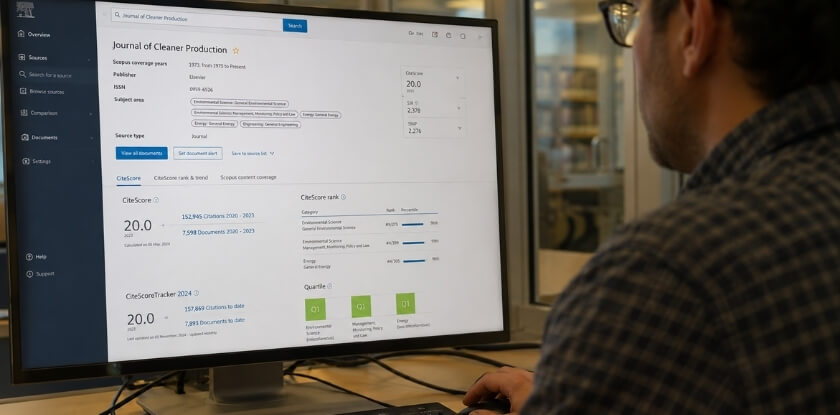
Scopus Sources — CiteScore Quartile
Scopus has its own quartile ranking, and it’s separate from both JCR and SCImago even though SCImago pulls from Scopus data. You access it directly at scopus.com/sources.
The metric here is CiteScore, also maintained by Elsevier. CiteScore counts citations over a four-year window (the current year plus three previous years) divided by documents published in that same period. That wider window tends to favor journals with strong sustained citation records over journals that get a short burst of attention.
CiteScore quartiles are assigned per subject category using the same top-25% = Q1 logic. But Scopus uses its own subject classification system called ASJC (All Science Journal Classification), which is different from the Web of Science categories JCR uses. Same journal, different categories, potentially different quartile in each system. This isn’t a flaw — it reflects genuinely different ways of classifying research.
To check a journal, go to scopus.com/sources, search by name or ISSN, click the journal, and look at the CiteScore Metrics section. You’ll see the percentile rank and the quartile for each subject category it’s assigned to.
One practical note: some institutions and funding bodies specifically distinguish between “Scopus-indexed Q1” and “Web of Science Q1.” Don’t assume they’re interchangeable. Check what your evaluator actually requires before you submit or publish.
Step-by-Step Guide: Finding a Journal Quartile by Journal Name
You’ve got a journal name — maybe from a call for papers, a supervisor’s recommendation, or a journal you’re already considering submitting to. Here’s exactly how to check its quartile ranking across all three major databases.

Method 1 — Using SCImago (scimagojr.com)
SCImago Journal & Country Rank is free, requires no login, and covers Scopus-indexed journals. It’s usually the fastest starting point.
Step 1: Go to scimagojr.com
Open your browser and go directly to [scimagojr.com](https://www.scimagojr.com). No account needed.
Step 2: Search by journal name or ISSN
At the top of the page, you’ll see a search bar. Type the journal’s name — or its ISSN if you have it, which avoids ambiguity with similarly named journals. Hit Enter.
Step 3: Select the correct journal from results
You’ll get a list of matching journals. Click the one you want. If multiple results appear, check the ISSN and publisher name to confirm you’ve got the right one.
Step 4: Read the quartile data
On the journal’s profile page, scroll to the section labeled SJR Indicators. You’ll see a table showing the journal’s subject categories. Each category has its own quartile listed — Q1, Q2, Q3, or Q4 — for each year.
This is critical: a single journal can have different quartile rankings in different subject categories. A journal ranked Q1 in “Medicine (miscellaneous)” might be Q3 in “Pharmacology.” Always check the specific subject category relevant to your research field.
Step 5: Check the year
SCImago updates annually. The most recent year shown is the one you should cite for current submissions. If your institution has specific requirements for research evaluation or academic funding criteria, confirm which year they reference.
Method 2 — Using JCR via InCites (jcr.clarivate.com)
The Journal Citation Reports, maintained by Clarivate Analytics, is the database behind the official Impact Factor and the JCR quartile system. You need institutional access — most universities subscribe through Web of Science or InCites.
Step 1: Go to jcr.clarivate.com
Navigate to [jcr.clarivate.com](https://jcr.clarivate.com). If your institution has access, you’ll either be logged in automatically through IP recognition or prompted to sign in via your institutional credentials.
No access? Ask your library. Many universities provide access through the Web of Science portal or InCites platform.
Step 2: Search the journal
Use the search box at the top. Enter the journal title or ISSN. JCR covers only Web of Science-indexed journals, so if a journal doesn’t appear here, it’s either not indexed or indexed only in Scopus/SCImago.
Step 3: Open the journal record
Click the journal from the results list. You’ll land on its full profile page.
Step 4: Find the JIF Quartile
Look for the Journal Impact Factor (JIF) Quartile — listed as Q1, Q2, Q3, or Q4 — within each subject category the journal belongs to. Like SCImago, JCR assigns quartiles per category, not per journal globally.
The quartile is based on where the journal’s Impact Factor falls within the ranked list of journals in that category. Top 25% = Q1, next 25% = Q2, and so on. You’ll also see the percentile rank, which gives you a more precise position within the category.
Step 5: Check multiple categories if applicable
Interdisciplinary journals often appear in two or more JCR categories. A single journal might be Q1 in one and Q2 in another. Pick the category that best matches your paper’s subject matter — that’s what reviewers and promotion committees will look at.
Method 3 — Using Scopus Sources (scopus.com/sources)
Scopus, owned by Elsevier, has its own source list that lets you check CiteScore and whether a journal is indexed. It doesn’t use the Q1–Q4 quartile label the same way JCR does, but you can cross-reference it with SCImago (which uses Scopus data) or use it to verify active indexing status.
Step 1: Go to scopus.com/sources
Navigate directly to [scopus.com/sources](https://www.scopus.com/sources). You don’t need a full Scopus subscription to access this page — it’s publicly accessible.
Step 2: Search for the journal
Enter the journal title or ISSN in the search box. You can also filter by subject area, publisher, or source type (journal, book series, conference proceedings).
Step 3: Confirm indexing status
The result will show whether the journal is currently active in Scopus. This matters — journals can be delisted. A journal that was Scopus-indexed two years ago might not be now. Always verify current status before submitting.
Step 4: Check CiteScore and subject ranking
Click on the journal to open its detailed record. You’ll see its CiteScore value and its ranking within Scopus subject categories. While Scopus itself doesn’t display a “Q1” label on this page, the percentile rank shown here feeds directly into SCImago’s quartile calculations.
If you want the actual Q1–Q4 label from Scopus data, use SCImago (Method 1) — it’s built on the same Scopus citation index, just with the quartile calculation applied on top.
Step 5: Use this to cross-check SCImago results
Scopus Sources is most useful as a verification tool. If a journal shows up in SCImago as Q1 but isn’t currently listed in Scopus Sources, something’s off — the indexing may have lapsed. Always cross-reference both.
Quick tip across all three methods: if a journal only appears in one database and not the others, that tells you something important about its reach and how different institutions will evaluate it. Many university promotion criteria and academic funding bodies specify which database’s quartile ranking they recognize — check yours before assuming Q1 in one system equals Q1 in another.
How to Find a Journal Quartile by ISSN Number
Sometimes you don’t have a clean journal name to search with. Maybe it’s abbreviated weirdly, or two journals share almost identical titles. The ISSN cuts through all of that. It’s a unique 8-digit identifier, and every major ranking database accepts it.
Your ISSN will look like this: 1234-5678. Print journals and online journals often have different ISSNs, so check which one you’re using before you start.
Finding the Quartile on SCImago Using ISSN
Go to [scimagojr.com](https://www.scimagojr.com). In the search bar at the top, type or paste the ISSN directly. No formatting needed — with or without the hyphen works fine.
The results page will show you the journal. Click on it. You’ll land on the journal’s profile page, which shows its SJR score, H-index, subject categories, and — crucially — the quartile ranking broken down by category and by year. A journal ranked in multiple subject areas can hold different quartiles in each one. That’s common, especially for interdisciplinary journals.
Scroll down to the “Evolution of the number of published documents” and the quartile chart. The chart lets you see whether the journal has moved up or dropped over time. Useful if you’re checking whether a journal was Q1 five years ago but has since slipped to Q2.
Finding the Quartile on JCR Using ISSN
Go to [jcr.clarivate.com](https://jcr.clarivate.com). You’ll need institutional access — this is a Clarivate Analytics product, and it sits behind a paywall for most users.
Once you’re in, look for the journal search field. Enter the ISSN. JCR will pull up the journal’s record and show you the Journal Impact Factor, the subject category it belongs to, and its quartile position (Q1 through Q4) within that category for the Web of Science citation index.
One thing to watch: JCR quartiles are based on Impact Factor rankings within each subject category. So a journal’s quartile is relative — being Q1 in a small niche category is a different benchmark than Q1 in a large general medicine category. The percentile rank column next to the quartile tells you exactly where it sits.
If your institution doesn’t have JCR access, check if they provide InCites access instead. Some universities route journal ranking lookups through InCites rather than the standalone JCR interface, but the underlying data is the same.
Finding the Quartile on Scopus Using ISSN
Go to [scopus.com/sources](https://www.scopus.com/sources). This page is actually free to access without login, which makes it useful when you’re off-campus.
There’s a search box with a dropdown. Change the dropdown from “Journal Title” to “ISSN.” Type in the ISSN and hit search. Scopus will return the journal, and clicking through gives you the CiteScore, the subject categories it’s indexed under, and the CiteScore percentile rank for each category.
Scopus doesn’t use the Q1–Q4 label in the same explicit way SCImago does, but the quartile is implied by the percentile. Top 25% = Q1. 25–50% = Q2. 50–75% = Q3. Bottom 25% = Q4. You just have to do that conversion yourself from the CiteScore Percentile column. Elsevier maintains this database, and it’s updated annually.
When the ISSN Search Returns No Results
This happens. A few reasons it might:
- The journal isn’t indexed in that database at all
- You’re using the print ISSN but the database only has the electronic ISSN (or vice versa)
- The journal changed its ISSN after a title change
Try the other ISSN variant if you have it. If the journal still doesn’t appear in SCImago, JCR, or Scopus, it’s either very new, very small, or not indexed. No index listing means no official quartile ranking — full stop.
At that point it’s worth checking whether the journal appears on Beall’s List or whether it passes a basic Think Check Submit review. Journals that aren’t indexed anywhere but still claim Q1 status are a red flag. Cross-reference with DOAJ if it’s an open access journal, or with the UGC CARE List or ERA list depending on your institution’s requirements. Academic funding criteria and university promotion criteria often specify which databases count — knowing that saves you from publishing somewhere that won’t be recognized during evaluation.
Quartile Comparison — Same Journal, Different Quartile in JCR vs SCImago vs Scopus
This trips up a lot of researchers. You check a journal in SCImago and it shows Q2. You check it in JCR and it’s Q1. Then a colleague finds it listed as Q3 in Scopus. All three are technically correct. Here’s why that happens and how to handle it.
Why the Numbers Disagree
Each database builds its quartile rankings from a completely different foundation.
- JCR (Journal Citation Reports, run by Clarivate Analytics) uses the Impact Factor, which is calculated from citations indexed in Web of Science. It ranks journals within subject categories defined by JCR itself — and a journal can appear in multiple categories, with a different quartile in each.
- SCImago uses the SJR (SCImago Journal Rank) indicator, pulling citation data exclusively from Scopus. The SJR metric also weights citations by the prestige of the citing journal, not just raw citation counts. Different weighting formula, different subject categories, different result.
- Scopus CiteScore, the third ranking system, divides citations received over four years by documents published in the same four-year window. That’s a wider citation window than Impact Factor, which only looks back two years. Longer window = more citations captured = rankings shift.
So the databases don’t just disagree about rankings — they’re measuring slightly different things with different data.
A Real Example
Take a mid-tier environmental science journal. In JCR, it might rank in the top 50% of its specific “Environmental Sciences” category, landing at Q1. But SCImago classifies the same journal under both “Environmental Science” and “Ecology,” and in the Ecology category it falls into Q2. Scopus CiteScore might place it in Q1 under a broader “Environmental Science” grouping because the four-year citation window captures a citation spike from a few highly referenced papers.
Same journal. Three systems. Three answers — all defensible.
Subject Category Assignment Is the Hidden Variable
This is the part people miss. The quartile isn’t just about the journal’s citation performance. It depends entirely on which subject category the journal gets assigned to.
An interdisciplinary journal covering both chemistry and materials science will likely have a different quartile rank in each of those two subject areas. In JCR, you’ll see a separate quartile listed per category. The same is true in SCImago.
When you’re reporting a journal’s quartile — for a grant application, university promotion criteria, or a research evaluation exercise — you should specify both the database and the subject category. Saying “this journal is Q1” without that context is incomplete. Saying “Q1 in JCR under Materials Chemistry (2023)” is precise.
Which Quartile Ranking Actually Counts for Your Purpose
This depends entirely on who’s asking.
- Academic funding bodies in many countries specify JCR explicitly, since it’s the longest-running standardized index and Clarivate’s InCites infrastructure is widely integrated into institutional reporting systems.
- Australian ERA (Excellence in Research for Australia) assessments use their own journal list, which draws from multiple sources — JCR quartiles often carry weight there, but ERA has its own ranking tiers (A*, A, B, C) that don’t map directly onto Q1–Q4.
- UGC CARE List in India uses a separate journal approval process that isn’t directly quartile-based, though SJR-indexed journals are generally accepted.
- Many European universities and Middle Eastern institutions accept either JCR or SCImago quartiles, but some specify one over the other in their promotion criteria. Check your institution’s exact policy before assuming either works.
If your institution doesn’t specify, JCR Q1 carries slightly more traditional weight in most fields. But SCImago is free, more comprehensive in terms of journal coverage, and perfectly legitimate for most purposes.
When the Discrepancy Is a Red Flag
Sometimes a journal deliberately promotes its SCImago ranking while hiding its JCR ranking — because it has one but not the other, or because the two rankings diverge significantly.
If a journal’s website only mentions one database, check the other yourself. If a journal claims Q1 but you can only verify Q3 or Q4, dig deeper. Cross-check against Beall’s List for potential predatory publishers, run it through Think Check Submit, and verify DOAJ membership for open access journals. A genuine Q1 journal doesn’t need to hide its rankings in other databases.
How to Document Quartile Rankings Accurately
When you’re writing a CV entry, submitting to an institutional research portal, or filling in grant paperwork, format it like this:
- Journal Name — Q1, JCR 2023, Category: Oncology
- Journal Name — Q2, SCImago 2023, Category: Cancer Research
Include the year. Rankings change annually. A journal that was Q1 in 2019 might be Q2 in 2023. Using an outdated quartile in a funding application can cause problems during review.
If you want to be thorough, note the percentile rank as well. Saying a journal sits at the 87th percentile in its JCR category tells a reviewer more than just “Q1” — since Q1 covers everything from the 75th to 99th percentile.
How Often Are Journal Quartile Rankings Updated?
This matters more than most researchers realize. If you’re checking a journal’s ranking before submitting, you need to know whether the data you’re looking at is current — or two years old.

SCImago (SJR) Updates
SCImago updates its rankings once a year, typically releasing new data in the first quarter of the calendar year. The 2023 edition, for example, covers publication and citation data from 2022. There’s always a one-year lag built in.
You can see the data year displayed directly on scimagojr.com when you pull up any journal profile. Don’t assume the page you’re reading reflects this year’s activity.
JCR (Journal Citation Reports) Updates
JCR also updates annually. Clarivate Analytics typically releases the new edition in June of each year. So the 2024 JCR release, available at jcr.clarivate.com, covers citation data from 2023.
One practical thing to know: the Impact Factor calculation uses a two-year citation window, so the number you see in June 2024 is based on citations from 2022 and 2023. The quartile ranking within a subject category gets recalculated at the same time.
Scopus / CiteScore Updates
CiteScore is handled differently by Elsevier, and this trips people up. There are actually two versions running simultaneously on scopus.com/sources:
- CiteScore Tracker — updated monthly, based on citations and documents accumulating in the current year
- CiteScore (final) — published annually, covering a full four-year citation window
The final CiteScore and its associated quartile ranking for any given year gets locked in around the beginning of the following year. The tracker gives you a live estimate, but don’t submit based solely on a tracker figure if your institution requires a verified quartile.
What This Means for You Practically
If a journal got indexed in Scopus in late 2022, it might not have a stable quartile ranking until 2024 data is released. Newly indexed journals often show no quartile at all for the first cycle. That’s not a bad sign — it just means not enough citation data exists yet.
Similarly, journals can move between quartiles. A journal sitting at Q2 this year could drop to Q3 or climb to Q1 when rankings refresh. If you’re targeting a specific quartile for university promotion criteria or academic funding criteria, check the ranking at the time of submission and again when your paper is accepted — those dates can be months apart.
One underrated habit: note the exact data year when you screenshot or record a journal’s quartile. Peer reviewers on promotion committees will sometimes ask for documentation, and “Q1 as of SJR 2023 data” is a much cleaner answer than “it was Q1 when I checked.”
Do Rankings Change a Lot Year to Year?
For most established journals, not dramatically. A Q1 journal in a stable field rarely drops to Q3 overnight. But journals near the borderline between two quartiles — say, ranked at the 50th or 75th percentile — can shift with even small changes in their citation counts or changes in the size of their subject category. Interdisciplinary journals are especially susceptible to this because their subject category assignments can be adjusted, which changes the pool they’re ranked against entirely.
How to Verify Whether a Journal Is Still Active and Indexed
Finding a quartile ranking is only half the job. A journal can show up in SCImago or JCR data from two or three years ago and still be completely defunct today — or worse, it got delisted quietly after a misconduct investigation. Submitting to a dead or delisted journal wastes months.
Here’s how to check that a journal is genuinely active and still indexed right now.
Check the Journal’s Current Status in Scopus
Go to [scopus.com/sources](https://www.scopus.com/sources). Search for the journal by title or ISSN.
Look at the “Coverage” column. It shows the exact years Scopus indexed that title. If coverage ends in 2021 and nothing is listed after that, the journal was either discontinued or removed from Scopus. That’s a red flag.
Scopus also shows a “Source Status” field. Active journals say “Active.” Discontinued titles are flagged clearly. Don’t skip this column.
Cross-Check Against Web of Science / JCR
On [jcr.clarivate.com](https://jcr.clarivate.com), search the journal. Active, indexed journals will show current-year data. If the journal doesn’t appear at all — even though you’ve seen it ranked somewhere before — it may have been removed from Clarivate’s citation index.
Clarivate does suppress and delist journals. It happens more than most researchers realize. If you find a journal on an old PDF ranking list but can’t locate it on the current JCR, check the Web of Science Master Journal List separately at mjl.clarivate.com. That list is updated more frequently and includes suppression notices.
Verify the Journal Website Is Real and Current
This sounds obvious. Do it anyway.
A live editorial board, recent published issues (within the last 6–12 months), working DOIs for recent articles, and a verifiable publisher address are the baseline. If the “latest issue” on the website is from 2020 and the editorial board links lead to dead faculty pages, the journal may be inactive or abandoned.
Check that the DOIs resolve. Paste a recent article DOI into doi.org. If it doesn’t resolve, that’s a serious problem.
Run It Through Beall’s List and Think Check Submit
[Beall’s List](https://beallslist.net) maintains a record of potentially predatory publishers and journals. It’s not a perfect tool and it’s had its controversies, but it’s still a useful first filter. If a journal you’re considering appears there, you want a very good reason to proceed.
Think Check Submit (thinkchecksubmit.org) gives you a structured checklist — editorial board transparency, contact information, peer review clarity, and whether the journal appears in recognized indexes. Work through it before submitting to any unfamiliar title.
Check DOAJ for Open Access Journals
If the journal is open access, search for it in the [Directory of Open Access Journals](https://doaj.org). DOAJ vets journals for editorial transparency and basic quality standards. A journal listed there has cleared at least a minimum bar.
A journal that claims to be open access but isn’t in DOAJ deserves extra scrutiny.
Country-Specific Lists: UGC CARE and ERA
If you’re in India and your publication needs to count toward academic credit, check the [UGC CARE List](https://ugccare.unipune.ac.in) directly. The list gets updated, and journals get removed. What was on the list when your supervisor submitted their paper may not still be there now.
Australian researchers using ERA (Excellence in Research for Australia) rankings should check the current ARC journal list rather than relying on older rankings circulating in departmental spreadsheets. ERA rankings have shifted across revision cycles.
One Final Check — CiteScore Trend in Scopus
Back in Scopus Sources, pull up the journal and look at its CiteScore trend over 3–5 years. A journal that had a CiteScore of 2.8 in 2020 and is now showing 0.4 either lost a huge portion of its citation base or had its indexing scope changed significantly. Either way, you want to know before you submit.
Active, healthy journals generally show stable or gradually improving metrics. A sharp unexplained drop is worth investigating before you commit six months of work to a submission.
How Quartile Rankings Are Used in University and Funding Evaluation
Quartile rankings aren’t just useful for deciding where to submit your paper. They’ve become embedded in how institutions measure research output, allocate internal funding, and make promotion decisions. If you’re a researcher, knowing how your institution uses these rankings affects which journals you should actually be targeting.

University Promotion and Tenure Criteria
Many universities — especially in Asia, the Middle East, and parts of Europe — now explicitly require publications in Q1 or Q2 journals for promotion to associate or full professor. This isn’t informal preference. It’s written into HR policy documents and faculty evaluation rubrics.
In Pakistan, HEC (Higher Education Commission) ties performance-based research incentives directly to journal quartile rankings from Web of Science. Publishing in a Q1 journal earns more points than Q2, Q3 earns fewer still, and Q4 sometimes counts for nothing at all in their scoring system. Similar structures exist in Turkey, Saudi Arabia, China, and across Southeast Asia.
Some European universities use ERA (Excellence in Research for Australia) rankings alongside SJR quartiles for benchmarking research quality in annual departmental reviews. It varies by institution, but the trend is consistent: quartile rank is a hard metric now, not a soft one.
Check your institution’s research quality framework or speak directly with your HR or research office. Don’t assume — what counts at one university may not count at another, even in the same country.
National and International Research Funding
Funding bodies use quartile rankings as an eligibility filter or as a scoring criterion in grant evaluation. The logic is simple: if your previous publications are in Q1 or Q2 journals, reviewers treat your track record as stronger.
In practice, some grant applications in Brazil (CAPES), South Korea (NRF), and across the EU require applicants to list publications alongside their SJR or JCR quartile. CAPES uses a Qualis classification system that maps partly onto JCR and SCImago rankings. Grants from research councils in the UK, while less prescriptive, still expect output in journals indexed in Web of Science or Scopus — both of which underpin quartile systems.
Academic funding criteria tied to quartiles also affects institutional block grants. Universities in many countries receive government research funding calculated in part on the quartile distribution of their faculty’s publications. A department with more Q1 publications literally brings in more money. That’s the blunt reality of why department heads care so much about where you publish.
How CiteScore and Impact Factor Feed Into Evaluation
Not all institutions use quartile rankings directly. Some still rely on Impact Factor as the primary metric — which comes from JCR, published by Clarivate Analytics. Others prefer CiteScore from Scopus (Elsevier). These aren’t quartile rankings themselves, but they feed into how quartiles are determined and are often cited alongside them in evaluation forms.
If your institution asks for your “journal’s impact factor,” they’re asking for the JCR metric. If they ask for the journal’s percentile rank or quartile, they could be referring to JCR, SCImago (SJR), or Scopus depending on their internal policy. When in doubt, provide all three. It takes five minutes to look up.
Interdisciplinary Journals and the Quartile Problem
Here’s where things get complicated. An interdisciplinary journal might be Q1 in one subject category and Q3 in another — in the same database. That’s not a bug. It reflects genuine differences in citation behavior across fields.
If you’re publishing a paper that crosses two disciplines, it matters which subject category your institution uses to evaluate your work. Some institutions take the best quartile from any applicable category. Others take the one most relevant to the department. Ask before you submit, not after.
This is also why SCImago Journal & Country Rank (scimagojr.com) and JCR (jcr.clarivate.com) sometimes give different quartiles for the same journal — they use different subject category classifications and different citation weighting methods. Neither is wrong. They’re just measuring different things with different data.
Avoiding Predatory Journals in Quartile-Based Systems
Some journals claim Q1 or Q2 status falsely. Predatory publishers sometimes list fabricated impact factors or misrepresent Scopus indexing. A journal can be listed in Scopus but then later removed — and quartile data from its indexed period may still appear on older records.
Before submitting, verify against Beall’s List, run the journal through Think Check Submit, and confirm it’s currently active in Scopus at scopus.com/sources or in the DOAJ if it’s open access. The UGC CARE List is another useful verification point if your institution is in India.
A Q1 ranking means nothing if the journal is delisted by the time your article goes through review. Cross-check the current indexing status, not just the historical quartile.
What This Means for Your Publishing Strategy
If promotion, funding, or institutional evaluation is part of your world, you can’t treat quartile rankings as an afterthought. Target journals based on their current quartile in the database your institution actually uses — JCR, SCImago, or Scopus. Those aren’t interchangeable, and submitting to a Q1 journal in SCImago that isn’t even indexed in Web of Science won’t help you if your institution evaluates only JCR quartiles.
Get clarity on the policy first. Then find the journal. It’s a much more reliable sequence than publishing first and hoping the numbers work out.
Predatory Journals vs Legitimate Quartile-Ranked Journals
Here’s a problem that comes up constantly: a journal claims to be Q1. You check their website, it says Q1 right there in the header. But when you actually search SCImago or JCR, the journal doesn’t exist in either database.
That’s a predatory journal doing what predatory journals do.
What Makes a Journal “Predatory”
Predatory journals charge authors article processing fees (APCs) while offering little to no real peer review. They exist to make money, not to advance scholarship. Many of them have professional-looking websites, fake impact factors, and invented quartile rankings that appear nowhere in any legitimate index.
The quartile claim is one of their favorite tricks. Because most researchers know Q1 means high quality, predatory publishers plaster “Q1” and “Scopus indexed” on their homepages — sometimes for journals that were delisted from Scopus years ago, or were never listed at all.
The Basic Check That Catches Most Fakes
If a journal claims a quartile ranking, verify it yourself. Don’t trust what the journal’s website says.
- Go to scimagojr.com and search the journal title or ISSN
- Go to jcr.clarivate.com and do the same
- Check scopus.com/sources to confirm current active indexing
If the journal doesn’t appear in any of these, its quartile claim is fabricated. Full stop.
A journal can’t have a Q1 SJR ranking if it’s not indexed in Scopus. It can’t have a Q1 JCR ranking if it’s not indexed in Web of Science. These rankings come from those databases. There’s no other source.
“Scopus Indexed” Doesn’t Always Mean Currently Indexed
This one catches a lot of researchers off guard. A journal might have been in Scopus three years ago, got evaluated, and was removed for quality issues. The publisher still advertises “Scopus indexed” because — technically — it once was.
On scopus.com/sources, you can filter by “Active” status. Use it. If the journal shows as discontinued or doesn’t appear at all, don’t submit there.
Elsevier periodically re-evaluates journals in Scopus and removes those that fail quality thresholds. Clarivate does the same for Web of Science. A journal’s historical indexing means nothing for your paper published today.
Tools That Help You Flag Predatory Journals
- Beall’s List — Originally maintained by librarian Jeffrey Beall, this list of potentially predatory publishers and standalone journals is now mirrored at several locations (cabells.com maintains a paid version; independent mirrors exist). Not infallible, but useful as a first flag.
- Think Check Submit (thinkchecksubmit.org) — A checklist-based tool designed to help researchers evaluate whether a journal is legitimate. Works through a series of yes/no questions about publisher transparency, editorial board visibility, peer review process, and indexing claims.
- DOAJ (Directory of Open Access Journals) — Listing in DOAJ means a journal has passed a vetting process. It’s not the same as having a Q1 ranking, but it confirms the journal operates transparently. Many legitimate open access journals appear in both DOAJ and SCImago.
None of these tools replace the direct quartile check. Use them alongside it.
Country-Specific Lists Add Another Layer
Depending on where you’re based, your institution may require journals to appear on specific approved lists — not just have a quartile ranking.
India uses the UGC CARE List for academic promotion criteria. Australia has the ERA (Excellence in Research for Australia) list. These lists have their own criteria and don’t automatically mirror SCImago or JCR rankings. A journal can be Q2 in SCImago and still not appear on UGC CARE — or vice versa.
If your promotion, funding, or PhD candidacy depends on publishing in an approved journal, check the relevant national or institutional list in addition to the quartile databases.
The Interdisciplinary Journal Problem
Interdisciplinary journals are genuinely tricky. A journal covering computational biology might rank Q1 in one subject category and Q3 in another — within the same database. Predatory journals exploit this by cherry-picking the highest quartile from whichever category gives them the best-looking claim.
When a journal advertises its quartile, ask: which subject category, in which database, in which year? If they can’t answer that specifically, be skeptical.
Legitimate journals are transparent about this. You can verify it yourself in under two minutes on scimagojr.com by clicking through to the journal’s profile and checking category-by-category rankings.
A Simple Decision Rule
Before submitting to any journal, run this check:
- Find the journal on SCImago, JCR, or Scopus Sources directly — not through the journal’s own website
- Confirm it’s currently active and indexed
- Note the actual subject category and quartile, not what the journal claims
- If anything doesn’t match, or the journal can’t be found, don’t submit
Publishing in a predatory journal doesn’t just waste your APC money. Many universities now explicitly reject publications from non-indexed or predatory sources for promotion and research evaluation purposes. The paper you paid $500 to publish might count for nothing — or worse, raise questions about your research practices.
Quartile rankings exist in verifiable databases. If a journal’s claimed ranking can’t be verified in 60 seconds, that tells you everything you need to know.
Common Myths About Journal Quartiles
Researchers make bad submission decisions all the time because of misconceptions that circulate in departments, on forums, and sometimes even from supervisors who haven’t checked the facts recently. Here are the ones that cause the most trouble.

Myth 1: Q1 Always Means the Journal Is the Best in Its Field
Q1 means the journal ranks in the top 25% of its subject category by a specific metric — SJR score, Impact Factor, or CiteScore. That’s it. It doesn’t mean the journal publishes the most rigorous peer review, has the fastest turnaround, or is the most respected among practitioners in your field.
Some Q1 journals in broad categories like “Medicine (miscellaneous)” sit there simply because they publish huge volumes and accumulate citations through sheer scale. Meanwhile, a highly specialized Q2 journal in, say, computational linguistics might be exactly where the most important work in that niche actually gets published. Ask researchers in the field, not just the ranking table.
Myth 2: A Higher Impact Factor Always Means a Higher Quartile
Not necessarily. Quartile is a rank within a subject category. A journal with an Impact Factor of 3.2 might be Q1 in a low-citation field like humanities, while a journal with an Impact Factor of 6.0 might only reach Q2 or Q3 in a high-citation field like oncology or biochemistry.
This trips up interdisciplinary researchers constantly. If you’re in a field where baseline citation rates are low, don’t assume your journal’s modest Impact Factor disqualifies it from Q1 status. Check the actual subject category ranking in JCR or SCImago.
Myth 3: SCImago and JCR Should Give the Same Quartile
They won’t. SCImago Journal & Country Rank uses SJR score, which weights citations by the prestige of the citing journal. Journal Citation Reports from Clarivate Analytics uses Impact Factor, which counts raw citations over a two-year window. Different formulas, different journal sets, different results.
A journal indexed only in Scopus won’t appear in JCR at all. A journal covered by Web of Science but not Scopus will appear in JCR but not SCImago. This is normal. It’s not an error you need to report or worry about — just use the database that’s relevant to your institution’s evaluation criteria.
Myth 4: A Journal Keeps Its Quartile Ranking Forever
Rankings update every year. JCR releases new data annually, and SCImago typically updates in the first quarter of the following year. A journal that was Q1 in 2019 might be Q2 now, or it could have been suppressed from JCR entirely for citation manipulation — something Clarivate does periodically.
Always verify the current year’s data before submitting. Don’t rely on a PDF someone shared in a department WhatsApp group two years ago.
Myth 5: If a Journal Claims to Be Q1, It Is Q1
This is where predatory journals cause real damage to researchers. Some journals advertise “Q1 status” or paste SCImago or JCR logos on their websites without any legitimate basis. Always verify directly at scimagojr.com or jcr.clarivate.com using the journal’s ISSN. If you can’t find it there, the claim is false.
Cross-check against Beall’s List, Think Check Submit, and DOAJ if you’re uncertain. The journal’s own website is not a valid source for quartile verification. Ever.
Myth 6: Open Access Journals Can’t Be Q1
Completely false. Many fully open access journals hold Q1 status across multiple databases. PLOS ONE, for example, appears in both SCImago and JCR with legitimate rankings. The open access model has nothing to do with a journal’s citation performance or its quartile position. Don’t conflate publication cost structure with quality metrics.
Myth 7: Your Paper’s Quartile Is Fixed at Submission
The quartile that matters for evaluation — university promotion criteria, academic funding criteria, ERA assessments — is usually the ranking at the time of publication or at the time of evaluation, depending on the specific policy. Some universities use the quartile at the year of publication; others use the most recent available ranking.
Check your institution’s exact policy. This detail can genuinely affect whether a publication counts toward a promotion case or grant assessment, and assuming either way without reading the policy is a gamble not worth taking.
Quartile Rankings for Interdisciplinary Journals
Interdisciplinary journals are genuinely tricky. A journal covering both environmental science and public health doesn’t fit neatly into one subject category — and that ambiguity shows up directly in how quartile rankings work for them.
Here’s the core issue: quartile rankings are always assigned per subject category, not per journal as a whole. So an interdisciplinary journal gets ranked separately in every category it’s indexed under. That single journal might be Q1 in one field and Q3 in another — at the same time, in the same database.
How SCImago Handles Interdisciplinary Journals
On scimagojr.com, when you search for a journal that spans multiple disciplines, you’ll see a list of subject categories rather than a single quartile badge. Each row shows a different category with its own SJR score and quartile assignment.
Take PLOS ONE as an example. It’s indexed under dozens of subject categories — Agricultural and Biological Sciences, Biochemistry, Medicine — and its quartile varies across them. It doesn’t have one quartile. It has many.
What you should do: identify which subject category is most relevant to your research area, then read that row specifically. Don’t grab whichever quartile looks best. Reviewers and funding bodies will check this, and citing Q1 status in an irrelevant category looks bad.
How JCR Handles It
JCR (at jcr.clarivate.com, operated by Clarivate Analytics) works the same way. A journal can appear in multiple Web of Science subject categories, and it gets an Impact Factor-based quartile rank in each one separately.
The practical difference with JCR is that category assignments there tend to be more conservative. A journal often appears in fewer categories in JCR than in SCImago. So you might find a journal is classified under two categories in JCR but twelve in SCImago. Neither is wrong — they just use different classification systems.
If your institution or funding body specifically asks for JCR quartile data, pull it from InCites or directly from jcr.clarivate.com and cite the exact category name alongside the quartile. That specificity matters.
Scopus and CiteScore Quartiles
Scopus (scopus.com/sources) assigns CiteScore quartiles, and it also categorizes journals by subject area. Interdisciplinary journals often appear in even more categories in Scopus than in JCR, because Elsevier’s classification tree is broader.
The CiteScore percentile rank is actually useful here. Instead of just seeing “Q2,” you can see that a journal is in the 67th percentile of its category — which gives you more precision when the quartile itself spans a wide range of journals.
The Real Problem: Which Quartile Do You Report?
This is where researchers get stuck. Your paper on climate-driven migration sits somewhere between environmental science, sociology, and public health. The journal you published in might be Q1 in Environmental Science, Q2 in Social Sciences, and Q3 in Public Health Policy.
Which one counts?
It depends entirely on who’s asking. University promotion criteria often specify the subject category that aligns with the faculty’s department. Academic funding criteria from national bodies sometimes require you to report the category most directly tied to your grant’s scope. Some ERA assessments in Australia require you to match the journal’s category to the research field code used in the submission.
The honest answer: there’s no universal rule. You need to check your institution’s specific policy, or ask your research office directly.
A Practical Tip for Interdisciplinary Work
If you’re choosing a journal before submission and your work crosses disciplines, look up the target journal in SCImago and check all its listed categories. Find two or three categories where the journal ranks Q1 or Q2. Then confirm whether your work genuinely fits those categories — not as a technicality, but because that’s where your readers actually are.
This also protects you from later scrutiny. If a promotion committee questions your quartile claim, you want a clear, honest answer for why you cited that specific category.
Watch Out for Journals That Game This
Some journals — particularly ones that edge toward predatory behavior without fully crossing the line — deliberately seek indexing in as many categories as possible. More categories means more chances to claim a favorable quartile in at least one of them. Beall’s List and Think Check Submit can help you assess whether a journal’s breadth of category coverage looks legitimate or suspicious. If a journal claims Q1 status in a category that has nothing to do with its actual content, that’s a red flag worth investigating before you submit.
Frequently Asked Questions
Is Q1 the best quartile for a journal?
Yes. Q1 means the journal ranks in the top 25% of its subject category by citation impact. Q2 covers 25–50%, Q3 covers 50–75%, and Q4 is the bottom quarter. For most university promotion criteria and academic funding applications, Q1 and Q2 carry the most weight — though what counts as “acceptable” varies by institution and country.
Can the same journal be Q1 in one database and Q3 in another?
Absolutely, and this happens more often than you’d expect. SCImago uses SJR scores, JCR uses Impact Factor, and Scopus uses CiteScore. Each database covers different journals, uses different citation windows, and assigns journals to different subject categories. A journal in a niche field might rank Q1 in SCImago’s narrow subject category but Q3 in JCR’s broader one. Always check which database your institution actually requires.
Do all journals have a quartile ranking?
No. A journal only gets a quartile if it’s indexed in the relevant database. Thousands of legitimate peer-reviewed journals aren’t in JCR, SCImago, or Scopus at all — especially newer journals or those from smaller publishers. No quartile doesn’t automatically mean predatory. It just means unranked in that system.
How do I find a journal’s quartile if I only have the ISSN?
Go to scimagojr.com or scopus.com/sources and paste the ISSN directly into the search bar. Both platforms accept ISSN as a search input. For JCR at jcr.clarivate.com, you can also filter by ISSN, though you’ll need institutional access.
Can a journal change quartiles from year to year?
Yes. Rankings update annually — SCImago usually releases updated data in the first half of each year, JCR typically updates mid-year. A journal can move up or down based on shifts in its citation count relative to other journals in that category. This is why you should always note which year’s data you’re citing when you submit to a funding body or promotion committee.
Is an open access journal less likely to be Q1?
Not necessarily. Plenty of open access journals hold Q1 status. High-profile titles published under open access models — including many indexed in DOAJ — appear in Q1 across multiple subject areas. What matters is citation impact, not the access model. That said, predatory open access journals almost never appear in legitimate quartile rankings. If you’re unsure about a journal, cross-check it against Beall’s List and run it through Think Check Submit.
My journal isn’t on SCImago. Does that mean it’s not indexed in Scopus?
Not exactly. SCImago pulls its data from Scopus, but there can be a lag. A journal recently added to Scopus may not appear in SCImago’s current dataset yet. Check scopus.com/sources directly for the most current Scopus indexing status.
Does a higher quartile guarantee better peer review?
No. Quartile rankings measure citation impact, not editorial quality or review rigor. A Q1 journal in a high-volume field may receive thousands of citations simply because of field size. Peer review quality is a separate issue entirely. Use quartile rankings for what they’re designed for — benchmarking citation influence within a subject category.
Are quartile rankings used the same way in every country?
No. India uses the UGC CARE List for faculty appraisals, which has its own separate journal classifications. Australia’s ERA framework uses a journal ranking system that doesn’t map directly onto Q1–Q4 either. The EU, UK, and many Asian universities commonly rely on JCR or SCImago quartiles for research evaluation, but always check your institution’s or funding agency’s specific requirements before assuming Q1 in SCImago is what they mean.
How do I check quartile rankings for an interdisciplinary journal?
Interdisciplinary journals are often listed under multiple subject categories, and the quartile can differ across each one. On SCImago, scroll down past the journal’s main details — you’ll see a breakdown by category. A journal might be Q1 in “Environmental Science” and Q3 in “Social Sciences.” For purposes of research evaluation, most institutions let you use whichever subject category is most relevant to your specific paper’s topic.
What if I can’t access JCR because it’s behind a paywall?
JCR requires a Clarivate Analytics subscription, usually accessed through your university library. If your institution doesn’t have access, ask a librarian — many universities have InCites or Web of Science bundles that include JCR. Alternatively, use SCImago as a free substitute. The rankings won’t be identical, but SCImago covers a comparable spread of indexed journals and costs nothing to use.
A quick decision framework
| Your situation | Use this |
|---|---|
| Institution requires Web of Science indexing | JCR (Clarivate) |
| Journal isn’t in JCR | SCImago via Scopus |
| Comparing two journals across disciplines | All three, then go with the best-matched subject category |
| Checking if a journal is predatory | Beall’s List, Think Check Submit, DOAJ |
| Australian research context | ERA list alongside SCImago |
| Indian academic context | UGC CARE List first, then SCImago |
One thing that trips researchers up: a journal can be Q1 in SCImago and Q3 in JCR simultaneously. That’s not a mistake. Different databases, different subject categories, different citation pools. If your funding body doesn’t specify a database, cite whichever ranking is most favorable — just be transparent about the source.
For interdisciplinary journals, always check the ranking in each subject category separately. A journal indexed under both “Medicine” and “Public Health” might sit in Q2 for one and Q1 for the other. You get to choose which category you cite, as long as it’s honestly relevant to your paper’s topic.
The percentile rank matters more than the quartile label when you’re comparing across fields. A Q1 journal in a niche subject category might sit at the 85th percentile, while a Q1 journal in a highly competitive category sits at the 99th. Both are Q1. They’re not equivalent.
Finally — check dates. Rankings update annually. A journal that was Q2 last year could be Q3 now. Always verify the ranking for the year your paper was submitted or published, not the current year. Reviewers do notice this discrepancy, and it matters in tenure files and grant applications where historical accuracy counts.
Use the tools. Cross-check when it matters. And when in doubt, check what your specific institution’s academic funding criteria actually say — because that document overrides everything else.
Final Thoughts — Which Tool to Use and When
There’s no single “correct” tool. The right one depends entirely on what your institution recognizes and what you’re trying to prove.
If your university, grant committee, or promotion panel specifically asks for JCR quartile, go to [jcr.clarivate.com](https://jcr.clarivate.com). That’s it. Don’t complicate it. JCR quartiles are calculated from Web of Science citation data and carry the most weight in formal research evaluation contexts — particularly in Europe, North America, and many parts of Asia where Clarivate Analytics indexing is the accepted standard.
If JCR doesn’t list the journal — which happens often with newer titles, regional journals, or humanities publications — SCImago ([scimagojr.com](https://scimagojr.com)) is your next stop. It’s free, it covers a broader range of journals through Scopus data, and the SJR quartile system is genuinely well-regarded. Many universities in Latin America, Spain, and parts of Eastern Europe give SCImago ranking the same credibility as JCR.
Scopus CiteScore rankings are useful when you need a third data point or when a journal sits awkwardly between categories in JCR and SCImago. CiteScore uses a four-year citation window rather than two, so it can give a more stable picture for journals with inconsistent annual citation counts.