
Realising the refusal letter is gone can make a bad week worse, especially when you are already thinking about the next step. Before you panic, it helps to know what that piece of paper actually mattered for. Here is a calm way to work through it.
Quick answer: You usually do not need the paper itself to move forward. Check your email, appointment account and CEAC status to confirm whether you got a 214(b) refusal or a 221(g) request for documents, then contact the embassy’s visa support channel. After a 214(b), build a stronger new application. After a 221(g), recover the instructions quickly.
Fact-checked by the MS International Editorial Team. Last verified against official sources: October 2026.
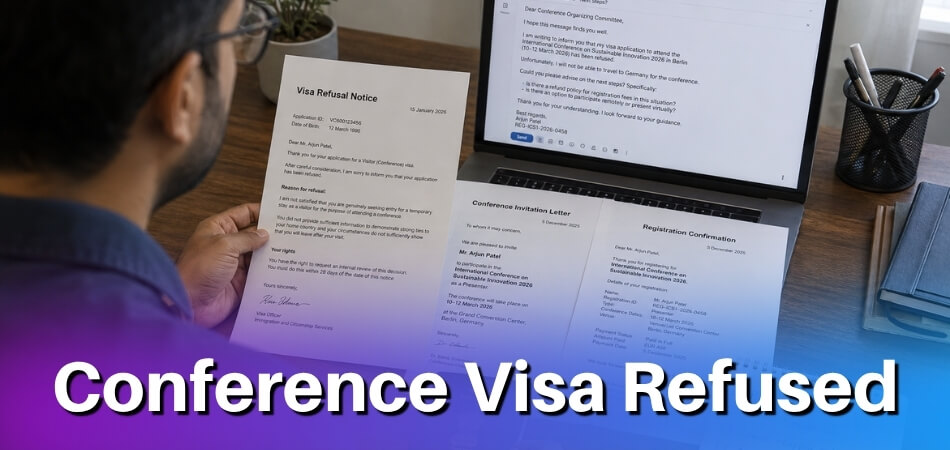
Losing a U.S. conference visa refusal letter feels stressful, but the physical letter is rarely the most important part of your case. What matters is the type of refusal you received, whether any action is still pending, and how you prepare the next application.
What to Do First After Losing a U.S. Conference Visa Refusal Letter
First confirm your refusal status, gather your application details, and work out whether your case was a final refusal or a pending document request. Do not rush into a new application until you know what happened.
Confirm Whether You Actually Need the Physical Letter
In many visitor visa cases the refusal notice is a short standard sheet that names the refusal section. It does not list every concern the officer had. For most conference travelers the key question is whether the refusal was under Section 214(b) or Section 221(g).
A 214(b) refusal is a decision on that interview, so losing the paper is usually not a barrier to reapplying. A 221(g) refusal means the application cannot be finished yet, so if you lost that notice, act quickly, because the missing instructions are the real problem. The section on refusal types below explains both.
Avoid Reapplying Until You Understand the Refusal Reason
A second application that looks the same as the first is likely to get the same result. Before you apply again, review your purpose of travel, conference proof, funds, home-country ties, travel plan and interview answers. The sections below explain how, and if your case was likely 214(b), you can start improving your file before you confirm anything. A lost letter is inconvenient, but a weak repeat application is the bigger risk. The first steps after any conference visa refusal, from telling the organizer to recovering costs, apply here too.
Can You Get Another Copy of a U.S. Visa Refusal Letter?
You may be able to get refusal information, but a U.S. embassy or consulate may not reissue an identical copy of the original letter. Your options depend on the refusal type, the embassy’s process and whether your case is still active.
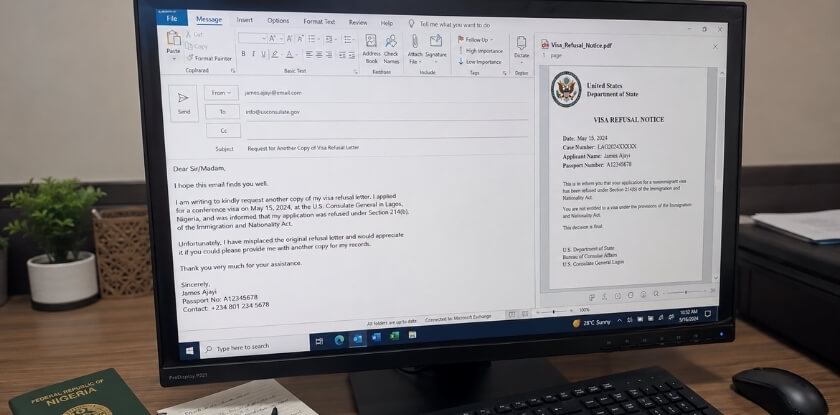
Why Embassies May Not Reissue the Same Refusal Slip
The refusal notice is normally handed over at the end of the interview or sent through an official system. Embassies often do not reprint it. They may instead point you to your appointment account, your CEAC status, the official visa support service, a formal records request, or a new application if the refusal was final.
What You Can Ask Them to Confirm
Even without the original letter, you can ask the embassy to confirm that the application was refused, which refusal section applied, whether your case is still pending, and whether any documents are still due. Keep the message short: say you attended a nonimmigrant visa interview, received a refusal notice and misplaced it, then give your identifying details. Do not send the same message every day, because duplicates create confusion and do not speed up a reply.
When a Lost Letter Is Urgent
After a 214(b) refusal the lost letter is usually not urgent. After a 221(g) refusal it may be, because the notice can contain a document checklist, a case number, passport submission instructions, the method for uploading documents, whether translations are needed and the deadline. The State Department says that if you submit the requested documents within one year of a 221(g) refusal, you do not need to pay a new application fee or fill in a new DS-160. After that, you must apply again and pay again. That one-year window is why 221(g) notices should be recovered quickly.
How to Recover Lost U.S. Conference Visa Refusal Information
Search your own records first, confirm your CEAC status, then contact the official support channel with complete case details. A formal records request is a backup and is usually too slow for urgent conference travel.
Step 1: Check Your Email and Visa Appointment Account
Start with the email address used for your appointment account. Search the inbox, spam, trash and archive, and open any PDF attachments or links carefully. Also search cloud storage, your phone gallery, downloads folder and printed files, and ask anyone who helped with your application, such as a consultant or travel agent. Refusal information does not always use the word “refusal”, so try terms like “visa”, “214(b)”, “221(g)”, “administrative processing”, “DS-160” and “CEAC”. Then log in to the appointment account. It may show appointment history, messages, courier details or document delivery instructions, which can confirm the case even if the letter itself is not there.
Step 2: Review the CEAC Visa Status Page
The CEAC visa status page shows whether your case is refused, issued or still pending. It does not give you a downloadable refusal letter. If it shows “Refused”, compare that with the interview. If the officer returned your passport and asked for nothing more, it was probably a 214(b) refusal. If you were given a checklist or asked for more information, it was probably 221(g). Note that many cases under administrative processing also display as “Refused” on CEAC, so check what the officer told you. To check your visa status on the CEAC portal, enter your DS-160 Application ID, your passport number and the first five letters of your surname.
Step 3: Contact the Correct Embassy or Consulate Support Channel
Use the visa support channel of the embassy or consulate where you applied, and do not write to random embassy addresses. A simple message works:
I attended a nonimmigrant visa interview for conference travel and received a refusal notice, but I misplaced the document. I would like to confirm the refusal section or any required next steps. My application details are listed below.
Do not argue the decision in this message. The goal is to recover information, not challenge the refusal.
Step 4: Use a FOIA Request as a Backup
If ordinary channels fail, you can ask the State Department for your visa records through its Freedom of Information Act (FOIA) process. Expect limits. Visa records are confidential under U.S. law, so the Department generally releases only documents that you submitted or received yourself, and it may redact parts. Internal officer notes are usually withheld. Embassies and consulates do not accept FOIA requests, so you file with the Department in Washington through its FOIA portal, give your full name, date of birth, visa type, the post where you applied and the refusal date, and prove your identity with a notarized or sworn signature. The law sets 20 working days for a first decision, but visa-record requests often take much longer, so this route suits long-term record recovery, such as legal review or several past refusals, and not a conference that is only weeks away.
Understand the Type of U.S. Visa Refusal You Received
Your next step depends on whether the lost letter was for Section 214(b) or Section 221(g). The two refusal types mean different things and need different actions.
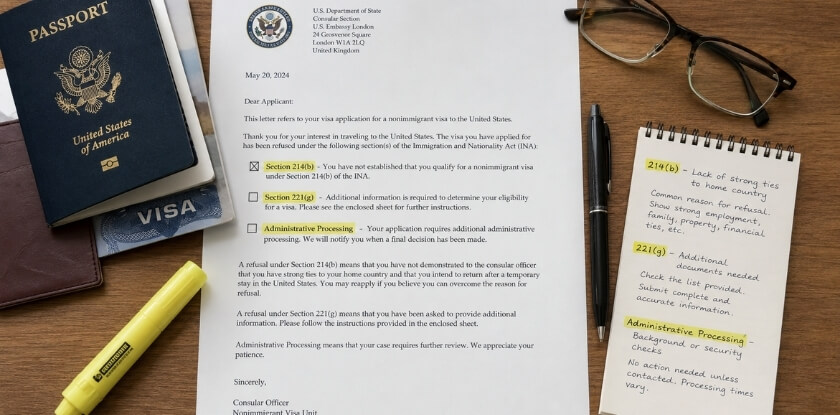
Section 214(b) Refusal for Conference and Visitor Visa Applicants
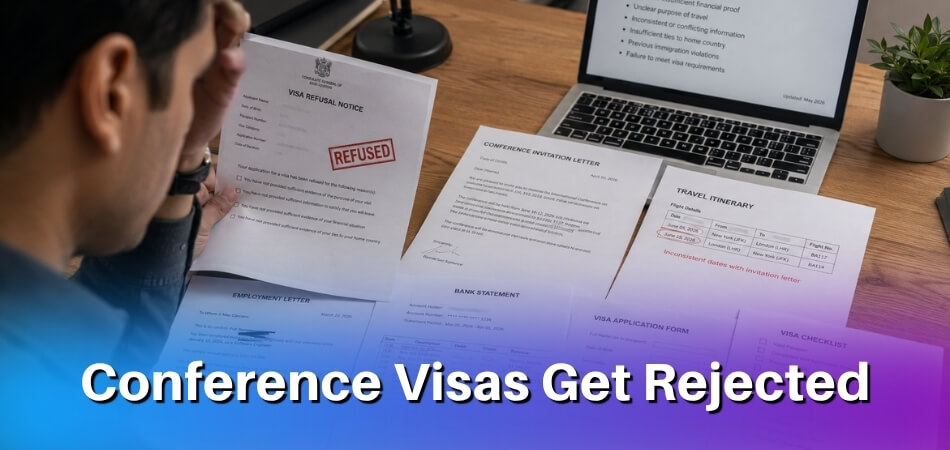
Section 214(b) is the most common refusal for temporary visitors, including conference attendees. It means the officer was not convinced you qualified at that interview. In conference cases the usual concerns are:
- The event did not clearly relate to your background
- The invitation letter was too general
- Your funds were unclear
- Your job, business or study ties looked weak
- The travel plan or return plan was not convincing
- Your answers were incomplete or inconsistent
There is no formal appeal for a 214(b) refusal. The usual path is to apply again when your circumstances or evidence have clearly improved.
Section 221(g) Refusal or Administrative Processing
A 221(g) refusal means the embassy needs more documents, more review or administrative processing. For conference applicants this can involve a clearer invitation, registration confirmation, employer or sponsorship documents, research background or updated identity documents. The notice matters more here because it lists exactly what to submit. If you lost it, check your email, appointment portal and CEAC, then contact the official support channel. Do not send random documents without guidance.
Why the Refusal Type Changes Your Next Step
| Refusal Type | What It Usually Means | Best Next Step |
| 214(b) | You did not qualify at that interview | Improve your case, then reapply |
| 221(g) | More documents or processing needed | Recover the instructions and respond within the stated time (one year at most) |
| Unknown | You lost the notice and are unsure | Check CEAC, email, appointment account and the support channel |
What Information to Provide When Requesting Refusal Details
Give the embassy or support service enough detail to find your case quickly. A vague request rarely gets a useful answer.
Identity and Application Details
Use the details exactly as they appeared on your application:
- Full name, date of birth and nationality
- Passport number (give both old and new numbers if your passport changed after the interview)
- Email address used for the visa account
- DS-160 confirmation number
- Visa category and interview date
- Embassy or consulate location
- Appointment confirmation number or fee receipt number, if available
- Courier or document delivery reference, if applicable
Say whether you received the notice after the interview or after a document submission, and mention the refusal section or any document request if you remember it. Your DS-160 number matters most because it links your identity to the application. If you cannot find it, check your email, printed appointment papers, screenshots and cloud storage.
Proof That Helps Locate Your Case
If support asks for evidence, be ready with your passport bio page, the DS-160 confirmation page, the appointment confirmation, the fee receipt, and any earlier embassy emails. Do not attach sensitive financial documents unless they are specifically requested.
What If the Embassy Does Not Respond?
Keep checking your official accounts, avoid repeated messages, and start reviewing your previous application for likely weaknesses. A slow reply does not mean you have no options.
Wait Before Sending Follow-Ups
Visa support offices can be slow, especially for old or closed cases. Wait a reasonable time, then send one follow-up that refers to your earlier request instead of starting a new message from scratch. For example:
I am following up on my previous request about a misplaced U.S. visa refusal notice. Could you please confirm which section of law applied and whether any further steps are needed?
Review Your Previous Application Yourself
If you cannot recover the letter quickly, work out the likely reason yourself. Ask whether your DS-160 matched your interview answers, whether you explained why the conference mattered, and whether any document looked incomplete or inconsistent. Then check each area below.
| Area | What to Check |
| Conference purpose | Is the event relevant to your work, study, business or research? |
| Invitation letter | Does it include your name, event dates, venue and role? |
| Registration proof | Can you show that you are properly registered? |
| Financial documents | Are the funds stable, clear and enough for the trip? |
| Home-country ties | Do you have strong reasons to return after the conference? |
| Travel plan | Are the dates, hotel and event schedule consistent? |
| Interview answers | Were your answers direct and believable? |
Consider Professional Guidance for Complex Cases
A simple 214(b) refusal can often be handled by improving your documents and answers. Professional help is worth considering if you have several refusals, suspect 221(g), have past immigration issues or a criminal record, have a technical or research purpose, or have funding that is hard to explain. A licensed immigration attorney is the safest choice. Avoid anyone who guarantees approval.
Can You Reapply for a U.S. Conference Visa Without the Refusal Letter?
Yes, you can usually reapply without the physical letter, but you must disclose the previous refusal truthfully. A stronger, more consistent application matters more than the paper.
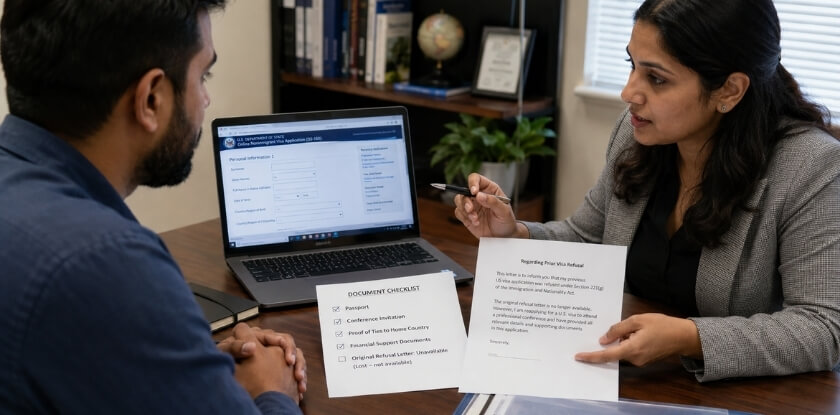
When a New Application Makes Sense
After a 214(b) refusal, the usual path is to apply again once your case is stronger: clearer conference documents, better documented funds, stronger ties, a simpler travel purpose, and fixed inconsistencies. A new application with nothing changed will probably end the same way, and the State Department advises applying again only when your circumstances have significantly changed. Reapplying means a new DS-160, a new fee and a new interview appointment, except for the 221(g) case described above.
How to Disclose a Previous Visa Refusal Correctly
When you complete a new DS-160, answer the previous refusal question honestly. Do not hide the refusal because you lost the letter, since your application history is held in the visa system. Give the best details you know: approximate refusal date, embassy location, visa category, and the refusal section if known. Keep the explanation factual and do not blame the officer. For example:
My previous B-1/B-2 visa application was refused after interview at the U.S. Embassy in [City] in [Month/Year]. I no longer have the refusal notice, but I have disclosed the refusal and prepared updated supporting documents.
How to Strengthen Your Next U.S. Conference Visa Application
Correct the weak points from the last refusal and make your purpose, funding and return plan easy to understand. The new application should not look like a repeat of the refused one.
Improve Proof of Conference Purpose
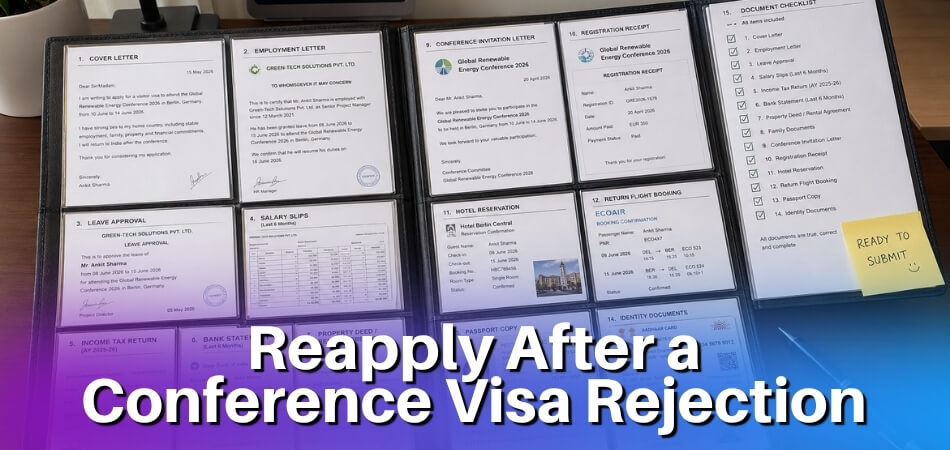
The officer should quickly see why you are attending, how the event relates to your background and why your stay is temporary. Useful proof includes the invitation letter, registration confirmation and payment receipt, the agenda, speaker or abstract acceptance, and an employer, academic or business letter. Documents should show your name, event name, location, dates and role.
Request Updated Documents From the Conference Organizer
If the first invitation was weak or too general, ask the organizer for a new one. Conference organizers can usually reissue a letter with your full passport name, the event title, dates, venue, your role and registration status. Make sure every date matches your DS-160, hotel plan, employer letter and itinerary, and do not reuse documents for an old event date.
Strengthen Financial Evidence
Officers look at the source, stability and consistency of funds, not only the balance. Useful documents include recent bank statements, salary certificates, business income records, tax documents, and a sponsorship or institutional funding letter with the sponsor’s financial documents. Avoid sudden large deposits without explanation. If someone else is paying, explain the relationship and the reason clearly.
Show Clear Home-Country Ties
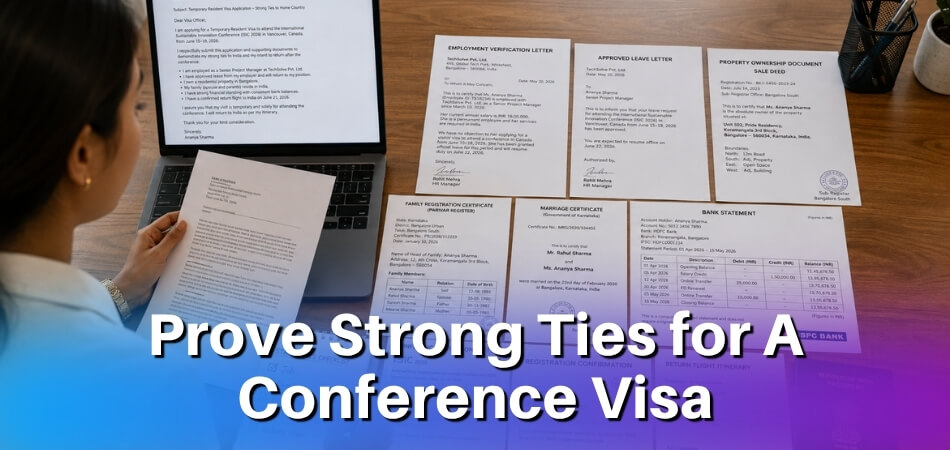
Show real reasons to return: full-time employment, business ownership, ongoing study, family responsibilities, property, or upcoming exams, projects or contracts. A few strong documents beat a large file of weak ones. Employees can add an employment letter, leave approval and salary slips. Business owners can add registration, tax records and client contracts. Students can add enrollment proof, class schedule or a supervisor letter.
Make Travel Plans Consistent and Credible
Arrival and departure dates, conference dates, hotel, city, funding source and employer approval should all match. If the conference lasts three days but you plan to stay a month, be ready to explain the extra time.
How to Prevent Losing Important Visa Documents Again
Keep digital and physical copies of every visa document in one organized folder. This helps with reapplications, future travel and later questions from officials.
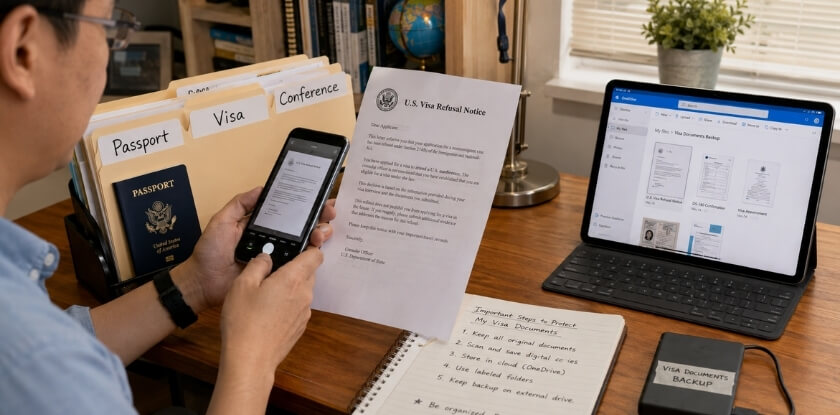
Create Digital and Physical Copies
Save your passport bio page, DS-160 confirmation, appointment confirmation, fee receipt, refusal notice or 221(g) letter, conference invitation and registration proof, hotel booking, itinerary, employer or university letter, sponsorship documents and embassy emails. Use clear file names such as USA-Visa-DS160-Confirmation.pdf, USA-Visa-Refusal-Notice.pdf and 221g-Document-Request.pdf.
Store Everything in One Folder With Subfolders
Make one folder for the full application, with subfolders such as Passport and Identity, DS-160 and Appointment, Conference Documents, Financial Documents, Employment or Study Proof, Embassy Communication, and Refusal or Follow-Up Records. Label updated conference files clearly so you never submit an old version by mistake.
Keep a Timeline of Applications and Decisions
Add a simple timeline with application date, DS-160 number, appointment date, embassy, visa category, result, refusal section, documents requested and notes for next time. It saves time on every future DS-160. Write it down now, while you still remember the details, because future applications may ask about earlier refusals.
From our experience at MS International: when an attendee tells us an earlier US visa was refused, we suggest recovering the refusal details before reapplying. Knowing whether it was a 214(b) refusal or a 221(g) hold tells you what has to change in the new application, and your new invitation letter should show the same conference details as your DS-160. Our invitation letter supports a visa application but does not guarantee approval, and it is issued within 3 to 5 business days after payment clears. Registration fees are non-refundable under our refund policy, including after a visa refusal, so check the dates and the policy of any organizer before you pay again.
FAQs About Losing a U.S. Conference Visa Refusal Letter
Losing the refusal letter leaves gaps to fill: what CEAC and a FOIA request can show, not knowing if the code was 221(g) or 214(b), and how to handle it at the next interview or with the conference organizer.
Is a U.S. visa refusal letter available online?
Usually, no. CEAC shows your case status but does not offer a downloadable refusal letter. Check your email and appointment account first; the embassy support channel can confirm which refusal section applied.
Can CEAC show the reason for refusal?
No, CEAC shows a status, not the reason. A case can read “Refused” even when it is a 221(g) request or administrative processing, so the details come from the refusal notice or the embassy.
How long does a FOIA request take?
There is no fixed time. The law sets 20 working days for a first decision, but visa-record requests often take much longer. It suits long-term record access, not urgent conference travel, and the Department generally releases only documents you submitted or received.
Is the refusal letter required for a new U.S. visa application?
No, but you must disclose the previous refusal truthfully. Answer the DS-160 refusal question honestly and give the best details you remember.
Should I contact the conference organizer after a refusal?
Yes, especially if you plan to reapply. Ask for an updated invitation, registration confirmation, schedule, payment receipt and proof of your role.
Can an immigration lawyer recover the refusal letter for me?
A lawyer may help you request records or understand the refusal, but cannot guarantee the embassy will reissue the letter. Help is most useful for multiple refusals, 221(g) or past immigration issues.
What if I cannot remember whether it was 214(b) or 221(g)?
Check CEAC, your email and your memory of the interview. A checklist or request for more documents points to 221(g). A returned passport and a statement that you did not qualify points to 214(b).
Can I still attend the same conference after losing the refusal letter?
Only if a new decision comes in time. After a 214(b) refusal, reapplying without stronger evidence will probably not help. After a 221(g) request, recover the instructions first, because that case may still be completed.
Should I mention the lost refusal letter during my next visa interview?
Only if it becomes relevant. Disclose the refusal on the DS-160 and answer every interview question honestly.
What if my visa consultant or travel agent lost the refusal letter?
Ask them for all saved records. Screenshots, emails, appointment details and notes can help you rebuild your file.
Conclusion
Losing your U.S. conference visa refusal letter does not stop you from recovering refusal details or applying again. Check your email, appointment account and CEAC status, then contact the embassy’s visa support channel with your DS-160 number, passport number and interview date. After a 214(b) refusal, build a stronger application; after a 221(g) request, recover the instructions and respond within the stated time, and within one year to avoid a new fee. Whichever applies, disclose the earlier refusal honestly.
Disclaimer: This article is general information, not legal or immigration advice. Visa rules, fees, and processing times change. Confirm the current requirements on the official U.S. Department of State website (travel.state.gov) before you apply.