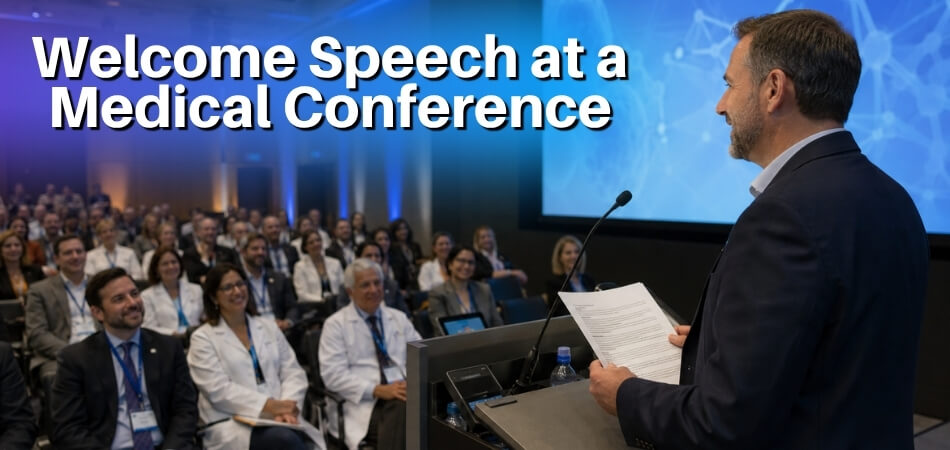

Both words appear on academic event listings, and it is easy to assume they mean the same thing. They overlap, but the right choice depends on what you want to take away from the day.
Quick answer: The difference between a colloquium and a conference is mainly scale and focus. A colloquium is a smaller academic meeting on one subject, usually built around a talk and open questions. A conference is larger and broader, with many sessions, speakers and networking. Pick a colloquium for depth and feedback, and a conference for breadth, visibility and contacts.
What Is the Main Difference Between a Colloquium and a Conference?
A colloquium is small, focused and discussion-based, while a conference is larger, broader and designed for presentations, networking and learning across several topics.
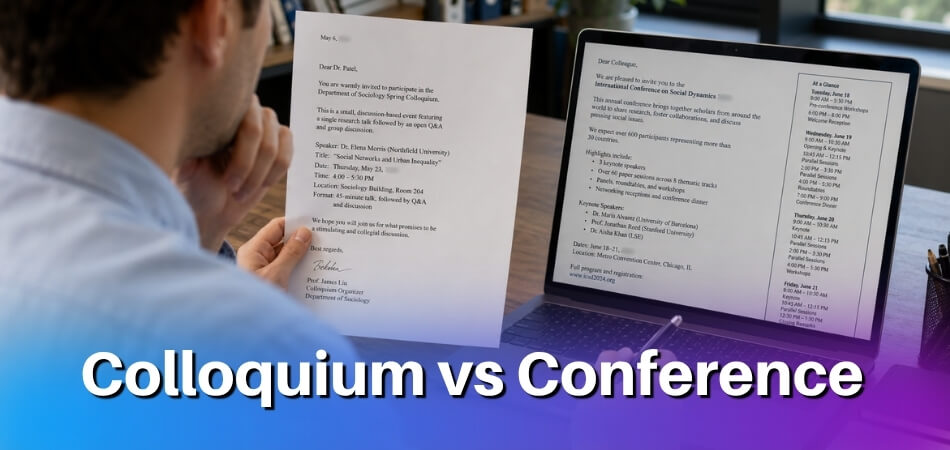
Merriam-Webster defines a colloquium as a usually academic meeting at which specialists deliver addresses on a topic or related topics and then answer questions about them. Cambridge Dictionary describes a conference as a large, formal meeting, often lasting a few days, where people discuss their work or subjects they study. Many university departments run a colloquium as a regular series of invited talks open to the whole department. A conference covers a wider range of topics and attracts a mixed audience of academics, professionals, students and exhibitors, usually across several sessions over one or more days.
Published guides draw the line in different places. A French congress centre (CID Deauville, 2023) describes a colloquium as a meeting organised around a specific theme, where experts present papers and debate recent advances. AiScholar (2025) describes it as a session where scholars present research in progress to peers in a department or research group. Read the table below as common patterns, and check how the organiser describes the event itself.
| Event Type | Best For | Main Focus |
| Colloquium | Deep academic discussion | One focused topic or research area |
| Conference | Broad learning and networking | Multiple topics, speakers, and sessions |
A colloquium may involve a single speaker, a small group of presenters, or a guided discussion among people with shared expertise. The setting is often personal, which makes it easier to ask questions and exchange detailed feedback. In short, a colloquium suits you when you want depth, discussion and expert feedback, and a conference suits you when you want variety, visibility and wider learning.
Colloquium vs Conference: Quick Comparison Table
Treat the table as typical patterns, not fixed rules.
| Comparison Point | Colloquium | Conference |
| Main Purpose | To explore one focused academic topic, research question, or theory | To share knowledge, present ideas, build networks, and discuss multiple topics |
| Typical Size | Small group of students, scholars, researchers, or invited participants | Larger gathering with local, national, or international attendees |
| Topic Scope | Narrow and specific | Broad, often divided into themes, tracks, or subject areas |
| Format | One lecture, research talk, or a few focused presentations with discussion | Keynotes, panels, paper presentations, workshops, breakout sessions, and exhibitions |
| Audience | Academics, researchers, faculty members, graduate students, and subject specialists | Academics, professionals, business leaders, researchers, students, exhibitors, and general participants |
| Duration | Usually a few hours or one day | Often one to several days |
| Interaction Style | Conversational and discussion-heavy | Structured, with formal sessions and planned networking |
| Networking Level | Limited but subject-specific | Wider networking across institutions, industries, and regions |
| Cost | Often free or lower-cost | Usually higher due to venue, speakers, logistics, and event scale |
| Best Outcome | Focused feedback and deeper understanding | Broader learning, collaboration, exposure, and networking |
What Is a Colloquium?
A colloquium is a focused academic meeting where a speaker or small group presents ideas on a specific subject and participants join a discussion afterward. It is common in universities, research institutes, graduate programs, and academic departments.
The main value of a colloquium is depth. Instead of moving through many topics quickly, participants take time to examine one idea, ask detailed questions, and exchange informed opinions.
Core Purpose of a Colloquium
The purpose is serious discussion around one academic or research topic. It is not usually designed for broad public networking or large-scale promotion. A colloquium may be used to present developing research, test a theory or method, receive feedback, or look at a subject from a more critical angle. For example, a graduate student may present early findings and receive comments from professors and researchers before developing the work further. Attendees usually leave with a stronger understanding of that one subject and a few contacts in the same area.
Who Usually Attends a Colloquium?
The audience usually includes faculty members, graduate students, researchers, scholars, academic guests, and subject specialists. Because attendees often know the background, the speaker can go deeper into methods, arguments, findings, and research questions.
Typical Colloquium Format
The format is simple and discussion-centered. A common structure is opening remarks, a speaker introduction, a main presentation, a question-and-answer session, group discussion, and closing remarks. Unlike a large conference, it usually has no parallel sessions or packed multi-day schedule.
What Is a Conference?
A conference is a structured event where people gather to share knowledge, present ideas, discuss important topics, and build professional or academic connections. Compared with a colloquium, it is usually larger, broader, and more varied in format.

A conference may focus on one overall theme but often includes many subtopics. A business conference may include sessions on leadership, finance, marketing, and technology. An academic conference may include research presentations from different fields or specialized tracks within one discipline.
Core Purpose of a Conference
The purpose is to bring people together for learning, presentation, networking, and collaboration. Participants can learn about current research or industry practice, present papers or case studies, meet peers and experts, build partnerships, improve skills in workshops, and gain visibility in a field.
Who Usually Attends a Conference?
The audience is wider than at a colloquium: researchers, students, faculty members, executives, industry professionals, speakers, sponsors, exhibitors, consultants, trainers, and general participants interested in the topic.
Typical Conference Format
A conference has several planned sessions arranged across a full schedule, lasting one day, several days, or longer. Common elements include keynote speeches, panel discussions, paper presentations, breakout sessions, workshops, poster sessions, networking sessions, exhibitions, and closing sessions. Large conferences may run several sessions at the same time, so attendees can follow the track that matches their interests.
Networking, Exhibitions, and Publications
Networking is a major advantage. Coffee breaks, receptions, lunch sessions, and meetups help attendees meet collaborators, employers, clients, partners, and experts. Many conferences also include exhibitions where organizations present products, services, tools, or programs. Academic conferences may also include paper presentations, abstracts, posters, or proceedings.
Expected Outcomes of Attending a Conference
Attendees may leave with new knowledge, professional contacts, research feedback, collaboration opportunities, practical skills, awareness of trends, and more confidence in presenting or networking.
Key Differences Between a Colloquium and a Conference
The table above gives the overview. The points below add what it cannot show.
Difference in Focus
A colloquium stays close to one topic, research question, theory, or academic issue, so participants can examine it in detail. A conference may be organized around one broad theme, but that theme is usually split into tracks, panels, workshops, and presentation categories.
Difference in Scale and Audience
A colloquium may involve participants from a department, research group, academic program, or invited audience, and most already know the subject or have a direct academic interest in it. A conference is larger and more mixed, with local, national, or international participants who attend to present research, learn, network, explore services, or represent an organization.
Difference in Interaction Style
In a colloquium, questions, critiques and debate are central. The small group lets people speak freely and follow a point until it is settled. In a conference, interaction is more formal and scheduled: questions come after sessions, in workshops, at exhibitor stands or during breaks. Because the event is large and time-limited, each person may get less time for detailed discussion in any one session.
Difference in Professional Value
A colloquium helps students, researchers and scholars refine ideas, sharpen arguments, practice presenting, and get detailed feedback from people who know the subject. A conference offers recognition, a wider audience for your work, possible collaborators, learning from experts, and a broader professional network.
Difference in Cost and Time Commitment
Many colloquia are hosted by universities, departments or research groups, so they may be free or carry a small fee, and they take less time. A conference usually needs more planning and a bigger budget, because registration, travel, hotel stays, meals, and time away from work or study add up.
Key Similarities Between Colloquia and Conferences
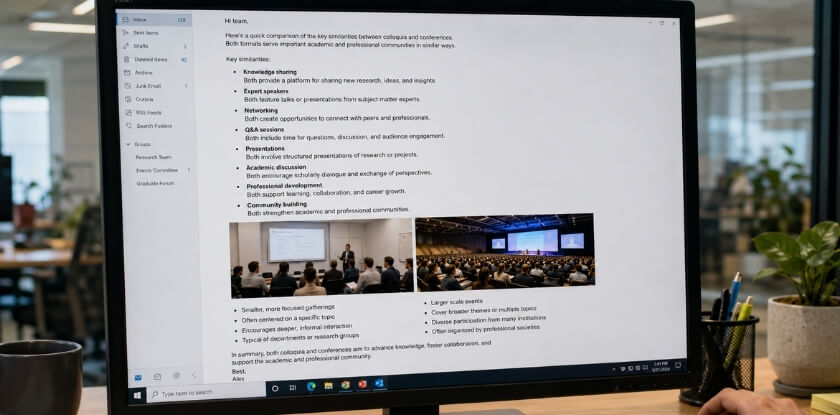
Despite the difference in scale, both bring people together to exchange knowledge, discuss ideas, and support academic or professional growth.
Both Support Knowledge Sharing
Both are built around learning. Speakers present ideas, research, findings, experiences, or expert opinions to an audience. A colloquium does this on one focused topic, a conference across several sessions or themes.
Both Include Presentations and Discussion
A presentation followed by discussion is the usual pattern. In a colloquium, one speaker may present a detailed topic and answer questions from a small group. In a conference, discussion happens through Q&A sessions, panels, breakout groups, workshops, and conversations between sessions.
Both Can Support Growth and Connections
A colloquium supports critical thinking, focused feedback, and deeper understanding. A conference supports wider exposure, practical learning, presentation experience, and broader professional relationships.
Types of Colloquia
Common types include research, thematic, graduate, and invitational colloquia. Names and practice vary by institution, but each keeps the focused nature of a colloquium while serving a different academic purpose.
Research Colloquium
A research colloquium is organized around a specific research topic, project, finding, or method. It gives researchers a chance to present work in progress or completed research to a focused audience. It is useful when the presenter wants feedback on the research question, methodology, evidence, interpretation, or next steps.
Thematic Colloquium
A thematic colloquium focuses on one central theme rather than one project. The theme may connect several speakers, perspectives, or disciplines, for example artificial intelligence in education, climate change policy, public health communication, or ethics in technology.
Graduate Colloquium
A graduate colloquium is designed for master’s or doctoral students, who present thesis work, dissertation progress, research proposals, or early findings. The goal is to practice presenting, build confidence, receive feedback, and prepare for a thesis or dissertation defense.
Invitational Colloquium
An invitational colloquium is selective: specific speakers or participants are invited to discuss a specialized topic, often experts, senior researchers, visiting scholars, or selected academic guests.
Types of Conferences
Common types of conferences include academic, professional or business, trade, workshop-based, and online or hybrid conferences. Each supports a different goal, such as research presentation, career growth, industry networking, training, or product discovery.
Academic Conference
An academic conference is designed for researchers, scholars, students, and educators to share findings, discuss theories, present papers, and receive feedback from people in the same or related fields. It may include poster sessions, panel discussions, keynote lectures, abstract submissions, peer-reviewed sessions, and conference proceedings.
Professional or Business Conference
A professional or business conference focuses on workplace knowledge, industry trends, leadership, strategy, and career development. Attendees include business owners, executives, managers, entrepreneurs, consultants, and professionals from different sectors. Expect expert talks, case studies, networking sessions, and skill-building discussions.
Trade Conference or Exhibition
A trade conference or exhibition is organized for a specific industry. Businesses, suppliers, buyers, and industry representatives attend to showcase products, explore services, and build commercial relationships, with booths, product demonstrations, and buyer-seller meetings.
Workshop-Based Conference
A workshop-based conference focuses on practical learning. Instead of only listening to presentations, participants take part in guided sessions where they learn skills, methods, tools, or strategies.
Online and Hybrid Conference
An online conference runs fully on digital platforms, while a hybrid conference combines in-person sessions with virtual participation. Both are easier for people who cannot travel.
How Colloquium and Conference Compare With Symposium, Seminar and Congress
A conference is usually the largest of these formats, and the other terms are names for smaller, narrower or more discussion-focused meetings. The lines are not fixed, so the table shows how two published guides describe them: Fourwaves (published March 2024, updated September 2026) and AiScholar (October 2025).
| Term | How the guides describe it |
| Symposium | Smaller and shorter than a conference, often one or two days, with a narrow topic and mostly invited experts |
| Seminar | Small and discussion-based, often led by one or two experts and held within one institution |
| Congress | A very large meeting, usually run by a professional association, with a formal tone |
| Colloquium | Smaller and theme-focused, or a department-level session for research in progress |
If a listing uses one of these words, read the programme before judging the event by its name.
Pros and Cons of Attending a Colloquium
The main benefits are focused learning, direct interaction, and detailed academic feedback. The main limits are a narrow scope, a smaller audience, and fewer networking options than a conference.
Advantages of a Colloquium
- Focused discussion: Attention stays on one topic and explores it in depth.
- Direct access to speakers: Smaller groups allow specific questions.
- Detailed feedback: Presenters can get comments on research, methods, evidence, or findings.
- Stronger academic engagement: The setting encourages active listening and critical thinking.
- Lower cost in many cases: University-hosted colloquia are often cheaper than large conferences.
- Specialist connections: You meet people with the same research interest.
Limitations of a Colloquium
- Narrow topic range: It may cover only one subject.
- Smaller audience: Fewer attendees means fewer networking options.
- Limited industry exposure: Many colloquia are purely academic.
- Less event variety: Exhibitions, multiple tracks, and large networking sessions are rare.
- Possible travel or time cost: Even a low-cost event may need transport or time away.
A colloquium is best when quality of discussion matters more than audience size.
Pros and Cons of Attending a Conference
The main benefits are broader learning, stronger networking, presentation opportunities, and professional exposure. The main limits are higher cost, time commitment, and the need to choose sessions carefully.
Advantages of a Conference
- Broad learning opportunities: Multiple topics, speakers, and sessions.
- Professional networking: You can meet researchers, leaders, exhibitors, and peers.
- Presentation opportunities: Participants may present papers, posters, case studies, or projects.
- Skill development: Workshops and training sessions build practical knowledge.
- Access to current trends: New research, technologies, and practices are on show.
- Collaboration potential: Conversations can lead to partnerships, research projects, or business relationships.
- Career visibility: Speaking or presenting can strengthen credibility in a field.
Limitations of a Conference
- Higher cost: Registration, travel, accommodation, meals, and transport add up.
- Time commitment: It may take one or more full days.
- Information overload: Many sessions make it hard to absorb everything.
- Less personal discussion: Large audiences limit direct contact with speakers.
- Scheduling conflicts: Sessions may run at the same time.
- Networking pressure: Meeting new people can feel hard without preparation.
Most of these can be managed by reviewing the agenda early, choosing priority sessions, setting networking goals, and preparing questions.
Colloquium or Conference: Which One Should You Attend?
Attend a colloquium for focused academic discussion, detailed feedback, and a deeper understanding of one topic. Attend a conference for broader learning, networking, presentation opportunities, and exposure to several ideas or industries.

Choose a Colloquium If You Want Focused Academic Discussion
A colloquium is the better option when you want to study one topic closely or get detailed feedback from people who understand the subject. It works well for students, researchers, faculty members, and scholars who want a smaller setting for serious discussion. Choose it to present developing research, ask direct questions, receive comments from specialists, improve a thesis or paper idea, or build connections within a narrow research area.
Choose a Conference If You Want Broader Learning and Networking
A conference is the better option when you want to meet more people, explore several topics, and gain wider exposure. Choose it to attend multiple sessions, meet professionals or researchers, present work to a larger audience, discover current trends, join workshops, build partnerships, or gain visibility beyond your own institution or organization.
Decision Table Based on Your Goal
| Your Goal | Better Choice | Why |
| Detailed feedback on one research topic | Colloquium | Smaller groups allow deeper comments |
| Practice academic presentation | Colloquium | The setting is focused and less overwhelming |
| Close discussion with subject specialists | Colloquium | The audience is smaller and more specialized |
| A lower-cost academic event | Colloquium | Many are hosted by universities or departments |
| Meet people from different fields, or explore several topics | Conference | A larger audience and multiple sessions |
| Present research to a wider audience | Conference | More visibility |
| Hands-on skill development | Conference | Workshops are more common |
| Stronger networking | Conference | Larger events create more chances to connect |
Questions to Ask Before Registering
Ask yourself: do you want depth or variety, detailed feedback or broader exposure, a small discussion group or a large event? Is networking a major goal? Are you working on research development, career growth, or professional visibility? How much time and budget do you have? The best event is the one that matches your current goal. Read the call for papers or programme too: the number of sessions, whether papers are reviewed and who the audience is will tell you more than the word in the title.
How to Prepare for a Colloquium vs a Conference
Preparing for a colloquium means getting ready for focused discussion on one topic. Preparing for a conference means planning your schedule, networking goals, materials, and sessions in advance.
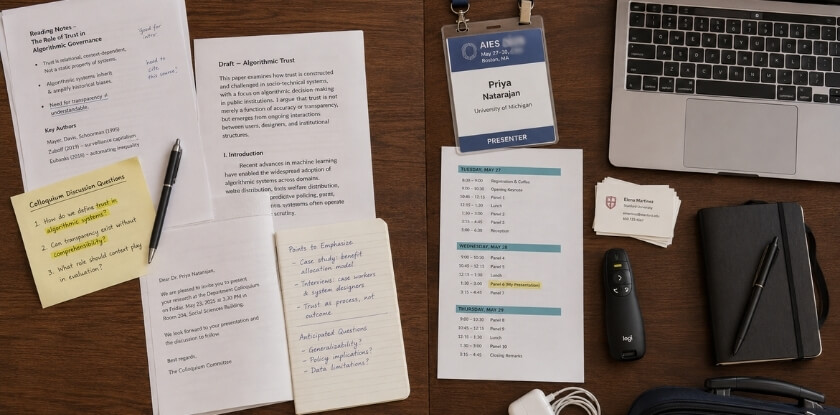
Preparing for a Colloquium
Review the title, abstract, speaker background, or any materials shared before the session, and prepare thoughtful questions about the argument, method, evidence, or conclusion. In a small group you may get a real chance to comment or respond.
If you are presenting, be ready to explain your research question, methods, findings, and the areas where you want feedback. Take notes during the discussion so you can use the comments later.
Preparing for a Conference
Review the agenda early and decide what you want to gain. Choose priority sessions, workshops, speakers, or networking activities, and mark first and second choices where sessions overlap. Prepare a short introduction about who you are, what you do, and why you are attending. If you are presenting, have your slides, poster, notes, or handouts ready, and plan travel, accommodation, registration time, dress code, and venue location.
What to Bring or Plan in Advance
| Preparation Item | Colloquium | Conference |
| Review topic materials | Important | Important |
| Prepare questions | Very important | Important |
| Plan session schedule | Usually simple | Very important |
| Prepare networking introduction | Helpful | Very important |
| Bring presentation materials | If presenting | If presenting |
| Plan travel and accommodation | Sometimes needed | Often needed |
| Bring business cards or digital contact details | Optional | Helpful |
| Follow up after the event | Helpful | Very important |
For a colloquium, preparation is mostly intellectual: read, think, and get ready to discuss. For a conference it is also practical: sessions, materials, networking, and logistics.
From our experience at MS International: Our events are in-person conferences in the Greater Toronto Area. Presenting authors submit work for double-blind review, which takes about 10 working days, and register after acceptance. If you want to attend without presenting, listener registration is available.
FAQ: Colloquium vs Conference
If you are weighing a colloquium against a conference, formality, cost, the chance to present research, networking and whether proceedings get published tend to decide it.
Is a Colloquium More Formal Than a Conference?
No, there is no rule that makes one more formal. Formality depends on the host and the event. A departmental colloquium is often an informal feedback session, while a conference may have keynotes and peer-reviewed papers. Of the related terms, “congress” is the one guides link with a formal tone.
Can a Colloquium Be Part of a Conference?
Yes. A colloquium can be a session format inside a conference. The PME45 conference’s call for colloquia (submission deadline 15 January 2022) asked for three related research reports in a 90-minute slot, with one discussant opening the discussion. A conference can also include smaller focused sessions or expert roundtables. The conference supplies the wider structure, and the colloquium gives a focused space for one subject.
Are Colloquia Only for Students and Researchers?
No, but they are most common in academic settings. Faculty, visiting scholars, graduate students, research teams, invited experts, and sometimes professional groups take part when the goal is focused discussion of a specialized topic.
Do Conferences Always Have Multiple Sessions?
Most do, but not all are large. A small one-day conference may have only a few talks or panels, while a large international one has many tracks, workshops, and exhibitions. What defines a conference is its organized structure for sharing knowledge and connecting people.
Which Event Is Better for Presenting Research?
A colloquium is better for early-stage feedback, and a conference is better for reaching a wider audience. Choose a colloquium for detailed comments from a small group before finalizing your work, and a conference when the research is ready for broader visibility or a formal academic program.
Which Event Is Better for Networking?
A conference, because it brings together more people from different institutions, industries, and places. A colloquium still offers useful contacts, but they are narrower and tied to one research area.
Can Both Events Be Held Online?
Yes, both can run online or in hybrid formats. A virtual colloquium may be a live research talk with online discussion, while a virtual conference may offer digital sessions, recorded presentations, and online networking rooms.
Are Conference Proceedings Always Published?
No. The University of Missouri Libraries guide (updated October 2026) says complete proceedings are not always published. Some contain only abstracts or a list of papers, and select papers may appear in journals or books instead. Check the call for papers for what the organiser will publish.
Do Colloquia Usually Cost Less Than Conferences?
Usually yes, especially when hosted by universities, departments, or research groups, and some are free for students or internal participants. Conferences often cost more because of larger venues, staff, speakers, catering, and multi-day programming.
How Do I Know Which Event Fits My Career Goals?
Match the event to your main purpose: a colloquium if you need focused feedback or deeper understanding of one subject, a conference if you want broader learning, exposure, networking, or collaboration. A simple rule is to attend a colloquium for depth and a conference for reach.
Final Takeaway: Colloquium vs Conference
Both help people share knowledge and build connections, so the right choice depends on your goal. Choose a colloquium when your priority is depth: focused discussion and direct feedback on one topic. Choose a conference when your priority is breadth, visibility, and networking.