
A humanities conference paper is written for the ear, not the eye, and treating it as a shortened journal article is a mistake. A journal article is built to be read slowly, returned to and annotated. A conference paper is heard once, in real time, by listeners who cannot pause or reread. Sentence length, the pacing of the argument and the handling of close reading or historical evidence all have to serve a listener.
Quick answer: To write a humanities conference paper, build one clear argument for the ear, not a shortened journal article. A 15–20 minute slot means roughly 1,900 to 3,000 words read at 125 to 150 words per minute. State your claim in the first two minutes, support it with one or two pieces of close reading or primary evidence, signpost every move, end on the claim, and rehearse aloud with a timer.
Last verified against official sources: October 2026.
What Are the Key Steps to Writing a Humanities Conference Paper?
There are eight steps: read the call for papers, choose one oral argument, write for the ear, time the draft, pick a delivery format, decide on visuals, prepare for questions and check your field’s norms. Each step is short here and developed in the sections after it.
Step 1: Read the CFP Carefully
Every Call for Papers defines a conversation the conference wants to have, and your paper has to enter it directly. Check the themes, the disciplinary scope (literature and cultural studies, history, philosophy or cross-disciplinary) and the formatting rules. A submission that ignores the CFP’s framing is easy to reject, even when the argument is strong.
Step 2: Build One Clear Oral Argument
A conference paper is not a condensed journal article. Pick a single, specific claim you can develop within the time limit. Trying to cover three related ideas usually means covering none of them well.
Step 3: Write to Be Heard
Sentence complexity that works on the page can collapse in delivery. Write shorter sentences than you think you need and read every paragraph aloud while drafting. If you stumble, the audience will too. Academic vocabulary is fine, but stacked jargon loses a room fast.
Step 4: Time Your Draft
Read the printed draft aloud at a natural pace with a clock running, then cut until you finish comfortably inside the limit. Going over is not a small problem: it eats the Q&A and tells the room you did not prepare. Use the word guide below to get close before you time it.
| Slot | Words at 125 to 150 per minute | Double-spaced pages (about 250 to 300 words) |
|---|---|---|
| 10 minutes | 1,250 to 1,500 | about 4 to 6 |
| 15 minutes | 1,900 to 2,250 | about 6 to 9 |
| 20 minutes | 2,500 to 3,000 | about 8 to 12 |
These are rules of thumb, not an official standard. A University of Chicago graduate guide for humanities presenters suggests budgeting about 2 minutes per double-spaced page when reading, which fits the table, and adds that people tend to read faster in the real talk than in rehearsal. Your own speed matters more, and the chair’s time limit is firm, so aim a little under the figure for your slot.
Step 5: Prepare Your Delivery Format
Decide whether you will read a full script, use detailed notes or work from an outline. Reading from a manuscript is the traditional default in the humanities and is completely standard, but good readers practise enough to look up regularly. Even occasional eye contact changes how the audience receives an argument.
Step 6: Handle Visuals and Handouts Deliberately
Slides are not required in most humanities fields, and a badly made deck distracts from the argument. Use a handout or a single slide only for material the audience genuinely needs to see.
Step 7: Prepare for the Q&A
The Q&A is part of the presentation. Know which objections your argument invites and think through your response, even if you do not script it. Two or three anticipated questions are enough.
Step 8: Check Professional and Disciplinary Norms
Fields differ on citation, originality and what counts as evidence. Philosophy conferences often expect a more adversarial Q&A, and history panels may weight archival evidence differently from theoretical argument, so a strong paper can still misfire if it misreads the room. If the conference publishes proceedings, check the submission requirements early, because formatting for publication differs from the spoken version.
What a Humanities Conference Paper Actually Is (and How It Differs from a Journal Article)
A humanities conference paper is a spoken piece of 15–20 minutes that makes one argument, and that single fact shapes how you write, structure and deliver it. Many first-time presenters treat it as a short journal article read aloud, and the result is a paper that is technically sound but almost impossible to follow in real time.
The Core Difference: Writing to Be Heard
A journal reader can pause, reread a dense sentence, skip to the footnotes or go back to an earlier paragraph. A conference audience has none of those options. Your argument moves at the speed you speak, and if a listener loses the thread, it is gone. Clarity and forward momentum therefore matter more than the layered, heavily subordinated prose that works on the page.
Footnotes belong in the written version, not in the spoken one. Academic networking after the session is where you point colleagues to the fuller bibliography. The spoken paper itself should keep moving.
How the Argument Changes
A journal article has room to survey scholarship, hedge across several paragraphs and build gradually to a thesis. A conference paper front-loads the stakes. Across literature and cultural studies, history and philosophy the oral shape is similar: state the problem, say what you will claim, build through evidence and close with the implication. It is more compressed than an article’s structure, and that is intentional. The table shows how the three common formats differ for the same piece of thinking.
| Spoken conference paper | Proceedings paper | Journal article | |
|---|---|---|---|
| Audience | Listeners in a room, one hearing | Readers, citable record | Specialist readers, long-term record |
| Length | About 1,900 to 3,000 words | Set by the conference or series | Set by the journal; humanities articles are often several thousand words, so check its guidelines |
| Citations | Spoken attribution (“as [Name] argues”) | Full notes or references in the required style | Full apparatus and engagement with scholarship |
| Structure | Claim early, signposts, one or two pieces of evidence | Same argument, written for the page | Sections, counterarguments, literature review |
| Review | Abstract screened against the CFP | Ranges from none to full peer review | Peer review, usually with revisions |
What Carries Over from Journal Writing
The intellectual standards are identical. Originality, rigorous engagement with evidence and honest acknowledgment of your argument’s limits do not change because the format is oral. Plagiarism is a serious concern whether the work appears in a journal, in proceedings or as a presentation: the format is different, the ethics are not.
Your research depth does not shrink either. A good conference paper is often the seed of a journal article, and many scholars present work in progress precisely to test an argument before committing to the longer form. Think of the formats as stages of the same thinking, shaped by different audiences.
Before You Write: Reading the Call for Papers and Scoping Your Argument
Most structural problems in a conference paper are locked in before the first sentence, by how you read the call for papers and how honestly you scope the argument to the slot.
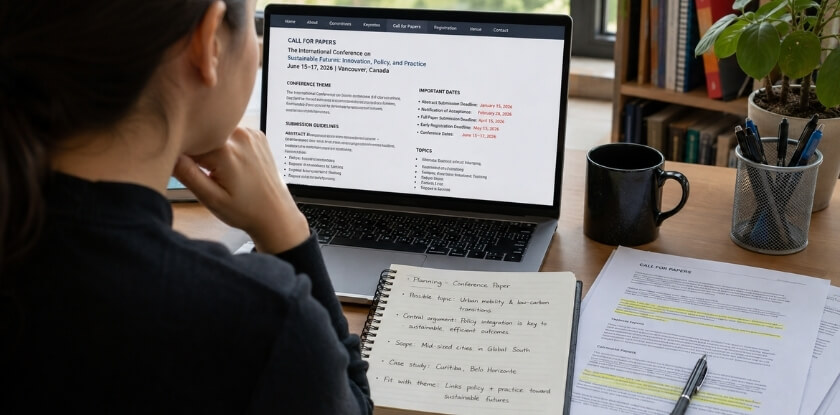
Decoding the Call for Papers (CFP)
A CFP is an invitation with specific terms, and reading it closely is the first piece of intellectual work you do. Many first-time presenters skim for the deadline and the theme keyword, then write what they were already planning to write. That produces submissions that technically fit but do not respond to what the conference is asking.
Start with the framing questions. Organizers usually state two or three animating concerns, and these tell you what conversation the panel wants. A literature CFP asking about “the politics of genre” signals something different from one asking about “genre as a readerly experience,” even if both accept papers on the same texts. History CFPs tend to foreground periodization, evidence and historiographical stakes. Philosophy CFPs tend to flag the tradition or problem-set under discussion.
Scope indicators count too. Phrases like “papers that engage with primary sources” or “work that crosses disciplinary boundaries” are criteria that reviewers will apply, not decoration.
Then check the practical requirements:
- the word count for the abstract;
- whether the conference uses blind review (MS International uses double-blind review, so remove identifying details from what you submit);
- whether accepted papers can go into conference proceedings;
- whether the event is in person, virtual or hybrid, which shapes how you will eventually present.
A broad CFP gives you more latitude, but you still need to locate your paper in the conversation the conference is staging, not just gesture toward it. A narrow CFP needs an abstract that shows direct engagement with its focus.
Narrowing Your Argument for a 15–20 Minute Time Slot
The time slot is the defining formal constraint, and scoping problems usually start with underestimating it. Slot length depends on how many papers share the session, and some slots include question time. The Medieval Congress presider guidance at Western Michigan University, for example, sets 20 minutes per paper in a three-paper session and 15 minutes in a four-paper session, inside a 90-minute session that also holds introductions, handouts and discussion. Texas Tech’s presentation guide gives 15 to 25 minutes for spoken papers, including questions. Ask the organizers which applies before you count words. A journal article typically develops three to five major moves; a conference paper can sustain one, maybe two. At about 130 words per minute a 20-minute paper runs to roughly 2,600 words and a 15-minute paper to about 1,950, which is not much room.
The practical test: what single claim do I want this audience to leave the room holding? If you cannot answer in one sentence, the argument is not scoped yet.
Narrowing usually means choosing one text, one case, one moment or one concept and treating it in depth rather than surveying four examples shallowly.
If you start from a longer essay, such as a seminar paper, do not trim it sentence by sentence. Texas Tech’s guide advises writing the full paper first and then reworking it into a spoken script, and an American Historical Association Perspectives viewpoint (Michael C. Coleman, 1996) suggests building a fresh outline from the essay instead of reading it. Choose the one claim, rebuild the order around it, then write for the ear.
- History: a particular document, exchange or event rather than a decade-long arc.
- Philosophy: one argument in a single text rather than a concept traced across three thinkers.
- Literature and cultural studies: a sustained close reading of a passage or scene that does real argumentative work, not plot summary with commentary.
Scoping also means being honest about what you leave out. A well-scoped paper makes a specific, defensible contribution and signals where the larger project is going. Audiences and reviewers read that precision as intellectual control, not limitation.
How to Structure a Humanities Conference Paper
Structure for the ear has three parts: an opening that states the argument, a body that develops one or two pieces of evidence with explicit signposts, and a closing that lands the claim instead of summarizing. The structure has to carry listeners through the slot without losing them, while still doing real intellectual work.
Opening: State Your Argument Early
You have roughly the first two minutes to orient the room before attention drifts, so use them to say exactly what you are arguing. The biggest structural mistake first-timers make is front-loading context and reaching the argument late. Building toward a thesis over several pages is conventional in an article; in a conference room it reads as stalling.
Your opening should name the problem or question, state your argument and give a brief map of where you are going. The map can be one sentence:
I will develop this through two close readings, then turn to what they reveal about how postcolonial memory works in the archive.
Skip the extended throat-clearing about why the topic matters. Trust your audience to understand the scholarly stakes and get to the claim, in the first paragraph if you can.
Body: Close Reading and Disciplinary Evidence
The body is where your method carries the argument: close reading in literature and cultural studies, archival evidence or historiographical intervention in history, conceptual analysis in philosophy. The key question is how much you can actually do in the time you have.
Most presenters try to fit in too much. For a 15–20 minute paper, one or two sustained pieces of evidence, developed properly, are almost always stronger than five mentioned briefly. A close reading that moves slowly, showing the audience what you see in the language, does more argumentative work than a list of examples that proves you have read widely.
- Select, do not survey. Choose the evidence that does the most work for your claim.
- Let the quotation breathe. Read a primary passage clearly and give listeners a beat before you analyze it. Dense citation lists and long block quotations are nearly impossible to follow by ear, so keep quotations short and spend your time on what they do. The analysis is the paper.
- Signpost every move. Your audience cannot see paragraph breaks. Say “This is the first example I want to develop” or “What shifts in the second case is the relationship between…” Five words of signposting save the room from getting lost. The UCR Graduate Writing Center also recommends short interim summaries that say what the paper has shown so far and what comes next.
Closing: Land the Argument, Not a Summary
Many papers end weakly because the presenter runs out of time and restates what was already said. A strong closing does something with the argument: it extends it, complicates it or points to what it opens up. What does your reading reveal that was not visible before? What question might future work address? What does it mean for current debates in your field?
Two or three sentences are enough. The point is to give the audience something to take into the Q&A, a real intellectual provocation instead of a recap. The University of Chicago guide suggests naming one thing you would like to discuss further (“I don’t have as much time as I’d like to discuss X, but I’m happy to go into more detail”) to steer the questions. Avoid ending on “So in conclusion, I hope to have shown…” That framing is passive and undersells what you just argued. End on the claim itself, or on what it makes possible. If the paper is likely to go into proceedings, the written conclusion can do more sustained work than the spoken one, but in the room the closing should land as an earned endpoint.
Disciplinary Conventions Across Humanities Fields
The humanities are not one audience: a paper that earns praise at a literature conference can land badly at a philosophy symposium, and a history paper grounded in archives can seem thin on theory to a cultural studies room. Before you write, know not only your argument but what kind of argument your field expects.
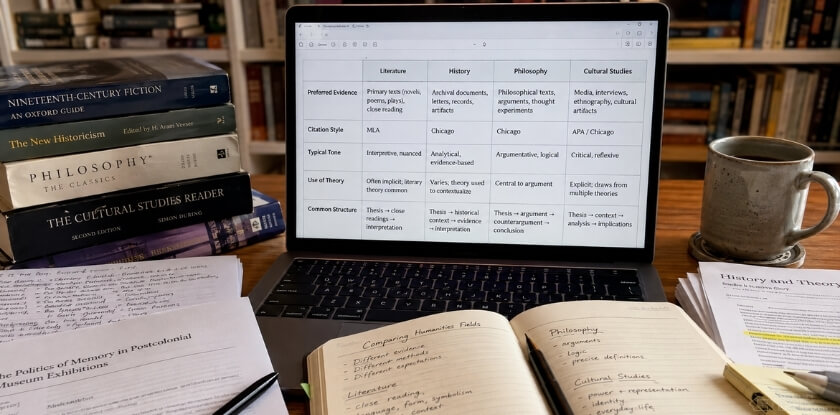
| Field | What the audience listens for | Usual citation system (check the CFP) |
|---|---|---|
| Literature and cultural studies | Sustained close reading with clear interpretive stakes | MLA or Chicago, depending on the venue |
| History | Credible, specific evidence, a story arc and historiographical positioning | Chicago notes and bibliography is widely used |
| Philosophy | A clear logical structure, announced early, with objections and replies | Varies by journal and conference; follow the CFP |
The citation column describes common practice, not a rule. Chicago’s own guide says its notes and bibliography system is preferred by many working in the humanities, including literature, history and the arts, but the conference or journal instructions win.
Literature and Cultural Studies
Close reading is the engine of most papers here, and it usually is the argument. A 15–20 minute slot does not need to survey an author’s career. One scene, chapter or episode read carefully and specifically is entirely appropriate, provided the interpretive stakes are clear.
Theoretical framing matters, but the ratio varies. Cultural studies papers often open with a more sustained theoretical setup before the textual analysis, while literature papers sometimes thread theory in lightly as method. Learn which mode your subfield expects by attending panels and keynotes before you present. Trim quotations to the phrase or line that matters; a run of block quotes read aloud is hard to follow and eats your time.
History
History papers live and die on the specificity and credibility of their evidence. Historians ask where something comes from, so make provenance clear even in speech. That does not mean reciting citations. Acknowledge the source base (“in the correspondence I examined from this period” or “court records from the 1780s show”) and move on. The evidence supports the argument and does not replace it.
Narrative matters more here than in some fields. A good historical paper often has an arc: a problem unfolds, a piece of evidence reframes something, and the conclusion revises how we understand a period or event. You should also signal early where your argument sits against existing scholarship, whether you are complicating a consensus, recovering a neglected case or challenging a prevailing reading.
Philosophy
Philosophy has some of the most distinctive conventions in the humanities. Clarity of argument structure is the dominant expectation, because listeners must follow the logical progression in real time. Announce the structure early and keep to it. “I’ll argue that X, and I’ll do this in three steps” is considered good practice here, not pedestrian.
Objections and replies are part of the genre. It is standard to anticipate a counterargument and answer it inside the paper, not only in the Q&A, because that shows you have tested the position you defend. Philosophy papers also tend to be tighter than those in other fields. One well-developed argument with one or two precise examples almost always beats an ambitious survey, and precision is the mark of quality.
Writing for the Ear: Oral Delivery and Presentation
Most humanities scholars read a complete written script aloud, and the skill is doing that without losing the room. A humanities paper is a written document that has to work as a spoken performance, and your delivery decisions matter as much as the argument.
Reading Aloud, Notes or Memorizing
A scripted text lets you control the argument precisely, stay inside the time slot and produce clean prose that could later appear in proceedings. Reading a full text aloud is the traditional default in literature and cultural studies, history and philosophy alike. Speaking from notes is also accepted, and some historians argue for it: the American Historical Association’s Perspectives published a 1996 viewpoint urging speakers to work from a plan instead of reading. Check the panel’s expectations, and if you have never been to an academic conference, do not assume a TED-style talk is wanted.
Reading badly is one of the fastest ways to lose an audience, though. If your eyes stay on the page, people disconnect. Practise until you know roughly where each paragraph ends so you can glance up regularly, and mark the script with line breaks and pauses. Print it large: 14 point at minimum, and many presenters prefer 16 point with generous line spacing and big page numbers. A standard 12-point, single-spaced manuscript is easy to lose your place in, especially under low room lighting.
Notes work if your argument is tightly structured and you can speak at length without drifting. The risks are going over time, losing precision and wandering from the claim. If you use notes, write the opening and closing sentences in full, since those are the moments where stumbling costs most.
Memorizing a full academic paper is the least practical option. It raises cognitive load, and one forgotten phrase can derail everything. A few people manage it for short papers, but for most first-time presenters it is not worth the gamble.
Managing Nerves and Presentation Anxiety
Presentation anxiety is common among experienced academics, not only first-timers, so nerves do not mean something is wrong. The most effective response is to practise out loud, more than once, with a clock running. Silent read-throughs do not reproduce the physical experience of speaking and consistently underestimate the length. Record yourself once to check your pace, and remember that people tend to read faster on the day than in rehearsal.
- Know the room setup before you arrive. Podium or table? Microphone? For a virtual event, check audio and screen sharing the day before, because technical problems at the start amplify anxiety.
- Breathe before you start. Take one breath before your first sentence and slow the opening by a beat. The audience is settling in too.
- Anchor your opening. Some presenters pick one friendly face for brief eye contact at the start, not to perform to that person but to steady themselves.
Slides, Handouts or No Visuals at All
There is no universal rule, and conventions vary. In many philosophy and literary theory panels, no visual aids is entirely standard. Where primary sources matter, as in close reading, a handout or slide showing the passage helps the audience follow without mentally recalling a text they may not know.
Slides should serve the argument instead of summarizing it. Putting your main claims on slides and reading them aloud creates a distracting double track. Use slides for things the audience must see: a quoted passage, a manuscript image, a map, a table of data, a timeline. Do not build an elaborate deck as a memory crutch. Confidence comes from reading aloud in rehearsal, not from the next bullet point behind you.
Handouts are underused and often better than slides in the humanities. One page can carry your key quotations, foreign-language passages, the title and full citation of your paper and your contact details for later networking. People can take it home, while slides vanish when the session ends. At a virtual event, share the handout as a PDF in the chat or by link. Print enough copies for the expected audience well in advance, because venues rarely have convenient printing nearby. Carry a printed copy of your own text as well, for accessibility reasons and in case the equipment fails.
Handling the Q&A Session
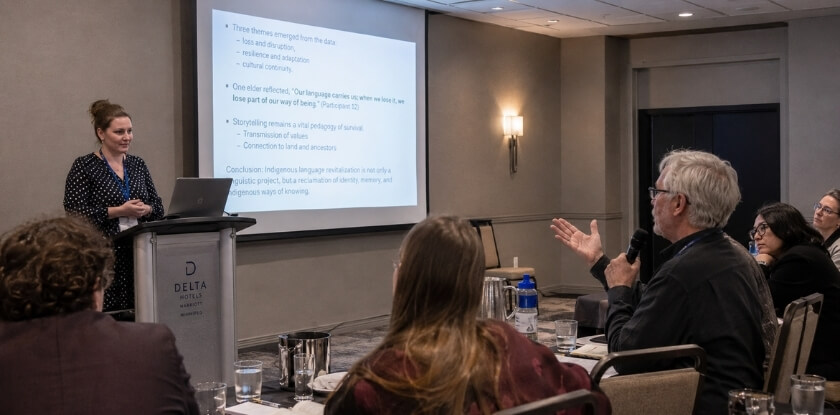
The Q&A is a conversation, not a test you can fail, but it needs different skills from reading a prepared text. Audience members use it to push back, connect your work to their own, ask about a methodological choice or raise counterexamples from their subfield.
What the Q&A Is Really For
In literature and cultural studies, history and philosophy it is also a form of intellectual community. Three habits help from the first question.
- Take the full question before you respond. Let the questioner finish, even if you think you know where they are going.
- Listen for the actual question. Some are long and loop through several moves, and others are arguments dressed as questions. Identify what is really being asked before you answer.
- Buy yourself a moment. “Let me think about that for a second” is acceptable, and no one will hold it against you.
When You Do Not Know the Answer
This happens to everyone, senior scholars included. If someone raises a text, case or framework you do not know, say so directly. Bluffing tends to show, and in a small field it can stick with you.
I don’t know that work well, but I’d like to read it.
If a question exposes a real gap in your argument, acknowledge it without apologizing: “I think that’s where my argument needs more work.” It shows honesty and invites conversation instead of closing it.
Handling Difficult or Hostile Questions
Sometimes a question feels like a challenge: someone disagrees with your framework, finds your method inadequate or thinks you are in the wrong archive. This is a normal part of academic conference culture, not a personal attack.
- Keep your answer focused and short. Identify the specific objection and address it instead of rebuilding your whole argument.
- Disagree gracefully. Across the humanities, and in philosophy especially, “I actually see that differently, and here’s why” is fine. You do not have to concede because someone pushed.
- Know when to defer. If a question opens a large debate, say it may be a longer conversation than the room allows and offer to continue afterward.
Preparing for Questions in Advance
As you write, list the objections you would raise against your own argument. Ask which parts of your reading are most contestable, where the evidence is thinnest and which theoretical commitments others will question. Know where your argument stops: the hardest questions probe the limits of what you claimed, and clear edges let you answer with confidence instead of panic.
If you present to an interdisciplinary panel, expect questions from frameworks you did not use. A historian facing philosophers or cultural studies scholars should decide beforehand how to translate between approaches. Concrete examples help here: the UCR Graduate Writing Center notes that audiences latch onto examples and use them as reference points in the Q&A. Treat the Q&A as part of the paper, because experienced listeners, especially in philosophy and history, use it as the real test of the argument.
Networking and Professional Norms at Academic Conferences
Much of the real intellectual exchange at a conference happens in hallways, at coffee breaks and over dinners, and good networking is simply finding your intellectual community. If you are a first-time presenter that can feel intimidating, but most academics are open to conversation because they remember being new.
How to Approach Other Scholars
- Introduce yourself with context. “I’m a PhD candidate at [university] working on eighteenth-century political pamphlets” gives someone something to respond to. A name alone does not.
- Engage with the papers you attend. If you found an argument on historical memory in postcolonial literature compelling, say so and say why. Specific responses open conversations better than generic compliments.
- Ask questions in panels. A thoughtful, genuinely curious question puts your name and interests in the room for a moment.
After You Present
The conversation does not end when the moderator calls time. People who approach you afterwards are showing interest, so exchange contact details or connect on academia.edu or a similar platform. If someone raises a critique or a source you had not considered, write it down. It may matter if you develop the paper for proceedings or a journal. You do not need a polished answer in the moment:
That’s something I’m still working through, and I’d love to follow up by email.
Professional Norms You Should Know
Humanities conferences have unwritten rules that are rarely explained to graduate students or first-timers.
- Attend other panels, not only your own. Showing up for your slot and leaving is noticed, and it suggests you see the conference as credential-gathering. Other sessions also give you more to talk about.
- Do not read email during presentations. At a virtual event, keeping your camera on and visibly paying attention still shapes the impression you make.
- Credit sources in conversation. “I’ve been thinking a lot with [scholar’s name] on this” is the spoken equivalent of a footnote.
- Treat unpublished work as unpublished. If a colleague presented a paper in progress, do not circulate their ideas without permission, and do not cite a conference paper in your own writing without checking with the author first.
Networking at Virtual Conferences
Hallway conversations do not happen automatically online, so create them: use the conference chat, join scheduled networking sessions and follow up directly with presenters whose work interests you. Email is perfectly acceptable, and a message sent during the conference lands with more context than one sent after inboxes fill up back home.
I attended your paper on [topic] at [conference name] and found your argument about [specific point] useful for my own work on [related topic]. I’d love to stay in touch.
Networking Without Feeling Transactional
The word can sound like collecting contacts for advantage. A better frame is finding the people working on overlapping questions across history, philosophy, literature and cultural studies. The relationships that matter most grow from genuine exchange: a paper with a clear argument, real engagement with other papers on their own terms and follow-up on conversations that interested you. The professional benefits follow from that, not the other way round.
Anxiety makes many first-timers disappear after their panel. You do not need to perform extroversion, but staying to hear questions directed at other presenters, introducing yourself to someone whose work intersects with yours or asking a question in another session are normal behaviours, and people do expect you to be present.
Ethical Considerations: Originality and Avoiding Plagiarism
Conferences run on trust: the audience assumes the argument, interpretations and close reading are yours, and the same originality standards apply as in print. Presenting a paper offers a new argument, application or reading. It does not have to be something no one ever said, because every argument builds on earlier scholarship. What you owe is a genuine contribution.
What Counts as Your Work
Recycling your own writing. Self-plagiarism follows you into conference presentations. If your paper reproduces substantial portions of a journal article you have already published, or you deliver the same work at three conferences without saying so, you are outside standard norms. Most disciplines expect presentations to be work in progress or new directions, not reruns. If material has appeared elsewhere, note it briefly, clearly and early.
Unpublished work. A conference paper is often a testing ground for a journal article or book chapter, and that is entirely appropriate. The originality requirement is about intellectual ownership, not whether the argument has been through peer review.
Collaborative work. If the paper comes out of a collaborative project, say so upfront. Presenting it as solely yours is plain misrepresentation, and conference circles are small enough that it surfaces.
Ideas you heard at conferences. Hearing an argument in a Q&A and then presenting a similar claim elsewhere without acknowledgment is a real hazard, even when the resemblance is accidental. Keep notes on what you hear and where you heard it.
Plagiarism in Close Reading and Quotation
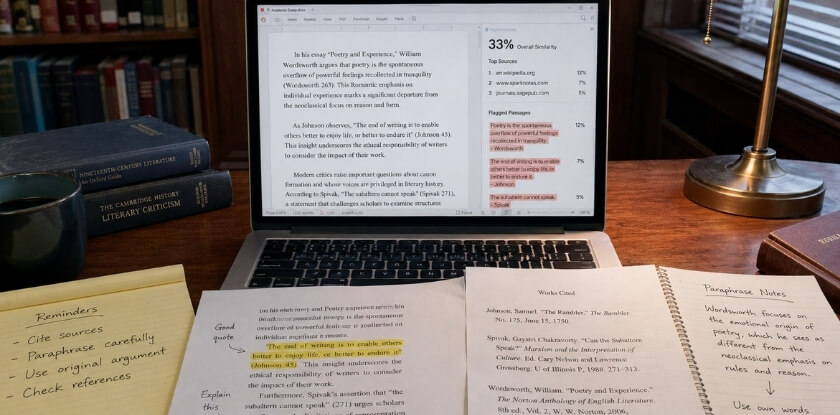
In these fields your evidence is often language, so quotation is standard. The problem arises when the analysis around a quotation mirrors another scholar’s interpretation without acknowledgment. Paraphrasing someone’s close reading without attribution is still plagiarism even if the wording changed, and it can happen accidentally after deep immersion in secondary literature. The fix is note-taking at the research stage: record where an interpretive idea came from, not just where a quotation lives.
Cite clearly in the written version. When speaking, a brief “as [Name] argues” or “following [Name]’s reading” signals attribution. You do not need a formal oral footnote, only acknowledgment of the debt.
The CFP and Originality
When you respond to a call for papers you are implicitly saying the work is original and not already published in substantially similar form. Some CFPs state this and others assume it. Before sending the same abstract or paper to several conferences, check each one’s policy: some fields encourage circulating work in progress and others treat it as a breach of submission norms. For MS International, submitted work must be original and must not have been previously published or be under review elsewhere.
If your paper will appear in proceedings, the originality standard moves closer to that of a journal article. Treat it as a publication and make sure the argument has not already appeared in print.
A Note for First-Time Presenters
Many first-timers worry that presenting unpublished work invites theft. The worry is understandable but usually overstated. Presenting establishes when and where you introduced an idea, and the professional consequences for plagiarizing a presentation are serious. The more practical risk runs the other way: not reading widely enough and accidentally reproducing someone else’s argument. A thorough literature check before you finalize the paper is the best protection.
Submitting Your Paper for Conference Proceedings
Not every conference publishes proceedings, and not every presenter is expected to submit a written version. First check whether the event produces a volume and whether submission is automatic, by invitation or open to all presenters.
What Proceedings Actually Are
Proceedings are a collected publication of papers delivered at a conference, usually peer-reviewed to some degree. In the humanities they sit in a particular tier: in hiring and tenure decisions they often carry less weight than a peer-reviewed journal article, depending on the institution, but they are a legitimate record of your scholarly activity and, for early-career researchers, a useful first publication credit. Some conferences in these fields produce none, others invite only certain presenters, and a few publish everything above a basic quality threshold. At MS International, accepted papers may be considered for conference proceedings where applicable, so it is not automatic.
From Spoken Draft to Written Version
The version you read in 15–20 minutes was written for the ear. A proceedings submission must work as standalone scholarship on the page. That usually means:
- expanding the close reading with fuller evidence and citation;
- adding the footnotes or endnotes that would have cluttered the oral version;
- tightening prose where speech gave you latitude to be loose;
- placing the argument more explicitly in existing scholarship.
You are not writing a journal article, and the argument can stay contained. Editors usually set a firm length cap, so read it before expanding. What you need is for every claim to be supported in writing as it would be in print.
Deadlines, Formatting and Review
Proceedings editors set their own submission deadline after the conference, and missing it can mean exclusion. Read the guidelines before formatting anything. Some proceedings use a specific style (Chicago, MLA, APA or a house style) and an official template. Getting it wrong creates revision requests you could have avoided. If the event was online, the process is usually the same as for an in-person one, though some small online conferences skip proceedings, so check the original call.
The level of review varies a lot. Some proceedings are fully peer-reviewed by external readers, some go through editorial review only and a few get little beyond copyediting. That matters for how you list the item: “peer-reviewed conference proceedings” and “conference proceedings” are not the same credit, and committees read them according to field convention. When in doubt, ask the editors what their review involves.
A last point for first-timers: if the opportunity is there and the paper is solid, submit. It is practice writing for an editorial audience, it gives you a credit and it forces the revision work that feeds a stronger article. Editors of volumes also sometimes approach presenters directly, which is easier when you have already made contact in person or in a conference chat.
Presenting at a Virtual or Online Conference
The intellectual work is identical online, but almost everything about delivery changes, and your voice and pacing carry more weight. In person, ambient energy and eye contact anchor both you and the audience. On a screen that feedback disappears, and listeners are watching a rectangle next to email notifications.
What Changes in a Virtual Format
- Test your audio first. A muffled or echoing microphone costs attention within two minutes. Use a headset or external microphone if the built-in one is poor, record 30 seconds in the room where you will present and play it back.
- Know the platform. Whether it is Zoom, Microsoft Teams, Webex or a dedicated academic platform, learn in advance how screen sharing works, whether you are muted while others present and who controls the recording. Some conferences are fully synchronous, while others are asynchronous and use pre-recorded papers. These are different presentations.
- Keep slides minimal, but do not skip them. A static face on a small screen is harder to stay with than a face plus a clean visual. One or two slides anchoring a key quotation or concept help, and a single clean shared document is often better than a full deck.
- Rehearse with the same setup. The slot does not expand for technical problems. If you read while sharing slides, practise the transitions until they are automatic.
Managing the Q&A Online
Moderators often use a raised-hand function or a chat queue, and you may not see questioners’ faces. Ask the organizer beforehand how questions arrive: typed in chat, unmuted one by one or relayed by a chair. If a question comes as text, read it aloud before answering. That gives you a moment to think, confirms you understood it and keeps the conversation audible to people not watching the chat.
Lag is real, and a half-second delay makes interruptions awkward. Leave a slightly longer pause after each answer so questioners can respond without talking over you. The same principles as in person apply: read the full question, answer what was asked and be direct about uncertainty.
When the Conference Is Asynchronous
Some online conferences ask for a pre-recorded video of your paper, typically 15–20 minutes, with a live Q&A scheduled later. Recording lets you stop and redo a section, which is an advantage, but the risk is over-polishing until it sounds produced instead of spoken. Aim for one clean read-through instead of stitching takes together, which flattens the natural rhythm. Label the file exactly as the organizers’ naming convention says, because they receive many videos and misnamed files get lost.
Practical Tips for a First Online Talk
Presentation anxiety does not disappear online and often grows, because visual feedback is limited. Do not read a quiet screen as a bad sign. Keep the paper open in a large font on the same screen, not a separate device, and place notes as close to the camera lens as you can so your eyeline stays forward. Keep water nearby, since nobody can hand you a glass mid-session.
Turning Your Conference Paper into a Journal Article
A conference paper and a journal article are related but distinct forms, and many humanities scholars treat the conference version as a working draft. The core argument, evidence and close reading often survive intact. What changes is almost everything around them.
What Has to Change
- Scale of the argument. The slot forced compression and gave a partial case. The article must account for counterarguments, secondary literature and the evidence you abbreviated.
- Documentation and citation. Spoken “as Spivak argues” needs a page number in print. Re-source every claim according to your field’s conventions and the journal’s required style.
- Engagement with scholarship. Reviewers expect a literature review or, in philosophy, sustained engagement with the texts you are working against. If you skipped it to save time, build it in now.
- Length and structure. Humanities articles are usually much longer than a spoken paper, often several thousand words, and the oral structure may need sub-headings or a full restructuring. Check the journal’s word limit.
Using Feedback from the Q&A
The Q&A is one of the most useful things to bring into revision. Write down every question, especially those that made you stumble or pointed to a gap. A counterexample or methodological objection from the room often maps onto what a peer reviewer will later raise. If someone asked about a text or scholar you had not addressed, engage with it in the article. Scholars who engaged seriously with your work are sometimes willing to read a draft or suggest journals.
Matching the Right Journal and Checking Prior-Publication Rules
Before revising extensively, identify two or three journals in your area and read their guidelines and recent issues. Some literature journals want a particular theoretical orientation, and history journals vary widely on archival evidence.
Then check how each treats earlier versions. COPE’s guidance asks journals to tell authors whether conference presentations or other early versions disqualify a paper, and policies genuinely vary: some journals treat conference abstracts and presentations as prior publication and others do not. A fully published, widely accessible proceedings version is more likely to be treated as prior publication than a spoken paper or a short abstract. Do not submit the same text to a proceedings editor and a journal at the same time. Disclose the conference version when you submit, revise substantially and, if the policy is unclear, ask the editor before you submit.
The Timeline Reality
Journal review and publication can take many months, and an open-ended timeline can stall revision indefinitely. The conference gave you a fixed deadline. Set your own date for a full draft soon after the conference, because the argument loses momentum once the conference feels distant.
Common Mistakes First-Timers Make (That the Body Did Not Cover)
The mistakes below are practical and specific, the kind that do not appear in advice about argument structure but that experienced attendees notice immediately.
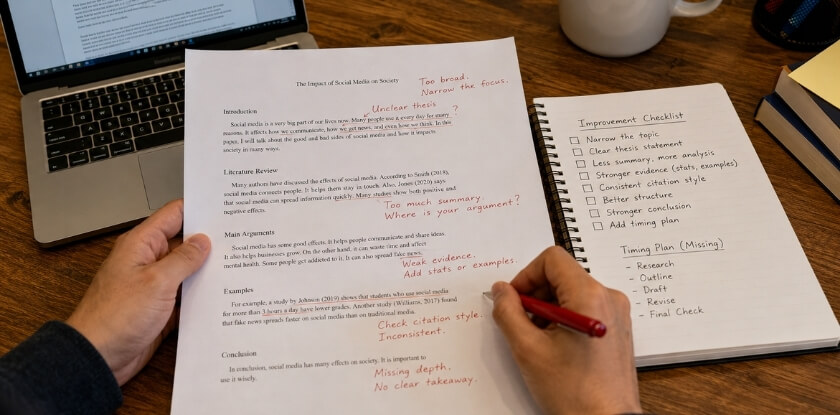
- Leaving the cutting until the last minute. Chairs enforce the limit, especially on back-to-back panels. A longer essay is a fine starting point, but cut it to the slot before you rehearse. If it runs 24 minutes at home, it will not shrink in the room, because pauses, long quotations and slide changes add time.
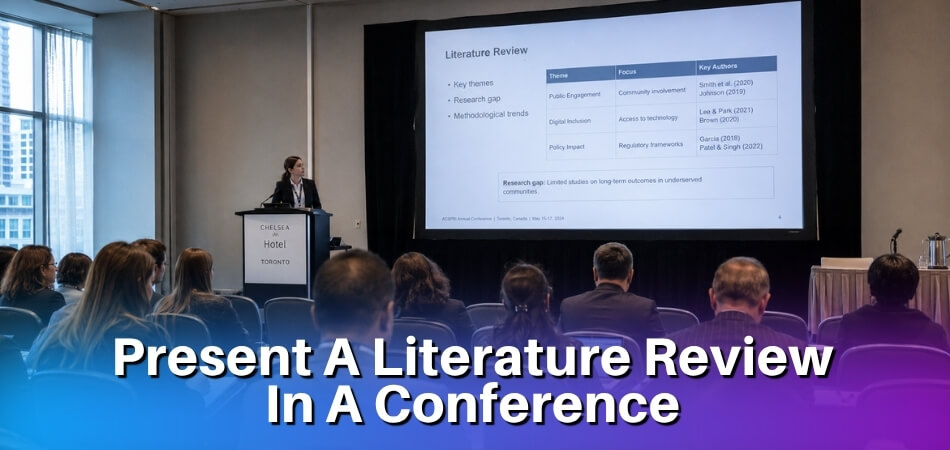
- Reading off slides or giving the paper article density. If your eyes are on the screen, you have broken the oral argument the paper depends on. Likewise, a conference paper is a working document, and loading it with the footnoting and literature review of a finished article makes it undeliverable in 20 minutes. The fuller apparatus belongs in the article. When the review itself is the paper, a literature review presented at a conference works best as a thematic argument, not a source-by-source tour.
- No physical backup. Projectors fail, files will not open and the display setup differs from what was advertised. If you use slides or anything digital, carry a PDF on a USB drive and keep a copy online. For a virtual event, test screen sharing on the platform the conference actually uses.
- An abstract that does not match the paper. Your abstract is a commitment to the programme committee and to the audience that picked your session. Delivering something substantially different in topic or method breaches norms even when unintentional. Arguments develop, so if yours shifted, say so in a line of your introduction.
Since I submitted the abstract, this project has moved toward the second case, so I will spend most of my time there.
From our experience at MS International: we review double-blind, so remove names and identifying self-references from the file, and we ask for APA format and the official template even if your field normally uses MLA or Chicago. Work must be original and not published or under review elsewhere, and most review decisions are returned within about 10 working days. Accepted papers may be considered for conference proceedings where applicable, and we do not claim that proceedings are indexed in any database. Make sure your abstract matches the paper you will actually deliver.
FAQ
Reading word for word or speaking from notes is only one choice a humanities presenter faces; paper length, slides or a handout, finishing early and a tough Q&A question matter too.
How long should a humanities conference paper be?
Plan on about 1,900 to 2,250 words for a 15-minute slot and 2,500 to 3,000 for a 20-minute slot, at a natural pace. Ask the organizers whether the slot includes questions, and aim slightly under so you do not eat into Q&A time.
Do I have to read my paper word for word, or can I speak from notes?
Either is fine: you can read a full script or speak from notes. Reading is the traditional default in the humanities, and speaking from detailed notes is also accepted. Check your panel’s instructions, rehearse aloud either way and look up often, because the argument has to land clearly for listeners.
Can I present a paper I’ve already submitted to a journal?
Usually yes, but the journal’s terms decide. COPE case advice says presenting findings at a conference is ordinarily fine whether or not the article is submitted, accepted or published, but if copyright has passed to the journal, it may limit handing out or reading the article text itself. Some journals treat a published proceedings version as prior publication, so disclose the talk when you submit.
What should I do if I get a question I can’t answer in the Q&A session?
Say so honestly. “I haven’t worked through that fully yet” or “that’s outside the scope of this paper” are legitimate answers, and wild speculation is worse than admitting a gap. You can invite the questioner to follow up afterwards, which doubles as academic networking.
Do I need slides or a handout?
No, neither is required in most humanities settings. A handout helps when the audience needs to follow long quotations or passages, and slides can distract from the language of the argument. Ask the organizers what equipment the room has, then decide by what serves the paper.
What happens if I finish early?
Finishing a minute or two early is fine and often appreciated. If you finish far short of your time, the argument is probably underdeveloped. Do not pad with improvised commentary: use the spare minutes to invite questions sooner.
Is it acceptable to present at a virtual or online conference for my CV?
Yes. Most fields treat online conferences like in-person ones for professional purposes. The paper is the scholarly contribution, and the format of delivery does not diminish it.
What if my paper was rejected by the CFP?
Revise and resubmit elsewhere. A rejection from one call tells you little about the work, since conference fit, panel themes and reviewer priorities vary widely. Many strong papers are placed on the second or third try.
Does presenting a conference paper count as a publication?
Usually not on its own. If the paper appears in proceedings, that may count as a minor publication under your institution’s criteria, but it carries less weight than a peer-reviewed journal article. Check how your department counts these items before your annual review.
How do I handle presentation anxiety before going up to speak?
Rehearse aloud at least twice before the event, ideally timed. Arriving early to look at the room and test audio also helps. Anxiety is common among first-time presenters, and it does not signal that something is wrong.
Should I memorize my paper?
No. If you lose your place, there is nothing to fall back on. Read from your text, and mark it up so you know where to pause, where to slow down and where to look up.
How do I know if my paper is ready to submit to conference proceedings after the event?
If it needs substantial revision before you would be comfortable seeing it in print, revise it first. Proceedings submissions are often lightly reviewed but are still public and citable. Submit work you would stand behind as a snapshot of your thinking.
Final Thoughts
A humanities conference paper compresses months of thinking into one argument that works when spoken to a room of strangers. What carries it is a clear line of argument, language listeners can follow in real time and enough rehearsal to deliver it without burying your face in the page. Give yourself time to draft, to cut and to practise out loud, and treat the Q&A as part of the intellectual work.