
Poor structure is not the worst thing a conference paper can have. The worst is a reviewer who cannot figure out what your contribution actually is. They read three pages, skim the methodology, check the results, and still have no clear sense of what is new, what problem you solved, or why it matters. A paper in that state has a hard time, whatever the grammar, citations or data look like.
Most writing guides hand you a template and leave you to figure out the rest. This guide explains why each section exists, what belongs inside it, and what mistakes quietly sink papers that are otherwise doing solid work. It applies if you are adapting a thesis chapter, writing with colleagues across time zones, or facing a tight page limit for the first time.
Quick answer: To write a conference paper, follow the order reviewers expect: title, abstract, introduction that ends with a clear contribution statement, related work, methodology, results, discussion and conclusion, all inside the conference’s page limit and template. Write the abstract last, state your research gap in one sentence, and read the call for papers for format, deadlines and duplicate submission rules before you start.
Last verified against official sources: October 2026.
A conference paper makes its case within strict page limits and survives review by busy reviewers who judge many submissions. The structure is not arbitrary. Each section answers a question the reviewer is already asking. The abstract signals relevance and scope. The introduction earns attention. The related work proves you know the field. The methodology shows your work is repeatable. Together they build a case that your contribution is real, original, and worth the conference’s time.
What Is a Conference Paper and How Is It Different from a Journal Article
A conference paper is academic writing submitted to a specific conference, presented there as an oral or poster presentation, and usually published in the conference proceedings. It is peer reviewed like a journal article, but it runs on a shorter, tighter schedule.
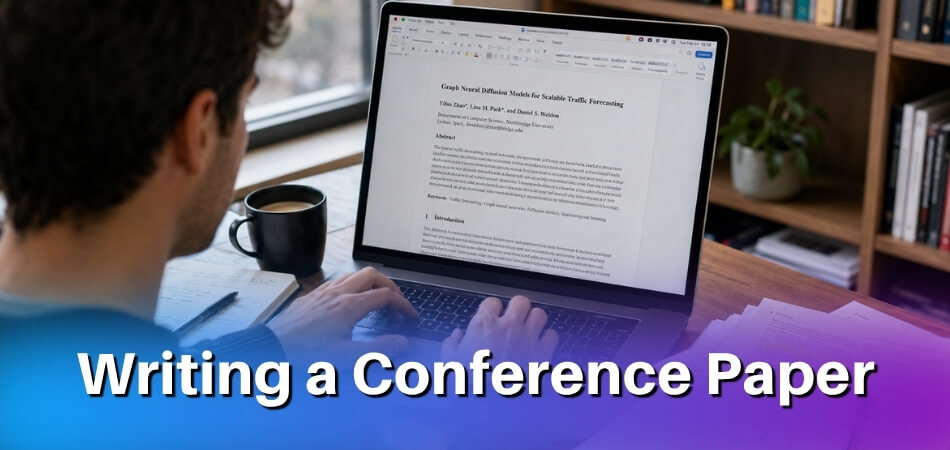
Both document types have abstracts, methodology, results and references. The rules around them differ:
| Feature | Conference paper | Journal article |
|---|---|---|
| Length | Set by the venue; many fall between about 4 and 12 pages | Longer, with limits set by the journal |
| Speed | Reviews back in weeks; presentation often within months | Can take a year or longer to publish |
| Review rounds | Often one round, limited rebuttal | Often several rounds with a formal response letter |
| Reviewers | Set by the program committee | Set by the journal editor |
| Purpose | One focused contribution, feedback, networking | Complete, exhaustive account |
Length and scope
Journal articles give you room for a thorough literature review, exhaustive results, multiple experiments and extended discussion. A conference paper is tighter, so you have to make your point fast. That compression is useful: it forces you to be clear about your contribution, because you have no space to bury it.
Speed to publication
You submit by the deadline, get reviewer feedback in weeks, revise if needed, and present at the conference. For PhD students who need publications on their CV, that speed matters.
Peer review intensity
Conference review is real, but generally lighter than journal review. The review may be single-blind (reviewers know your name; you do not know theirs) or double-blind, where both sides stay anonymous. Journal review is usually more iterative. Lighter does not mean easy: some highly selective conferences in fields like machine learning or systems research accept only a small fraction of submissions.
Originality expectations and duplicate submission rules
Journals prohibit submitting the same paper to two places at once, and most conferences do too. Many conferences also refuse work already published in a journal. Some fields, computer science in particular, accept a short conference paper later becoming a longer journal article, but you must disclose it, add substantial new content, and avoid self-plagiarism. Getting this wrong can lead to retraction and lasting professional damage. The ethics section below covers the details.
Does conference ranking matter?
Yes. A paper accepted at a top-tier conference in your field carries far more weight than one at a minor workshop. In computer science, selective conferences are often a main publication venue and can carry as much weight as journals. In many other fields, conference papers count as preliminary work and journals are the main measure. Know your field’s norms before deciding where to target.
When a conference paper makes sense
Write one when you have preliminary results that are not yet ready for a journal, you want feedback from your research community, you are adapting a thesis chapter into a standalone publication, or you want to present and make connections at the conference itself. None of these reasons require the work to be less serious or less rigorous.
Choosing the Right Conference Before You Submit
Choose a conference whose topics list, ranking, page limit and deadlines fit your paper, and decide before you write your methodology. Picking the wrong venue wastes months: you can write a sound paper, format it perfectly, and still be desk-rejected within days because the venue was the wrong fit.
Understanding a Conference’s Scope and Ranking
Start with scope. Read the call for papers and its topics list, not just the conference name. Then look at papers accepted in the last two or three years. Many conferences post their proceedings, and this shows what the program committee actually values. If your work on graph-based recommendation systems resembles nothing in the last three proceedings, that is a real signal.
Ranking matters, but context matters more. In computer science, CORE rankings (A*, A, B, C) and metrics like the h5-index give a rough quality signal, though neither replaces reading the program and the review process. A well-matched B-ranked conference in your niche often serves a paper better than a reach submission to a venue where your topic is peripheral.
Be honest about where your work sits. Incremental results on a well-studied problem are probably not a fit for top-tier venues. That is strategy, not judgment. Smaller, specialized conferences can offer more field-specific feedback, while very selective ones set a higher bar for what counts as a novel contribution.
If you are adapting a thesis or spinning a chapter off a longer journal article, check the conference’s self-plagiarism policy. Some set a minimum share of new content compared with prior published work, and some forbid duplicate submission outright. At some venues, violations lead to rejection or a ban from future submissions.
Checking Word Count, Page Limits, and Submission Deadlines
Page limits are non-negotiable, and each conference sets its own. Some IEEE-sponsored conferences set a base limit and let you buy extra pages for a per-page fee, while others refuse anything over the cap, so always read the call for papers. Check what the count includes, such as figures, tables and references. Eleven pages for a ten-page limit does not make you look thorough; it can get the paper rejected without review.
Plan a proofreading or editing pass before submission. This is not about proficiency: even highly fluent writers benefit from a second pair of eyes on technical prose, and reviewers do comment on language clarity. Multi-author papers with four or five contributors also need coordination time, and collaborative writing across time zones adds real friction.
Download the template early. Column widths, font sizes and margins change how much fits on a page, and a paper that looks fine in a standard Word document can run two pages over once it is pasted into a double-column template.
Deadlines come in layers. There is often an abstract deadline, sometimes earlier than the full paper deadline, where you register title, authors and a short summary. Missing it can mean you cannot submit the full paper at all. Map the full timeline: abstract deadline, full paper deadline, notification date, camera-ready deadline and the conference itself. Work backward and leave buffer for co-author review. If the deadline is only days away, a two-day conference paper schedule shows how to plan the remaining hours.
Check whether the conference allows or requires supplementary material such as datasets, code or appendices. Some venues limit what reviewers may look at beyond the main submission, which shapes what goes in the paper and what you link externally.
Check whether review is single-blind or double-blind, because it changes how you prepare the file. In double-blind review the call for papers explains how to remove names, affiliations and identifying details, including citations to your own work and file properties, and an anonymity slip can lead to rejection before the technical review starts.
The Complete Structure of a Conference Paper: Step by Step
A conference paper follows a recognizable skeleton: title, abstract, introduction, related work, methodology, results, discussion and conclusion. Reviewers expect it, and deviating without a good reason usually hurts. What matters is executing each section precisely enough that a reader understands what you did, why it matters, and whether to trust the results.
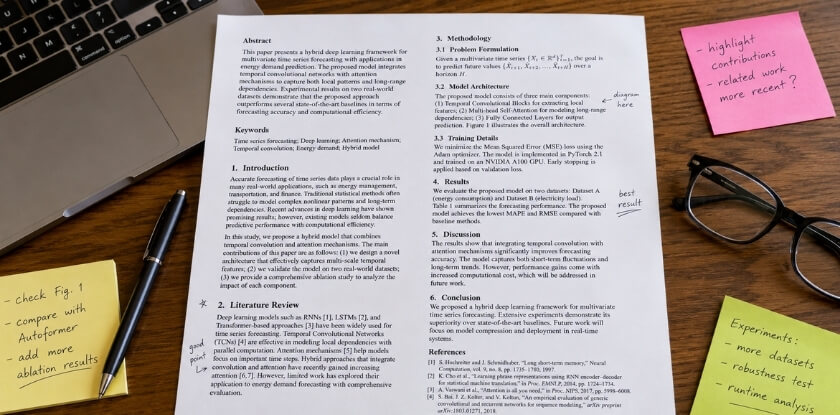
| Section | The question it answers | Relative size in the paper |
|---|---|---|
| Abstract | What is this paper, in 150 to 250 words? | Smallest |
| Introduction | Why does this matter, and what is new? | Small |
| Related work | What exists, and where is the gap? | Small to medium |
| Methodology | What exactly did you do? | Medium |
| Results | What happened? | Largest |
| Discussion and conclusion | What does it mean? | Medium |
The sizes are a rough planning aid, not a rule, and fields differ. Sketch the split first, then adjust to the venue’s limit.
Title: How to Write a Strong, Searchable Title
Your title tells a reader what the paper is about and gets indexed in databases such as IEEE Xplore, the ACM Digital Library or Google Scholar.
Keep it specific. “A Novel Approach to Image Segmentation” says almost nothing. “Boundary-Aware Semantic Segmentation Using Lightweight Transformer Encoders for Real-Time Medical Imaging” names the method, the application and the context. Avoid starting with “A Study of” or “An Investigation into”, which add length without meaning.
Think of the keywords a researcher would type into a search engine, and put them in the title. If the paper introduces a named method or dataset, include the name: it becomes the handle people use to cite you. Check the venue’s formatting rules too, since some set character limits and a title that wraps awkwardly in a two-column layout looks unprofessional.
Abstract: Summarizing the Paper in 150 to 250 Words
The abstract is the hardest 200 words you will write. Venues set their own limit, often somewhere around 150 to 250 words, and committees read dozens in a sitting, so yours must be dense with information. A functional abstract answers four questions in order:
- What is the problem?
- What did you do about it?
- What did you find?
- Why does it matter?
No citations, no lengthy background, no “this paper is organized as follows.” ICMJE’s manuscript guidance notes that abstracts are the only substantive part of an article indexed in many electronic databases and should accurately reflect the article.
Write the abstract last. You cannot summarize a paper you have not finished. Draft a placeholder early, then rewrite it once the results section is done. Finally, read it against your conclusion. If the abstract promises something the conclusion does not deliver, fix it before submission.
Introduction: Identifying the Research Gap and Stating Your Contribution
The introduction moves from broad context to a narrow problem to your solution. Start with two or three sentences on why the problem area matters. Show what existing work has done. Then show what is missing. That gap is your justification for writing the paper at all, and you should be able to state it in one or two sentences. In any field the gap comes from the literature: finding a research gap in civil engineering, for example, starts with recent review articles and the limitations of the newest papers.
Put your contribution statement near the end of the introduction and make it explicit. A short list works if the format allows it:
- We propose X method for Y problem.
- We evaluate it on Z benchmark and, for example, show an improvement over the previous state of the art.
- We release our code and dataset publicly.
That is specific and falsifiable, and it tells the reviewer exactly what to look for in your results. Do not write an introduction that reads like a history lesson. Background is necessary, but the reader needs to see where your paper sits in the field. If the venue asks for a roadmap of sections, keep it to one sentence per section; if not, skip it.
Literature Review / Related Work: Where Your Work Stands
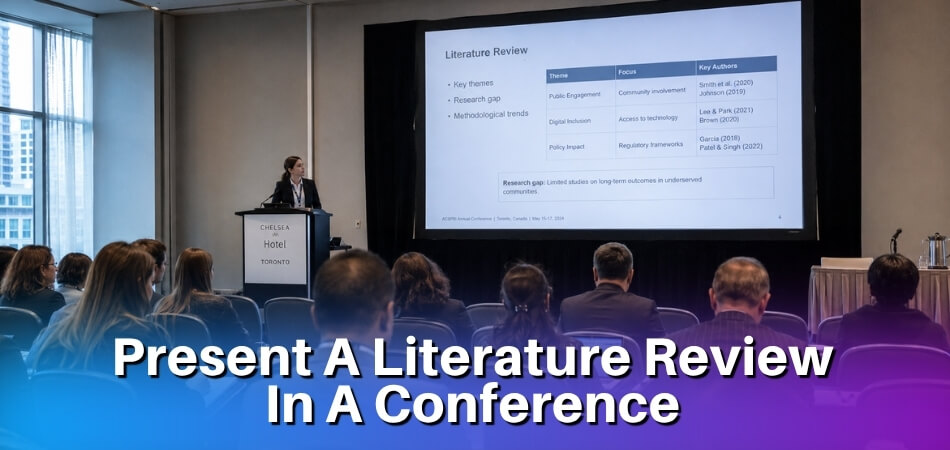
Most conference papers call this section “Related Work”. The label matters less than the function: it shows you know the field and that you are not duplicating something already done.
The common mistake is summarizing papers one by one: “Smith et al. did X. Jones et al. did Y.” That is a bibliography with extra words. Reviewers want synthesis. Group existing work into two or three thematic clusters, characterize each, then note the shared limitation your paper addresses. Be accurate and fair, because you will often be reviewed by the people who wrote the prior work.
The section also shows your citation coverage. If you miss foundational citations that any senior researcher in your area would expect, that is a red flag, so run a quick check in IEEE Xplore or the ACM Digital Library before you finalize it. Keep it proportionate: in a short paper it rarely needs more than a page. If it grows beyond that, you are summarizing too much and comparing too little.
Methodology: Writing a Reproducible and Clear Research Design
This section carries the technical weight. If a reader cannot understand or reproduce what you did, your results are unverifiable, which is a fast path to rejection. Write as if explaining to a capable colleague who was not in the room, and be precise about every decision that could have gone differently: why this dataset, this architecture, this metric.
For experimental papers, include:
- Dataset description (size, source, preprocessing steps)
- Model or algorithm details (enough to reimplement)
- Evaluation metrics and why they are appropriate
- Baselines you compared against, and why they are fair comparisons
For qualitative or human-subjects research, describe the participant sample, data collection procedure and analysis method with the same level of detail.
A system architecture figure or a pipeline flowchart can say in one image what takes three paragraphs. Label every component and reference each figure in the text. Do not selectively report preprocessing steps that would change how your results look, and do not tune on your test set. Reviewers who know the field often notice.
Results: Objective Presentation Using Tables and Figures
Results sections fail in two ways: they drown the reader in unstructured numbers, or they report only the figures that look good. Present results in the order of your research questions. If the introduction poses two questions, answer them in the same sequence.
Use tables for numerical comparisons across conditions or baselines, and figures for trends and distributions. Every table and figure needs a self-contained caption. Report what the numbers are and save interpretation for the discussion. Do not repeat every table or figure value in the text: ICMJE’s manuscript guidance says to point to the table and describe what matters. Negative results are publishable and increasingly valued.
If you are adapting a thesis, remember that thesis result sections are far longer and more discursive than conferences expect. Six pages of tables is not six pages of contribution, so trim hard.
Discussion and Conclusion: Interpretation, Limitations, and Significance
This is where you explain what the results mean, and where many conference papers go thin. Start with interpretation: do the results answer the research questions, and are they what you expected? Then state the limitations honestly, such as dataset size, conditions you did not test, or assumptions that may not hold elsewhere. Close with significance and a clear next step. Avoid conclusions the data do not fully support, a point ICMJE’s guidance makes for the discussion section.
The conclusion should restate the contribution in a sentence or two, matching what the abstract promised, and stop. It is not a place for new results.
Adapting a Thesis or Journal Article into a Conference Paper
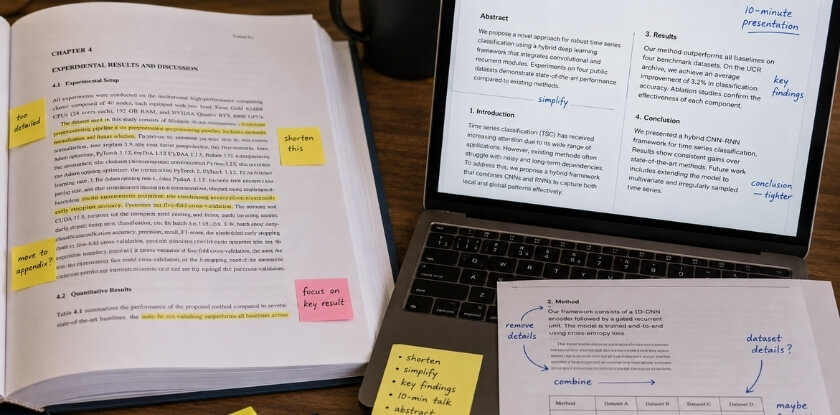
Keep your core contribution, research gap, methodology and key results, and cut everything that only proves competence. Adapting is not copy-paste with a shorter word count: structure, tone and level of detail all shift, and reviewers notice when they do not.
What to Keep and What to Cut
Thesis chapters are written to prove competence. Conference papers are written to communicate a contribution. That difference shows in what you keep.
Cut aggressively:
- Extended background. Two to three paragraphs covering the directly relevant prior work is usually enough for related work.
- Pedagogical explanations written for a committee that may include non-specialists. Conference reviewers in your field do not need them.
- Side experiments unrelated to your main claim. Keep every result, positive or negative, that bears on the claim you make, and leave out only work that tests something else.
- Lengthy appendices and proofs. If a proof is essential, summarize it and cite your thesis or a longer technical report.
Keep carefully:
- Your methodology description, tightened but not gutted. Readers must be able to reproduce your work.
- The result tables and figures that directly support your contribution statement. One strong figure beats three mediocre ones.
- Precise citations in the required format, because sloppy references signal a rushed paper.
Reusing text from your own unpublished thesis is generally fine. Reusing text from a published paper without disclosure is not, and most conferences require that the work is not under review elsewhere at the same time. Check the submission guidelines explicitly.
Strategies for Adjusting Length and Tone
Know your page limit before you start cutting. It includes figures, tables and references. Work section by section with a target length for each, using the relative sizes in the structure table above, and sketch the skeleton first.
Tone is trickier. Thesis writing tends to be hedged, exhaustive and formal. Conference writing can be more direct: make a claim, show evidence, move on. If a sentence only softens another sentence, cut it.
Make sure the adapted paper stands alone. Reviewers will not have your thesis. If the methodology refers to “Chapter 4 of the original study” or figures are numbered from a larger document, fix that. Also keep in mind that language in a thesis is reviewed by advisors over months, while a conference adaptation can feel rushed and expose grammar problems that were hidden before.
Best Practices for Multi-Author and Collaborative Writing
Settle author order and roles before anyone writes, use one master document with version history, and set internal deadlines a week before the real one. “We wrote it together” can mean anything from one person doing everything to a genuine effort across institutions, so the process matters for fairness and for a paper that holds together.
Determining Author Order and Individual Contributions
Author order carries real meaning, so sort it out early, ideally before the first word is written. In many STEM fields the first author did the most work, the last author is typically the senior supervisor or PI, and those in between are roughly ordered by contribution. In some fields, such as mathematics and economics, alphabetical order is standard. Know your field’s convention.
A contribution statement is the cleaner approach. Some venues ask for one, and writing one forces an honest conversation. The CRediT taxonomy, a standard of 14 contributor roles, is a handy framework: conceptualization, methodology, formal analysis, writing (original draft), writing (review and editing) and so on. Assigning them explicitly prevents the later argument about who deserves what.
Have the authorship conversation at the start, not after submission. It is much harder to remove someone’s name after they have seen a draft. Adding someone as a courtesy because they are your supervisor or run the lab is called gift authorship, a recognized research ethics problem. The ICMJE authorship criteria that many journals follow ask for a substantial contribution to the work, drafting or critically reviewing it, final approval, and accountability for it; people who fall short are acknowledged instead of listed. Listing a senior colleague for name recognition without real contribution falls in the same category. If you are adapting a thesis, an advisor who contributed to the original research belongs on the list; one who only approves the submission probably does not, but this depends on your institution.
Designate a corresponding author before submission. They handle reviewer feedback and communicate with the program committee. Also remember that drafting a section does not make someone its “owner”: ownership of ideas and ownership of prose are different, so say so explicitly.
Version Control and Writing Workflow for Teams
The biggest source of chaos is file management. “final_v3_ACTUAL_final_revised_2.docx” is a joke until it costs you a deadline.
- Tool: Overleaf (for LaTeX) or Google Docs. Overleaf has built-in history and works with IEEE and ACM templates; Google Docs is simpler for shorter papers, with comments attached to text. If the team insists on Word, use OneDrive or Dropbox with version history and a naming convention such as
paper_YYYYMMDD_initials.docx. - Master document: one person owns it and integrates changes, especially in the final week. Merging simultaneous edits is a nightmare.
- Internal deadline: if the conference deadline is March 15, your draft-complete date is March 8, leaving a week for integration, formatting, proofreading and the late “I just thought of something.”
- Splitting work: by section, not by random paragraph. Methodology goes to whoever ran the experiments, related work to whoever did the reading. The abstract and contribution statement are a joint effort.
- Decision log: record why you made specific choices in a shared document, chat channel or email thread. Reviewers may ask you to justify decisions made six months earlier.
- Language pass: agree that one fluent English writer does a final pass to smooth sentences, not to overwrite ideas.
Duplicate submission and self-plagiarism rules apply to the whole team, not only the corresponding author. Every co-author should know what version of the work exists elsewhere and what is currently under review. One person’s honest mistake about prior publication can invalidate the entire submission.
Writing Differences Between Oral Presentation and Poster Presentation Papers
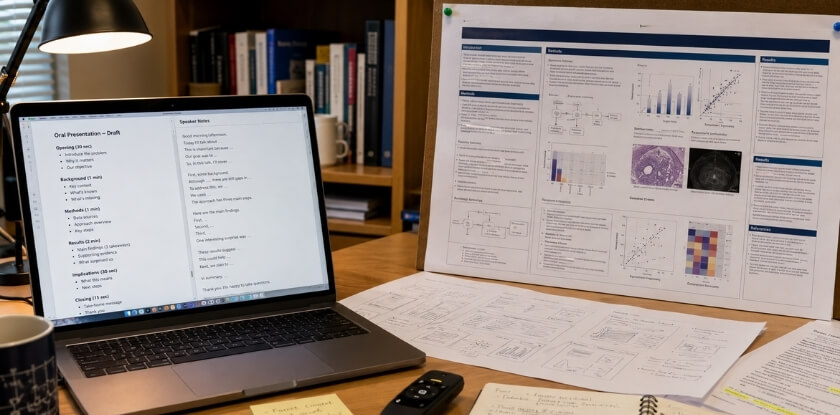
The core structure is the same for both, but an oral paper can lean on the talk to fill gaps, while a poster paper often has to stand completely alone. Conferences may set different page limits for each, so read the call for papers.
| Aspect | Oral paper | Poster paper |
|---|---|---|
| Reader | Reads it before or after your talk | May read it alone, later, with no talk |
| Methods detail | Slightly leaner; the talk explains hard choices | Self-contained; spell out parameter choices and caveats |
| Abstract | Can end with a forward-looking sentence | Complete, a compressed version of the whole paper |
| Figures | Matter, but slides carry the visuals | The paper often builds around one clear figure |
| Language | Delivery can compensate for phrasing | Prose is all there is; shorter paragraphs help |
What Actually Changes, and What Doesn’t
You still need an abstract, an introduction that establishes the research gap, methodology, results and discussion. What changes is emphasis, depth and how you picture the reader. An oral paper gets read once, quickly, before or after your talk, and people want enough detail to follow the argument. A poster paper may be read on a train home after someone scans the QR code or picks up the proceedings, with no talk and no you explaining anything.
Depth and Detail in Each Format
Oral papers can be slightly leaner in methodology, because you explain the harder design choices verbally. “Lean” does not mean vague. Do not cut your contribution statement, do not obscure your evaluation criteria, and do not assume the talk will rescue a weak methods section. Poster papers need more self-contained prose: if your method involves an unusual parameter choice or your results have a caveat, say so in the paper. When space forces cuts, cut related work before methodology and extended discussion before core results.
Writing the Abstract for Each
For an oral paper, you can afford a slightly more forward-looking sentence at the end of the abstract, previewing where the discussion is going. For a poster paper, the abstract should let someone who reads only that understand what you did, how, and what it showed. A poster abstract that only teases the result leaves the reader with nothing. Do not tease.
Figures and Visual Communication
Poster papers live or die on figures. If your main result fits in a clear graph or diagram, build the paper around it and write the surrounding prose to support it. In an oral paper the slides carry the visuals, so the paper’s figures matter less. Either way captions must be complete. “Results on Dataset A” tells the reader almost nothing. A better caption reads:
Accuracy comparison across five baseline models on Dataset A (n=1,200), using 5-fold cross-validation.
Tone and Language
Neither format rewards flowery writing, but poster papers benefit from shorter paragraphs and cleaner sentences, because readers may skim in fragments. Non-native speakers feel this asymmetry sharply: in a talk, strong delivery compensates for imperfect phrasing, while in a poster paper the prose is all there is. Put clarity in results and methodology first.
After Acceptance: Aligning Paper and Presentation
Once you know your slot, reread the paper through the right lens. For an oral slot, check that the introduction sets up the talk you plan. For a poster slot, check that every claim is fully supported on the page. Keep the accepted manuscript separate from the version you annotate for slides or poster layout, so there is no doubt about which file was submitted. The submission deadline usually comes before you know your format, so write the strongest paper first and do a targeted revision pass afterwards. Delivering the talk or standing at the poster is a separate skill from writing the paper.
Writing Tips for Non-Native English Speakers
Write the ideas first, fix the language second, and ask a fluent reader to check clarity. Imperfect grammar is easier for a reviewer to forgive than an argument they cannot follow, so clarity comes first.
Get the Ideas Down First, Then Fix the Language
Do not try to write perfect English on the first pass. It slows you down and breaks your thinking. Write the methodology in rough English, get the logic right, then refine. A tool like Grammarly or LanguageTool can catch basic errors afterwards, such as subject-verb agreement, article usage and run-on sentences.
Three Problem Areas to Check
Articles (a, an, the). This trips up speakers of many languages, and English article rules are genuinely inconsistent. Reading many published papers in your field helps you absorb the patterns, and Purdue OWL has a free guide to article usage.
Verb tense consistency. Past tense is standard for what you did (“We trained the model on…”). Present tense is for established facts (“The algorithm runs in O(n log n) time”). Decide on a convention and check it during revision.
Hedging language. Academic English uses qualifiers such as “suggests”, “indicates” and “may contribute to”. Non-native writers can over-hedge or under-hedge. Match the confidence of your language to the strength of your evidence.
Work With a Native Speaker, But Carefully
Ask a native speaker to flag sentences that read awkwardly, and be clear that you want language feedback, not content feedback. Someone outside your field may “correct” technical phrasing that is right in context, so understand each edit before accepting it. If your institution has an academic writing center, use it; many offer free review for non-native speakers.
Citation Style and Formatting Are Not Optional
IEEE and ACM styles have specific rules about author name order, journal abbreviations, punctuation and capitalization, and malformed references cost you credibility quickly. Use a reference manager such as Zotero, Mendeley or BibTeX with LaTeX. Pull citation data from the ACM Digital Library or IEEE Xplore, because those exports are usually correctly formatted, and do not type references by hand.
Simple Sentences Are Not Weak Sentences
Academic writing does not require long, complex sentences. Short, direct sentences are harder to misread. “The model outperformed the baseline by 4.2% on F1 score” beats “It was observed that the proposed model demonstrated a superior performance relative to the established baseline across the F1 score metric by approximately 4.2%.” If you are unsure a long sentence is clear, split it.
Before You Submit
Do a final read-through for language only, ideally out loud, since sentences that are hard to say are usually hard to read. Check the page limit once more: papers squeezed in with font tricks or shrunk margins signal carelessness. Build in at least two days before the deadline for language polishing and formatting, because one day is rarely enough.
Ethics and Plagiarism: Common Problems in Conference Papers
The main problems are self-plagiarism, duplicate submission, careless citation and data manipulation. Reviewers and program committees take them seriously, and the consequences can be lasting.
Self-Plagiarism and Duplicate Submission
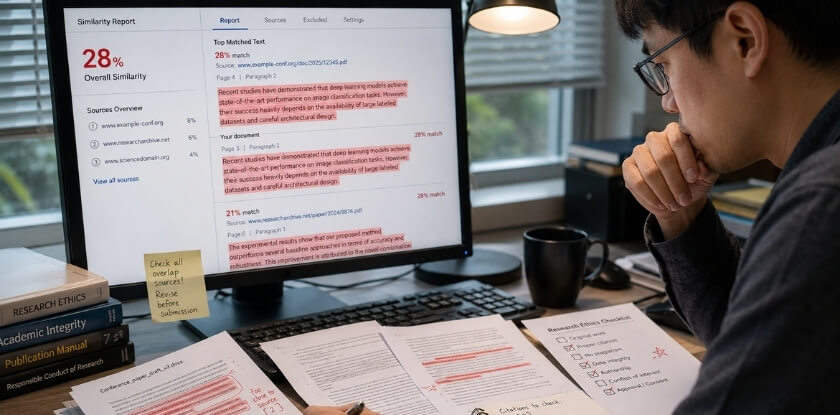
Self-plagiarism catches out authors who do not realize that reusing their own text is still a problem. If you published it before, you cannot republish it as new work without disclosure. That applies to your thesis, journal articles and workshop papers. The words are yours, but the publisher may hold the copyright.
Duplicate submission is a separate and harder violation. Submitting the same paper to two conferences at once is prohibited by most conferences and major publishers, with narrow exceptions only where a venue says otherwise. Submission systems often ask you to confirm you are not doing it, and some venues check for overlap with other submissions and published work. The result can be desk rejection or, at some venues, a ban from future submissions.
Adapting a thesis is fine and common, but “adapting” means writing a new focused contribution, not copying three pages of your methodology chapter under a new title. Run your draft through a plagiarism checker such as iThenticate before submission, to catch passages you forgot you had used elsewhere.
The grey area is extended work. If your paper extends a workshop or short paper, cite that earlier work and explain what is new. Some conferences allow this and some do not, so read the call for papers, and if it is unclear, email the program chair. For journal versions, ACM and IEEE both treat the conference-to-journal path as legitimate when the journal paper adds substantial new material and cites the conference version. What counts as substantial is set by each journal or society, and some state a minimum share of new content, so read the target journal’s instructions. ICMJE’s rules on duplicate publication also expect authors to disclose related earlier work when they submit. Keep a changelog of what changed, since it is easy to reintroduce text that was cut for plagiarism reasons.
Citation Ethics and Data Integrity
Bad citation practice ranges from sloppy to fraudulent. Cite what you actually read: citation chains where nobody checked the original source spread errors. Go back to the primary source and verify it says what you think it says. A wrong year or misspelled author name will not get a paper rejected, but a citation that does not support its claim might raise flags.
Ghost citations, added to pad the list or flatter a likely reviewer, are an integrity issue. So is the opposite: omitting competing work to make your contribution look more original. Reviewers in your area may notice and call it out.
Do not fabricate results, report only the experiments that worked, or adjust figures without disclosing it. Fabricated or selectively reported results are treated as serious misconduct and can lead to retraction. If a reviewer raises a data integrity concern, take it seriously even if you believe they are wrong: acknowledge the concern, explain your methodology clearly and offer to add detail. Getting defensive rarely helps, while being precise does.
Handling Reviewer Feedback and Revising Your Paper
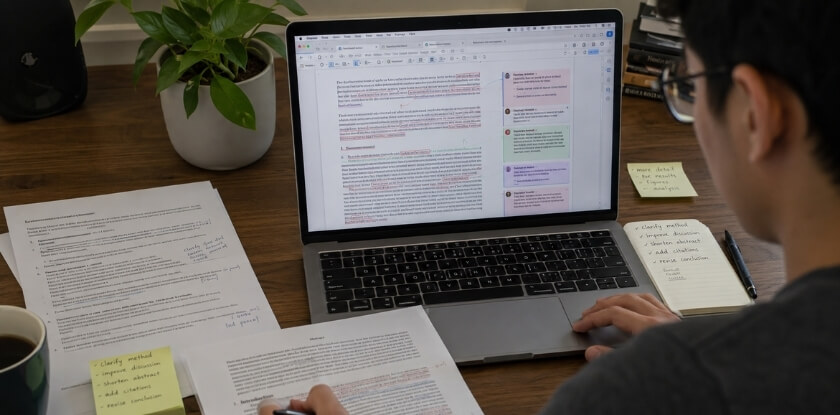
Wait a few hours, number every comment, answer each one in a point-by-point response letter, and show where the paper changed. Authors can lose ground here not because the research is weak, but because they misread what reviewers want or write a response that makes things worse.
How to Read and Interpret Reviewer Comments Correctly
Do not read feedback the moment it arrives if you are frustrated. Wait a few hours, then go through it with a notebook. Most reviewers are trying to improve the paper, and even harsh comments often point at a real problem. Work out the underlying concern, not just the surface wording.
Most comments fall into a few categories: factual objections (“your comparison ignores X method”), clarity issues (“it is unclear how the threshold was selected”), scope concerns, and requests for more evidence. Treat each separately, and number every point even if the review looks disorganized. Skipping even a minor comment signals carelessness.
Some comments will contradict each other. You need not satisfy every demand, but acknowledge the tension and explain your choice:
Reviewer 1 suggested expanding Section 3, while Reviewer 2 recommended cutting it for space. We trimmed the theoretical background but retained the core derivation to stay within the page limit while preserving methodological clarity.
Separate mandatory revisions from suggestions. “The authors must clarify” or “this claim is unsupported” needs a fix. “It would be interesting to see” is often optional, though acknowledging it still helps. Pay special attention to comments on your contribution statement, literature review or research gap, which often drive the decision and are among the most fixable. If a reviewer says your related work “doesn’t engage with recent literature”, that is a concrete instruction to add citations, usually from the last two to three years.
Writing an Effective Response Letter
A response letter is not a formality. Where a conference allows a revision round, it is how reviewers and chairs judge whether you took their concerns seriously.
- Open with one or two sentences thanking the reviewers.
- Restate each comment briefly in your own words.
- Explain what you changed, or why you did not.
- Point to the exact place in the revised manuscript.
Be specific. Not “we updated the methodology section” but:
We revised Section 3.2 (page 6) to clarify the parameter selection process.
If you disagree, acknowledge the concern as legitimate, then give evidence: a citation, a calculation or your own data. “We respectfully disagree” followed by a concrete explanation works. A dismissive one-liner does not. Be honest about what you changed and what you did not. If you could not run an additional experiment because of time or resources, say so and explain what you did instead.
Mirror the reviewer’s numbering and avoid walls of text. A two-column table, comment on the left and response on the right, works well when there are many comments. With several authors, one person writes the first full draft and the others review it, since letters written by committee can read as inconsistent and hedged.
Finally, watch the revision deadline, which can be short. Keep clearly labeled files such as revision_v1 and revision_v2, plus a tracked-changes version if the conference requires one, and double-check that you upload the right file, because there is rarely a way to fix it afterwards.
FAQ
Drafting a conference paper brings decisions beyond the structure itself, from stating the research gap and a modest contribution to author order, citation style, version control and when to start before the deadline.
How long should a conference paper be?
It depends on the conference: the call for papers sets the page limit. The count may include figures, tables and references. Some conferences allow extra pages for a fee, and others reject papers over the cap. Going over the limit can mean rejection before review.
What sections should a conference paper have?
A standard conference paper has a title, abstract, introduction, related work, methodology, results, discussion, conclusion and references. Some venues merge or rename sections, so the call for papers and template decide. Check them before you outline.
Is a conference paper the same as a journal article?
No. A journal article is usually longer, more exhaustive and goes through multiple revision rounds. A conference paper presents one focused contribution under tighter limits and a faster turnaround. They serve different purposes, and one does not replace the other.
Can I submit the same paper to two conferences at once?
No. Most conferences and major publishers prohibit submitting the same paper to two venues at once, and both submissions can be rejected. Submit to one venue at a time, and resubmit elsewhere only after a rejection or a formal withdrawal. If a policy is unclear, ask the program chair.
What is the difference between self-plagiarism and expanding your own work?
Self-plagiarism is reusing substantial text or results from your own published work without disclosure. Expanding your work is fine when you cite the earlier paper and show clearly what is new; the target journal or conference sets how much new material it expects. Copying paragraphs from a published paper without attribution is not.
How do I write a contribution statement if my results are modest?
Be honest and specific. A modest result can still be a valid contribution. “We show that method X outperforms method Y on dataset Z under low-resource conditions” is a solid statement. Reviewers value precision over inflated claims.
My paper got rejected. Should I resubmit it unchanged?
Not unchanged. Reviewer feedback, even from a rejection, usually points to real weaknesses. Address the concerns and revise before sending it to the next conference, or you risk hitting the same blind spots again.
Does author order matter?
Yes, and conventions vary by field. In many computer science and engineering papers the first author did the most work and the last is the senior researcher. Settle order early, because it is much harder to negotiate after the work is done.
Should I write differently for a poster than for an oral presentation?
Slightly. The written paper is often the same document submitted to the same proceedings, and reviewers assess the text, not your slides. Poster papers need more self-contained prose and clearer figures, while oral papers need a narrative that holds up when spoken.
Is the abstract really that important?
Yes. It is often the first thing a reviewer reads and the only part many readers see in a digital library. It should state the problem, your approach and your key result in about 150 to 250 words, or whatever limit the conference sets.
What citation style should I use?
Use whatever the conference specifies. Many computer science and engineering conferences use IEEE style, ACM venues use ACM’s reference style, and some humanities-adjacent conferences accept APA or Chicago. MS International asks for APA. The wrong style rarely causes rejection, but it signals carelessness.
I’m a non-native English speaker. How do I handle language quality?
Write clearly and simply. Grammar tools catch surface errors but not structural awkwardness, so ask a fluent reader in your field to review one section. Imperfect grammar matters less when the science is clear, but genuinely confusing writing gets flagged.
How do I know if a conference is worth submitting to?
Check where its proceedings are indexed, look at the program committee, and see who published there recently. Rankings such as CORE give letter grades to computing venues. Be skeptical of any conference with high fees and no clear review process, or one that sends acceptance emails within days.
Do I really need to state the research gap explicitly?
Yes. The research gap is the space between what existing work has done and what your paper addresses, and it justifies the paper’s existence. State it at the end of the introduction or related work, before the methodology. Without it, reviewers wonder why the paper needed to be written.
How do I handle version control on a collaborative paper?
Use a shared platform from day one. Overleaf is the usual choice for LaTeX papers, and in Word you should agree a strict file-naming convention and name one person to merge changes. Conflicts in the document are usually less damaging than conflicts between co-authors about which version is current.
How early should I start writing relative to the submission deadline?
Earlier than you think. Work backward from the full paper deadline, allow more time for a paper written from scratch than for a thesis adaptation, and keep the final week for polishing, not drafting.
Conclusion: Your First Conference Paper, Start Today
The conventions of a conference paper are specific and largely unwritten, which is why a first submission can feel hard. Once you understand what each section does, the writing gets easier.
From our experience at MS International: our author submission page asks for APA format, and papers are reviewed double-blind. Full papers normally run four to twelve pages, including tables, figures, references and appendices, and the work must be original and not published or under review elsewhere. Most review decisions come within about 10 working days, as an acceptance, revision request or rejection. Accepted papers presented in person at our Greater Toronto Area conferences may be considered for conference proceedings where applicable, but acceptance alone does not guarantee publication.
Start with a clear research gap. If you cannot name it in one sentence, go back to your literature review. Put the contribution statement where reviewers find it immediately, check the page limit and template early, and spend an hour confirming the venue fits before you spend forty hours polishing for the wrong audience. A poster track is a different format, not a consolation prize.
Your first paper will not be perfect, and that is fine. The goal is to get your work in front of the right people in a form that communicates your contribution clearly and honestly. Pick a deadline, open the template, write the abstract last, and go from there.