
You just presented a conference paper, and before adding it to your CV one question stops you: does this actually count as a publication?
Quick answer: Yes, a full conference paper counts as a publication when it appears in peer-reviewed proceedings. How much it counts depends on your field, the venue’s review and indexing, and who is reading your CV. Computer science and engineering committees often weigh it close to a journal article, while humanities and social science committees usually put journal articles first.
Last verified against official sources: October 2026.
The gap between “technically a publication” and “counts for something useful” is where many early-career researchers get into trouble. They list a conference paper exactly like a journal article, assume it carries the same authority on the academic job market, and then wonder why tenure reviewers or grant panels are not impressed. This guide covers the questions that follow: peer review, field norms, indexing in Scopus, Web of Science or Google Scholar, duplicate submission when you expand the paper into a journal article, and how the paper should appear on a CV.
This article is about a full paper in published proceedings. If you only gave a talk or presented a poster, the question is different: a presentation is usually listed as a presentation, not a publication.
Why the Answer Depends on Your Field and Who Is Asking
A peer-reviewed paper in published proceedings is a publication, but how much it counts depends on your field, your career stage and who is assessing it.
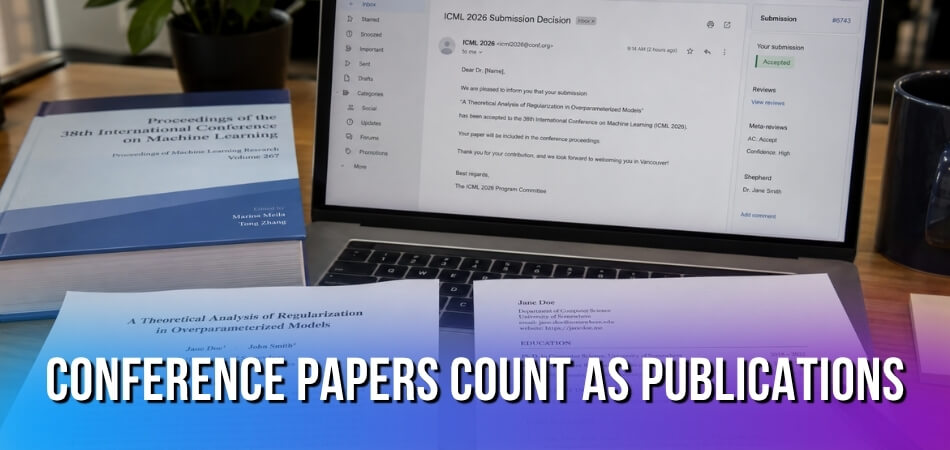
If your paper went through review, was accepted and appears in a proceedings volume, it exists in the scholarly record and is a publication by almost any reasonable definition. The confusion comes from how different audiences treat it. A promotion committee in Psychology or Social Science may mentally mark it down because it is not a journal article. A Computer Science or Engineering hiring panel may weight it equally, sometimes higher, because top venues such as NeurIPS or ICSE carry great prestige in those fields. Same paper, different reception.
So the real question is not whether it counts. It is how much it counts, and to whom. Three things affect this in practice:
- Peer review matters. A paper in reviewed proceedings carries more weight than one from a conference that accepted everything submitted. Look for the venue’s published acceptance rate.
- Indexing matters. If the proceedings are in Scopus or Web of Science, most funding agencies and PhD committees will accept the paper without hesitation. If it only appears on a conference website, expect more scrutiny.
- Duplication matters. Many fields expect an expanded journal version of a strong conference paper, but publishing substantially identical work twice without disclosure is an ethics problem (see the duplicate publication section below).
On your CV, list conference papers, but list them separately from journal articles. Transparency matters more than the count.
Peer-Reviewed vs Non-Peer-Reviewed Conference Papers: Why the Distinction Matters
The biggest factor separating a conference paper that counts from one that does not is whether it went through genuine peer review. Conference organizers rarely advertise themselves as non-reviewed, and the line between “reviewed” and “rubber-stamped” is blurrier than most academics admit.
How to Identify Peer-Reviewed Conference Proceedings
Check the submission process on the conference website. A genuinely peer-reviewed conference will usually show:
- A defined review timeline with more than one reviewer assigned to each submission
- A published acceptance rate (competitive venues often list one)
- A program committee with named academics from recognizable institutions
- Author notification that includes reviewer comments, not just accept or reject
If the site promises a decision within 48 to 72 hours of submission, that is a desk check at best, not peer review.
Indexing is a useful second signal. Scopus and Web of Science apply selection criteria to the proceedings they cover, so being in them suggests a review process existed. Google Scholar is different: it collects scholarly-looking files automatically, so appearing there tells you nothing about review quality.
Field context matters too. In Computer Science and Engineering, major IEEE and ACM conferences run rigorous review, and many use double-blind review, though practice varies by conference. In Social Science, Psychology and the Humanities, conference papers are more often works in progress, and full peer-reviewed proceedings are less standard.
Finally, look at the proceedings publisher. A volume published through a recognized series such as ACM Digital Library, IEEE Xplore or Springer’s Lecture Notes series is a stronger credibility signal than a PDF on the conference’s own domain. Publishers still decide volume by volume, so check the specific volume.
Limitations of Non-Peer-Reviewed Conference Papers
They still have value. A non-peer-reviewed conference paper is useful for showcasing active research, getting early feedback and building a record of conference activity. On a CV for a PhD application, listing it is entirely appropriate as long as you are honest about what it is.
The problem is misrepresentation. Listing a non-reviewed paper under “Peer-Reviewed Publications” is the kind of thing tenure and academic job market committees can spot, and one inflated line can raise questions about the rest of your record.
Research grant and funding agency forms are more direct. Many specify “peer-reviewed publications” in their eligibility or scoring rules, and a paper from a no-review, pay-to-attend conference does not meet that wording, however the proceedings are formatted. Such papers also often fall outside Scopus and Web of Science, so they may not appear in the citation counts that promotion committees use.
If you cannot verify that your paper had real review with identifiable reviewers and documented criteria, do not dress it up as something it is not.
How Conference Paper Importance Varies by Field and Discipline
“Is a conference paper a publication?” has no universal answer. The same paper, venue and review process can be career-defining in one discipline and barely noticed in another.
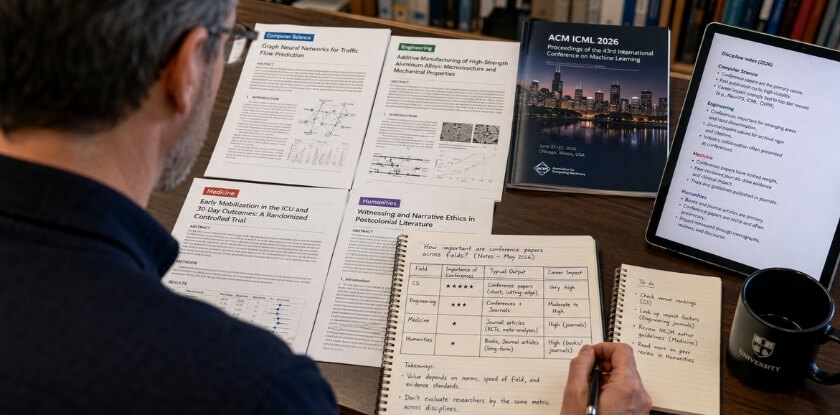
| Field | Usual view of a peer-reviewed conference paper | What carries the most weight |
| Computer Science, most Engineering | A primary research output, often equal to a journal article | Flagship conference papers and strong journals |
| Social Science, Psychology | Supporting evidence of engagement; mixed recognition | Peer-reviewed journal articles |
| Humanities, Arts | Early-stage work or a road-test for ideas | Journal articles and books; juried work in the arts |
Computer Science and Engineering: Where Conference Papers Equal Journal Articles
In CS and most Engineering subfields, conference papers are not second-tier. They are often the primary currency of research output, and that has been part of the culture for decades.
Top venues such as NeurIPS, ICML, CVPR, SIGCOMM and SOSP are highly selective, with rigorous review, and their proceedings are widely indexed. Many CS departments evaluate such papers with the same weight as journal articles, sometimes more.
The field has put this in writing. The Computing Research Association’s best-practice memo on evaluating computer scientists and engineers for promotion and tenure, approved in August 1999, says that for experimentalists conference publication is preferred to journal publication. It gives shorter time to print, a chance to present to peers and, typically, more reviews per paper as reasons. It is guidance for the field, not a rule, so your own department’s criteria still decide.
Speed is part of the reason. Computer Science moves fast, and a conference cycle gets work out sooner than a typical journal process, which matters when last year’s benchmark is already obsolete. For an academic job or a research grant in machine learning, a strong conference paper list is not a consolation prize.
Not all conference papers are equal even within CS. A workshop paper at a small regional event is not the same as a full paper at a flagship venue, so make that clear on your CV.
Social Science and Psychology: Moderate and Mixed Recognition
These fields sit in the middle, and “mixed” is the right word because they have not standardized their view of conference papers.
Journal articles dominate. A peer-reviewed article in a respected outlet, indexed in Web of Science or Scopus, is the benchmark output most promotion committees and funding agencies expect. Conference papers supplement that record and rarely substitute for it.
That does not make presenting worthless. Psychology meetings such as APA or APS attract serious researchers, and presenting there signals active engagement. But most such presentations do not result in published proceedings, so no citable, indexed artifact is left behind. Where peer-reviewed proceedings do exist in adjacent areas such as communication studies or some branches of sociology, they are taken more seriously, but a committee will still count your journal articles first.
Humanities and Arts: Where the Journal Article Still Reigns Supreme
In the Humanities and Arts the hierarchy is not subtle. The peer-reviewed journal article, ideally in an established journal, is the main unit of scholarly output, and for many departments a monograph from a reputable press sits at the top.
Part of this is structural. Many Humanities conferences produce no formal proceedings: you submit an abstract, read a paper, and the written version may never be published. What appears on a CV as a “conference paper” is then often an oral paper with no independent indexed existence, which is very different from how CS handles proceedings. Where written proceedings do exist, they are less consistently indexed in Scopus or Web of Science than in STEM fields. Google Scholar may pick them up, but citation counts in these fields are low by STEM standards, so indexing is a weaker proxy for quality.
Conference activity still matters for community engagement and for road-testing ideas before they become articles, but it will not carry a promotion case alone. In the Arts, a juried exhibition or performance may count for more than any written paper. If your Humanities paper was later published in proceedings, list it accurately: do not inflate it into a journal publication, and do not dismiss it either.
How Universities, Funding Agencies, and Promotion Committees Evaluate Conference Papers
Evaluators weigh publications rather than count them, and the written rules of your own institution or funder matter more than general advice.

The Weight of Conference Papers in Tenure and Promotion Decisions
At most research universities, a tenure committee looks at the quality and standing of outputs, not just their number. In CS departments, a strong proceedings paper from a top venue is widely treated as equivalent to a journal article, and the committee considers where the conference sits in the field’s informal ranking. In Psychology, Social Science and the Humanities, conference papers are expected but do not replace journal publications in a tenure file.
Practical points:
- Many tenure guidelines list publication categories (refereed journal articles, book chapters, conference papers) and weight them separately. Read your institution’s faculty handbook before assuming anything.
- Peer-reviewed proceedings indexed in Scopus or Web of Science tend to be treated more seriously than non-indexed papers, even within one institution.
- Search committees at research-intensive universities may discount a list heavy on conference papers and thin on journal articles, unless you are in CS or Engineering.
Conference papers count, but rarely equally. Ask your department chair or a recently tenured colleague how your committee reads them.
Do Conference Papers Count in Research Grant and Funding Applications?
Yes, with conditions that vary by funding agency and grant type. Your publication list is part of your track record, and each agency, whether a national funder or an international programme, publishes its own guidance on what it accepts, so read the call text.
Peer-reviewed proceedings give reviewers something to evaluate, especially when the paper is indexed or has citations. A paper from a small unindexed workshop is harder to assess and carries less weight. Points that matter in grant contexts:
- Full papers vs. abstracts. Reviewers often distinguish them. An abstract accepted to a conference is not the same as a full peer-reviewed paper in published proceedings, so list them separately in your grant bibliography.
- Related outputs. If a conference paper and a journal article cover substantially the same work, listing both as separate achievements can raise questions about your real output. Say how they relate.
- Field expectations carry over. An Engineering or CS applicant with strong proceedings from top venues looks productive. A Psychology applicant whose record is mostly conference papers may face harder questions about research maturity.
Funders generally weight peer-reviewed journal articles more heavily, but in CS and Engineering, high-impact conference papers that are indexed and cited support your case. Conference papers help when they are peer-reviewed, indexed and clearly described. They hurt when they are padded, miscategorized or used to hide a thin journal record.
Citation and Indexing: Scopus, Web of Science, and Google Scholar
A conference paper “counts” in the formal sense when someone can find it and cite it in a way that gets tracked, and that is what indexing decides.
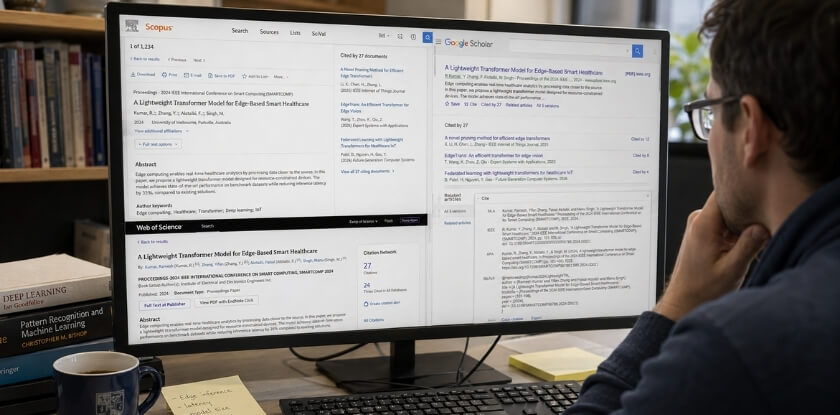
| Database | Coverage of conference papers | What committees read into it |
| Scopus | Selected proceedings that publish full papers; meeting-abstract-only events are not usually covered | Formal indexed output |
| Web of Science | Selected proceedings in the Conference Proceedings Citation Index, chosen volume by volume | Formal indexed output |
| Google Scholar | Broad automatic coverage of repositories, author pages and preprint servers | Visibility and citation counts, but softer evidence |
What Gets Indexed and What Does Not
Not all conference papers end up in citation databases. A paper from a small workshop with no published proceedings might exist only as a PDF on an organizer’s site, and it will not appear in Scopus or Web of Science, or in Google Scholar unless it is posted somewhere crawlable.
Proceedings published through IEEE Xplore, the ACM Digital Library or Springer’s conference series are more likely to be indexed, but being published there is not a guarantee. Scopus and Web of Science cover major proceedings in Computer Science, Engineering and related fields selectively. If your paper lands in a covered volume, it gets a DOI and citation tracking and behaves much like a journal article for discoverability.
Scopus and Web of Science: The Institutional Standard
When a tenure review or grant application asks for “indexed publications”, it usually means Scopus and Web of Science. Both cover selected conference proceedings, with caveats. Clarivate states that proceedings are selected at the level of the volume, not the event, so coverage of a conference one year does not guarantee the next year’s volume. Scopus covers conferences that publish full-text papers rather than abstracts only. Its own description says conference material enters either as a special issue of a regular journal or as a dedicated proceedings title, and a proceedings book can hold full papers or only abstracts, so check which one your volume is.
In Engineering, Chemistry, Physics and Computer Science, a paper in a covered volume can sit beside journal articles on your list without awkward asterisks. In Social Science, Psychology and the Humanities, indexing is far less consistent: a psychology conference may produce an abstract book that no major database ever picks up.
What Google Scholar Actually Tells You
Google Scholar is most useful for citation counts. If your conference paper has been cited, Scholar will show it even when the paper is indexed nowhere more formal. In Computer Science many conference papers are cited heavily, and on a job or PhD application that evidence is worth showing.
But Scholar citations without formal indexing are softer evidence. They help; they do not replace an indexed proceedings record when formal criteria require one. Google Scholar also groups versions of the same work, so overlap between a conference paper and a later journal article is often visible to anyone who looks at your profile.
Practical Points for Your CV
- If the paper is in Scopus-indexed proceedings you can say so, for example “indexed in Scopus”, but only after checking the database directly.
- If the paper appears only on Google Scholar, do not claim Scopus or Web of Science. Anyone can check the database.
- For PhD programs, grants and fellowships where indexing matters, confirm the volume is actually indexed before you claim it.
A paper in a well-indexed proceedings series is a legitimate, traceable publication. A paper that lives only as a slide deck or a program listing is not, and the fact that Google Scholar picks up almost anything does not turn a non-reviewed abstract into a publication.
The Role of Conference Papers in PhD Applications and Academic Job Searches
For both, a peer-reviewed conference paper is positive evidence, but admissions and hiring readers weigh it by field and by what surrounds it.
PhD Applications
Any peer-reviewed publication signals that you can produce scholarly research. A conference paper in reputable proceedings shows you submitted work, survived review and had it accepted, which is notable for an undergraduate or master’s student, since committees understand that journal articles are uncommon at that stage. In CS and Engineering, a paper at a well-regarded, selective venue can impress an admissions committee more than a minor journal article, because reviewers know the venue names.
In Social Science, Psychology and the Humanities, a journal article carries more weight and conference papers read as preliminary work. Admissions readers there want to see whether you can push a project to full publication. If your paper has been cited, even once, include that: it suggests the work is already part of the conversation.
Academic Job Searches
For CS and Engineering faculty positions, a strong conference record can stand alongside journal output, sometimes ahead of it, because search committees in those fields know a proceedings paper went through serious scrutiny. For tenure-track posts in Social Science, Psychology, Arts and Humanities, committees expect journal articles, usually indexed in Scopus or Web of Science. Conference papers are not harmful, but they will not make up for a thin journal record. Be honest with yourself about that.
What a Thin Conference Record Actually Signals
A long list of conference papers with no journal follow-through can raise questions. It can suggest you present early-stage work but do not complete the publication cycle. Five conference papers and no journal submission in progress is worth fixing before you go on the job market.
On the other hand, two or three strong peer-reviewed conference papers with citations, plus a journal article in preparation, is a credible early-career profile. It shows momentum, not just activity. Conference papers open doors, but rarely by themselves.
How to List Conference Papers on Your CV or Resume
List them in their own section, labelled by review status, in one consistent citation style, and never mixed into the journal list.
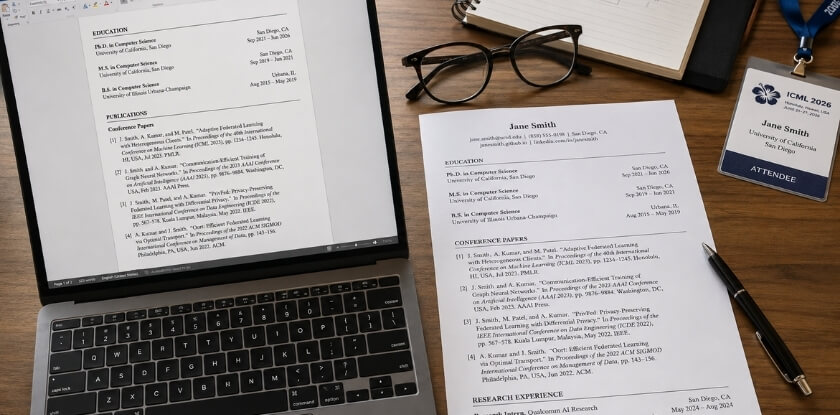
| Output type | Where it goes on a CV |
| Full paper, peer-reviewed proceedings | “Peer-Reviewed Conference Proceedings” or “Conference Papers” |
| Full paper, no peer review | “Conference Papers” with a note, or “Conference Presentations” |
| Abstract-only talk or poster | “Conference Presentations” or “Conference Abstracts” |
| Journal article, book chapter, report | Separate headings such as “Journal Articles” and “Other Publications” |
Use a Separate Section or a Clear Subsection
Do not mix conference papers with journal articles under one “Publications” header without subheadings. In Computer Science or Engineering, where a top conference paper can outrank most journal articles, you might list conference papers first. In Social Science or Psychology, journals normally come first. Know your discipline’s conventions.
The Basic Citation Format
Pick one style and keep it throughout. APA, Chicago, MLA and IEEE all work; consistency is the point, and some conferences or departments name a required style. A conference paper published in proceedings is formatted in APA 7 like a chapter in an edited book:
APA style: Author, A. A., & Author, B. B. (Year). Title of the paper in sentence case. In E. Editor (Ed.), Title of the proceedings (pp. 1145–1157). Publisher. https://doi.org/xxxxx
Always include author names, year, paper title, full conference or proceedings name, page numbers if available, and a DOI or URL. If the proceedings were published in a journal, use the journal-article format instead. Check the style’s current manual for variations.
Flag Peer-Reviewed Papers Clearly
If your paper was peer-reviewed, say so in the section heading (“Peer-Reviewed Conference Proceedings”) or with a short parenthetical note when you mix reviewed and non-reviewed work. A promotion committee or funding agency will notice the difference, so do not make them dig for it.
Abstracts, Posters, and Talks Are Different
A poster or talk based on an abstract only, with no full paper and no peer review, belongs under “Conference Presentations” or “Conference Abstracts”. These are legitimate academic activities, but they are not publications, and conflating them with proceedings can undermine your credibility.
Indexing and Visibility
Your paper will likely show up in citation searches whether or not you flag it. But for PhD programs, certain grants and international fellowships, confirm the paper is actually indexed before claiming it. Check directly. Do not assume.
Avoid Double-Counting
If you expanded a conference paper into a journal article, list both but make the relationship clear:
Patel, R., & Smith, J. (Year). Journal article title. Journal Name, 12(3), 45–67. (Extended version of the conference paper listed above.)
Listing the two with no sign that they are related can look like inflating your publication count.
A Note on CV vs. Resume
On a traditional academic CV, list every conference paper in reverse chronological order. On a resume for industry, where hiring managers rarely want a full bibliography, be selective: choose the papers most relevant to the role, or give a count such as “5 peer-reviewed conference papers in machine learning”. Update the section when a paper is accepted, not only when it is published. “Accepted” or “forthcoming” is a legitimate status, as long as you label it accurately.
Double Publication and Duplicate Submission: Ethical Problems You Must Avoid
Sending the same work to two venues at once, or publishing it twice without disclosure, is an ethics violation whether one outlet is a conference and the other a journal. The problem is not the format. It is the missing disclosure.
Duplicate Submission
Duplicate submission means sending a manuscript to two or more publications at the same time. Most journals and peer-reviewed proceedings prohibit it, and their submission forms ask you to confirm the work is not under review elsewhere. Some journals also ask on the submission form whether any part of the work has appeared elsewhere, so a prior version will not stay unseen.
Double Publication (Salami Slicing and Self-Plagiarism)
Double publication is when work that has already appeared is published again, in full or in part, without clear acknowledgment of the earlier version. Self-plagiarism means reusing your own published text without saying so. Salami slicing is a related problem: splitting one study into several thin papers.
Legitimate paths exist. In Computer Science and Engineering it is widely accepted to present at a conference first and then expand the work for a journal. The expansion has to be real: new experiments, extended analysis or additional data, not a few added paragraphs and a reformatted reference list. Journals that allow this usually require you to cite the conference version and disclose the relationship at submission. Where researchers get into trouble is listing the conference paper and the journal article as two independent contributions on a CV or in a funding report.
Does an Earlier Abstract or Talk Block a Journal Submission?
Usually not. The ICMJE recommendations, which many journals follow, say a journal may consider a full report after a preliminary one such as a meeting abstract or poster, and may consider a paper that was presented at a scientific meeting but not published in full. A full paper already printed in proceedings is different, and falls under the novelty rules below. ICMJE also allows secondary publication in some cases, but only with approval from the editors of both journals and a citation of the primary version.
What “Sufficient Novelty” Actually Means
There is no universal percentage rule, and any figure you see quoted is a rule of thumb, not a standard. Some journals set their own expectations for new content; others judge whether the two versions make meaningfully distinct contributions. Social Science and Psychology conferences often produce full papers that closely resemble journal submissions, so overlap matters a lot there. If you are unsure, ask the journal editor before you submit. The editor can say whether the conference version needs disclosure or rules the submission out.
Citation Indexing Complicates This Further
Databases may index both the conference paper and the journal article as separate records. That is not automatically a problem. It becomes one only if you present the two as independent, original contributions when applying for jobs or reporting outputs to a funder.
The Practical Rule
Expand, disclose and cite. Do real additional work, tell the journal editor in your cover letter, and reference the conference paper in your manuscript. COPE’s guidance on redundant publication rests on the same ideas: full cross-referencing and disclosure at submission. COPE has no rules written specifically for conference proceedings, so the target journal’s instructions to authors are your first reference. Getting this wrong can follow you into tenure review and every later application.
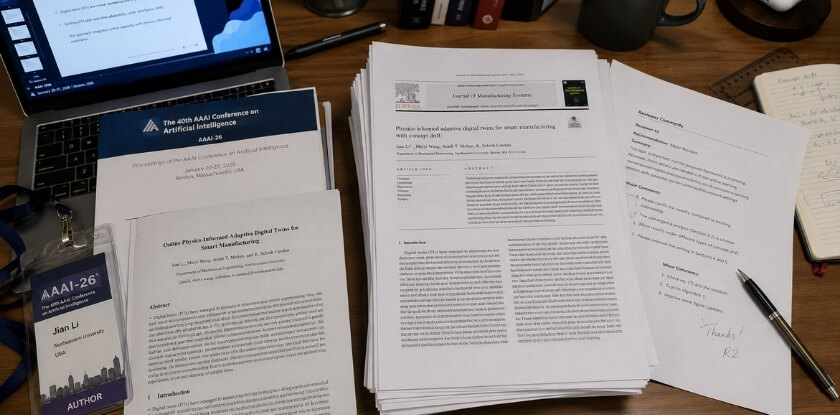
Conference Paper vs Journal Paper: Key Differences at a Glance
They are not interchangeable: journal articles are longer and slower with deeper review, while conference papers are shorter, faster and more variable in rigor.
| Feature | Conference paper | Journal article |
| Length | Shorter; set by the call for papers (page limits vary by conference) | Longer, with a full study: methods, results, discussion, limitations |
| Review | Varies widely from rigorous to light | Usually several rounds, often blind, with revisions |
| Indexing | Inconsistent; check the volume | Usually reliable for established publishers |
| Speed | Faster; tied to the conference calendar | Slower, with more thorough review |
| Weight | High in CS and Engineering; supporting elsewhere | Usually the benchmark output |
Length and Depth
Journal articles present a complete study. Conference papers are shorter by design, because conferences move fast and the paper presents work that may still be developing. The page limit comes from the call for papers, so read it before you write.
Peer Review Rigor
“Peer-reviewed” does not mean the same thing across formats. A reputable journal usually uses multiple rounds of review, and reviewers request revisions. Conference proceedings vary widely: some selective venues in Computer Science and Engineering run genuinely rigorous review, while others accept most submissions. The label covers both ends of that spectrum, so look at the specific venue’s review process and acceptance rate.
Indexing and Discoverability
Most articles from established journal publishers end up in Scopus or Web of Science fairly reliably. Conference papers are inconsistent: some proceedings are indexed and many are not. If a funder or committee counts indexed publications, a paper outside those databases may not count toward that metric, however good the research.
Speed to Publication
Conferences win on speed. Submit before the deadline, present at the event, and the proceedings usually follow on the organizers’ schedule. That matters in fast-moving fields like Computer Science and AI. Journals take longer, which is the trade-off for deeper review and higher perceived authority.
Authority and Weight
On a CV or in a job search, a peer-reviewed article in a strong journal generally outweighs a conference paper, with exceptions: a paper in a flagship CS conference can carry more weight than a mid-tier journal article in the same field. In Psychology, Humanities and most Social Science disciplines, journals dominate and conference papers are supplementary.
Can a Conference Paper Become a Journal Article?
Yes, if the journal version is substantially expanded and you disclose the conference version. Most journals ask whether the work has been published before. Answer honestly, describe the conference version, and explain what is new. Full rules are in the duplicate publication section above.
From our experience at MS International: At our conferences, papers go through double-blind review, follow APA format, and must not be published or under review elsewhere. Presenting does not by itself produce an indexed publication. Accepted papers presented in person may be considered for conference proceedings where applicable, and most review decisions are returned within about 10 working days. Our advice is to ask the organizers in writing what publication outcome applies to your paper, and to describe it on your CV in exactly those terms.
FAQ
Counting a conference paper depends on who does the counting: a CV, a tenure file, a PhD application or Scopus and Web of Science indexing, plus the case of a paper that was not peer-reviewed.
Does a conference paper count as a publication on a CV?
Yes, in most cases. List it under a dedicated “Conference Papers” or “Conference Proceedings” heading, separate from “Journal Articles”. Conference papers are accepted scholarly output, so be accurate about what yours is.
Are conference papers peer-reviewed?
Some are, some are not. It depends entirely on the conference. Major CS and Engineering venues often run rigorous review with selective acceptance, while other events review lightly or not at all. Check the call for papers or proceedings front matter for a stated review process.
Do conference papers count toward tenure?
It depends on your institution and field. In Computer Science they often carry significant weight. In Psychology, Social Science and the Humanities, tenure committees usually prioritize journal articles. Ask your department chair and read the written criteria.
Can I submit the same paper to a journal after it has been published in conference proceedings?
Yes, if you substantially expand it and disclose the conference version, but not as the same text. Cite it in the manuscript and explain what is new in the cover letter. Some journals do not accept previously published work, so read the target journal’s policy.
Do conference papers get indexed in Scopus or Web of Science?
Some do. Both databases cover selected proceedings, not all, and Web of Science selects volume by volume. Google Scholar casts a wider net. If indexing matters for a grant or job, check the specific proceedings in the database itself.
Is a conference paper “published”?
Yes, once it appears in proceedings, it is published work. What “published” is worth varies: a Humanities promotion committee may not weigh it like a journal article, while a CS hiring committee may value it above a mid-tier journal paper.
Do conference papers help with PhD applications?
Yes, they can. A conference paper shows you have engaged with the research community beyond coursework. It is not required, but any real, reviewed output helps your application stand out, and a paper in well-known peer-reviewed proceedings weighs more than one from a venue with no review.
Can a conference paper be cited?
Yes. Conference papers are citable, and many collect significant citations, particularly in Engineering and Computer Science. Whether Google Scholar, Scopus or Web of Science tracks those citations depends on whether the proceedings are indexed there.
Should I list conference presentations separately from conference papers?
Yes. A talk without a published paper is a presentation, not a publication. Use “Conference Presentations” for talks and posters, and “Conference Papers” or “Peer-Reviewed Proceedings” for papers in proceedings. Mixing them misleads readers.
What if my conference paper was never peer-reviewed?
You can still list it, but describe it honestly and do not imply peer review. Some hiring committees and funding reviewers will ask. Being caught misrepresenting a paper is far worse than having a non-reviewed paper on your record.
Are papers at MS International conferences published?
Papers are double-blind reviewed, and accepted papers presented in person may be considered for conference proceedings where applicable. Publication and indexing are not automatic, so ask the organizers what applies to your conference before describing it on a CV.
Conclusion: Make the Right Decision Based on Your Own Context
A peer-reviewed conference paper in well-indexed proceedings is a real publication, and in Computer Science and Engineering it may be your strongest output. In Psychology, Social Science and the Humanities, list it honestly as supporting work and put journal articles first.
If the paper was not peer-reviewed, list it with an honest note and never under peer-reviewed publications. If you plan a journal version, expand it, disclose it and cite it. Finally, talk to someone who has recently been through the process you face, such as a recent hire in your department or a supervisor who has sat on hiring committees. They can tell you how your committee actually reads a CV.