
Sharing your research at a conference is a real academic achievement. But when it is time to label that work on a CV, a grant form or a promotion file, calling a talk a “publication” can backfire.
Quick answer: No, a conference presentation is usually not a publication. A talk or poster is an event, while a publication is a written work that was accepted, made publicly available and can be cited. It becomes a publication only when the full paper is published in proceedings, a journal or a book. If you only presented, list it as a presentation.
Last verified against official sources: October 2026.
This guide is about the talk, poster or abstract itself: when it counts, and how to list it correctly.
When Does a Conference Presentation Count as a Publication?
Only when a written version is published. Until then, universities, employers and funding bodies usually treat a talk or poster as evidence of research activity, not as a publication.
It counts as a publication only when there is a full written version that has been formally accepted and published, for example through:
- Conference proceedings
- A peer-reviewed journal
- An edited academic book
- A professional publisher
- An indexed digital library
- A university or society publication platform
The easiest rule: if you only presented it, list it as a presentation; if the full paper was published, list it as a publication.
| Conference Work | Publication Status |
| Oral presentation only | Not a publication |
| Poster presentation only | Not a publication |
| Abstract listed in a program | Usually not a full publication |
| Slides uploaded online | Usually not a publication |
| Full paper in proceedings | Publication |
| Conference paper with DOI or stable publisher record | Publication |
| Journal article based on the presentation | Publication |
This guide covers the talk, poster or abstract itself. How fields such as computer science, engineering, humanities or medicine treat full papers in proceedings is a separate question.
What Counts as a Publication in Academic and Professional Contexts?
A publication is a written work that has been formally accepted, made publicly available and preserved in a reliable record. It is not just an idea shared with an audience. It is a documented contribution that others can find, read, verify and cite.

Common academic publications include journal articles, conference papers published in proceedings, book chapters, scholarly books, peer-reviewed reports, technical papers and edited volume contributions. A strong publication usually has four features.
Formal Review and Acceptance
A publication normally goes through editorial review, peer review or committee review before acceptance. Reviewers may check originality, relevance, structure, evidence, methods, references and overall quality.
A presentation may be accepted after an abstract review, but that is not always the same as a publication review. A short abstract only shows what the talk is about. A full publication review usually examines the complete written work.
Public Availability and Permanent Record
A publication stays available beyond the conference date, on a journal website, publisher platform, proceedings page, institutional repository or academic database.
This permanent record is one of the biggest differences between the two. A live talk is heard only by attendees, while a published paper can be found and cited long after the event ends.
DOI, ISBN, ISSN, or Proceedings Details
Publications often carry details that make them easy to locate and cite: a DOI, ISBN, ISSN, page numbers, article number, volume, issue, publisher name or stable URL.
These details are not the only proof of publication, but they help confirm that the work has an official record. A conference paper is more likely to be accepted as a publication when several of them are present. A DOI alone is not proof of a full paper: Elsevier notes that conference abstracts often have a DOI but can legitimately be republished in most cases.
Citability and Academic Recognition
A publication can be cited in a formal academic style because readers can locate the source. A presentation can sometimes be cited too, especially if slides, recordings or abstracts are available. It should then be cited as a conference presentation, not as a journal article or published paper.
What Is a Conference Presentation?
A conference presentation is a structured delivery of research, ideas, findings or professional experience at a conference. It lets presenters share work with a relevant audience and get feedback from people in the same field.
Presentations may be based on completed research, early findings, case studies, teaching practices, technical projects, literature reviews or professional experience. They are valuable, but they are not automatically publications.
Oral Presentation
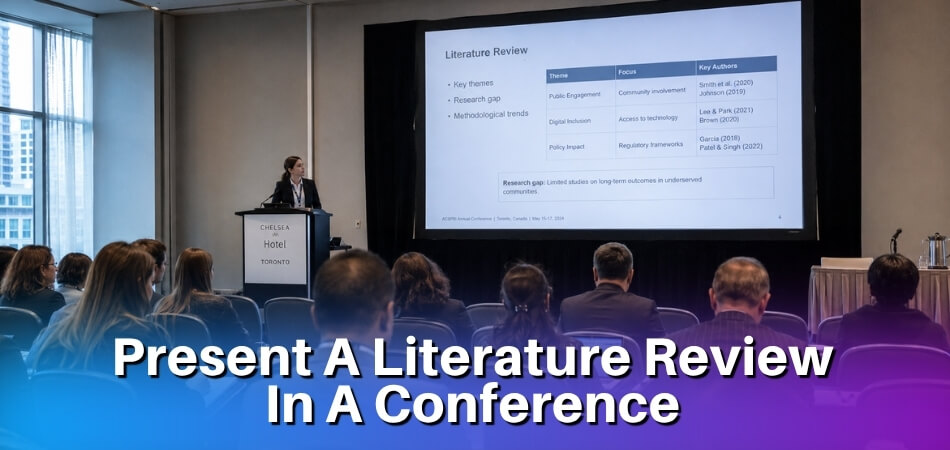
An oral presentation is a spoken talk delivered during a conference session. The presenter usually explains the problem, methods, findings and conclusions within a fixed time limit, often with slides. It shows subject knowledge and communication ability, but it does not count as a publication unless a full written version is officially published.
Poster Presentation
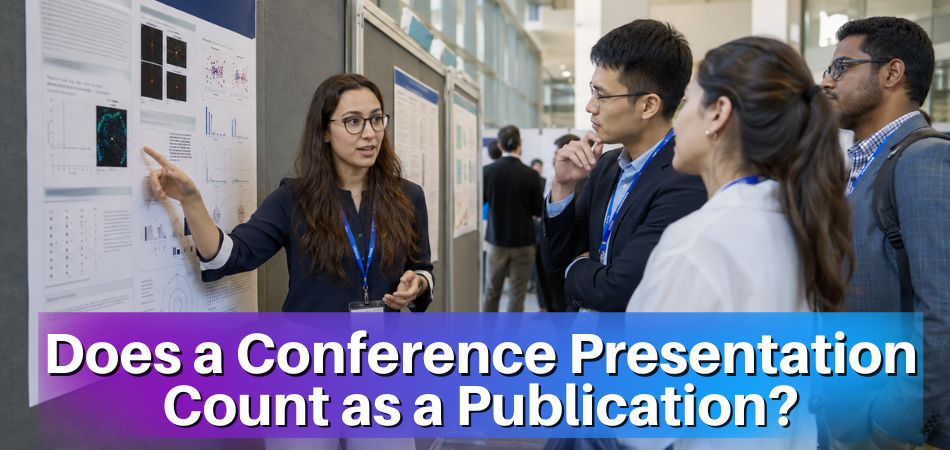
A poster presentation uses a visual display to summarize research. The presenter discusses the poster with attendees during a poster session. Many science, medicine, education, engineering and social science conferences use poster sessions. They help researchers share work quickly, but a poster alone is not a formal publication.
Invited Talk or Keynote Presentation
An invited talk is delivered by someone specifically asked to speak by the organizers. A keynote is often a major presentation by a recognized expert. These carry strong professional value, but they are still not publications unless the content is also published as a paper, article, chapter or proceedings contribution.
Abstract-Only Presentation
An abstract-only presentation means a short summary was accepted, but no full paper was published. The abstract may appear in a program, booklet or conference website. It shows participation, yet it does not contain the complete research.
Workshop or Panel Presentation
Workshops and panels are interactive formats used for training, discussion or expert exchange. They may show leadership and professional experience, but they do not count as publications unless a written work is formally published.
Conference Presentation vs. Conference Publication: Key Differences
A conference presentation is an event-based activity, while a conference publication is a written academic record. Both may come from the same research, but they are not the same type of output.
| Comparison Point | Conference Presentation | Conference Publication |
| Purpose | Share ideas, findings, or experience with attendees | Record research for long-term access and citation |
| Format | Talk, poster, keynote, panel, or workshop | Full paper, proceedings paper, article, or chapter |
| Review | Often based on abstract or proposal review | Usually reviewed as a complete written work |
| Detail | Shorter and selective | More complete and documented |
| Availability | May be limited to the event | Publicly available through a stable source |
| Permanence | Temporary unless archived | Part of a lasting scholarly record |
| Citation | Cited as a presentation if needed | Cited as a publication |
| CV placement | Conference Presentations section | Publications section |
The key question is: was a full written work officially published? If not, treat it as a presentation.
When Can a Conference Presentation Become a Publication?
A presentation becomes a publication when the research is developed into a complete written paper and officially published. The talk itself is not enough. There must be a formal written record.

When a Full Paper Is Peer Reviewed
If you submit a full paper with background, research questions, methods, results, discussion, conclusion and references, and it is accepted after review, the paper is a publication. The earlier talk remains a presentation, unless you tie it directly to the published work.
When It Is Published in Conference Proceedings
Conference proceedings are official collections of papers from a conference. If your full paper appears in them, it is usually considered a publication.
A title in the event schedule is not enough, and neither is a certificate of presentation. The full written paper must be included in the official proceedings or publication platform. Not every set of proceedings carries the same weight, so check the publisher, review process and citation details before presenting the work as a formal publication.
When It Receives a DOI, ISBN, or Stable Record
A page range, article number, publisher page or permanent repository record makes a conference paper easier to verify as a publication. Check these on the paper itself, as described under “DOI, ISBN, ISSN, or Proceedings Details” above.
When It Appears in Academic Databases
Published conference papers may appear in databases or digital libraries such as Google Scholar, Scopus, Web of Science, IEEE Xplore, ACM Digital Library, PubMed, ERIC, SpringerLink or ScienceDirect, depending on the field and publisher.
Indexing can strengthen recognition, but always check the document type. A database record for an abstract is not the same as a full published paper.
When Workshop Papers Are Published
Workshop papers can count as publications if they are reviewed and published in official workshop proceedings or a recognized series. This applies in fields such as computer science and engineering. If the workshop was only discussion, training or a live session with no published paper, list it as a workshop presentation.
Which Conference Activities Are Not Publications?
Most things you do at a conference stay presentations: if nobody published your full paper, it is not a publication, however well the event went.
Talk or Poster Without a Published Paper
Even at a respected conference, a talk or poster stays a presentation until a full paper is published. Typical examples:
- A 15-minute talk based on an accepted abstract
- A poster displayed during a conference session
- A research demo with no written paper
- A panel contribution with no proceedings paper
- An invited lecture with no published article
Abstract Listed Only in a Program
An abstract in a program or abstract book is normally a short summary, not a complete study. Describe it as a conference abstract or abstract presentation.
Slides Shared Online
Slides on a conference website, university page, personal site or slide platform do not automatically become a publication. They may be useful and citable, but they are not usually peer reviewed.
Internal or Informal Presentations
Class presentations, lab meetings, department talks, company briefings, private workshops and internal seminars are not usually publications. They may show experience, but they lack public availability, review and a stable record.
Can You Cite a Conference Presentation?
Yes, you can cite a conference presentation if it is identifiable and relevant, but cite it as a presentation. A citation does not turn it into a publication.
A citation does not need a published paper, but readers must be able to understand or locate the presentation. That is why a good reference carries enough detail.
What to Include in a Citation
A basic reference lists the presenter, year and date, title, presentation type, conference name, location and a URL or archive link if one exists. APA 7 puts the full conference dates after the presenter names, then the title, a short description in square brackets, then the conference name and location. University APA 7 guides show descriptions such as [Conference presentation], [Paper presentation], [Poster session] or [Keynote address]. To cite only the abstract, add “abstract” to the bracket.
Rahman, S. (2026, March 12–14). Digital learning barriers in rural classrooms [Paper presentation]. Example Education Research Conference, Toronto, ON, Canada.
Rahman, S. (2026, March 12–14). Digital learning barriers in rural classrooms [Poster session]. Example Education Research Conference, Toronto, ON, Canada.
Other styles (MLA, Chicago, IEEE) order these details differently, so follow the style your journal, supervisor or university asks for.
Slides, Abstracts, and Published Papers Are Different
Choose the label by what you are actually citing:
| Source Type | How to Cite It |
| Oral talk | Presentation, with a bracket such as [Paper presentation] |
| Poster | Presentation, with [Poster session] |
| Slide deck found online | Slides, described by file type, for example [PowerPoint slides] |
| Abstract only | Presentation with “abstract” added to the bracket |
| Proceedings paper | Published conference paper, no presentation bracket |
| Journal article based on the talk | Journal article |
If a full paper exists, cite the published paper rather than the live presentation, because it is more complete and easier to verify.
How to List Conference Presentations on a CV or Resume
List presentations in a separate CV section, not under publications. This keeps your record accurate and avoids overstating your work.

Use a section title such as Conference Presentations, Academic Presentations, Selected Presentations, Invited Talks or Posters and Presentations.
What Each Entry Should Include
A strong entry has the author’s name, year, title, presentation type, conference name, location and date, in this order:
Rahman, S. (2026, March). Digital Learning Barriers in Rural Classrooms. Oral presentation at the Example Education Research Conference, Toronto, Canada.
Label the Presentation Type Clearly
Always say whether the work was an oral presentation, poster presentation, invited talk, keynote presentation, panel presentation, workshop presentation, conference abstract or published conference paper. This helps readers judge the format and level of contribution.
Move Published Papers to the Publications Section
If the full paper was published, place it under Publications rather than Conference Presentations, with proceedings title, publisher, year, page range, and DOI or URL. If the same work was both presented and published, avoid making it look like two separate achievements unless your CV format requires both. A note works well:
Presented at the 2026 Example Business Research Conference; full paper published in conference proceedings.
How Different Academic Fields Treat Conference Presentations
Fields value presentations differently, but the rule stays the same: presentation alone is not publication.
Computer Science and Technology
Computer science often gives strong value to conference papers published in peer-reviewed proceedings, for example in artificial intelligence, cybersecurity, software engineering and data science. Still, a talk is not the same as a published paper. What matters is whether the full paper was accepted and published.
Engineering
Engineering conferences are used to share prototypes, experiments, models and technical solutions. Some papers are published in proceedings, while others remain presentations. Check for a proceedings record, DOI, publisher page or indexing before listing the work as a publication.
Medicine and Health Sciences
Medical conferences often include abstracts, posters and clinical updates. These are useful for sharing early findings, but they are not usually full publications unless later published as journal articles or proceedings papers.
Social Sciences
Researchers use conferences to test arguments, discuss early results and get feedback. Presentations are respected as academic activity, but journal articles, books and chapters usually carry stronger publication value.
Humanities
Humanities scholars often present early versions of essays, chapters or interpretations. These talks support scholarly exchange, but they become publications only when developed into written and published work.
Business, Education, and Environmental Studies
These conferences often mix academic, professional and practical audiences. Presentations can build visibility and partnerships, but publication status still depends on whether a full paper is officially published.
Why Conference Presentations Still Matter
Presentations matter because they show research activity, visibility and professional engagement even when they are not publications.
They can help you:
- Share early findings
- Receive expert feedback
- Build confidence in public speaking
- Meet researchers and professionals
- Improve a paper before submission
- Show active participation in your field
- Build a path toward future publication
Some publications begin as presentations. A presenter shares early results, takes questions, revises, expands the analysis and later submits a stronger paper to a journal or proceedings. For students and early-career researchers, this shows initiative and builds an academic network.
Does Presenting at a Conference Count as Prior Publication for a Journal?
Usually not for a talk, poster or abstract, but the journal’s own policy decides. Prior publication is a different test from “is it a publication on my CV”, because journals ask whether the work has already been released in a way that makes a new article redundant.
The ICMJE Recommendations (section on duplicate and prior publication) say they do not prevent a full report from following a preliminary one, such as an abstract or poster displayed at a scientific meeting. They add that a journal may consider a paper that was presented at a meeting but not published in full, or one being considered for proceedings or a similar format. Elsevier’s editor guidance says it does not view an abstract as prior publication, and COPE says journals should have a policy on whether proceedings count, noting that policies vary for abstracts, conference papers and presentations.
| What was shared | How journals usually look at it |
| Talk or poster at a meeting, no written paper | Not a barrier under the ICMJE wording above; confirm with the journal |
| Abstract only, even with a DOI | Not prior publication for Elsevier, which notes such abstracts can legitimately be republished in most cases |
| Full paper in proceedings | Depends on the journal and the field; ask before submitting |
Fields differ. Elsevier notes that in computer science, presenting at a conference is often regarded as formal publication, while in other fields conference papers are considered purely preliminary. Before you submit, read the journal’s author instructions, mention the earlier presentation in your cover letter (the ICMJE says the submission letter should state any substantial overlap with published or submitted work), and make sure the new article goes clearly beyond the talk.
Common Mistakes to Avoid
The biggest mistake is calling every conference activity a publication. Accurate labeling protects your credibility.
Listing Presentations as Publications Without Proof
Do not list a presentation under Publications unless you can verify that a full written version was officially published. Look for a proceedings record, DOI or publisher page, ISBN or ISSN, page numbers or article number, database indexing and official citation details.
Confusing Abstract Acceptance With Publication
An accepted abstract does not mean a published paper. If only the abstract was accepted, list it as a conference abstract or presentation.
Forgetting to Mention Presentation Type
Leaving out the type confuses readers. Label the work as oral, poster, invited, workshop, panel, abstract or published paper.
Assuming All Proceedings Are Equal
Some proceedings are peer reviewed and indexed, others are simple event records. Do not assume the weight of one from the name of another.
Using “Published” Too Loosely
Some conferences say abstracts are “published” in a program. That may be true in a limited sense, but it does not mean your work is a full academic publication. Use precise wording, for example:
| Conference Record | Safer Description |
| Listed in event schedule | Conference presentation |
| Printed in abstract booklet | Conference abstract |
| Slides uploaded online | Presentation slides |
| Article in journal | Journal publication |
Quick Decision Guide: Presentation or Publication?
The fastest way to classify conference work is to ask whether a full written version was officially published.
Ask these questions:
- Was a full paper submitted?
- Was the full paper accepted for publication?
- Was it reviewed?
- Was it made publicly available?
- Does it have citation details such as DOI, ISBN, page range, or publisher record?
- Can other researchers find and cite it?
- Does the official conference record call it a paper, abstract, poster, or presentation?
Then pick the safest label from this table:
| Situation | Best Classification |
| Live talk with slides only | Conference presentation |
| Poster only | Poster presentation |
| Panel discussion | Panel presentation |
| Invited lecture | Invited talk |
| Full paper in proceedings | Conference publication |
| Paper with DOI and publisher page | Published conference paper |
| Expanded journal version | Journal publication |
| Published workshop paper | Workshop publication |
When uncertain, choose the more accurate and modest label. It is better to list work as a presentation than to present it wrongly as a publication.
How to Verify Whether Your Conference Work Was Published
Confirm publication status from the official record, not only from the acceptance email or certificate. Conferences use terms in different ways, so check what actually happened to the written work.

Start with the conference website. Look for a proceedings page, accepted papers list, digital library link, publication partner or archive. If your work appears only in the schedule, it is probably a presentation. If your full paper appears in a proceedings volume or on a publisher platform, it is more likely a publication.
Next, check the document itself. A published conference paper usually has a complete title, author list, abstract, body sections, references and citation details, and may show page numbers, an article number, DOI, ISBN, ISSN, publisher name or copyright notice.
You can also search academic databases for your paper title in quotation marks. If the result is a proceedings article, journal article or publisher-hosted paper, read the record carefully and make sure it is the full paper, not only the abstract, slide deck or program listing.
If you are still unsure, ask the organizer or publication chair a direct question:
Was my full paper published in official proceedings, or was only my abstract or presentation included in the program?
Their answer tells you how to label the work on your CV, and accurate classification helps reviewers trust your record. This matters most before you submit a CV for graduate school, academic hiring, promotion, grant funding or immigration-related professional documentation.
From our experience at MS International: submissions go through double-blind peer review, and the possible decisions are acceptance, revision request or rejection. Accepted papers may be considered for conference proceedings where applicable, so an acceptance to present is not the same thing as a published paper. Check the conference page and your acceptance email for the exact wording, and do not describe your work as published, or as indexed anywhere, until you can see the record yourself.
FAQs About Conference Presentations and Publication Status
The publication status of a poster, a talk, an abstract or slides posted online matters for your CV, for Google Scholar and for a journal’s prior publication rules.
Is a poster presentation a publication?
A poster presentation is not usually a publication. It is a visual presentation of research. It becomes one only if it is connected to a full published paper, proceedings record or formally published abstract.
Is an oral presentation a publication?
An oral presentation is not a publication by itself. It is a spoken presentation. If the same research is later published as a full paper, the written version may count as a publication.
Is a conference abstract a publication?
A conference abstract may be publicly available, but it is usually not a full publication. It is a short summary, not a complete paper. List it as a conference abstract unless a full version was published.
Is a conference paper the same as a presentation?
No. A conference paper is written; a conference presentation is delivered. A researcher may present at the event and also publish a paper, but the two formats are not the same.
Can I publish my conference presentation later?
Usually yes. The ICMJE says a full report may follow an abstract or poster shown at a scientific meeting, but journal policies differ. Check the journal’s rules and mention the earlier presentation in your cover letter.
Do conference presentations appear on Google Scholar?
Only if there is a public, indexable record. Google Scholar’s inclusion guidelines list conference papers and abstracts on sites that meet its technical rules, and they do not mention slides or posters. A published proceedings paper or a repository copy can be found there.
Does presenting at a conference count as prior publication for a journal?
Usually not for a talk, poster or abstract. The ICMJE does not bar a full report after an abstract or poster shown at a meeting, and Elsevier does not treat an abstract as prior publication. A full paper in proceedings can be treated differently, so check the journal.
Should conference presentations be listed under publications?
No, not unless a full written version was officially published. Use a separate section, such as Conference Presentations or Academic Presentations.
What if my slides are available online?
Online slides can be cited as slides, but they are not usually publications. A slide deck does not normally go through the same review and publishing process as a paper.
Are conference proceedings equal to journal articles?
Both can be publications, but they are not always equal in academic weight. Their value depends on the field, review process, publisher, indexing and institutional standards.
Does a presentation certificate prove publication?
No. A certificate proves participation or presentation, not publication. To prove publication, you need a published paper, proceedings record, DOI, publisher page or formal citation details.
Conclusion
A conference presentation is a valuable achievement, but it is not usually a publication. It does not become one unless the research is written as a full paper, accepted through an official process and made available through a reliable publication record.
If you delivered a talk, displayed a poster, joined a panel or shared slides without a full written paper, list it under Conference Presentations. If your full paper appeared in proceedings, a journal, an edited volume or a recognized publisher platform, list it under Publications.