

Your research paper is ready, but the path to getting it published in Scopus-indexed proceedings feels unclear and overwhelming. You’ve probably already run into the problem: dozens of conference invitations landing in your inbox every week, many of them looking legitimate on the surface but turning out to be predatory conferences that will drain your budget, waste months of your time, and leave your work completely unindexed. Even researchers who successfully avoid those traps often hit a wall after submission — unsure about camera-ready submission formatting, confused by copyright transfer agreements, or anxious about why their published paper hasn’t appeared in Scopus yet.
Quick answer: To publish in Scopus-indexed conference proceedings, start by verifying your target conference against the Scopus Source List and cross-checking the publisher — typically Elsevier, Springer Nature, IEEE, or similar established names — against Beall’s List to rule out predatory venues. Submit an abstract, go through peer review, revise based on reviewer comments, then prepare your camera-ready submission using the publisher’s official template (such as the Springer Nature conference proceedings Word template or a LaTeX format). Pay any required APC (Article Processing Charge), complete the copyright transfer, and upload your final files. After publication, your paper typically enters Scopus indexing within two to six months, though indexing lag varies by publisher and volume.
Understanding the full process matters because a single wrong decision — choosing an unverified venue or misreading the scope of a conference — can cost you registration fees, travel expenses, and months of revision work with nothing to show for it in your citation record. Platforms like ORCID, ResearchGate, and your own institutional repository help your work gain visibility, but none of that matters if the proceedings themselves never make it into Scopus citation indexing. Publishers affiliated with COPE follow editorial standards that make indexing far more predictable, and checking an ISSN against the ISSN Portal before you register for any conference is a five-minute step that can save you a year of frustration. Bodies like EPJ Web of Conferences and iConf operate under clear indexing agreements — but you still need to know what to look for.
This guide walks you through every step in detail — from abstract submission all the way to seeing your paper appear in Scopus.
What Are Scopus-Indexed Conference Proceedings?
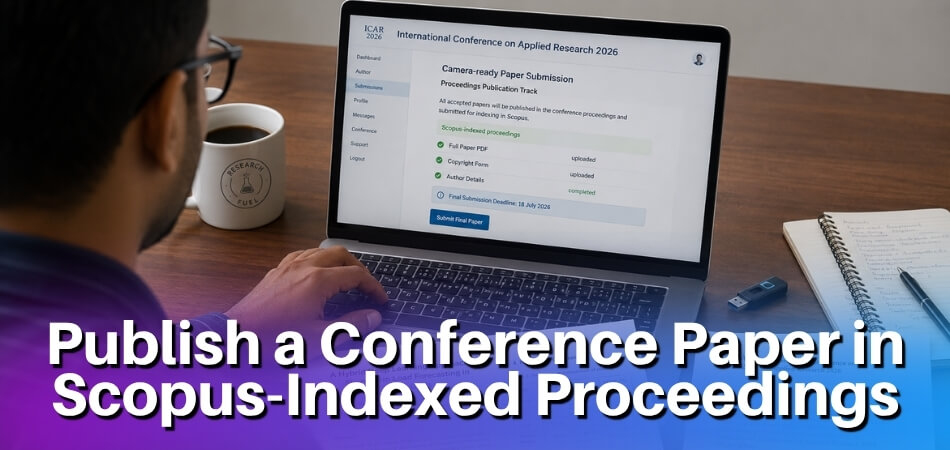
Scopus is Elsevier’s abstract and citation database — one of the largest of its kind, covering peer-reviewed journals, books, and conference proceedings. When a conference’s proceedings volume gets indexed in Scopus, it means every paper published in that volume becomes searchable, citable, and trackable within the database. Your paper gets a Scopus record. Your citation count becomes visible. Your h-index moves.
That matters a lot in academic careers, grant applications, and institutional research evaluations.
But here’s what confuses many early-career researchers: Scopus indexes the proceedings, not the conference itself. A conference doesn’t have a standing Scopus status that automatically covers every future edition. Each proceedings volume — usually published under an ISSN via a publisher like Springer Nature, IEEE, or EPJ Web of Conferences — gets evaluated separately. Some annual conferences have been indexed consistently for years. Others drop out. A few never make it in at all.
This distinction is critical. A conference can claim to be Scopus-indexed based on a previous year’s proceedings, but that’s no guarantee your paper — submitted for this year’s edition — will end up indexed too.
Conference proceedings that do get into Scopus typically come through established publishers. Springer Nature’s CCIS (Communications in Computer and Information Science) series is a common vehicle. So are IEEE Xplore proceedings, Elsevier’s own conference series, and various society-affiliated publishers. Each of these publishers has standing agreements with Elsevier’s Scopus team, which makes indexing more predictable — though still not automatic for every volume.
The Scopus Source List is the practical tool you need here. It’s a downloadable spreadsheet maintained by Elsevier that lists all currently indexed sources, including conference series. You can filter by source type, ISSN, and publisher. If a proceedings series appears there with an active status, that’s a strong signal — not a guarantee, but meaningful. Cross-referencing an ISSN on the ISSN Portal can also confirm whether a proceedings series is legitimate and registered.
Indexing takes time. Even after your paper appears in a publisher’s official proceedings volume, there’s an indexing lag — sometimes three to six months, occasionally longer — before it shows up in Scopus. New researchers often panic thinking something went wrong. Usually, it hasn’t.
How to Find the Right Scopus-Indexed Conference
Not every conference that claims Scopus indexing actually delivers it. Finding the right venue takes a bit of legwork, but it’s straightforward once you know where to look.
Using the Scopus Source List and ISSN Portal
Start with the official Scopus Source List. Elsevier maintains a downloadable Excel file at scopus.com that lists every source currently indexed — journals, book series, and conference proceedings. Download it, filter by “Conference Proceedings” in the source type column, and search by keyword, subject area, or publisher name. This is your ground truth. If a conference series isn’t in that file, it’s not Scopus-indexed, regardless of what the organizers claim on their website.
One thing that trips people up: the list reflects current indexing status. A proceedings series can be added or removed. Check it fresh each time you’re scoping out a venue, not just once.
The ISSN Portal (portal.issn.org) is useful for cross-referencing. Every legitimate serial publication — including recurring conference proceedings — should have a registered ISSN. If a conference has been running for several years but has no ISSN, that’s a red flag. You can look up the ISSN, confirm the title matches, and verify the publisher. It takes two minutes and can save you months of wasted effort.
Identifying Reliable Publishers — Elsevier, Springer Nature, IEEE, and Others
The safest bets are the big three: Elsevier, Springer Nature, and IEEE.
Elsevier publishes many proceedings through its Procedia series — Procedia Engineering, Procedia Computer Science, Procedia CIRP, and others. These are open-access and consistently indexed. Springer Nature handles proceedings primarily through Lecture Notes in Computer Science (LNCS), Lecture Notes in Networks and Systems, and similar series. IEEE conference proceedings are indexed on IEEEXplore, and most are on the Scopus Source List.
That said, publisher name alone isn’t a guarantee. A conference associated with Springer Nature still needs to be in the Scopus Source List to count. Some Springer proceedings volumes are indexed; others aren’t. Always verify the specific series, not just the publisher.
ACM and Taylor & Francis also publish indexed proceedings. The pattern is the same: check the source list for the specific series title.
One practical tip — if you’re submitting to an IEEE-sponsored conference, look it up on the IEEE conference search tool at conferences.ieee.org. Approved IEEE conferences usually confirm Scopus indexing in their call for papers, but you should still cross-check.
Niche-Specific Proceedings Such as EPJ Web of Conferences and iConf
Beyond the big publishers, there are niche-specific series worth knowing about.
EPJ Web of Conferences (published by EDP Sciences) is a strong option for physics, materials science, and related fields. It’s open-access, operates under a conference proceedings model where organizers pay a volume fee rather than individual authors paying an APC, and it appears in the Scopus Source List. If you work in experimental or applied physics, it’s worth bookmarking.
iConf is aimed at information science and library science researchers. It’s a smaller community, but the proceedings have been indexed and the review process is legitimate.
For engineering and applied sciences, MATEC Web of Conferences (also EDP Sciences) follows a similar structure to EPJ. Same publisher, same model, different disciplinary focus.
When you’re looking at niche series like these, run the usual checks: Scopus Source List, ISSN Portal, and a quick look at whether the organizers are affiliated with a recognized academic society or institution. Predatory conferences have learned to mimic the look of legitimate venues — vague committee listings, stock photo keynote speakers, and suspiciously low rejection rates are all warning signs. Beall’s List, though no longer actively maintained in its original form, has archived versions that still flag known bad actors. Use it as a reference, not an absolute authority.
Find a conference where your work fits the scope, the proceedings will actually be indexed, and the peer review is real.
How to Identify and Avoid Predatory Conferences
This is where a lot of researchers get burned. Predatory conferences have gotten better at mimicking legitimate ones, and the damage is real — a paper published in a fake Scopus-indexed conference does nothing for your CV and can actually raise questions about your judgment.
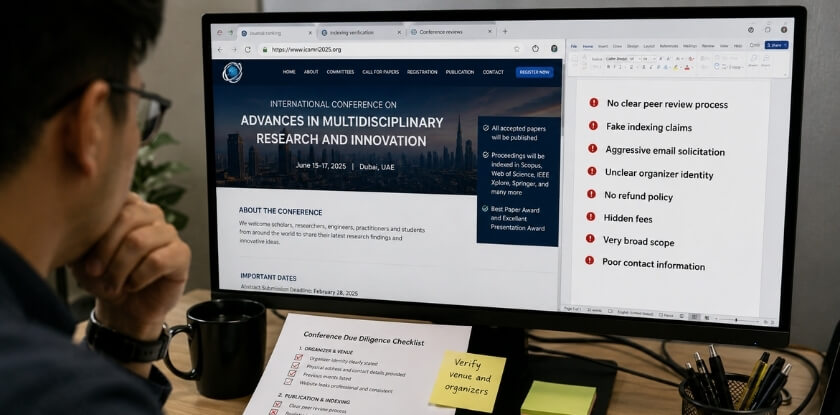
Red Flags — Unusually Fast Acceptance, Vague Reviewer Information, and Fake Indexing Claims
The most obvious warning sign is speed. Legitimate peer review takes weeks, sometimes months. If you submitted an abstract on Monday and got an acceptance email by Wednesday, that’s not efficiency — that’s a rubber stamp. Real conferences with genuine Scopus indexing through publishers like IEEE, Springer Nature, or Elsevier have structured review timelines. Two to six weeks for abstract decisions is normal. Two days is not.
Watch the language in acceptance emails. Phrases like “your paper has been accepted after careful review” sent within 48 hours, or “accepted pending minor revisions” with no actual reviewer comments attached — these are signals something is off.
Fake indexing claims are rampant. You’ll see conference websites that list “Scopus-indexed” without any verifiable source. Always cross-check. Go directly to the Scopus Source List (accessible via Elsevier’s website) and search for the conference proceedings serial or ISSN. If it’s not there, it’s not indexed, regardless of what the website says. You can also check the ISSN Portal to verify whether the conference proceedings series even has a registered ISSN — many predatory events don’t bother.
A few other concrete red flags:
- No named program committee. Legitimate conferences list their technical program committee publicly. If the website only has a generic “scientific committee” with no names, affiliations, or links, be suspicious.
- Broad, catch-all scope. A conference that accepts papers on “engineering, medicine, social sciences, and arts” isn’t building a focused academic community. It’s collecting APCs.
- Unusually high or unusually vague APC. The Article Processing Charge for legitimate proceedings varies, but you can benchmark it. IEEE conference papers typically don’t charge authors separately for indexing — costs are built into registration. If a conference is charging a separate “Scopus indexing fee” on top of registration, walk away.
- The proceedings don’t have a DOI structure. Springer Nature conference proceedings, for example, are published through Lecture Notes in Computer Science or similar series with clean DOIs, ISBNs, and verifiable publication records.
- Website looks copied. Some predatory conferences clone the look of IEEE or ACM websites almost exactly. Check the domain name carefully and look for the organizing institution — it should be a real university or professional society with a verifiable history.
Using Beall’s List, COPE Guidelines, and Community Cross-Checks
Beall’s List started as a catalogue of predatory open-access journals, but community-maintained versions now track predatory conferences too. The original list by Jeffrey Beall was taken down in 2017, but archived versions exist and independent researchers continue updating them. A quick search for a conference organizer’s name or the hosting entity against current Beall’s List archives can save you months of wasted work.
COPE — the Committee on Publication Ethics — publishes guidelines on what responsible conference peer review should look like. Their standards cover things like reviewer independence, conflict-of-interest disclosure, and post-acceptance editorial processes. If a conference’s stated review process doesn’t align with basic COPE principles, that’s a practical indicator of quality, even if it doesn’t conclusively prove predatory behavior.
The most reliable check, honestly, is community knowledge. Before submitting, search the conference name on ResearchGate, Twitter/X, or academic forums. Researchers talk. If a conference has burned people before, there’s usually a thread about it somewhere. ORCID profiles of supposed keynote speakers can help too — if someone is listed as a keynote but has no record of attending or speaking, they may not know they’re listed at all, which is a known tactic.
Cross-check the organizer against iConf, a legitimate directory of ICT conferences, if your field is technology-focused. For broader fields, look for the conference in DBLP, the ACM Digital Library, or comparable discipline-specific databases. If a conference claims multi-year history but has zero indexed proceedings in any real database, the history is fabricated.
Email a named program committee member directly. Not the conference contact address — a specific person listed as a reviewer or committee chair. Ask them to confirm their involvement. If they’re real and genuinely affiliated, they’ll respond. If the name is fake or lifted from a real researcher without permission, you’ll either get no reply or a confused “I have no idea what you’re talking about.”
Trust your instincts on urgency pressure too. Legitimate conferences don’t send countdown emails telling you your acceptance will expire in 24 hours if you don’t pay. That’s sales tactics, not academic publishing.
Setting Up Your Author Profile — ORCID and ResearchGate
Before you submit anything anywhere, get your author identity sorted. This sounds administrative, and it is — but it directly affects whether your published paper gets properly attributed, indexed, and found.
Why ORCID Matters for Conference Publishing
ORCID gives you a persistent 16-digit identifier that follows you across institutions, name changes, and publication venues. It’s free. Registration takes about three minutes at orcid.org.
The reason this matters for Scopus specifically: when Elsevier indexes a paper, it tries to match author names to existing Scopus Author IDs. If you’ve published before, you might already have one — often auto-generated and sometimes duplicated. Linking your ORCID to your Scopus profile lets you merge duplicates and claim records cleanly through the Scopus Author Feedback Wizard.
Many conference submission systems — especially those run through IEEE, Springer Nature, and similar publishers — now have an ORCID field in the submission form. Fill it in. Don’t skip it. If the conference uses a camera-ready submission template (whether that’s the Springer Nature conference proceedings Word template or a LaTeX class file), there’s usually a macro or field for your ORCID iD. Use it.
If your co-authors don’t have ORCIDs yet, push them to register before submission. A paper with three authors where only one has an ORCID creates attribution gaps you’ll spend time fixing later.
ResearchGate — Useful, But Not Indexing
ResearchGate is a different kind of tool. It doesn’t index your paper in any bibliographic database. Scopus doesn’t pull data from ResearchGate, and being on ResearchGate has zero effect on whether your paper appears in Scopus after publication.
What it does do: it gets your paper in front of other researchers who are searching by topic. After your paper is published and indexed, upload the accepted manuscript or the published PDF (depending on the publisher’s self-archiving policy — Elsevier, Springer Nature, and IEEE all have different rules on this). ResearchGate will often auto-suggest your paper to you for claiming; accept it, verify the details, and make sure the title, authors, and DOI are correct.
Keep your ResearchGate profile current. Add your institutional affiliation, your research interests, and a profile photo. Shallow profiles get less traffic. That’s just how the platform works.
One Common Mistake to Avoid
Don’t create multiple ORCID accounts across different email addresses. It violates ORCID’s terms and creates the exact attribution mess you’re trying to avoid. If you’ve accidentally created a duplicate, ORCID support can help you merge them — but it takes time.
Similarly, on ResearchGate, don’t have two profiles under different email addresses. Consolidate. Duplicate profiles dilute your citation metrics and confuse anyone trying to verify your work.
Connecting the Dots to Your Scopus Record
Once your paper is published and the indexing lag has cleared — this can take anywhere from a few weeks to several months depending on the conference proceedings and the publisher’s submission schedule to Scopus — log into Scopus and search your name. If the paper appears but isn’t linked to your author profile, use the Author Feedback Wizard to correct it.
If your ORCID was included in the submission metadata, the connection is usually made automatically. That’s the whole point of registering it before you submit, not after.
Your institutional repository may also require your ORCID for deposit — check your institution’s open access policy before submission, because some funding bodies mandate it as a condition of APC support.
Complete Timeline — From Abstract Submission to Full Paper Publication
The gap between “I have a paper idea” and “it’s indexed in Scopus” is usually six to twelve months. Sometimes longer. Understanding each stage before you start saves you from missing deadlines, getting rejected on a technicality, or submitting the wrong document format at the worst possible moment.
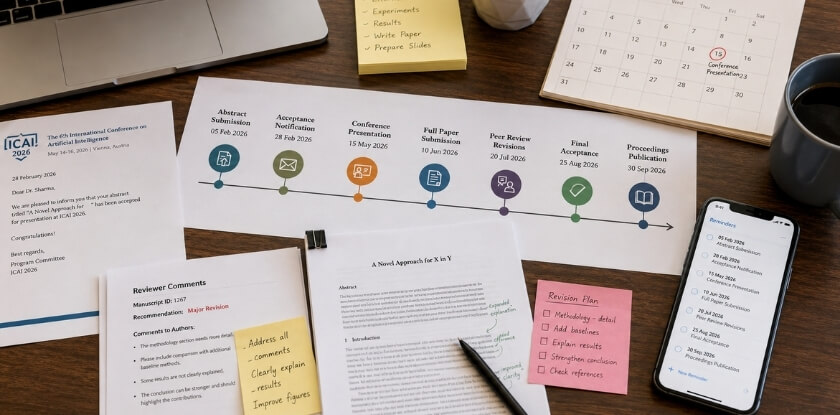
Here’s what that journey actually looks like.
Call for Papers → Abstract Submission → Notification
It starts with the Call for Papers (CFP). Most conferences post their CFP three to nine months before the event date. You’ll find these on the conference website, through mailing lists, or on aggregator sites. When you spot one, the first thing to check isn’t the submission deadline — it’s the scope. Does your research topic genuinely fit the conference tracks? A paper on machine learning for medical imaging sent to a general computer science conference with no biomedical track will almost certainly get desk-rejected.
Not every conference requires an abstract submission before the full paper. Some go straight to full paper. But many — especially larger IEEE or Springer Nature proceedings — use a two-stage process. You submit a 200-to-500-word abstract, they confirm fit, then you write the full paper. This saves everyone time.
Abstract submission happens through a conference management system. Likely EasyChair, HotCRP, or a custom portal. Create your account early. These systems have a habit of going slow or throwing errors in the final hour before a deadline.
Notification of abstract acceptance usually takes two to four weeks. You’ll get a simple accept or reject. If accepted, you move forward. If rejected, move on — don’t wait for detailed feedback, because abstract rejections rarely come with any.
Check the time zone on the deadline. “23:59 AoE” (Anywhere on Earth) is different from “23:59 CET.” Get that wrong and your submission is just late.
Full Paper Submission → Peer Review → Revision Round
Once abstract acceptance lands in your inbox, you typically have four to ten weeks to submit the full paper. That window sounds reasonable. It isn’t, especially if you’re finishing experiments or co-authoring across institutions.
Format matters here. Most Scopus-indexed conference proceedings follow strict templates. IEEE has its own two-column format. Springer Nature conference proceedings use a specific Word template and a LaTeX class — LLNCS (Lecture Notes in Computer Science) is the most common. EPJ Web of Conferences has its own. Download the correct template the same day you get your acceptance notification. Formatting a paper from scratch in the wrong template is painful. Reformatting it three days before the deadline is worse.
Page limits are enforced. Six pages, eight pages, twelve pages — whatever the CFP states, that’s your ceiling. Some conferences charge an APC (Article Processing Charge) for extra pages. Know this upfront.
After submission, your paper enters peer review. For most Scopus-indexed proceedings, that means two to three reviewers, and the process is usually single-blind — reviewers know who you are. Review periods run three to six weeks. You won’t hear anything during that time, and chasing the program chair doesn’t speed it up.
Outcomes come in roughly four categories: accept as-is (rare), minor revision, major revision, or reject. Minor revision means small fixes — grammar, a missing reference, a figure that needs redoing. Major revision can mean rerunning experiments or restructuring an entire section. Both have deadlines, usually one to three weeks.
When you resubmit after revision, write a clear response letter. Bullet each reviewer comment and explain exactly what you changed and where. Reviewers don’t re-read your whole paper looking for what you did — point them to the page and paragraph. Being precise here directly affects whether you clear the revision round.
Camera-Ready Submission → Copyright Transfer → Final Publication
Once the revised paper is accepted, you move into camera-ready submission. This is your final, publication-ready version. No more edits after this. The conference will give you a short window — often just five to ten days.
Camera-ready requirements are stricter than the initial submission requirements. You’ll need to embed all fonts (critical for PDF submissions), make sure figures are high resolution, and ensure the reference style matches exactly. IEEE papers often require IEEE PDF eXpress validation before upload. That tool checks your PDF against technical publishing requirements. Run it early because it sometimes flags issues that take a full afternoon to fix.
At the same time, you’ll complete copyright transfer. This is usually a digital form — IEEE’s eCF system, Springer’s copyright form, or a similar platform. You’re assigning publication rights to the publisher. Read what you’re signing. Some agreements allow you to post a pre-print in an institutional repository; others restrict it. If your institution or funder requires open access, flag this before signing — some conferences offer an open access route, sometimes at an additional APC.
Registration is non-negotiable. Nearly all conferences require at least one author to register and pay before the camera-ready deadline. No registration, no publication. Full stop.
After that, you wait. The paper goes through final production — typesetting, proceedings compilation, assignment of a DOI. If the conference proceedings are published through a major publisher like Springer Nature or IEEE, the volume often appears online within a few weeks of the event, sometimes before it.
Scopus indexing doesn’t happen on publication day. There’s an indexing lag — typically two to six months after the proceedings appear. Scopus crawls the publisher’s metadata, cross-checks against its source list, and then adds the records. You can track progress using your ORCID profile or by searching the Scopus database directly once you have a DOI. When it shows up, your paper is fully indexed, citable, and searchable — which is the whole point.
Paper Format, Templates, and Structure
Getting the format right isn’t optional. Most conference proceedings publishers — Springer Nature, IEEE, Elsevier — will desk-reject your paper before it even reaches a reviewer if the formatting is off. So before you write a single line of your methodology section, download the official template and build your document inside it from the start.
Springer Nature Conference Proceedings Word Template and LaTeX
Springer Nature publishes a large share of Scopus-indexed conference proceedings, and they provide two official templates: one for Microsoft Word and one for LaTeX. Both are available through the Springer Nature author guidelines page. The LaTeX package is called llncs2e — it’s the standard for Lecture Notes in Computer Science (LNCS) and related series.
If you’re working in Word, download the .docx template directly from the Springer Nature website. Don’t create a new document and try to replicate the styling by eye. Open the template itself and write into it. The margins, font size (10pt Times New Roman for body text), column layout, and spacing are all pre-set. Changing any of these — even slightly — will cause formatting issues when the publisher processes your camera-ready submission.
For LaTeX users, the llncs2e class file controls everything. Your document starts with:
\documentclass{llncs}Use \institute{} for your affiliation and \email{} for contact details. Don’t try to redefine the title block or section heading styles. The template is intentionally rigid, and that rigidity is the point.
A few specific things that trip people up:
- Page limit is strict. Most Springer LNCS proceedings cap papers at 12–15 pages including references. Going over, even by half a page, means the camera-ready gets rejected.
- Figures must be high-resolution. 300 DPI minimum. EPS or PDF vector formats are preferred over JPG.
- Author names go in a specific order. Family name last, given name first, no titles. Double-check this — it affects how Scopus indexes your author profile and how your name appears in citation records.
- Affiliations link by number, not symbol. The template uses numbered superscripts for affiliations. If you copy text from a draft that used asterisks, clean them out.
For IEEE proceedings, the template is different — IEEE uses a two-column format with 10pt font and specific margin settings. Download the IEEE Conference template from the IEEE Author Center. Don’t use a Springer template for an IEEE submission or vice versa. They’re not interchangeable.
EPJ Web of Conferences, which covers physics-heavy events, uses its own LaTeX class as well. Check the specific conference page for the right package — they’ll link directly to it.
If you’re writing in LaTeX and your co-authors use Word, agree on a format early. Converting between the two mid-submission is painful and often breaks the formatting.
Formatting Abstract, Keywords, and References — Common Mistakes and Fixes
These three elements get more wrong than anything else, and the errors are usually small enough that authors don’t notice until the paper comes back.
Abstract
Springer LNCS limits abstracts to 150–250 words. IEEE typically allows up to 150. Check the specific call for papers — don’t guess. The abstract should stand alone: no citations, no undefined abbreviations, no “In this paper we…”-style openers. Get to the point in the first sentence.
A common mistake is writing an abstract that describes what the paper does rather than what it found. “We propose a method for X” is weaker than “Our method reduces processing time by 40% compared to baseline Y.” If you have a result, lead with it.
No references in the abstract. Ever. Some authors include “[1]” in their abstract thinking it adds credibility. It doesn’t, and several publishers flag it as a formatting error.
Keywords
Most proceedings ask for 4–6 keywords. These aren’t just for readers — they feed into database indexing, including Scopus subject classification. Be specific. “Machine learning” as a keyword is nearly useless. “Federated learning,” “gradient compression,” or “Byzantine-fault tolerance” are better.
Don’t repeat words that already appear in the title. And don’t use keyword strings like “deep learning; neural network; artificial intelligence” that are so broad they apply to thousands of papers. Check what terms similar papers in the same Scopus subject area use — that’s your signal.
References
This is where most formatting errors happen. Springer LNCS uses a numbered reference style formatted to their specific standard. IEEE uses its own numbered format. Neither accepts APA, MLA, or Chicago. If your reference manager (Zotero, Mendeley, EndNote) has the wrong citation style loaded, every reference in the paper will be wrong.
Download the correct .csl or .bst file for the specific publisher. For LNCS, the BibTeX style file is splncs04.bst. Use it.
Common reference mistakes and how to fix them:
- Missing DOIs. Most publishers now require DOIs where they exist. Run your reference list through a DOI lookup tool (CrossRef’s search works well) and add any that are missing.
- Inconsistent formatting. Some references in full format, others abbreviated. Usually happens when you mix manually typed references with exported ones. Pick one approach and stick to it.
- Conference proceedings cited as journals. A paper published in LNCS should be cited as a book chapter in a proceedings volume, not as a journal article. Check that the reference type in your citation manager is set correctly.
- Page numbers missing. For conference papers, include the page range from the proceedings volume. “pp. 134–148” not just “p. 134.”
- Author initials vs. full names. Some styles want “J. Smith,” others want “John Smith.” The template will tell you which — follow it exactly.
If you’re using LaTeX with BibTeX, compile your document at least twice after updating the .bib file to make sure all citation labels resolve. A missing \cite{} that shows up as [?] in the PDF is an immediate red flag during camera-ready review.
Self-citation is fine, but don’t inflate it. Some reviewers and Scopus quality checks flag papers where more than 20–25% of references are to the same author group. Keep it proportionate.
Publication Fees (APC) — How Much It Costs and How to Manage It
Not every Scopus-indexed conference charges a fee. That surprises a lot of early-career researchers who assume APC is universal. It isn’t — but you still need to understand the fee landscape before you submit anywhere, because some costs are non-negotiable and others are negotiable or avoidable entirely.

What You’re Actually Paying For
The APC (Article Processing Charge) in conference proceedings typically covers peer review administration, proceedings compilation, publisher indexing work, and — if it’s open access — making your paper freely available online. Some conferences also bundle in conference registration, which inflates the number significantly.
IEEE conferences, for example, often charge registration fees that double as your publication fee. The paper doesn’t go in if you don’t register. That’s not an APC in the traditional sense, but the financial effect is identical.
Springer Nature proceedings under their Lecture Notes series tend to charge per paper — usually between €150 and €400 per article depending on the conference organizer’s agreement. EPJ Web of Conferences operates similarly, with costs that vary by event.
Open-access proceedings charge more. Expect €500–€2,000 for fully open-access Scopus-indexed proceedings, depending on the publisher.
Typical Cost Ranges by Publisher Type
Here’s a rough breakdown to help you budget:
- IEEE conference papers: Registration fees range from ~$400 to $900 USD depending on the conference tier and whether you’re a student or IEEE member
- Springer/Lecture Notes in Computer Science (LNCS): Often €150–€450 per paper, sometimes included in registration
- Elsevier/SSRN-hosted open-access proceedings: Highly variable — some are zero, some are €1,000+
- EPJ Web of Conferences: Typically handled at the conference level; organizers pay a bulk fee, so individual authors sometimes see nothing on their invoice
- Independent Scopus-indexed proceedings (smaller societies): Can be anywhere from free to $600 USD
These aren’t exact quotes — fees shift year to year. Always check the conference website’s “Author Information” or “Registration” page directly.
When There’s No Fee at All
Plenty of legitimate Scopus-indexed conferences charge nothing. Many IEEE technical conferences in developing regions waive APCs for student authors. Some society-run events — particularly in physics, mathematics, and engineering — publish proceedings with institutional funding, so the cost is invisible to authors.
If a conference is completely free, that’s not automatically a red flag. Cross-check it on the Scopus Source List anyway. Free is fine. Free and not on Scopus Source List is a problem.
How to Get Someone Else to Pay
Most researchers don’t pay APCs out of pocket. Here’s what actually works:
- Institutional funding. Your university’s research office or library often has an open access fund. Email them before you submit — not after acceptance. Some funds have quarterly budgets that run dry.
- Grant coverage. If your research is funded, check whether your grant terms allow APC payment. EU Horizon grants, for instance, explicitly require open-access publication and often cover associated fees. NSF grants in the US have similar provisions.
- Waiver requests. Many publishers offer fee waivers for researchers from low-income countries or for authors with demonstrated financial hardship. IEEE, Springer Nature, and Elsevier all have waiver processes. You typically need to apply during submission — don’t wait until after acceptance to ask.
- Author discounts. IEEE members pay lower registration fees than non-members. If you’re paying $600 for a conference and an annual IEEE membership costs $200, the math usually favors joining.
What to Watch Out For
Hidden fees are common with less established conferences. The abstract submission is free, the full paper submission is free, then acceptance arrives and suddenly there’s a €600 “camera-ready processing fee” mentioned in the fine print of the acceptance email.
Read the entire author instructions page — not just the call for papers — before you submit anything. Look for a dedicated “Fees” or “Registration” section. If you can’t find one and the conference can’t give you a clear answer by email, that’s a signal worth taking seriously.
Also be aware that paying an APC does not guarantee indexing. Your paper needs to be in a proceedings volume that Scopus actually indexes. Even if the conference is on the Scopus Source List this year, indexing decisions are made volume by volume. The fee goes to the publisher or conference organizer — Elsevier, as the company behind Scopus, indexes independently of who charges what.
Camera-Ready Submission and Copyright Transfer Costs
These aren’t fees in cash, but they carry real implications. When you submit your camera-ready version — the final formatted paper, usually using the Springer Nature conference proceedings Word template or LaTeX — you’ll almost certainly sign a copyright transfer agreement.
Read that document. Some agreements transfer full copyright to the publisher, which restricts where you can later share your work. Others use a license model (Creative Commons variants are common in open-access proceedings) that lets you post to your institutional repository or ResearchGate without restriction.
If copyright transfer is total and non-negotiable, you can usually still post a preprint — the version before peer review — to your institutional repository legally. Check the publisher’s self-archiving policy first. Springer Nature and IEEE both publish these policies publicly.
The camera-ready step itself costs nothing extra in most cases. But missing the deadline for it typically means your paper doesn’t make the proceedings at all, so treat it as seriously as the original submission deadline.
What to Do After Your Paper Is Accepted
Getting the acceptance email feels great. But the work isn’t over. The next two to four weeks are where a lot of authors make avoidable mistakes — missed deadlines, wrong file formats, copyright confusion. Here’s what you actually need to do.
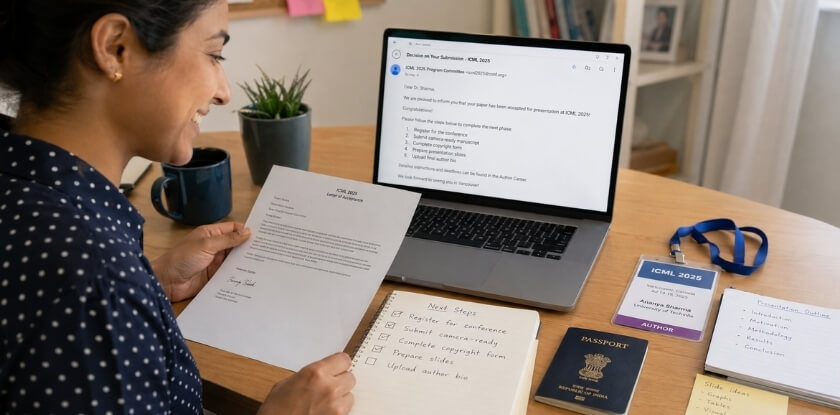
Camera-Ready Checklist and Copyright Form
The “camera-ready” version is your final, publication-ready manuscript. This is not the time for new content. It’s about making sure your paper meets every formatting requirement before the proceedings go to print or upload.
Start with the reviewers’ comments. Even if your paper was accepted with minor revisions, address every single point. Editors do check. Missing a reviewer request can delay publication or, in rare cases, get your paper pulled.
Then go through this checklist before you submit anything:
- File format. Most publishers — Springer Nature, IEEE, EPJ Web of Conferences — want a PDF and the source files (Word or LaTeX). Check the specific instructions. Some want only PDF. Some want both. Don’t guess.
- Template compliance. If you used the Springer Nature conference proceedings Word template or the equivalent LaTeX class, double-check margins, font sizes, and section heading styles against the template specs. Even one wrong margin can trigger a desk rejection at the camera-ready stage.
- Page count. Confirm you’re within the allowed page limit. Going one page over is common. If you’re over, cut — don’t shrink the font or tighten margins to squeeze it in. Editors notice.
- Figures and tables. All figures should be at least 300 DPI. Blurry figures in a PDF look worse in print. Label everything properly.
- Author details. Make sure your name appears exactly as it does on your ORCID profile. Inconsistent author name formatting across publications creates headaches later, especially when Scopus tries to attribute citations correctly.
- References. Format every reference according to the publisher’s style. For Springer Nature proceedings, that’s usually numbered Vancouver-style. For IEEE, it’s their own bracketed format. Wrong reference formatting is flagged constantly at camera-ready review.
- The copyright transfer form. This usually comes as a separate document — either a PDF you sign and scan, or an online form through the publisher’s submission portal. Read it before you sign. Some forms transfer full copyright to the publisher. Others grant a license while you retain copyright. Know which one you’re signing. If your institution or funder has open access requirements, check whether the form is compatible before you agree to it.
Submit everything by the stated deadline. Camera-ready deadlines are hard deadlines. Proceedings have to be compiled, and if you miss the window, your paper may not make it into the published volume — which means no Scopus indexing at all.
Save a copy of everything you submit, including the signed copyright form. You’ll need it later.
Uploading to ResearchGate and Your Institutional Repository After Proceedings Are Published
Once the proceedings are officially published — meaning they have a DOI and are live on the publisher’s platform — you can start thinking about visibility.
Two places matter most: ResearchGate and your institutional repository.
ResearchGate. Go to your ResearchGate profile and add the paper. Use the DOI to import the metadata automatically rather than typing it manually — this reduces errors and links your paper correctly in the system. The bigger question is whether you can upload the full text.
Check your copyright form. If you signed a standard copyright transfer, you may only be allowed to share a preprint or accepted manuscript version, not the publisher’s formatted PDF. Springer Nature and Elsevier both have self-archiving policies you can look up directly. IEEE is more restrictive with formatted PDFs but generally allows the accepted manuscript. When in doubt, upload your accepted manuscript (the post-peer-review, pre-typeset version) — that’s almost always allowed.
Institutional repository. Many universities require researchers to deposit publications in their repository as a condition of employment or funding. Check your institution’s open access policy. If a deposit is required, your library’s research support team can usually help with embargo periods and which file version to submit.
Depositing in your institutional repository also creates a stable, indexed record of your work that lives outside any one commercial platform.
After both are done, go back to your ResearchGate profile and confirm the paper is linked to your ORCID. You can sync this manually through your ORCID account by adding the work with its DOI. This matters because Scopus and other databases use ORCID identifiers to consolidate your publication record — and any citation that comes in later gets attributed correctly.
The indexing lag. Just because your paper is published doesn’t mean it’s in Scopus yet. Scopus indexing of conference proceedings can take anywhere from a few weeks to several months after the proceedings go live. Don’t panic if you search for your paper in Scopus immediately after publication and don’t find it. Check back in 60 to 90 days. If it still isn’t there, contact the conference organizers — they can follow up with the publisher about indexing status.
How to Avoid Rejection — Common Mistakes and How to Fix Them
Rejection stings, but most of it is preventable. The same handful of mistakes show up again and again in conference paper submissions, and once you know what reviewers are actually looking at, you can fix most problems before you ever hit submit.
The Abstract Is Doing Too Little Work
Reviewers read your abstract first. If it’s vague, they’re already skeptical before they reach your methodology section. A weak abstract reads like a summary of what you plan to discuss rather than what you actually found. State your research question, your method, and your key result — all in the abstract. Numbers help. “Accuracy improved by 12%” beats “results showed improvement” every single time.
Keep it tight. Most Scopus-indexed proceedings cap abstracts at 250–300 words. Going over signals you haven’t edited carefully.
Ignoring the Conference’s Scope
This is more common than it should be. Submitting a paper on machine learning for healthcare to a civil engineering conference because you found an open call — reviewers notice. Program committees reject out-of-scope papers fast, often without detailed feedback, which wastes a submission cycle you could have spent somewhere better. Before you submit, read the last two years of accepted papers from that conference. If your topic doesn’t appear anywhere near those, move on.
Formatting Errors
If the conference uses Springer Nature conference proceedings Word template or a LaTeX format, use it exactly as given. Don’t import your content into a custom layout and think it’s “close enough.” Page limits, font sizes, margin requirements — these are hard rules. Some proceedings automatically desk-reject papers that exceed the page limit, even by half a page.
Check:
- Font and font size throughout (including headings, captions, and references)
- Figure resolution (300 DPI minimum for most proceedings)
- Reference style (IEEE style vs. author-year varies by venue)
- File format required for submission (PDF, DOCX, or both)
Spend 20 minutes with the author guidelines before you touch the template. It saves hours later.
Weak Literature Review
Reviewers at established venues like IEEE or Springer Nature conferences expect you to know the field. Citing papers from 10 years ago while ignoring recent work is a fast path to a “major revision” or rejection. Check publication dates. If your references are mostly pre-2018 for a fast-moving field like NLP or computer vision, you have a problem. Use your institutional repository access and Google Scholar to find recent work, and actually engage with it — don’t just cite to hit a number.
Not Positioning the Contribution Clearly
Your paper needs to answer one question for the reviewer: why does this matter and what does it add? If that answer isn’t obvious by the end of the introduction, reviewers will look for it throughout the paper and get frustrated. Write a direct contribution statement. Something like: “This paper makes three contributions: (1)… (2)… (3)…” is not fancy, but it works. Reviewers appreciate clarity.
Methodology Gaps
Vague methodology is one of the most cited rejection reasons in peer review. If you can’t reproduce your own results from what you’ve written, neither can anyone else. Be specific about datasets, parameters, evaluation metrics, and any preprocessing steps. If your experiment used a specific benchmark, name it. If you used a threshold of 0.7, say 0.7.
This matters especially in conferences where proceedings go to Scopus — indexing by Scopus doesn’t mean editorial standards are low. IEEE and Elsevier-affiliated proceedings in particular have reviewers who flag thin methodology quickly.
Grammatical and Language Issues
This isn’t about being a native English speaker. It’s about clarity. Reviewers won’t fix your sentences for you — they’ll just note “language issues” and recommend rejection. If English isn’t your first language, run your paper through a human proofreader or a paid editing service before submission. Grammarly catches surface issues but misses technical writing problems entirely. A colleague who writes in English regularly is worth more than any tool here.
Missing or Wrong ORCID
More conferences now require ORCID IDs in the submission system. Submitting without one, or entering a wrong ORCID, creates problems at the camera-ready stage and can delay your paper in post-acceptance processing. Set yours up at ORCID.org before you start any submission, and keep the 16-digit identifier somewhere accessible.
Submitting Without Checking the Scopus Source List First
This is the mistake that hurts most, because you only find out after the work is done. Before you submit anywhere, go to the Scopus Source List and confirm the conference proceedings series is actively indexed. A proceedings series that was indexed three years ago may have been discontinued or suspended. The ISSN Portal can help you confirm the ISSN is legitimate and matches the proceedings you’re targeting. Five minutes of verification saves months of frustration.
Resubmitting a Rejected Paper Without Revising It
If a paper gets rejected with reviewer comments and you resubmit it elsewhere unchanged, you’re betting the next set of reviewers won’t notice the same problems. They usually do. Treat reviewer feedback as a free consultation. Even harsh comments usually point at something real. Address the substantive issues, revise the manuscript, and then resubmit.
Most rejections aren’t about the research being bad. They’re about presentation, positioning, and process. Fix those, and your acceptance rate improves significantly.
How Long Does Scopus Indexing Take — Citation and Indexing Lag
Getting your paper accepted is one thing. Seeing it actually appear in Scopus is another. These are two completely separate events, and the gap between them trips up a lot of researchers — especially those who need the indexed record for a promotion application, grant report, or annual review.
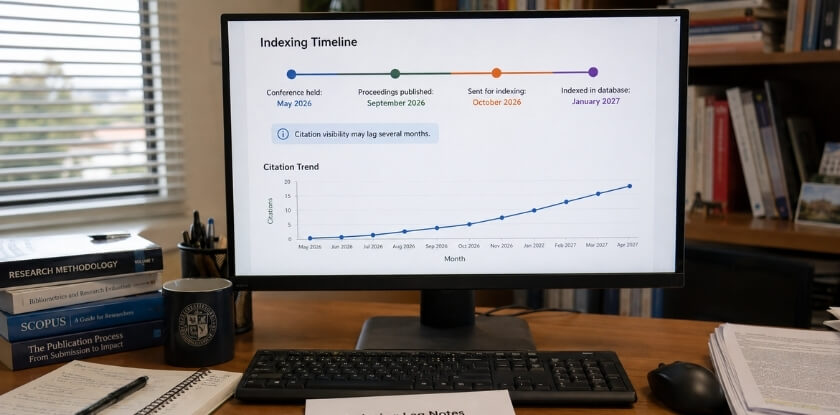
Here’s the honest picture.
The Typical Timeline After Publication
Once your camera-ready submission is processed and the proceedings volume is officially published — whether through Springer Nature, IEEE, Elsevier, or a smaller publisher like EPJ Web of Conferences — the indexing process begins on Scopus’s end. But it doesn’t happen overnight.
For most conference proceedings, the realistic wait is 3 to 6 months from the publication date. Sometimes it’s shorter. Sometimes it runs to 9 months or longer. There’s no fixed schedule that Scopus publishes, and the publisher has limited control over how quickly Elsevier’s indexing team processes a new volume.
IEEE proceedings tend to index faster — often within 8 to 12 weeks — largely because of their established data feed relationship with Scopus. Springer Nature proceedings can take longer, particularly for newer series. EPJ Web of Conferences, which handles a high volume of physics and applied science proceedings, tends to be fairly consistent but can still lag by several months.
What “Indexed” Actually Means Here
There are two distinct things you’re waiting for:
- The paper record appearing in Scopus — this means someone searching Scopus can find your paper, see the abstract, authors, and affiliation.
- The citation count being tracked — this is separate. Even after your paper appears, citations to it won’t show up immediately. Scopus needs to process citing articles that reference yours, which adds another layer of delay.
So a paper can be “in Scopus” but show zero citations even if three papers published last month cited it. That’s normal. The citation indexing lag can add another 4 to 8 weeks on top of the base indexing lag.
How to Check Whether Your Paper Is Indexed
Don’t wait passively. Do this:
- Go to [scopus.com](https://www.scopus.com) and search your full paper title in quotes.
- Also search by your ORCID iD — if your ORCID is linked to your Scopus author profile, papers should eventually aggregate there automatically.
- Check the Scopus Source List to confirm the proceedings volume (not just the conference series) is still listed. Sometimes individual volumes aren’t indexed even if previous years were — publisher changes, quality reviews, or late submission of metadata to Elsevier can all cause gaps.
If nothing shows after 6 months, don’t assume something is wrong yet. But at the 9-month mark, it’s worth contacting the proceedings publisher and asking them to verify the volume metadata was submitted to Scopus correctly.
What to Do If Your Paper Isn’t Appearing
First, confirm you’re looking at the right publication year and volume. Scopus sometimes indexes a proceedings volume under a slightly different title than what you expect.
Second, check the ISSN Portal to verify the proceedings series has a registered ISSN. Missing or incorrect ISSN data is one of the more common reasons a volume stalls in Elsevier’s intake process.
Third, reach out to the conference organiser or the publisher directly. Ask specifically: “Has the full metadata for this volume been submitted to Scopus, and do you have a reference number or confirmation from Elsevier?” A reputable publisher will have this information. If they can’t answer that question, that’s a red flag worth taking seriously.
You can also upload your paper to an institutional repository or ResearchGate in the meantime. This won’t accelerate Scopus indexing, but it keeps your work discoverable and timestamped while you wait.
One Thing Researchers Often Miss
Scopus indexing lag affects your h-index calculation too. If citations to your paper are made by articles that aren’t themselves indexed in Scopus yet, those citations won’t count in your Scopus metrics at all — even after your paper appears. Google Scholar will usually pick these up faster, which is why your citation count can look meaningfully different between the two platforms. Neither is wrong. They’re just measuring different things with different update cycles.
Patience matters here. The system is slower than most researchers expect, and that’s not necessarily a sign anything has gone wrong.
Frequently Asked Questions (FAQ)
Is every conference proceeding published by Springer or IEEE automatically Scopus-indexed?
No. Publisher name alone doesn’t guarantee indexing. Springer Nature and IEEE both publish some proceedings that aren’t in Scopus. Always check the specific proceeding series or volume against the Scopus Source List directly. A paper published in a well-known publisher’s series can still miss indexing if that particular series wasn’t accepted or was later discontinued.
How do I check if a conference proceeding is in Scopus before I submit?
Go to the Scopus Source List (available on the Elsevier website), download the current Excel file, and search by ISSN or series title. Cross-reference the ISSN using the ISSN Portal to confirm the series details match. If you can’t find a clear match, email the conference organizers and ask for the exact source title and ISSN they use for Scopus submission. A legitimate conference will answer that question without hesitation.
Can I submit the same paper to two different Scopus-indexed conferences?
No. That’s dual submission, and it’s an ethical violation under COPE guidelines. Peer review assumes your work is exclusively under consideration. Getting caught — and it does happen — can get both papers retracted and permanently damage your academic record.
What happens if my paper gets accepted but the proceedings never appear in Scopus?
It happens. The conference may have lost its Scopus coverage, or the publisher may not have submitted the volume for indexing. Your options are limited at that point. You can upload the paper to your institutional repository or ResearchGate to maintain visibility, but you can’t force Scopus to index it. This is exactly why you verify indexing before submitting, not after.
How long does indexing actually take after the proceedings are published?
Anywhere from a few weeks to over a year, depending on the publisher and how quickly the volume gets submitted to Scopus. IEEE and Springer Nature volumes tend to appear faster. Smaller or newer series can have significant indexing lag. Don’t assume something is wrong at the 3-month mark — check again at 6 months, and if there’s still nothing, contact the conference publisher directly.
Do I need to pay an APC to publish in a Scopus-indexed conference proceeding?
Not always. Many conference proceedings charge a registration fee that covers publication — there’s no separate APC. Others do charge an Article Processing Charge on top of registration, especially for open-access volumes. EPJ Web of Conferences, for example, typically passes costs to the organizing institution rather than individual authors. Always ask for a full cost breakdown before committing.
Will my conference paper count the same as a journal article for academic evaluation?
That depends entirely on your institution, your country’s research assessment framework, and your field. In computer science, high-quality conference papers (think major IEEE or ACM venues) carry real weight. In life sciences or social sciences, journal articles generally rank higher. Ask your department head or check your institution’s specific publication requirements before targeting a conference as your primary output.
My ORCID profile doesn’t show my conference paper. What’s wrong?
Nothing is necessarily wrong. ORCID doesn’t automatically pull in all Scopus records. You may need to manually add the work through your ORCID dashboard, or wait for Scopus to sync the record after indexing completes. Once your paper appears in Scopus with your author profile linked, you can import it to ORCID directly from Scopus.
Is it okay to post my camera-ready paper on ResearchGate before the proceedings are published?
Check your copyright transfer agreement first. Some publishers allow posting of the accepted manuscript (not the final formatted version) on personal or institutional sites. Others restrict it until after official publication. IEEE, for instance, has specific self-archiving rules. Don’t assume — read the agreement you signed, or check the publisher’s author rights page.
How do I know if a conference is predatory?
Watch for unsolicited emails with vague praise, no clear peer review process, no named editorial committee, and ISSN numbers that don’t match anything on the ISSN Portal or Scopus Source List. Cross-check against Beall’s List archives (historical reference, not updated currently) and look for red flags like guaranteed acceptance or absurdly short review timelines. Legitimate conferences reject papers. If a conference has never rejected anyone, that tells you everything.
Can a paper get removed from Scopus after it’s been indexed?
Yes. If a source loses its Scopus coverage — which Elsevier reviews periodically — papers from affected volumes can be removed. This is rare but real. It’s another reason to target established, long-running series from major publishers rather than new or untested ones.
Does Scopus indexing mean my paper will get cited?
Indexing makes your paper discoverable. That’s it. Citations depend on the quality and relevance of your work, how well you’ve written the abstract and keywords, and whether researchers in your area are actively looking for what you’ve done. Being in Scopus is the floor, not the ceiling.
Conclusion — Next Steps for a Successful Publication
You’ve made it through the full process — from checking the Scopus Source List to understanding indexing lag. That’s not a small thing. Most researchers who struggle with publication aren’t failing because their research is weak. They’re failing because the process itself is confusing, and nobody laid it out clearly for them.
So here’s where you actually stand, and what to do next.
If You Haven’t Submitted Yet
Start with venue selection. Not with writing. Find a conference that’s genuinely Scopus-indexed — verify it on the Scopus Source List directly, cross-check the ISSN on the ISSN Portal, and look at whether past proceedings from that event actually show up in Scopus search results. Don’t rely on the conference website alone.
Once you’ve confirmed the venue, check Beall’s List and look for COPE membership among the publishers. Springer Nature, IEEE, Elsevier, and EPJ Web of Conferences all have established track records. Newer or smaller operators need more scrutiny.
Then write to the deadline. Use the official template — whether that’s the Springer Nature conference proceedings Word template or a LaTeX file provided by the organizer. Formatting errors are an avoidable reason for rejection.
If You’re Currently in Review
Don’t sit idle. Set up your ORCID profile properly if you haven’t already. Start a ResearchGate profile and pre-populate it with your earlier work. When your paper gets accepted, you’ll want these ready.
Keep an eye on your email. Camera-ready submission windows are often short — sometimes as tight as 7 to 10 days. Missing that window can push your paper out of the current volume entirely.
If Your Paper Has Been Accepted
Read the copyright transfer agreement before you sign it. Understand what rights you’re keeping — specifically whether you can deposit a preprint or post-print in an institutional repository. Most IEEE and Springer Nature agreements allow some form of self-archiving. Know what yours says.
Pay any APC on time. If your institution covers it, get that process started early because internal reimbursement approvals can be slow.
Submit your camera-ready file exactly as specified. One wrong file format or a missing figure can delay the entire proceedings volume.
After Publication
Post your paper to ResearchGate. Add it to your ORCID record. Share the DOI directly — not just the conference page link. If your institution has an open-access repository, deposit there too.
Then wait. Scopus indexing lag is real — it typically runs anywhere from a few weeks to several months depending on the publisher and how quickly the proceedings volume gets processed. IEEE tends to be faster. Smaller publishers take longer. Don’t assume something is wrong until at least six months have passed.
Check Scopus periodically by searching your paper title. Once it appears, your citation count becomes trackable and your author profile starts building automatically within the system.
The Honest Bottom Line
This process takes time. A realistic timeline from abstract submission to confirmed Scopus indexing is often 12 to 18 months. That’s normal.
What separates researchers who consistently publish in credible venues from those who get stuck — or worse, end up in predatory proceedings — is mostly process discipline. Verify first. Format correctly. Meet every deadline. Read what you sign.
Do those four things, and the rest is just execution.
