You have been given 60 minutes on the main stage, but should you use all of it? Some keynote speakers accept whatever slot they are handed without a second thought. Others fill every minute because they assume more content signals more value. Neither habit serves the audience well, and both can quietly weaken a strong talk.
Quick answer: Published guidance commonly puts a keynote at about 30 to 60 minutes, with 45 minutes a frequent target, but the slot your organizer sets is the number that counts. TEDx talks are typically kept under 18 minutes. Ask whether Q&A sits inside your slot, and plan to finish a few minutes early rather than late.
Last verified against official sources: October 2026.
This article covers keynote length by event type, how to turn minutes into a script length, and what happens when a talk runs long or ends too soon.
How Long Should a Keynote Speaker Speak?
Plan for the time the organizer gives you, and treat 30 to 60 minutes as the usual range, with shorter slots at virtual events and ceremonies. There is no official standard for keynotes in general. Speaker-bureau pages give ranges such as 30 to 60 minutes and 45 to 90 minutes, so the program matters more than any rule of thumb.
The 18-Minute Benchmark
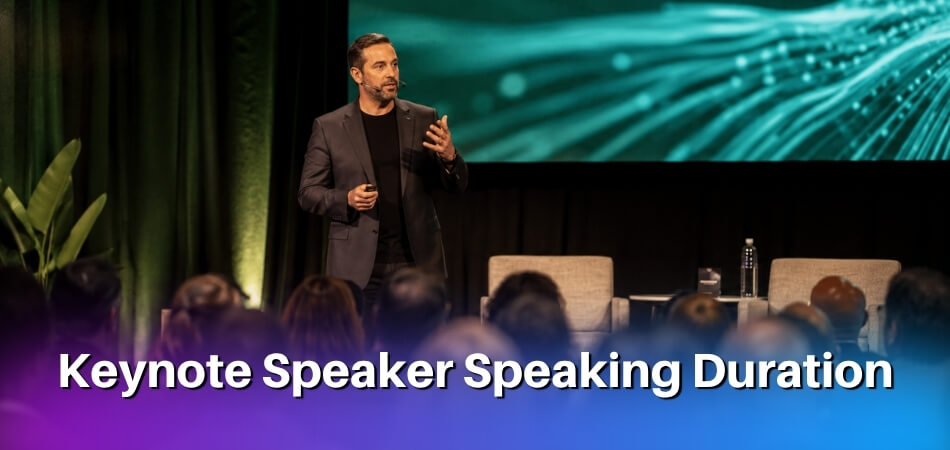
TEDx rules say talks are typically under 18 minutes, and a TEDx talk that runs past 18 minutes is reviewed by the TEDx team before it can be published on the TEDx YouTube channel. Dialogue-style formats can run up to 30 minutes. If you are unsure what to aim for in a short slot, 18 minutes is a defensible default.
Confirm the Slot Before You Write
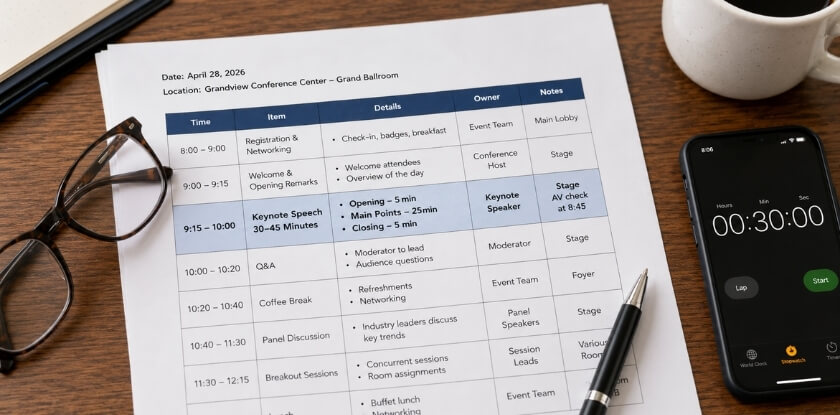
Ask for the exact start and end time, and ask whether Q&A is included in that block. Conference speaker instructions differ here: some give a keynote a block that already includes questions, while others add separate question time. A speakers bureau (BigSpeak, 2025) notes that a good Q&A can add 15 to 30 minutes, so the answer changes how much you can script. Then build in a buffer. Running over is not a minor inconvenience: it squeezes every session that follows and leaves a poor impression whatever the content was.
The Standard Keynote Length: Why 30 to 60 Minutes Works
Organizers usually settle on 30 to 60 minutes because it is long enough to develop a real argument and tell a story with stakes, yet short enough that most people stay engaged instead of politely enduring.
Attention Span and the Range
Attention does not run in one smooth, unbroken stream. Research on exactly how long people can focus is mixed, and a fixed limit of 10 or 20 minutes is a rule of thumb, not a proven law. In practice, effective keynote speakers build reset points into the talk: a story shift, a question to the audience, a visual change, a moment of humor. These are structural tools, not padding.
Done well, a 45-minute keynote does not demand 45 minutes of deep concentration. It asks for a series of shorter bursts joined by transitions. A 90-minute talk that ignores this will lose much of the room by the halfway point.
Context shapes attention too. At a corporate conference, people carry phones and have back-to-back sessions competing for their focus, so a 30-minute slot forces a speaker to prioritize, which often gives a sharper talk than one stretched to an hour. Academic audiences tolerate more density, but even specialists have a limit, and a presenter who runs long signals poor preparation as much as anything.
What the TED 18-Minute Rule Teaches
TED curator Chris Anderson has explained the limit as long enough to be taken seriously and short enough to hold attention. He has also said it suits online viewing and forces speakers to cut down material. It came from running events, not from a laboratory finding, and the neuroscience explanations repeated online are mostly later gloss.
The useful lesson for keynote speakers is not that every talk should be 18 minutes. It is that a constraint forces clarity. With 18 minutes you cannot afford a rambling opening or a detour through side research, so every minute has to earn its place. The rule has become shorthand for not wasting anyone’s time, a useful mindset even when the format does not apply.
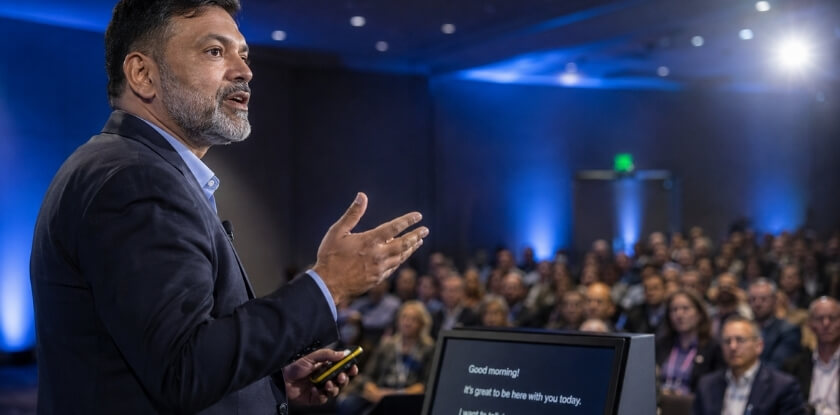
A 45-minute corporate keynote does not need to copy a TED Talk. The room and expectations differ. But the editing questions carry over: what is the single core idea, what is the clearest path from opening to close, and what can be cut without losing anything essential? Speakers who ask those questions of a 45-minute slot tend to deliver better talks than those who treat the time as something to fill.
Keynote Length by Event Type
Different events carry different expectations, and timing that works at a corporate off-site can lose an academic audience. The figures below are typical ranges drawn from speaker-bureau and event-planning advice, not rules, so confirm with your organizer.
| Event type | Typical keynote length | Main reason |
|---|---|---|
| Corporate conference | 30 to 45 minutes, in a slot of up to 60 with Q&A | Dense agenda, phones in pockets |
| Academic conference | 45 to 60 minutes, sometimes longer | Audience expects depth |
| Commencement or ceremony | About 10 to 20 minutes | Audience is there for the graduates |
| Virtual event | 20 to 30 minutes | Attention drops faster on screen |
| Hybrid event | Toward the shorter end, around 30 minutes | Remote viewers disengage sooner than the room |
| TED or TEDx | Typically under 18 minutes | Format rule |
Corporate Conferences and Business Events
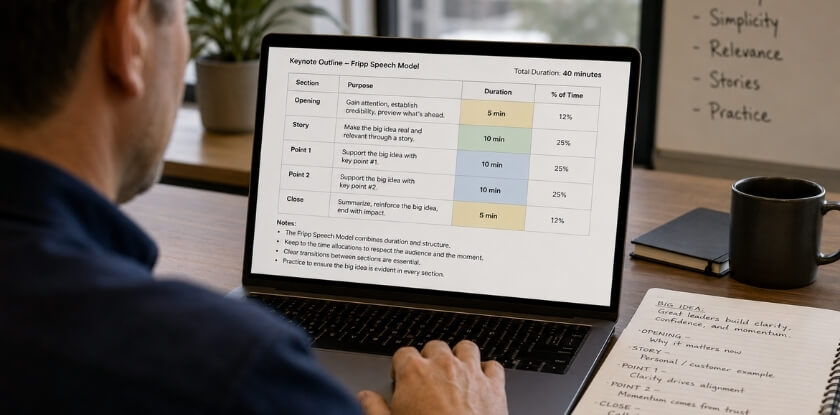
Corporate events are tightly scheduled, with breakouts, panels and networking blocks competing for the same day. Organizers often want a keynote that fits a 45- to 60-minute window, leaning shorter when the agenda is dense. Corporate audiences expect a full presentation that justifies the time away from work, so a very short talk can feel undercooked. Forty-five minutes tends to be the sweet spot: long enough for a real narrative arc, short enough that attention holds.
If the organizer books 60 minutes and expects questions, your prepared remarks should land closer to 40. Corporate audiences penalize running over. Five extra minutes in a hotel ballroom cascades into every session after yours, and respecting the clock reads as professionalism.
Academic and Professional Conferences
A plenary keynote at a scholarly conference often runs 45 to 60 minutes and sometimes longer, partly because the audience expects depth and the format allows it. Longer is not automatically better, though. A 75-minute keynote that could have made its case in 50 rarely earns praise for thoroughness; it earns a reputation for being hard to sit through.
At professional association conferences in fields such as medicine, law or engineering, expectations vary widely by discipline and by program. A tech or design conference may deliberately target 30 to 40 minutes, closer to the TED model, because its audience is used to that format. Ask the organizer what the expectation is. Programs are usually built around fixed blocks, and finishing a little short is usually received better than running over.
Commencement and Ceremonial Events
At commencement, the audience is there for the graduates, the families and the ritual of the day, not primarily for the speaker. That changes pacing. Guidance varies, but most experienced speakers keep these speeches short, often 20 minutes or less, and the ones people quote tend to be concise. Brevity gives a speaker room to be memorable rather than merely complete, and an emotionally charged audience seated outdoors has little patience for a long one.
Virtual and Hybrid Events
Engagement tends to drop faster online than in a room, partly because the competing distractions sit on the same device. For a purely virtual event, 20 to 30 minutes is a safer plan than a full hour, although some speaker-bureau advice allows up to 45 minutes, so confirm what the organizer wants. Some organizers have moved to short keynotes with extended Q&A, which keeps the format interactive and gives viewers a reason to stay.
Hybrid events add a wrinkle. The room and the remote audience experience the same talk differently, and what holds a live room for 50 minutes can feel long on a laptop in a home office. Erring shorter protects both groups. Pace also changes online: some speakers talk faster when they cannot read the room, so rehearse the actual timing instead of trusting the script length.
When a Shorter or Longer Keynote Makes Sense
Go shorter when the context pushes you that way, and longer only when the content or format earns it. Match duration to what the audience needs, not to whatever feels standard.
When a Shorter Keynote Works Better
Shorter does not mean lesser. A 15 to 20 minute keynote can beat a 45-minute one when the setting calls for it.
- Virtual and hybrid events. The room energy that carries a speaker through a long talk is missing. Twenty to 25 minutes followed by questions or discussion usually holds more attention than pushing through a full 45.
- Opening keynotes at full-day conferences. A tight 20 to 30 minute set warms the room without exhausting people who still have hours ahead.
- TEDx and TED-style formats. Organizers hold speakers to the limit strictly. It forces you to cut everything that is not essential, which usually improves the talk.
- Senior executive audiences. A C-suite audience often responds better to a focused 20-minute talk than to a drawn-out 50-minute one. Their time is limited and they know it.
When a Longer Keynote Is Justified
Going past 60 minutes is rarely necessary, but some cases earn it.
- Deep technical or academic content. If you are presenting original research or walking through a complex framework, the audience expects the time investment and arrives prepared for it.
- Workshop-style keynotes. When the speaker guides exercises or group discussion, 75 to 90 minutes can work because people are not listening passively the whole time.
Commencement is the opposite case. Graduates, families and faculty seated in the sun have a low tolerance for length, and the speeches people remember tend to be on the short side.
Let the Audience Signal the Right Length
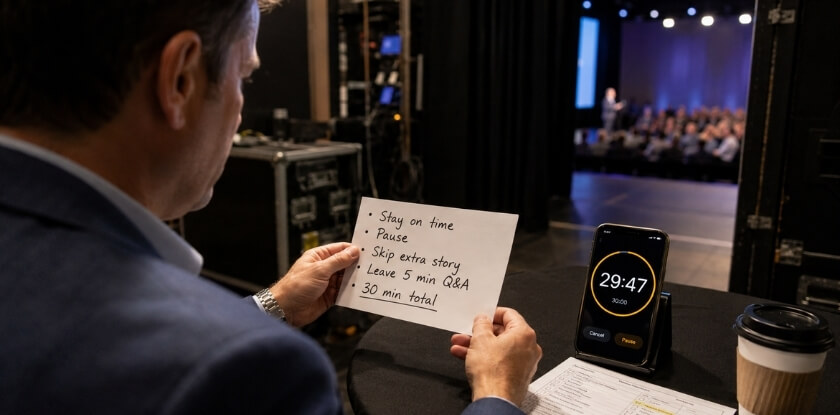
Experienced speakers watch the room. Shuffling, phone-checking and side conversations suggest the content has passed its natural end, whatever the clock says. Build in natural stopping points so you can adjust, because ending five minutes early is usually better than finishing three minutes late.
Word Count Guide: How Many Words for 20, 30, 45 or 60 Minutes?
A rough rule is 130 words per minute for a scripted live keynote, so a 30-minute slot is about 3,900 words, but your own pace decides. Speaking-coach guides commonly put presentation pace somewhere around 120 to 150 words per minute. Analyses of famous TED talks have found faster speakers, so treat any single figure as a starting point and measure yourself.
Pace is not fixed. You slow down for emphasis, pause after a punchline and breathe before a key transition. The table shows what each pace means for a script.
| Slot | At 120 wpm | At 130 wpm | At 150 wpm |
|---|---|---|---|
| 20 minutes | 2,400 words | 2,600 words | 3,000 words |
| 30 minutes | 3,600 words | 3,900 words | 4,500 words |
| 45 minutes | 5,400 words | 5,850 words | 6,750 words |
| 60 minutes | 7,200 words | 7,800 words | 9,000 words |
These totals assume continuous speech. Pauses, audience reaction and Q&A use some of the slot, so a script that fills every minute on paper will overrun on stage. A 45-minute script much beyond 6,000 words usually means a rushed delivery or an overrun, and reading it aloud tells you more than counting pages.
What Each Length Gives You
20 minutes. This is the TED neighborhood. Stay at the lower end of the range and leave yourself a buffer.
30 minutes. A common length for breakout keynotes and academic presentations. You can introduce a concept, work through two or three supporting points and land a clear close without rushing or padding.
45 minutes. Where many full keynotes sit. There is room for an opening story, substantive content and some interaction. Dense material without variety will tire the room, so build in a beat or a question near the midpoint.
60 minutes. Genuinely long. Speakers who write out a full script at this length often find the draft runs well past the table figure, then wonder why they keep running over. If you are booked for an hour, plan content for about 50 minutes and let the rest breathe.
Why Speakers Consistently Run Long
A frequent cause is writing for reading pace instead of speaking pace. Material that felt tight in rehearsal also feels drawn out in the room. If you clock 125 words per minute alone at a desk but deliver at 115 in front of 500 people, pausing and letting applause settle, a 60-minute script becomes a 65-minute keynote or more. Organizers notice, and the other speakers on the program notice even more.
Time yourself reading aloud, not silently, and do it at least once in conditions close to the real delivery, ideally in the outfit you will wear on stage, since formal clothing can limit movement. Virtual talks can be shorter on screen, so trim your script slightly for them and check the rhythm in rehearsal.
What Happens When a Keynote Runs Too Long (or Too Short)?
Both directions carry real costs.
When a Keynote Runs Too Long
Past a certain point people stop absorbing and start disengaging. They check phones, lose the thread and plan lunch. The damage goes beyond comfort: if the first 40 minutes were strong and the speaker grinds on for another 30, people remember the slog, not the insight. Overruns usually have a few specific causes.
- Underestimating real pace. Word counts are often calculated from a relaxed read-through, then the speaker slows down on stage. Add pauses, reactions and a slow-starting room, and a 45-minute talk becomes 65.
- Skipping the hard cuts. Speakers rehearse everything they wrote instead of what the audience needs. Cutting a favorite story hurts during prep, but the audience never misses what they never heard.
- Ignoring the schedule. A long keynote compresses every session after it. Organizers lose control of the day, panelists are shortchanged, and the speaker earns a quiet reputation as difficult to work with.
For virtual and hybrid events the problem is sharper. There is no social pressure keeping viewers in their seats, so a talk that drifts past its stated end time loses people fast.
When a Keynote Runs Too Short
Ending far early has its own problems, though they are less obvious. If the audience expects 45 minutes and gets 18, the reaction is rarely gratitude. It can read as underprepared, or as a speaker who did not respect the event enough to develop a full argument. Eighteen minutes feels right in a TEDx setting because that is the format; in a slot built for an hour, it feels like a fuse went out.
A very short keynote also creates awkward logistics. If the program built a Q&A buffer into the slot and the speaker finishes 25 minutes early, the organizer is suddenly improvising in front of a live audience. The one fair exception is a speaker who reads the room and wraps up tight because the content is complete and the energy is right. That is a skill. Stopping because you ran out of material is something else.
Signals That Something Has Gone Wrong
You will not always get direct feedback, but the room tells you. A talk that runs long tends to bring scattered applause, slow starts on questions and people shifting toward the exits. A talk that ends too soon tends to bring a flat, slightly confused response, polite applause with a pause underneath it.
The cleanest fix happens before the event. Practice at speaking pace against a real timer, in the format the event will use. For a 45-minute slot, many experienced speakers rehearse to 40 to 42 minutes, which leaves a natural buffer without padding the content.
From our experience at MS International: Our speakers present in person at events in the Greater Toronto Area, and the moderator introduces each speaker before the talk. Your confirmation and the final conference programme set your time, and presentation lengths vary by event, so check your slot and whether a question period is included before you finalize your slides. Keynote and invited roles are arranged separately from the standard presenting-author route. Speakers cover their own travel, accommodation and personal costs unless something else is agreed in writing.
FAQ
Keynote length depends on more than the slot on the agenda: the 18-minute rule, speaking pace, audience size and whether Q&A eats into the time all play a part.
How long is a typical keynote speech?
Published guidance commonly puts a keynote at 30 to 60 minutes, with 45 minutes a frequent target at corporate conferences. Shorter slots of 20 to 30 minutes suit tight schedules. Advice varies, so your organizer’s slot is the real answer.
Is the 18-minute rule real?
Yes, for TED and TEDx. TEDx rules say talks are typically under 18 minutes, and longer ones are reviewed before publication. It is a format rule, not a law of attention, and a full keynote at a multi-day conference usually needs more time.
Can a keynote be too short?
Yes. If the program booked an hour and you finish in 10 minutes, it can feel dismissive. Many organizers would expect more than 15 to 20 minutes for anything billed as a keynote, but ask what they want.
How long should a commencement speech be?
Short, often 20 minutes or less, with no fixed rule. Audiences at graduations are seated for a long ceremony, often outdoors, and the speeches people remember tend to be the concise ones.
What is the right length for a virtual event keynote?
Shorter than in person, usually 20 to 30 minutes, although some speaker-bureau advice allows up to 45. Screen fatigue sets in faster, and hybrid viewers are especially likely to drop off when a presentation drags.
How fast do most speakers talk?
Coaching guides commonly give about 120 to 150 words per minute for presentations, and individual pace varies. At 130 words per minute, a 45-minute keynote is roughly 5,850 words of script. Time yourself reading aloud to find your own figure.
Should a keynote speaker always use every minute?
No. Finishing a few minutes early is usually better received than running over. Organizers build buffers into schedules for good reason, and respecting the time signals professionalism.
Who controls the keynote length?
The organizer sets the slot, and the speaker works within it. If you want the length adjusted, raise it well before the event, not on the day.
Does audience size affect keynote length?
Somewhat. Larger audiences often expect a more substantial presentation, while smaller settings can support a shorter, conversational keynote. Event type matters more than headcount.
Does Q&A count as part of the keynote time?
It depends on the organizer. Some conference instructions count questions inside the keynote block and others add separate time, so ask for the exact block in writing. Then script less than the full slot if questions are included.
Final Thoughts
Keynotes often go wrong not because the speaker is boring but because the speaker misjudged how long the audience could stay with them. The right length respects attention and fits the context the organizer has built around you.
Aim for 30 to 45 minutes if you have flexibility, and treat a shorter slot as discipline rather than a setback. Know your duration before you write a word, and build the talk to finish just inside it.