It’s the night before your conference. You’re standing in front of your wardrobe, holding a blazer in one hand and a hoodie in the other, genuinely unsure which one will make you look like you belong in that room. You don’t want to show up overdressed at a conference full of people in jeans, but you also don’t want to be the only person in a t-shirt while everyone else looks polished. The frustrating part? You checked the registration website three times. There’s no dress code listed anywhere. There never is.
That uncertainty is almost universal among researchers. PhD students packing for their first poster presentation, early-career researchers heading to an IEEE conference or the Society for Neuroscience annual meeting, even senior faculty traveling to the American Chemical Society conference — nearly everyone has that same low-grade anxiety about getting the clothing wrong. Academic conference dress norms are informal by tradition but surprisingly specific by discipline, and nobody really talks about them out loud.
Quick Answer: What To Wear To A Scientific Conference? Business casual or smart professional attire is the widely accepted standard at most scientific conferences. For men, safe choices include chino trousers, an Oxford shirt, loafers, and a business blazer for more formal sessions. For women, tailored trousers, a wrap dress, or a smart blouse with smart flats all work well. Presenters, speakers, and panelists should dress one step more formal than general attendees — if the room is business casual, speakers should lean smart professional. Dress expectations also shift noticeably by field: STEM and engineering conferences like IEEE run noticeably more casual, while medical conference dress codes and social science conferences such as the American Sociological Association conference tend toward a more polished, professional standard. When in doubt, business casual is almost always appropriate and never offensive.
This guide gives you specific, practical answers matched to your exact situation. You’ll find outfit recommendations broken down by scientific discipline, by your role at the event — attendee, presenter, poster presenter, or keynote speaker — by career stage from PhD student to tenured professor, and by budget, including thrift store professional wear and sustainable fashion brands like Patagonia and Eileen Fisher. Whether you’re headed to a summer academic conference, a hybrid conference video call, or a black-tie gala dinner at the end of a three-day meeting, you’ll know exactly what to pack.
What Is the Dress Code for a Scientific Conference?
There isn’t one universal answer. That’s the honest truth, and anyone who gives you a single rule is oversimplifying.
The baseline for most scientific conferences sits somewhere in the business casual range — think chino trousers, an Oxford shirt, a clean blazer, and decent shoes. But that baseline shifts depending on your field, your role, the specific event, and even the time of year. A Society for Neuroscience annual meeting in Washington D.C. in November looks different from a summer academic conference at a beachside venue in Greece.

The General Starting Point
If you genuinely have no other information to go on, aim for smart professional attire without going full suit-and-tie. For most attendees, that means:
- Chino trousers or tailored trousers in a neutral color
- A collared shirt, blouse, or wrap dress
- A business blazer if you’re presenting or meeting with potential collaborators
- Smart flats, loafers, or clean leather shoes
You want to look like you take your work seriously. That’s really the whole job.
Why Field Matters So Much
STEM field dress culture is notoriously casual compared to, say, medicine or the social sciences. Show up to an IEEE conference in a full suit and you might feel oddly overdressed next to a room full of engineers in plaid flannel. Show up to an American Sociological Association conference in jeans and a hoodie and you’ll likely stand out in the wrong direction.
The American Chemical Society conference sits somewhere in the middle — generally business casual, though it leans more polished at evening events and plenary sessions. Medical conference dress codes tend to be more conservative overall. Social science conference fashion norms vary widely but often track closer to business professional than most hard-science meetings.
Your field has its own unspoken contract. Pay attention to it.
What “Business Casual” Actually Means Here
Academia uses this phrase loosely, which causes real confusion. In the conference context, business casual dress code means:
- No jeans (usually — though some fields bend this)
- No athletic wear, hoodies, or visible logos
- Shoes that aren’t sneakers, unless they’re genuinely clean and presentable
- Clothes that fit and aren’t visibly wrinkled
It does not require a blazer at every moment of every day. Wear one for your talk, your poster session, or a scheduled networking event. You can drop it during a casual lunch break.
One More Thing to Calibrate
Think about what you’re doing at the conference, not just where you’re going. Poster presentation attire calls for slightly more polish than just attending talks. If you’re interviewing for a postdoc position in a hotel lobby on the side, dress one level up from the general crowd. If you’re running field research sessions as part of the event, comfort and practicality take priority over appearance.
The goal isn’t to look like a banker. It’s to look like someone whose ideas are worth taking seriously.
How Your Academic Field Shapes What You Should Wear
Academic conferences aren’t monolithic. What reads as appropriately professional at an IEEE conference can feel stiff and odd at an American Sociological Association conference, and showing up to a Society for Neuroscience annual meeting dressed like you’re heading to a tech startup casual Friday will raise a few eyebrows. Field culture is real, and ignoring it costs you socially even if you’re technically dressed fine.
Here’s how it breaks down by discipline.
STEM and Technology Conferences
STEM fields have the widest range of dress norms, which honestly makes them the trickiest to navigate. Physics and mathematics conferences tend toward casual — jeans and a clean button-down are completely normal. Engineering conferences, especially IEEE events, sit somewhere in the middle: business casual dress code is the unspoken standard, but nobody’s showing up in a suit unless they’re giving a keynote or representing industry.
For men, chino trousers and an Oxford shirt cover most situations. Add a business blazer if you’re presenting or heading to an evening networking event. For women, tailored trousers with a blouse or a wrap dress both work well without being overdressed at conference events.
One thing that trips up PhD students: STEM culture sometimes treats formal dress as performative or unnecessary. It isn’t. You’re still being evaluated, informally, by people who might later review your grants or hire you. PhD student professional dress doesn’t need to be expensive — it just needs to look intentional.
Medical and Health Sciences Conferences
Medical conference dress code expectations sit noticeably higher than most science fields. Think about who attends: clinicians, hospital administrators, pharmaceutical company reps, department heads. The room has a professional formality to it by default.
Business casual is the floor, not the ceiling. Smart professional attire is genuinely expected here, especially if you’re presenting. A blazer over tailored trousers or a structured dress is appropriate. Casual is conspicuous in a way it simply isn’t at, say, a computational biology meeting.
There’s also a practical angle — medical conferences often run across multiple days with long sessions, receptions, and sometimes a conference gala dinner. Plan for that range. Wrinkle-resistant fabrics are useful when you’re changing between a poster presentation and a dinner event in the same day without access to your hotel room.
Social Sciences and Humanities Conferences
Social science conference fashion norms are notably more expressive than STEM fields. At an American Sociological Association conference, you’ll see everything from sharp academic blazers to deliberately artsy or political clothing choices. Personal style is more visible and, in some subcultures within these fields, more socially meaningful.
That doesn’t mean anything goes. Cleanliness and intentionality still matter. But you have real latitude here to dress in a way that reflects your identity rather than defaulting to a generic corporate template.
For early-career researchers in social sciences, the risk runs in both directions — being too casual reads as unserious, but being too stiff reads as out of touch with the culture of the field. Aim for academic conference dress norms rather than corporate ones. Smart separates, interesting textures, thoughtful accessories. Ethical clothing choices and sustainable fashion brands like Eileen Fisher or Patagonia are genuinely recognized and respected in many of these communities in a way they might not be in biomedical circles.
Biology, Environmental Science, and Field-Based Disciplines
These fields are interesting because there’s often a split between the conference itself and the identity of the people attending it. Environmental scientists, field ecologists, and conservation biologists tend to have a more relaxed, outdoors-oriented dress culture — but that doesn’t mean conference attire should look like you’ve just come in from a transect survey.
When you’re actually at the conference sessions, treat it like any other science conference: business casual at minimum, smart professional attire for presentations. But you’ll notice the room skews more toward comfort-forward choices — smart flats over heels, loafers, layers that travel well. A capsule wardrobe for travel that transitions from daywear to networking event outfit without needing a full change is particularly practical in this context.
If there’s a field excursion component — common at ecology and environmental conferences — pack separately for that. Wear your field research clothing on those days, obviously, but don’t let it bleed into your conference presentation days. The distinction matters more than it might seem.
What to Wear Based on Your Role at the Conference
Your role at a conference changes everything. Someone sitting in a keynote audience has completely different practical needs than someone who’s been standing next to a poster board for three hours answering questions. Here’s how to think about it by situation.

Attending Sessions and Keynotes as an Audience Member
This is the most forgiving role. You’re not presenting anything, nobody’s looking at you specifically, and your job is to sit, listen, take notes, and stay comfortable.
Business casual dress code is the right benchmark here. Chino trousers and an Oxford shirt will work at almost any conference, from an IEEE conference to an American Sociological Association conference. A wrap dress or tailored trousers with a neat top covers you equally well. Smart flats or loafers beat heels if you’re walking between buildings.
Conference venues are often cold. Bring a layer. A business blazer stuffed in your conference tote bag is easy to pull out when the air conditioning turns a ballroom into a freezer.
Don’t overthink it. Clean, neat, and comfortable. That’s genuinely enough.
Presenting a Paper or Talk
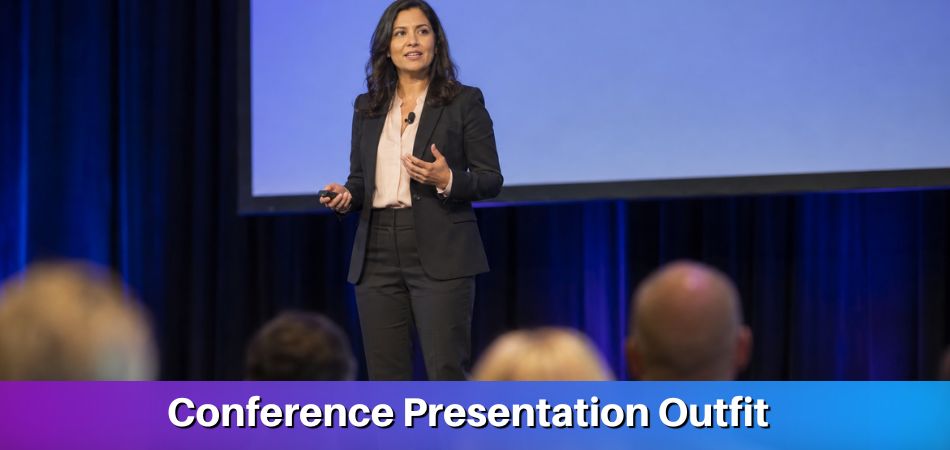
This is where you step it up — not dramatically, but intentionally. You’re standing in front of your peers, and first impressions genuinely do affect how people receive your work, especially early in your career.
For PhD student professional dress, a blazer changes the equation fast. Wear it over a simple Oxford shirt or a fitted top. Tailored trousers or a smart skirt. Nothing that’ll distract — avoid loud patterns or anything that requires constant adjustment while you’re at a podium.
Footwear matters more than people admit. You’re standing, moving, possibly navigating steps to a stage. Smart flats or low-heeled shoes are sensible choices. Loafers work well for any gender.
If you’re presenting at something like a Society for Neuroscience annual meeting or an American Chemical Society conference, smart professional attire is common. You won’t be overdressed in a blazer. You also won’t be underdressed in clean chinos and a button-down — but a blazer does communicate that you took the day seriously.
Wrinkle-resistant fabrics are your friend if you’re traveling. Pack your presentation outfit in a garment bag or hang it immediately when you check in.
Presenting a Poster
Poster sessions are physical. You’re on your feet for two to three hours, you’re probably carrying a poster tube to the session, and you’ll be having rapid-fire conversations back to back.
Poster presentation attire should lean toward the practical end of smart casual. Comfortable shoes are non-negotiable — smart flats or loafers, not dress shoes that pinch by hour two. A blazer still reads well and signals that you’re the presenter, not just browsing. But skip anything overly formal.
Keep your hands free. A lanyard for your name badge is standard, and you’ll want pockets or a small bag for your phone and business cards. Big conference tote bags are fine for hauling your poster tube in, but leave them at your table during the session itself — they just get in the way.
Layers again: poster halls vary wildly in temperature depending on how many people are packed in.
Networking Sessions, Conference Dinners, and Social Events
Networking events call for a slight step up from your daytime conference outfit. Not always formal, but polished. If the conference schedule says “networking reception,” business casual with a bit more care — a nicer blouse, a blazer, cleaner shoes — works well.
Conference gala dinner attire is different. When you see “gala” or “formal dinner” on the schedule, that usually means smart evening wear. For women, a midi dress or tailored jumpsuit. For men, a dark blazer with dress trousers, or a suit if you have one. Black tie is almost never expected at academic events, so don’t panic.
Summer academic conferences that hold outdoor events have their own considerations. Breathable fabrics, low heels or flats on grass, and sunscreen in your bag.
The goal at any social event is to feel relaxed enough to actually talk to people. If you’re tugging at your dress or sweating in a shirt that’s too stiff, that’s a problem. Confidence shows in how you carry yourself, not just what you wear.
Workshops and Hands-On Lab Sessions
This is where the dress code actually shifts. If you’re attending a workshop that involves any hands-on activity — lab demonstrations, fieldwork components, equipment handling — field research clothing logic applies.
Closed-toe shoes are often required in lab settings, full stop. A Society for Neuroscience or American Chemical Society event might have workshop components with explicit safety requirements. Check the session description before you assume your usual conference outfit works.
Comfortable, moveable clothing matters too. Tight blazers and restrictive trousers aren’t practical when you’re reaching across a bench or crouching to adjust equipment. Dark colors are a sensible choice — spills happen.
If the workshop is purely discussion-based (which many are), your regular business casual dress code is fine. But it’s worth glancing at the session agenda ahead of time so you’re not showing up in a silk blouse to something that turns out to be surprisingly hands-on.
Scientific Conference Outfit Ideas for Women
Business Casual Options for Everyday Attendance
The day-to-day sessions at most scientific conferences — panel discussions, poster halls, workshops — call for something comfortable enough to survive eight hours of walking and sitting, but pulled together enough that you look like you belong there.
A solid go-to combination: tailored trousers (black, navy, or grey) paired with a neat blouse or a fitted knit top. That’s it. You don’t need to overcomplicate it.
Wrap dresses work exceptionally well here. They pack flat, resist wrinkles, look polished without trying too hard, and work across a surprisingly wide range of field cultures — from a social science conference like the American Sociological Association conference to a hard-science meeting. Pair one with a cardigan if the conference hall runs cold (and they always do).
If you’re attending something like the Society for Neuroscience annual meeting, where the dress culture skews a little more casual than, say, a medical conference, dark jeans with a structured blouse and a business blazer is completely appropriate and genuinely comfortable. The blazer does most of the heavy lifting visually. Everything underneath can be relatively relaxed.
Wrinkle-resistant fabrics are worth seeking out deliberately, especially if you’re flying in. Ponte fabric trousers, jersey wrap dresses, and blended cotton-spandex tops all survive a suitcase better than pure cotton or linen. Brands like Eileen Fisher and Patagonia make pieces designed with exactly this kind of travel wear in mind, and both have strong sustainable fashion credentials if ethical clothing choices matter to you. Budget-wise, thrift store professional wear is genuinely viable — a second-hand blazer from a good thrift shop can look identical to a $200 new one after a steam.
One practical note on the conference tote bag situation: if you’re carrying a poster tube, a laptop, and your notebook, a crossbody or structured tote keeps you from looking disheveled. It also frees both hands for coffee. Priorities.
Smart Professional Options for Presentations
Presenting means people are looking at you, not just your slides. That shifts the calculus slightly.
For an oral presentation — whether it’s a 15-minute talk at an IEEE conference or a keynote — you want an outfit that reads authoritative but doesn’t distract. A well-fitted blazer over a solid-colour blouse with tailored trousers is the most reliable formula here. The fit matters more than the price tag. A cheap blazer that actually fits your shoulders will always look better than an expensive one that doesn’t.
Smart professional attire for presentations doesn’t mean formal. It means intentional. No logos, no loud prints that read poorly on camera if it’s a hybrid conference video call, and nothing that requires constant adjustment — tugging a too-short hem during your Q&A is memorable for the wrong reasons.
For a poster presentation, you’re standing for one to two hours, possibly squeezing into tight spaces while pointing at your figures. A wrap dress or trousers-plus-blouse combination works better here than anything restrictive. PhD students and early-career researchers especially tend to overdress for poster sessions — you don’t need a full formal suit. Smart business casual reads perfectly competent and won’t leave you exhausted by hour two.
Colour is worth a quick thought. Jewel tones (emerald, burgundy, cobalt) tend to read well on camera and in person. Avoid head-to-toe beige or light grey if you’ll be standing in front of a pale presentation slide background — you’ll wash out.
If your conference includes a gala dinner, that’s a separate outfit entirely. Most conference gala dinner attire sits at cocktail level — a midi dress, a jumpsuit, or dress trousers with a statement blouse. Check the invite language; “smart casual” and “black tie” mean very different things.
Footwear: Balancing Comfort and a Polished Look
Conference floors are unforgiving. Most large venues — convention centres hosting the American Chemical Society conference, sprawling hotel complexes, university campuses — involve serious walking distances. Heels that worked fine for a two-hour dinner will wreck you by 3pm on day two.
Smart flats are the default answer for a reason. A pointed-toe or almond-toe flat in leather or faux leather reads professional, pairs with almost everything, and holds up across a 10-hour day. Loafers — particularly block-heeled or flat styles — sit in the same category and have become standard at most academic conference settings without any pushback.
If you prefer some height, a block heel of 5–7cm (around 2 inches) is workable. Anything stiletto is genuinely not worth it unless you have a single short presentation and then you’re done for the day.
One thing people underestimate: the importance of break-in time. Don’t wear new shoes to a conference. Even comfortable-looking flats can destroy your feet on day one if they haven’t been worn before. Wear them around the house or on short errands for at least a week first.
Ankle boots work well for autumn and winter conferences — they’re comfortable, professional, and versatile enough to carry from daytime sessions into a networking event outfit without changing. Stick to a clean, minimal silhouette rather than anything too fashion-forward if you’re at an IEEE or STEM-heavy meeting, where the dress culture tends to be fairly conservative.
Bring a backup pair if you can fit them in your bag. Rolled-up ballet flats take up almost no space and have saved countless researchers from a genuinely miserable second afternoon.
Scientific Conference Outfit Ideas for Men
Men at scientific conferences have it both easier and harder than they might expect. Easier because the range is fairly narrow — nobody’s going to show up in a tuxedo. Harder because “business casual” means something different at an IEEE conference than it does at an American Sociological Association conference, and getting it wrong in either direction feels awkward.

Here’s what actually works, across different situations.
Business Casual Options for Everyday Attendance
For general session days — keynotes, panel discussions, workshops — business casual dress code is the standard most male attendees default to, and it’s a reasonable call.
A pair of well-fitted chino trousers in navy, grey, or khaki does most of the heavy lifting. Pair them with a button-down Oxford shirt, either tucked or neatly untucked, and you’re covered for about 80% of conference situations. Add a clean pair of dark jeans and a collared shirt if the conference culture leans casual — this works at plenty of STEM field events where the dress norms have always been relaxed.
A few specifics:
- Chinos should actually fit. Not slim-fit skinny, not dad-baggy. Just clean and fitted through the thigh.
- Oxford shirts in light blue, white, or soft grey read professional without looking stiff.
- Avoid short-sleeve dress shirts unless you’re at a summer academic conference in a genuinely warm venue with no air conditioning — which almost never happens.
The PhD student professional dress challenge is usually about budget, not taste. A decent business casual outfit doesn’t need to cost much. Thrift store professional wear is genuinely worth your time — a good chino and an Oxford shirt from a charity shop or thrift store looks identical to a new one once it’s washed and ironed. Nobody knows.
If you want to buy new on a budget, look for wrinkle-resistant fabrics. Traveling with clothes that need ironing is a pain, and most conference hotels charge a lot to use one.
Smart Professional Options for Presentations
If you’re giving a talk, presenting a poster, or chairing a session, bump it up a level.
A business blazer changes everything. You can wear the same chino trousers and Oxford shirt you’d wear to a regular session, throw a blazer over it, and suddenly you look like you belong at the front of the room. That’s not superficial — it signals to the audience that you take the occasion seriously. At an American Chemical Society conference or a Society for Neuroscience annual meeting, presenters who look composed and put-together tend to get taken slightly more seriously before they’ve said a word. That’s just reality.
For a proper presentation outfit, smart professional attire usually means:
- Tailored trousers (not jeans) in charcoal, navy, or black
- A plain or subtly patterned dress shirt — avoid busy prints that distract on slides or on video
- A blazer that actually fits your shoulders
- No tie needed unless you’re in a medical conference context or presenting to a particularly formal audience
The blazer doesn’t need to be expensive. A well-fitted blazer from a mid-range brand or a good secondhand store will outperform a cheap ill-fitting one every time. Fit is the entire point.
If you’re presenting at a hybrid conference video call session — where part of your audience is on screen — pay attention to your shirt colour against your typical Zoom conference background. Light blue or white against a neutral background works well. Dark grey tends to disappear.
Your poster presentation attire should still include a blazer if possible. You’ll be standing next to your work for an hour or two, talking to senior researchers, potential collaborators, and hiring committee members. This isn’t the moment to wear a hoodie, even at a relaxed STEM event.
Footwear and Accessories That Complete the Look
Shoes matter more than most men at conferences think about.
For everyday attendance, loafers are a solid choice — comfortable enough for a full day on concrete floors, smart enough to pair with chinos or tailored trousers. Dark leather or suede in brown or black work with most outfit combinations. Clean white sneakers can work at more casual conferences, but read the room — they’d look out of place at a medical conference dress code environment.
Avoid anything that requires serious break-in time. Conference days are long. You’ll be standing, walking between rooms, hovering near the poster boards, and possibly running to a session that started five minutes ago in a different building.
For accessories, keep it minimal and functional:
- A name badge lanyard you didn’t get from the conference desk looks more put-together than the standard neon one, but honestly, most people just use whatever they’re given.
- A decent conference tote bag or a structured backpack is fine. Avoid plastic shopping bags or anything that’s visibly falling apart.
- If you’re carrying a poster tube, just carry it — there’s nothing you can do to make a poster tube look stylish.
On ethical clothing choices: if that’s a consideration for you, brands like Patagonia make professional-adjacent pieces — specifically their chinos and fleece layers — that hold up well at conferences while aligning with sustainable fashion values. Eileen Fisher is largely women’s focused but worth knowing if you’re buying for others. These aren’t the only options, and they’re not necessary, but they exist if you want them.
The early-career researcher wardrobe reality is this: you don’t need much. Three or four pieces that mix and match will carry you through a full conference week. A capsule wardrobe for travel — two trousers, three shirts, one blazer — is genuinely enough.
Conference Outfit Guide for PhD Students and Early-Career Researchers
Nobody tells you this stuff in grad school. You figure out funding, methodology, literature reviews — but what to actually wear to your first American Chemical Society conference or Society for Neuroscience annual meeting? You’re on your own.

Here’s the honest truth: you don’t need to spend a lot. But you do need to think about it before you’re packing at midnight the day before your flight.
The Budget Reality
Most PhD students are working with tight finances. A full professional wardrobe isn’t realistic, and it doesn’t need to be. The goal is a small, functional set of pieces that work across multiple days and events — not a new outfit for every session.
Three or four solid items beat ten mediocre ones. Always.
Start with one good blazer. A well-fitting business blazer in navy, grey, or black anchors almost every conference situation — poster presentation, networking lunch, keynote hall. Pair it with chino trousers or tailored trousers and an Oxford shirt, and you’re appropriately dressed for 90% of what a conference throws at you. Women can swap in a wrap dress under the blazer and cover both the daytime session and a casual evening event without changing.
Thrift stores are genuinely useful here. Places like Goodwill or ThredUp carry blazers and trousers that fit academia’s business casual dress code perfectly. You’re not looking for fashion — you’re looking for fit and fabric. A structured blazer in good condition from a thrift store works exactly as well as a new one from a department store.
If you’re buying new and conscious about it, Patagonia and Eileen Fisher both make pieces designed to last, and they hold up to conference travel better than fast fashion alternatives. These are ethical clothing choices that also make financial sense over a 5-year PhD — you buy once.
What Early-Career Researchers Get Wrong
Two common mistakes. First, underdressing because the lab environment is casual. STEM field dress culture in the lab — jeans, hoodie, sneakers — doesn’t transfer cleanly to a conference floor. The IEEE conference or an American Sociological Association conference is a professional event, not an extension of your department hallway.
Second, overdressing anxiously. Showing up overdressed at a conference is less common than underdressing, but it happens. A full formal suit at a social science conference where most attendees are in smart casual reads as stiff, not impressive.
Watch what your PI and senior postdocs wear. That’s your calibration point.
Poster Presentations Specifically
Poster presentation attire needs to be practical in a specific way. You’ll be standing for two to three hours, possibly in a warm, crowded hall. Wear comfortable shoes — smart flats or loafers over heels. Bring your poster in a poster tube, not folded, and carry a conference tote bag with essentials. Your name badge lanyard is going to be around your neck all day, so avoid delicate necklines that clash awkwardly with it.
Avoid anything with a busy pattern behind you — it competes visually when people are trying to read your poster. Solid colours work better.
Building a Capsule Wardrobe for Travel
Wrinkle-resistant fabrics are not optional when you’re flying economy and sharing a hotel room with a colleague. Polyester-blend chinos and jersey blazers travel much better than linen or pure cotton. Pack light. A capsule wardrobe for travel built around 3 bottoms, 4 tops, and 1 blazer covers a 4-day conference with room to breathe.
Roll, don’t fold. Hang things in the bathroom while you shower the first night to knock out creases.
Hybrid and Virtual Components
Hybrid conference video calls and virtual sessions have their own logic. If you’re presenting remotely or joining a session from a hotel room, check your Zoom conference background before you go live. Wear your blazer. Dress from the waist up at minimum — you never know when you’ll need to stand up or share a webcam.
A plain wall or a simple, neutral background reads more professionally than a cluttered hotel desk or an unmade bed.
The Bigger Picture
Academia dress expectations are changing, slowly. PhD student professional dress doesn’t have to mean expensive or rigid. It means intentional. You’re building a professional identity alongside your research identity, and how you show up at a Society for Neuroscience annual meeting or an early-career researcher networking event is part of that.
Dress for the environment you’re walking into. Look like you belong in the room. That’s it.
Budget-Friendly Professional Outfit Ideas for Researchers
Looking put-together at a conference doesn’t require spending hundreds of dollars. Most researchers are working on grad student stipends, postdoc salaries, or tight departmental travel budgets. The goal is simple: look intentional, not expensive.
Build Around Three or Four Core Pieces
A small capsule wardrobe for travel works better than packing your entire closet. Pick pieces that mix and match.
For a four-day conference, something like this covers you:
- Two bottoms (chino trousers in navy or grey, or tailored trousers in a neutral)
- Two or three tops (an Oxford shirt, a plain blouse, or a fitted t-shirt that reads clean and professional)
- One layer (a business blazer or structured cardigan)
- One pair of shoes that works across all days — loafers or smart flats
That’s it. Rotate combinations and you’ll look different each day without overpacking or overspending.
Where to Actually Buy Budget Conference Clothes
Thrift stores are genuinely underrated here. Goodwill, ThredUp, and Poshmark frequently have blazers and tailored trousers in excellent condition for $10–25. Many conference attendees have no idea those pieces weren’t bought new. This also overlaps with ethical clothing choices — buying secondhand reduces waste without the premium price of sustainable fashion brands like Patagonia or Eileen Fisher.
For new purchases, Uniqlo and Target’s A New Day line hit a good price-to-quality ratio. H&M’s more structured pieces hold up fine for a few days of conference wear. You don’t need to invest in a premium brand to look credible at an IEEE conference or an American Chemical Society conference poster session.
Wrinkle-Resistant Fabrics Save You
This matters more than most people realize. You’re traveling, potentially sharing a hotel room, and you won’t always have access to an iron. Wrinkle-resistant fabrics — polyester blends, ponte knit, travel jersey — keep you looking sharp without effort. A ponte blazer at $35 from a mid-range retailer will come out of a suitcase looking fine. A cheap cotton dress shirt won’t.
Check the fabric label before buying. If it says “100% cotton” and it’s a shirt you’re folding into carry-on luggage, plan to iron it or don’t buy it for conference use.
The PhD Student Problem: Looking Professional on Almost Nothing
PhD student professional dress is a genuine challenge because you might have $80 to spend total. Prioritize exactly one blazer in a neutral color. That single piece transforms almost any outfit — wear it over jeans for a casual session, over a dress for the gala dinner, over a plain shirt for your poster presentation. It’s the highest-return purchase you can make.
Shoes are where people cut corners and then regret it. Conference days are long — eight hours of walking, standing at your poster, networking event after dinner. Don’t wear uncomfortable shoes just because they look expensive. A clean pair of loafers or smart flats from Clarks or even Old Navy works fine and won’t destroy your feet by day two.
What You Don’t Need to Buy
Skip the conference-specific “power outfit” idea. You don’t need a $300 blazer to make a good impression at a Society for Neuroscience annual meeting or an American Sociological Association conference. Fit matters more than price. A well-fitting $40 blazer beats a sloppy $150 one every time.
You also don’t need new everything. If you already own acceptable pieces, wear them. The early-career researcher wardrobe doesn’t need a complete overhaul before every conference — it needs a few reliable go-tos that travel well and look clean.
A Quick Reality Check on “Looking Professional”
Academia dress expectations vary by field, and most attendees aren’t scrutinizing your outfit. They’re thinking about their own talk, their poster, whether they need coffee. What you’re avoiding is anything distracting — wrinkled, stained, too casual, or visibly uncomfortable. Hit that bar and you’re done. Budget got you there just fine.
What to Wear to a Virtual or Hybrid Scientific Conference
Virtual conferences changed the rules. You’re still representing yourself professionally, but now you’re doing it through a webcam, often from a spare bedroom or a hotel desk.
The mistake most people make is treating a virtual session like a Zoom call with friends. It’s not. If you’re presenting at an IEEE conference or attending a Society for Neuroscience annual meeting remotely, people can still judge what they see on screen — and first impressions still happen.

The Golden Rule: Dress From the Waist Up (But Not Only the Waist Up)
Yes, the camera cuts off below your chest. But wear real trousers anyway. This is practical advice, not just etiquette. You might stand up unexpectedly. You might need to move your laptop. Sitting in pyjama bottoms while presenting your research creates a weird psychological disconnect that affects how you carry yourself.
On screen, focus your energy on what actually shows: your top half, your collar, and your face.
A solid-colour Oxford shirt or a simple wrap dress in a mid-tone colour works well on camera. Avoid white — it tends to blow out under ring lights or natural window light. Avoid busy patterns too. Thin stripes and fine checks create visual noise on video compression, which is distracting for your audience.
Colour and Contrast Matter More On Screen
Your Zoom conference background affects how your outfit reads. If your background is dark (a bookshelf, a dark wall), a lighter top helps you stand out. If it’s a bright or white background, go for muted jewel tones — navy, burgundy, forest green.
Avoid wearing the same colour as your virtual background. That sounds obvious, but it happens.
Hybrid Conferences Are the Harder Problem
Hybrid is genuinely tricky. You might be presenting in-person to a live room and being streamed to remote attendees at the same time. In that case, dress as you would for the in-person version. Smart professional attire — a business blazer, tailored trousers, smart flats or loafers — covers both audiences.
The in-room attendees and the virtual ones should both see someone who looks pulled together. Don’t dress down because “it’s partially virtual.”
Lighting Beats Wardrobe Every Time
Here’s something nobody mentions in dress guides: your outfit can be perfect and still look terrible if your lighting is bad. A ring light or a simple desk lamp positioned in front of your face (not behind you) will do more for your on-screen presence than an expensive blazer. If you’re attending an online session of an American Chemical Society conference or presenting at any hybrid event, spend five minutes sorting your lighting before worrying about which shirt to wear.
What About Networking Events and Social Sessions?
Most virtual conferences now include informal networking slots, breakout rooms, and sometimes even virtual gala dinners. For those, you can drop the formality a notch. A neat crewneck, a relaxed but clean blouse — something that reads “I made an effort” without looking like you’re about to give a keynote.
For actual virtual gala events, some researchers do make the effort to dress up. It’s not required, but it’s a nice gesture to the organisers and other attendees. A collar or a smart top takes 30 seconds to throw on.
A Few Practical Notes
- Camera height: Position your laptop or camera at eye level. This affects how your outfit and face read on screen more than anything else.
- Avoid logos: Branded conference tote bags and name badge lanyards are invisible on a virtual call, but bold logo tees or branded hoodies look unprofessional.
- Wrinkle-resistant fabrics matter even here. If you’re travelling to a hybrid conference and presenting from a hotel room, a wrinkled shirt looks worse on camera than it does in person because the compression flattens everything into a 2D image.
The short version: treat virtual presenting like a slightly relaxed version of in-person presenting. Not casual. Not formal to the point of discomfort. Just clearly intentional.
Dressing for the Weather: Outfit Tips for Hot-Weather and Summer Conferences
Summer conferences are genuinely tricky. You need to look pulled-together enough for a poster presentation or a networking lunch, but you’re also dealing with humidity, full days on your feet, and conference centers that can’t seem to decide whether they’re a sauna or a meat locker.
Plan for both extremes at once.
Most conference venues — hotels, convention centers, university halls — run aggressive air conditioning from June through August. You might be sweating outside at 90°F and shivering inside an hour later during a plenary session. This is the single biggest mistake people make with summer conference packing: dressing only for the outdoor temperature.
The Layering Strategy That Actually Works
A lightweight blazer or structured cardigan is your best friend here. Not a heavy wool blazer — something in cotton, linen blend, or ponte fabric that folds into a bag without looking destroyed. You carry it into sessions, drape it over your chair, throw it on for your talk or poster presentation, and take it off the moment you step back outside.
For the base layer, breathable fabrics matter more than aesthetics. Linen Oxford shirts, moisture-wicking cotton blouses, and bamboo-blend tops all hold up through a long conference day far better than polyester or tight synthetic blends. If you’re presenting, avoid anything that visibly shows sweat — light grey is particularly unforgiving.
What to Actually Wear
For women, a wrap dress in a breathable fabric is one of the most practical summer conference options there is. It travels without creasing badly, looks appropriate at the American Chemical Society conference or a Society for Neuroscience annual meeting, and works equally well for a morning session and an evening networking dinner. Pair it with smart flats that you can genuinely walk in for six hours.
Tailored trousers in a linen or linen-cotton blend with a tucked blouse hit the business casual dress code mark without overheating you. Avoid heavy denim entirely — it retains heat and looks too casual for most academic conference dress norms unless you’re in a very informal field.
For men, chino trousers in lighter colors (tan, stone, light khaki) with a short-sleeve Oxford shirt is a legitimate option at most summer scientific conferences. At an IEEE conference or a social science conference like the American Sociological Association conference, this reads as perfectly appropriate. If you’re giving a talk, add the blazer for those thirty minutes, then take it off.
Linen suits exist and they work, but they wrinkle aggressively. If that bothers you, stick to wrinkle-resistant fabrics like ponte, techno fabric, or treated cotton blends. Brands like Patagonia make travel-ready casual blazers that hold up surprisingly well in conference contexts, and Eileen Fisher offers lightweight separates that layer cleanly if you’re looking at ethical clothing choices.
Footwear and Practical Gear
Comfortable shoes are not optional at a summer conference. You’re covering ground — registration desks, exhibit halls, lunch venues, evening receptions. Loafers in leather or a breathable upper work well and look sharp enough for most settings. Avoid new shoes you haven’t broken in. Blisters at a conference are a misery that affects your whole performance.
Carry a conference tote bag that’s large enough for your essentials — laptop, notebook, a folded layer, a water bottle. If you’re presenting a poster, the poster tube gets checked or left in your hotel room after setup, so you don’t need to plan your outfit around carrying it all day.
Your name badge lanyard will sit against your chest all day. This sounds minor, but it affects how the front of your outfit reads in photos and on video. Avoid very busy patterns at the neckline if you’re being photographed or if there are hybrid conference video call components where you’re on camera.
A Note on Overdressing in Summer
There’s a real concern about being overdressed at conference in summer — especially in field sciences, informatics, or computational research where the culture skews casual. A full suit jacket in July at an outdoor welcome reception reads as stiff and uncomfortable. Read the conference program and social media for cues before you pack. Most conferences now post photos from previous years; that’s genuinely useful data.
The goal isn’t to look impressive. It’s to look like you belong there and have your mind on your research, not your outfit.
Can You Be Overdressed at a Scientific Conference?
Yes, technically. But it’s rarely a real problem.
Being overdressed at a scientific conference is almost always less damaging to your impression than showing up underdressed. A well-fitted blazer and tailored trousers at a casual IEEE conference might make you stand out slightly — but in a way people quickly forget. Showing up in wrinkled jeans and a worn t-shirt to a formal medical conference gala dinner? That’s harder to walk back.
That said, there’s a version of overdressed that can actually work against you.
When Overdressing Becomes a Problem
If your outfit signals that you don’t understand the culture of your field, that’s when it matters. Wearing a full formal suit to a laid-back ecology field session or a social science conference where American Sociological Association conference norms lean decidedly casual can read as slightly out of touch. Not offensive, just… off. Like you did your research on “conference attire” in general without thinking about your specific community.
The bigger risk is comfort and practicality. Scientific conferences are long. You might be standing at your poster for four hours, then walking between session halls, then networking over cocktails in the same outfit. Wearing a tight formal blazer or shoes that look great but destroy your feet by noon is a real tactical mistake. The overdress problem isn’t usually about being too polished — it’s about choosing form over function so aggressively that you’re visibly uncomfortable by 2 PM.
High heels at a venue with hard floors. A structured suit jacket with no breathability during a summer academic conference in an under-airconditioned building. A full formal dress at an event that involves poster tubes, a conference tote bag, and a lot of stair climbing. These combinations make your day harder without earning you any meaningful professional benefit.
The Real Question Is Calibration
Think about it in terms of one step up or down from the room average. Business casual dress code is almost always a safe landing point. If the room tends to run casual, being one notch above that — smart professional attire, clean chinos, an Oxford shirt, smart flats or loafers — reads as polished without being alienating. PhD students and early-career researchers especially benefit from sitting slightly above the baseline. You’re still building your professional identity. Looking intentional helps.
Senior faculty in STEM fields often wear whatever they like because they’ve already built their reputation. You haven’t yet. That’s not a judgment — it’s just the reality of career stage and how first impressions work at a networking event or a poster session.
Fields Where This Matters More
STEM field dress culture skews casual enough that a full formal suit genuinely does raise eyebrows. At something like a Society for Neuroscience annual meeting, you’ll see everything from smart professional outfits to literal hoodies. A suit jacket paired with dark chino trousers and a clean shirt hits the right register — clearly professional, not weirdly formal.
At a medical conference, an American Chemical Society conference, or any event with significant industry presence, the range shifts upward. Pharmaceutical reps and industry scientists will be in full business professional. Academic attendees usually land in smart business casual. Here, being overdressed barely registers as a problem at all.
Social science conference fashion norms tend to be more eclectic and expressive. Academia dress expectations in fields like sociology or anthropology allow for a lot more personal style. In that context, showing up in a rigid corporate suit can feel performatively formal — like you’re trying to signal something about authority rather than just showing up to engage with ideas.
One Practical Rule
If you’re uncertain, wear layers you can remove. A wrap dress, a blazer over an Oxford shirt, a light cardigan — these let you adjust the formality level mid-day based on what you’re actually reading in the room. That’s easier than regretting your choices at 9 AM with no alternatives available.
Overdressed is recoverable. Uncomfortable all day is not.
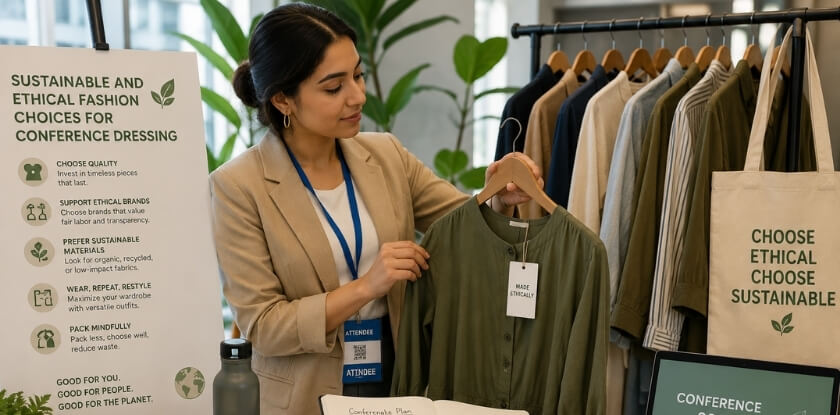
Sustainable and Ethical Fashion Choices for Conference Dressing
Researchers talk about climate data, environmental impact, and responsible resource use all day — then fly home with a suitcase full of fast-fashion pieces worn once. There’s a real gap between professional values and wardrobe habits in academia, and it’s worth closing.

That doesn’t mean wearing hemp sackcloth to the Society for Neuroscience annual meeting. It means being intentional about what you buy before the next conference.
Buy Less, Choose Better
The most sustainable conference outfit is one you already own. Seriously. Before ordering anything new, check what you have. A dark blazer, well-fitted chino trousers, a clean Oxford shirt, or a wrap dress in a neutral color — these work across virtually every academic conference setting, from an IEEE conference technical session to an American Sociological Association panel.
A small capsule wardrobe built around three or four interchangeable pieces handles most conference schedules without luggage stress. Pair that with wrinkle-resistant fabrics and you’re done planning.
Brands Worth Considering
If you do need to buy something, a few brands have genuinely made commitments worth looking at:
- Patagonia makes workwear-adjacent pieces — fleece, button-downs, travel trousers — that hold up for years and use recycled materials. Their repair program is real, not marketing.
- Eileen Fisher runs a take-back program called Renew, where they resell or recycle worn garments. Their tailored trousers and wrap dresses suit most academic conference dress norms without looking corporate or stiff.
- Thought Clothing and Pact offer affordable basics — smart flats, layering pieces, simple tops — made from organic or recycled fibers.
None of these require a big spend on every purchase. One quality blazer from an ethical brand lasts a decade. That math usually beats buying cheap every year.
Thrift Stores Are Genuinely Underrated
Thrift store professional wear gets overlooked by researchers who feel they should project a polished image. But secondhand shops — especially in university towns — are stocked with barely-worn business blazers, loafers, and smart professional attire from faculty who cleaned out their offices.
Sites like ThredUp, Poshmark, and Vinted let you search specifically for tailored pieces in your size. A good quality secondhand blazer at $15 beats a fast-fashion version at $40 in durability and environmental footprint.
Fabric Choices Matter
When you’re buying new, fabric choice is the single highest-impact decision. Natural fibers like organic cotton, linen, and wool last longer and biodegrade. Recycled polyester is a reasonable compromise for travel — it handles wrinkles better, dries fast, and keeps plastic out of landfill.
Avoid buying specifically synthetic blends that pill after three washes. They end up in the bin anyway, which defeats the budget argument too.
Ethical Clothing at STEM vs. Social Science Conferences
This is worth a brief note. Social science conference fashion norms — particularly at American Sociological Association events — tend to be more consciously political about brand and presentation. You’ll see researchers actively making statements through what they wear or choose not to wear. That’s normal and accepted there.
At a medical conference or an IEEE conference, nobody’s reading your label. Practical and presentable is the standard. Ethical choices matter to you; they don’t need to be visible to your audience.
A Simple Framework
If you want to approach this practically without overthinking it:
- Use what you have first. Style around your existing wardrobe before buying.
- Buy secondhand before buying new. One conference outfit shopping session on ThredUp takes twenty minutes.
- If buying new, prioritize durability over price. A $90 pair of tailored trousers worn 50 times has a lower cost-per-wear than a $30 pair worn five.
- Choose versatile colors. Navy, grey, black, and camel work across every conference scenario — poster presentation attire, networking events, a conference gala dinner, or a hybrid conference video call.
Conference dressing doesn’t require a virtue signal or a sacrifice of comfort. It just requires a bit of planning and fewer impulse purchases before you pack.
What NOT to Wear to a Scientific Conference
Some of this is obvious. Some of it isn’t. Either way, showing up in the wrong thing can distract from your work before you’ve said a word — and at a conference where you’re presenting, networking, or meeting potential collaborators, that matters.
Overly Casual Clothing
Flip-flops, athletic shorts, and gym trainers are a no. Even at a relaxed summer academic conference where the vibe is informal, there’s a line between “casual academic” and “I came from the beach.” Jeans can work — dark, well-fitted jeans paired with a neat Oxford shirt or a blazer read as intentionally casual. Faded jeans with a wrinkled t-shirt do not.
Hoodies fall into a grey zone. A clean, fitted zip-up in a neutral colour at a tech-adjacent conference like an IEEE conference? Probably fine. That same hoodie at an American Chemical Society conference or the Society for Neuroscience annual meeting? You’ll stand out for the wrong reason.
Anything That Competes with Your Poster or Presentation
This one catches people off guard. If you’re doing a poster presentation, you’re standing next to your work for two or three hours. Loud prints, clashing colours, or anything visually busy pulls attention away from your data. Stick to solid colours or simple, muted patterns. Let the science do the talking.
Uncomfortable Shoes
You will walk more than you think. Conference venues are large, floors are hard, and networking events mean standing around for hours. Stilettos that look great in the morning will wreck your afternoon. If you can’t walk comfortably in it for six hours, leave it at home. Smart flats, low-heeled boots, and loafers are the reliable choices here for a reason.
Heavily Wrinkled or Visibly Dirty Clothes
Obvious? Yes. But it happens, especially with travel. If you’re packing for a conference trip, wrinkle-resistant fabrics aren’t just a convenience — they’re a practical choice. Pull something straight from your suitcase and it looks like you slept in it, and that reads as careless regardless of how strong your research is.
Overpowering Fragrance
Strong cologne or perfume is a real problem at scientific conferences. You’re in enclosed seminar rooms, crowded poster halls, and close-quarters networking events. Some attendees have sensitivities or allergies. Keep fragrance minimal or skip it entirely.
Inappropriate Formalwear at the Wrong Event
Going too formal is its own pitfall. A full black-tie suit at a daytime session will make you look like you wandered in from a wedding. Unless you’re attending a conference gala dinner — which is a different context entirely — heavy formalwear is out of place in most scientific conference settings. Business casual dress code and smart professional attire are the benchmarks, not a red carpet look.
Clothing That Creates Logistical Problems
Think practically. You might be carrying a conference tote bag, managing a name badge lanyard, hauling a poster tube, or taking notes on a laptop. Anything with no pockets, extremely fussy layers, or a silhouette that makes movement awkward will just frustrate you through the day. Tailored trousers with actual pockets beat a pencil skirt every single time when you’re covering ground.
One Quick Note on Field-Specific Missteps
Social science conference fashion norms lean more relaxed than STEM field dress culture. Showing up to an American Sociological Association conference in full business formal might actually read as oddly stiff to your audience. At a medical conference dress code situation, the reverse is true — underdressing can signal that you haven’t read the room. Know your field, and when in doubt, lean slightly more polished rather than less.
Packing Smart: What to Bring in Your Conference Bag
Your outfit is only part of the equation. What you carry with you — and how you carry it — matters more than people give it credit for.

The Bag Itself
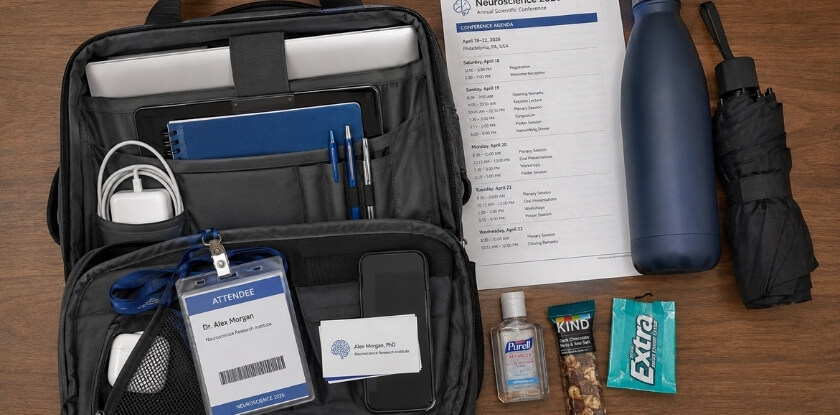
A good conference tote bag handles most situations. Something structured enough to hold a laptop, a water bottle, and a folder without collapsing on itself. Avoid oversized backpacks if you’re presenting or attending formal sessions — they read as “student on a field trip,” not “researcher here to network.” A slim backpack or a tote with a zip closure is the practical middle ground.
If you’re transporting a poster, you already know the poster tube is non-negotiable. Carry it over one shoulder, not dragging on the floor. Some venues have poster storage near the presentation hall — check in advance so you’re not hauling it through every coffee break.
What Should Actually Be in the Bag
The basics first:
- Business cards. Yes, still. Digital alternatives like QR codes are fine as a backup, but a physical card is faster in a crowded networking session.
- A notebook and pen. Your phone dies. The app crashes. Paper doesn’t.
- Your name badge lanyard**** in a spot you can reach in under five seconds. Fumbling for it at registration is awkward.
- Portable charger. Conference venues are notorious for having three accessible outlets shared between 400 people.
- A printed copy of your schedule. Session rooms change. Wifi fails.
Outfit Backup Items
Pack a spare. Not your entire capsule wardrobe — just a few targeted things.
A travel-sized stain remover pen is worth more than it sounds. Coffee at 8am before your poster presentation is a real threat. Wrinkle-resistant fabrics help, but a collapsible clothes steamer or even a damp hotel towel works for touch-ups the night before.
Bring one layer you can add or remove easily. Conference rooms are either freezing or inexplicably warm. A lightweight blazer or a cardigan over a wrap dress or an Oxford shirt solves this without needing to change.
If you’re wearing smart flats or loafers, pack a second pair of insoles or blister patches. Three days of concrete convention center floors is brutal. No one tells you this before their first conference.
For Presenters Specifically
If you’re giving a talk or standing at a poster for two hours, check your outfit for things that catch or snag on microphone clips. Lapels on a business blazer work well. Avoid necklaces or lanyards that hang loose over a lapel mic — they rattle.
Print your slides or poster abstract once. Backup USB drive with the presentation file. Some venues still use presenter laptops from 2014.
Small Things That Make a Big Difference
A reusable water bottle, because conference hydration is genuinely terrible. Earplugs or headphones for the train or hotel, so you can decompress between sessions. A small snack — granola bar, nuts — for when the afternoon session runs long and the catering table is picked clean.
None of this is glamorous. But showing up to your first major conference — an IEEE conference, a Society for Neuroscience annual meeting, an American Chemical Society conference — with everything you need means you spend your mental energy on the actual work, not the logistics.
Frequently Asked Questions
Is there an official dress code for scientific conferences?
No. Almost none of the major scientific conferences — IEEE, American Chemical Society, Society for Neuroscience, American Sociological Association — publish a formal dress code. The standard expectation sits somewhere around business casual, but what that means in practice varies a lot by field, by the specific event, and by the culture of the organizing institution. When in doubt, check the conference website for photos from previous years. That tells you more than any written guideline would.
What’s the safest outfit choice if you have no idea what to wear?
A clean, well-fitted blazer over neutral trousers or tailored pants gets you through almost any conference scenario without looking out of place. Pair it with an Oxford shirt or a simple blouse, add loafers or smart flats, and you’re covered for everything from a morning session to an evening networking event. It’s not exciting, but it works everywhere.
Can I wear jeans to a scientific conference?
Sometimes. Dark, clean jeans with no distressing can pass in casual-leaning fields — think computer science, ecology, or parts of social science. At a medical conference or a formal symposium with a gala dinner, jeans read as underdressed. Read the room. If the keynote speaker is in a suit, jeans aren’t the move.
What should a PhD student wear to their first conference?
Don’t overthink it. Business casual is the target. Chino trousers and a tucked-in shirt or a wrap dress work fine. You don’t need to spend a lot — a few pieces from a thrift store or a budget retailer, chosen carefully, look as professional as anything expensive. Focus on fit and cleanliness over brand. Nobody is checking labels.
Does it matter what I wear for a poster presentation specifically?
A little, yes. You’ll be standing for a long time — often two to three hours — so comfort genuinely matters. Wear shoes you can stand in. Avoid anything that requires constant adjusting. Smart, polished attire still applies, because you’re essentially presenting to an audience one person at a time. A business blazer you can remove if the hall gets warm is a practical choice.
What do I wear to the conference gala dinner?
Step up from your daytime look. For most academic gala dinners, smart professional attire is appropriate — think a dress, a blazer with dress trousers, or something you’d wear to a nice dinner out. Very few academic galas require black tie, but check the invitation wording. “Smart casual” and “formal” mean different things, and the invitation usually specifies one or the other.
What about virtual or hybrid conferences — does dress still matter?
Yes, from the waist up. If you’re presenting or paneling on a video call, wear something you’d wear in person for that same role. A solid-colored shirt or blouse reads well on screen. Avoid busy patterns — they distort on camera. Your Zoom conference background matters too; a messy environment undercuts a polished outfit.
Should I wear comfortable shoes or professional-looking ones?
Both, ideally. A good pair of loafers or smart flats can be both. Conference days are long, and you’ll walk more than you expect — between sessions, to and from hotels, across convention center floors. Shoes that look sharp but destroy your feet by 2 p.m. are a bad trade. Break in new shoes before the event if you’re buying something new.
Is it possible to be overdressed at a scientific conference?
It happens, but it’s rarely a real problem. Being slightly overdressed tends to land better socially than being clearly underdressed. The exception is when you’re so formal that you seem disconnected from the culture of your field — a full three-piece suit at a field ecology meeting, for example, can read as strange rather than impressive. Match the general register of your discipline and you’ll be fine.
Are sustainable fashion brands worth considering for conference clothing?
If budget allows, yes. Brands like Patagonia and Eileen Fisher make professional pieces that hold up to travel and repeated wear, which matters if you’re attending multiple conferences a year. Wrinkle-resistant fabrics are worth prioritizing regardless of brand — clothes that come out of a suitcase looking presentable save real time and stress on conference mornings.
Final Thoughts: Dress to Present Your Best Professional Self
No single outfit works for every conference, every field, or every person. That’s actually fine. The goal was never to have a universal uniform — it was to show up without your clothes becoming a distraction, either to others or to yourself.
If you spent the whole morning session tugging at a collar or worrying your shoes were too casual for the keynote hall, that’s mental energy you didn’t spend on the actual science. That’s the real cost of getting it wrong.
Here’s a practical summary of what actually matters:
- Know your field’s baseline. An IEEE engineering conference and an American Sociological Association meeting operate on different unspoken codes. Engineering skews more casual. Social science conferences tend to dress up slightly more. Medical conferences often sit somewhere in the middle, especially if clinicians are present. When you’re unsure, check the conference website for photos from previous years. Three minutes of image searching tells you more than any general guide.
- Dress one half-step above what you think the average attendee wears. Not a full step — that tips into uncomfortable territory. Just slightly sharper. It signals that you take the event seriously without making you the odd one out at the coffee station.
- Fit and condition matter more than price. A clean, well-fitting Oxford shirt from a thrift store reads better than a wrinkled blazer that cost three times as much. Pressed trousers and polished shoes cover a lot of ground regardless of brand.
- Think about what you’re physically doing. Presenting a poster means standing for two or three hours. Smart flats or low-heeled loafers will serve you far better than anything with a high heel. Carrying a poster tube, conference tote bag, and juggling a name badge lanyard already tests your coordination — don’t add uncomfortable footwear into that equation.
- One solid capsule works. Three or four pieces that mix and match — a blazer, two shirts or blouses, one pair of tailored trousers or a wrap dress, versatile shoes — gets most people through a three-day conference without checked luggage. Stick to wrinkle-resistant fabrics and you won’t spend your evenings ironing.
The networking reception, the gala dinner if there is one, the poster session, the panel Q&A — each of those has a slightly different feel. But if your core outfit is business casual and you’ve packed one slightly dressier option, you’re covered for almost all of it.
PhD students and early-career researchers often worry most about this. Don’t. No one at the Society for Neuroscience annual meeting is critiquing your blazer choice during a session break. What people remember is whether you were confident, whether you knew your work, whether you were easy to talk to. Clothes just need to not actively undercut that impression.
Dress like you belong there. Because you do.