
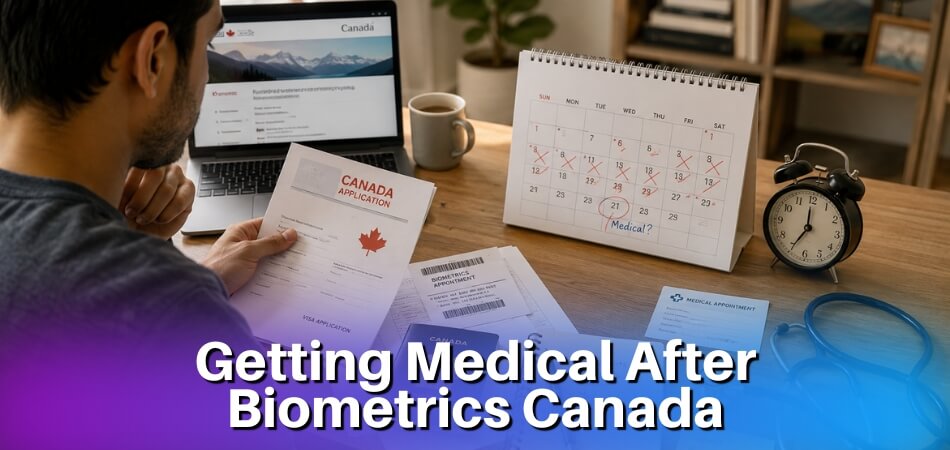
Your fingerprints are done, and now you are watching your inbox for a medical request that may or may not come. It is hard to plan travel around a step nobody gives you a date for.
Quick answer: IRCC publishes no fixed waiting time for a medical request after biometrics. Most visitors staying 6 months or less, including conference attendees, never get one. If your application does need a medical exam, the request comes once an officer reviews your file, which can be a few weeks or several months after biometrics. Express Entry applicants are different: they complete the medical exam before applying, so it comes before biometrics.
Fact-checked by the MS International Editorial Team. Last verified against official sources: October 2026.
Biometrics and the immigration medical exam are two separate requirements. Biometrics (your fingerprints and photo) confirm who you are. The medical exam checks health admissibility. Giving biometrics does not mean a medical request will follow.
Your need for a medical exam depends on your application type, how long you will stay, where you have lived or travelled, and the job you will do in Canada. The sections below explain each case, what to do when a request arrives, and how to check your status.
How Long Does It Take to Get a Medical Request After Biometrics in Canada?
There is no official timeline. IRCC sends medical instructions when an officer reviews your file and confirms that you need an exam. For some applicants that happens a few weeks after biometrics. For others it takes longer, and many applicants never receive a request because their application does not require one.
The table below shows when the medical step usually happens for each application type, based on IRCC’s published rules.
| Application type | Medical exam needed? | When it usually happens |
| Visitor visa, 6 months or less (tourism, business, conference) | Generally no | Not applicable, unless you will work in a job where public health must be protected |
| Visitor, student or worker staying more than 6 months | Yes, if you lived in or travelled to a listed country for 6 months or more in a row in the past year, or will work in a public-health-sensitive job | Upfront before applying, or after IRCC sends instructions |
| Parent and grandparent super visa | Yes | Either upfront or when IRCC sends its request, whichever comes first |
| Express Entry (permanent residence) | Yes, for you and all family members | Upfront, after the invitation to apply and before you submit, so before biometrics |
| Other permanent residence, including family sponsorship | Yes, for you and all family members | After IRCC sends instructions; complete it within 30 days |
Many IRCC program pages say only that IRCC will send instructions for the medical exam by email, with no timeframe. If your online account does not change after biometrics, that alone is not a sign of a problem. The file may simply be waiting for an officer.
What Happens After Biometrics in a Canada Visa Application?
After biometrics, IRCC continues to assess eligibility, admissibility and background checks before making a decision. Biometrics are one step, not approval. If a visitor visa is approved, the next request is usually for your passport, and most applicants report waiting several weeks for a passport request after biometrics.
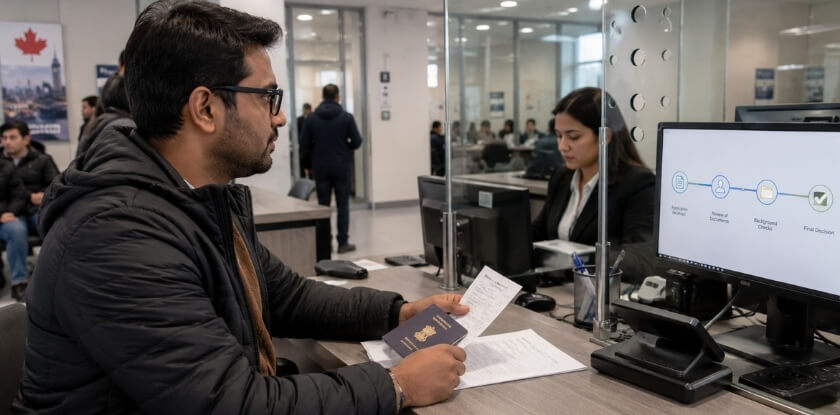
For a visitor visa, the officer looks at your purpose of travel, funds, travel history and ties to your home country. For study permits, the officer reviews the letter of acceptance, finances and study plan. For permanent residence, IRCC reviews eligibility, family members, background and admissibility. The order of these checks varies, so a medical request may arrive before, during or after other reviews.
If a medical exam is needed and you did not do one upfront, IRCC sends instructions through your online account or by email. The instructions include your medical forms or reference details and the deadline.
Is a Medical Exam Always Required After Biometrics?
No. IRCC requires a medical exam only in specific cases. These are the main ones:
- All permanent residence applicants, including Express Entry and family sponsorship, plus their family members, even those not coming to Canada.
- Temporary residents staying more than 6 months who lived in or travelled to a country on IRCC’s list for 6 months or more in a row during the year before coming to Canada.
- Parent and grandparent super visa applicants.
- People who will work where public health must be protected, even for stays of 6 months or less: health care workers, clinical lab workers, long-term care attendants, medical students and short-term locum physicians, workers in primary or secondary schools or child care, and domestic workers or in-home caregivers for children, seniors or people with disabilities.
- Agricultural workers who spent 6 months or more in a row in a listed country during the year before coming to Canada.
Most short-term visitors, including people travelling for tourism, family visits, business meetings or conferences, fall outside these rules. MS International Conferences runs its events in cities across the Greater Toronto Area, and conference visits are typically a few days long, so attendees are usually well inside the 6-month limit.
There is also a temporary IRCC public policy (in force until October 5, 2029) that lets some applicants already living in Canada skip a new exam if they had one with a physical exam in the last 5 years and the result meets IRCC’s criteria. If you rely on it, include the IME number from your earlier exam in your application. Your instructions from IRCC will tell you whether it applies.
Biometrics vs Medical Exam
| Requirement | Main purpose | Completed through |
| Biometrics | Identity check using fingerprints and photo (CAN$85 per person, CAN$170 maximum for a family applying together) | Visa Application Centre or other official collection point |
| Medical exam | Health admissibility assessment | IRCC-approved panel physician |
Upfront Medical Exam vs Medical Request After Biometrics
An upfront medical exam is done before you apply. A medical request after biometrics means you wait for IRCC’s instructions.
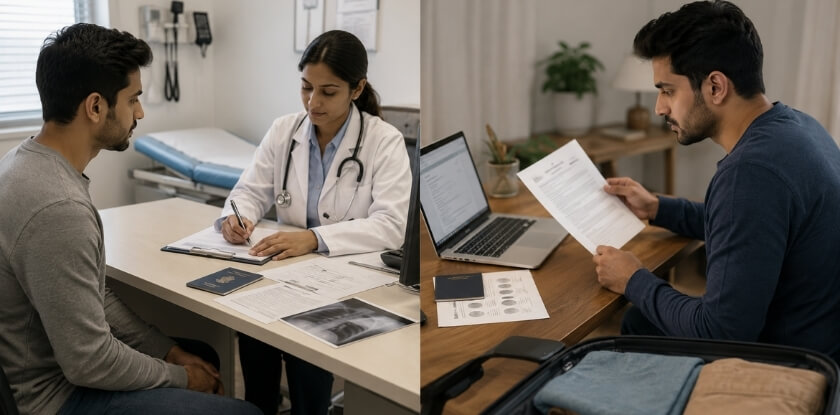
IRCC allows an upfront exam for visitors (including super visa), students and workers. For Express Entry, the exam is done after you receive an invitation to apply and before you submit; IRCC has required this upfront exam since August 21, 2025. For other permanent residence programs, IRCC says not to book early: wait for the instructions it sends after you apply.
After an upfront exam, the panel physician gives you a confirmation document (often called the eMedical information sheet) with your reference number, sometimes referred to as the IME number. You must include a copy with your application, and upload it if you apply online. This is how IRCC links your results to your file, so keep it until you receive a final decision.
If you are not sure whether you need an exam, waiting for instructions is the safer choice. It avoids paying for an exam you may not need.
What Affects the Timing of a Medical Request?
The timing depends mostly on when an officer reaches your file and whether your case needs an exam at all. Two people who gave biometrics on the same day can get very different updates.
- File complexity: Family members, previous refusals, or missing and unclear documents can delay the officer’s review, and with it the medical instructions.
- IRCC workload: Processing volume varies by visa office, season and program.
- Panel physician availability: Once the request arrives, your timeline also depends on how soon you can get an appointment.
- Follow-up tests: The physician or IRCC may ask for extra tests or specialist reports. This does not mean refusal, but it adds time, so complete any specialist request as soon as possible.
How to Book a Canada Immigration Medical Exam After Biometrics
Book with an IRCC-approved panel physician as soon as you receive the instructions, and finish before the deadline. Your own doctor cannot do this exam.
- Read the instructions. Check your IRCC account messages and email, including the spam folder. Note the deadline; for permanent residence it is 30 days from the date you receive the instructions.
- Find a panel physician. Use IRCC’s official panel physician search. A clinic that is nearby but not on the list will not do.
- Book early. If the nearest clinic has no early slot, try another approved clinic in your area or a nearby city.
- Prepare your documents (see below).
- Attend the exam. Expect identity checks, medical history questions, a physical exam and tests based on your age and application type. You pay all medical exam fees at the appointment, including any special tests, and for permanent residence IRCC does not refund them if the application is refused.
- Keep your proof. The physician sends results directly to IRCC. Keep the confirmation document until your application is finalized.
Documents to Bring to Your Canada Medical Exam
Bring ID, your IRCC paperwork and any relevant health records. IRCC’s guidance lists:
- your passport (preferred) or another accepted government-issued photo ID;
- the Medical Report form or instructions IRCC sent you, if you did not do an upfront exam;
- your glasses or contact lenses, if you wear them;
- a list of the medicines you currently take;
- reports, test results or prescriptions for any past or current medical condition, which can shorten processing;
- four recent photos, but only if the clinic does not use eMedical (call ahead to check).
Vaccination records are optional but useful to bring.
What Happens After the Canada Medical Exam?
The panel physician sends your results directly to IRCC. You do not upload the medical report yourself.
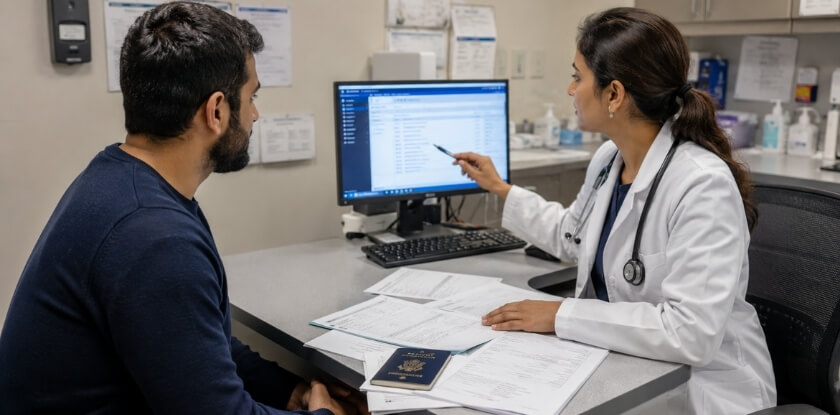
The clinic may wait for lab results before submitting, so it can take some time before anything changes in your account. IRCC does not publish a standard time for this. Results are valid for 12 months. If your application is not finalized in that time, IRCC may ask you to repeat the exam.
If your account later shows that the medical has passed, IRCC has accepted your results. That is good news, but it is not a visa approval. Eligibility, security and final decision steps can still be pending. If IRCC asks for more medical information, respond quickly and follow the instructions exactly.
Common Mistakes That Delay Medical Processing
Most avoidable delays come from a missed deadline, the wrong doctor or lost proof.
- Assuming everyone gets a medical request. If your case does not need one, IRCC will continue without it.
- Missing the deadline. For permanent residence, missing the 30-day deadline can lead to refusal.
- Using a non-approved doctor. Results from a doctor who is not a panel physician are not accepted.
- Losing upfront medical proof. Without the confirmation document, IRCC may not be able to link your results.
- Ignoring follow-up tests. Extra tests are not a refusal, but delaying them holds up your file.
- Not checking messages. Requests can arrive in your account or by email, so check both, including spam.
How to Check Your Canada Medical Exam Status
Track your application in your IRCC secure account or the application status tracker. Updates may not appear right after your appointment.

A slow update usually means the clinic has not submitted results yet, lab reports are pending, IRCC has not reviewed them, or upfront medical proof has not been linked. Contact the clinic first and ask whether the results were sent. If the clinic confirms submission and your account still shows nothing after a reasonable time, or your deadline is close, contact IRCC through its web form.
If you are attending one of our events and your visa is still in processing close to the conference date, MS International can issue a visa expedite request letter to support a request to IRCC, alongside our conference invitation letter for visa applications.
Frequently Asked Questions About Medical After Biometrics Canada
Waiting for an IRCC medical request after biometrics leads to doubts about doing the exam early, using your own doctor, who pays, how long results stay valid and what a passed medical means for the visa.
How long after biometrics will I get a medical request for Canada?
IRCC publishes no fixed timeline. If your application needs a medical exam, the request comes when an officer reviews your file, sometimes within a few weeks and sometimes much later. Many visitors never receive one.
Can I do my medical exam before biometrics?
Yes, in some cases. Visitors, students and workers can do an upfront exam, and Express Entry applicants must do it before applying. For other permanent residence programs, IRCC asks you to wait for its instructions.
Can I use my own doctor for the Canada immigration medical exam?
No. Only an IRCC-approved panel physician can do the exam.
How long are Canada immigration medical results valid?
12 months from the date of the exam. If your application is not finalized in that time, IRCC may ask for a new exam, so do not take an upfront exam long before you apply.
How long do I have to complete the medical exam after the request?
For permanent residence, 30 days from receiving the instructions. Missing it can lead to refusal. For temporary residence, IRCC sets no fixed number of days, so follow the deadline in your letter.
Who pays for the Canada immigration medical exam?
You do. IRCC says you pay all exam fees, including special tests, at your appointment. For permanent residence it does not refund them if your application is refused.
Does medical passed mean visa approved?
No. It only means IRCC accepted your medical results. The panel physician does not decide your visa, and other checks and the final decision can still be pending.
What if I do not receive a medical request after biometrics?
Your application may not need one, or IRCC has not reached that stage yet. Keep checking your account and email, and do not book an exam unless an upfront exam is allowed for your application or IRCC asks for it.
Disclaimer: This article is general information, not legal or immigration advice. Visa rules, fees, and processing times change. Confirm the current requirements on the official Government of Canada (IRCC) website before you apply.