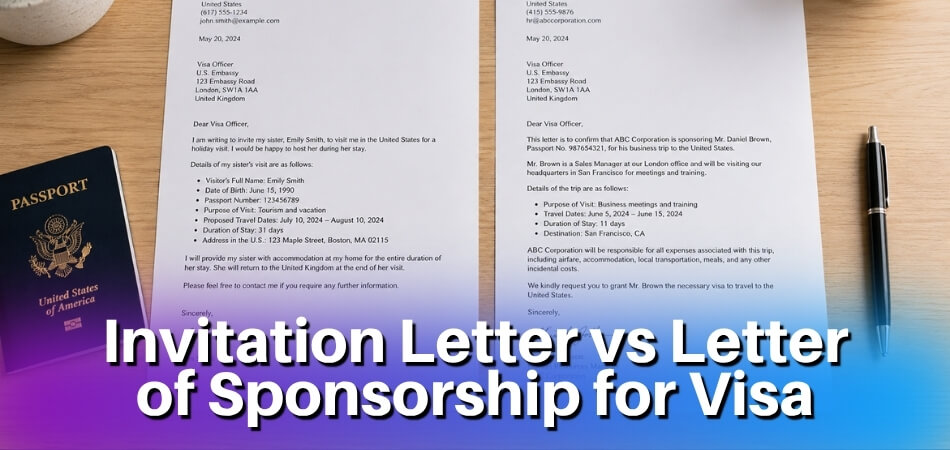

A visa support letter is a formal letter from a host, company, university, event organizer, hospital, or family member that backs up someone’s visa application. It explains who is inviting the visitor, why the trip is happening, how long it will last, and what arrangements are in place. This guide shows you how to write one, with a sample letter for each type of writer.
Quick answer: To write a visa support letter, use letterhead or a clean personal format and state the host’s details, the visitor’s name and passport data exactly as in the passport, the purpose of travel, arrival and departure dates, accommodation, who pays, and that the stay is temporary. Close with a signature, and keep it to one page. It supports a visa application but never guarantees approval.
Fact-checked by the MS International Editorial Team. Last verified against official sources: October 2026.
What Is a Visa Support Letter?
A visa support letter is a written statement from a person or organization in the destination country that confirms the visitor has a real reason to travel. It is submitted together with the visa application to help the embassy or consulate understand the trip. It can support visits for business meetings, conferences, academic programs, family visits, medical treatment, training, or short-term events.
The letter does not replace the visa application form or the embassy’s official requirements. It works as one supporting document, so it has to agree with the passport, itinerary, accommodation proof, financial documents, and event registration that go with the application. A strong letter is accurate, professional, and easy for the visa office to verify.
Why a Visa Support Letter Matters for a Visa Application
The letter gives a visa officer a clear, checkable explanation of the trip, but it never decides the outcome. It names the person inviting the visitor, the reason for the visit, the planned stay, and who covers the costs, which saves the officer from guessing. A letter from a company, university, event organizer, hospital, or verified host also adds credibility and context.
Official sources are consistent about its limits:
| Country | What the official guidance says |
| Canada (IRCC) | A letter of invitation does not guarantee a visa. Officers assess the applicant. Writing the letter does not make the inviter legally responsible for the visitor in Canada, but it should be truthful and written in good faith. For business guests, IRCC tells the host to provide two copies of the letter. |
| United States (State Department) | A letter of invitation is not needed to apply for a visitor visa and is not a factor in deciding whether to issue it. Officers look at the applicant’s own circumstances and ties to the home country. |
| United Kingdom (GOV.UK) | For a business event or conference, the guide to supporting documents says to provide a letter of invitation from the organiser. Research and exchange visitors are asked for a letter from the UK host organisation. |
Rules change and differ by visa type, so always read the embassy’s own checklist before relying on a letter. A support letter can make an application easier to understand when it is complete, accurate, and consistent.
Key Information to Include in a Visa Support Letter
Every letter needs the same core facts, written in the order a visa officer expects to read them. The details must match the visa application exactly.
| Part of the letter | What to write |
| Host or organization details | Full name, address, phone number, and email. For a company, university, hospital, or organizer, add the organization name and official contact details on the letterhead. |
| Date and embassy address | The date, then the embassy, consulate, or visa office name and address when known. If you do not know who will read it, use “Dear Visa Officer” or “Dear Sir/Madam.” |
| Visitor’s identity | Full name exactly as in the passport, plus date of birth, nationality, and passport number. Small mistakes in names or numbers create doubt. |
| Purpose of travel | The real reason, such as a conference, business meeting, academic program, family visit, training, or medical treatment. It must match the visa category and the other documents. |
| Dates and duration | Arrival date, departure date, and total length of stay, matching the itinerary, hotel booking, or event schedule. |
| Accommodation | Where the visitor will stay, such as a hotel, university housing, hospital accommodation, or the host’s home, with the address if available. |
| Financial responsibility | Who pays for flights, accommodation, meals, local transport, registration fees, or medical costs: the visitor, host, employer, institution, or sponsor. |
| Temporary stay | One short sentence that the visitor is expected to return home after the planned end date. Do not make unrealistic guarantees. |
| Closing | The host’s name, title, phone number, email, signature, and an official stamp or seal if one exists. |
Step-by-Step Guide to Writing a Visa Support Letter
Work in this order: collect the facts, draft the letter, check it against the application, then sign and send it. Most errors happen because the writer starts typing before the visitor’s documents are in hand.
- Collect the facts from the visitor: a passport copy, the planned dates, and any registration, itinerary, or appointment papers. Use the passport as the only source for names and numbers.
- Choose the format: official letterhead with name, address, phone, email, and logo for an organization. For a personal host, put your full name, address, phone number, and email at the top.
- Introduce yourself: say who you are and why you are writing. If you write for an organization, give your job title and your connection to the visitor or event, so the officer can see you have the authority to issue the letter.
- Describe the visit: state the purpose, dates, and a brief activity plan such as event days, meeting days, treatment appointments, or academic sessions. The schedule should show a clear beginning and end.
- Confirm accommodation and costs: name the place and the payer for each major cost. Clear financial details remove uncertainty.
- Add the temporary-stay sentence, then close: a polite closing with your full name, title, contact details, and signature.
- Cross-check, sign, and save: compare every name, date, and number with the visa form and attachments, sign by hand or digitally, and save the final version as a PDF so the formatting does not change when it is shared or printed.
Keep the tone formal, direct, and polite. Leave out emotional explanations, slang, and vague promises.
Types of Visa Support Letters and Who Can Issue Them
The structure stays the same for every type; what changes is who signs the letter and which extra details it must carry. The writer must be directly connected to the trip, reachable, and able to confirm what the letter says. When someone else pays for the trip, a sponsorship letter may be needed alongside the invitation.

| Type | Who writes and signs it | Extra details to include |
| Business | A manager, HR officer, company director, or authorized representative | The inviting company, the visitor’s business role, purpose (meetings, training, negotiations, audits, professional visits), meeting dates, who pays, confirmation that the visit is temporary |
| Conference or event | The event or conference organizer | Event name, location, dates, organizer details, and the visitor’s role: delegate, speaker, presenter, exhibitor, or attendee, plus registration status |
| Student or academic | A university, college, school, research center, or academic department | Program name, institution, department, dates, academic purpose, and any housing or funding arrangements. It may cover study, research, exchange, academic visits, training, workshops, or visiting scholar activities |
| Family or visitor | A family member, friend, or personal host | The relationship, visit purpose, stay dates, address where the visitor will stay, financial support if offered, and expected return |
| Medical | An authorized doctor, administrator, or medical office at a hospital, clinic, or medical center, for treatment, consultation, surgery, follow-up care, or medical evaluation | Patient name, treatment purpose and expected dates, facility details, accommodation plan, who covers medical and living costs, and a reference to supporting medical reports. It should match the patient’s treatment documents |
Writing for a Business Guest Coming to Canada
IRCC lists extra details for a Canadian business or event host, beyond the visitor’s own facts. A company representative writes the letter, and some firms name specific people who may sign it. IRCC asks for:
- The host company: full legal name, headquarters address, addresses of any facilities the guest will visit, website if there is one, registration or incorporation date, and a short description of the business.
- The person inviting: full name, job title and position, Canadian address and phone numbers, and a work email address.
- The relationship: how the company knows the guest and whether the two are related or know each other personally.
- Copies: give each guest two copies, one for the visa application and one to show on arrival.
- Event code: if the event is registered with IRCC, the organizer gives guests an event code, and the guest enters it on the visa application so IRCC can identify them as a participant.
Some Canadian visa offices may ask for a notarized letter, so follow the checklist for your application.
Visa Support Letter Format and Template
Use one clear page, formal wording, and the same order every time. The base template below fits any purpose; the sample letters that follow show how to adapt it for each writer.
Base template:
[Host or Organization Name]
[Address]
[Phone Number]
[Email Address]
[Date]
To:
[Embassy/Consulate/Visa Office Name]
[Address, if available]
Subject: Visa Support Letter for [Visitor’s Full Name]
Dear Visa Officer,
I am writing to support the visa application of [Visitor’s Full Name], a citizen of [Country], holding passport number [Passport Number]. [He/She/They] has been invited to visit [Destination Country] from [Start Date] to [End Date].
The purpose of the visit is to [explain purpose briefly, such as attend a conference, join business meetings, visit family, take part in an academic program, or receive medical treatment]. During the visit, [Visitor’s Full Name] will [briefly mention planned activities].
[Visitor’s Full Name] will stay at [hotel/residence/accommodation address]. The expenses for [travel/accommodation/meals/registration/medical care] will be covered by [visitor/host/organization/sponsor].
This visit is planned for a temporary period, and [Visitor’s Full Name] is expected to return to [Home Country] after completing the visit.
Please contact me if any further information is required.
Sincerely,
[Signature]
[Host Full Name]
[Job Title, if applicable]
[Organization Name, if applicable]
[Phone Number]
[Email Address]
Use this template as a guide, not as a fixed script. Replace every placeholder with accurate details, delete lines that do not apply, and make sure the information matches the applicant’s visa form, passport, travel plan, and supporting documents.
Sample Letter From a Conference Organizer
Use this when the visitor is attending, speaking, or presenting. State the registration status honestly and do not claim that the organizer pays for anything it does not pay for.
[Conference Name] Organizing Committee
[Address] | [Email] | [Phone][Date]
To the Visa Officer, [Embassy/Consulate]
Re: Participation of [Visitor’s Full Name], passport no. [Number]
Dear Visa Officer,
[Visitor’s Full Name], born [Date of Birth] and a citizen of [Country], is registered as a [speaker/presenter/delegate] at [Conference Name], held at [Venue, City, Country] from [Start Date] to [End Date]. The registration was confirmed on [Date].
[He/She/They] will present [paper or topic title, if applicable] on [Session Date] and plans to arrive on [Arrival Date] and depart on [Departure Date].
The registration fee has been [paid/waived] by [payer]. Travel and accommodation will be arranged and paid by [visitor/employer/sponsor]. This letter is not a guarantee of a visa and does not make the organizer responsible for the visitor’s expenses.
You may reach me at the details above to confirm this registration.
Yours faithfully,
[Name], [Title], [Signature]
Sample Letter From an Employer or Host Company
Use this when a company in the destination country invites a business visitor. The signer should have the authority to commit the company.
[Company Name] | [Address] | [Phone] | [Email]
[Date]
Consular Section, [Embassy/Consulate]
Subject: Business visit of [Visitor’s Full Name]
Dear Sir/Madam,
[Company Name] invites [Visitor’s Full Name], [Job Title] at [Visitor’s Company] in [Country] (passport no. [Number], born [Date of Birth]), for business meetings with our [department/team] in [City] between [Start Date] and [End Date].
The meetings concern [short description, such as a supplier audit, equipment training, or contract discussions]. The visitor will not be employed by us and will receive no salary from [Company Name].
[Visitor’s Company / Our company] will pay for [flights/hotel/meals/local transport]. The visitor has hotel accommodation at [Hotel Name and Address] and returns to [Home Country] on [Departure Date], where [he/she/they] holds a position at [Visitor’s Company].
Please call or email me to verify any detail.
Sincerely,
[Name], [Title], [Signature, company stamp]
Sample Letter From a University or Academic Institution
Use this for visiting scholars, researchers, exchange visits, workshops, and short courses. Name the program and the department so the officer can verify it.
[University Name], [Department]
[Address] | [Email] | [Phone][Date]
To: [Embassy/Consulate/Visa Office]
Subject: Academic visit of [Visitor’s Full Name]
Dear Visa Officer,
The [Department] at [University Name] welcomes [Visitor’s Full Name] (passport no. [Number], citizen of [Country]) as a [visiting scholar/workshop participant/exchange guest] from [Start Date] to [End Date].
The visit is part of [program or project name], and the activities are [lectures/joint research/lab work/workshop sessions]. The host faculty member is [Name, Title].
[Housing: on-campus housing at (address) / the visitor’s own arrangements]. Costs are covered by [university/scholarship/home institution/visitor]. The visitor’s home institution, [Name], expects [him/her/them] back by [Date].
For verification, please contact [Name] at [Email/Phone].
Sincerely,
[Name], [Title], [Signature, official stamp]
Sample Letter From a Family Member or Personal Host
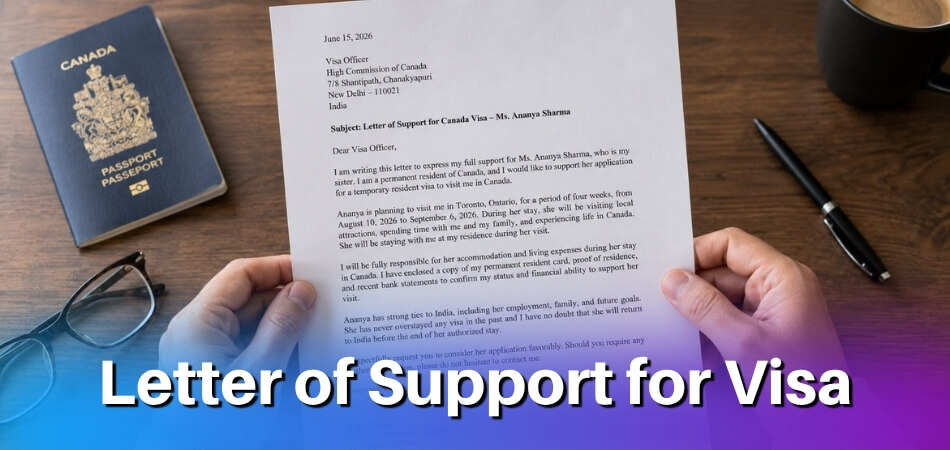
Use this for a short-term personal visit. Add a copy of your ID or proof of status and, where it helps, proof of the relationship. For Canada, IRCC asks the inviter to include details such as the visitor’s relationship to them, the purpose and length of the stay, where the visitor will stay, how expenses will be paid, and when the visitor plans to leave. It also asks for the inviter’s own details: date of birth, job title, Canadian address and phone number, status in Canada, and family details.
[Your Full Name]
[Home Address] | [Phone] | [Email][Date]
To: [Embassy/Consulate/Visa Office]
Subject: Invitation for my [relationship] [Visitor’s Full Name]
Dear Visa Officer,
I am a [citizen/permanent resident/resident] of [Country], living at the address above, and I am inviting my [relationship], [Visitor’s Full Name] (born [Date of Birth], passport no. [Number]), to visit me from [Start Date] to [End Date].
The visit is to [reason, such as attend a family event or spend time together]. [He/She/They] will stay in my home. I will pay for [food and local travel] and [visitor] will pay for [flights and personal costs].
[Visitor’s Full Name] has a [job/business/studies] in [Home Country] and will return on [Departure Date]. I have enclosed a copy of my [passport/residence card/ID].
Sincerely,
[Signature], [Your Full Name]
How to Show That the Visitor’s Trip Is Genuine
Replace general statements with specific facts the visa office can check. The goal is a visit that looks planned, temporary, and consistent with the application.
| Weak wording | Stronger wording |
| “A personal visit” or “a business trip” | “To attend the annual regional safety conference on 12 to 14 March” |
| “For a few weeks” | “Arriving 10 March and departing 16 March” |
| “All costs will be covered” | “The host pays for the hotel and meals; the visitor pays for flights” |
| “He will certainly return home” | “He is expected to return on 16 March to his position at his home employer” |
If the host covers costs, say which costs are included. If the visitor is self-funded, say so clearly and attach financial proof. The return date should match the planned departure date. The letter becomes stronger when each claim is backed by a document, which is listed in the next section.
Documents to Attach With a Visa Support Letter
Attach only the documents that prove a statement in the letter; the exact set depends on the visa type, travel purpose, and embassy requirements.
| Document | What it proves |
| Visitor’s passport copy | Name, nationality, and passport number |
| Invitation or event letter, registration | The reason for travel, especially for conferences, meetings, training, or academic events |
| Travel itinerary | Dates, planned activities, and length of the visit |
| Accommodation proof | Where the visitor will stay: hotel booking, host address, or university housing confirmation |
| Financial proof | Who can cover expenses: bank statements, sponsor documents, employer letters, or funding confirmation |
| Host ID or residency proof | The identity and legal status of the person inviting the visitor |
| Proof of relationship | For family or personal visits: birth or marriage certificates, photos, or communication records |
| Program or appointment documents | Meeting agenda, admission letter, treatment appointment, or medical report |
Extra papers that do not support the travel purpose can make the application harder to review.
Common Mistakes and Tips for a Clear, Professional Letter
Most weak support letters fail on small, avoidable points: missing facts, details that do not match the application, or an unsigned page. Use this as a final check before the letter goes out.
| Mistake | What to do instead |
| Missing visitor details or travel dates | Include full name, nationality, date of birth, passport number, arrival date, departure date, and total stay |
| Unclear purpose, weak accommodation, or unclear expense coverage | Name the exact reason, the exact place the visitor will stay, and who pays for which cost |
| Casual or emotional wording | Use simple formal language. Avoid slang and vague promises |
| No signature or contact details | Add the host’s full name, title, phone number, email, and a handwritten or digital signature, plus a stamp or seal for organizations |
| Names, dates, or addresses that differ from the visa form | Check the letter against the form, passport, itinerary, invitation documents, and financial proof |
| Placeholders or template wording left in | Read the finished letter once, line by line, before signing |
| Long background stories | Keep it to one page, in a logical order, with names, passport numbers, dates, and contact details easy to find |
Official letterhead helps when the letter comes from a company, university, hospital, or event organizer, because it shows the issuer is real and reachable.
When Should You Update a Visa Support Letter?
Update the letter whenever an important detail changes before submission or before the visa decision is made.

Update the letter if there is a change in:
- Travel dates: arrival date, departure date, or visit duration
- Visitor details: name spelling, passport number, nationality, or date of birth
- Travel purpose: conference role, meeting plan, family visit reason, academic program, or treatment schedule
- Accommodation: hotel booking, host address, university housing, or hospital stay
- Financial support: who will pay for travel, meals, accommodation, registration, or medical costs
- Host details: address, phone number, email, job title, or organization contact
After updating, add the new date, check the whole document again, and make sure it matches the visa application and attachments. A clean updated version is better than a corrected letter with confusing edits.
From our experience at MS International: Our conference invitation letter is issued on the organizer’s letterhead within 3 to 5 business days after payment clears and is sent as a PDF to the email address on the registration, so the name must be written exactly as it appears on the passport. We may contact you if details are missing or names do not match. A US$50 administrative fee may apply to changes requested after the letter has been issued. A notarized version is optional, costs US$100, typically takes up to 10 business days, and is non-refundable. Our letter confirms conference participation only. It does not confirm accommodation, cover expenses, or guarantee a visa.
FAQ: Writing a Visa Support Letter
Typed or handwritten, on letterhead or plain paper, emailed or written in another language: a visa support letter involves format choices, plus mistakes, old letters and separate visitors.
Should a Visa Support Letter Be Typed or Handwritten?
It should be typed. A typed letter is cleaner, easier to read, and looks more professional. After typing it, the host should sign it before submission.
Does a Visa Support Letter Need Official Letterhead?
Not always, but it is recommended when the letter comes from a company, university, hospital, event organizer, or institution, because it shows the writer is real and reachable. A personal host can put full contact details at the top instead. If your checklist names a format, follow it.
Is a Visa Support Letter Always Required?
No. The US State Department says an invitation letter is not needed to apply for a visitor visa. IRCC may ask for one, and GOV.UK tells conference visitors to provide one from the organiser. Your application checklist shows what applies to you.
Does a Visa Support Letter Guarantee a Visa?
No. IRCC says a letter of invitation does not guarantee a visa, and the US State Department says a letter is not a factor in deciding whether to issue one. The letter only supports the application.
Can a Visa Support Letter Be Sent by Email?
Usually yes, as a clear, signed PDF, but the visa office’s own submission rules come first. IRCC tells business hosts to give each guest two copies, and some offices want printed copies or an upload through their portal.
Should Each Visitor Have a Separate Support Letter?
Yes, each visitor should usually have their own letter. Separate letters keep passport details, dates, accommodation, and financial support clear for each applicant.
Can an Old Visa Support Letter Be Used?
An old letter should be updated before submission. Visa officers expect current details, especially the latest date, travel schedule, accommodation plan, and host contact information.
What Should You Do If There Is a Mistake in the Letter?
Correct it and prepare a clean updated version. Do not submit a letter with wrong names, passport numbers, dates, addresses, or expense details, because mismatched information can weaken the application.
Can a Visa Support Letter Be Written in Another Language?
Only if the visa office accepts that language. IRCC requires an English or French translation of any document in another language, with an affidavit unless a certified translator in Canada did it, and GOV.UK requires a full translation that can be independently verified. Writing the letter in English avoids this step.
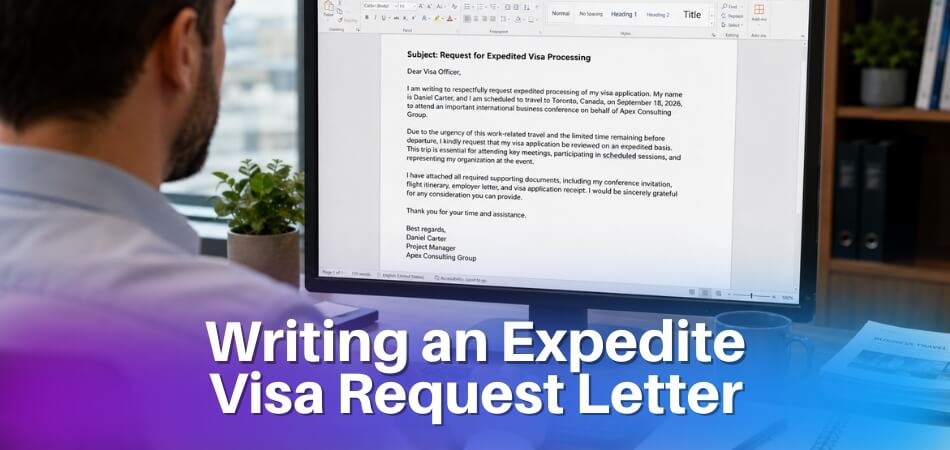
Is a Visa Support Letter the Same as an Expedite Request Letter?
No. A support letter explains the trip and the host. An expedite request letter asks for an earlier appointment or faster handling and has its own rules, set by each embassy or visa office.
Final Thoughts
A visa support letter works best when it is clear, honest, and complete: who invites the visitor, why, for how long, where the visitor stays, and who pays. Write it from the visitor’s passport and documents, adapt the sample letter that fits your situation, and review everything once more before signing.
Disclaimer: This guide is general information, not legal or immigration advice. Requirements differ by country, visa type, and embassy, so check the official website of the visa office handling your application.