
Your flight is three weeks away, but the next visa interview slot is six weeks out. That gap is the reason expedite requests exist, and the letter you send is often the only chance to explain it. Some authorities, such as USCIS and U.S. embassies and consulates, accept a short, well-documented request, while others, such as UK Visas and Immigration and IRCC, have no formal expedite letter route. A vague one gets nowhere.
Quick answer: To write an expedite visa request letter, state your urgent reason and exact travel deadline in the first paragraph, add your case or application number, attach a document that proves each claim, and end with one clear request: an earlier appointment or faster processing. The authority decides, and approval is never guaranteed. Conference travel alone often does not qualify.
Fact-checked by the MS International Editorial Team. Last verified against official sources: October 2026.
This guide covers who reads the letter, the difference between an earlier appointment and faster processing, which reasons are accepted, a six-step structure, three sample letters, where to send the request, and what to do afterwards.
What Is an Expedite Visa Request Letter and When Do You Need One?
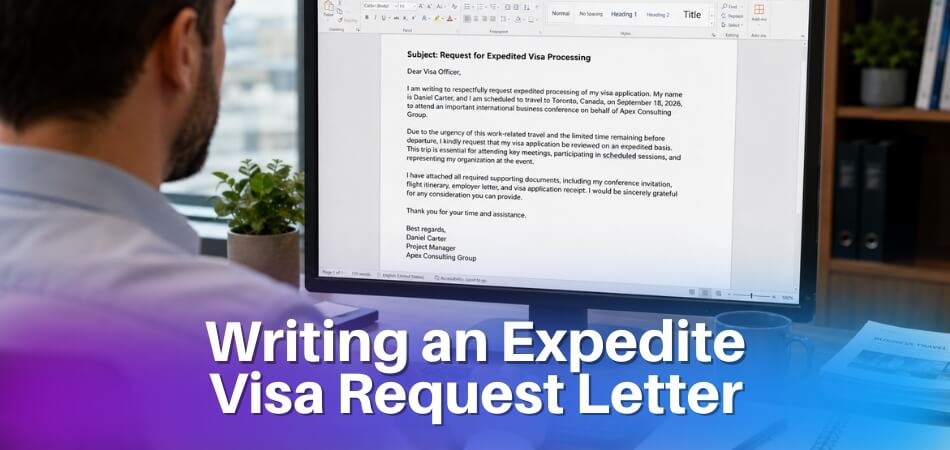
An expedite visa request letter is a short formal letter asking a visa authority to give your case earlier attention than the standard timeline allows. It explains who you are, which application or petition you filed, why waiting creates a real hardship, and which documents prove it.
Standard processing can run from a few weeks to several months. A fixed enrollment deadline, an employment start date that cannot move, a critically ill relative abroad or a funeral are the kinds of situations these mechanisms exist for. Without a credible, documented letter, a request has little weight.
Who Actually Reads These Letters?
It depends on where your application sits. A USCIS Service Center or Field Office reviews petition-based requests. For nonimmigrant visas, the U.S. embassy or consulate in your country decides on an earlier appointment. UK Visas and Immigration and IRCC each run their own systems. Find out which authority holds your case before you write a word, because the submission method differs and the wrong office wastes time you do not have.
When a Letter Is Required and When It Is Optional
For USCIS, you generally need a pending case with a receipt notice first. USCIS says to call its Contact Center, or, if you have an online account with secure messaging, to choose “expedite” as the reason for your inquiry and upload your documents there, rather than mail a standalone letter. It asks you to make only one request. For an embassy appointment, you usually use the post’s scheduling system and may add a supporting letter. Some processes, such as a visa application centre that collects paper documents, do need a physical letter. Digital or paper, treat it as a formal letter: tone, structure and evidence quality all affect the outcome.
Expedited Appointment vs. Expedited Processing: These Are Not the Same
An expedited appointment gets you an earlier interview slot; expedited processing asks the authority to decide an existing application sooner. Confusing them sends your request to the wrong place for the wrong reason.
| Topic | Expedited appointment | Expedited processing |
| What you ask for | An interview before the first available date | A faster decision on a filed case |
| Where it goes | The U.S. embassy or consulate handling your interview | The office holding your file, such as a USCIS Service Center or Field Office |
| Application filed yet? | Often not decided yet; a U.S. post usually asks for the DS-160, fee and first available booking first | Yes, a pending case is needed |
| What it does not change | How long the decision takes after the interview | Your interview date at a consulate |
For petition-based cases such as an I-130, the request goes to USCIS and the embassy only joins later at the consular stage. For a U.S. tourist, student, work or visitor visa there is usually no USCIS step at all, and your request goes to the post. UK and Canadian visas run through their own portals.
Why the Distinction Changes What You Write
For an appointment, the consulate asks a narrow question: does your situation justify jumping the scheduling queue? You need your itinerary, proof of the time-sensitive event and a clear statement that no available date gets you there in time. Medical emergencies and funerals tend to qualify. Academic deadlines work only where that post accepts them. For USCIS, the criteria are formal and published in the USCIS Policy Manual, so you must connect your reason to them, not just say you would like to travel sooner. IRCC’s visitor visa pages describe no standard expedite request the way USCIS does, so anything you send there explains urgency and relies on an officer’s discretion.
One Letter Does Not Cover Both
If you need an early appointment and faster processing afterwards, write two letters. They go to different recipients and cite grounds relevant to each stage. Merged into one, the letter reads as unfocused and each reader may assume the other side will deal with it.
What Qualifies as a Valid Reason for Expediting?
A valid reason is genuinely urgent, falls into a category the office recognizes, and is backed by a document. Saying you are in a hurry is not enough, and a convenient travel date is not a reason.

If your situation does not fit a recognized category, no wording will rescue the letter. The table lists the main categories and the evidence that carries each one.
| Reason | Evidence that carries it |
| Medical emergency (yours or a relative’s) | Physician’s letter on letterhead with diagnosis, treatment dates and why travel cannot wait; for a relative, also proof of your relationship |
| Funeral or bereavement | Death certificate (certified translation if needed), funeral notice or obituary, proof of relationship |
| Academic or research deadline | Institution letter stating the program, start or report-by date and the consequence of arriving late; I-20 or offer letter |
| Employment start date | Signed offer letter with the date, plus an employer letter on letterhead confirming the post cannot be deferred |
| Business or severe financial loss | Contract name and value, letter from the counterparty, proof that your presence is required, financial records showing the loss |
| Government or legal obligation | Court summons, official notice or government letter requiring your presence by a set date |
Reasons That Usually Do Not Qualify
The State Department’s visa wait-times page says travel to attend a wedding or graduation ceremony, assist a pregnant relative, take part in an annual business, academic or professional conference, or enjoy last-minute tourism does not qualify for an expedited appointment. Posts add their own lists. The U.S. Embassy in Spain and Andorra, for example, also lists a flight you have already booked, a visa refused in the past 12 months for the same travel purpose, and a student whose I-20 start date falls before the first available appointment. The same page says a conference speaker or presenter may qualify, with evidence that lists you as a speaker. Read your own post’s page before you write.
Emergency Travel (Medical, Funeral, Humanitarian)
This is the strongest category and moves fastest when the documents are solid. If you are the patient, the physician explains the diagnosis, the urgency and why treatment must happen at the destination. If you travel to be with someone, include a hospital letter or discharge paperwork and proof of your relationship. For a funeral, a death certificate, a funeral notice and a relationship document are what make the request checkable. Even where an appointment is granted quickly, the visa still has to be approved, so your underlying application must be clean.
Other humanitarian cases, such as caring for a minor left without a guardian or reaching a relative displaced by a disaster, are harder to define. They need a specific, credible account and whatever third-party proof exists, such as official records or statements from agencies. Vague family hardship without documents is unlikely to succeed.
Academic or Research Deadlines
The core requirement is a fixed deadline you do not control: an enrollment deadline, a program start date, a funded research position or a field study window tied to the season. The institution’s letter should state the program name, the date and, ideally, that late arrival means losing the place or the funding. Conference attendance is treated separately, and the conference sample below explains why it is the weakest academic ground. If the deadline is already close, explain why you could not apply earlier, because adjudicators look at the timeline. USCIS also considers whether you filed on time for planned events.
Work, Business, or Financial Urgency
This category gets the closest scrutiny because the harm has to be shown with records. What holds up is concrete, quantifiable harm: a work visa where the start date will be missed, a lapsing contract, or a job offer that will expire. USCIS lists severe financial loss to a company or person as a criterion, and notes that the need for urgent action must not come from a late filing or a late reply to a request for evidence. General claims that your company needs you or that a missed meeting will cost money do not work. Name the contract, give the value, and show why your personal presence is required.
Government or Legal Obligations
This is one of the clearest categories because an outside authority generates the paperwork: a summons, subpoena or hearing date, a required appearance before an immigration authority abroad, or a fixed-date appointment at a foreign embassy. Attach the official document and point to any stated consequence of not appearing. The obligation must not be self-imposed.
How to Write an Expedite Visa Request Letter: Step by Step
Use a standard business letter, put the reason and deadline in the first paragraph, give exact dates, list your attachments and make one request. Officers read many of these letters and need to understand yours within seconds.
Step 1: Use the Right Format and Salutation
First confirm how and where you submit, since USCIS, embassies, consulates and UK Visas and Immigration all use different channels. Then write a clean business letter: date at the top, your full name and address, then the recipient’s details. Open with “Dear Visa Officer” or “To the Consular Officer, [Embassy Name]”. For USCIS, “Dear USCIS Officer” works. “Hi there” or no salutation suggests you did not take the request seriously.
Step 2: State Your Urgent Reason Clearly in the Opening
Say who you are, which visa or petition you want expedited and why, in two or three sentences. Do not build up to the reason.
I am writing to request expedited processing of my [visa type] application, Receipt Number [XXX], due to a medical emergency requiring my immediate travel to [country] no later than [specific date].
That one sentence gives the officer your case, your reason and your deadline. Whether it is a medical emergency, funeral travel, an academic deadline, an employment start date or a government obligation, name it directly.
Step 3: Provide Specific Dates, Deadlines, and Travel Details
This is where most letters fall apart. “I need to travel soon” or “my job starts shortly” gives the officer nothing to act on. Spell out:
- Your required travel or arrival date
- The deadline you face (enrollment, start date, court date, medical appointment, funeral date)
- Flight details or your planned itinerary, if you have them
- The filing date of your original application, and any processing-time context such as an I-130 filed months ago
- The date you learned of the urgent need, and why the work or event cannot wait or be moved
For a student visa, give the exact date enrollment closes and the date the semester begins. For a work visa, give the start date and the employer’s name. For a Schengen business trip, give the meeting date, the company and the consequence of missing it. Dates and numbers are the evidence that your urgency is real.
Step 4: List Supporting Documents You Are Attaching
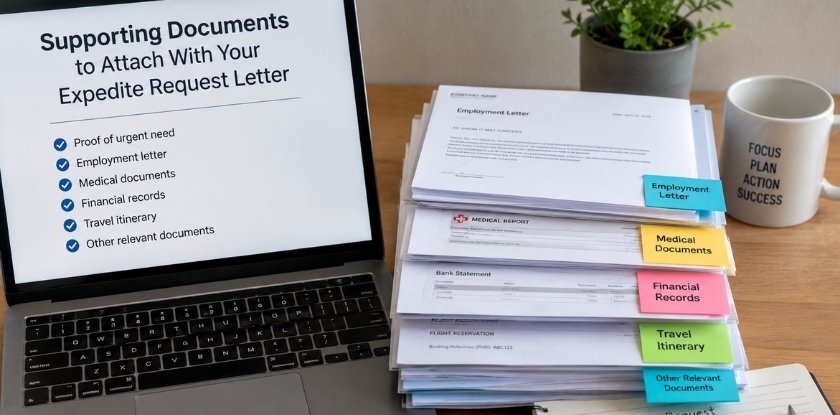
Name every attachment in the body of the letter and say why it matters, using the table above to choose them. Add your application confirmation or receipt, a signed itinerary or flight reservation, and any earlier correspondence with USCIS, the embassy or IRCC about your case. Claims of financial urgency with no records are likely to be refused, and the same logic applies at IRCC, where officers want documents, not assurances. Attach clean copies and keep the originals.
Step 5: Maintain a Respectful, Professional Tone
Stick to facts and let the documents show how serious things are. Skip phrases like “I am absolutely desperate”. Avoid complaints about how long processing has taken, even if your case was mishandled; this letter is not the place for that argument. A calm, direct letter reads as credible, and emotional or confrontational language does the opposite.
Step 6: Close with Your Contact Information and a Clear Request
Make one unambiguous request, for example: “I respectfully request that my application be expedited given the documented circumstances above. I am available to provide any additional information and can be reached at the details below.” Then list your full name, case or application number, phone, email and mailing address, plus your attorney’s details if you have one. Sign by hand for paper, or follow the portal’s rules online. Keep a copy of the letter, all attachments and the submission confirmation in case you need to follow up or respond to a denial.
Expedite Request Letter Samples by Visa Type
The structure is the same for every visa type, but the reason, the documents and the recipient change. The samples below are templates, not guarantees: adapt them, and make sure every claim is backed by a document you can attach.
Tourist / Visitor Visa Expedite Letter Sample
Visitor visa requests go to the U.S. embassy or consulate in your home country, or to the relevant consular post for a Schengen or UK short-stay visa. The most common qualifying reasons are medical emergencies, funeral travel and urgent family situations.
[Your Full Name] [Your Address] [City, Country, Postal Code] [Email Address] [Phone Number] [Date]
Visa Section [Name of U.S. Embassy / U.S. Consulate / Consulate-General] [Address]
Subject: Expedite Appointment Request, B-2 Tourist/Visitor Visa, [Your Full Name], [Date of Birth]
Dear Visa Officer,
I am writing to respectfully request an expedited appointment for my B-2 visitor visa application. My name is [Full Name], date of birth [DOB], and my passport number is [XXXXXXX].
My mother was diagnosed with [condition] on [date], and her treating physician has advised that she requires immediate surgery scheduled for [date]. I am her primary caregiver and must travel to [city, U.S. state] to be present. The earliest available regular appointment at this consulate is [date], which falls after her surgery date and makes a standard appointment timeline untenable.
I have attached the following supporting documents:
- Letter from my mother’s physician at [Hospital Name], confirming the diagnosis, surgery date, and my required presence
- Proof of my mother’s U.S. legal status (copy of her Green Card / visa)
- My return flight itinerary (travel dates: [departure] to [return])
- Proof of accommodation in the U.S.
- Evidence of strong ties to [home country]: employment letter, property ownership documents, and bank statements
I have a genuine intent to return to [home country] after my visit. I am available for an interview at your earliest convenience and can provide any additional documentation you require.
Thank you sincerely for considering this request.
Respectfully,
[Your Full Name] [Signature]
The subject line carries your name, date of birth and visa category so staff can identify the letter at once. The physician’s letter is the critical attachment; without it the request has little weight. For funeral travel, substitute the death certificate or an official obituary and a letter from the funeral home confirming the date. For a Schengen request, address the embassy handling your application and reference the Schengen category. The documents standard is the same: the more official and dated your evidence, the better.
Student Visa Expedite Letter Sample
Student requests usually arise when the appointment falls too close to, or after, an enrollment deadline or program start date. This applies to F-1 and M-1 visas in the United States and, with different wording, to UK Student route and Canadian study permit applications. The I-20 from your school is your anchor document.
[Your Full Name] [Your Address] [City, Country, Postal Code] [Email Address] [Phone Number] [Date]
Visa Section [U.S. Embassy / U.S. Consulate Name] [Address]
Subject: Expedite Appointment Request, F-1 Student Visa, [Your Full Name], I-20 Program Start Date: [Date]
Dear Visa Officer,
I am respectfully requesting an expedited visa appointment for my F-1 student visa application. I have been accepted to [Full University Name] in [City, State] to pursue a [degree level, field of study] beginning [program start date].
My I-20, issued by [University Name]’s Designated School Official, lists a program start date of [date] and a report-by date of [date]. The earliest regular appointment available at this consulate is [date], which falls after my mandatory report-by date. Missing this date would result in the cancellation of my enrollment and the forfeiture of [amount] in tuition already paid.
I am enclosing the following documents:
- Original I-20 issued by [University Name], with report-by date highlighted
- Official university acceptance letter
- Proof of SEVIS fee payment (I-901 receipt)
- Evidence of financial support (bank statements, scholarship award letter)
- DS-160 confirmation page
- Proof of tuition payment or enrollment deposit
I have no prior U.S. visa violations. My academic program is time-sensitive and cannot be deferred without significant academic and financial consequences. I am available for an interview at any time that suits the consulate.
Thank you for your consideration.
Sincerely,
[Your Full Name] [Signature]
The report-by date on the I-20 is what makes this request credible. If your current appointment falls before that date with room to spare, an expedite is hard to justify, and consular officers will check the dates. Posts differ on this ground, and some list it among the cases that generally do not qualify, so check your own post’s page first. For a Canadian study permit, keep the same structure (clear identification, specific dates, Letter of Acceptance, a short explanation of the conflict) but send it through the channel IRCC tells you to use, not as a formal letter by default.
Work Visa Expedite Letter Sample
Work visa letters are driven by the employment start date, and your employer’s letter does most of the work. This sample is written for an H-1B consular stamp, but the structure applies to a UK Skilled Worker visa or a Canadian work permit as well.
[Your Full Name] [Your Address] [City, Country, Postal Code] [Email Address] [Phone Number] [Date]
Visa Section [U.S. Embassy / U.S. Consulate Name] [Address]
Subject: Expedite Appointment Request, H-1B Work Visa Stamping, [Your Full Name], Employment Start Date: [Date]
Dear Visa Officer,
I am writing to request an expedited appointment for H-1B visa stamping. My U.S. employer, [Company Name], has filed an approved H-1B petition on my behalf (Petition Number: [Receipt Number]), with an employment start date of [date].
The earliest available regular appointment at this consulate is [date], which is [X days/weeks] after my employment start date. My employer has stated in writing that if I am unable to report by [date], the position may be reassigned due to [specific business reason: project launch, client contract start, etc.]. The role involves [brief description], and my absence will directly impact [specific team or project].
I have attached the following:
- Approved H-1B petition approval notice (I-797)
- Employer letter confirming employment start date, role, and business urgency
- Offer letter from [Company Name]
- Travel itinerary
- Proof of current valid status (if applicable)
- DS-160 confirmation
I have previously held U.S. visas without incident and have no immigration violations on record. I appreciate your time and ask that you consider the business urgency of my situation.
Respectfully,
[Your Full Name]
[Signature]
The employer letter should be on company letterhead, signed by an HR director or senior manager, and state the business impact of a delay. Vague statements such as “his presence is needed” carry little weight.
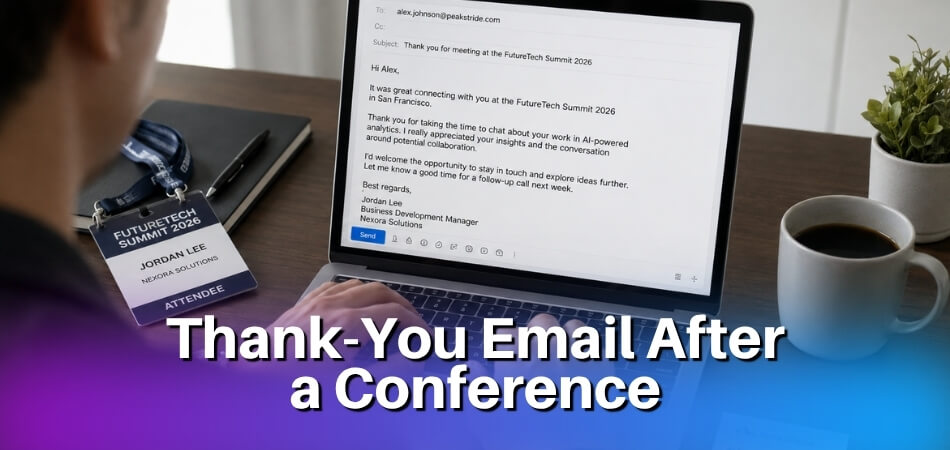
Conference Attendee Expedite Letter Sample
Conference travel is the hardest case, as the list of reasons that usually do not qualify shows. A speaker or presenter has the better argument, but only at posts that accept it. If your post offers a paid expedite option, that route does not depend on your reason. If you still write a letter, keep it honest and short. Mention the fixed dates, the registration and the organizer’s letter, and do not claim an emergency that does not exist.
Dear Visa Officer,
I am a registered delegate at [Conference Name], taking place in [city, country] from [date] to [date], where I am presenting [paper title / role]. My B-1 visa application (DS-160 confirmation [number]) is complete and my first available interview is on [date], which falls after the conference begins.
I respectfully ask whether an earlier appointment is possible. I understand that conference attendance may not meet the usual criteria, and I will gladly accept any earlier slot you can offer. I have attached my registration confirmation, the organizer’s invitation letter, my acceptance notice and my itinerary.
Respectfully,
[Your Full Name] [Signature]
Where and How to Submit Your Expedite Request
Use whichever channel the receiving authority designates, and confirm it before you send anything. The right letter sent to the wrong place or through the wrong channel can cost you days you do not have.
| Authority | How requests are made | Points to know |
| USCIS (Service Center or Field Office) | Through the USCIS Contact Center or the expedite request guidance on uscis.gov; the written statement carries your evidence | Map your reason to the published criteria; do not mail a letter to a Service Center unless told to |
| U.S. embassy or consulate | The post’s own appointment system, form or email, after you have the DS-160, fee payment and first available booking | The process varies by post; the State Department says an annual conference does not qualify; a few posts offer a paid expedite (US$750) for B visas until December 31, 2026 |
| IRCC (Canada) | The IRCC web form for an application already filed, or the instructions in your application package | IRCC says another web form will not speed things up; the outcome rests on officer discretion |
| UK Visas and Immigration | No formal expedite letter route; pay for priority or super priority service when you apply | Priority usually means a decision in 5 working days and super priority by the end of the next working day, where offered; check the current fee on GOV.UK |
| Schengen consulates | Each member state sets its own rules; email or phone the consulate early | No single Schengen process; bring documents to the appointment |
Submitting to USCIS (Service Center vs. Field Office)
Service Centers are not walk-in offices, and mailed letters pass through intake centers that can take weeks, so follow the current expedite guidance on uscis.gov instead. If your case is at a Field Office for an interview or biometrics, ask the USCIS Contact Center how that office accepts written requests before you send anything. USCIS weighs the totality of the circumstances and decides at its discretion. For severe financial loss it expects the harm to be significant and documented. Having only a work authorization need is not enough by itself, according to the Policy Manual. USCIS does not consider expedite requests where premium processing is available, and a case cannot be decided until every processing step, such as biometrics or requested evidence, is complete, so finish those first.
Submitting to a U.S. Embassy or Consulate
For nonimmigrant visas, the embassy or consulate is your recipient and USCIS is not involved. A U.S. post first needs the DS-160, the application fee and a booking of the first available interview, and only then weighs an expedite request. Expect a short text box, sometimes just a few hundred characters. State the emergency and the deadline in one or two sharp sentences there and upload the full letter and documents as a PDF. Some posts accept email requests, others only a form, so read the specific embassy page. A physical letter is rare for first requests, but may suit a follow-up after a denial or when you are already at the consulate for another purpose.
The Paid US$750 Option for B Visas
A few U.S. posts offer a paid expedite instead of a reason-based request. The State Department is testing it through 31 December 2026 at select posts only, and the U.S. mission in Mexico was the first to take part. B-1 and B-2 applicants pay US$750 per appointment, on top of the standard visa fee, for an interview within 10 business days, subject to availability. The fee is not refundable, the appointment cannot be rescheduled, and it does not guarantee a visa. Check whether your post takes part before you write a letter.
Submitting to Non-U.S. Visa Authorities (UK, Canada, Schengen, etc.)
UKVI does not run an expedite request process like USCIS. The practical route is the paid priority or super priority service at the time of application. GOV.UK lists priority at an extra £500 and super priority at an extra £1,000 on top of the application fee, so confirm the current amounts and whether your visa is eligible. A letter explaining an emergency may be passed on through the visa application centre, with no guarantee of a separate review.
IRCC describes no dedicated visitor visa expedite form. Its web form page says another web form will not speed things up unless you are already eligible for urgent processing, and its processing-time page says calling will not get your application processed faster. If you have already applied and your file is past the normal processing time, use the web form once, quote your application number, state the date by which you need a decision and attach documents. For IRCC-registered events, a Special Event Code can allow coordinated processing, but it does not guarantee priority.
Schengen applications go through the consulate of the member state, so contact it by email or phone as soon as you know you need speed, explain the urgency briefly, and ask whether an earlier appointment is possible. For a funeral or serious illness, many consulates try to help, but you often need to follow up yourself.
Online Submission vs. Physical Letter: Which to Use?
Use whatever the authority designates. Physical letters make sense when the authority asks for them, when a visa application centre collects paper documents, or when you are following up on a denial and want a formal record. Print on clean paper, sign by hand and arrange the attachments in order. Where only a small text box exists, keep the core argument tight there and attach the full letter.
What to Do After Submitting: Follow-Up Strategy
Wait a reasonable time, follow up once and politely, and keep a record of every contact. Silence does not always mean refusal, since processing teams handle large volumes.
Give It the Right Amount of Time Before Following Up
Use the waiting period stated by the specific office. Where none is stated, a few working days for an embassy and a longer wait for USCIS is reasonable, and a date-specific emergency can justify an earlier nudge. Consulates and visa application centres with slower communication channels need more patience.
How to Follow Up Without Hurting Your Case
Keep the message short and factual: name, case or application number, the date you submitted, and the reason in one sentence, then ask for a status update. Repeated aggressive follow-ups can mark you as a nuisance. One polite email or call after the waiting period is enough, and where an embassy asks you to use its inquiry form, use that instead of calling. Use the same professional tone as your letter and mention the documents you attached, because the reader may not have your file open.
Document Every Contact You Make
Keep a running log with the date, method, name of any officer and what you were told. It matters if you escalate or file a formal inquiry later.
When to Get Professional Help
If travel is within two weeks and the request has been refused for a time-sensitive reason, an immigration attorney is worth the cost. An attorney can draft a more targeted follow-up, spot grounds you missed and coordinate two tracks, such as a USCIS petition and a separate embassy appointment.
What If Your Expedite Request Is Rejected?
A refused expedite request is not a refused visa: your underlying application stays active. There is no formal appeal for an expedite decision, so the practical step is a new request with new evidence.
How to Reapply
Go back through your letter and find the gaps. Was there an itinerary, an employer letter with the start date, a doctor’s note with dates and a reason travel cannot wait? When you resubmit, add evidence rather than rewording. If the situation has escalated, such as a worsening medical condition or a closer deadline, document that. The new request should stand alone without relying on the reviewer having seen the first. If a document was missing that you actually have, resubmit with it and say it was omitted before.
Other Options by Authority
For USCIS, you can ask the Contact Center about the reason, resubmit with stronger documents, or ask your congressional representative’s office to make an inquiry, which is free. In Canada a Member of Parliament’s office can do the same. This does not guarantee approval but can prompt a second look. At an embassy, check whether the post has a walk-in procedure for documented emergencies, and read its website. At a Schengen consulate, ask whether a second request is allowed and what would strengthen it. At IRCC, another web form will not speed things up, so write again only if you have new documents and your file is past the normal processing time. Keep the tone factual and respectful.
Common Mistakes That Get Expedite Requests Denied
The usual causes are missing proof, a reason outside the recognized categories, the wrong office or channel, and a request sent too late. Avoiding them will not guarantee approval, but making them almost guarantees a refusal.
Vague or Emotional Language Without Documentation
“I really need this visa urgently” tells the officer nothing. Every applicant feels urgent. What separates approved from refused requests is specific, documented fact: name the condition and include the doctor’s letter, attach the offer letter for a start date, provide the death certificate for a funeral. Emotional appeals without papers are dismissed because approval criteria are evidence-based, not because officers are unsympathetic.
Misidentifying the Correct Authority or Request Type
USCIS handles petition processing; consular processing happens at the embassy. A request for faster processing sent to a post that only schedules interviews, or an appointment request sent to a Service Center, is useless. For non-U.S. visas, a Schengen request goes to the consulate handling your application, and UKVI and IRCC have their own channels. Know who controls your case and whether you need an earlier slot or a faster decision before you send anything.
Reason Outside the Recognized Categories
A preference to travel sooner does not qualify, and for leisure or a standard conference the bar is high. A reason that sits outside the recognized categories usually fails, however legitimate it feels personally.
Applying Too Late
A perfect request can fail if it arrives days before travel, because an earlier slot may simply not exist. Sending a student request one week before a deadline, when the next slot is weeks away, is not workable whatever the letter says. If your deadline is three weeks out, submit now.
Inflating or Misrepresenting the Reason
Officers spot inconsistencies. A medical emergency with a return flight two weeks after the procedure, or business urgency with an unsigned contract, does not add up. Misrepresentation can damage your credibility and future visa eligibility. State exactly what is true, and do not exaggerate the timeline or the stakes. If you have several reasons, lead with the strongest and leave out marginal ones, since weak grounds dilute a good one.
Writing in a Way That Reads as a Template
Officers can tell when a generic sample was lightly edited. “My important business meeting” with no specifics, or “a family emergency” with no names or dates, is treated that way. Keep the professional tone but make the details yours.
Forgetting Contact and Case Information
Without a case or receipt number, full legal name, date of birth or passport number, staff must search for your file before anyone reads the letter, and at USCIS a request that cannot be tied to a case may be lost. Include the visa type and the date you filed, plus your contact information.
Example Evidence Packages: What Strong Requests Contain
Strong requests share one pattern: the claim is specific, the documents match the claim, and the urgency can be checked by someone else. The scenarios below are illustrative, not reports of real approvals, and no outcome is promised.

| Scenario | Package that makes it checkable |
| Medical emergency, visiting a hospitalized parent in the U.S. | Attending physician’s letter on hospital letterhead naming the diagnosis and prognosis, admission records showing ICU status, proof of relationship, and an itinerary within two weeks |
| F-1 student with a report-by date before the first appointment | I-20 with the date, a university letter stating that missing it forfeits admission, proof that the first appointment is later, and the current appointment confirmation |
| UK Skilled Worker with a fixed start date | Certificate of Sponsorship, employer letter explaining the cost of a delayed start, completed checks, and flight booking; paid priority service is the more reliable route |
| Funeral travel for a Schengen visa | Translated death certificate, funeral notice from the family, proof of relationship, flight booking before the funeral, and proof of residence and employment |
| USCIS request citing severe financial loss | Statement with monthly income lost, rent and savings figures, bank statements showing the trend over about three months, and documents on the lapse of income |
| Witness at a court hearing abroad | Letter from the court on official letterhead confirming the date and role, plus the complete visa application |
A court-issued or hospital-issued letter carries more weight than a personal statement, and a bank-statement trend shows more than a single snapshot. None of these letters needs to be long: state the reason, name the deadline, list the attachments and ask directly. Brevity with precision is what a successful expedite request looks like, and a bare claim without a document gives the officer nothing to approve even when the situation is real.
Can a Conference Organizer Support Your Expedite Request?
A conference organizer can supply supporting letters, but only the embassy or immigration authority decides on an expedite. For conference travel, your registration confirmation and the organizer’s invitation letter are the documents that show the dates are fixed.
MS International Conferences Inc. offers a Visa Expedite Request Letter (US$100, non-refundable) only to delegates who have completed registration for an eligible event. It confirms your participation and the event details, and is a supporting document that may help your case, but it does not guarantee approval, faster processing or visa issuance. You cannot request it before registering.
Expedite Visa Request Letter FAQ
Drafting an expedite letter for USCIS, a Schengen consulate or IRCC means thinking about response times, supporting documents, how precise the dates must be and a second try after a denial.
Can I submit an expedite request before my visa application is even filed?
Generally no. USCIS says you may request an expedite after you receive a receipt notice, and a U.S. embassy usually wants the DS-160, the fee and a booked first available appointment first. Check the specific embassy’s instructions, since the process varies.
How long does USCIS take to respond to an expedite request?
USCIS publishes no response time for expedite requests. It decides at its discretion, and its answer on the request is not a decision on your case. Make only one request, follow the guidance on uscis.gov, and check your case status online.
Does having an attorney improve my chances?
Not by itself. An attorney can help you frame the reason and avoid structural mistakes, but USCIS or the embassy judges the merits of your circumstances. A clear letter with strong documents beats a poorly substantiated attorney-drafted one.
My expedite request was denied. Can I submit another one?
Yes, if your situation has changed or you have new evidence, such as an updated medical report or a revised start date. Resubmitting an identical request with no new information rarely changes anything.
What supporting documents carry the most weight?
It depends on your reason: a physician’s letter on letterhead for medical cases, a signed employer letter tying a date to a loss for work cases, and an institution’s deadline letter for academic cases. The closer a document ties a specific date to a specific consequence, the better.
Is an expedite request possible for a Schengen visa?
There is no formal EU-wide process. Each member state’s consulate sets its own rules, and some accept urgent appointment requests with documentation. Contact the specific consulate directly.
Can I expedite a tourist visa or visitor visa?
Yes, in genuine emergencies such as a funeral or serious illness, but last-minute tourism does not qualify at U.S. posts. A few U.S. posts also sell a US$750 expedited B-visa interview slot. Document your reason as for any other visa.
What is the difference between submitting online and mailing a physical letter?
Use the channel the authority designates. For USCIS, follow the current expedite guidance on uscis.gov rather than mailing to a Service Center. For embassies, use the post’s own system. Mailing an unrequested letter to an embassy often gets no response.
Does IRCC have an expedite process?
Not for visitor visas, as far as IRCC’s pages describe. Its web form page says another form will not speed things up unless you already qualify for urgent processing. If your file is past normal processing time, you can ask about it through the web form.
How specific does my letter need to be about dates?
Very specific. “I need to travel soon” tells the reviewer nothing, while “my employment starts March 3rd and my employer confirms the post cannot be held” gives them something to act on. Every date in your letter should be supported by a document.
Can I submit an expedite request for a student visa close to an enrollment deadline?
It depends on the post. Some accept it with documents, while at least one U.S. post lists an I-20 start date before the first appointment as not qualifying. If yours accepts it, provide the institution’s deadline letter, your I-20 or equivalent, and your itinerary.
Final Thoughts: Make Your Expedite Request Count
Make the urgency easy to see: state the reason, give exact dates, link them to the processing timeline and attach documents that prove every claim. Send it through the correct channel in good time, keep the tone professional, and if a request is refused, return with new evidence rather than the same letter. Keep a copy of the letter, the attachments and the confirmation. A well-documented request cannot guarantee approval, but it gives the authority the strongest reason to consider your case.
From our experience at MS International: Our invitation letter is issued within 3 to 5 business days after payment clears, and a US$50 fee may apply to corrections after it is issued, so check your name and passport details when you register. The Visa Expedite Request Letter is separate, supports your case without guaranteeing anything, and our page asks participants to avoid non-refundable travel arrangements until the necessary visa approvals are in place.
Disclaimer: This article is general information, not legal or immigration advice. Expedite rules, fees and channels change and differ by authority and post, so confirm the details with the official USCIS, State Department, IRCC and GOV.UK websites before you apply.