Someone always gets it wrong. The event planner books a speaker for two hours because the venue is available and the budget is spent — then watches the room empty out after forty-five minutes. Or the speaker has thirty minutes on the clock, builds a beautiful story arc, and gets cut off by a stage manager just before the payoff lands. Both situations are avoidable, and both stem from the same problem: nobody stopped to ask what the right length actually looks like for this event.
Most keynote speakers should plan to speak for between 30 and 60 minutes. That range holds up across most professional settings for two reasons: it aligns with natural audience attention span before cognitive load starts working against you, and it gives a well-structured talk enough room to open strong, build through the middle, and close with genuine impact. The exceptions matter, though. TED Talks and TEDx events cap speakers at 18 minutes — a deliberate constraint that TED curator Chris Anderson has described as long enough for seriousness, short enough for focus. On the other end, many corporate conference formats run closer to a 45-minute keynote followed by a separate 15-minute Q&A session, treating the two as distinct parts of the same speaking slot.
What you won’t find in most articles on this subject is a framework you can actually use. They give you a number. This one explains what drives the number — event type, audience psychology, room energy, program structure, and the shape of the message itself. Whether you’re an event planner allocating time on a run sheet or a speaker like Patricia Fripp, whose Fripp Speech Model treats structure and timing as inseparable, the goal is the same: the talk ends at exactly the right moment, and the audience feels it.

How Long Should a Keynote Speaker Speak? (Quick Answer)
Most keynote speakers should plan for 18 to 45 minutes. That’s the honest, practical answer — but the right number within that range depends entirely on the event type, the audience, and what comes before and after you on the schedule.
Here’s a rough benchmark to work from:
| Event Type | Typical Keynote Length |
|---|---|
| Corporate conference | 30–45 minutes |
| TED / TEDx Talk | 18 minutes (hard cap) |
| Graduation ceremony | 12–20 minutes |
| Gala dinner or awards night | 10–20 minutes |
| Half-day or full-day summit | 45–60 minutes |
| Workshop-style keynote | 60–90 minutes |
These aren’t arbitrary. They’re built around real audience attention span research and decades of event planning experience.
Why 18 Minutes Became a Gold Standard
Chris Anderson, TED’s curator, didn’t pull 18 minutes out of thin air. The format was designed specifically to match how long most people can sustain genuine focus on a single speaker without cognitive fatigue kicking in — what researchers studying cognitive load theory would describe as the ceiling of working memory engagement before retention drops off.
TED Talks proved the model works. A tightly constructed 18-minute talk can carry more weight than a 60-minute ramble. Patricia Fripp, a past president of the National Speakers Association, has made a similar point for years: discipline in structure produces more impact, not less.
That said, 18 minutes is a performance format. No Q&A session, no interaction, no tangents. If your speaking slot includes audience questions or group discussion, you’re building a different kind of session entirely.
The Real Variables That Determine Length
- The event format is everything. A 45-minute keynote at a corporate conference is standard because the session is usually the main event — the audience came specifically to hear you. A gala dinner keynote at 40 minutes will lose the room. People are eating, talking, drinking. Keep it tight.
- Your position on the schedule matters. If you’re closing a full-day conference, the audience has already sat through six hours of content. Even a genuinely excellent speaker loses ground after 30 minutes in that spot. If you’re opening the day, you have more runway.
- Words per minute affects everything. Most professional speakers land between 120 and 160 WPM in delivery. At 130 WPM, a 30-minute keynote needs roughly 3,900 words of actual spoken content. That’s a useful number if you’re scripting or timing your rehearsals.
- Your story arc needs room — but not too much room. A well-built presentation structure has a setup, a conflict or insight, and a resolution. That full arc can work in 12 minutes or 45 minutes. The length doesn’t determine quality. The clarity of the arc does.
The short version: match the format, respect the schedule, and never assume more time means more impact. It usually doesn’t.
Why Keynote Speech Duration Actually Matters
Duration isn’t just a logistics question. It directly affects whether your audience walks away energized or exhausted — and whether your core message actually sticks.

Audience Attention Span and Cognitive Load
Here’s a hard truth: most audiences stop absorbing new information long before a speaker stops talking.
Research consistently puts the window of peak cognitive engagement somewhere between 10 and 20 minutes for a single continuous idea. After that, the brain needs a reset — a story shift, a visual break, a moment of humor, something. Cognitive load theory explains why: working memory has a finite capacity, and once it’s full, new information gets processed poorly or not at all. You’re essentially speaking to people who’ve mentally checked out while their bodies are still in the chair.
This is exactly why TED Talks cap speakers at 18 minutes. Chris Anderson, TED’s curator, has described that limit as “long enough to be serious and short enough to hold people’s attention.” It’s not arbitrary. It’s based on how the brain actually works under passive listening conditions.
The longer you run, the more you fight this curve. A 90-minute keynote without structural variation isn’t impressive — it’s a gamble. Most speakers lose the room somewhere around minute 45 and never get it back.
That said, audience attention span isn’t fixed. It shifts based on context. A fired-up crowd at an industry conference, after two strong coffees and a compelling opening, will stay with you longer than a post-lunch audience at a gala dinner. Event planners need to factor in the time slot, the room energy, and what came before the speaker hit the stage. A 60-minute keynote at 9 AM in a well-lit room hits differently than the same talk at 2 PM after a heavy meal.
The practical takeaway? Don’t treat duration as a default. Treat it as a decision that needs to match the cognitive state of your specific audience at that specific moment.
Message Delivery and Story Arc
Every keynote has a job to do. That job usually boils down to one central idea delivered in a way that moves people — to think differently, act differently, or simply remember something long after they leave the room.
The story arc is how you get there. And the arc needs time — but not unlimited time.
Patricia Fripp, the veteran speaking coach and past president of the National Speakers Association, talks about structure in terms of a beginning that hooks, a middle that builds, and an end that lands. The Fripp Speech Model emphasizes that every element should serve the central message. Nothing decorative. Nothing just to fill time.
When speakers don’t respect this, one of two things usually happens. Either they rush — cramming too much into a tight slot and leaving the audience confused — or they pad, adding stories and tangents that dilute the original point. Both problems often come down to not properly calibrating duration against content.
A well-constructed 20-minute keynote with a clean arc will almost always outperform a bloated 50-minute one. Why? Because the story arc depends on tension and release. Setup, complication, resolution. That rhythm breaks down when a speaker meanders.
Words Per Minute is a useful calibration tool here. Most experienced speakers deliver somewhere between 120 and 150 WPM in a keynote setting — enough to feel natural without rushing or dragging. At 130 WPM, a 20-minute speech runs roughly 2,600 words. That’s a real constraint. Knowing your WPM helps you script and time accurately so the arc lands where it should, not two minutes after the session was supposed to end.
The story arc also has to account for what follows. If there’s a Q&A session built into the slot, that changes the shape of the talk itself. The keynote can end slightly more open-ended, letting questions fill in the edges. If there’s no Q&A, the close needs to do more heavy lifting — which means you need the time to build to it properly.
Bottom line: duration and structure aren’t separate problems. They’re the same problem.
Standard Keynote Speech Length by Event Type
Not every event is the same, and treating them like they are is where a lot of speakers — and planners — go wrong. The “right” length depends heavily on context: the formality of the room, how much the audience has already sat through, and what’s expected to come after you.

Here’s how duration typically breaks down across the most common event formats.
Corporate Events and Conferences
Most corporate keynotes run between 45 and 60 minutes. That’s the industry norm, and the National Speakers Association broadly supports it as the sweet spot for professional audiences in a conference setting.
That said, 60 minutes doesn’t mean 60 minutes of talking. A well-structured corporate keynote usually includes a Q&A session tacked on at the end, which means your actual prepared speech should land closer to 40–45 minutes. If the event planner books you for an hour, ask them upfront whether that includes or excludes Q&A. That one question saves a lot of awkward clock-watching.
Audience attention span is a real constraint here. Research tied to cognitive load theory suggests that sustained active listening starts to degrade after 20 minutes without some kind of pattern interrupt — a story, a question to the audience, a shift in format. So even inside a 45-minute speaking slot, smart speakers build natural breaks into their structure rather than delivering one long continuous monologue.
Patricia Fripp, longtime member of the National Speakers Association and creator of the Fripp Speech Model, has consistently argued that tightening your material — cutting it down rather than padding it out — is what separates forgettable speakers from the ones people remember. More time doesn’t equal more impact. Often the reverse is true.
For corporate conferences with multiple speakers on a single day, individual keynotes sometimes get compressed to 30 minutes. That’s enough time to land one strong idea with supporting evidence and a clear call to action. Don’t try to cover three ideas in 30 minutes. Pick one and go deep.
TEDx and TED-Style Talks
This one’s simple: 18 minutes maximum. That’s not a suggestion — it’s the official TED format, set by Chris Anderson, TED’s curator, who has described 18 minutes as long enough to be serious but short enough to hold attention.
TEDx events follow the same cap. If you’re speaking at one, you’ll likely get anywhere from 9 to 18 minutes depending on the event organiser. Some TEDx organisers assign slots as short as 6 minutes for lightning-style presentations.
The 18-minute ceiling has had a measurable influence on the broader speaking world. A lot of corporate event planners now specifically request “TED-style” keynotes — by which they usually mean focused, narrative-driven, and under 20 minutes. That’s a useful data point if you’re a speaker building your offerings.
Words Per Minute matters here more than in longer formats. Most confident speakers deliver at 130–150 WPM in a presentation context. At 150 WPM, 18 minutes gives you roughly 2,700 words. That’s not a lot. Every sentence has to earn its place.
The story arc in a TED-style talk is tighter too. You don’t have room for lengthy preamble. The idea needs to be established early, developed clearly, and closed with something memorable — all inside a window that most people spend watching a Netflix episode recap.
Academic and Graduation Ceremonies
Graduation keynotes are genuinely tricky. You’re speaking to an audience with wildly different levels of investment in the room — graduates who are excited but also restless, parents who’ve been sitting for 90 minutes already, and faculty who have somewhere else to be.
The practical expectation for a graduation ceremony keynote is 15 to 25 minutes. Some institutions push for as little as 10 minutes, especially when the ceremony itself is long. If you’re asked to speak at a graduation and you’re given latitude on length, err toward the shorter end. Fifteen focused minutes will land better than 25 wandering ones.
Academic conferences operate differently. Keynote speakers at academic conferences — especially those framing a full-day or multi-day event — often get 45 to 60 minutes, sometimes with time for scholarly Q&A built into the slot. The audience is there specifically for intellectual engagement, so longer, more structured arguments work here in a way they wouldn’t at a graduation or gala.
One thing worth flagging: academic audiences are not necessarily more forgiving of poor pacing. They’re often more critical. A rambling academic keynote is just as damaging to your credibility as a rambling corporate one.
Awards Nights and Gala Dinners
Keep it short. Seriously. 15 to 20 minutes is the ceiling for a keynote address at an awards night or gala dinner. Often 10–12 minutes is the better target.
People at these events are there for the awards, the food, the networking, or all three. The keynote is context-setting — it frames the evening, establishes a theme, or creates emotional momentum before the recognition elements kick in. It is not the main event.
A speaker who goes long at a gala dinner creates an atmosphere problem. The audience gets restless. The event planner starts sweating. The catering team hovers. None of that is good for anyone.
The format also matters. At a gala dinner, people are often seated at round tables, drinks in hand, with background noise that doesn’t fully disappear even when you’re speaking. That environment demands crisp, punchy delivery — shorter sentences, stronger imagery, and zero reliance on dense data or complex arguments. Save those for the conference stage.
If you’re an event planner booking a keynote speaker for an awards night, build the speaking slot into the run of show before the awards begin, not in the middle or after. Attention drops sharply once the recognition element starts.
How to Decide the Right Duration for Your Event
Event Schedule and Time Slot Considerations
Look at the full run sheet before you commit to any duration. A 45-minute keynote sounds reasonable in isolation, but if it sits between a lunch break that always runs long and a sponsor panel that can’t be moved, you’re setting the speaker up to get cut short or rushed.
The speaking slot is your hard boundary. Work backwards from it.
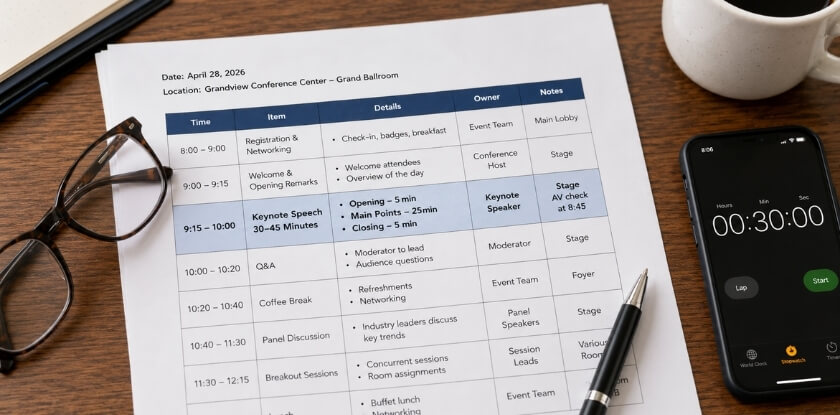
If your event planner has blocked 60 minutes for the keynote, that number includes the time the speaker walks to the stage, gets introduced, and walks off. Realistically, that eats 3–5 minutes on each end. Your actual usable speech time is closer to 50 minutes, sometimes less.
Corporate conferences are the worst offenders here. Sessions stack tightly, attendees drift in late after coffee, and AV checks bleed into the opening. Build buffer in. If you’re a speaker, ask the event coordinator exactly when the previous session ends and when yours must end — not when it “should” end.
Graduation ceremonies have their own constraints. There’s a formal program to follow, often union-contracted venue time, and an audience that includes grandparents standing in direct sunlight. Twenty minutes is genuinely the ceiling for most commencement keynotes. Push past it and you’ll feel the crowd shifting.
Gala dinners and awards nights are the trickiest. The keynote often sits between courses or before a ceremony, and the catering staff has its own timeline that nobody told the speaker about. If you’re planning one of these events, tell the speaker upfront: “You have 20 minutes, the plates need to clear at 7:45, and that’s not flexible.”
One practical rule: if your speaking slot is under 30 minutes, don’t schedule a topic that requires setup, context, and a case study. It won’t fit cleanly. Either shorten the scope or extend the slot.
Is Q&A Time Included in the Total Duration?
This trips up both speakers and planners constantly. A client books a “45-minute keynote” and assumes that means 45 minutes of speech. The speaker assumes it means 35 minutes of speech plus 10 minutes of Q&A. Nobody clarified it, and now someone’s wrong.
Get this in writing.
The National Speakers Association recommends speakers confirm Q&A logistics as part of pre-event communication — not the day of. Is Q&A included in the total block, or does it extend the session? Who moderates it? Is there a time limit per question?
If Q&A is inside the total duration, a 45-minute slot typically breaks down to 35 minutes of prepared content and 10 minutes of audience questions. Some speakers stretch to 40/5, which works if the material is dense and the audience skews introverted. Others prefer 30/15, especially in workshop-adjacent formats where the room has a lot to process.
If Q&A is outside the slot, the speaker needs to know that too. Ending your prepared content at exactly 45:00 and then fielding questions for another 15 minutes is a different kind of energy management. Cognitive load theory is relevant here — audiences who’ve just absorbed a full keynote aren’t always sharp questioners. If Q&A follows immediately with no break, expect softer engagement.
One more thing: always have a hard stop for Q&A. Open-ended Q&A sessions at corporate conferences regularly eat into the next speaker’s time. Set a visible countdown, or have the emcee ready to step in at the two-minute mark.
Speaker Style and Delivery Format
Duration isn’t just about clock time. It’s about how a speaker uses time. Two speakers given 40 minutes can produce wildly different experiences based purely on delivery pace and format.
Words Per Minute (WPM) matters more than most people account for. A conversational speaker typically lands around 120–140 WPM. A high-energy presenter pushing a message might hit 160 WPM. Patricia Fripp, whose Fripp Speech Model emphasizes precise language and deliberate pacing, coaches speakers to slow down specifically because audiences need processing time. At 130 WPM, a 30-minute speech is roughly 3,900 words. That’s your script benchmark.
TED Talks run 18 minutes by design. Chris Anderson, TED’s curator, has been direct about why: it’s long enough to develop an idea seriously, short enough to demand discipline. TEDx events follow the same model. That constraint forces speakers to cut ruthlessly, which usually improves the talk. If you’re adapting a TEDx-style format for a corporate conference, the 18-minute structure still works well.
Format changes the math too. A storytelling-heavy keynote needs more time than a data-driven presentation because story arc requires setup, tension, and resolution — you can’t rush that without losing the emotional payoff. A presenter using heavy visuals might move slower because the audience is reading slides and listening simultaneously, which compounds cognitive load.
If you’re planning an event and evaluating a speaker, ask them: “How do you typically structure your material, and what’s your ideal slot length?” A speaker who says “I can do 20 to 60 minutes, whatever you need” is either very flexible or hasn’t thought about it carefully. The better answer is something like, “My core content runs 35 minutes and I can add or trim based on your schedule.” That tells you they understand their own material.
Match the format to the context. A high-energy motivational speaker at a sales kickoff can hold a room for 50 minutes because the emotional register supports it. That same duration at an end-of-day session on day two of a conference? You’ll lose half the room by minute 35.
The Fripp Speech Model — How Duration and Structure Work Together
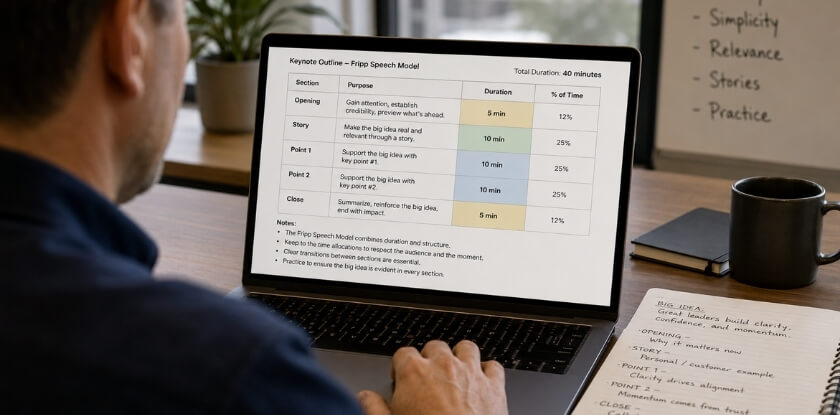
Patricia Fripp is a Hall of Fame speaker and speech coach who has worked with everyone from C-suite executives to competitive speakers on the NSA circuit. Her approach — often called the Fripp Speech Model — makes one thing very clear: duration and structure are inseparable. You can’t decide how long a keynote should be without first deciding what it needs to do.

The core idea is simple. Every minute of a speech should earn its place. Not fill it.
The Three-Part Arc and Why Timing Tracks It
Fripp builds speeches around a tight story arc: opening hook, core content with supporting stories, and a call-back close. That structure isn’t decorative. It’s functional. And each phase has a natural time weight.
For a 45-minute keynote, the rough breakdown looks like this:
- Opening hook: 3–5 minutes. Fast. Sharp. Gets the room.
- Core content (usually 3–4 key points with stories): 30–35 minutes.
- Close and call-back: 5–7 minutes.
Compress the speech to 20 minutes and something has to give. Usually it’s the stories — and that’s a problem, because stories are how audiences retain the message. Strip them out and you’ve got a lecture, not a keynote.
Extend it to 90 minutes without adding genuine substance and you’re just padding the middle section. Audiences feel that. Cognitive load theory explains why — working memory saturates around the 20-minute mark without a reset (a story, a question, a shift in energy). Fripp’s model builds those resets in naturally. A longer speech needs more of them, not just more content.
What This Means for Your Speaking Slot
If you’re an event planner assigning a 30-minute speaking slot to a keynote speaker, you’re not just cutting time — you’re cutting structure. A speaker trained in the Fripp model or anything similar needs to know that constraint before they build the talk, not after.
Thirty minutes is workable. But it demands ruthlessness. One strong central idea. Two stories maximum. A clean close. That’s it.
Chris Anderson, TED’s curator, essentially enforces the same logic with the 18-minute TED Talk format. He’s said publicly that the limit forces speakers to sharpen their thinking. Eighteen minutes isn’t arbitrary — it’s long enough for a complete idea with emotional texture, short enough that the audience never mentally checks out. TED and TEDx operate on that same principle globally, and it holds up.
Patricia Fripp pushes a similar discipline from the speaker side. Know your point. Build your structure. Then time it. Not the other way around.
The Mistake Speakers Make with Duration
Most speakers start by asking “how long do I have?” That’s the wrong first question.
The right first question is “what is the one thing this audience needs to leave with?” Once that’s clear, the structure follows. Once the structure is set, the duration becomes obvious — or at minimum, negotiable from a position of knowledge.
A speaker who knows their material runs at roughly 125–150 words per minute (WPM) in a live keynote setting, accounting for pauses and audience reaction. That’s your calibration tool. A 45-minute keynote is approximately 5,600–6,700 words of actual spoken content. Write to that, rehearse to that, and you’ll hit your time. Guess, and you’ll overrun.
Fripp’s coaching consistently returns to rehearsal as the mechanism that locks duration to structure. Not a rough run-through. A timed, full-voice rehearsal that mirrors real conditions. That’s where you find out your 45-minute keynote is actually 52 minutes — before you’re on stage.
When the Q&A Changes the Equation
One variable that breaks a lot of structured keynotes: the Q&A session.
If your speaking slot is 60 minutes and the program includes Q&A, you need to know upfront whether that 60 minutes includes Q&A or sits outside it. Big difference. A Q&A tacked onto a full 60-minute keynote often runs an event 15–20 minutes long. Corporate conference planners feel that pain constantly.
Fripp’s approach treats the close as sacred — meaning Q&A, if it happens, should come before the final close, not after. You take questions, then you return to your close and leave the audience with the message. That’s a structural choice that also protects your timing. The event finishes cleanly. The audience leaves on your terms, not mid-question about your third bullet point.
It’s a small adjustment. It makes a noticeable difference.
Words Per Minute: How to Calculate Exactly How Long Your Speech Will Run
Most speakers guess at how long their talk will run. That’s how you end up either scrambling to fill dead air or getting the hook from a stage manager. There’s a better way — and it takes about five minutes.
The baseline number you need is Words Per Minute (WPM). For a keynote speaker delivering with natural pacing, clear enunciation, and occasional pauses for effect, the standard range sits between 120 and 150 WPM. Faster than 160 and you’re outrunning your audience. Slower than 110 and people start checking their phones.
Finding Your Personal WPM
Read a piece of your prepared speech aloud — not in your head, actually aloud — for exactly 60 seconds. Count the words. That number is your WPM. Do it three times and average the results, because nerves, emphasis, and momentum all shift your pace.
Most speakers clock in around 130 WPM when they’re genuinely comfortable with the material. Chris Anderson has noted that TED speakers are coached toward the lower end of that range specifically because complexity of ideas requires processing time from the audience. Cognitive load theory backs this up — novel or dense information needs white space around it, and your pacing creates that space.
The Basic Formula
Once you have your WPM, the math is simple:
Word count ÷ WPM = raw speaking time in minutes
A 2,600-word speech at 130 WPM runs exactly 20 minutes on paper. But that’s the raw number. Nobody delivers a keynote without pauses, audience laughter, a sip of water, or a moment to let a point land. Real delivery typically adds 10–15% to your raw time.
So that 20-minute calculation becomes closer to 22–23 minutes in practice. If your speaking slot is 25 minutes, you’re comfortable. If it’s 20 minutes, you need to cut about 300 words — roughly a page of script.
Practical Word Count Targets by Duration
Here’s how this translates into real targets:
| Speaking Slot | Target Word Count (at 130 WPM) | With 15% Buffer |
|---|---|---|
| 10 minutes | 1,300 words | 1,100 words |
| 20 minutes | 2,600 words | 2,200 words |
| 30 minutes | 3,900 words | 3,300 words |
| 45 minutes | 5,850 words | 5,000 words |
| 60 minutes | 7,800 words | 6,600 words |
If you’re running a Q&A session after your keynote, subtract that time before you calculate. A 45-minute slot with 15 minutes of Q&A means you’re writing for 30 minutes, not 45. Event planners frequently forget to communicate this distinction to speakers — and speakers frequently forget to ask.
Why Timing Varies Even With the Same Word Count
Patricia Fripp has pointed out for years that the structure of a speech changes its runtime as much as the word count does. A story arc with emotional beats requires slower delivery. Data-heavy sections need pauses so the audience can process. A rousing close at a corporate conference might be punchy and fast. The same 2,500 words can run anywhere from 17 to 24 minutes depending on what they contain.
This matters especially for graduation ceremonies and gala dinners, where audiences aren’t fully locked in and speakers naturally slow down to compensate. That 20-minute prepared talk can creep to 26 minutes without the speaker realizing it.
The Practical Solution
Record yourself delivering the full speech at least twice before the event. Not a section — all of it. Time both recordings separately. If they vary by more than 90 seconds, your pacing isn’t locked in yet.
The National Speakers Association recommends timing runs in the same physical state you’d be in presenting — standing up, using gestures, not sitting at a desk reading. Seated rehearsal consistently underestimates real delivery time.
Build your final script to land at roughly 85–90% of your total allotted slot. That gives you room for an audience reaction you didn’t plan for, a brief tech hiccup, or a moderator who ran two minutes long before handing you the mic. Speakers who run over their slot frustrate event planners and crowd out the program. Speakers who finish early and hand the time back gracefully? They get invited back.
Common Mistakes When Setting Keynote Duration
Most duration problems don’t happen because someone was careless. They happen because people make assumptions that seem reasonable until the event actually runs.

Here are the ones that come up again and again.
Booking the Speaker Before Setting the Time Slot
This one causes more headaches than anything else. An event planner confirms a keynote speaker, negotiates the fee, signs the contract — and only then figures out where the slot fits in the program. Now you’re negotiating duration after the fact, often with a speaker who has already built a 60-minute presentation.
Lock the time slot first. Then book the speaker.
Giving “About an Hour” as the Brief
Vague briefs produce vague results. “About an hour” to one speaker means 50 minutes. To another it means 70. A speaker preparing without a hard stop time will almost always err on the side of more — because more feels thorough.
Give an exact number. “You have 45 minutes on stage. We need you off the platform by 2:15.” That’s a brief a professional can work with.
Forgetting to Account for the Q&A
This is a classic. The agenda shows a 45-minute keynote slot. The speaker prepares 45 minutes of material. The host then announces, “We’ll take 10 minutes of questions.” Now you’re running 10 minutes over, the next speaker is waiting, and the catering team is hovering.
If there’s a Q&A session planned, it comes out of the slot — not after it. A 45-minute block with Q&A should be a 30-minute speech plus 15 minutes of questions. Patricia Fripp has made this point repeatedly in her coaching work: the Q&A is part of the presentation, not an optional add-on.
Assuming Corporate Audiences Can Handle More
There’s a persistent belief in the corporate conference world that business audiences are somehow more patient than general audiences. They’re not. Cognitive load theory doesn’t care about job titles. A room full of senior executives sitting through a 90-minute keynote after a full day of sessions will mentally check out around the 40-minute mark just like anyone else.
Attention doesn’t scale with seniority. It depletes.
Treating TED Talk Length as a Universal Standard
Yes, the 18-minute TED Talk format — championed by Chris Anderson and the TED curation team — is genuinely well-calibrated for its specific context. Filmed content, single-idea speeches, global online audiences. But planners sometimes apply that number to completely different situations.
A graduation ceremony keynote at 18 minutes will feel abrupt. A gala dinner keynote at 18 minutes might be perfect. A technical deep-dive at a professional conference at 18 minutes is almost certainly too short. TEDx and TED are a format, not a benchmark for every event.
Not Building in a Buffer
Even experienced speakers — people who have been on stage hundreds of times — occasionally run long. The audience laughs more than expected. A story lands differently in the room and earns a pause. An emotional moment needs breathing space.
Build 5 minutes of buffer into any speaking slot over 30 minutes. This isn’t pessimism — it’s basic scheduling hygiene. Event planners who work with the National Speakers Association’s guidelines know that a tight program with zero flex will break under real conditions.
Confusing Preparation Time With Stage Time
Some speakers work on the assumption that more preparation means they can speak longer without losing the audience. Preparation matters enormously — but it doesn’t extend audience attention span. No matter how well-prepared the speaker is, the story arc still needs to resolve before the room starts mentally leaving.
The length of the speech is an audience decision as much as a speaker decision. If the audience has mentally checked out at the 50-minute mark, it doesn’t matter how much material is still left.
Letting the Speaker Self-Determine Duration
Unless you’re working with someone very experienced who has proven judgment about timing, don’t ask the speaker how long they need. Ask them how long the event requires and confirm they can deliver inside that constraint.
“How long do you want to speak?” is the wrong question. “Can you deliver the outcome we need in 40 minutes?” is the right one.
Tips for Keynote Speakers: Staying Within Your Allotted Time
Running over time is one of the fastest ways to damage your reputation as a speaker. Event planners talk. If you blow past your slot at a corporate conference, the person booking speakers next year will remember. Staying tight to your allotted time isn’t a minor courtesy — it’s professional discipline.

Here’s how to actually do it.
Rehearse Out Loud, Not in Your Head
Reading through your notes silently is not rehearsal. Your mouth moves slower than your brain. Most speakers who think they’ve timed a talk haven’t — they’ve estimated it, which is a different thing entirely.
Record yourself speaking at full delivery pace, including any pauses you’d naturally take. Then check the clock. The National Speakers Association consistently reinforces this: the only reliable timing method is live, spoken rehearsal. Do it at least twice.
Build in a 10% Buffer
If your speaking slot is 45 minutes, build your content to fill 40. That 5-minute gap absorbs the unexpected — a slow intro from the host, a technical delay, a moment where the audience response runs longer than expected. Patricia Fripp has made this point plainly: a tight speaker always has a little room to breathe, and a sloppy one never does.
It also gives you somewhere to go if you land a strong laugh or a genuinely engaged crowd. You can sit in that moment rather than rushing past it.
Know Your Words Per Minute Rate
The average conversational speaking pace sits around 130–150 Words Per Minute (WPM). Keynote delivery, with intentional pauses and audience engagement, usually runs closer to 120–130 WPM. If you know your personal rate, you can calculate almost exactly how long any script will run.
Write a passage. Count the words. Divide by your WPM rate. You’ll have your time within about 30 seconds of accuracy. This matters more than people think — especially at a gala dinner or awards night where you’re one of several speakers and the whole evening’s timeline shifts if you overrun.
Use Structure as a Natural Brake
A clear story arc with defined sections — opening, core argument, supporting examples, close — gives you natural cut points. If you’re running long during rehearsal, you can remove an example without breaking the speech. If you try to cut from an unstructured talk, you’ll either lose the thread or end abruptly.
This is exactly why structure and timing are tied together. Chris Anderson, TED’s curator, has talked about how TED Talks rarely go to the full 18-minute limit — not because speakers don’t have enough material, but because the structure forces economy. You say what you need to say, then you stop.
Place Time Markers Inside Your Talk
Divide your total time into thirds. Know exactly where you should be at each marker. If you’re doing a 30-minute keynote, you should be wrapping your second main point around the 20-minute mark, not still setting up your first.
Write a subtle timestamp into your notes — not visible to the audience, just a small cue that tells you “if it’s 2:15pm and I’m not here yet, I need to move.” Experienced speakers do this instinctively. If you’re still building the habit, make it explicit.
Don’t Rely on the Event Team to Rescue You
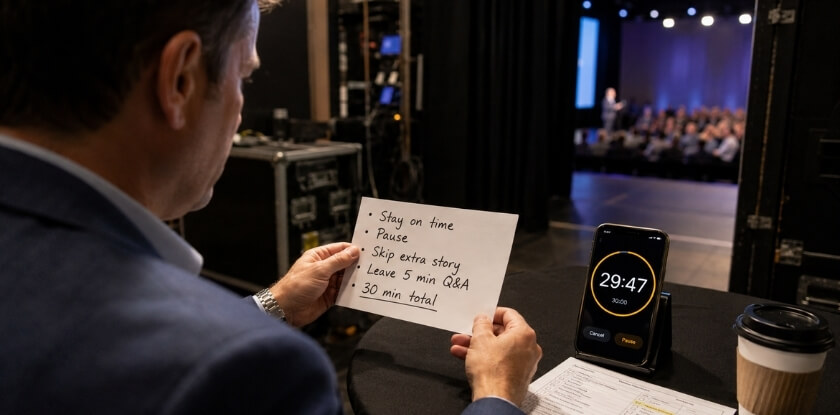
Some venues use a countdown timer visible to the speaker. Some don’t. Some will give you a 5-minute warning card. Some will forget entirely. Don’t build your timing strategy around something you can’t control.
Wear a watch. Place your phone face-up. Know your start time before you walk out. You’re responsible for your own clock — full stop.
Manage the Q&A Separately
If your speaking slot includes a Q&A session, treat that as a separate time block. Your prepared speech should land comfortably within its own allocated portion, leaving clean room for questions. A 45-minute slot that’s formatted as “30 minutes of talk, 15 minutes of Q&A” requires two separate timing disciplines.
Don’t let your keynote bleed into the Q&A window just because you technically still have time on the clock. Audiences read that as disorganisation, even if you’re technically within the total slot.
The Hardest Skill: Cutting in the Moment
Sometimes things go sideways. The host runs long. There’s a fire drill. You start 8 minutes late through no fault of yours. You still need to finish on time.
This means knowing, in advance, which parts of your talk are optional. Which story could be dropped? Which section can be summarised in one sentence instead of three? The speakers who handle this gracefully have thought it through beforehand. The ones who don’t, just keep talking and hope no one notices.
They always notice.
FAQ
How long is a typical keynote speech?
Most keynote speeches run between 30 and 60 minutes. Corporate conferences usually land around 45 minutes. TED Talks cap at 18 minutes, which is a deliberate choice based on audience attention research. The “typical” length really depends on the event format, the audience, and what comes before and after you on the agenda.
Is 20 minutes too short for a keynote?
Not at all. Twenty minutes can be exactly right — especially for gala dinners, awards nights, or any event where the speech isn’t the main attraction. The risk isn’t being too short. It’s trying to cram 60 minutes of content into 20, which always shows. If you’ve got 20 minutes, build a tight story arc with one central idea and leave people wanting more.
What’s the maximum length a keynote speaker should go?
Ninety minutes is the practical ceiling for almost any speaking slot, and that’s with a break or strong audience interaction built in. Past 60 minutes without a compelling reason, you’re testing patience. Patricia Fripp and other National Speakers Association veterans will tell you the same thing — length without substance just wears people down.
How many words is a 45-minute keynote?
At a comfortable speaking pace of around 130 Words Per Minute (WPM), a 45-minute keynote is roughly 5,850 words. Some speakers run closer to 150 WPM, which puts you around 6,750 words. Time yourself reading your draft aloud — that’s the only reliable way to know. Don’t guess.
Should a keynote speaker include Q&A in their time slot?
Depends on the event. If you’ve been given a 45-minute slot and Q&A is expected, build your speech to 30–35 minutes and leave the rest for questions. If the event planner hasn’t specified, ask directly. Walking off stage 10 minutes late because Q&A ran over is a fast way to not get booked again.
How long should a keynote be at a graduation ceremony?
Short. Seriously. Graduation audiences are uncomfortable, emotionally charged, and full of family members who didn’t come to hear you — they came to watch their kid cross a stage. Fifteen to twenty minutes is plenty. The best graduation keynotes often land under 15. No one has ever complained that a graduation speech was too short.
Do TED Talk rules apply to regular keynotes?
The 18-minute TED Talk format works because it’s engineered for that specific context — a focused intellectual audience, a curated event, and global video distribution. Chris Anderson has explained that 18 minutes is long enough for depth but short enough to hold attention and force discipline. Most corporate conference speakers don’t have those same constraints, so there’s no need to artificially cap yourself at 18 minutes. But the underlying principle — that a time limit forces clarity — applies everywhere.
What should an event planner tell a speaker about timing?
Be specific. Don’t say “around 45 minutes.” Say “you have a 45-minute slot, the first 5 minutes are for your introduction, and we need you off stage by 2:15 PM sharp because we have a hard break.” Vague timing guidance leads to speakers running long. Give them the exact window, whether Q&A is included, and what happens if they run over.
Can cognitive load theory help speakers decide how long to speak?
Yes, practically. Cognitive load theory tells us the brain has a limited capacity for processing new information in a short window. After about 20 minutes of dense material, retention drops unless you reset with a story, a pause, or a shift in format. For longer keynotes, this means structuring your speech in chunks — not delivering 60 minutes of non-stop argument. A natural story arc with emotional beats, examples, and pauses isn’t just good storytelling. It’s how you work with the brain instead of against it.
What if I’m asked to cut my keynote on the day?
It happens. Have a version of your talk that can end 10 minutes early without feeling abrupt. Know which sections are essential and which are “nice to have.” The speakers who handle last-minute cuts gracefully are the ones who know their material well enough to adapt on the fly — not the ones reading from slides they can’t skip.
Final Thoughts: The Right Length Is the One That Fits
There’s no universal answer here. That’s not a cop-out — it’s just the truth.
A 45-minute keynote that holds every person in the room is more valuable than a 20-minute one that loses the audience at minute eight. But a tight, focused 18-minute talk that lands a single powerful idea? That can outlast a 90-minute presentation in the minds of attendees for years. TED Talks proved that conclusively, and Chris Anderson has said as much — constraint forces clarity.
The variables that actually determine the right duration are practical ones. The event type. The position in the agenda. Whether there’s a Q&A session attached to the slot. The energy level of the audience at that point in the day. Whether it’s a gala dinner where people have wine in front of them, or a corporate conference at 9am where they’re caffeinated and ready to focus.
Context wins every time.
If you’re a speaker, the single most useful habit you can build is preparing multiple versions of your material. Patricia Fripp and the broader National Speakers Association community have both reinforced this for decades — a 60-minute, 45-minute, and 30-minute version of the same talk isn’t three talks. It’s one talk you actually control. You strip to the essential story arc, cut the secondary examples, and tighten the transitions. What remains is stronger, not weaker.
If you’re an event planner, stop treating the speaking slot as a soft number. Set it firm, communicate it clearly, and build buffer into the run-of-show around it — not inside it. A speaker who knows they have exactly 40 minutes will plan for 40 minutes. Give them “around 45” and they’ll run to 52.
Cognitive load theory tells us audiences can only absorb so much before retention drops. That threshold arrives faster than most speakers assume, especially after lunch or late in a packed conference day. Shorter is almost always safer than longer. The audience that leaves wanting more will remember the speaker. The one that leaves relieved it’s over won’t.
Get the duration right and everything else in the presentation is easier — the structure, the pacing, the energy in the room. Get it wrong and even excellent content gets buried under the audience’s awareness that something is off.
That’s really the whole thing. Know your event. Know your audience. Know your words per minute. And then respect the time you’ve been given.