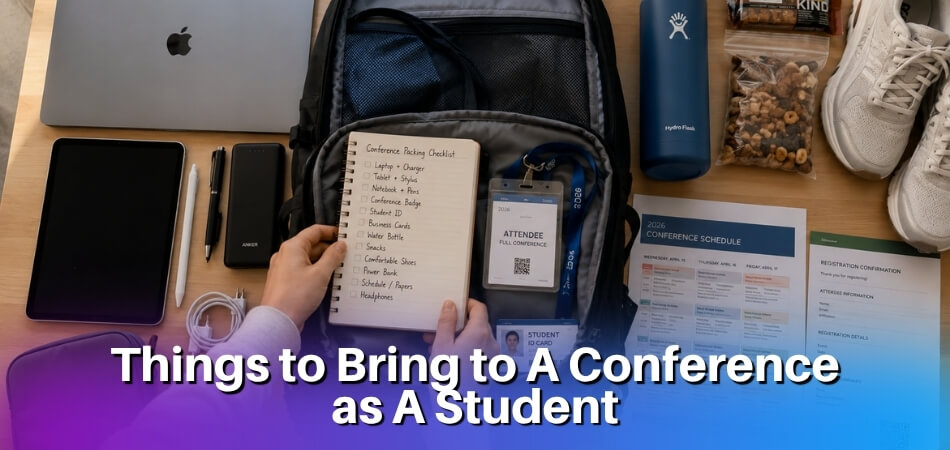
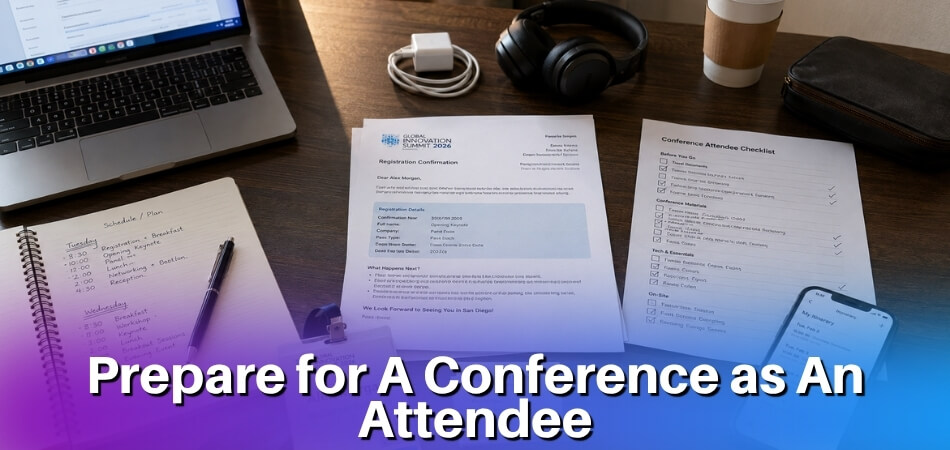
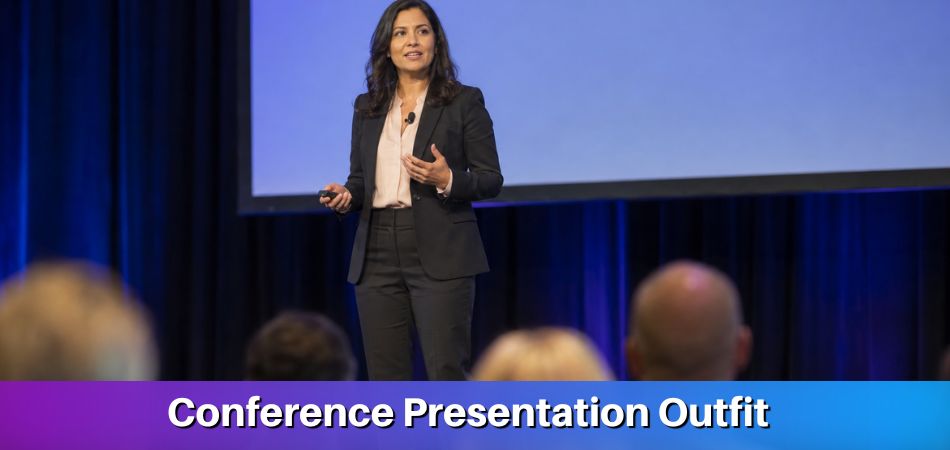
The night before a business conference, a full closet can still feel empty. You want to look credible and polished, without being the only person in a power suit or the only one in casual knitwear. That tension is real, and this guide is built to settle it.
Quick answer: For a business conference, wear a well-fitted blazer with trousers or a midi dress in navy, black, camel or grey. Add comfortable block heels or polished flats, bring a light layer because session rooms can run cold, and keep accessories simple. Dress one step more formal if you are speaking, and go more relaxed only when the invitation says smart casual.
What to Wear to a Business Conference (Female)
A fitted blazer with trousers, a midi dress or a shift dress suits almost any professional conference. Adjust the formality to the dress code, the industry and your role at the event.

Neutral colors, clean lines and clothes that actually fit your body matter more than any single item. The table shows how the four common dress code labels translate into outfits.
Dress Code at a Glance
| Dress code | What to wear | Where it can appear |
|---|---|---|
| Business formal | A suit with trousers or a skirt, a structured blazer over a matching dress, or a floor-length gown for evening galas | Legal, finance and executive events |
| Business casual | A blazer over smart trousers, a well-cut midi dress, or a blouse with structured pants. Denim is usually a no | Corporate and professional events |
| Smart casual | A quality knit top with trousers, or a casual-cut dress with heeled ankle boots. A blazer is optional | Creative, tech and startup events |
| Resort business casual | The same logic as business casual, in lighter fabrics and slightly more relaxed styling | Warm-destination or resort venues |
Understanding Conference Dress Codes
Read the invitation, the industry and last year’s photos together, and when nothing is stated, default to business casual. Invitations are often vague, and a boardroom suit among people in dark jeans and blazers is as awkward as the reverse.
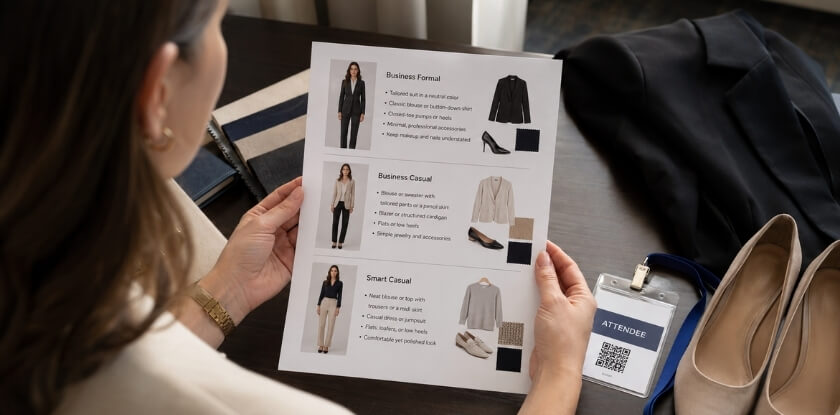
Business Formal vs Business Casual vs Smart Casual
Business formal is the most structured tier. Hemlines stay modest, fabrics are good quality (wool, crepe, ponte), and shoes are closed-toe heels or flats in leather or a leather-look finish. It suits legal, financial and executive conferences, or wherever external clients or senior leaders are in the room.
Business casual is the standard many corporate conferences name, and it trips people up because it sounds more relaxed than it is. It does not mean casual Friday. Athleisure, shorts, flip-flops, distressed denim, sheer or very low-cut tops and anything that reads as weekend wear do not work.
Smart casual shows up at creative, tech and startup events. You have more room for pattern, color and silhouette, such as dark jeans with a structured blazer or a wrap dress, but the standard is still polished. The test is whether the outfit looks intentional: not dressed up, just put together. A university career centre guide (UCLA, 2023) says jeans suit only more relaxed settings and should have no rips or tears.
If the invite names no dress code, look at photos from previous years and the conference’s industry. They tell you more than a written line would.
What ‘Resort Business Casual’ Means
This label appears at off-site conferences, retreats and events at resort or hotel venues, often in warm destinations. The organizers want professional behavior and a polished look, while accepting that you are not in a downtown office.
You can soften the formality a little: linen trousers, a smart sundress with a blazer, a flowy midi in a solid or subtle print, or a well-fitted co-ord set. Colors can be lighter or warmer than usual. Shorts, beachwear, flip-flops and anything you would wear to the pool stay off the list. Block or wedge heels cope with uneven outdoor surfaces better than stilettos, and professional flats are fine.
If You Are Unsure, Ask
If the dress code is ambiguous, especially in an unfamiliar cultural context, send the organizers a quick email and ask. A short question usually gets a clear answer, and it takes two minutes.
Core Outfit Formulas That Always Work
Four combinations cover most conference days, from opening keynote to networking dinner. They work because they are predictable: they look polished, photograph well and take little thought once packed.
| Formula | Best for | Shoes |
|---|---|---|
| Blazer and trousers, silk blouse | Business formal to smart casual | Flats or block-heeled mules |
| Midi dress in a solid or minimal print, structured cardigan or blazer | Business casual | Low heel |
| Shift dress, statement necklace | Business formal and business casual | Pointed-toe flats |
| Wide-leg trousers, fitted turtleneck | Smart casual or warm-weather events | Loafers |
The Blazer and Trousers Combination
This is the most dependable base in professional dressing. A well-fitted blazer over trousers signals competence without looking stiff, and it moves between dress codes just by swapping what is underneath.
For business formal, keep blazer and trousers in the same fabric family, such as a matching suit in navy, charcoal or deep camel, with a silk blouse or fitted turtleneck beneath, which reads more polished than a standard button-down. For business casual or smart casual, a relaxed blazer in a textured fabric like bouclé or linen, with trousers in a complementary neutral, can go from a morning panel to an evening drinks reception with little change.
- Pick a rise you are comfortable sitting in all day, and hem the trousers to skim the top of your shoes.
- Block heels help if you walk all day.
- The blazer doubles as a layer when the air conditioning is aggressive, which it can be.
It is also the safest choice on stage: the structured silhouette reads clearly from a distance and on camera.
The Midi Dress or Shift Dress Option
A single-piece dress removes the need to coordinate separates. You put it on, add shoes, and you are done.
A midi dress with a defined waist is a strong all-day option. It photographs well, is comfortable through long sessions and works in person and on video, where the top half matters most. For video, keep the neckline clean and skip busy prints that distort on screen. A shift dress suits business formal settings: it is clean and easy to layer, and a structured blazer over it creates a suit-like look without separates.
Both styles are easy to adjust:
- A midi with a slight A-line skirt moves easily when you walk between sessions and sit through long ones.
- A single-piece dress in one color needs no matching, which helps when you want fewer decisions on the day.
In summer, a sleeveless shift in breathable crepe or ponte is practical, as long as you carry a jacket for indoor sessions. In winter, a long-sleeve midi in a heavier knit or wool blend works alone or under a coat.
Outfit Choices by Your Role at the Conference
Your role shapes your outfit priorities more than the dress code does. A speaker, an attendee and an organizer face different visibility, different movement demands and send different messages.
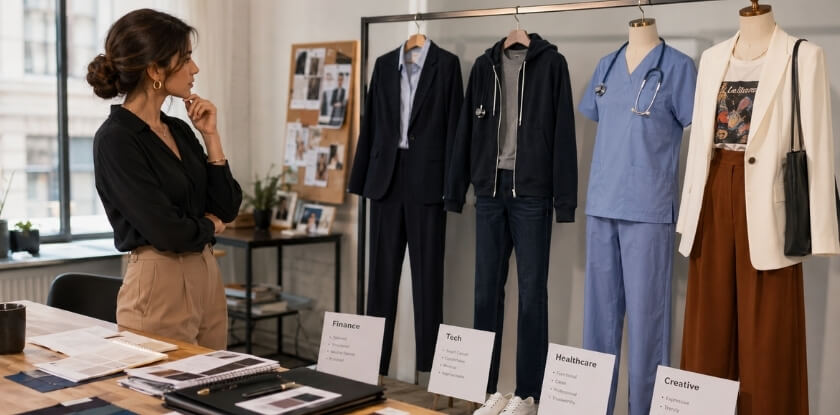
Speaker
Dress one level more polished than the audience. If attendees are in business casual, aim for business formal-adjacent. You are the focal point, so every choice reads louder than it would on anyone else.
Wear something with structure. A blazer and trousers, a well-cut midi or a sharp shift dress all project confidence. Avoid anything you will need to adjust mid-talk, such as a hem or a neckline.
Think about the camera. If the session is recorded or livestreamed, your outfit works as a virtual outfit too, so avoid busy patterns and thin stripes. Solid colors and simple textures work best.
Add one stronger color. Head-to-toe neutrals can fade into a bland backdrop. A cobalt jacket or a deep burgundy dress helps you hold attention without trying too hard.
Plan for standing. You may be on your feet for the whole slot, so choose heels you can stand in or polished flats. Stilettos on a raised stage are a hazard.
Mind the microphone. Statement earrings are fine, but anything that moves, jingles or catches a lapel mic is not. A clip-on transmitter also needs somewhere to sit, so a jacket or a waistband with a structured pocket saves the sound technician a problem.
Attendee
Attendee dressing has more flexibility, but you still represent yourself professionally.
Match the stated dress code, then add one layer of polish. If the event signals business casual, lean toward the sharper end. A blazer over a smart casual dress, or trousers with a clean blouse, reads well in any session room.
Comfort is a legitimate priority. You will be moving between sessions, standing in networking breaks and possibly crossing several floors or buildings, so choose shoes you can manage for a full day, not two hours.
Layer on purpose. Room temperatures vary wildly. A cardigan, blazer or light jacket you can remove in a warm panel and put back on in an air-conditioned breakout room is a real wardrobe strategy, and it saves you changing the whole look.
Choose a bag that works. Attendees carry more than speakers: notes, a laptop, a charger, business cards. The bag should look professional and be large enough to function. A tote that collapses under its own weight once you add a water bottle is the wrong one.
Organizer
Organizers are visible all day in a different way from speakers and attendees. You move constantly, solve problems and meet sponsors, speakers, attendees and venue staff.
Prioritize mobility and endurance. The outfit has to hold up from early setup through the evening reception without looking wrinkled by noon. Ponte trousers, a structured knit blazer or a jersey midi are more practical than crisp cotton. Organizers are on their feet for much of the day, so flats or low block heels are the sensible option. Save statement heels for a day when you are sitting in sessions.
Make yourself easy to identify. A consistent color tied to the event branding, or a lanyard or badge holder, helps attendees find you. If you have a team, even loose coordination tells attendees whom to approach.
Pick tones that photograph cleanly. Neutrals need no fussing, and a few interchangeable pieces in one palette are the most practical framework for a long event.
Keep the silhouette unfussy. Avoid delicate fabric that snags on equipment, hemlines that catch on stairs and voluminous sleeves around table setups.
Fit, Proportion and Comfort
Fit, color placement and silhouette do most of the work, and none of it needs a new wardrobe. The same outfit sits differently on different people, so choose what feels comfortable and looks deliberate.
Fit and Proportion Tips
These are not rules. They are ways to make an outfit look intentional and stay comfortable through a long day.
Wear a monochromatic palette. One color head to toe, such as navy, charcoal, burgundy or black, creates an unbroken line that looks deliberate and needs little coordination. Tone-on-tone camel or slate works too.
Choose a structured, single-breasted blazer. A clean lapel and a defined shoulder line give an outfit structure. Boxy or oversized cuts read as more casual, which suits smart casual events better than formal ones.
Opt for a simple neckline. A V-neck or clean crew neck shell under a blazer is easy to wear and works with minimal jewelry or none.
Choose the trouser cut you find comfortable. Wide-leg, straight and tapered styles all work. Whatever the cut, hem it for the shoes you plan to wear, since a hem that drags on the floor is a trip hazard on stairs.
Check your hemlines. Try a midi or skirt in a full-length mirror, then sit and walk in it. It should feel comfortable on stairs and in a chair.
Define the waist if you like. A slim belt in the same color family adds structure to shirt dresses and longer blazers. Skip it if it feels restrictive.
Let one piece lead on pattern. Bold stripes, large prints and color-blocked panels draw attention. A printed blouse pairs better with plain trousers than with printed ones.
Choose comfortable undergarments. Smooth-line underwear and a well-fitted bra are more comfortable through a full day and sit better under fitted shift dresses and knit blazers.
Keep accessories simple. A long pendant or a scarf draped down the front adds a vertical line. A chunky necklace competes with the neckline, so choose one statement piece, not several.
A midi dress in a deep neutral with a V-neck covers most of these points at once, which makes it an easy piece to pack.
Virtual vs In-Person Conference: What Changes
The principles stay the same on video, but color, necklines, lighting and comfort matter in different ways. Knowing what changes keeps you from overdressing for the camera or underdressing for a room.
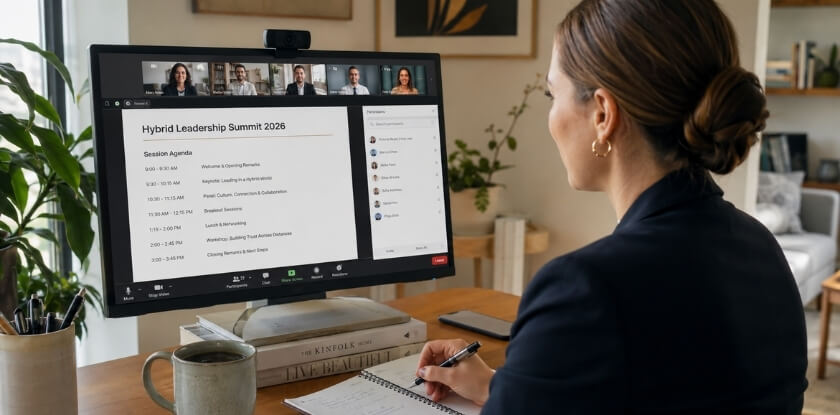
Dressing for a Virtual Conference
The camera crops and compresses everything. What looks polished in person can look flat, busy or washed out in a video frame.
Color and pattern. Solid colors perform best. Busy prints, fine stripes and herringbone can flicker on many video setups. Jewel tones such as emerald, cobalt and burgundy tend to read well. Pure white can blow out under harsh lighting, so off-white or cream is safer.
Neckline and upper body. Because only the top half shows, put the effort there. A fitted blazer, structured top or polished blouse signals professionalism. Chunky necklaces can knock against a microphone and add noise.
Background and lighting. A clean background and natural or ring-light in front of your face do more for how you look than any clothing choice. A blazer over a blouse also pulls the look together if the room behind you is untidy.
The below-desk reality. A professional top with casual bottoms is pragmatic for most attendees. If you are presenting by video, or might stand up or appear in full frame, wear a complete outfit. People get caught out by the moments they did not anticipate. For a virtual event you need only one or two polished tops in solid colors or subtle patterns, good lighting and a clean backdrop, and wearing proper trousers anyway can keep you in a work mindset.
Dressing for an In-Person Conference
An in-person outfit has to work across an entire day: several sessions, hallway networking, a sit-down lunch and possibly an evening reception.
Your bag is part of your look. A structured tote or leather work bag holds materials neatly and reads as intentional. Overstuffed, sagging or very casual bags undercut a professional outfit. If you carry a lot, tuck a second smaller bag inside rather than overloading one.
Plan the full day arc. If the day runs into a dinner or drinks reception, decide on that outfit before you leave the hotel. A shift dress with swapped accessories, or the same blazer and trousers with a different blouse, can make the transition. Earrings and a change of shoes take little space and give you a different look for the evening. Alternate your shoes if the event spans several days.
The One Thing Both Formats Share
Your outfit should be the last thing anyone thinks about, including you. When it fits, suits the occasion and needs no constant adjusting, you can focus on the conversations, the sessions and the people you came to meet.
Seasonal Adjustments: Summer and Winter Conferences
Match fabric and layers to the season, since a July conference and a January one call for different choices at the same formality. The aim is to stay comfortable enough to focus, instead of sweating through a wool blazer or shivering in a sleeveless shift.
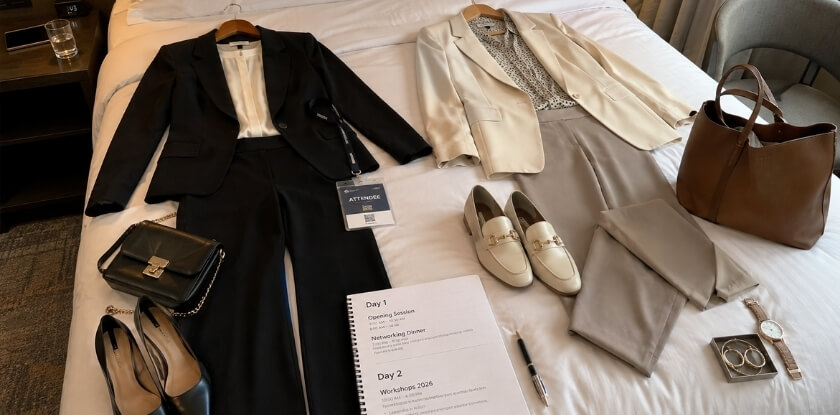
Summer Conference Dressing
Summer means polished clothes with heat, humidity and air conditioning that swings between extremes.
Fabric is everything. Breathable natural fabrics such as linen, cotton or lightweight crepe handle warmth without wilting by mid-afternoon. Polyester blends tend to trap heat and show moisture. A linen midi in a neutral color looks sharp and stays comfortable. Linen creases easily, so steam it before you go or choose a linen blend.
Layer for the air conditioning. Venues can feel much colder inside than outside, so pack a lightweight blazer or structured cardigan. A sleeveless shift works for an outdoor lunch break, and the blazer goes back on for the main sessions.
Keep colors light but not casual. Soft neutrals, ivory, blush and light grey read as professional without the weight of a dark navy suit. A white or cream blouse with lightweight trousers is one of the safest summer combinations.
Choose footwear for heat and distance. Low block-heeled sandals in a nude or tan tone look professional and allow airflow. If you prefer flats, leather or leather-look flats keep the look polished.
For resort business casual, think of a professional dressed for the climate, not someone on holiday: a flowy but structured midi, or a linen blazer over wide-leg trousers.
Winter Conference Dressing
Winter calls for warmth without bulk. Build on a capsule wardrobe of neutrals so pieces mix across several days.
Start with heavier fabrics. A wool-blend midi under a blazer also handles cold commutes and over-heated rooms. Wool-blend trousers, a structured blazer in charcoal or deep navy and a fine-knit turtleneck make a warm, put-together outfit for business formal or business casual.
Layer with thought. You move between cold outdoor air, heated rooms and sometimes overheated networking spaces. A fine merino base, a blouse or top and a blazer give you three layers to adjust. Heavy chunky knitwear as the outer layer reads as too casual for formal settings.
Change your shoes. Ankle boots with a low or block heel are warm, professional and more practical than pointed-toe stilettos on cold, possibly wet floors. Suede or leather in neutral tones pairs well with midi skirts and trousers.
Go darker on color. Deep burgundy, forest green, charcoal and rich camel work well without feeling heavy, individually or together. A palette built from one or two of them makes packing easy.
Treat your coat as part of the outfit. You will wear it into the venue, through registration and on any outdoor transfers. A structured wool or wool-blend coat in camel, black or charcoal suits a professional look. Skip puffer jackets for formal events unless the program is largely outdoors.
Adjust accessories by season. A silk or fine-wool scarf in a muted print adds polish and warmth in winter, and a tan or light cognac tote lightens the look in summer.
Accessories, Bags, Hair, and Makeup
The finishing details either pull a professional look together or quietly undermine it. Your outfit does most of the work, but bag, shoes, hair and makeup make it read as intentional.
Bag and Accessory Selection
Structured tote or leather work bag. A medium-to-large structured tote in black, tan or navy is the most versatile. It should fit a laptop or tablet, a notebook, a portable charger and your essentials without turning into a carry-on. It sits upright on a chair or beside you at a table and photographs well if you speak. Oversized canvas shoppers read as casual and look sloppy by mid-afternoon.
Crossbody for evening. For a cocktail reception or informal dinner, a sleek crossbody or small clutch lets you move freely without hauling your day bag.
Shoes. Low or mid-height heels are a solid conference choice: comfortable enough to last a day, polished enough for any session. Break in any new pair before you travel, since blisters on day one affect every day after. If heels are not practical, pointed-toe or almond-toe flats in a neutral work just as well. Block heels add stability if you walk between venues or stand for long periods.
Jewelry. Keep it simple: small studs or hoops, a watch and one bracelet or ring. Nothing that jingles when you gesture, and nothing so large it competes with the outfit.
Scarves and belts. A fine-knit scarf doubles as a layer in cold rooms and adds polish to a neutral blazer and trousers. A thin leather belt can define a shift dress or blazer.
What to leave at home. Backpacks usually read too casual for business formal or business casual, unless the event is clearly tech or startup. Novelty bags, loud prints and anything visibly worn or peeling should stay out of your bag selection.
Hair and Makeup for a Professional Conference Look
The goal is to look put together and comfortable without looking ready for a photo shoot. Makeup is a personal choice, and a professional look does not depend on it.
Hair. A low bun, sleek ponytail or blowout all work. The common thread is that hair is visibly styled rather than air-dried. If you wear your hair naturally or in a protective style, make sure it is groomed and tidy at the front. When you speak, keep hair off your face so the audience can see your expression. For a speaking slot, think about how it looks from 15 feet away under stage lighting. Flyaways that look relaxed in a photo can read as messy on stage, and a half-up or pinned style holds better through a long day.
Makeup. If you wear makeup, a natural-to-polished finish suits a conference day. Focus on even skin tone, groomed brows and either a defined eye or a bold lip, rarely both. A red or berry lip with minimal eye makeup is professional and memorable. Heavy contouring or strong eye makeup can look overdone in well-lit conference photos, though a beauty conference leaves more room for expressive styling. Matte or satin finishes hold up under fluorescent lighting better than dewy, highlighter-heavy looks.
Touch-ups and fragrance. Blotting papers and a setting spray in your bag carry you from morning keynotes to evening panels. Wear a light fragrance or skip it at indoor events. Closed rooms, shuttles and hotel elevators are no place for a heavy scent, and some attendees have sensitivities.
Budget-Friendly Conference Outfit Strategy
You can look sharp on a modest budget by buying a few well-fitting neutrals and planning outfits as a system. Looking polished does not need a new wardrobe every season.
Build Around Neutrals First
Black, navy, camel, grey and ivory mix with almost everything, so every item pulls double or triple duty.
Anchor with workhorses. A well-fitted blazer and trousers from a mid-range shop can form the backbone of your whole capsule. They do not need to be expensive. They need to fit.
Add one or two dresses. A solid neutral midi or shift dress is a complete outfit. Wear it alone on day one and with a blazer on day two.
Make shoes do double duty. One pair of comfortable heels and one pair of professional flats in neutral tones cover every scenario.
Where to Spend and Where to Save
Spend on fit-critical pieces. Blazers and trousers must fit the shoulders and waist, so they are worth a slightly higher budget or a small alteration cost. A cheaper blazer that fits well looks better than a pricier one that does not.
Save on basics and accessories. Blouses, camisoles and layering pieces under a blazer do not need to be premium. The same goes for a structured bag, simple studs and a classic watch. Clean, simple and cohesive reads as professional, not expensive branding.
Shop Before You Need To
Outfits bought in a rush the week before cost more and fit worse. If a conference is two months away, that is the time to browse, try things on and order online with room to return. End-of-season sales can lower the cost of workwear, though sizes may be limited.
Thrift and consignment shops are underrated for conference dressing. Structured blazers, shift dresses and separates can turn up in good condition, so check seams, lining and hems before you buy.
Making Budget Outfits Look Intentional
The gap between a polished budget outfit and one that reads as cheap usually comes down to condition, proportion and coordination.
Check condition. Pilled cardigans, scuffed heels and wrinkled trousers undermine a good outfit. A fabric shaver and an iron are cheap and make a visible difference.
Keep proportions intentional. A blazer over a fitted blouse with trousers creates structure that looks considered, and does visual work people assume only expensive clothes can do.
Limit your color story. Outfits in two or three tones look more deliberate than a mix of unrelated colors, whatever anything costs.
Cross-Cultural and International Conference Dress Etiquette
Professional dress varies by country, so research the host country and industry before you pack. What reads as confident in New York can look overly casual in Tokyo or unexpectedly conservative in Amsterdam. At an international event a little research stops you standing out for the wrong reasons.
Research Before You Pack
Look at who is hosting the conference and where. A financial summit in Singapore runs on different visual norms from a creative conference in Berlin, and the country, industry and seniority of attendees all shape what is appropriate.
Check the website for dress code wording. “Business formal” means formal business attire everywhere, but the execution varies. In East Asia it usually means conservative cuts, modest hemlines and little skin exposure. In parts of Western Europe, a well-cut blazer over a sleek midi would pass in the same category. Photos from previous years help more than any written code.
Region-Specific Expectations
These are broad patterns, not rigid rules.
East Asia (Japan, South Korea, China). Conservative and formal is the safer side. Structured silhouettes, modest necklines, closed-toe shoes and neutral colors signal respect. Avoid anything too fitted or revealing, and keep accessories understated.
South and Southeast Asia. Codes vary widely. In formal business settings such as India’s financial sector or Singapore’s corporate world, business formal standards apply. In warmer countries like Thailand or the Philippines, lightweight fabrics in a professional cut, such as linen blazers and breathable shift dresses, are expected. Where religious norms apply, as in parts of Malaysia or Indonesia, covering shoulders and knees is standard courtesy.
Middle East. Modesty matters in countries like the UAE, Saudi Arabia and Qatar. Long sleeves, longer hemlines and nothing form-fitting show awareness of local norms. Even in cosmopolitan Dubai, lean conservative.
Western Europe. Dress is generally refined rather than formal. A blazer with trousers or a smart midi fits most conferences. Clean, minimal looks are a safe bet. Loud patterns and logo-heavy pieces can read as less professional.
North America and Australia. Business casual is the usual default, with more room in color, pattern and fit. A conference in Washington D.C. will read more formal than one in San Francisco or Sydney.
Latin America. Professional dress often involves more color and personality. A well-fitted dress in a rich jewel tone, or separates with an elegant blouse, works well, and being underdressed can be a bigger concern than overdressing.
Color and Modesty Across Cultures
White. In Western business settings white signals cleanliness and polish. In some East Asian cultures it is associated with mourning. One white blouse under a dark blazer is rarely an issue, but an all-white outfit deserves a second thought for certain destinations.
Red. In China red is celebratory and auspicious, so wearing it can be positive. In other contexts it can read as aggressive or attention-seeking, so judge by the setting and your role.
Black. Black is safe for professional dress in most places, though some cultural contexts attach specific associations to it. When unsure, navy, charcoal or deep burgundy give the same polish without ambiguity.
Fit and coverage. Globally, the professional default leans toward coverage of shoulders, décolletage and hemline. A sleeveless sheath that is fine at a domestic event may call for a blazer or cardigan in a more conservative setting, so a layer lets you adapt on arrival.
Practical Packing for International Conferences
A blazer does a lot of work across cultures: it covers your shoulders, lifts a base outfit and signals seriousness in any region. Pack at least one.
Shoes matter too. In Japan and parts of Southeast Asia you may meet venues where shoes come off, and slip-on flats save awkwardness. Comfortable heels work for formal settings, but bring a pair of professional flats as a backup on any international trip.
Conference Capsule Wardrobe Packing List
Pack around the 3-3-3 rule: three tops or dresses, three bottoms and three pairs of shoes that all mix and match. That gives enough variety for a three- to four-day conference without overpacking, and it avoids both the heavy suitcase and the emergency shopping trip at 7 a.m.
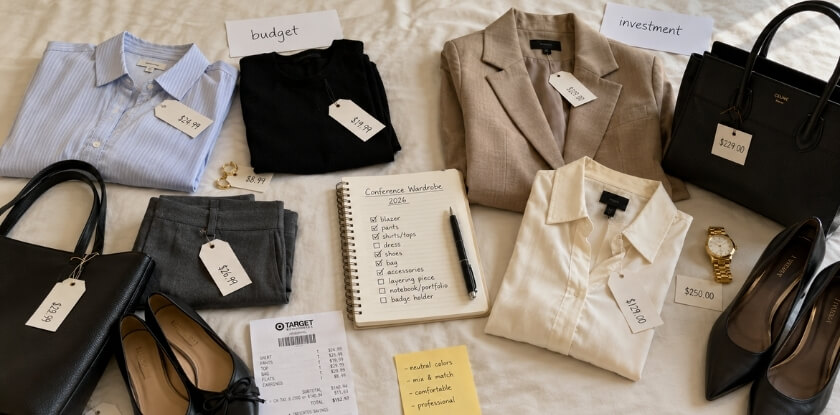
Keep everything in one neutral palette, such as navy, black, ivory, camel and grey, with one or two muted accent pieces for personality. When every piece works with at least two others, you multiply your options without adding weight. On a three-day trip, three outfit bases with a scarf, bag or jewelry swap is enough. Lay your speaking outfit out first, confirm it works under stage lighting, then build the rest of the capsule around it.
The Core Clothing List
| Category | Pack | Why |
|---|---|---|
| Blazer | 1 well-fitted neutral | Works over a midi, with trousers, or over a shift dress for an evening panel |
| Trousers | 1 pair in black or navy | The most versatile piece in the bag |
| Dress | 1 midi or shift dress | A complete outfit that packs flat |
| Tops | 2 (a silk-look blouse and a crewneck or mock-neck knit) | Cover the remaining days and layer under the blazer without bunching |
| Evening option | 1 ponte wrap skirt or fitted jumpsuit | For a networking dinner or off-site smart casual event |
| Layer | 1 lightweight cardigan or fine-knit turtleneck | Hotel ballrooms and convention centers can run cold whatever the weather outside |
| Shoes | Comfortable heels, professional flats, and optionally loafers | Heels and flats together cover every formality level. Loafers earn their place at large multi-hall conferences |
A sample 3-3-3 list: a silk blouse, a fitted blazer that can work as a top and a midi dress; trousers in a dark neutral, a pencil skirt and a second trouser in a lighter shade; comfortable heels for evening, flats for daytime sessions, and clean white or nude sneakers for travel days or casual evenings. The blazer can go over the blouse or the dress, or belted over trousers as a longline layer.
Accessories and Conference Bag
Keep accessories to a small, curated set. A structured tote or quality leather shoulder bag is your main bag, and it should hold a notebook, laptop or tablet, charger and water bottle without looking blown out. A slim crossbody saves you from carrying the full tote to evening events. For jewelry, two or three pieces are enough: studs or small hoops, a watch or bracelet, and one necklace if your necklines call for it. Professional accessories do not need to be expensive, only intentional.
The Quick-Reference Packing Checklist
| Group | Items |
|---|---|
| Bags | Structured tote, slim crossbody for evening, foldable tote for swag and materials collected during the conference |
| Touch-ups | Blotting papers, travel lip color, dry shampoo, travel-size deodorant and fragrance |
| Practical extras | A pashmina or scarf that doubles as a wrap, fashion tape, a small sewing kit, a stain remover pen, a spare top in case of spills |
A Note on Speaker vs. Attendee Packing
If you are speaking, one day needs more planning than the rest, so lay that outfit out first. If you are organizing, pack for comfort as well as polish, because you will be on your feet from setup to the evening reception.
From our experience at MS International: our conferences are held in person in the Greater Toronto Area. You arrive at the check-in time in your confirmation email, collect your badge and meet the session coordinator or moderator before you present. The business pages do not state a dress code, so follow the guidance above and ask the organizers if you are unsure. The speaker page also advises keeping a backup copy of your presentation on a USB drive, so plan a bag or pocket where it stays safe.
FAQ: What to Wear to a Business Conference (Female)
For women attending a business conference, outfit decisions involve jeans, shoes for a long day, the 3-3-3 packing rule and what to leave at home.
What is the safest outfit for a female business conference attendee?
A fitted blazer with dress trousers or a midi dress in a neutral palette is the safest choice, with closed-toe shoes you have already broken in. It works across business formal and business casual without looking out of place in either.
Can I wear jeans to a business conference?
Only at smart casual or resort business casual events. Clean, dark, undamaged jeans can work with a blazer, but ripped or faded pairs do not. When in doubt choose trousers and keep jeans for evening social events.
What shoes work best for a full conference day?
Professional flats or low, comfortable heels work best, and new pairs need breaking in before you travel. You will walk between sessions, stand at booths and network for hours, so save stilettos for a keynote or gala dinner where you mostly sit.
What should a conference speaker wear?
Wear one level more polished than the audience, with a single focal point such as a bold blazer or a striking color. Avoid busy prints and anything that rustles near a lapel microphone.
How do I dress for a virtual conference?
Dress for what the camera captures: a polished top, good contrast against your background and simple accessories. A blazer over a blouse looks pulled together and hides a messy room.
What is the 3-3-3 packing rule for conferences?
Pack 3 tops or dresses, 3 bottoms and 3 pairs of shoes that all mix and match. It covers several days and dress code shifts without overpacking.
What should a conference organizer wear differently from an attendee?
An organizer should prioritize ease of movement and a recognizable, consistent look. A signature color or a branded blazer helps people spot you, and comfort matters more than formality.
How do I dress for a summer conference in a hot climate?
Choose breathable fabrics like linen or lightweight wool blends, and build around a midi or shift dress. Carry a light blazer or structured cardigan, because indoor air conditioning can be aggressive.
What is appropriate for an international conference dress code?
It depends on the host country, so research local norms first. Some business settings, including parts of Asia and the Middle East, expect more coverage, and refined, minimal looks are a safe choice in Europe. A neutral capsule wardrobe lets you adjust on arrival.
What should I not wear to a business conference?
Avoid shorts, flip-flops, athleisure, ripped denim and sheer or very low-cut tops. Choose clean, fitted clothes that need no adjusting during the day, and follow any stricter code the invitation sets.
Do I need a special bag for a business conference?
You need a structured bag large enough for a tablet or notebook. A tote or quality leather shoulder bag in a neutral tone suits most events, and backpacks with casual branding look out of place in formal settings.
Are budget-friendly work outfits appropriate for a big conference?
Yes, price does not show on a well-fitted, well-pressed outfit. A shift dress, trousers and a solid blazer look as polished as expensive ones when they fit properly.
Choosing Your Outfit: A Simple Rule
Dress for the room you are walking into, one step more polished than you think you need, and pack a layer for the unexpected. Start with a neutral base, add one or two pieces that reflect your taste, and settle the outfit the night before. Then your attention stays on the conference, not on a hotel bathroom mirror at 7 a.m.