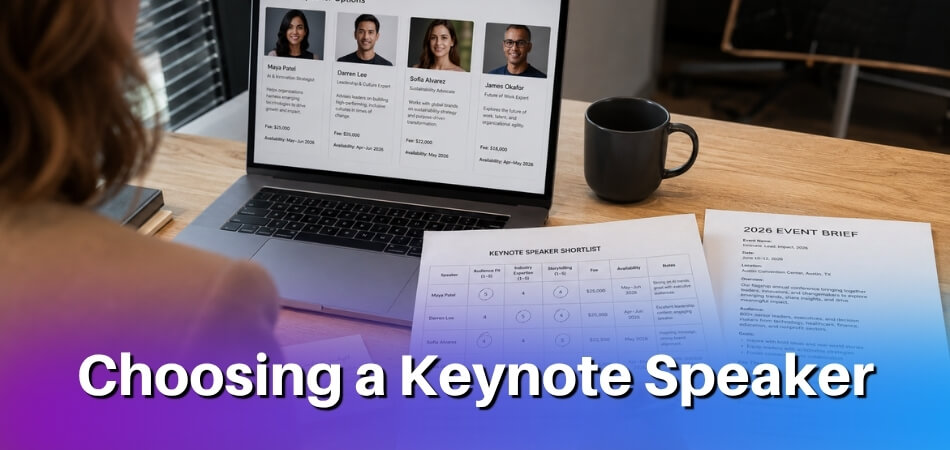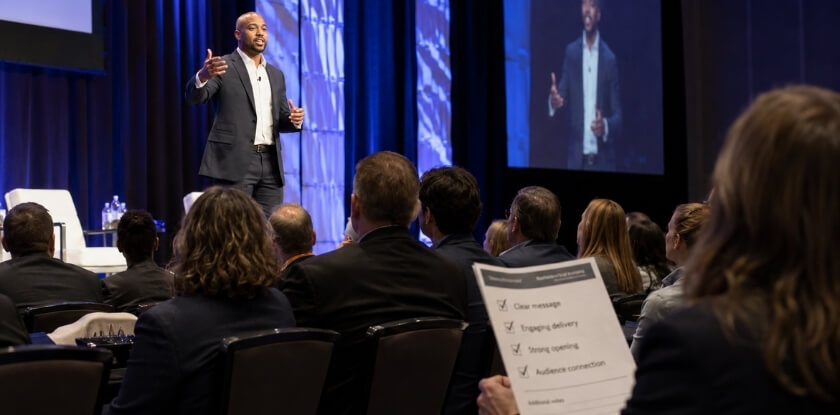
You have the venue booked, the budget approved, and the date circled on the calendar. Then someone asks the one question nobody prepared for: who’s actually giving the keynote? Suddenly you’re staring at a spreadsheet of 200 names pulled from a speakers bureau website, a stack of TED Talks bookmarked at 2am, and three conflicting opinions from your planning committee. The clock is ticking, and every speaker seems to promise the same thing — inspiration, transformation, standing ovations. How do you cut through the noise and find the person who is genuinely right for your audience?
Choosing a keynote speaker comes down to six core criteria: audience alignment, topic relevance, proven delivery experience, transparent speaker fees, verified testimonials from comparable events, and a clear post-event impact you can actually measure. Start by defining what success looks like for your corporate conference or virtual event before you ever browse a single speaker profile. That decision filters out roughly 80% of the names on any list.
Most guides stop at “know your audience and set a budget.” This one goes further. What follows is a complete speaker selection framework — built for real event organizers, not ideal ones — covering how to vet speakers on LinkedIn, YouTube, and Instagram, how to handle DEI considerations without treating them as a checkbox, what changes when you shift from an in-person event to a hybrid event, how to negotiate speaker fees without burning a relationship, and how to book a speaker in 72 hours when your original choice falls through. You’ll also get a post-event survey system designed to turn audience engagement data into measurable event ROI.
How to Choose a Keynote Speaker — A Direct Answer
Choosing a keynote speaker comes down to four things: audience fit, message alignment, proven delivery, and budget reality. Get all four right and the rest is logistics.

Match the Speaker to Your Audience, Not Your Taste
The most common mistake event organizers make is booking someone they personally admire. Your opinion doesn’t matter here — your audience’s reaction does. A speaker who crushes it at a corporate conference for Fortune 500 CMOs might completely miss the mark at a mid-size manufacturing industry summit. They’re different rooms, different problems, different expectations.
Start by writing one sentence that describes exactly who will be sitting in those seats. Their industry, their seniority level, what’s keeping them up at night. That sentence is your filter for every speaker you consider.
Check Alignment Between Their Message and Your Conference Agenda
A keynote isn’t a standalone speech. It sets the tone for everything that follows — the breakout sessions, the panels, the networking conversations. If your conference agenda is built around operational efficiency and your speaker only talks about disruptive innovation at a surface level, you’ve created a disconnect that attendees will notice even if they can’t articulate why.
Ask the speaker directly: “How would your talk connect to these three themes we’re building the day around?” Their answer tells you everything.
Verify Their Delivery — Specifically
Don’t take a bio at face value. Watch at least 20 minutes of unedited footage. Not a highlight reel. Go to YouTube, search their name, find something raw. A TEDx talk is fine, but also look for conference footage where the room isn’t perfectly set up and the audience isn’t primed to applaud. That’s closer to what you’ll actually get.
LinkedIn is useful for checking professional credibility. Instagram shows you how they communicate casually and whether their personal brand is consistent. Neither replaces watching them work a real room.
Get Speaker Testimonials From Event Planners, Not Just Attendees
Attendees can tell you if they enjoyed a talk. Event planners can tell you if the speaker showed up prepared, honored the agreed-upon topic, respected time limits, and was easy to work with backstage. Those are the things that determine whether your event runs smoothly.
Ask the speakers bureau or the speaker’s own team for two or three references from event organizers specifically. Call them. A five-minute phone conversation is worth more than a page of written testimonials.
Know What You’re Actually Paying For
Speaker fees vary wildly — from $2,500 for a rising thought leader to $150,000+ for a household name. The fee itself isn’t the full picture. Factor in travel, accommodation, AV requirements, and whether they charge separately for customization. Some speakers listed through the National Speakers Association (NSA) have transparent fee structures. Others negotiate.
Here’s the short version: define your total speaker budget before you start shopping, not after you’ve already fallen in love with someone out of range. It saves everyone time.
The 60-Second Framework
If you need a fast decision process, use this:
- Does their topic directly serve your audience’s current challenges?
- Have you watched 20+ minutes of real delivery footage?
- Did a past event planner give them a genuine recommendation?
- Does their fee fit your budget including all extras?
- Can they customize the content to your industry and event theme?
Five yes answers. That’s your speaker.
Step 1 — Define Your Event Goals and Audience First
Before you look at a single speaker reel or browse a speakers bureau website, you need to get clear on two things: what you want this event to accomplish and who’s actually sitting in the room. Skip this step and you’ll end up picking someone who gives a great talk that has nothing to do with why people showed up.
Setting Your Event Theme and Desired Outcomes
Start with a blunt question: what do you want attendees to do differently after this event?
That’s not the same as “what’s the theme.” A corporate conference might have the theme “Innovation in Uncertain Times,” but the outcome you’re chasing could be anything — getting your sales team to adopt a new mindset, convincing leadership to sign off on a strategic shift, or simply re-energizing a burned-out workforce. Those three goals call for completely different speakers, even under the same theme.
Write down your outcomes in concrete terms. Not “inspire the team” — that’s too soft to work with. Try “we want attendees to leave with at least one specific strategy they can apply to client retention in Q3.” That level of specificity makes it much easier to evaluate whether a speaker is actually the right fit.
Your conference agenda should connect directly to these outcomes. If the speaker’s message contradicts or ignores what the rest of the day is building toward, you’ve got a problem. The keynote isn’t a standalone performance. It sets the tone for everything else.
Also think about format early. A 45-minute in-person keynote, a 20-minute virtual event slot, and a hybrid event where half the audience is remote all require different energy, pacing, and audience engagement strategies. A speaker who kills it on a live stage might completely lose a virtual audience without camera skills and tighter structure.
One more thing worth doing: define success metrics now, before you book anyone. Are you measuring post-event survey scores? Social media mentions? Leads generated? Knowing this shapes your speaker brief and makes post-event ROI measurement actually meaningful later.
Understanding Audience Demographics and Expectations
Who is your audience, really? Not just their job titles.
Think about experience level, industry background, average age range, and — critically — what they’ve already heard. A room full of senior executives who’ve attended 30 corporate conferences have zero patience for generic motivational content they could’ve found on YouTube five years ago. A younger, mid-level audience at their first major industry event has completely different expectations.
Pull whatever data you have. Registration forms, past post-event survey results, LinkedIn demographic data if you promoted the event there — use it. If you ran a similar event before, look at which sessions scored highest and why.
DEI (Diversity, Equity, and Inclusion) matters here too, and not just as a checkbox. If your audience is diverse and your keynote speaker doesn’t reflect or speak to that diversity in any meaningful way, people notice. That disconnect affects how the room receives the message. It’s a practical concern, not just a principled one. More on this later in the guide, but flag it now at the goal-setting stage so it shapes your entire selection process from the start.
Also consider what your audience already knows about a topic. If you’re booking a thought leader on AI for a room of software engineers, surface-level “AI is changing everything” content will land flat. That same talk could be perfect for a room of operations managers who are just starting to explore the space.
One practical move: send a short pre-event survey to registered attendees. Ask them what they’re hoping to take away, what challenges they’re currently dealing with, and whether they have a preference on speaker style — storytelling-heavy vs. data-driven, for example. It takes 10 minutes to set up and gives you real signal instead of guesses. It also gives you something concrete to share with potential speakers so they can tailor their content accordingly.
Get your goals and audience profile locked down before you contact a single agent or browse a single TED Talk. Everything else in the speaker selection process builds from this.
Step 2 — Build Your Speaker Selection Framework
Once you know your event goals and audience, you need a way to evaluate speakers consistently. Without a framework, you end up going with whoever gets recommended loudest — and that’s how you book someone impressive on paper who completely misses the room.

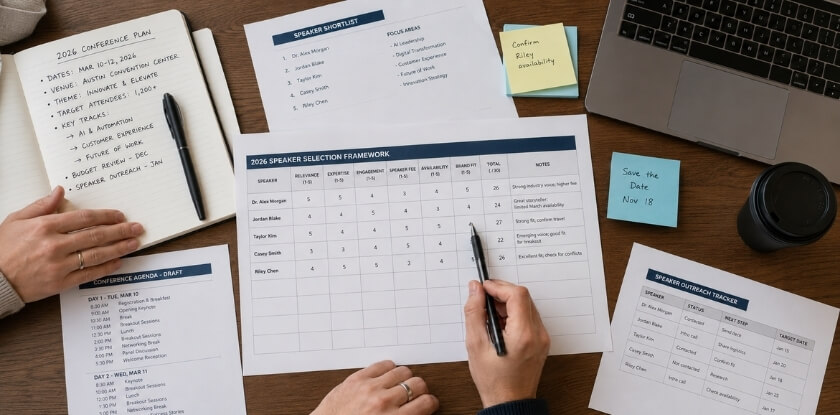
A speaker selection framework doesn’t have to be complicated. It’s basically a scorecard with three core filters: expertise fit, delivery style, and track record. Run every candidate through those three, and you’ll cut your shortlist from 20 names to 3 real contenders fast.
Expertise Alignment — Matching the Speaker’s Knowledge to Your Theme
There’s a difference between someone who talks about a topic and someone who has actually done the work. Your audience will feel that difference within five minutes.
If your corporate conference is focused on AI adoption in mid-size companies, you don’t want a speaker who covers “technology and innovation” in broad strokes. You want someone who has led AI integration projects, advised companies through that specific transition, or at least built a body of work — published articles, research, a course — specifically on that problem.
Ask yourself: Does this speaker’s expertise match the specific challenge my audience is dealing with right now? Not the general topic. The specific pain point.
Check their LinkedIn profile. Look at what they’ve published, what industries they’ve served, and how they describe their own work. A genuine thought leader in a field will have a clear, consistent point of view across their content — not just a speaker bio that lists 12 unrelated topics.
One practical test: look at their last five keynote topics on their website or through a speakers bureau listing. If those topics vary wildly (leadership, wellness, sales, technology, culture — all in one list), that’s a generalist speaker. Sometimes that’s fine. But if your event needs depth, you want a specialist.
Evaluating Speaking Style and Customization Ability
Two speakers can have identical credentials. One will hold a room; the other will lose it by slide 10.
Style matters. And it has to match your audience’s expectations. A high-energy, humor-driven keynote works beautifully at a sales kickoff. That same energy can feel exhausting or tone-deaf at a healthcare leadership summit.
Watch at least 15–20 minutes of unedited footage. Not the highlight reel — those are marketing materials. Look for full keynote recordings on YouTube or conference recap videos. You want to see how they handle a real audience: do they read from slides, or do they actually own the room? How do they respond when something goes slightly off? Do they interact with attendees or just deliver a monologue?
The customization question is just as important. Ask directly: “What does your prep process look like for a new event?” A good speaker will talk about pre-event calls, reviewing your conference agenda, interviewing a few attendees, and adjusting examples to fit your industry. A speaker who says “my talk is pretty adaptable” without describing how — that’s a red flag.
You can also ask for a sample of a customized slide deck or a written brief they prepared for a previous event. Some will share these. The ones who take customization seriously usually have a process they’re proud to walk you through.
For hybrid or virtual events specifically, ask whether they’ve adapted their material for remote audiences. A 60-minute in-person keynote doesn’t translate directly to a virtual event format. The best speakers know this and have adjusted accordingly.
Reviewing Past Performance — Videos, Testimonials, and References
This is where you do your actual due diligence. Don’t skip it because you’re in a hurry.
Speaker testimonials on a personal website are essentially self-selected marketing. They’re worth a quick read, but they’re not your primary source. What you want are references you can actually call.
Ask the speaker or their speakers bureau contact for two or three references from events similar to yours — similar audience size, similar industry, similar format. Then call those people. Event planners and conference organizers are usually willing to give you a straight answer, especially if you ask specific questions: Did the speaker deliver what they promised? How did the audience respond? Did anything go wrong, and how did they handle it? Would you book them again?
That last question is the clearest signal. A non-committal answer tells you more than a glowing one.
For video review, here’s a quick checklist:
- Watch the Q&A — does the speaker give thoughtful, unrehearsed answers or stall?
- Check audience body language — are people on their phones or actually engaged?
- Listen for specificity — are they citing real data and real stories, or recycling vague anecdotes?
- Note the closing — did the audience leave with something actionable, or just inspired?
TED Talks and similar recordings are useful for evaluating communication quality. But a polished TED Talk is a highly produced, heavily rehearsed 18-minute format. It doesn’t automatically mean they can deliver a 45-minute keynote for your event with live audience interaction. Look for both.
If the speaker is active on Instagram or LinkedIn, check how they engage with their community there too. It tells you something about how they think, what they prioritize, and whether their public persona matches how they actually communicate in real, unscripted moments.
Step 3 — Evaluate the Speaker’s Personal Brand and Social Media Presence
Before you sign a contract, spend an hour doing your own research. A speaker’s online presence tells you a lot — how they communicate, how they treat their audience, whether they’re still actively working in their field. Don’t rely only on the polished bio their speakers bureau sends over.
What to Look for on Each Platform
YouTube is your best starting point. Full-length talks, not just highlight reels. Watch at least 20 minutes of an unedited conference presentation. Are they holding the room? Do they lose energy mid-talk? Can they handle a crowd that’s not fully engaged? Highlight clips are easy to cut well. Full-length recordings don’t lie.
LinkedIn shows you professional credibility and consistency. Check how often they post, what they post about, and — critically — how people respond. A thought leader who posts once every three months and gets five likes isn’t exactly owning their space. Look at the comments too. Real engagement from professionals in their field means something. Generic “great post!” comments from random accounts? Not much.
Instagram is more useful than people expect, especially for speakers who work in culture, DEI, wellness, or leadership. It reveals personality, values, and how they engage outside of formal settings. Check Stories and Reels, not just the polished grid photos. You’re looking for someone who’s consistent and authentic, not someone running a personal brand that’s clearly outsourced to a social media agency.
TED Talks carry real weight. A main-stage TED Talk with 1M+ views is a strong signal — not because views equal quality, but because TED’s selection process is rigorous. TEDx is a different situation. There are thousands of TEDx events worldwide, and quality varies wildly. Watch the actual talk before you cite it as a credential.
One thing most event planners skip: Google the speaker’s name alongside words like “controversy,” “lawsuit,” or “complaint.” It takes two minutes. You don’t want to find something awkward three days before your corporate conference.
How to Spot Red Flags and Green Flags
Green flags:
- Consistent posting over months or years, not just a spike around book launches or news cycles
- Speaking engagements at events you recognize, listed with specifics (event name, date, company)
- Speaker testimonials that mention specific outcomes — “changed how our team handles conflict,” not just “amazing speaker”
- Video content that shows them handling Q&A well, adapting tone to different audiences
- A clearly defined area of expertise. The best keynote speakers own a lane.
Red flags:
- A website that lists every possible topic under the sun — leadership, sales, wellness, AI, comedy, motivation. Real specialists don’t work that way.
- Testimonials that are vague, undated, or not attributed to a real person with a real title and company
- No evidence of recent work. If the newest conference clip is from 2019, ask why.
- Social media follower counts that are massive but engagement is dead — 80K followers and 12 likes per post suggests bought followers or an inactive audience
- A speaking reel that’s entirely applause and crowd shots with no actual substance from the talk itself
One more thing worth checking: how do they show up in conversations about DEI? If your event has a DEI focus, or if your audience is diverse in meaningful ways, you need to know the speaker’s track record. Look at who they’ve spoken for before, what they’ve written or said about inclusion, and whether their own platform reflects that in any real way — not just performatively.
The National Speakers Association (NSA) membership isn’t a quality guarantee by itself, but it does indicate someone who takes the profession seriously enough to invest in it professionally. Worth noting when you’re comparing two finalists who are otherwise similar on paper.
Bottom line: treat this step like a background check, not a marketing review. You’re not trying to get excited about the speaker here. You’re trying to find reasons to say no before you’ve committed money and your conference agenda to someone who might disappoint.
Step 4 — Choosing Between a Virtual and an In-Person Speaker
The format of your event shapes almost everything about your speaker decision — budget, logistics, energy in the room, and how much the audience actually retains. Virtual and in-person speakers aren’t interchangeable. Each comes with real trade-offs you need to weigh before you book.

Advantages and Limitations of Virtual Speakers
The obvious win with virtual speakers is cost. You’re not paying for flights, hotels, ground transport, or per diems. For international thought leaders or high-demand names who charge $50,000+ for in-person appearances, a virtual keynote might run 30–50% less. That’s a meaningful budget difference for most event organizers.
Scheduling flexibility is another genuine advantage. A speaker based in London can open your morning session in Chicago without anyone boarding a plane the night before. That opens up your candidate pool considerably — especially useful if your speaker selection framework identified very specific expertise that’s hard to find locally.
But virtual speakers come with real limitations. Audience engagement drops. It’s not speculation — most event planners who’ve run both formats will tell you the same thing. A live audience in a room generates energy that feeds back to the speaker, and that loop just doesn’t exist on a screen. Even the best virtual presenters know this.
Technical failure is a legitimate risk, not a hypothetical one. A frozen stream or audio dropout during a keynote is embarrassing and hard to recover from. You need a dedicated technical producer, a backup connection, and a pre-event run-through. Budget for all three.
Also worth being honest about: some speakers are genuinely less effective virtually. Watch their YouTube content or any recorded virtual sessions before booking. If their delivery relies heavily on working the crowd, moving around a stage, or spontaneous audience interaction, that style doesn’t translate well to a webcam.
The Impact and Logistics of In-Person Speakers
In-person keynotes, when they land well, are the most memorable part of any corporate conference. The audience is fully present, distractions are lower, and a skilled speaker can read and adjust to the room in real time. That responsiveness matters more than most people realize.
Logistically, though, it’s heavier. You’re coordinating travel, accommodation, AV requirements (some speakers have very specific stage setup needs — rider documents are common), green room requirements, and timing down to the minute. Build buffer time into your conference agenda. Flights get delayed. Always have a backup plan, even if you never use it.
Speaker fees for in-person events also include all travel costs on top of the speaking fee itself. Get exact figures in writing before you budget. A speaker quoting $15,000 can end up costing $18,500 after business class flights and two nights at a conference hotel.
The good news: the post-event survey data consistently shows higher audience satisfaction scores for in-person keynotes versus virtual ones, assuming the speaker was the right fit to begin with. Event ROI is easier to demonstrate to stakeholders when the room was clearly energized.
For larger events working through a speakers bureau, ask specifically about the speaker’s in-person track record. Request testimonials from past event organizers — not just the speaker’s own website testimonials, but direct references you can call.
Which Format Works Best for Hybrid Events
Hybrid events are the trickiest to get right. You have two distinct audiences simultaneously — people in the room and people watching remotely — and a single speaker has to serve both at once. Most don’t do it naturally.
The honest answer is that in-person speakers generally perform better in hybrid settings. They can command the physical room, which keeps your live audience engaged, while your technical team handles the broadcast experience for remote viewers. The alternative — a virtual speaker presenting to a hybrid room — usually leaves the in-person audience feeling like an afterthought.
If you go with a virtual speaker for a hybrid event anyway, position the screen prominently and treat the virtual presentation as a true main stage moment. Don’t let it feel like a video call projected on a wall. Production quality here directly affects how both audiences perceive the speaker.
A few hybrid-specific things to sort out before you book:
- Time zones — your in-room audience and your virtual audience might be in very different locations. Schedule accordingly.
- Q&A logistics — decide early how you’ll take questions from both audiences. It needs a moderator and a clear system, or it falls apart.
- Speaker preparation — brief your speaker on the hybrid format specifically. Not all speakers have experience with it, even experienced ones. The National Speakers Association (NSA) has resources on hybrid delivery, and some speakers have pursued specific training in this area. Ask directly if they’ve done hybrid events before.
The format question ultimately comes down to your audience, your budget, and what kind of experience you’re trying to create. Pick the format that serves those three things. Then find the speaker who fits that format, not the other way around.
Step 5 — DEI Considerations: Ensuring Diversity, Equity, and Inclusion
Why Diversity in Your Speaker Roster Matters
Your audience is not a monolith. People come to a corporate conference with different professional backgrounds, life experiences, and perspectives — and they notice, fast, when the stage doesn’t reflect that.
A speaker lineup that’s entirely one demographic sends a signal. It may not be intentional, but it lands that way. Attendees from underrepresented groups often describe that feeling as being an afterthought. That erodes trust in your event before the first session even ends.
Beyond optics, there’s a practical case here. Research from McKinsey (2023) consistently shows that diverse perspectives generate stronger problem-solving outcomes. A keynote speaker who brings a genuinely different lens — whether that’s industry background, lived experience, gender, ethnicity, or cultural context — tends to surface ideas your audience hasn’t already heard. That’s what makes a talk memorable.
The National Speakers Association (NSA) has made public commitments around increasing representation in professional speaking. More speakers bureaus are now building dedicated DEI rosters. You have more options than you did five years ago. Use them.
One more thing. DEI in speaker selection isn’t about tokenism — it’s about intentionality. There’s a real difference between booking a speaker because of their identity category and booking them with full respect for their expertise while also knowing their perspective adds something your event needs. Keep that distinction front of mind throughout the process.
A Practical DEI Checklist for Selecting Speakers
Run through this before you finalize any speaker lineup:
1. Audit your current shortlist. Look at your top candidates side by side. Note gender, ethnicity, age range, and professional background. If everything looks identical, that’s your first signal to go back and expand the search.
2. Widen your sourcing channels. Don’t rely on the same three referral sources you always use. Search LinkedIn specifically for thought leaders from underrepresented groups in your industry. Organizations like ColorComm, Leadercast, and the National Speakers Association maintain speaker directories with diversity filters. Use them.
3. Check for substantive expertise — not just lived experience. A speaker should be booked because they’re genuinely the best person to deliver that message to your audience. Their background informs their perspective, but their track record of delivering results for audiences is what you’re actually hiring.
4. Review speaker testimonials with a DEI lens. Who gave the testimonials? If every reference comes from a company that looks exactly like yours, you might not get a clear picture of how the speaker performs across different audience types.
5. Ask your speakers bureau directly. If you’re working with a bureau, tell them DEI representation is a requirement, not a preference. Give them a specific brief. Vague requests get vague results.
6. Evaluate speaking fees equitably. There’s documented evidence that speakers from underrepresented groups are sometimes offered lower fees for the same caliber of work. Know the market rate for your budget range, and don’t negotiate differently based on who’s sitting across the table from you. Speaker fee negotiation should be consistent.
7. Check your event’s visible representation beyond the keynote. Panels, breakout sessions, emcees, moderators — all of it counts. If your keynote speaker is diverse but every other voice on stage isn’t, attendees see the full picture.
8. Confirm logistical accessibility. This one gets overlooked. Does your venue accommodate speakers with physical disabilities? Are you offering captioning or interpreting services for virtual event attendees? Inclusion means the logistics support the intention.
9. Gather post-event data. Add specific questions to your post-event survey about whether attendees felt the speaker lineup was representative and relevant. That data should directly shape your next conference agenda.
DEI isn’t a box to check on a planning spreadsheet. It’s an ongoing commitment that gets refined with every event you run.
Step 6 — Managing Budget, Availability, and Speakers Bureaus
Budget conversations make a lot of event planners uncomfortable. They shouldn’t. This is just logistics — and if you handle it clearly upfront, you’ll save yourself weeks of wasted back-and-forth.
How Speakers Bureaus Work and When to Use One
A speakers bureau acts as a middleman between you and professional speakers. They represent a roster of talent, handle contract negotiations, manage logistics, and take a commission — typically 25–30% of the speaker’s fee, paid by the speaker, not you. Some bureaus do charge booking fees, so always ask directly.
The big ones — like Washington Speakers Bureau, Harry Walker Agency, and Premiere Speakers Bureau — carry high-profile names. If you’re looking for a former U.S. senator or a Fortune 500 CEO, a bureau is often your only practical route. They also handle exclusivity clauses, travel riders, and AV requirements, which saves your team real time.
The National Speakers Association (NSA) is worth knowing about too, though it’s different. NSA is a professional membership organization, not a booking agency. Their directory is a good place to find speakers who are serious about the craft — many are independent and bookable without a bureau in the middle.
When should you skip the bureau entirely? If you’ve found someone through LinkedIn, YouTube, or a direct referral, you can often reach out yourself. Independent speakers frequently prefer this — no commission split means more flexibility on their rate. For mid-tier speakers charging $5,000–$20,000, going direct is almost always worth trying first.
Use a bureau when:
- You need a celebrity-level or politically prominent name
- You’re short on time and want someone to vet options for you
- You’re planning a large corporate conference with strict contractual requirements
- You want bureau-backed assurance on deliverables and cancellation coverage
Skip the bureau when:
- You’ve already identified your speaker
- Your budget is under $10,000
- The speaker has publicly listed contact info or a booking form on their site
One thing to know: bureaus won’t always show you every available speaker at your price point. They’ll show you the ones with higher commissions or who are easier to move. Ask specifically, “Who else in this fee range would fit this brief?” A good bureau rep will level with you.
Strategies for Negotiating Speaker Fees
Speaker fees are not fixed prices. Almost everything is negotiable — the rate, the travel terms, the deliverables, the exclusivity window. Most speakers and bureaus expect some back-and-forth.
Start with a real number in your head. Know your budget before any conversation. If your ceiling is $15,000 all-in, say so early. This isn’t weakness — it’s efficient. It prevents everyone from wasting time on a $40,000 proposal.
A few specific tactics that actually work:
- Bundle the deliverables. Ask if they’ll include a pre-event webinar or a Q&A session at the same rate. Many speakers would rather add value than lower their base fee. You get more, they protect their listed price.
- Offer marketing exposure. If your conference has real reach — a large attendee list, strong social following, media coverage — mention it. Some speakers, especially those building a personal brand or promoting a new book, will reduce their fee in exchange for visibility. It’s a trade, not a discount.
- Be flexible on dates. Speakers often have “open” windows they’d like to fill. If your event date has some flexibility, ask if any upcoming weeks are slower for them. You can sometimes get a 15–20% reduction just by shifting your event a few weeks.
- Ask about non-profit or first-time event rates. Many speakers have a separate rate structure for these situations. You won’t know unless you ask.
- Watch the travel costs. A speaker based in New York flying to Seattle for your event might add $2,500–$4,000 in flights, hotel, and ground transport. If you have a regional speaker who fits just as well, those savings are real. For virtual events and hybrid events, you eliminate this entirely — which is a legitimate budget argument for going virtual.
Lowballing insultingly. If someone’s listed fee is $25,000 and you open with $5,000, you’ve damaged the relationship before it starts. A reasonable opening counter is 15–20% below their quoted rate. From there, work on the bundled deliverables and travel terms to close the gap.
Get everything in writing before you finalize anything. Verbal agreements on speaker fees don’t hold. A proper contract should spell out: the fee, payment schedule, cancellation terms (for both sides), travel and accommodation details, AV requirements, the exact length and format of the talk, and any exclusivity restrictions — like whether they can speak at a competing event in the 60 days around yours.
If you’re working through a bureau, they’ll provide the contract. If you’re going direct, have a simple service agreement ready. It protects both parties and keeps the whole thing professional.
Step 7 — How to Coordinate Multiple Speakers at the Same Event
Running one keynote speaker is manageable. Running three, four, or five across a full-day corporate conference is a logistics problem that most event organizers underestimate until they’re standing backstage at 9:47 AM watching two speakers argue about who goes first.
Coordination isn’t just scheduling. It’s about building a program that feels like a coherent experience rather than a random playlist of presentations.
Sequencing Speakers to Fit Your Conference Agenda
Order matters more than most people realize. The opening speaker sets the emotional temperature of the room. The closing speaker is what your audience actually remembers. Everything in the middle has to earn its place.
A few rules that hold up in practice:
- Open with energy, not credentials. Put your highest-energy, most immediately engaging speaker in the first slot — not necessarily the most famous one. You’re fighting morning coffee fatigue and first-day nerves. A slow, data-heavy opener can kill momentum before lunch.
- Save your anchor speaker for after the first break. By that point, latecomers are seated, technical issues have been resolved, and the audience is actually present. That’s when your headline name lands hardest.
- Use subject matter to create narrative flow. If your conference agenda moves from industry trends → tactical skills → future outlook, map your speakers to that arc. Don’t put your “what’s changing in AI” speaker after your “here’s how to implement AI tools today” speaker. Sequence them logically so each talk builds on the last.
- Watch the energy dips. Post-lunch slots are the graveyard of conference agendas. Put an interactive speaker there — someone who does Q&A, audience polling, or a workshop-style format. This is not the slot for a 45-minute solo lecture.
Practically, build your sequence in a shared spreadsheet that lists each speaker’s name, topic, format (keynote, panel, fireside chat), duration, AV needs, and any hard time constraints they’ve given you. Cross-reference that with your venue’s room availability, catering schedule, and any sponsor obligations. One document that everyone — your event planner, AV team, and speaker liaisons — can access in real time prevents most of the chaos.
Maintaining Consistent Tone and Messaging Across Speakers
Here’s where multi-speaker events quietly fall apart. Each speaker shows up with their own content, their own slides, their own framing. By Speaker 4, your audience has heard three conflicting definitions of “innovation” and two contradictory takes on the same industry trend. It feels like a mess — because it is.
You don’t need every speaker to say the same thing. You need them to play on the same field.
- Send every speaker a one-page event brief. This document should include: the event theme (in plain language, not marketing-speak), the core audience profile, two or three key messages you want the audience to leave with, and any terminology that’s central to your brand or industry. Keep it to one page. Speakers won’t read a twelve-page document sent three days before the event.
- Schedule a pre-event coordination call. Get all speakers on a 30-minute call together — or individual 15-minute calls if schedules don’t align. Ask each speaker to share a two-sentence summary of their talk. You’ll immediately spot conflicts, redundancies, or gaps. Fix them before the event, not during.
- Designate a content lead. Someone on your team needs to own the messaging thread across all speakers. This is the person who flags it when Speaker 2’s case study directly contradicts Speaker 5’s recommendations, or when two panelists have chosen the same opening story (it happens). The National Speakers Association recommends that event organizers treat speaker coordination as a content curation role, not just a logistics one — and that framing is exactly right.
- Brief your emcee properly. If you have an emcee or host linking the sessions, they’re your consistency glue. Give them transition language, topic bridges, and a few connecting points between each speaker. A well-briefed emcee can smooth over tone mismatches that would otherwise feel jarring.
One last thing: don’t over-homogenize. Audiences respond to different voices, styles, and perspectives. The goal isn’t to make all your speakers sound like the same person — it’s to make the event feel intentional rather than accidental.
Step 8 — How to Book a Speaker at the Last Minute or in an Emergency
It happens. A confirmed keynote speaker cancels two weeks before your corporate conference. Or your event date shifts and your original speaker is suddenly unavailable. Last-minute bookings are stressful, but they’re also more common than most event organizers want to admit.

The good news: it’s completely doable. You just need to move fast and cut out the parts of your normal vetting process that aren’t critical under time pressure.
A Quick-Vetting Checklist for Urgent Bookings
When you’re working with a tight timeline — say, under three weeks — you can’t afford to spend five days reviewing demo reels and chasing references. You need a compressed checklist that hits the non-negotiables and nothing else.
Here’s what actually matters in an emergency booking:
1. Watch at least one full talk, not just a highlight reel. Speaker highlight reels are edited to look good. A 45-minute recorded conference talk tells you whether this person can hold a room for the actual length of your session. Check YouTube first. Most working speakers have at least one full-length recording up there.
2. Confirm topic fit in one conversation. Get on a 20-minute call. You’re not pitching them — you’re asking three specific questions: What’s their current core talk? Have they addressed an audience similar to yours? Can they customize the opening and closing for your event context? If any answer is vague, that’s a red flag.
3. Check recent speaker testimonials. Don’t ask for a reference list that takes a week to chase down. Go to their LinkedIn profile right now. Look at the recommendations section. Look at what event planners and conference organizers have written, not just colleagues or clients. Recent is key — within the last 18 months ideally.
4. Confirm logistics immediately. Travel availability, tech setup for hybrid or virtual events, contract turnaround time. Some speakers have agents who take days to process paperwork. Ask upfront: can you sign within 48 hours? Some can’t. That matters.
5. Verify their current engagement quality, not historical reputation. A speaker who was a big draw five years ago may not land the same way now. Check their Instagram or LinkedIn for recent content. Are people actually commenting and engaging, or is it just polished posts with minimal response? Engagement tells you whether they’re still actively resonating with audiences.
What you can skip under time pressure: a full reference check with three calls, reviewing a customized proposal deck, and extended back-and-forth on contract language. Get the basics covered, and move.
Using Speakers Bureaus and Your Network for Emergency Bookings
Speakers bureaus exist for exactly this situation. A good bureau has relationships with dozens of confirmed, available speakers and can often turn around a booking in 24 to 72 hours. The National Speakers Association (NSA) maintains a directory you can search by topic, availability window, and event type. That’s a useful starting point if you don’t already have bureau contacts.
When you call a bureau in an emergency, be brutally direct. Tell them your event date, your topic, your budget range, and your audience size in the first 60 seconds. Don’t build up to it. They’ll immediately tell you who’s actually available, not who’s theoretically a good fit.
Your personal network is often faster than a bureau.
Reach out to other event organizers you know — people who’ve run conferences in your industry. A speaker referral from someone who’s actually booked that person recently is worth more than anything a bureau brochure says. Post in your event planner communities. Someone will know someone who’s available and credible.
A few things to keep in mind with emergency bookings:
- Speaker fee negotiation gets harder, not easier. Don’t expect a discount because you’re in a bind. If anything, some speakers charge a premium for last-minute bookings. Know your hard ceiling before the conversation starts.
- Availability windows matter. If you’re booking a virtual event speaker, their calendar opens up significantly compared to in-person. That gives you more options.
- Have a backup ready. Even once you’ve confirmed your emergency replacement, identify a second option. Two cancellations in a row is rare, but it happens, and you don’t want to start from scratch again.
One practical move: once this crisis is over, build a shortlist of three to five speakers you’d feel comfortable booking quickly in the future. Keep their contact info, their current speaker fee range, and notes on their topic fit. That list will save you significant pain the next time something falls apart.
Step 9 — Measuring Your Speaker’s Impact After the Event
Most event organizers do a solid job booking the speaker and then drop the ball entirely on measuring whether it actually worked. That’s a waste. You spent real money — sometimes tens of thousands of dollars — so you need to know what you got for it.
Measuring impact isn’t complicated, but it does require you to decide before the event what “success” looks like.
Short-Term Metrics — Audience Feedback and Engagement
The easiest data to collect is right after the session ends. Send a post-event survey within 24 hours — response rates drop sharply after that window closes. Tools like SurveyMonkey, Typeform, or even a simple Google Form work fine.
Ask specific questions, not vague ones. “How would you rate the speaker?” gives you almost nothing useful. Instead, ask things like:
- “Did the speaker’s content apply directly to your role or industry?”
- “What’s one thing you’ll do differently based on what you heard today?”
- “Would you recommend this speaker to a colleague planning a similar event?”
That last question is a net promoter score in disguise. It’s genuinely useful.
Beyond surveys, look at your live engagement data. For virtual events, most platforms track chat activity, poll responses, and session drop-off rates. A speaker who held 90% of attendees through a 60-minute session is performing very differently from one where 40% left at the 20-minute mark. For in-person events, watch the room. Are people on their phones or actually listening? Did the Q&A run over because questions kept coming?
Social media mentions matter too. Check LinkedIn, Instagram, and Twitter/X for audience posts during or right after the session. If attendees are quoting the speaker or sharing key moments, that’s organic signal you can’t fake.
Speaker testimonials — formal or informal — start here. Capture positive feedback now, while it’s fresh, and ask standout attendees if they’d be willing to provide a written quote. That’s useful for your speaker referral network and for any internal case-making you need to do.
Long-Term Metrics — Behavioral Change and Organizational Impact
Here’s where most event ROI conversations fall apart. Short-term satisfaction scores are easy. Proving that a keynote speaker actually changed behavior? That’s harder.
Give it 30, 60, or 90 days. Then go back to your audience with a follow-up survey — shorter this time, maybe 3-4 questions. Ask whether they applied anything from the session. Did a sales team start using a new framework? Did a leadership group shift how they run meetings? Did a DEI-focused keynote actually prompt any policy conversations or internal reviews?
You’re looking for behavioral indicators, not feelings. “I was inspired” fades. “We changed our onboarding process” doesn’t.
For corporate conference settings, tie the speaker’s topic directly to whatever internal KPIs were already being tracked. If the speaker addressed employee retention, look at your 90-day turnover data. If the topic was sales psychology, check pipeline conversion rates. You won’t always find a clean causal link, but directional data tells a story.
Some organizations use pre/post assessments — a short knowledge or attitude quiz taken before the keynote and again 6 weeks later. This approach is common in training contexts and works especially well when the speaker is covering a technical or behavioral topic rather than straight inspiration.
The National Speakers Association (NSA) has written about this distinction between “edutainment” and measurable organizational impact. Worth keeping in mind when you’re scoping what kind of speaker you actually need for your next event.
Post-Event Resources and Speaker Follow-Up
A good keynote speaker doesn’t disappear after the session. Most professionals will offer to provide follow-up materials — slide decks, reading lists, resource guides, or access to their online content. Ask for these during the contracting stage so it’s built into the agreement.
Share those resources with your audience within 48 hours of the event. Attach them to your follow-up email, post them in your event app or community platform, or add them to whatever internal knowledge base your organization uses. Momentum fades fast. Resources extend the shelf life of the message.
If you’re working with a speaker you want to potentially bring back — or refer to other event planners — stay in touch. Connect on LinkedIn. Drop a short note 60 days after the event with a brief data point: “Wanted to share that 74% of attendees rated your session as the most valuable of the conference.” Speakers appreciate that. It also keeps you on their radar when they have speaking slots to fill or can offer a referral your way.
One more thing: document everything internally. Create a simple speaker evaluation file that captures the speaker fee, audience rating scores, follow-up survey results, and any qualitative feedback. The next time you’re building a conference agenda, you’ll have actual data to work from instead of just memory.
That file — even a basic spreadsheet — becomes your own speaker selection framework over time. It compounds in value every event you run.
What Makes a Good Keynote Speaker?
Most event planners ask this question backward. They look for someone impressive first, then try to justify the fit. The better approach is to know what “good” actually means in concrete terms — then measure candidates against it.

They Have a Clear, Ownable Message
A strong keynote speaker doesn’t just talk about a broad topic. They own a specific angle on it. That specificity is what makes a talk memorable three weeks after the conference ends.
Ask yourself: could you summarize their core message in one sentence? If you can’t after watching two of their talks on YouTube, your audience won’t be able to either.
They Read the Room — Every Time
Energy management is a real skill. The best speakers adjust their delivery based on audience feedback in real time. They notice when energy drops at 2:45 PM on day two of a conference and they do something about it. This isn’t something you can fake consistently.
Look for this in their demo reel. Watch a full recording if you can, not just the highlight clips. Highlight clips hide the awkward pauses and dead spots that tell you everything.
Their Credentials Match Your Audience’s Expectations
A corporate conference audience of senior finance executives has different credibility filters than a room full of startup founders. Someone who spent 20 years at Goldman Sachs lands differently than someone who wrote a book about financial mindset.
Neither is wrong. But the mismatch will cost you audience trust within the first five minutes.
They Deliver Audience Engagement, Not Just a Performance
There’s a difference between a speaker who’s entertaining and one who actually shifts thinking. You want the second type. The National Speakers Association calls this “transformation” — the audience leaves able to do or think something they couldn’t before.
Post-event surveys are blunt about this. Ask one direct question: “Did the keynote change how you’ll approach [specific topic]?” A yes rate below 60% is a red flag. Above 80% means you found someone worth rehiring.
They’re Easy to Work With
Seriously. Ask any event organizer who’s dealt with a difficult speaker. They’ll remember that experience longer than the talk itself.
Easy to work with means: they submit their bio and headshot without three reminders, they do a 20-minute tech check before a virtual event without complaining, they stay to take photos with attendees if you ask. Small things. They compound.
Speaker testimonials from other event planners are your best source here — not testimonials from audience members. Call the event coordinator, not the attendee.
They Have Staying Power Beyond the Stage
The talk shouldn’t be a one-off moment. Good keynote speakers leave behind something — a framework your team keeps referencing, a concept that shows up in internal meetings, a LinkedIn post from an attendee that your CEO screenshots and sends to the whole company.
That downstream effect is where event ROI actually lives. When you’re evaluating speakers, ask their references: “Did the team talk about this speaker’s ideas after the event?” That answer tells you more than any speaker fee negotiation ever will.
What “Good” Looks Like Across Different Event Types
| Event Type | Most Important Speaker Quality |
|---|---|
| Corporate leadership summit | Credibility + frameworks they can apply Monday morning |
| Sales kickoff | High energy + practical tactics |
| DEI-focused event | Lived experience + actionable organizational steps |
| Industry conference | Deep subject matter expertise |
| Hybrid event | Camera presence equal to stage presence |
The criteria shift by context. A speaker who’s perfect for a sales kickoff might fall completely flat at a thought leadership summit. That’s not a judgment on the speaker — it’s a matching problem.
One Thing That’s Often Overlooked
Curiosity. The speakers who consistently get booked back — the ones who show up 30 minutes early to walk the room, who ask the event planner “what’s keeping your audience up at night?”, who actually read the conference agenda before they arrive — those are the ones whose talks connect.
You can find credentialed, polished, well-reviewed speakers everywhere. Finding one who’s genuinely curious about your specific audience? That’s rarer. And it shows in the room.
How Are Keynote Speakers Chosen?
The honest answer is: it depends heavily on who’s doing the choosing and how much process they’ve actually built around it.
At large corporations, a dedicated event planner or internal events team usually owns the selection process. They’ll pull a shortlist from a speakers bureau, review speaker testimonials, cross-reference LinkedIn profiles and YouTube demo reels, and run candidates through an internal approval chain before anything gets signed. That process can take weeks.

At smaller organizations, one person — often a marketing manager or executive assistant — makes the call based on a referral, a name they saw at another conference, or someone their CEO follows on Instagram. No formal framework. Just gut instinct and a phone call.
Neither approach is inherently wrong, but the structured one tends to produce better outcomes.
The Most Common Selection Methods
- Committee-based selection. A panel of stakeholders reviews candidates against predefined criteria — topic fit, speaker fee, audience relevance, and DEI representation. Common at larger corporate conferences and association events.
- Speaker referral network. An event organizer asks peers who’ve hired recently. This is surprisingly effective. A colleague who watched someone bomb on stage will tell you. So will someone who saw a speaker get a standing ovation.
- Speakers bureau recommendations. Bureaus know their talent. If you give them a clear brief — budget, audience profile, topic, event format — they’ll send you three to five names that actually fit. The tradeoff is that they represent speakers, so their suggestions aren’t fully neutral.
- TED Talks and YouTube research. Many planners start here. Watching 15 minutes of someone on stage tells you more than any bio ever will. Look for how they handle the room, not just what they say.
- LinkedIn and thought leader content. A speaker who’s consistently active on LinkedIn, posting substantive takes rather than self-promotion, is usually someone who stays current in their field. That matters for a keynote.
Who Has Final Approval?
Usually, the event organizer builds the shortlist. But final sign-off typically comes from whoever controls the budget — a CMO, a CEO, a board committee, or an executive sponsor. That means you often need to make the business case for your top pick, not just say you like them.
If you’re coordinating a conference agenda with multiple stakeholders, expect pushback. Someone will always want a bigger name. Someone else will question the speaker fee. Build your recommendation around the audience and event goals, and you’ll have solid ground to stand on.
The speakers who get chosen consistently aren’t always the most famous. They’re the ones whose topic lands at the right moment, whose demo reel closes the deal, and whose references check out without hesitation.
Frequently Asked Questions
How far in advance should I book a keynote speaker?
For major corporate conferences, 6–12 months out is the standard. Top-tier speakers — especially those who’ve gone viral on TED Talks or have heavy social media followings — fill their calendars fast. If your event is 3 months away, you still have solid options, but your shortlist will be shorter. Last-minute bookings (under 4 weeks) are doable; just expect availability gaps and less room to negotiate the speaker fee.
What’s a realistic budget for a keynote speaker?
It varies wildly. A local industry expert might charge $2,500–$5,000. A nationally recognized thought leader typically runs $10,000–$30,000. Celebrity speakers or former heads of state can exceed $100,000. Working through a speakers bureau usually adds a commission layer, but it also saves you research time and reduces booking risk. Be upfront about your budget early — most speakers or their reps will tell you quickly whether there’s a fit.
Is it worth hiring through a speakers bureau vs. booking directly?
Both work. A speakers bureau gives you vetted options, handles contracts, and often has relationships that smooth out negotiations. Booking directly — through LinkedIn, Instagram, or a speaker’s own website — can save money and gives you a more direct relationship. The tradeoff is more legwork on your end for vetting, contracts, and logistics.
How do I know if a speaker is actually good, not just well-marketed?
Watch full-length video, not highlight reels. A polished 90-second clip proves nothing. Look for recordings of complete keynotes on YouTube — ideally from events similar to yours in format and audience size. Read speaker testimonials from event organizers specifically, not just attendees. And if you can, talk to a past event planner who hired them. That conversation will tell you more than any demo reel.
Can a virtual speaker be as effective as an in-person one?
Yes, but only if the setup is right. A speaker phoning in on a basic Zoom call rarely lands well. The best virtual keynote experiences involve professional audio and lighting on the speaker’s end, a moderator managing audience engagement live, and interactive elements like Q&A or polling built into the session. For hybrid events, this gets more complex — you need someone who can genuinely connect with two audiences at once, which not every speaker can do well.
How do DEI considerations actually affect speaker selection?
It’s not about checking boxes. A speaker whose background and perspective genuinely aligns with your audience’s experience will always land better than a high-profile name who has no real connection to your industry or community. When building your shortlist, look beyond your existing speaker referral network — it tends to surface the same names repeatedly. Organizations like the National Speakers Association (NSA) maintain diverse speaker directories that are worth exploring early in your search.
What should I include in a post-event survey to measure speaker impact?
Keep it short or people won’t fill it out. Ask three things: Did the speaker deliver on the stated topic? Did you leave with something actionable? Would you recommend this speaker to a colleague? Those three questions give you a practical read on event ROI without burying attendees in a 20-question form. Net Promoter Score-style questions work well here too.
What’s the difference between a keynote speaker and a panel moderator?
A keynote speaker owns a solo session — typically 30 to 60 minutes — and drives a single narrative from start to finish. A panel moderator facilitates conversation between multiple guests and keeps the session on track. These are different skills. Some people do both well; many don’t. Be clear when reaching out which role you’re filling so you’re not accidentally booking a keynote speaker for a job that requires moderation instincts, or vice versa.
Should my keynote speaker also be available for other parts of the conference agenda?
It depends on your event format. Some speakers offer workshop add-ons, breakout sessions, or VIP dinners as part of a package — and that can add real value if your audience wants deeper access. Others prefer to deliver their keynote and leave. Clarify this expectation before you sign anything, because retrofitting it into a contract later usually means paying more or dealing with friction.
Conclusion — Choosing the Right Keynote Speaker Is an Investment, Not an Expense
A bad keynote doesn’t just waste money. It sets the tone for your entire event, and not in a good way. People remember the opening speaker. They talk about it on LinkedIn. They bring it up in post-event surveys. One wrong choice can color how attendees feel about everything else on your conference agenda.
The good news? If you’ve worked through the steps in this guide, you’re not guessing anymore.
You defined what your audience actually needs. You built a speaker selection framework before you started reaching out to anyone. You evaluated social media presence and watched real footage on YouTube — not just a polished highlight reel. You thought through the DEI implications, weighed virtual against in-person options, and figured out your real budget before talking to a speakers bureau.
That’s not how most event organizers approach this. Most people start with a name, then work backwards to justify it.
The Real Cost of Getting It Wrong
Speaker fees are visible. Event ROI is what actually matters. A $15,000 keynote speaker who generates genuine audience engagement, strong post-event survey scores, and measurable behavior change among your attendees is a bargain. A $3,000 speaker who reads from slides and leaves people checking their phones is expensive at any price.
Think about it that way every time budget pressure pushes you toward the cheaper option.
What to Take Away From All of This
A few things are worth keeping close:
- Referrals beat cold searches. Your speaker referral network — colleagues, the National Speakers Association, trusted event planners — will almost always surface better candidates than a generic Google search.
- Watch them work before you book. TED Talks, Instagram clips, and YouTube recordings exist for exactly this reason. Use them.
- Negotiate everything, not just the fee. Speaker fee negotiation isn’t only about the number — it’s about travel, prep calls, post-event content rights, and follow-up availability.
- Measure after the event. Run the post-event survey. Look at what people actually said. If the speaker moved the needle, book them again or refer them to someone else. If they didn’t, document that too.
- For emergencies, have a backup list. One or two names with confirmed availability windows and known fees. That list saves events.
This Gets Easier Over Time
The first time you go through a full speaker selection process, it’s slow. By the third or fourth event, you’ve got a template, a shortlist of people who’ve delivered for you before, and a clearer instinct for what works with your specific audience.
That institutional knowledge is genuinely valuable. Protect it. Keep notes after every event. Save the post-event surveys. Build relationships with the speakers who showed up and delivered — those connections are worth more than any speakers bureau catalog.
Good keynote speakers don’t just fill a slot on the schedule. They give your audience something to think about on the drive home. That’s what you’re actually buying. Make sure you get it.