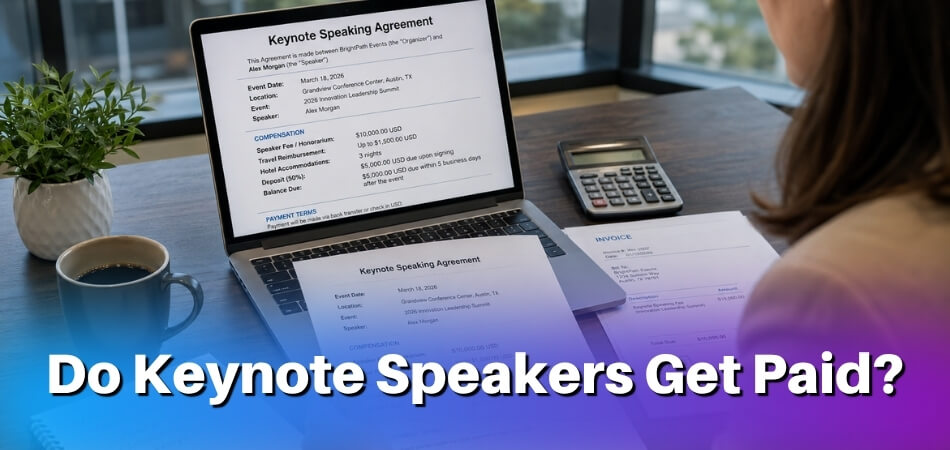

A late start with no clear process is the easiest way to end up with the wrong keynote speaker. With only a few weeks left, planners scramble through Google, accept the first available name that looks good on paper, overpay because there is no time to negotiate properly, and land a speaker whose style or message does not quite fit the audience. A sound booking process saves budget, avoids contract surprises, and makes sure the speaker actually fits your event.
Quick answer: To book a keynote speaker, define your goals, audience and budget first, then shortlist three to five candidates through a speakers bureau, a directory or referrals. Check availability early, agree the fee and contract terms in writing, and send a detailed briefing after signing. Start months ahead for in-demand names, and ask what the fee does not include.
This guide follows the booking in order, from budget and shortlist to contract, briefing and a review after the event.
How to Book a Keynote Speaker (Step by Step)
The booking runs in ten moves, and the order matters: goals and budget come before any outreach, and the contract comes before the briefing. The table gives the sequence in one view, and the sections below cover each stage in detail.
| Stage | What you do | Covered in |
|---|---|---|
| 1. Define | Write two or three outcomes you want from the keynote, describe the audience, set a budget range | Step 1 |
| 2. Shortlist | Use a bureau, directories and referrals to reach three to five candidates | Step 2 |
| 3. Check availability | Send your date, place, format and audience to the agent or bureau | Step 4 |
| 4. Vet | Watch full talks, speak to past organizers, look for red flags | Step 2 |
| 5. Talk fees | Ask what the quote includes, then negotiate extras as well as the base fee | Steps 3 and 4 |
| 6. Contract | Read cancellation, exclusivity, deliverables and the technical rider before signing | Step 4 |
| 7. Brief | Send the written briefing, then follow up with a call | Step 5 |
| 8. Logistics | Confirm travel, schedule and contacts about four to six weeks out | Step 5 |
| 9. Final check | Reconfirm everything two or three days before; rehearse if the event is online | Steps 5 and virtual section |
| 10. Evaluate | Collect feedback, score the speaker against your goals, share it | Step 6 |
Step 1: Define Your Event Goals, Audience, and Budget
Before you contact a single speaker or browse any directory, write down what the keynote has to achieve. Skipping this step means weeks spent on speakers who are wrong for your audience, your message or your budget, and it makes every later conversation with a bureau or agent slower.

What Information to Prepare Before Reaching Out
Bureaus and agents handle many inquiries. The more concrete your brief, the more useful their recommendations will be.
- Your event’s core purpose. Are you trying to motivate a sales team, teach an industry audience, open a conference on a high note, or support a culture change? A speaker who is brilliant for a leadership summit may be entirely wrong for a technical developer conference. Write down two or three outcomes you want attendees to leave with.
- Audience profile. Think about who is actually in the room: seniority, industry background, how much they already know. A speaker used to C-suite executives frames content very differently from one who usually speaks to frontline managers or college students.
- Event format. Say whether the event is in person, virtual or hybrid. Fees, AV needs and logistics all shift with format, and some speakers do noticeably better on camera while others depend on room energy.
- Budget range. Have an actual range ready, not just “reasonable”. Keynote fees vary widely with the speaker’s profile and demand, and travel costs sit on top. Knowing your ceiling stops you falling for a speaker who is several tiers above what you can pay.
- Event details. Date (offer several possible dates, because your first choice may be taken), location or platform, expected attendance, session length, and whether you need exclusivity. That last term means the speaker agrees not to appear at a competing event for a set period, and some speakers charge extra for it.
- Decision-makers. Know who signs off on the speaker, the fee and the contract, and get them on board before you start negotiating, so approvals do not hold up your first-choice speaker.
Budget for the Hidden Costs Too
The speaker fee is only part of what you will spend. Budget separately for travel and accommodation, AV and technical needs, and any honorarium or gift your organization usually provides. For virtual events, add platform costs and the speaker’s own technical setup. Missing these lines early creates real problems when the contract arrives.
How Far in Advance Should You Book?
Earlier than feels necessary. Speakers bureaus commonly advise six to twelve months for major events, with nine to twelve months common for large conferences of several hundred attendees, and longer for the most in-demand names such as bestselling authors or well-known public figures. Less in-demand speakers can often be booked two to six months out, but your choice narrows as the date gets closer.
One bureau’s booking guide breaks it down by speaker type: nine to twelve months for premium names, six to nine for mid-range speakers such as authors and subject-matter experts, and three to six for local or regional talent. It adds that under three months, quality and affordable options become limited.
If your event is eight to twelve weeks away, you are in short-notice territory. Quality speakers are still available, but you will be choosing from whoever has open dates rather than from a full shortlist. A bureau can help here because it knows who has gaps, and a very late booking may carry a rush premium. Virtual and hybrid events sometimes book faster since travel is simpler, yet the most sought-after speakers still go early in any format.
Busy periods in the speaking calendar can stretch the window further, and they differ by industry. Ask the bureau which dates are tight before you fix yours.
Step 2: Find the Right Speaker
With goals, audience and budget settled, the search can begin. Use a bureau if you want a managed shortlist, search directories or referrals yourself if you want more control, and aim for three to five serious candidates.
Using a Speakers Bureau vs. Booking Directly
Both routes work. The choice depends on your time, your experience with speaker negotiations, and whether you already have a name in mind.
A speakers bureau books speakers on behalf of event buyers. It is a managed marketplace and intermediary between you and the speaker, and it handles availability checks, fee negotiation, contract drafting and logistics, and gives you vetted talent, professional contracts and a contact if something goes wrong. Many bureaus send a shortlist at no charge to the buyer, with each name’s background, topic focus and fee range. A speaker’s own agent is different: an agent represents the speakers contracted to that agency, so you deal with the speaker’s side of the table. Bureau commission is commonly cited at around 20 to 30 percent of the speaker’s fee, though it is negotiated rather than fixed, and it is usually built into the quoted fee instead of added on top. Ask how the quote is made up.
Booking directly through the speaker’s website or management cuts out that layer. It can sometimes lower the fee, especially for independent speakers without exclusive representation. The trade-off is that vetting, scheduling, contract review and travel coordination all fall to you.
For a large event, several speakers, or a high-profile name, a bureau is usually worth it. For a smaller event or a speaker you already know, going direct is reasonable. One caution on bureaus: a bureau may lean toward speakers who earn it more, so keep your event goals as the filter, not sales pressure.
Where to Search: Bureaus, Directories, and Referrals
No single place holds every right speaker, so most planners combine sources.
- Speakers bureaus are the most structured start. Agencies such as Washington Speakers Bureau represent speakers across industries and price levels. You submit a brief and they come back with recommendations matched to your goals and budget.
- Directories such as SpeakerHub, eSpeakers and the National Speakers Association (NSA) “Find a Speaker” search let you filter by topic, industry, price range and location on your own. They suit planners who want to browse without being pitched, or who are looking for emerging voices. In Canada, the Canadian Association of Professional Speakers is another source of members.
- Referrals are underrated. Ask colleagues who ran similar events, your industry association, or organizers in adjacent fields. A referral gives you a first-hand account of how the speaker performed, how easy they were to work with, and how the audience reacted, none of which a reel can show.
Cross-reference across sources. A speaker who appears in bureau listings, has strong referrals and keeps an active professional presence is a safer bet than someone visible in only one place.
How to Vet and Shortlist Candidates
Narrow a long list before you reach out. Contacting ten speakers at once wastes everyone’s time and makes you look disorganized. Build a shortlist of three to five, and open formal conversations with your top two or three, scoring each speaker against the same criteria. That keeps your negotiating position flexible and leaves you a fallback if the first choice is unavailable.
- Watch the speaker reel critically. Every speaker has a highlight reel, so watch for substance, not just energy. Does the content match your audience’s level? Do they handle complex topics clearly or stay on the surface? Give a speaker at least 10 to 15 minutes of footage before shortlisting, because a bio tells you almost nothing about stage performance. Look for full-length talks too: conference recordings on YouTube often show more than polished promo videos.
- Check fit with your audience. A speaker who wins over sales kickoffs may land flat at a healthcare conference. Look at the industries and audiences in their bio and past engagements.
- Check the fee tier against your budget. Ask the bureau or agent for a fee range before you invest time. It saves both sides an awkward conversation later.
- Speak to past organizers. Ask the bureau or the speaker for two or three organizer contacts. A short call tells you more than any bio. Ask how the speaker handled the briefing, whether they customized content, and how the audience responded. Check recent testimonials from organizers (not just audiences) and look for public controversies that could trouble your audience or sponsors. With a bureau, ask directly about recent cancellations or performance issues.
Availability comes next, in Step 4. Check it early, before you grow attached to one name.
Step 3: Understand Speaker Fees (What’s Actually Included)
The number a speaker or agent quotes is rarely the full cost, and building your event budget around that number alone is a reliable way to run short.

Fee Ranges by Speaker Tier
There is no universal pricing standard, but the market sorts itself into loose tiers. Published estimates differ a lot between bureaus, from a few thousand dollars at the bottom to six figures for celebrity names, and most come from booking sites with a commercial interest, so treat any figure as a rough guide and ask for a written quote. As one reference point, the National Speakers Bureau’s 2026 cost guide (the page carries no publication date) lists entry-level speakers at $1,500 to $5,000, mid-range at $5,000 to $15,000, professional at $15,000 to $30,000 and celebrity names at $30,000 to $100,000 or more. It also says to expect to cover airfare, ground transport and accommodation on top. Other bureaus publish different ranges.
- Emerging speakers speak regularly but have not yet built a national reputation. They are often a good fit for smaller events or tight budgets, and many are building their profile, which can make them more flexible on fees.
- Mid-tier speakers include well-known industry experts, former executives, published authors and academics with strong credentials. They usually have a documented track record, solid reels and, often, professional representation.
- High-profile speakers are nationally recognized figures, bestselling authors, prominent athletes and former senior public officials. Agents and larger bureaus handle most of the negotiation at this level, and calendars often fill six to twelve months ahead.
- Celebrity speakers are a category of their own, with fees well above the other tiers.
If a fee looks surprisingly low for the speaker’s profile, confirm what it covers before you get excited. The base quote is often just a starting point.
What’s Typically Included and What Costs Extra
The speaking fee usually covers the presentation and the speaker’s preparation. The standard talk is usually built into that fee, but customization is a separate conversation.
| Item | Usually in the base fee? | What to ask |
|---|---|---|
| The standard keynote and preparation | Yes | Talk length and format |
| Travel and accommodation | Usually billed separately | Flat allowance or actual costs, flight class, hotel tier, meals or a per diem |
| Customization and research time | Often extra | Is a pre-event call included, or charged? |
| Workshop or breakout sessions | No, separate engagement | Price for added time |
| Exclusivity | Sometimes extra | Which events, how long |
| Virtual delivery | Varies | Lower, equal or higher than in person, and any studio or setup fee |
| Recording and reuse | No, live event only by default | Separate agreement and fee for streaming or licensing |
Some further detail on the awkward ones. Domestic travel might mean a business-class flight, a hotel night or two and ground transfers, and international travel can add a lot more, so ask upfront whether travel is included or invoiced on top. A generic version of the talk is in the fee, while one built around your event goals may not be. For virtual events, some speakers charge less because there is no travel, and others charge the same or more because a quality remote appearance needs their own lighting, camera and AV investment.
When you review a contract, check every one of these lines before signing. A modest quote can grow quickly once travel, customization and recording rights are added, which is fine as long as your event budget expected it from the start.
Step 4: Check Availability, Negotiate, and Sign the Contract
Once you have a shortlist and a rough budget range, confirm who is actually free and get the deal structured properly. This is where planners lose time by being too informal: a few loose emails, no contract review, and suddenly you are three weeks out with nothing locked.
How to Approach the Bureau or Speaker’s Agent
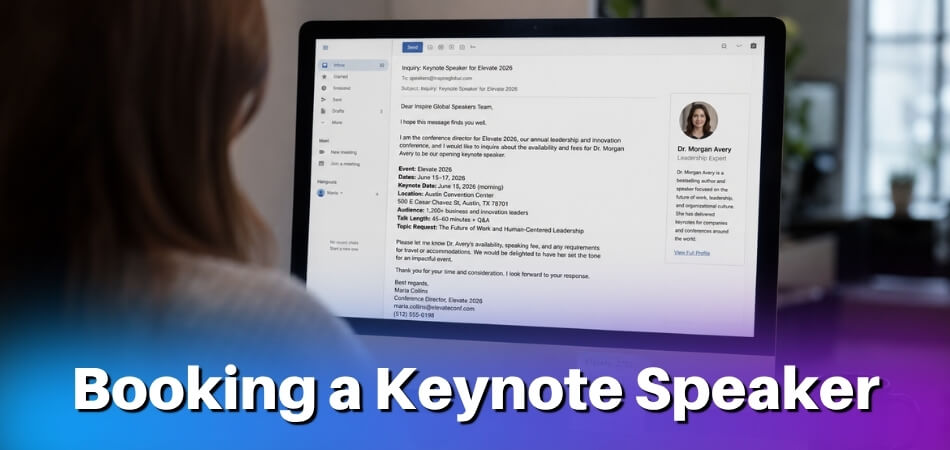
Lead with specifics. Give the event date, city or platform, format, expected audience size, topic focus and budget range. A vague “we’re interested in booking someone on leadership” gets a slow reply. Ask about availability in the first message, before you get attached to one name. The same applies to direct outreach: be concise and put the date near the top.
Many bureaus show availability calendars, and for a direct booking a quick email inquiry before deeper vetting is standard. Popular speakers can be booked out months ahead, and even with an open date they may have exclusivity commitments that rule your event out. If a speaker is taken for your date, ask about alternative dates only if your schedule has flexibility. Otherwise move to the next name. If the speaker is available, some agencies place a provisional hold on your date while you move towards a formal offer, so ask whether a hold is possible while you finalize budget and approval.
What to Negotiate Beyond the Fee
Most people focus on the speaking fee, but there is often more room elsewhere. Bureaus rarely cut fees sharply for well-known speakers, though they often have flexibility on what is included. Offering something beyond the base fee helps: a prominent industry platform, media coverage, or several booking dates.
- Travel and accommodation. Some speakers bundle a flat allowance into the quote, others invoice actual costs afterward. Flight class and hotel tier are open to discussion. Booking flights and hotel yourself through your organization’s vendor accounts may cost less than reimbursing premium bookings.
- Content customization. Ask what level of audience research and tailoring is included. Some speakers do a pre-event call as standard, others charge for it. Settling this before signing avoids a generic keynote that your audience could have watched online.
- Usage rights. If you plan to record the session for a replay, a member library or marketing clips, negotiate that in advance. Licensing afterward can cost as much as the original fee if it is not addressed upfront.
- Add-ons. Speakers who sell books or run half-day workshops sometimes discount the speaking fee if you guarantee a bulk book purchase or bundle a session. Whether the speaker also does a post-talk Q&A or a meet-and-greet can also be agreed here.
Get any verbal agreement confirmed in writing before you go further. Bureaus often have less room on price than an independent speaker does, so know whether you are dealing with a bureau, an agent or the speaker.
Key Contract Clauses to Review
A speaker contract protects both sides, and it is where booking problems are either prevented or created. Read it fully before signing, and if anything is unclear, push back in writing and ask for an amendment. A professional agent will not be surprised.
| Clause | What to check |
|---|---|
| Payment schedule | Deposit, balance due date and accepted payment methods. Speaker agencies commonly describe a deposit of around half at signing, with the balance due before the event in some contracts and after it in others, so confirm the dates. Ask for an itemized estimate of expenses in writing, and, for a speaker based in another country, ask your finance team about tax and withholding rules before the first payment. |
| Your cancellation terms | What you owe if you cancel or postpone, and when. Terms vary: many contracts use a sliding scale that rises as the date approaches, and deposits are often non-refundable. One contract guide from CAG Speakers gives reference ranges only: deposit forfeited at roughly 60 or more days out, 50 to 75 percent of the fee owed at 30 to 59 days, and the full fee under 30 days. Check whether your event insurance covers speaker cancellation. |
| Force majeure | Covers genuine emergencies outside either side’s control. Check the wording so it cannot work as a general way out of the booking. |
| The speaker’s cancellation terms | Notice period, refund of fee and deposit, and whether a comparable substitute will be offered. Organizers often spell out their own cancellation but leave the speaker’s vague, so ask for both sides to be covered. Harder to fix at short notice for virtual or hybrid events. |
| Exclusivity | Some speakers will not appear at competing events within a period. A clause can also stop you from booking competing speakers on similar topics at the same event, which matters most at multi-speaker conferences. Check who the clause binds. Restrictions that name specific competitors or events are easier to agree than a blanket ban. |
| Deliverables | Talk length, format, whether slides come in advance, and any post-event obligations. |
| Recording and name use | Whether the session can be recorded, shared or cut into clips, and whether you may use the speaker’s name, photo and biography in promotion. |
| Governing law and disputes | Which jurisdiction applies and whether disputes go to arbitration. For a high fee, have a legal adviser look at liability limits too. |
| AV and technical rider | Larger names attach a rider listing stage setup, microphone type, clicker, screen size and, for online events, the platform and bandwidth. Make sure your venue or platform can meet it before you sign. Mismatches are a common source of last-minute friction. |
| Briefing obligations | Some contracts require you to deliver a formal briefing by a set date. Miss it and you have less standing to complain about a generic talk. |
Once both sides sign, send the contract to your AV team and event coordinator so the technical requirements are flagged immediately, not in the week of the event. Have a legal adviser read the final wording if the stakes are high. Sample clauses found online differ widely and are not a substitute for advice.
Booking a Speaker for Virtual and Hybrid Events
Virtual and hybrid formats are now routine, and booking a speaker for one adds points that in-person events do not have. The logistics, technical needs and contract wording should reflect the format from the start. This section is general guidance for organizers running online or mixed events.

What Changes About the Booking Process
The standard steps still apply: define goals, check availability, negotiate, sign. A few things shift.
Clarify the format upfront. Tell the agent or bureau immediately whether the event is fully virtual or hybrid. They are different engagements. A hybrid keynote means managing two audiences at once, which takes more preparation and can raise the fee.
Expect a different fee structure. Many speakers have a lower virtual rate than their in-person rate, but do not assume so. High-demand speakers often charge the same in any format, and some set a separate virtual rate. Ask the bureau directly.
Confirm technical delivery early. Some speakers present from a professional studio, others from a laptop in a hotel room, and the difference shows. Ask what their setup includes (lighting, camera, microphone, background) and whether your AV team should coordinate with them.
Technical and AV Requirements
Sorting out the technical side well before the date prevents problems that goodwill cannot fix on the day.
Platform compatibility. Find out which video conferencing or streaming platforms the speaker has used and is comfortable with. Not everyone is equally at home on Zoom, Teams, Webex or a custom stream. If your event uses a less common platform, give the speaker access well ahead.
Bandwidth and rehearsal. Ask for a tech rehearsal at least 48 hours before the event, from the same location and connection the speaker will use on the day. Write it into the contract as a scheduled commitment, not a favour. Tell a speaker presenting across time zones the exact local time they go live, the platform, and whom to contact if something breaks.
Slide and video files. At virtual events your AV team often controls the slides rather than the speaker. Agree who controls them, how files are sent and in what format. Many speakers feel strongly about this because it affects their pacing.
Recording and broadcast rights. Online events are almost always recorded, and hybrid events often stream live. State in the contract whether the session can be recorded, who owns the recording, how long it can be kept, and whether it can be shared publicly or only internally.
What to Include in the Contract for Virtual Events
The standard contract covers most of what you need, with a few additions.
Exclusivity matters more online. A speaker appearing at a competitor’s virtual event the same week, or on the same platform, can confuse your audience in a way that rarely happens at a physical conference. If it matters, negotiate a window and put it in writing.
The cancellation clause should also cover technology failure. Define what happens if the speaker’s connection drops mid-talk: a rescheduled session, a partial refund or another remedy. Bureaus often have standard wording for this, so ask.
Travel costs fall for virtual appearances, but some speakers charge a studio or technical setup fee instead. Confirm what the quoted fee includes.
Briefing a Speaker for a Virtual or Hybrid Audience
Cover everything in a normal briefing (see Step 5) plus a few format points.
For hybrid events, say how many people are in the room and how many are remote, and how the remote group experiences the session. A keynote to 500 people in a ballroom with 2,000 watching online is a different challenge from a fully virtual session of 300.
Share the run-of-show so the speaker knows how they will be introduced, whether someone else moderates the Q&A, and how questions arrive (live chat, a moderator filter, polling). Online Q&A goes off the rails without a clear format.
Finally, say what the speaker can see while presenting. Some setups show a gallery of attendees, others only slides or one moderator camera. Speakers who rely on audience energy need to know in advance.
Step 5: Pre-Event Coordination and Briefing
Once the contract is signed, the coordination work begins, and a written briefing plus one clear contact does most of the job. Events quietly succeed or fall apart here, usually because of weak communication rather than the speaker’s talent.
Send a Comprehensive Speaker Brief
The briefing is your most important coordination tool. It lets the speaker tailor the talk to your audience and saves you from answering the same questions by email for three weeks.
Cover the event’s core goals, the audience (industry, seniority, what they already know and hope to take away), the confirmed date and time zone, the session length and where the speaker sits in the agenda. Include what the audience should feel or do afterwards, what other speakers are covering, and any topics that are sensitive or off-limits. The more specific the briefing, the better the speaker can tailor; generic information produces generic keynotes.
Do not send a two-page PDF and consider the job done. Follow up with a call. Many professional speakers, especially those with a bureau or agent, schedule a pre-event call as standard. Use it.
Confirm All Logistics in Writing
About four to six weeks out, confirm travel and accommodation and send the full schedule.
Venue and travel. Share the venue address, nearest airports, hotel block details and any ground transport you are arranging. If travel costs are covered under the contract, confirm the reimbursement process or tell their team that you are booking directly.
Schedule and run-of-show. Send the whole day’s timeline, not just the speaker’s slot: when to arrive for a sound check, where the green room is, and when they will be introduced. If a VIP dinner, breakout or post-keynote meet-and-greet is expected, confirm it now, not the day before.
AV and technical rider. Get the speaker’s rider early (screen size, clicker preference, microphone, stage dimensions, confidence monitor) and pass it straight to your AV team, which should test whatever needs testing. For online events, clarify the platform, whether they stream locally or remotely, internet needs and their technical contact on the day.
Coordinate on Content and Customization
If your contract includes a discovery call or tailored content, give the speaker something to work from: your event theme, pre-event survey results, recent company announcements, or industry data your audience is dealing with.
If there is a specific outcome you want, say it plainly. A speaker who understands the arc you intend lands the keynote better than one arriving with a generic deck.
Assign a Single Point of Contact
Speakers and agents should not bounce between five people on your team. Name one person, usually the event planner or a coordinator, as the contact from signing to post-event wrap-up.
Conflicting information from several contacts is a common source of pre-event friction. One contact also means a change such as a venue shift, a time adjustment or a shorter session reaches the speaker cleanly and once.
Final Confirmation Before the Event
Roughly 48 to 72 hours out, send a final confirmation to the speaker or their representative. Recap the venue address, parking or arrival instructions, call time, session time, who greets them on arrival, and a mobile number for your on-site contact.
If the schedule has changed since signing, this is your last clean chance to align everyone. Do not assume the speaker remembers details from an email sent six weeks ago.
Step 6: Evaluate Speaker Performance After the Event
Wrapping up the day and moving on wastes the best chance to learn. A structured review shows whether the speaker delivered on the goals you set in Step 1 and builds the records that make every later booking easier.
Collect Audience Feedback Promptly
Send a short survey within 24 hours, while the session is fresh. Response rates tend to fall quickly after that. Ask attendees to rate the speaker’s relevance, clarity and engagement, and whether they would recommend the speaker to a colleague. Leave one open comment field. If your registration platform or event app has built-in polling, let it push the survey at the end of the session. Share a summary with the speaker. Most professionals want it and use it to improve.
Assess Against Your Original Event Goals
Pull out the brief you wrote before contacting anyone. Did the speaker address your actual goals, or deliver a polished but off-target talk? Did they customize or give a recycled standard keynote? Did the AV they requested match what happened on stage? Were they on time, prepared and easy to work with? Rate each of these separately. One blended score hides the detail.
Document the Logistics, Not Just the Content
Note how communication went in the lead-up, whether the briefing was respected, whether travel and accommodation stayed within the agreed scope, and how the team handled last-minute changes. If the session was recorded, watch it back: pacing, energy shifts and moments that fell flat often show more clearly on video.
Virtual and Hybrid Events
Online events give you exact viewing numbers, drop-off points if the platform tracks them, and often ratings submitted straight after the talk. If a large share of viewers left in the final stretch, flag it to the bureau if you use one again. If engagement jumped in one segment, note that too. For hybrid events, collect feedback separately from the room and the remote audience, because their experience of one keynote often differs, and averaging them hides what to improve. Also record the technical execution: connection quality, slide handoffs and handling of the online audience.
Feed the Results Back Into Your Process
Write a short internal summary and attach it to the speaker’s file: survey data, logistics notes, and a clear recommendation on whether you would book them again and for what kind of event. If you used a bureau, sharing aggregated feedback is standard practice and helps it place better speakers with you next time.
Over time these records become a private speaker directory fitted to your audience. You learn which tier gave the best return for the fee, which speakers stayed within budget including travel, and which ones did more than their reel promised. You also learn who to avoid, which is often worth more than any referral. The next shortlist then rests on evidence rather than starting from scratch.
How to Book a Good Speaker on a Tight Budget
A limited budget does not mean settling for a bad speaker. It means being more deliberate about where you look, how you ask and what you offer.

Rethink What “Affordable” Actually Means
Fees vary enormously with profile, demand and event type, and plenty of excellent speakers charge far less than the best-known names while delivering content that works just as well for the right audience. Match the speaker to your goals rather than chasing name recognition you do not need.
Where to Find Budget-Friendly Speakers
- Academic and professional communities. University professors, industry researchers and association leaders often speak for less than commercial rates. Their content tends to be dense and credible, which suits professional audiences.
- Up-and-coming voices. Someone who has spoken regionally for a couple of years, has a solid reel and a niche following usually charges far less than a national circuit speaker. Search directories and LinkedIn, and filter the NSA directory by topic and experience level.
- Referrals. Ask colleagues whom they have seen speak well at similar events. Referrals cut vetting time and surface names a bureau search would not.
- Direct outreach. Bypassing an agent avoids the bureau commission, and speakers without major representation may be more flexible when there is no middleman.
Negotiate Without Being Awkward About It
Speakers often expect some negotiation, especially for smaller events and nonprofits. A few things help.
- Offer something concrete. Promotion through your event marketing, a professional video of the talk, or introductions to other planners can offset a lower fee. Speakers value exposure and relationships as well as the payment.
- Ask about partial packages. A speaker who charges a premium for a full keynote may do a shorter 20-minute talk, a panel appearance or a workshop at a reduced rate.
- Be open about your budget. Saying what you can spend saves a long back-and-forth. Many will say yes or no quickly, and some will find a way to make it work.
- Offer a virtual option. Where the fee is partly driven by travel, a virtual format removes those costs, and some speakers accept a lower fee for a smaller time commitment.
Watch the Contract Carefully on a Tight Budget
When money is tight, details matter more. Pay close attention to cancellation terms, so you know where you stand financially if the event falls through or the speaker pulls out. An exclusivity clause can add unexpected cost if your event is part of a series, so clarify it first.
Travel is one of the most common budget surprises. If the contract does not cap travel and accommodation or require pre-approval, those costs can overshoot your plan quickly. Get the limits in writing before you sign.
Lower-Cost Options Worth Considering
If the budget cannot stretch to a traditional keynote, consider these:
- A panel of three or four practitioners, which often costs less in total than one name speaker and gives the audience several perspectives.
- Local business leaders or executives from your audience’s own industry, who often speak for little or no fee in exchange for the platform.
- Speakers promoting a book or a new venture, who sometimes reduce the fee because the stage serves their own goals.
None of these is a compromise by definition. With good vetting and a clear briefing, a lesser-known voice who fits your subject will outperform a famous one only loosely related to your topic.
Common Booking Mistakes to Avoid
Many mistakes come from moving too fast and skipping steps, and the main ones are already covered above: no defined goals (Step 1), judging by the fee alone (Step 3), late outreach (Step 1), an unread contract (Step 4), a thin briefing (Step 5), light preparation for online events, and no review afterwards (Step 6). A few errors need their own warning.
- Treating a referral as a guarantee. A colleague recommending someone they saw three years ago is a starting point, not a decision. Watch a recent reel, read feedback from comparable events, and check that the current material suits your audience.
- Using emails instead of a signed agreement. A thread of emails cannot replace a contract. Content approval rights, cancellation, and what happens if technology derails an online session all need to be written down.
- Assuming online events need less preparation. They need more technical coordination, including a backup plan for connectivity problems and a check on how the content looks to both room and remote audiences.
How to Get Booked as a Keynote Speaker (Brief Overview)
If you are on the other side of this process, trying to win keynote bookings rather than fill them, the basics mirror what planners look for: be findable, credible and easy to evaluate quickly.

Build a Professional Profile That Does the Work For You
Planners and bureaus decide fast, so your profile should answer their core questions before they contact you.
- Get a speaker reel produced. A two-to-three minute video of you on stage is expected at any serious level. Clips from real events carry more weight than a polished studio recording with no audience.
- List yourself in speaker directories. NSA, eSpeakers and SpeakerHub profiles put you in front of planners who are actively searching, and a strong profile does more for steady bookings than most other marketing.
- Be transparent about your fee. Bureaus and agents need to know where you sit. If your range is unclear, you will be filtered out of searches before anyone calls.
Make It Easy to Book You
Friction loses bookings. When an agent or planner reaches out, they are usually juggling a shortlist and a deadline. Reply quickly to availability requests, and have your contract ready with your standard terms on travel and accommodation, cancellation and any exclusivity you require. A planner who has to chase you for basic logistics will move to the next name. A one-page rider covering AV needs, room setup and briefing needs shows planners you have done this before.
Get Referrals and Bureau Representation
Referrals are a common source of bookings, so ask satisfied clients directly. A post-event feedback conversation is a natural moment to request an introduction or a written recommendation.
Approach a reputable bureau once you have a real track record and a defined topic. Bureaus take a commission, but they connect you to budgets your own network may not reach, and they handle fee negotiation for you. Getting in is competitive, since they represent speakers who already have traction, yet even a smaller regional bureau can speed up your bookings.
From our experience at MS International: For most applicants, the route to our in-person conferences in the Greater Toronto Area is the presenting-author track: submit work for review and register after acceptance. Keynote and invited-speaker roles are arranged separately with the organizing team, and buying an author ticket does not create one. Speakers cover their own travel, accommodation, visa, transportation and personal expenses unless MS International has agreed otherwise in writing, and participation creates no entitlement to an honorarium, speaker fee or travel reimbursement without that written agreement. If you are an organizer, the same rule is worth following: put every promise about fees and expenses in a signed document.
FAQ
Once a speaker is picked, booking brings paperwork and money decisions: bureau versus agent, negotiating the fee, costs beyond it and a briefing document for an experienced speaker.
How far in advance should I book a keynote speaker?
Six to twelve months ahead is the usual bureau advice for major conferences and in-demand names. Less in-demand speakers can sometimes be booked two to six months out. With under three months left, options narrow, so start with a bureau.
What’s the difference between a speakers bureau and a speaker agent?
A bureau books speakers for event buyers from a broad roster, while an agent represents the speakers contracted to that agency. Both usually earn a percentage of the fee. With a bureau you are the client; an agent will push for the speaker’s best terms.
Is the speaker fee the total cost?
Usually not. Travel, hotel, ground transport and AV needs are often billed separately, and some speakers charge for pre-event calls, custom content or exclusivity. Ask for a full written breakdown before you sign.
Can I negotiate the speaking fee?
Yes, most fees have some flexibility, but trading scope usually works better than asking for a discount. Offer a shorter talk, fewer extras, off-peak dates or several engagements, and state your actual budget early so the agent can find a workable number.
What should a speaker contract include?
At minimum: date, venue, fee, payment schedule, cancellation terms for both sides, force majeure, travel and accommodation arrangements, recording rights, exclusivity if it applies, and the technical rider. An email thread or a handshake does not replace a signed agreement.
How do I know if a speaker is actually good?
Watch a full-length recording, not only the highlight reel, then speak to a past organizer. A well-edited two-minute clip can make anyone look polished. Feedback from comparable events, or references through the bureau, shows how they perform in practice.
How much does it cost to book a keynote speaker?
It varies widely with the speaker’s profile and demand. One bureau’s 2026 guide lists $1,500 to $5,000 for entry-level speakers and $30,000 to $100,000 or more for celebrity names, with travel extra. Treat bureau figures as rough guides and ask for a written quote.
What if I can’t afford a well-known speaker?
Book an emerging speaker, a subject-matter expert or an academic who speaks professionally. Referrals from colleagues often turn up strong candidates who connect well with a specific audience, and the NSA directory lets you browse by topic and experience.
Do I need a different process for virtual or hybrid events?
The core steps are the same, but confirm the technical side early: platform, lighting, audio, time zones and a backup if the connection drops. Ask what the speaker charges for virtual delivery, since it can be lower, equal or higher than the in-person rate.
What happens if a speaker cancels last minute?
Your contract’s cancellation terms decide it, so they should cover refunds, any penalty and deadlines for both sides. A reputable bureau can often suggest a replacement quickly, which is another reason to settle the speaker’s cancellation terms before signing.
Should I send a briefing document even if the speaker seems experienced?
Yes, because experienced speakers expect one. Your audience, theme, agenda, what comes before their slot and what you want attendees to do afterwards are not obvious from outside. A written brief helps even a seasoned professional fit the room.
Your Next Step
Booking a keynote speaker takes more planning than most people expect the first time. Write down your goals and budget range first, leave as much lead time as you can, and put every agreement in writing. The speakers and fees will change from event to event, but the sequence stays the same.