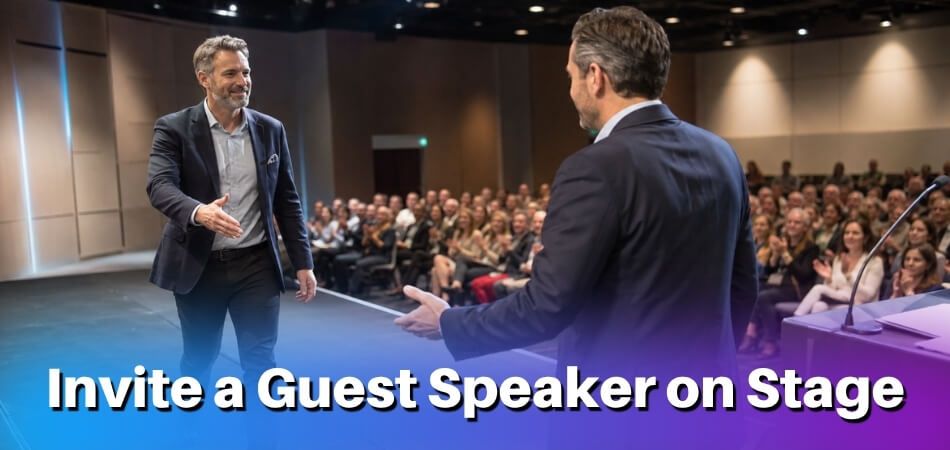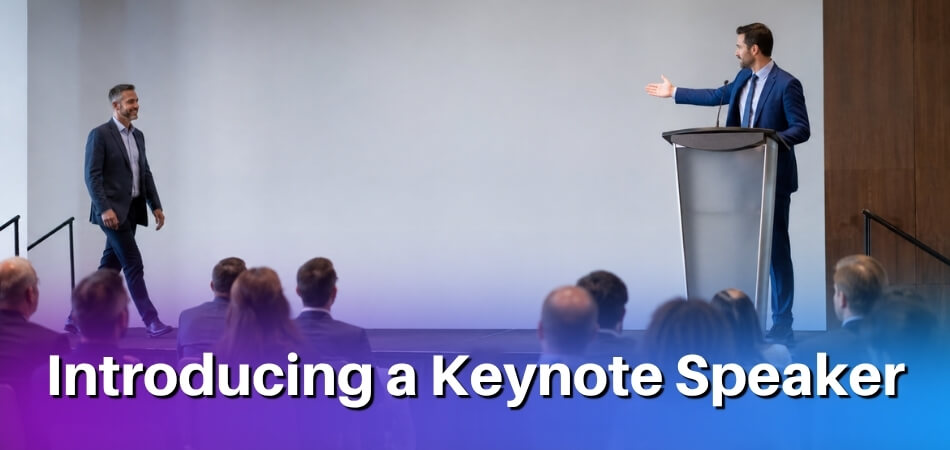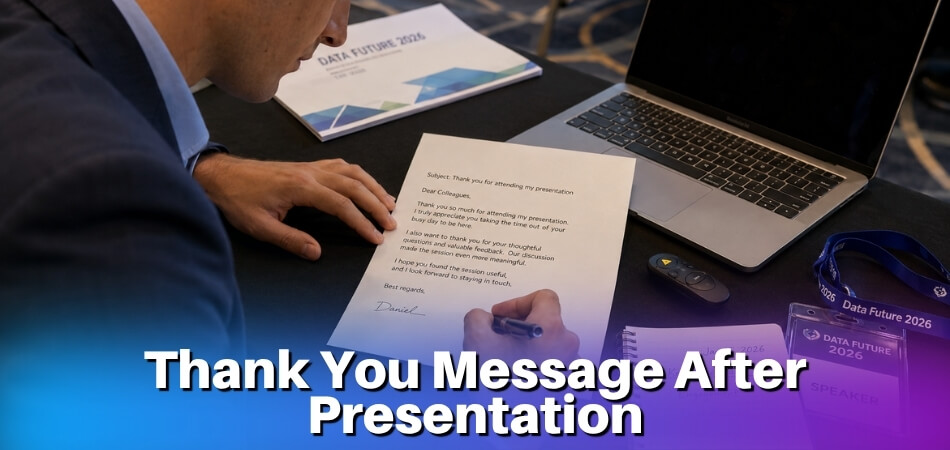

Landing the right keynote speaker can make or break an event. Organizers spend weeks debating who to invite, then freeze when it is time to send the message. You know the name you want on the program, whether that is a featured speaker with a packed calendar, a plenary speaker who commands a room, or a guest speaker who fits your theme. The hard part is approaching them without looking like you have never done this before.
Quick answer: To ask someone to be a keynote speaker, send a personal email, or write to their agent or speaker bureau, that names the event, date, audience, topic, fee and travel terms. Research their past talks, invite them months ahead, and follow up once after about a week.
This guide covers the full process: preparing your terms, choosing a channel, working with a bureau, sample invitation emails and a formal letter, follow-up, and what to do after a no.
How to Ask Someone to Be a Keynote Speaker
A keynote invitation works when it reaches the right person through the right channel, makes a specific ask, and gives the speaker enough information to say yes confidently. That is true whether you call the role featured speaker, guest speaker, plenary speaker or opening speaker.

The process in five steps:
- Identify the right person for your event’s audience and theme.
- Find their preferred contact method: personal email, speaker bureau, website contact form or LinkedIn.
- Send a personalized invitation email or formal letter with the event date, format, audience size, topic, fee and travel terms, and a clear ask.
- Follow up once if you hear nothing within 5 to 7 business days.
- Once they agree, send a written speaker confirmation with the full event details.
The tricky parts are in the execution: how you word the first message, how cold outreach differs from asking a warm contact, and what to do when a speaker goes quiet or says “maybe”. The sections below cover each case.
Before You Reach Out: What to Prepare First
Walking into outreach without your details locked down is one of the fastest ways to lose a speaker’s interest. People worth inviting as a keynote speaker are busy, and vague requests tend to get ignored or deprioritized. Get your information together before you write a single word.
Event Details You Must Have Ready
If you cannot answer a speaker’s basic questions in your first message, they will either ask (best case) or quietly decline.
- Event name and type. Conference, summit, corporate gathering or industry meetup. The format matters because a speaker’s preparation, time commitment and expectations differ across each.
- Date and length of the keynote. Give the date, the start time, and how long they will speak, including any Q&A.
- Location. For in-person events, the city, venue name and any relevant travel context. For a virtual or online event, specify the platform (Zoom, Teams or whichever you use) and any technical requirements.
- Audience size and profile. “About 400 mid-level HR professionals from the financial sector” is useful. “Our attendees” is not.
- Topic or theme. You do not need to script their talk, but you should have a clear sense of the angle you hope they will take and why they, specifically, are the right fit for it.
- The role you are asking for. Keynote, plenary, panel, workshop and moderator are different jobs, so name the one you mean.
- Technical and accessibility needs. Say what you provide, such as AV setup, captions or other accommodations, and ask what the speaker needs.
- Your response deadline. Open-ended invitations tend to drift.
If the slot is opening or plenary, say so. The first slot on an agenda carries different weight than a breakout session, and speakers like to know where they sit in the program.
Research the Speaker Before You Write
A tailored invitation starts with research. Check that the speaker’s topics fit your audience and theme, read or watch a recent talk, and look on their official site for a booking page or an agent. If a mutual contact can vouch for your event, ask for a warm introduction; it gives the speaker a reason to take your message seriously.
Decide on Fee, Travel, and Other Incentives
Before you contact anyone, you need to know what you are offering. Trying to negotiate compensation mid-conversation because you had not thought it through creates friction and signals disorganization. Once these details are settled, your invitation reads like it came from a serious organizer, not someone still figuring things out.
| Term | What to decide before the first email |
|---|---|
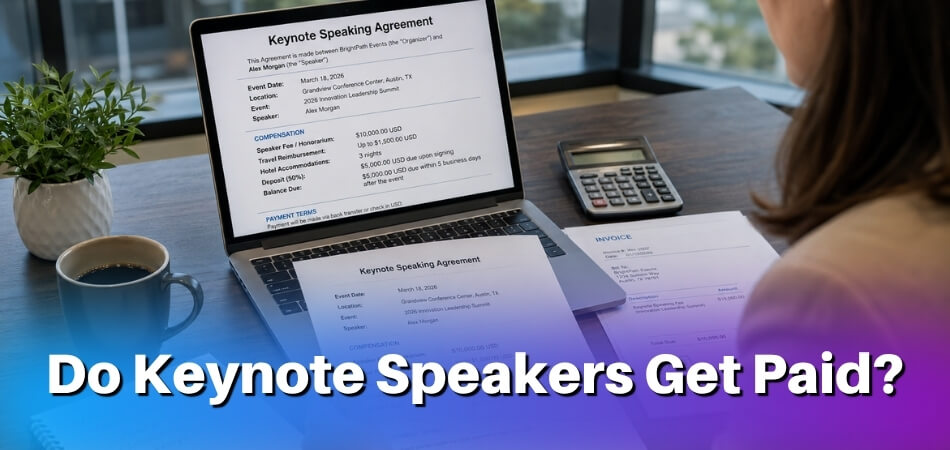
| Honorarium | Whether you offer one, and the amount or range. Fees vary widely: a recognized speaker with a large following will expect far more than an emerging expert or a community-focused speaker, who may be happy with a smaller figure or a waived registration for their team. Do not guess a number; ask the speaker or their agent. If your budget is zero, be honest upfront and lean harder on the other items. Universities and public bodies may have their own rules for paying and documenting honoraria, so check with your finance office. |
| Travel | Whether you cover flights, hotel and ground transport, or the speaker pays their own way. Travel is often the deciding factor for speakers from another city or country. |
| Recognition | Where they will be listed, how they will be introduced, and whether they can reuse a recording of their session. |
| Other perks | Conference passes for colleagues, a chance to sell or promote their book or course, or access to attendee contact information where it complies with privacy rules. Each can carry real weight, depending on who you are asking. |
Recognition matters more than many organizers expect. Being listed as the featured speaker on a well-promoted event website, receiving a formal speaker introduction, and getting access to the recorded session are tangible benefits. Spell them out: an invitation that describes real audience reach beats a vague one even when the fee is the same.
Public speaker programs show one way travel terms can be split. The ACM Distinguished Speakers Program policies, for example, have ACM cover the speaker’s long-distance travel while the host pays local transport, hotel and meals. Your own arrangement can differ, but state it plainly.
From our experience at MS International: For most applicants, the route to our in-person conferences in the Greater Toronto Area is the presenting-author track: submit work for review and register after acceptance. Keynote and invited roles are arranged separately with the organizing team, and buying an author ticket does not create one. Speakers cover their own travel, accommodation, visa, transportation and personal costs, and taking part creates no entitlement to an honorarium, speaker fee or travel reimbursement unless MS International has agreed otherwise in writing.
How Far in Advance Should You Invite a Keynote Speaker?
Invite a well-known keynote speaker several months ahead. One speaker-bureau guide recommends starting outreach 6 to 12 months before the event, and a university conference guide says to invite keynotes “as far in advance as possible”. The right lead time depends on the speaker’s profile and the season, so treat any number as a rule of thumb.
| Months before the event | What the bureau guide says it suits |
|---|---|
| 9 to 12 | Large events or premium speakers; popular keynoters can be booked a year or more ahead |
| 6 to 9 | Mid-range budgets: subject experts, authors and rising speakers |
| 3 to 6 | Tight budgets or local and regional talent, with fewer options and less date flexibility |
| Under 3 | Still possible, but choice and affordability are limited and your negotiating leverage drops |
Bureaus gain from early booking, so read these as guidance, not rules. Invite sooner than feels necessary: it also leaves room to move to your next candidate if the first one declines.
How to Choose the Right Channel: Email, Phone, or In-Person
Email is the best first contact for most keynote invitations. The channel shapes how the invitation lands: the wrong medium feels intrusive, while the right one shows you thought about the relationship and not only the ask.
Email: The Default for Most Situations
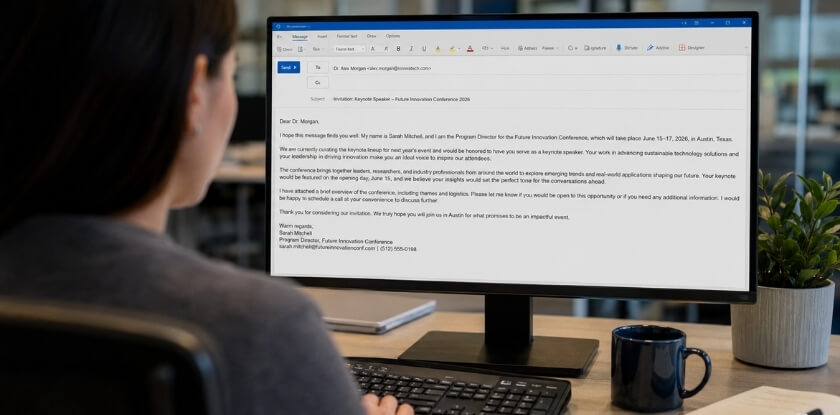
Email is the standard first-contact method for most organizers, and for good reason. A well-written invitation works for both cold outreach and warm contacts, and it gives the potential keynote speaker time to read, think and answer when it suits them. It lets you lay out the dates, format, audience and terms clearly without rushing anyone through a call. It is professional, it leaves a record, and it puts no one on the spot.
If the speaker has a booking agent, your email may reach an assistant or a bureau first. Address it to the right person where you can, and keep the subject line specific. “Keynote Invitation: [Event Name], [Date]” tells the reader more than “Opportunity for You.”
Phone and Video Calls: When You Have a Real Relationship
Calling a stranger to ask if they will be your featured speaker is too much, too fast. With a contact you have worked with before, a quick call to float the idea before the formal letter can make things smoother. They know what is coming, and you can answer questions in real time.
For a speaker in another time zone, a short video call can cover format preferences, session length and technical needs. A call is rarely the place to ask for a firm yes, and it makes the process feel less transactional than a cold email. Gauge interest, then follow with the written invitation so they have something concrete to consider.
In-Person Asks: Conferences and Industry Dinners
If you meet the person you hoped to invite as an opening or plenary speaker at another event, it is fine to mention it. Keep it low-pressure: “I’d love to send you details about our event in the spring, would that be alright?” Let the conversation be a door-opener, not a pitch meeting. The in-person ask works best when a formal email follows quickly, because a hallway conversation is easy to forget.
Cold Outreach: Different Rules Apply
Cold outreach to a guest speaker or conference speaker you have never met needs more care, whatever the channel. Email is still the best entry point, but the bar for that first message is higher. You need to say why you are contacting them specifically, why your event is worth their time, and what you offer.
Do not cold-call someone well known. If their booking contact is public, email that address. If they have a bureau or agency, go through it; bypassing it rarely works and makes a poor first impression.
Social media has a limited role. A LinkedIn message can open a warm introduction or help you find the right email, but it is not the place for a full invitation. Keep it to one line: you would like to send details of a speaking opportunity, and ask the best way to reach them.
Matching Channel to Contact Type
| Your relationship | Best first move |
|---|---|
| Unknown speaker, no shared connection | Email their official booking or contact page, or their agency |
| Met once or twice | Email directly and mention where you met |
| Colleague you know well | A call or message to test interest, then a formal email |
| Someone in your immediate network | Ask informally first, then confirm in writing once they show interest |
Whatever the channel, the first contact has one goal: to get them to the written invitation, where they can review everything properly.
Should You Go Through a Speaker Bureau or Agent?
If the speaker is represented, contact the agent or bureau, not the speaker. Agents exist partly to handle exactly this kind of inquiry. They screen requests and negotiate fees, and they are often faster to respond than the speaker’s personal inbox.
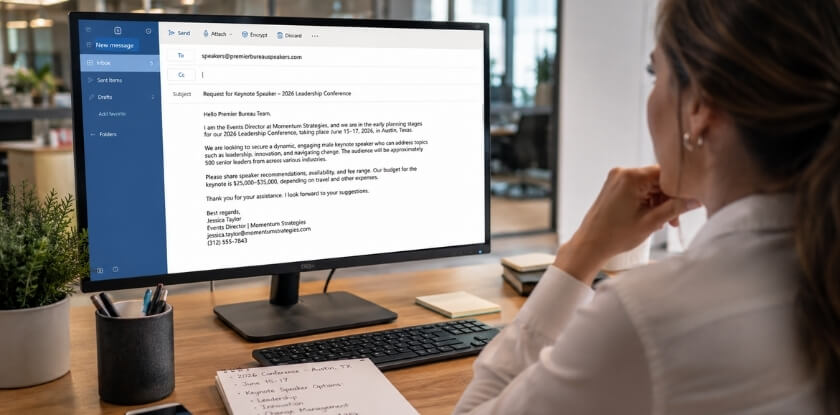
Write to an agent the same way you would write to the speaker: by email, with full event details, your fee range and your travel terms. Agents judge the inquiry partly on how complete and professional it looks, so a thin message gets a thin reply. Expect questions about audience size, date flexibility, recording rights and who pays for travel. Having those answers ready speeds everything up.
Fees for represented speakers are set by the bureau or agent, so ask for their terms in writing instead of assuming a range. Also ask who signs the contract and when your date is held.
How to Ask a Professional Contact (Someone You Don’t Know Well)
Reaching out to someone you barely know, or have never met, is hard. The instinct is to over-explain or under-ask. A cleaner approach is to treat the invitation like a business proposal: be direct about who you are, what you are asking and what is in it for them.
Fill in every bracket before sending. A cold email with placeholder details signals disorganization, and that is enough reason for a busy speaker to pass.
Sample Invitation Email for a Professional or Cold Contact
Use this for someone you have met once, followed online or identified as the right fit. Adjust the specifics to your event.
Subject: Keynote Speaker Invitation: [Event Name], [Date]
Dear [Name],
My name is [Your Name], and I am the [title/role] of [Organization]. We are hosting [Event Name] on [Date] in [City], a [brief descriptor, for example a one-day industry conference for HR professionals in retail] expecting [X] attendees.
We would like to invite you to join us as our featured speaker for the opening session. Your work on [specific topic, book, research or recent talk] gives us confidence that your view on [topic] would matter to our audience.
The keynote would run about [X] minutes, with time for Q&A if you wish. We are offering an honorarium of [amount] and can cover travel and accommodation for in-person attendance. If a virtual format suits your schedule better, we can accommodate that as well.
We are writing early so you have adequate time to consider the invitation and, if you are interested, to plan accordingly. The event date is [Date]. We hope to confirm speakers by [confirmation deadline].
If you would like to talk through the details first, I can set up a short call. You can reach me at [email] or [phone].
Thank you for considering it.
[Your name]
[Title, Organization] [Contact information]
How to Ask Someone You Know Personally
Asking someone you already know feels easier on the surface, but it has its own pitfalls. Familiarity should not make the request look casual or undercooked. A personal contact still deserves a clear, well-structured invitation that respects their time and gives them everything they need to say yes.
The key difference is tone. Drop the formal pleasantries and write the way you speak to this person. You still need the event, the date, the audience, what you are asking them to do, and what is in it for them.
Sample Invitation Message for a Personal Contact
This works for email and adapts easily to a direct message or a phone call.
Subject line: Speaking at [Event Name]: would love to have you headline
Hi [Name],
I am organizing [Event Name] on [date] in [city], and I would like you to be our keynote speaker.
The event brings together [short audience description, for example “around 300 marketing professionals focused on B2B growth”]. With your background in [specific area], you are a natural fit, and frankly you were the first person I thought of.
The slot is [length, for example 45 minutes] with a short Q&A after. We are happy to shape the topic around something you are working on right now.
For our part, we can offer [honorarium amount if applicable], cover travel and accommodation, and look after whatever you need before and during the event. I can send the full details once we have spoken.
Would you be open to a quick call this week or next to see if this works for your schedule?
[Your name]
[Title, Organization] [Contact details]
How to Invite a Keynote Speaker for a Virtual Event
For a virtual event, put the platform, time zone and recording terms in your first message. Many featured speakers find it easier to say yes when there is no travel, no hotel and no lost days, but they still need to know what they are agreeing to: the format, the audience size and whether it is recorded.
The logistics, the ask and the speaker’s concerns all differ from a traditional in-person conference, so address them upfront instead of sending a generic invitation and hoping the speaker asks the right questions. Many conferences are held in person, so use this version only if your own event is online.
Sample Invitation Email for a Virtual or Online Event
Subject: Speaking Invitation: [Event Name] | [Date] | Online
Dear [Speaker’s Name],
I am the event organizer for [Event Name], a [brief descriptor, for example “one-day virtual summit for mid-career HR professionals”] on [Date] at [Time, including time zone].
We would love to have you open the day with a [length, for example 45-minute] keynote on [topic or theme]. Your work on [specific project, book or area] speaks directly to what our audience is wrestling with.
The practical side: the event runs on [Platform, for example Zoom Webinar or StreamYard], with roughly [number] registered attendees. Your session would be [live / pre-recorded with a live Q&A]. We are offering an honorarium of [amount], and our team will handle technical setup and a run-of-show call beforehand. The recording will be [shared with attendees only / made public, specify which].
If you want to see the schedule or lineup so far, I can send it over. Would a short call next week suit you? If not, I am glad to answer questions by email.
We would be honored to have you as our plenary speaker.
Warm regards,
[Your Name]
[Title] [Organization] [Phone / Email / Website]
The subject line tells the speaker at once what the email is about, and the logistics sit in one tight paragraph. The recording clause matters because speakers often have strong views on whether a session is posted publicly. For a personal contact, trim the introduction and open with your relationship instead.
How to Write a Formal Keynote Speaker Invitation Letter
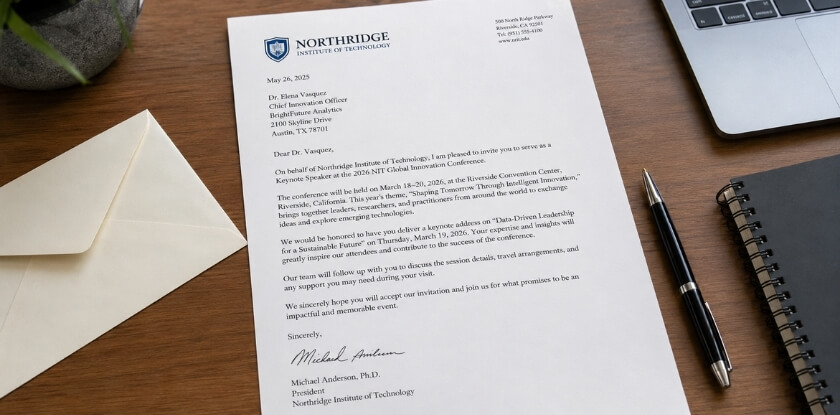
Write a formal letter when you approach a high-profile speaker, write through an agent, or run a large professional conference where written correspondence carries more weight than a casual email. It sets a professional tone from the start. It gives the speaker or their representative a complete document to refer to, and for large or institutional events it can be needed for internal approval or a visa application.
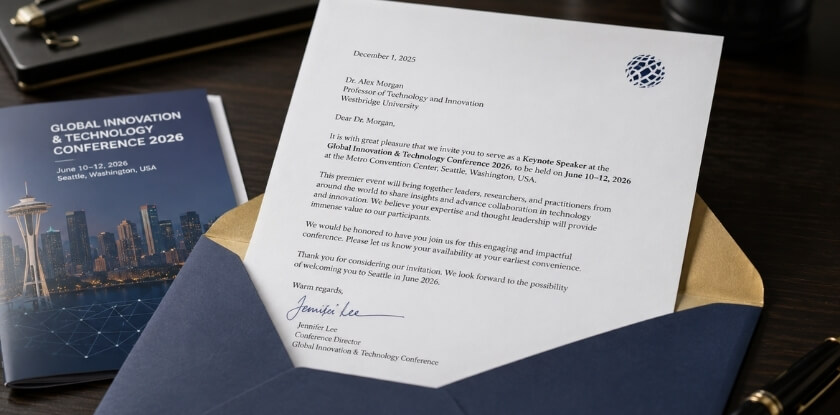
Full Sample Invitation Letter
Adjust the bracketed details and tighten or expand sections depending on how well you know the speaker.
[Your Name] [Your Title] [Organization Name] [Address] [Email | Phone] [Date]
[Speaker’s Full Name] [Speaker’s Title] [Speaker’s Organization or Agency] [Address]
Dear [Speaker’s Name],
I am writing on behalf of [Organization Name] to formally invite you to serve as keynote speaker at [Event Name], scheduled for [Date] at [Venue or Platform Name] in [City, State / or “held virtually”].
[Event Name] is [one sentence on what the conference covers, who attends and its scale]. This year’s theme is “[Theme],” and your work on [specific topic, book or area] makes you a natural fit for what our audience hopes to take away.
We invite you to deliver the [opening / closing / plenary] address, about [30 to 45] minutes, with [10 to 15] minutes for audience questions if you wish. The session is planned for [approximate time slot] on [date].
We are pleased to offer an honorarium of [$X,XXX], [economy/business class] travel, hotel accommodation for [X nights] and reimbursement of reasonable ground transportation. For an online event, we can discuss a digital delivery setup and the technical support you need.
The event draws [number] attendees from [industries or sectors]. [One sentence on past speakers or audience reach, only if it is true.]
If you can confirm, we will move forward with a formal speaker agreement and send full event details, promotional materials and logistics.
We kindly ask for a reply by [RSVP deadline], as we are finalizing the program. You are welcome to contact me at [email address] or [phone number].
Thank you for considering this invitation. We hope to welcome you as our [keynote / featured / conference] speaker.
Sincerely,
[Your Name] [Title] [Organization Name] [Contact Information]
How to Follow Up If You Don’t Hear Back
Follow up once after five to seven business days. Silence after an invitation is common. Busy professionals miss messages, inboxes fill up, and your request can slip through without any deliberate dismissal, so a well-timed follow-up is a normal part of the process and not a sign of desperation.
When to Send Your First Follow-Up
Give your first message five to seven business days. If you sent a cold message to someone you do not know, lean toward the longer end; if the contact is someone you have worked with before, five days is reasonable. Do not wait longer than ten days for a first follow-up, because the further you get from the original message, the harder it is to keep the thread in context.
How to Write the Follow-Up
Keep it short. Reference your original message in one sentence, restate the date, format and role, and ask a direct question. You are nudging someone who may have missed it, not resending the invitation.
Subject: Following up: [Event Name] Keynote Invitation
Hi [Name],
I wanted to follow up on the invitation I sent last week about speaking at [Event Name] on [date]. I would love to have you as our featured speaker for the opening session and want to be sure this reached you before we go further with planning.
Could we have a brief call this week? I can answer any questions on the format, honorarium or travel terms.
What to Do After a Second Silence
If another five to seven days pass, send a second follow-up, but change the channel. If you emailed first, try LinkedIn, or ask a mutual connection to pass on a note.
- Try a different contact path. If the speaker works through an agency or manager, now is the time to use that route.
- Give the person an easy out. Add a line such as: “If this isn’t the right fit for your schedule, I completely understand. Just let me know and I won’t follow up again.” That often prompts a reply where silence did not.
- Set a hard internal deadline. Three weeks in with no answer, move to your next candidate. Your timeline does not pause for one unresponsive contact.
One Special Case: Virtual Events
For an online event, speakers who declined an in-person invitation sometimes reconsider when the ask is smaller. If you have not already said the event is fully remote, the follow-up is the place to mention it. Travel concerns and scheduling conflicts shift when no flight is involved.
What Not to Do
Do not send more than two follow-ups on the same channel. Three emails with no reply is a clear signal, and pushing further damages your reputation as an organizer.
Do not apologize excessively for following up. A single “I know you’re busy” is fine. Repeating it reads as uncertain and undermines the professionalism of your invitation.
Once you do get an answer, whether yes, no or a request for more information, reply quickly. Delayed replies on your side after a speaker finally responds are one of the fastest ways to lose a confirmed keynote speaker before the contract is signed.
What to Do If the Speaker Says No
Thank them and move on to your next candidate. A rejection is not the end of your planning; it is a redirect. How you respond matters, both for this event and for any future relationship with that person.
Don’t Take It Personally
A decline does not always reflect on your event. Schedules fill months ahead, travel stacks up, and some speakers have strict rules about what they accept. A no can simply mean timing, not quality.
Send a brief, gracious reply anyway: “Completely understand, and I hope we can connect on a future event.” It takes thirty seconds and keeps the relationship intact.
Ask If They Can Recommend Someone
A speaker may know peers at a similar level and point you to someone free. A speaker who cannot make your date might say, “You should reach out to [colleague], who covers similar ground and is taking conference dates this season.” You get a warm lead, and you show the original contact that you handled the rejection well. Both are useful.
Revisit Your Speaker Shortlist
Hopefully you went in with more than one name. If you built a tiered list before the outreach began, move to the next candidate and use what you learned from the first invitation: refine your email, adjust the offer if the budget allows, or sharpen how you describe the audience and event details. If the first speaker declined because of travel, lead with travel coverage and a clear logistics plan next time.
Reconsider the Role
A speaker who declines the keynote may accept something lighter, such as a panel seat, a recorded message or a later date. Ask directly: “If the keynote isn’t feasible, would a 20-minute featured session work for you?” Not every speaker thinks in terms of all or nothing. A plenary commitment is a big ask, and an opening or guest slot may sit differently on their calendar.
Keep the Door Open for Next Year
Note the decline and the reason. When you plan the next cycle, reach out earlier and refer to the earlier talk: “We spoke last year about [Event Name] and you mentioned your schedule was packed. We are starting earlier this year and wanted to come back to you first.” That kind of follow-up email signals that you are organized and that you value them specifically, not as a name to fill a slot.
How to Motivate a Speaker to Say Yes
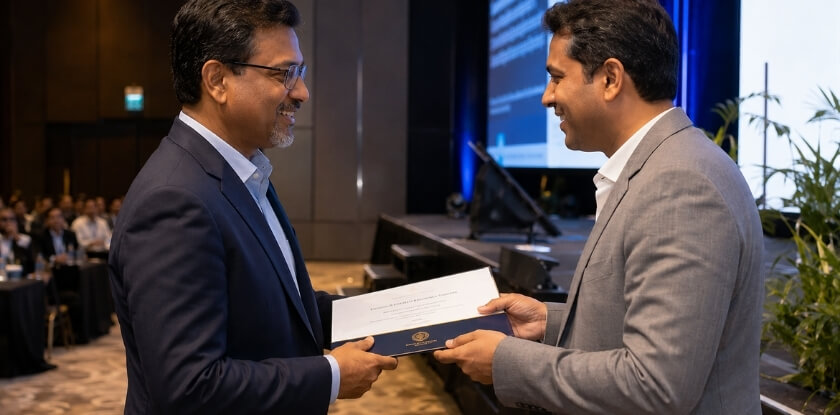
A speaker says yes when they see a clear reason: an audience worth their time, credible exposure, fair terms and a topic they can own. It is easy to focus on how to phrase the invitation and forget why the speaker would agree at all. If your outreach gives no clear reason, even a perfectly worded email gets a polite decline.
They Want to Know the Audience Is Worth Their Time
A speaker’s biggest question is whether the room will care. Describe the audience specifically. Not “professionals in the field”, but something like “400 mid-level marketing managers from B2B software companies, many of them responsible for annual budgets.” That tells them whether the audience matches what they care about.
Name the reach. If the session will be recorded or streamed, say so. Many speakers see that as an extension of their audience.
Recognition and Exposure Still Matter, But Only If They’re Real
Telling a well-known plenary speaker that your event will “raise their profile” falls flat. For a speaker building visibility in a new niche, it can be a real draw. Match the offer to where they are in their career: a rising academic, a consultant moving into corporate events or an author with a new book will respond differently from someone who already headlines.
Be specific. “We’ll feature you on our event page and send your bio to our mailing list of [number] subscribers” is an offer. “We’ll give you great exposure” is not.
The Honorarium and Logistics Need to Be Addressed Early
Avoiding the money conversation only delays the moment the speaker finds out the offer does not work for them. State the fee clearly. Even a modest fee shows respect, and if the budget is tight, say so: “Our speaker honorarium is [amount], which we know may be below your standard rate, and we are happy to discuss what else we can offer.” That opens a conversation instead of closing one.
Cover travel and accommodation up front. A speaker who would cross the country at their own expense will think twice, so confirm what is covered. For online events, time zone, tech setup and AV support become the logistics to address.
Give Them a Topic They Can Actually Own
A speaker handed someone else’s agenda will disengage, and the audience will feel it. Tell them the theme you have in mind, explain why it fits their work, and leave room for them to shape it. Frame the invitation around their specific expertise instead of squeezing them into a pre-set title. Asking which angle interests them shows you did your homework.
Personal Connection Beats Flattery Every Time
An email that opens with “we’re huge fans of your work” and nothing else reads as generic. Reference a talk, a book chapter, an interview or a public decision, so they see you chose them for a real reason. With personal contacts that is easy. With cold outreach it takes a few extra minutes of research, but it separates an email that gets read from one that gets archived.
Don’t Overlook What the Event Itself Offers
Sometimes the event is the draw: a well-regarded annual conference, a tight-knit niche community or an event that attracts media coverage. If your event has a strong reputation, mention past speakers (with permission, or if it is public). If the speaker was already interested in attending as a participant, an invitation to speak becomes an easy yes, and if your conference brings together people they want to meet, say so. Networking value is a real motivator, especially at mid-career levels.
Other Names for ‘Keynote Speaker’ (And When They Matter)
Use the title that matches the role: keynote and plenary for a headline address, featured for shared top billing, guest for informal settings. The title is not just a label. It signals exactly what role you are asking the speaker to fill and affects how seriously they take the ask. These terms are not all interchangeable.
The Common Alternatives and What They Signal
| Term | What it signals | Best used for |
|---|---|---|
| Featured speaker | Prominence without one dominant slot | Multi-track conferences where several speakers share top billing |
| Guest speaker | Softer, more general | Smaller events, classrooms, team offsites |
| Plenary speaker | All attendees in one room, full attention | Academic and scientific conferences |
| Opening speaker | Sets the tone for the whole event | When you want the first slot; say so explicitly |
| Conference speaker | Generic, fills a program rather than anchoring it | Regular sessions; avoid it if you offer the top slot |
Some speakers like the opening slot and others find it high-pressure, so state it in the invitation instead of calling it a keynote and surprising them later. Event guides do not agree on one definition: some treat keynote and plenary as the same role, while others say a keynote sets the theme and usually opens or closes the event and plenary talks are spread through the programme.
When the Terminology Actually Matters
For most invitations, “keynote speaker” is the safest choice: it is universally understood and signals the centerpiece of the event. Use “plenary speaker” for an academic invited to a research conference, since it orients them to the format at once: the audience will not be split across breakout rooms, so the speaker gets everyone’s full attention. Use “featured speaker” at a virtual or in-person event with several prominent voices, to avoid implying one person dominates. A guest speaker label suits a team offsite or a classroom, where “keynote” would feel overblown, and asking a guest speaker for a class calls for a shorter request.
If you negotiate a fee or travel terms, the title in the contract should match the invitation. Some speakers also search their name and your event after accepting, and a different title on your website or program than in the original invitation feels careless. Consistency matters.
FAQ
Reaching a keynote you have no connection to raises its own set of doubts, including going through an agent or manager, the event details to include and a fee above your budget.
Can I ask someone to be a keynote speaker by email?
Yes, email is the standard and preferred channel for most speaker invitations. Keep it concise, name the event clearly, and state what you are asking up front instead of burying it at the bottom.
How far in advance should I send a speaker invitation?
For a well-known speaker, one speaker-bureau guide suggests six to twelve months ahead. For smaller or local events, three to six months can work, with fewer options. Start earlier if you can.
Do I have to offer an honorarium?
No, but you must address compensation in your first message. If you can offer an honorarium, name it. If your event is volunteer or nonprofit, say so honestly; many speakers will still consider it when the exposure fits their goals.
What if I don’t have a personal connection to the speaker?
Cold outreach works if the invitation is specific and professional. A generic “we’d love to have you speak” rarely gets a reply. Mention the speaker’s actual work and explain why they suit your audience.
Should I follow up if they don’t respond?
Yes, once, after five to seven business days. A second note on a different channel is acceptable, but a third or fourth email on the same one does more harm than good.
How do I ask a speaker’s agent or manager instead of the speaker directly?
Contact the agent by email and include the event details, your budget and the travel terms. Agents decide partly on how complete and professional the first inquiry looks.
Is a formal invitation letter required?
For large or institutional events such as academic conferences, government forums and major summits, yes, it is expected and often needed for the speaker’s internal approval or a visa. For smaller events, a well-written email is enough.
What event details should I include in the invitation?
At minimum: event name, date, location or platform, audience size and type, topic or session title, format (keynote length, Q&A) and any compensation you are offering.
What’s the difference between a keynote speaker, a guest speaker, and a plenary speaker?
A keynote speaker gives the main address that sets the event’s theme, a plenary speaker addresses all attendees in one session, and a guest speaker is any invited presenter. The terms overlap, so state the format clearly whichever title you use.
What if the speaker asks for more than my budget allows?
Be upfront about your ceiling. Some speakers will negotiate when the audience is relevant or the visibility is meaningful; others will not, and that is reasonable. Have that conversation early, before you announce their name publicly.
Final Thoughts
Asking someone to be a keynote speaker takes clarity, respect for their time and enough detail to decide. Get those right and the outreach lands, whether the speaker is a cold contact or an old colleague. It gets easier with practice. Start earlier than feels necessary, be honest about what you are offering, and follow up without apology.