
Researchers often hear that journal papers and conference papers are different, but it is rarely explained clearly. If you are planning where to send your next piece of work, the choice shapes how it is reviewed, seen and judged. Here is a plain comparison to help you decide.
Quick answer: A journal paper is a full peer-reviewed article published in a journal issue, usually after several review rounds. A conference paper is a shorter paper submitted to a specific event, reviewed on a fixed deadline and published in the proceedings. Journals normally carry more weight for promotion, but in computer science and engineering, selective conference papers can count as much. Indexing and review rigor vary by venue, so check each one.
Last verified against official sources: October 2026.
A journal paper and a conference paper are both ways of publishing research, but they differ in how they are reviewed, how long they take, how they are indexed and how much they count when your record is judged. This article compares them side by side, then looks at field norms, presentation formats, indexing, promotion, and the rules for turning one into the other.
Journal Paper vs Conference Paper: At a Glance
The core difference is that a journal paper is a formal article in a periodical, while a conference paper is a contribution to one event’s proceedings, usually presented in person as an oral talk or a poster.
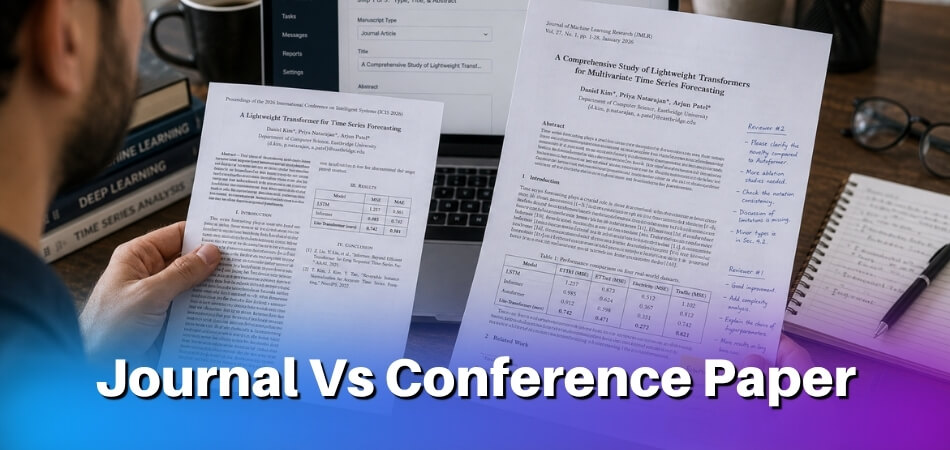
The table below lays out the main variables side by side. The figures are typical, not rules, and they change by field and venue.
The Core Differences at a Glance
| Factor | Journal Paper | Conference Paper |
| Review process | Full peer review, often several rounds with revisions | One review round against a deadline; accept or reject is common |
| Typical review time | Several months to over a year | Weeks to a few months, tied to the conference date |
| Length | Full article with methods, results and discussion; limits are set by each journal | Commonly 4 to 12 pages depending on the template; some venues accept extended abstracts |
| Output format | Article in a journal volume or issue | Paper in a proceedings volume, printed or digital |
| Indexing | Scopus, Web of Science or PubMed, depending on the journal | Sometimes Scopus, Web of Science, IEEE Xplore or the ACM Digital Library; varies widely |
| Impact factor | Journals can have one (from Journal Citation Reports) | Proceedings volumes generally have none, because the impact factor is a journal measure |
| Career weight | Counts more in most fields | Very high in computer science, lower in medicine |
| Presentation | Not required | Usually required, as an oral talk or a poster |
Forms Each Can Take
Both sides come in more than one form, and the form changes how the work is judged.
- Journal: original research article, short report or communication, review article, case study and methods paper.
- Conference: abstract, extended abstract, short paper and full paper. The full paper is the form most often compared with a journal article.
Page limits and review depth for each form are set by the journal or the call for papers.
What This Means Practically
A journal paper gives you a permanent, indexed record with a clear citation trail. The longer review usually means deeper scrutiny and more revision, which tends to improve the final work.
A conference paper gets your research out sooner and puts you in front of people who work on the same problem. In medicine and life sciences, conference presentations are mainly for feedback and networking, and the journal article remains the main measure of output.
Key Differences: Peer Review, Length, and Speed
Journal papers go through a slower, deeper process, and conference papers move on a fixed calendar. Those two production routes explain most of the other differences.
How the Peer Review Process Differs
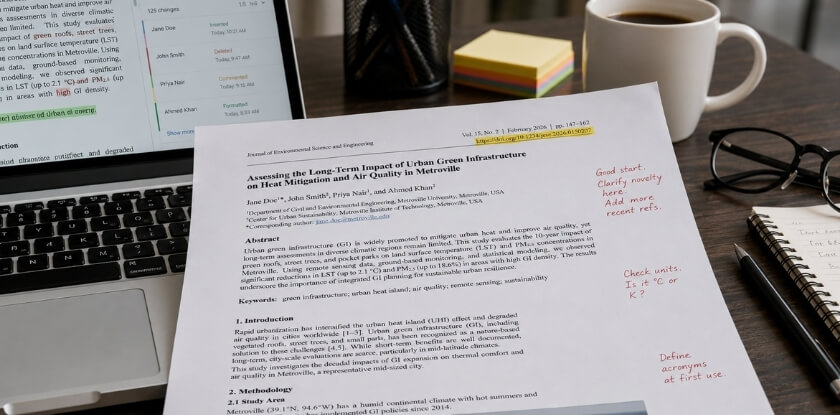
A journal paper typically goes through one or more rounds of review by subject experts before it is accepted. Reviewers can ask for major revisions, extra experiments or a restructured argument, and that back-and-forth can stretch over months.
Conference papers are reviewed against a submission deadline, because the program committee has to finalise the whole programme before the event. Reviews tend to be shorter, and many conferences offer only accept or reject decisions, so a full revision cycle is rare.
The rigor gap depends on the field. In computer science, conferences run by IEEE and ACM societies are heavily peer reviewed and carry serious weight. In medicine and life sciences, conference abstracts are often screened lightly, and the prestige sits with journals.
Review style varies as well. Many journals in the social sciences and humanities use double-blind review. Some major conferences are double-blind, others single-blind, and some small events do only an editorial check before papers reach the proceedings. Read the venue’s review policy before you submit.
Differences in Length and Depth
Journal papers are expected to be complete and self-contained: full methodology, detailed results, thorough discussion and extensive citation of prior work. The word limit depends on the journal and the field, and literature-heavy fields allow longer articles.
Conference papers are shorter by design. A full paper commonly runs four to twelve pages depending on the template, and posters or extended abstracts can be one or two pages. Always follow the page limit in the call for papers, because it is set by each event.
The length gap reflects a gap in purpose. A conference paper is often a snapshot of work in progress, a preliminary finding or one component of a larger study. A journal paper is expected to be the definitive account. In humanities and social sciences, conference papers tend to be closer in depth to articles than in STEM fields, but still rarely as long or as thoroughly cited as the published version.
Publication Speed: Which One Is Faster
Conferences are usually faster. You submit, hear back within weeks or a few months, present at the event, and the paper appears in the proceedings around the same time.
Journal timelines are longer, because they include review rounds, revision periods, editorial processing and the publication queue. Medical journals in particular can take many months from first submission to publication. Speed varies a lot by journal, so check its published review times where available.
This matters if you are early in your career and need a citable output, or if you work in a fast-moving field where being scooped is a real risk. A conference paper in indexed proceedings gives you a record before the full journal version is ready.
A preprint on a platform such as arXiv lets you establish priority without waiting, but it is not peer reviewed. It does not replace an indexed conference paper or journal article for formal credit.
Which Matters More by Field
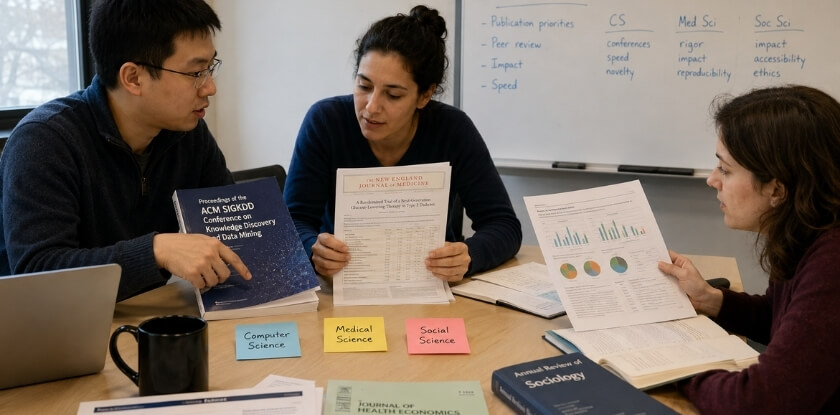
Fields do not share one standard for what counts as a strong publication. A computer scientist and a medical researcher can look at the same conference paper and reach opposite conclusions about its value.
| Field | What carries the most weight | Role of conference papers |
| Computer science and engineering | Selective conference papers and journals | Primary research output at top venues |
| Medicine and life sciences | Journal articles in PubMed, Scopus or Web of Science | Early feedback, networking, abstracts |
| Social sciences | Journal articles | Works in development that should become articles |
| Humanities | Journal articles, book chapters and monographs | Where ideas are tested; little formal weight |
Computer Science: Why Conference Papers Carry So Much Weight
In most areas of computer science, a paper at a top conference is treated as a primary research output, often alongside or above journal articles. Researchers coming from medicine or the social sciences are often surprised by this.
The reason is speed and selectivity. Venues such as NeurIPS, CVPR, ICML and SIGCOMM are selective, peer-reviewed conferences, and their papers are cited as primary results. A journal version of the same work can take much longer, by which point the conference paper has already shaped the conversation. Check a venue’s published acceptance rate rather than assuming it is low. Only full papers at competitive venues carry this weight. A workshop abstract does not.
Medicine and Life Sciences: Why Journals Dominate
In medicine, a conference presentation shares early findings and gets feedback, and the journal publication is the record that counts. Peer-reviewed journals indexed in PubMed, Scopus and Web of Science are the standard unit of output, and journal prestige weighs heavily in career evaluation. A paper in a leading journal such as The Lancet or NEJM can change a career, while a poster at a conference does not, however good the research.
Oral and poster presentations are treated as works in progress. Attendees expect the work to appear later as a journal paper. That creates a specific ethical risk: submitting substantially the same data to two journals, or publishing a conference paper and then a journal paper with nothing new, runs into double publication policies that medical journals enforce strictly. For clinical research, the journal paper is also where clinicians and systematic reviewers look for evidence.
Social Sciences and Humanities: A Journal-Centric Culture
In sociology, political science, economics and psychology, peer-reviewed journal articles are the main currency for promotion and grants. Conference papers are taken seriously as works in development, but evaluation committees generally expect them to become articles.
Humanities follow a similar logic with one addition: the book chapter and the monograph carry significant weight, especially in history, literary studies and philosophy. A scholar may publish journal articles throughout a career while also working toward a single-author book. Conferences are intellectually central there, but a high-quality journal article still drives the formal record. Citation counts matter less than in STEM, so indexing is slightly less critical.
Presentation Formats Explained: Oral, Poster, and Full Paper
When you submit to a conference you also choose how your work is presented, and that affects what ends up in the proceedings and how much it counts.
Oral Presentations
An oral presentation is the traditional slot: you speak to a session audience, commonly for 15 to 20 minutes, followed by questions. Getting an oral slot often signals that reviewers ranked your submission highly, and in computer science it can be genuinely competitive.
The accompanying paper is usually published in full in the proceedings, and whether it is indexed depends on the conference. Oral presentations also require you to show up, so if travel funding is an issue, check before you submit whether remote presentation is allowed.
Poster Presentations
A poster presentation means displaying your work on a board during a dedicated session and discussing it with whoever stops by. It is more informal and conversational, and it suits early-stage work or negative results.
For publication, the situation varies. Some conferences publish a short abstract for poster presenters, and others publish nothing at all, so there is no citable paper. Read the submission guidelines before assuming a poster produces a publishable output. Posters are a normal part of conference culture in life sciences and medicine, and less common in humanities and social sciences.
Talk Length vs. Paper Length
If your venue expects the paper to be read aloud, a common rule of thumb is about two minutes per double-spaced page, so a 15 to 20 minute slot fits roughly 7 to 10 pages. It is not a standard, and slide-based talks work differently, so time yourself once and follow the call for papers.
Full Papers in Proceedings
A full paper is a complete written submission published alongside the other accepted papers. It is what most researchers mean when they say they “published at a conference”. Full papers go through peer review, often receive DOIs and appear in the proceedings volume.
Some conferences also call for extended abstracts or short papers. These are real submissions with their own review, but they are shorter and usually carry less weight. For your record, the type and length of the submission matter, not just the conference name.
How Format Affects Your Publishing Strategy
A full paper in indexed proceedings is a citable publication. A poster with no proceedings entry is professional development, not a publication. In journal-heavy fields, a presentation in any format is mostly a way to get feedback before you write the journal article. In computer science, aiming for oral or full-paper acceptance at a well-indexed venue is a real publishing strategy, not a consolation prize. Do not send the same paper to two conferences at once. That is duplicate submission, and most venues prohibit it.
Indexing Differences: Scopus, Web of Science, IEEE, and ACM
Journals are more consistently indexed than conference proceedings, so indexing is the point where a conference paper is most likely to disappoint. A paper outside the major databases is hard for other researchers to find, and it may not count in institutional metrics.
How Journal Papers Get Indexed
Most reputable journals aim for Scopus, Web of Science or both, the databases that promotion committees, grant reviewers and institutional rankings usually treat as standard. Web of Science is often described as the more selective of the two, and journals with an impact factor in Journal Citation Reports carry extra weight in medicine and life sciences.
A journal listed in Scopus has passed a quality evaluation, and its papers add to your author profile, citation count and h-index. A journal that is in neither database is a signal to pause before you submit. It does not automatically mean the journal is predatory, but your paper may not count in institutional metrics.
How Conference Papers Get Indexed
Conference indexing varies enormously, and the field decides how much it matters. In computer science, proceedings from reputable IEEE and ACM conferences are often indexed in Scopus or Web of Science and treated as legitimate scholarly output. Researchers outside computer science sometimes underestimate how seriously these proceedings are taken. Outside it, conference papers are far less consistently indexed, and a poster abstract in a supplement volume is rarely indexed in any meaningful way.
Scopus indexes many conference series, particularly in engineering, computing and physical sciences, and Web of Science covers selected proceedings through its Conference Proceedings Citation Index. Inclusion is selective, so never assume a conference qualifies.
Who Decides Whether a Conference Is Indexed
The organiser does not apply for indexing directly. Clarivate states that only publishers may submit proceedings volumes to the Conference Proceedings Citation Index, that its selection is at the level of the publication and not the event, and that each volume is evaluated independently, so earlier coverage does not guarantee later volumes. Scopus describes conferences as published as one-off conferences, serial publications or part of a journal: serial titles go through its title evaluation, and one-off conferences follow the Engineering Village selection process.
Before you submit, ask the organiser which publisher produces the proceedings and whether that volume has been accepted for indexing, then check the database itself rather than the conference website.
IEEE and ACM as Special Cases
IEEE Xplore and the ACM Digital Library are discipline-specific databases that many computer science hiring committees check directly, whether or not a paper also appears in Scopus. Both organisations publish journals and conference proceedings, so the boundary between the two is less sharp in computer science than in other disciplines.
A Practical Check Before You Submit
Before committing to a venue, run three quick checks:
- Look up the journal or proceedings in the Scopus source list.
- Check the Web of Science master list if your institution weights that database.
- In computer science, check whether the proceedings appear in IEEE Xplore or the ACM Digital Library.
This matters most early in your career. An impressive-sounding conference that is not indexed may feel like a publication on your CV, but it will not show up when a hiring committee pulls your Scopus profile. Citations to preprints do accumulate, but promotion processes in most fields still expect indexed publications as the baseline.
Career and Academic Promotion: Which One Carries More Weight
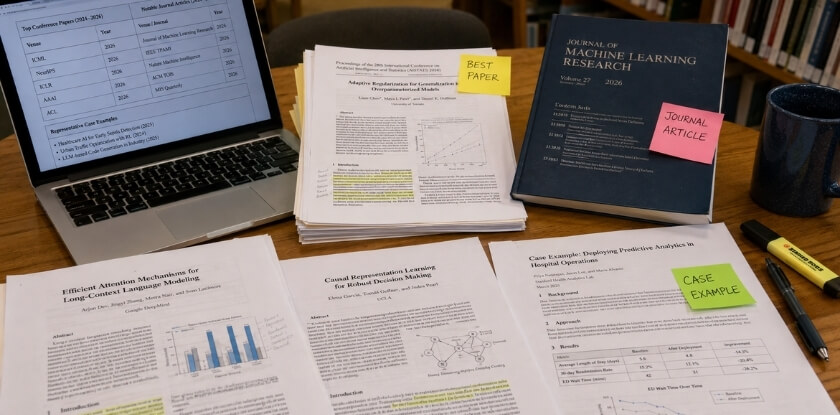
In most academic systems, journal papers carry more weight for promotion, tenure and grants, and conference papers play a supporting role. Computer science and engineering are the main exception, as described in the field section above.
The Default Hierarchy, and the Computer Science Exception
In medicine, life sciences and the social sciences, a strong journal record often decides whether you get tenure, a postdoctoral position or funding, and conference papers rarely substitute for articles. In the humanities, a book chapter or monograph may outrank both, but journal articles still count for more than conference papers.
Computer science is the notable exception. A paper at a highly competitive venue such as NeurIPS, ICML or CVPR is understood by the field to represent rigorous review and real impact, and hiring committees at research universities and industry labs count it. If you are building a career in machine learning, systems or human-computer interaction, ignoring the conference circuit would be a strategic mistake.
What Promotion Committees Actually Count
Institutions use some combination of the following:
- Number of journal articles in indexed outlets (Scopus, Web of Science)
- Impact factor or journal ranking (Q1, Q2 and so on in Scimago or Clarivate)
- Citation counts across your body of work
- Conference papers at field-recognised venues, weighted more heavily in computer science and engineering
- Invited talks, keynotes or committee roles that come from conference visibility
Conference papers often appear under “additional outputs” rather than the primary count, except where proceedings are formally recognised as equivalent to journals. Many universities publish their exact criteria, and working backward from those is more useful than general advice.
Early Career vs. Senior Researcher
Early in a career, conference papers do something journals cannot easily do: they get your name into the field faster, generate citations sooner and create chances for collaboration before your journal pipeline exists. A PhD student presenting at a recognised conference gains credibility and feedback that shapes later journal submissions.
For senior researchers, promotion to full professor, fellowships and grant panels in most fields mainly evaluate journal output and citation record. A conference paper at that stage matters mainly if it announces a new research direction or signals community leadership.
For New Researchers: Which Type Should You Start With
Start where your field’s evaluators look. Computer science and engineering researchers can reasonably start with a conference paper, and researchers in medicine, social sciences and humanities should aim for a journal article.
If You Are in Computer Science, Engineering, or a Related Technical Field
A conference submission makes sense: top venues carry prestige, the review is rigorous and the feedback is quick. The deadline also helps while you are still building writing habits. Pick the venue carefully, because predatory conferences are a real problem. If the acceptance rate is not published and the proceedings are not in a reputable index, skip it.
Many researchers publish a shorter conference version first, which also gives them a deadline and fast feedback, and expand it into a journal paper later. That is common and widely accepted when the journal version adds substantial new content (see the section on extending a conference paper below).
If You Are in Medicine, Life Sciences, or Clinical Research
Start with a journal submission if your data is complete and the study can stand on its own. Conference abstracts here are rarely indexed as full papers, and a poster does not carry the career value of a peer-reviewed article. The review will take longer, but the output is more durable than a conference proceeding.
If You Are in Social Sciences or Humanities
Present early work at a conference to get feedback before committing to a full journal submission, and treat it as a testing ground for your argument, not a standalone credential. A strong journal paper will almost always matter more for promotion.
Practical Starting Advice for Any Field
- Junior researchers in journal-heavy fields should aim for a few solid journal papers before leaning on conferences, because the journal record carries you through hiring rounds. PhD students and postdocs in computer science or engineering should build a mixed portfolio from the start.
- Researchers in multidisciplinary fields may face a hybrid expectation. A computational biologist, for instance, can be judged partly by computer science norms and partly by life sciences norms, depending on the department.
- Talk to your supervisor or a senior colleague before you submit. Norms vary by institution as well as by field.
- Do not fixate on impact factor at first. A real peer-reviewed paper in a Scopus or Web of Science venue beats an unindexed paper in a prestigious-sounding one.
- Consider a preprint if your field accepts them. It gives you a timestamp and informal feedback. This is common in physics and economics, and growing in life sciences. Check the target journal’s policy first.
- Do not wait for perfect. A submitted paper that gets reviewed teaches you far more than a manuscript on your hard drive.
From our experience at MS International: Our conferences review submissions double-blind and ask authors to follow APA format. Full papers are normally between four and twelve pages including tables, figures, references and appendices. Submissions can be abstracts, full papers, case studies, review papers or professional presentations. Most review decisions are returned within about ten working days, and the author receives an acceptance, revision request or rejection by email. We ask that the work is not published or under review elsewhere, and accepted papers may be considered for conference proceedings where applicable. We do not say that our proceedings are indexed in any particular database, so authors who need indexing for promotion should confirm what applies to their event before submitting.
Can a Conference Paper Be Submitted to a Journal? Is Double Publication Allowed?
Often yes, but only as a genuine extension of the earlier paper, and only with full disclosure. The rules are set by each journal, not by one universal standard.
The General Rule: Extension, Not Repetition
Most reputable journals will consider a manuscript that began as a conference paper, provided the journal version contains substantial new material: new data, extended analysis, more experiments or a deeper discussion. Some journals mention figures such as 30% new content as a rule of thumb, but this is not a universal rule. The IEEE Author Center sets no percentage: it asks authors to disclose earlier conference versions, cite them and state clearly how the new submission differs. Individual societies and journals may set their own thresholds, so read the target journal’s policy.
Reformatting a conference paper without meaningful expansion is a form of duplicate submission. Many journals run overlap checks on submissions, so a conference paper repackaged as an article is likely to be noticed, and the outcome ranges from rejection to retraction if it is already published.
What “Substantial Extension” Actually Means
- Additional experiments or datasets. In medicine and life sciences especially, editors expect new empirical evidence, not a repackaged conference dataset with a longer discussion.
- Deeper theoretical grounding. In social sciences and humanities, this might be a fuller literature review, a more developed framework or cases that did not fit the conference page limit.
- New sections, not just longer ones. Stretching a paragraph into two pages is not an extension. A new study, analytical dimension or set of results is.
How to Handle Disclosure
Disclosing the conference origin is not optional. Most journals ask on the submission form whether the manuscript is based on earlier work. In your cover letter, identify the conference paper, its proceedings and how it was presented, and explain what the journal version adds. Cite the conference paper in the manuscript too.
The form of the earlier version matters. The ICMJE says journals may consider a paper that was presented at a scientific meeting but not published in full, while a full paper in proceedings is a publication that many journals treat as prior publication. Check which applies to your target journal.
This manuscript extends our paper presented at [Conference, year]. The journal version adds [new dataset / additional experiments / a new analysis section], which were not in the proceedings version.
Failing to disclose is treated as an integrity problem even when the overlap would have been acceptable with transparency. Prior conference publication is rarely a barrier. Concealment is.
When Overlap Is Simply Not Permitted
Some journals refuse manuscripts that share content with any earlier publication. This is more likely where conference papers already count as full archival publications, as in much of computer science. Some conferences explicitly encourage later journal expansion, but that is a policy of the event and the journal, not a default. Check the author guidelines before you start writing. Wording like “we do not consider work previously published in any form” means you should choose another journal or build a substantially new manuscript.
What About Preprints?
Posting a preprint before the proceedings are published is generally acceptable and is not duplicate submission, because a preprint is not peer reviewed, although some conferences and journals set their own preprint rules. After the proceedings appear, you can still submit an extended version to a journal, and you should disclose both the proceedings version and the preprint in the cover letter.
The Practical Strategy
If you plan to turn a conference paper into a journal article, plan the extension before you write the conference version. Decide which further experiments, data or analysis the journal version will add, while reporting the conference results fully. That gives you a genuine extension and something real to say in the cover letter. Staged publishing like this is legitimate across fields: the conference paper builds visibility and early feedback, and the journal paper carries the citation weight. Problems start only when the same work is counted twice with nothing new added.
What Is a Book Chapter and How Is It Different from a Journal or Conference Paper
A book chapter is a contribution to an edited volume, written on an editor’s invitation or call and published by an academic press. It sits in its own category and is often overlooked as a publishing option.

How It Differs from a Journal Paper
Publishers such as Springer, Elsevier, Routledge and Cambridge University Press publish edited volumes. Some chapters are peer reviewed, but in many volumes the editor alone reviews contributions, so quality control is less standardised than independent double-blind journal review.
Indexing is inconsistent too. Some book series from major publishers are indexed, but many are not, so a chapter may collect citations more slowly than a journal article. Chapters also tend to be longer and more narrative, which suits reviewing a subfield or presenting a theoretical framework better than reporting one empirical study.
How It Differs from a Conference Paper
A book chapter has no event attached and usually takes much longer to reach print, since edited volumes can run for a year or more from invitation to publication. There is no presentation component, and the audience is often broader or interdisciplinary rather than a specialist conference crowd.
When a Book Chapter Makes Sense
In social sciences and humanities, a well-placed chapter in a respected volume can be a meaningful line on a CV, particularly early in a career. In STEM, institutions usually treat chapters as secondary to journal papers and indexed proceedings. A chapter that synthesises several of your earlier journal papers into a broader argument is legitimate and is not double publication.
One caution: invitations sometimes come from low-quality publishers that charge fees and produce volumes with no real indexing. Check the publisher’s reputation, confirm whether the volume will be indexed, and ask whether the chapter will have a DOI. A chapter without a DOI is hard to find in modern academic publishing. Check how your institution weights chapters before investing significant time.
FAQ
Journal or conference paper, the differences show up in publishing speed, peer review, promotion credit, duplicate submission, preprints and what changes for Humanities and Social Sciences researchers.
Is a conference paper a published paper?
Yes, a full paper that appears in conference proceedings counts as published and can be cited. A talk or poster not published in full is treated differently, and the ICMJE says journals may still consider such work. Disclose any earlier version when you submit to a journal.
Do journal papers always take longer to publish than conference papers?
Usually, yes. Journal review often takes many months, while a conference paper can go from submission to proceedings in a few months. Some journals offer fast-track options, but they are still slower on average.
Can I cite a conference paper in my research?
Yes. Conference papers are citable and often cited, especially in computer science. Check whether the proceedings are indexed in Scopus or Web of Science if citation tracking matters for your work.
Is a conference paper peer reviewed?
It depends on the conference. Many review full papers, but some only screen abstracts or do an editorial check, so read the conference’s review policy. Journal review is generally more thorough and involves more revision rounds.
Does a conference paper count toward academic promotion?
It depends on your field and institution. In computer science, strong conference papers carry real weight. In medicine, life sciences and social sciences, committees typically prioritise journal papers. Check your institution’s published criteria.
What counts as duplicate submission?
Sending the same manuscript to two journals, or two conferences, at the same time is duplicate submission and is prohibited by most venues. Expanding a conference paper into a journal article is generally fine if you add substantial new work and disclose the original version.
Who decides whether conference proceedings are indexed in Scopus or Web of Science?
The publisher of the proceedings, not the author. Clarivate says only publishers may submit proceedings volumes for Web of Science evaluation, and each volume is evaluated separately. Ask the organiser which publisher produces the proceedings, then check the database.
Are preprints allowed before journal submission?
Most journals allow preprints on platforms such as arXiv or SSRN. Policies differ, so check the specific journal before posting, as a handful still restrict it.
Can a poster presentation be turned into a full paper?
Yes. A poster usually shows early-stage work, and developing it into a conference or journal paper later is a normal part of research, as long as the final submission is substantially more developed.
Which is better for a researcher in the Humanities or Social Sciences?
Journal papers. Conference presentations in these fields build your network and give feedback, but the journal article is what usually counts for hiring, tenure and grants. Humanities proceedings are rarely indexed.
If my conference paper is already indexed in Scopus, can I still publish a journal version?
Often yes, if the journal version is substantially extended and you disclose the conference version. Some journals explicitly invite extended versions, and others do not accept them. Check the author guidelines first.
Is a conference abstract the same as a conference paper?
No. An abstract is a short summary of your work, often one page or less, while a conference paper is the full written text. Some conferences accept abstracts only, so read the call for papers to see whether a full paper is expected and whether it will be published.
How long is a typical conference paper compared with a journal article?
A full conference paper is commonly four to twelve pages, depending on the template. A journal article is usually longer, with the limit set by each journal. Follow the page limit in the call or author guidelines, because it differs by venue.
Conclusion
Choosing between a journal paper and a conference paper depends on your field, your career stage and what you need from a publication right now.
In computer science and engineering, a strong conference paper at a good venue can carry real weight. In medicine, life sciences, social sciences and humanities, a peer-reviewed journal article is what committees usually want to see. A conference paper gets your work out sooner, and a journal paper tends to age better in your record. Many researchers build a mix of both, and the safest way to link them is a properly extended and disclosed journal version.