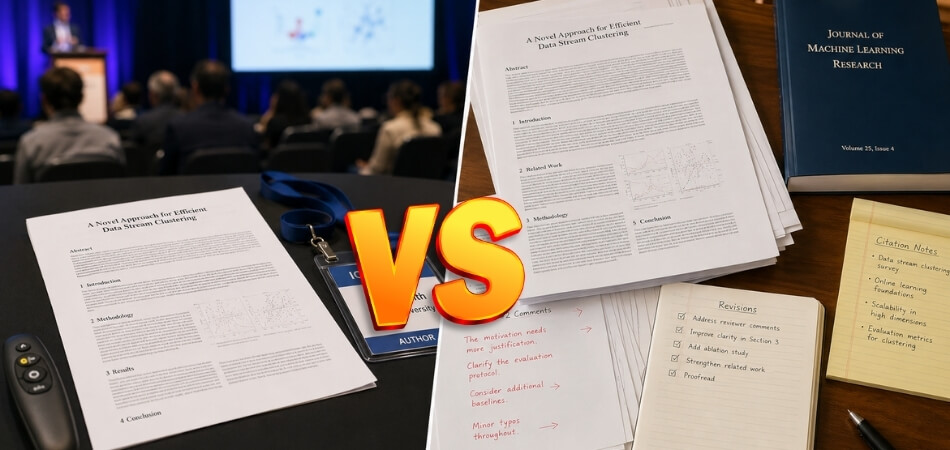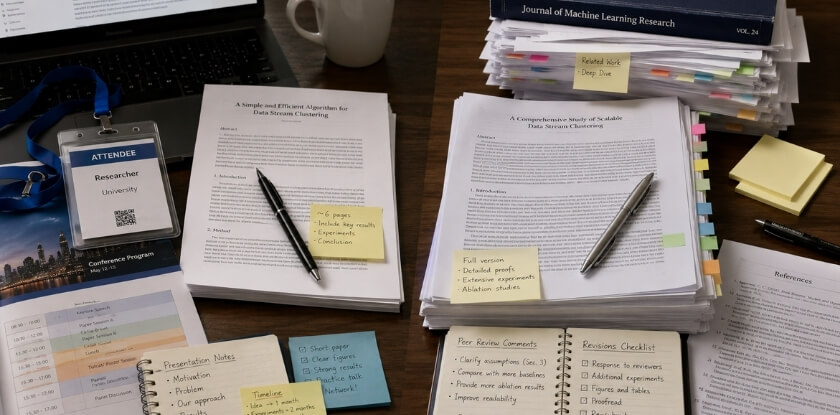
Your research is ready — but where do you submit it? A conference or a journal? It sounds like a straightforward logistics question, but for a PhD student staring down a committee deadline, an early-career researcher fielding hard questions from a supervisor, or an academic with a tenure review creeping closer on the calendar, it is one of the most consequential choices you will make about a piece of work. Get it wrong and you can waste months, miss a field’s key conversation, or land a publication that carries far less weight than you expected in the venues that actually matter — Scopus, Web of Science, or a discipline-specific index like PubMed or the ACM Digital Library.
Conference papers and journal papers are not interchangeable, and neither is universally better than the other. A conference paper typically goes through a faster, lighter peer review process — often two to four weeks for a decision — and results in published proceedings that can be cited almost immediately, but the work is usually shorter, presented in person, and carries a lower citation weight outside fields like Computer Science or Engineering, where venues such as NeurIPS, ICML, and CVPR rival top journals in prestige. A journal paper involves a deeper, multi-round peer review that can stretch from three months to over a year, produces a longer and more thoroughly scrutinized article indexed with a DOI across major databases, and typically earns stronger citation traction over time — though it demands more from authors and often comes with an Article Processing Charge (APC) for open access publication through publishers like Elsevier, Springer, or Wiley.
The right answer depends on your discipline, where you are in your career, and what you actually need this publication to do for you.
Conference Paper vs Journal Paper: Key Differences at a Glance
The honest answer most supervisors won’t tell you upfront: these two formats serve different purposes, and picking the wrong one for your research stage can quietly hurt your career. Here’s what actually separates them.

Peer Review Process
Journal peer review is thorough — sometimes brutal. You typically get two to four reviewers, multiple revision rounds, and the whole thing can stretch six months to two years before you see a decision. Journals indexed in Web of Science or Scopus hold reviewers to a higher standard of critique, which means your methodology gets scrutinized hard. That’s the point.
Conference peer review is faster and lighter. Most venues give each submission to two or three reviewers, with a single round of feedback. Top-tier Computer Science conferences like NeurIPS, ICML, and CVPR are genuine exceptions — their review processes rival many journals in rigor, and acceptance rates sit around 20–25% or lower. But most mid-tier conferences? The bar is lower.
Timeline From Submission to Publication
Journals: plan for 6–24 months. Some Elsevier and Springer journals have cut this with faster-track options, but don’t count on speed.
Conferences: 3–6 months from submission to presentation, including the event itself. If you need a publication on your CV before a grant deadline or Tenure Review panel, that timeline matters enormously.
One workaround researchers use: post a Preprint to arXiv or SSRN the same day you submit. Your idea is timestamped publicly while the formal process runs its course.
Length and Depth
Typical journal articles: 6,000–12,000 words. You have room to build a full literature review, justify your Research Methodology, and discuss limitations properly.
Conference papers are shorter — usually 4–10 pages in two-column format (common in IEEE and ACM Digital Library templates). That constraint forces you to present a focused contribution, often a proof-of-concept or preliminary finding, rather than a complete study.
Acceptance Rates
| Venue Type | Typical Acceptance Rate |
|---|---|
| Top CS conferences (NeurIPS, CVPR, ICML) | 15–25% |
| Mid-tier conferences | 30–50% |
| High-impact journals (Nature, Science) | <10% |
| Solid discipline journals (PLOS ONE, mid-tier Elsevier) | 20–50% |
These numbers aren’t fixed, but they give you a rough orientation. PLOS ONE evaluates scientific soundness rather than perceived impact, which pushes its acceptance rate higher than prestige journals.
Citation Weight and Indexing
This is where field matters enormously.
In Physics, Biology, and the Social Sciences, journal articles carry far more citation weight. Hiring committees and grant reviewers count journal publications first. Your h-index on Google Scholar will grow faster if your work lands in indexed journals rather than conference Proceedings.
In Computer Science and parts of Engineering, that logic flips. A paper in CVPR or NeurIPS Proceedings indexed in the ACM Digital Library or IEEE Xplore regularly outperforms journal citations. Researchers in these fields understand the culture.
For Humanities and qualitative Social Sciences, the picture is more fragmented. Conference papers often carry very little weight at all — a Book Chapter sometimes does more for your profile than a conference presentation.
Quick Comparison Table
| Factor | Journal Paper | Conference Paper |
|---|---|---|
| Peer review depth | High (2–4 reviewers, multiple rounds) | Moderate (2–3 reviewers, 1 round) |
| Timeline | 6–24 months | 3–6 months |
| Length | 6,000–12,000+ words | 4–10 pages (formatted) |
| Acceptance rate | 10–50% (varies widely) | 15–50% (varies widely) |
| Citation weight | High in most fields | High in CS/Engineering |
| Scopus/WoS indexing | Standard for ranked journals | Selective — varies by conference |
| Cost (Open Access) | APC: $500–$5,000+ | Registration fee: $200–$800+ |
| DOI assignment | Almost always | Usually, via Proceedings |
| Revision opportunity | Yes — often required | Rarely post-acceptance |
One thing the table can’t capture: the networking and visibility that come from presenting at a conference in person. That’s real, especially for PhD Students and Early-Career Researchers building their first connections in a field. A journal article sits on a server. A conference forces you into a room with people who might cite you, hire you, or collaborate with you later.
Both formats have a role. The question is which one fits where you are right now.
What Is a Conference Paper and How Does It Work?
Definition and Structure of a Conference Paper
A conference paper is a research paper submitted to an academic conference, presented there (usually in person), and then published in the conference’s Proceedings — a collected volume of all accepted papers from that event.
The structure looks familiar: abstract, introduction, methodology, results, discussion, references. Standard stuff. But the length is tighter than a journal paper. Most conferences cap submissions at 6–10 pages, though venues like IEEE and ACM sometimes allow extended versions up to 12 pages. You’re expected to make your point quickly.
In fields like Computer Science and Engineering, conference papers carry serious weight. NeurIPS, ICML, and CVPR papers are cited thousands of times — often more than journal papers in the same subfield. That’s not the case everywhere. In Biology, Humanities, and most Social Sciences, conferences are networking events first, publication venues second. Journal papers dominate those fields.
The DOI assigned to a conference paper is permanent and tied to the Proceedings volume. You’ll find most major conference papers indexed in Scopus, Web of Science, or the ACM Digital Library, depending on the publisher and indexing agreements. Google Scholar picks up nearly all of them regardless.
One thing PhD students often miss: once your paper appears in the Proceedings, it’s a published work. That matters later for self-plagiarism and double publication rules. You can’t quietly submit the same content to a journal without substantial expansion and disclosure.
The Peer Review Process: Conferences vs Journals
Conference peer review is faster and, in most cases, less thorough. That’s not an insult — it’s just the reality of the model.
Here’s how it typically works: you submit by a hard deadline, a Program Committee assigns two to four reviewers, and you get feedback within four to eight weeks. Reviewers are often PhD students or early-career researchers themselves, especially at mid-tier venues. There’s usually no revision round. Accept or reject, done.
Top-tier CS conferences are an exception. CVPR and NeurIPS run review processes that rival journals in rigor — multiple review rounds, author rebuttals, meta-reviews. Acceptance rates at these venues sit around 20–30%, sometimes lower. Getting in is genuinely hard.
Journal peer review is slower and more iterative. Expect at least one round of major revisions, sometimes two or three. The timeline from submission to acceptance runs anywhere from six months to two years, depending on the journal, the field, and whether reviewers keep dragging their feet. Elsevier, Springer, and Wiley journals vary enormously on this.
The practical difference: a conference gets you feedback and a publication in months. A journal gets you more thorough scrutiny and (usually) higher citation weight in the long run. Neither is objectively better. It depends on where you are in your career and what your field rewards.
Presentation Requirements and Proceedings Publication
Acceptance doesn’t mean automatic publication in most cases. You need to actually show up — or send someone from your team.
Most conferences require at least one author to register and present. If nobody presents, the paper gets pulled from the Proceedings. Registration fees can sting: IEEE and ACM conferences often run $500–$1,000 USD for student rates, higher for non-members. Add travel, accommodation, and visa costs if the conference is international, and you’re potentially looking at $2,000–$5,000 out of pocket or from grant funding.
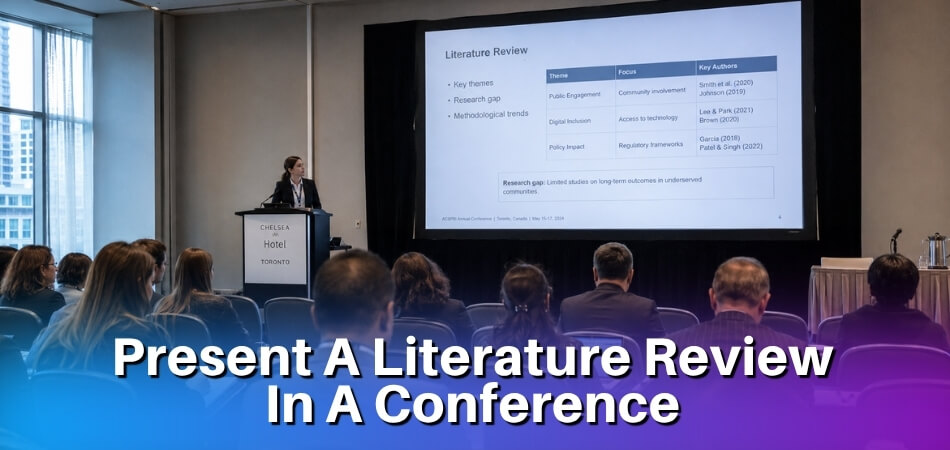
Presentation formats vary. You might give a 15-minute oral presentation with Q&A, or you might stand next to a printed poster for two hours answering questions from whoever stops by. Oral slots go to papers the committee considers higher-impact. Poster presentations are completely normal — don’t read anything negative into getting one.
After the conference, Proceedings are published either online immediately or within a few months. Many are hosted permanently on publisher platforms — IEEE Xplore, ACM Digital Library, Springer Link. Some are uploaded to arXiv as preprints before or after acceptance, which is standard practice in Computer Science and Physics.
Check the conference’s Open Access policy before you submit. Some require an Article Processing Charge (APC) for open access publication, some don’t. For anything unfamiliar, run it through Think Check Submit and verify it’s listed in a legitimate index rather than something on Beall’s List. Predatory conferences exist. They’ll take your money, publish anything, and the paper will count for nothing in a Tenure Review or grant application.
What Is a Journal Paper and How Does It Work?

Definition and Structure of a Journal Article
A journal paper is a full-length research article published in a periodical academic journal — something like Nature, PLOS ONE, or an Elsevier or Springer title indexed in Scopus or Web of Science. Unlike conference papers, journals aren’t tied to an event. They publish on a rolling or scheduled basis, and your work sits permanently in that journal’s archive with its own DOI.
The structure is more demanding than most conference formats. You’re typically looking at a full Introduction, Literature Review, Research Methodology section, Results, Discussion, and Conclusion — sometimes 6,000 to 12,000 words depending on the field. In Biology or Medicine, you’ll also include supplementary data, ethics statements, and conflict-of-interest disclosures. In Computer Science or Engineering, you might be expected to submit reproducibility materials alongside the manuscript.
The key distinction from a conference paper is scope. Journal papers are expected to present complete, self-contained research. Not a promising result. Not preliminary findings. The full story, with all the evidence.
Most journals also ask for structured abstracts, keyword lists, and increasingly — your ORCID identifier. That last part matters because it links your published output to your researcher profile permanently, across databases.
Peer Review Depth and the Revision Cycle
This is where journal publishing gets genuinely different. The peer review process at a reputable journal isn’t a two-week checkbox exercise. Expect two to four expert reviewers, detailed written critiques, and a revision process that can run through multiple rounds. A single submission can take anywhere from three months to well over a year from submission to acceptance.
The typical cycle goes like this: you submit, it goes to an editor who decides whether it’s even worth sending out for review (desk rejection is common — some journals reject 50–70% at this stage), then it goes to external reviewers, then you get a decision: accept, minor revisions, major revisions, or reject. Major revisions often mean going back to the same reviewers with a detailed response letter. That loop can repeat.
For PhD students, this process teaches you something conferences don’t. Responding to reviewer comments is a skill. You learn to separate your ego from your manuscript, address criticism methodically, and sometimes completely restructure an argument.
One thing worth watching: not all journals use the same review model. Single-blind (reviewers know who you are), double-blind (neither side knows), and open peer review (everything is public) are all common depending on the publisher and field. Wiley, Elsevier, and Springer each have journals using different models even within the same discipline.
If you’re unsure about a journal’s legitimacy, run it through Think Check Submit before submitting anything. Cross-reference with DOAJ for open access titles and check Beall’s List for predatory publishers. The revision cycle at a predatory journal won’t help your career — it’ll hurt it.
Impact Factor, Indexing, and Citation Weight
The Impact Factor (IF) is a metric published annually by Clarivate, calculated as the average number of citations received by articles in a journal over the previous two years. It’s imperfect. It’s gamed. And it still matters enormously in Tenure Review decisions, grant applications, and hiring committees in most fields.
A journal indexed in Web of Science with an IF above 5.0 carries real weight on a CV. One indexed only in Google Scholar — not Scopus, not Web of Science — carries much less. This isn’t opinion. It’s how most research evaluation systems are structured.
Indexing is the actual gatekeeping mechanism here. Being in Scopus or Web of Science means your article feeds into the Citation Index used to calculate h-index scores and institutional research rankings. If your paper isn’t indexed in those databases, it’s invisible to those metrics — even if people are reading it.
Open access journals complicate this picture in interesting ways. A paper in PLOS ONE — indexed in both Scopus and PubMed, fully open access under a Creative Commons License — can outperform a paywalled journal paper in raw citation counts simply because more people can read it. The Article Processing Charge (APC) for PLOS ONE is around $1,800 USD as of recent years, which is steep for early-career researchers without institutional funding.
arXiv and SSRN are different animals entirely. Posting a preprint there gets your work visible fast, but a preprint isn’t a published journal article. It hasn’t passed peer review. Listing it on your CV requires being clear about that distinction — conflating preprints with publications is the kind of thing that damages credibility during a Tenure Review.
Citation weight from journals also compounds over time in a way conference papers rarely do. A strong journal article in a high-IF publication can accumulate citations for a decade or longer. That sustained citability is what drives an h-index upward, which is why experienced researchers generally treat journal publications as the foundation of their academic output, not the supplement.
Field-Specific Differences — Which Publication Type Does Your Discipline Value More?
Publication norms vary dramatically by field. What counts as a strong publication record in computer science looks almost nothing like what hiring committees expect in history or sociology. Before you decide where to submit, you need to know the rules of your own discipline.
Why Conference Papers Outrank Journal Papers in Computer Science
This surprises a lot of people outside the field, but in computer science — especially machine learning, computer vision, and systems research — top conference papers often carry more weight than journal articles. The reason is speed. The field moves fast. A journal paper that takes 18 months to clear peer review might be citing work that’s already been superseded twice over.
Venues like NeurIPS, ICML, and CVPR have acceptance rates under 25%, sometimes closer to 15%. Getting a paper accepted at one of these is genuinely competitive. Researchers in the field know this. Hiring committees at top universities and research labs treat a NeurIPS paper the way other fields treat a high-impact journal publication.
IEEE and ACM Digital Library archive most of these proceedings formally, with DOIs and proper indexing in Scopus and Web of Science. So it’s not that conference papers are informal — they’re fully citable, permanently archived, and widely indexed. They just arrive faster.
If you’re a PhD student in machine learning or computer vision, your conference publication record is probably what gets you through the first filter in any academic job application. Journals matter too, but they’re rarely the headline item.
Which Is Preferred in STEM Fields Such as Engineering, Physics, and Biology?
It’s mixed, and the specific subfield matters more than the broad category.
In physics, journal papers dominate. Physical Review Letters, Nature Physics, and similar journals set the standard. That said, arXiv preprint culture is extremely strong — most papers get posted there immediately and the community reads them before formal peer review even starts. The journal publication still matters for your CV, but your actual scientific impact often spreads through arXiv first.
Engineering sits somewhere in between. Electrical and mechanical engineering have strong IEEE conference traditions. Civil and chemical engineering lean more toward journals. If you’re in a subfield with major annual conferences indexed in Scopus and Web of Science, those conference papers count seriously. If your field’s conferences aren’t particularly selective, journals are the safer bet for demonstrating quality.
Biology is mostly journal-first. PubMed indexing is essentially the gold standard for biomedical research. Publishers like Elsevier, Springer, and Wiley dominate, and journals like Nature or Science are the career-defining targets. PLOS ONE changed the landscape somewhat by introducing rigorous peer review without editorial judgment on novelty — useful for solid but incremental work. Conference papers exist in biology, but they rarely carry the same weight as a peer-reviewed journal article indexed in PubMed or Scopus.
One thing that cuts across all STEM fields: check where the top people in your specific subfield are publishing. Look up a few faculty members whose careers you want to emulate. Run their names through Google Scholar or check their ORCID profiles. See the mix. That tells you more than any general advice.
The Dominance of Journal Papers in Humanities and Social Sciences
Conference papers exist in humanities and social sciences, but they rarely function as the primary research output. A conference presentation is mostly a way to get feedback, network, and test ideas. The actual publication that goes on your CV — and that matters for tenure review — is the journal article or, in many humanities fields, the book.
In history, philosophy, and literary studies, a monograph from a reputable press outranks almost everything. Journal articles matter, but they’re often seen as stepping stones or standalone contributions that don’t reach the same prestige ceiling as a book. Conference papers are almost invisible in terms of career advancement.
Social sciences — economics, sociology, political science — are more journal-focused, but the journals carry enormous weight. Top economics journals like the American Economic Review have acceptance rates that make NeurIPS look generous. A single publication in one of these can define your early career. SSRN functions a bit like arXiv in these fields, hosting preprints widely before formal publication.
Citation metrics also work differently here. The h-index and Citation Index matter less in humanities than they do in science, partly because the citation culture is different. A book chapter might get cited far more than a journal paper in some corners of the field, and researchers track citations through Google Scholar rather than relying heavily on Scopus or Web of Science, both of which have historically had weaker humanities coverage.
If you’re in a social science field with strong quantitative traditions — economics, certain areas of psychology — the norms look more like STEM. If you’re in interpretive social sciences or any area of humanities, prioritize journals and books, and treat conference papers as development opportunities rather than outputs.
Conference Paper vs Journal Paper for PhD Students — Which Should You Choose?
The honest answer is: it depends on your field, your timeline, and what your department actually requires. But there are patterns worth knowing before you make the call.

Thesis Requirements and Supervisor Expectations
Most PhD programs don’t hand you a rulebook that says “publish X journal papers and Y conference papers.” Requirements are looser than people expect — and more political than people admit.
In Computer Science, many thesis committees are perfectly satisfied with a candidacy built entirely on conference papers. A first-author paper at NeurIPS, ICML, or CVPR carries more weight than a mid-tier journal paper in most CS departments. Your supervisor almost certainly knows this. If they’re pushing you toward conferences, there’s a reason.
In Engineering and Physics, the expectation usually tilts toward journal publications indexed in Scopus or Web of Science. A paper in an IEEE Transactions journal, for instance, will sit better on your thesis bibliography than a workshop paper — even if the workshop paper got more reads.
In Biology and Medicine, PubMed-indexed journals are the standard. Conference proceedings matter far less. If you’re writing a thesis in biomedical research and you’ve only got conference papers, your committee will notice.
Humanities and Social Sciences are different again. Book chapters, monographs, and peer-reviewed journal articles matter most. Conference papers are treated as works in progress, not finished outputs.
Before you submit anything, have a direct conversation with your supervisor about what the thesis examination committee will expect to see. Don’t assume. Ask specifically: “Does the department require journal publications for thesis submission?” Some do. Some require a minimum number of published or accepted journal articles before they’ll approve your defense date.
Also check whether your program allows a publication-based thesis (sometimes called a thesis by publication or paper-based thesis). If it does, the format of those papers — journal vs. conference — matters a lot. Most institutions that allow this route require peer-reviewed journal articles, not conference proceedings.
How Your Choice Affects Your Graduation Timeline
This is where things get real. Journal peer review is slow. Genuinely slow.
A typical journal submission at a mid-tier Elsevier or Springer journal takes 3–6 months just to get initial reviewer feedback. If you get a major revision decision, add another 2–4 months. Rejection with invitation to resubmit? Start the clock again. It’s not unusual to spend 12–18 months getting a single paper accepted.
Conference papers move faster. Submission to decision is often 2–3 months. You know exactly when the conference proceedings will be published because the conference date is fixed. If you’re accepted, your paper gets a DOI and appears in the ACM Digital Library or IEEE Xplore on a predictable schedule. That predictability matters when you’re trying to hit a defense deadline.
Here’s a scenario worth thinking through: you’re in your third year, your funding ends in 18 months, and your supervisor wants you to have at least two publications before the defense. Going exclusively for journal papers at that stage is a gamble. Conference submissions give you a faster feedback loop and a more controlled timeline.
That said, don’t confuse speed with ease. Acceptance rates at top-tier CS conferences like CVPR hover around 20–25%. You can still get rejected fast.
One practical option many PhD students use: submit to a conference first, get the paper out in proceedings, then expand it substantially for a journal version. This is legitimate as long as the journal version adds significant new content — new experiments, deeper analysis, extended methodology. Just be aware that some journals explicitly ask whether a prior version exists, and you need to disclose it. Submitting the same paper twice without disclosure is double publication, which is a form of self-plagiarism and can have serious consequences.
Why Conference Papers Offer Strategic Advantages for Early-Career Researchers
Conference papers do something journal papers can’t do quickly: they put you in a room with people who work on exactly what you work on.
Presenting at a conference — even a regional one — gets your name attached to your research in a way that a journal PDF sitting behind a paywall doesn’t. You talk to potential collaborators, future employers, postdoc supervisors. Networking isn’t a nice-to-have. For an early-career researcher, it’s part of the job.
Your h-index and citation count on Google Scholar build faster from conference papers in active communities. In CS fields especially, a well-placed conference paper can accumulate dozens of citations within a year. That citation velocity matters when you’re applying for postdocs or faculty positions and someone is reviewing your Google Scholar profile.
Conference deadlines also impose external structure on your work. That’s genuinely useful when you’re three years into a PhD and struggling to finish a paper. A hard submission deadline with a specific date forces you to close the loop on a project.
There’s also the arXiv factor. Most CS and Physics conference submissions go up as preprints on arXiv before or alongside the conference. This means your work is publicly accessible and citable before formal proceedings are published. Researchers can find it, cite it, and contact you about it. A journal paper under review at Elsevier, by contrast, is invisible until it’s accepted and published — sometimes for over a year.
For researchers in fields where Open Access matters to funders, conference proceedings through IEEE or ACM often have clearer licensing terms. Some are already open access by default. Journal papers frequently require paying an Article Processing Charge (APC) to make them open access — sometimes $2,000–$5,000 or more. If your grant doesn’t cover that, or if you’re self-funded, that’s a real barrier.
None of this means you should avoid journals. But if you’re early in your PhD and trying to build visibility, establish collaborations, and hit thesis requirements without blowing your timeline, strategic conference submissions aren’t a compromise. They’re a plan.
Citation and Indexing: How Conference Papers and Journal Articles Differ on Scopus, Web of Science, and Google Scholar
Where your paper gets indexed matters almost as much as where it gets published. A well-written paper sitting in an unindexed proceedings volume might as well be invisible to most researchers searching the literature.
The Basics of Indexing and Why It Affects You
Scopus and Web of Science are the two databases that most institutions, grant committees, and tenure review panels treat as authoritative. Both track citations and feed into metrics like your h-index. Getting indexed in either one isn’t automatic — the publication venue has to qualify first.
Google Scholar is different. It casts a much wider net, picking up conference papers, journal articles, preprints on arXiv or SSRN, theses, and even book chapters. Broader coverage sounds good, but it also means you can’t use Google Scholar alone to claim your work is “properly indexed.”
How Journal Articles Are Indexed
Most reputable journals published by Elsevier, Springer, Wiley, or IEEE are indexed in both Scopus and Web of Science. Open-access journals listed in the Directory of Open Access Journals (DOAJ) and journals like PLOS ONE are also indexed in Scopus. Nature and Science are indexed across every major database you can name.
Each indexed article gets a DOI, which creates a stable, citable identifier. That DOI ties into citation tracking across databases, so when someone cites your paper, it counts — in your h-index, in your institution’s research output metrics, everywhere.
The Impact Factor of a journal is calculated using Web of Science citation data. It has real consequences: some funding bodies and institutions in Engineering, Biology, and Physics explicitly require publications in journals with a minimum Impact Factor. That’s a system worth understanding before you submit anywhere.
How Conference Papers Are Indexed — And Where It Gets Complicated
This is where things vary a lot by field. In Computer Science, major conference proceedings from venues like NeurIPS, ICML, and CVPR are indexed in Scopus and Web of Science. An accepted paper at CVPR carries serious citation weight. The ACM Digital Library and IEEE Xplore both feed into Scopus indexing.
But not all conference proceedings make it in. A regional conference that publishes its own PDF proceedings with no DOI? That probably won’t appear in Scopus at all. Google Scholar might pick it up, but Scopus and Web of Science likely won’t.
In Humanities and Social Sciences, conference papers rarely get indexed in either database. Most citation tracking in those fields runs through Google Scholar, JSTOR, and discipline-specific databases instead.
Before you submit to any conference, check whether its proceedings are indexed. Go directly to the Scopus source list or the Web of Science master journal list and search for the conference. Don’t rely on what the conference organizers claim in a call for papers — verify it yourself.
The Citation Gap in Practice
Journal articles generally accumulate more citations over time than conference papers, even in Computer Science. Journal versions of a paper get cross-referenced in systematic reviews, meta-analyses, and literature surveys more often because those searches typically filter by journal sources.
There’s a common pattern in CS and Engineering: researchers post a preprint on arXiv, present at a conference like NeurIPS, and then publish an extended version in a journal. The journal version then picks up the bulk of long-term citations. Both exist, both count, but they serve different stages of the research lifecycle.
This is why Self-Plagiarism and Double Publication rules matter here. If you publish a conference paper and then submit a substantially similar journal article without clearly disclosing the relationship, that’s an ethical problem. Most journals now explicitly require you to declare prior conference presentations. Extended versions need to add meaningful new content — typically 30% or more new material is the informal benchmark you’ll see editors reference.
What Shows Up in a Tenure Review or Grant Application
When a Tenure Review committee or grant evaluator pulls your publication record, they’ll usually look at Scopus or Web of Science first. Conference papers that aren’t indexed in those databases may not appear in automated counts at all — even if they’re important papers in your field.
Some institutions accept ACM and IEEE conference papers as equivalent to journal publications for faculty evaluation. Most don’t. Know which category your institution falls into before you spend six months writing a conference paper that won’t move your metrics.
Registering your ORCID and keeping it current connects your work across databases and catches papers that might otherwise be attributed incorrectly. It’s a small admin task with real long-term value for your citation record.
Preprints and Citation Counting
Posting to arXiv before formal publication can generate citations before your paper officially appears anywhere. Those preprint citations show up in Google Scholar and sometimes in Scopus, depending on how citing authors formatted their references.
Be aware that arXiv isn’t peer-reviewed. It’s a preprint server. If your field expects peer-reviewed publications — and most do for career advancement — a paper that only exists on arXiv doesn’t fully count. It helps with visibility. It doesn’t substitute for formal publication in a peer-reviewed journal or indexed conference.
A Quick Checklist Before Submitting Anywhere
- Search the Scopus source list and Web of Science master list before submitting to a conference or journal.
- Use SHERPA/RoMEO to check what version of your paper you can share publicly after publication (preprint, postprint, or published PDF).
- If a journal or conference isn’t on either major database but claims to be “indexed,” cross-reference with Think Check Submit and check Beall’s List for predatory publisher warnings.
- DOAJ is worth checking for open-access journals that are genuinely indexed and not predatory.
Indexing isn’t the only thing that matters, but it’s the thing most researchers underestimate when they’re early in their careers. A paper in the wrong venue can disappear from the literature in ways that a paper in the right venue simply won’t.
Publication Cost Comparison — Article Processing Charges vs Conference Registration Fees
Money is often the deciding factor, and nobody talks about it honestly enough. Let’s fix that.
How Much Do Journal Article Processing Charges (APCs) Actually Cost?
If you’re submitting to a fully open access journal, you’re almost certainly paying an Article Processing Charge (APC). The range is enormous — and often shocking for first-time authors.
At the lower end, PLOS ONE charges around $1,800 USD. Mid-range open access journals from Springer or Wiley typically run $2,000–$3,500. Nature’s flagship open access option, Nature Communications, sits at roughly $6,790 as of 2024. Some high-tier journals from Elsevier push past $5,000 for certain titles.
These aren’t processing fees in the traditional sense. You’re essentially paying for the open access publishing model — where anyone can read your work under a Creative Commons License without a paywall.
Hybrid journals complicate this further. A hybrid journal is a subscription-based journal that also offers an open access option for individual articles. You can publish for free if you’re okay with the article sitting behind a paywall. If you want it openly accessible, you pay the APC anyway. Many researchers don’t realise they have this choice until it’s too late.
Subscription-model journals — the traditional kind — charge nothing upfront. You submit, go through Peer Review, and if accepted, it’s published at no cost to you. The journal makes money through institutional subscriptions. This is still the norm in fields like Physics, the Humanities, and parts of Biology. Your university library essentially pays on your behalf.
The Impact Factor doesn’t correlate cleanly with APC cost, by the way. Some mid-impact journals charge more than high-impact ones, simply because of their open access business model.
One thing worth checking before you submit anywhere: look up the journal on SHERPA/RoMEO. It tells you what versions of your work you can legally share (Preprint, Postprint, or publisher PDF), which affects your distribution options even after you’ve paid — or not paid.
Breaking Down Conference Registration and Travel Costs
Conference costs are less visible on paper but hit harder in practice.
Registration fees for a major international conference — think IEEE, ACM Digital Library events, NeurIPS, ICML, or CVPR — usually fall between $500–$1,200 for a standard registration. Student rates often cut this roughly in half, so $300–$600 is realistic if you qualify. Some smaller regional conferences charge under $200.
That’s just registration. Add flights, accommodation, and food for a 3–4 day conference in a major city, and you’re looking at $1,500–$4,000 for a North American or European venue. A trip to Asia or Australia from Europe or the US can push this to $3,000–$6,000 all in.
So in many cases, attending a conference costs more than publishing open access — it’s just less obvious because the costs are spread across different budget lines.
PhD Students often rely on departmental travel grants, supervisor funding, or national research grants to cover this. Early-Career Researchers at institutions with limited research budgets frequently have to decline invitations entirely. Presenting your paper via the Conference Proceedings but not attending in person is sometimes allowed, but many conferences require at least one registered author to present — either physically or virtually.
Virtual conferences, which became common post-2020, have changed this calculation significantly. Registration-only costs with no travel can drop total expenses to $200–$600. But the networking value drops too. Depends what you’re optimising for.
One cost people miss: if you present at a conference and then publish an extended version in a journal, you need to be careful about Self-Plagiarism and Double Publication policies. Some journals require the conference version to be cited, and others require at least 30–50% new content. Overlooking this doesn’t just cause ethical problems — it can lead to retraction, which is expensive in a different way entirely.
Open Access Alternatives and Fee Waiver Policies
You don’t always have to pay, even for open access.
Most major publishers — Elsevier, Springer, Wiley — have formal APC waiver or discount programmes for researchers from low- and middle-income countries. These are based on the Research4Life initiative and World Bank country classifications. If your institution is in a qualifying country, you can often get a full or partial waiver. You need to apply for it explicitly during submission; it doesn’t happen automatically.
Some journals have institutional agreements through your university library. These “read and publish” or “transformative agreements” mean your institution has pre-paid for a number of open access publications per year. Check with your library before assuming you need to pay out of pocket. Many researchers miss this entirely.
arXiv and SSRN are free. Full stop. You post a Preprint, it gets a DOI (or arXiv identifier), and your work is immediately available. It doesn’t replace formal peer-reviewed publication, but it gets your research into circulation fast — and it’s indexed by Google Scholar. For Computer Science and Physics especially, arXiv preprints get cited before the final journal version even appears.
For identifying legitimate open access journals without surprise fees, the Directory of Open Access Journals (DOAJ) is your baseline check. If a journal claims to be open access but isn’t listed there, treat that as a red flag. Cross-reference with Think Check Submit and scan Beall’s List if something feels off about the solicitation you received.
ORCID won’t save you money, but registering for a free ORCID iD means all your publications — whether they’re in Scopus, Web of Science, PubMed, or just on arXiv — get tracked under one persistent identifier. Useful when a Tenure Review committee is assessing your output and you need a clean publication record without chasing down citations manually.
Bottom line: the cheapest route is a no-APC subscription journal or a free preprint server. The most expensive is a top-tier open access journal combined with an in-person international conference. Most researchers end up somewhere in the middle, and the right answer depends almost entirely on your funding situation and what your field actually values.
Copyright and Self-Archiving Policy — Preprints, Postprints, and Your Rights as an Author
Most researchers sign away more rights than they realize. When you submit to a journal or a conference, you’re typically handing over copyright to the publisher — and the terms vary wildly depending on who that publisher is.
Understanding what you can legally do with your own work after publication isn’t just an academic exercise. It affects whether your paper is discoverable, whether you can share it with collaborators, and whether you can post it on your personal site without getting a takedown notice.
Preprints vs. Postprints — What’s the Difference?
These terms are used interchangeably and incorrectly all the time, so let’s be precise.
A preprint is the version of your paper before peer review — essentially, the manuscript you submitted. Posting a preprint to arXiv or SSRN before journal submission is common in physics, computer science, economics, and increasingly in biology. It doesn’t count as prior publication in most cases, but you should check the journal’s policy first.
A postprint (also called the accepted manuscript) is the version after peer review and revision, but before the publisher applies their formatting and typesetting. This is the version most publishers will allow you to self-archive — often with a 6- to 12-month embargo.
The version of record is the final formatted PDF with the journal’s branding, DOI, volume, and page numbers. That’s what publishers guard most fiercely. You generally cannot post this version on a public repository without explicit permission.
Conference Papers and Self-Archiving
Conference papers are actually more permissive than many researchers assume. IEEE and ACM Digital Library — two of the biggest venues in computer science and engineering — allow authors to post the accepted manuscript on personal or institutional websites and on arXiv. IEEE calls this the “Author’s Accepted Version.” ACM updated its policy in 2019 to allow open access posting of the accepted manuscript immediately, with no embargo.
For fields like machine learning, this matters a lot. Papers from NeurIPS, ICML, and CVPR are routinely posted on arXiv before the conference happens. That’s not an accident — it’s standard practice, and those venues explicitly support it.
Journal Papers — Publisher Policies Vary Enormously
Elsevier, Springer, and Wiley all have different policies, and even within those publishers, individual journals may have separate rules. This is where SHERPA/RoMEO becomes essential.
SHERPA/RoMEO (sherpa.ac.uk/romeo) is a database that tells you exactly what each journal allows: can you post the preprint? Can you post the postprint? Is there an embargo? Is posting in a repository allowed? Check it before you sign anything.
General patterns worth knowing:
- Elsevier typically allows preprint posting and postprint posting after a 12-month embargo for most journals. The version of record is not allowed.
- Springer (now Springer Nature) allows postprint posting after embargo, and many of their journals are on Green Open Access.
- Wiley allows postprint self-archiving after 12 months for most journals.
- PLOS ONE is fully Open Access under a Creative Commons License (CC BY 4.0), so you can post the version of record anywhere, immediately.
Nature and Science have their own distinct policies. Nature journals allow posting of the accepted manuscript on preprint servers and institutional repositories after a 6-month embargo (some journals). Always verify — these change.
Open Access, APCs, and What You Actually Own
If you pay an Article Processing Charge (APC) for Gold Open Access, you typically retain copyright under a Creative Commons License. This means the paper is publicly accessible, you can reuse it, and others can too (within the license terms). You’re paying for immediate open availability, not for rights — those you already have under the CC license.
If you publish traditionally (no APC, paywalled), you’ve almost certainly signed a copyright transfer agreement. That means the publisher owns the paper. You can share it under their specific conditions, but you can’t just post the PDF wherever you want.
The arXiv Question
arXiv is not just a physics repository anymore. It’s the de facto preprint server for computer science, mathematics, quantitative biology, and increasingly other fields. Posting to arXiv gets your work indexed on Google Scholar within days and establishes a timestamp on your ideas.
SSRN serves a similar function for economics, social sciences, and law.
Neither arXiv nor SSRN is peer-reviewed. Don’t confuse preprint visibility with publication credit — a paper on arXiv does not count as a published paper on your CV, even if it gets cited. But it does help your h-index on Google Scholar, since Google Scholar picks up citations to preprints.
Self-Plagiarism and Double Publication
This comes up more than it should. You cannot publish the same work twice as if it’s two original contributions. Extending a conference paper into a full journal article is fine — and common practice in CS and engineering — but there must be substantial new content. Usually 30% or more new material is the informal threshold, though journals don’t publish a fixed number.
Be transparent. Cite your own conference paper in the journal submission and explain what’s new. Many journals require you to disclose prior conference presentation. Failing to do this is considered double publication, which is a research ethics violation. Some publishers check via Crossref and iThenticate automatically.
ORCID and DOI — Keep Your Records Clean
Register for an ORCID if you haven’t already. It’s free, takes five minutes, and permanently links your publications to you regardless of name changes, institutional affiliations, or journal transfers. Every paper you publish should eventually be connected to your ORCID profile.
Every formally published paper gets a DOI. Preprints on arXiv also get DOIs now. When citing your own work or tracking where it gets cited, the DOI is what makes it trackable across Scopus, Web of Science, and citation databases.
Checking Whether a Journal Is Legitimate
Before you submit anywhere you’re not familiar with, run it through Think Check Submit (thinkchecksubmit.org). It’s a straightforward checklist that helps you identify predatory publishers. You can also check Beall’s List (though it’s no longer officially maintained, archived versions still circulate) and the Directory of Open Access Journals (DOAJ) for verified legitimate Open Access venues.
Legitimate journals don’t spam you with unsolicited invitations to submit. If an email lands in your inbox promising fast peer review and asking for a paper within two weeks, be skeptical.
Before you submit anywhere: check SHERPA/RoMEO for self-archiving rights, read the copyright transfer agreement before signing, and consider posting a preprint to arXiv or SSRN to establish your timestamp. Know the difference between your preprint, your postprint, and the version of record. And if you’re extending a conference paper into a journal article, disclose it upfront — it protects you.
Your rights as an author aren’t just legal formalities. They determine whether your work reaches people or sits behind a paywall that most researchers can’t access.
How Conference Papers and Journal Articles Affect Career Advancement — Tenure, Promotion, and Hiring
Your publication record doesn’t just demonstrate research activity — it directly shapes how hiring committees, tenure boards, and grant panels judge your potential. And the weight they give to conference papers versus journal articles varies enormously depending on your field, your institution, and even the country you’re working in.
What Hiring Committees Actually Look At
When a search committee reviews your CV, they’re rarely counting publications in the abstract. They’re looking at where you published, who cited you, and whether your work appears in venues that people in the field actually respect.
In Computer Science, a single paper at NeurIPS, ICML, or CVPR often carries more hiring weight than three or four journal articles at mid-tier venues. This isn’t an informal understanding — it’s baked into how CS departments structure their evaluation criteria. Selective top-tier conferences have acceptance rates below 20%, sometimes below 15%, and committees know it. Your h-index matters, but the venue reputation matters just as much at the point of hire.
In Biology, Engineering (non-CS), Physics, and most of the Humanities and Social Sciences, the expectation runs the other way. Journal papers indexed in Scopus or Web of Science — especially those carrying a solid Impact Factor — are the standard unit of academic currency. A strong publication in Nature, Science, or a well-regarded Elsevier or Springer journal signals that your work survived rigorous, extended peer review. Conference papers in these fields are generally treated as supplementary evidence, not primary output.
If you’re applying for positions across disciplines or at institutions with different traditions, check what the job ad actually says. Some postings specify a requirement for “peer-reviewed journal publications.” That language is usually not an accident.
Tenure and Promotion: Where the Stakes Get Real
Tenure review processes are conservative by design. Most institutions assess you against a defined benchmark — and that benchmark is almost always weighted toward journal articles in recognized venues.
In the United States, tenure dossiers typically require external reviewers to evaluate the significance of your work. Those reviewers are going to cite Web of Science citation counts, Impact Factor, and whether your papers appear in journals the field treats as authoritative. A pile of conference papers, even good ones, doesn’t substitute for journal articles in most non-CS tenure cases.
In Computer Science departments, including those inside engineering schools, the situation is more nuanced. Some tenure committees have updated their criteria to explicitly recognize top-tier conference publications. Others haven’t. You need to know which type of department you’re in before you start building your pre-tenure publication strategy.
One practical move: look at the CVs of people who recently earned tenure at your institution or comparable institutions. Where did they publish? That’s more reliable than anything written in a faculty handbook.
Promotion Beyond Tenure
Once you’re past tenure, the calculus shifts slightly. You’re no longer just proving you can produce research — you’re demonstrating impact. This is where citation counts, h-index, and indexing in Scopus or Web of Science become even more prominent. Journal articles accumulate citations over a longer window than conference papers in most disciplines. They also get indexed more reliably, which matters for grant panels who query Citation Index databases to assess your track record.
That said, prolific publication in respected conference series can build an impressive citation profile in CS and related fields. Papers indexed in the ACM Digital Library or IEEE Xplore are citable, discoverable, and often heavily cited. Researchers with strong h-indexes built substantially on conference publications do get promoted.
Grant Funding and Research Assessment
National research assessment exercises — the UK’s REF, Australia’s ERA, and equivalent frameworks in other countries — have their own rules about what counts. Some explicitly value journal articles over conference papers. Others evaluate quality and impact regardless of venue type. Check the specific framework for your country.
For grant applications, funding bodies often ask you to list your five most significant publications. Choose strategically. If your best work is a conference paper with 200 citations tracked on Google Scholar, that may outperform a journal article with 15 citations in a niche venue. Concrete citation evidence helps here regardless of format.
Early-Career Researchers: Getting the Balance Right
If you’re an early-career researcher or PhD student, the honest answer is you probably need both — but in the right proportion for your field.
Conferences build your network fast. You present, you get feedback, people know your name. That matters for hiring because academic hiring has a significant informal component. But if your publication list is all conference papers in a journal-dominant field, you’re going to struggle to compete against candidates with solid journal records.
A reasonable working approach for most non-CS fields: aim for at least two to three strong journal articles before your thesis defense if you can. In CS, a couple of top-tier conference papers and one good journal article covers most bases.
One thing that trips people up: self-plagiarism and double publication. You cannot publish the same core research in a conference proceedings and then republish substantially the same material in a journal without major new contribution and proper disclosure. Journals check this. Some use similarity-detection software. The academic term is “duplicate publication,” and it’s a career risk that’s not worth taking. Expanding a 6-page conference paper into a full journal article with new experiments and analysis is usually fine — but copying is not. Check the journal’s policy explicitly, and read up on SHERPA/RoMEO to understand what’s permitted for self-archiving and follow-on publication.
The Preprint Question
Posting to arXiv or SSRN before formal publication has become standard in many fields. It establishes priority, attracts early citations, and lets your work circulate while it’s still in review. From a career standpoint, preprints can help — but they don’t replace journal or conference publications on your CV. Committees want to see peer-reviewed output. A preprint that’s been sitting on arXiv for two years without conversion to a formal publication may actually raise questions rather than answer them.
Register your ORCID and make sure all your publications — conference papers, journal articles, preprints, book chapters — are linked to it. Hiring committees and funding panels increasingly use ORCID records to verify publication history, and having a clean, consistent record with proper DOI links for each item looks professional.
There’s no universal answer. Field norms dominate. What matters is understanding the specific expectations of the jobs you’re applying for, the tenure track at your institution, and the funding bodies you depend on — and then publishing accordingly. Gut-checking that understanding against the actual CVs of successful people in your position is more reliable than any general advice, including this.
How to Convert a Conference Paper into a Journal Paper
Most conference papers aren’t finished work. They’re snapshots — early results, proof-of-concept findings, or work that ran into a page limit before it could breathe properly. Converting one into a full journal article is a completely normal part of academic publishing, but you need to do it carefully or you’ll run into serious problems.
What Types of Conference Papers Are Suitable for Journal Submission?
Not every conference paper deserves a journal version. Some genuinely don’t have enough material to expand without padding.
The best candidates share a few traits. The conference paper reported preliminary or partial results and the full study is now complete. Or the methodology was solid but the evaluation was limited — one dataset, a small sample, a narrow set of comparisons. These gaps are exactly what a journal reviewer will ask you to fill.
Papers from major venues like NeurIPS, ICML, or CVPR in Computer Science often fall into this category. You submitted a 9-page paper, you got useful reviewer feedback, and now you have six more months of experiments sitting on your hard drive. That’s a journal paper waiting to happen.
Conference papers that work poorly as journal conversions are usually ones that were already comprehensive — conference venues like some IEEE and ACM Digital Library tracks allow longer formats, and if you essentially published your full study at the conference, there’s little honest ground left to cover.
Ask yourself one question: can you add at least 30–40% genuinely new content? If the answer is no, don’t force it.
A Step-by-Step Expansion Strategy Covering Length, Literature Review, and Methodology

Step 1: Read the target journal’s scope and word count first.
Before you touch your conference paper, pick a journal. Elsevier, Springer, Wiley, and PLOS ONE all have different expectations. A journal in Electrical Engineering won’t accept the same structure as one in Social Sciences. Check the author guidelines for length requirements — most full journal articles run 6,000–10,000 words, sometimes more.
Step 2: Audit what’s actually thin in your conference version.
Typical weak spots: the literature review (conference papers almost always cut this down), the methodology section (often abbreviated due to page limits), the results (fewer experiments, smaller datasets), and the discussion (usually one paragraph, if you’re lucky).
Write a list. Be honest. “My related work section covers 12 papers but the journal version needs 30–40” is a real and fixable gap.
Step 3: Expand the literature review properly.
This isn’t about adding citations to hit a number. Search Scopus, Web of Science, and Google Scholar for work published after your conference submission date. There’s almost always something new. Update your discussion of existing work so it reflects the current state of the field, not the state it was in when you wrote the conference version.
Step 4: Extend your methodology or experiments.
This is the core expansion. Add more experiments, test on additional datasets, run ablation studies you didn’t have time for, or extend your theoretical framework. In Biology and Physics, this might mean additional trials or extended data collection. In Humanities or Social Sciences, it might mean additional case studies or a more rigorous theoretical treatment.
Reviewers at journals like Nature or Science will tear apart a thin methodology section. Don’t leave that door open.
Step 5: Rewrite, don’t paste.
This is where people get into trouble. You cannot copy your conference paper wholesale into the journal submission. Rewrite each section even when the content is similar. More on why in the next sub-section.
Step 6: Handle the preprint and prior publication disclosure.
If you posted to arXiv or SSRN before or after the conference, note this in your cover letter. Many journals are fine with it, but they need to know. SHERPA/RoMEO is a practical tool for checking what your conference’s publisher allows you to reuse.
Step 7: Write a clear cover letter.
Tell the editor directly: this work extends a conference paper published in [Conference Name] [Year]. Explain specifically what is new — in concrete terms, not vague gestures. “We have added three new experiments, expanded the related work from 12 to 35 papers, and included a theoretical proof not present in the prior version” is the right kind of statement.
How to Avoid Double Publication and Self-Plagiarism
Double publication means submitting the same work to two places and presenting it as two separate original contributions. Self-plagiarism means reusing your own previously published text without attribution. Both are taken seriously by journal editors, and both can result in retraction.
The core rule is simple: the journal version must be substantially new work. Most publishers define “substantial” as at least 30% new content, though this isn’t a universal standard. IEEE and ACM Digital Library both have explicit policies on this — check them for your specific venue.
The practical traps to watch for:
- Your methods section. It’s tempting to copy-paste your experimental setup because “the methodology didn’t change.” Rewrite it. Paraphrase your own prior description, add more detail, and cite the conference paper as prior work.
- Your results. If you’re reporting the same results that appeared in the conference proceedings, cite the conference paper. Don’t present them as new findings. New experiments sit alongside — and build on — the old ones.
- Your introduction and conclusion. These are the most likely places for unconscious self-plagiarism. The framing of the problem, the contribution statements, the takeaways — rewrite all of it.
Tools like iThenticate will flag your own previously published text. Many journals run submissions through it automatically. Don’t assume you’re safe just because you wrote it yourself.
One structural move that helps: make the conference paper a named, cited reference in your journal submission. Put it in the related work section or the introduction. Say explicitly: “This paper extends our earlier work presented at [Conference] [Citation], with the following new contributions.” That transparency tells editors and reviewers exactly where you’re starting from and makes the line between old and new work visible to everyone.
Getting this conversion right isn’t complicated. It just requires honesty about what’s actually new, enough additional work to justify a full journal article, and clean attribution of the prior conference version.
Conference Paper vs Journal Paper vs Book Chapter — A Three-Way Comparison
Most guides treat this as a binary choice. It isn’t. Book chapters are a real third option, and for certain researchers in certain fields, they’re actually the most sensible route. Understanding where all three sit relative to each other saves you from making a decision based on incomplete information.
What a Book Chapter Actually Is
A book chapter is a contribution to an edited volume — a collection assembled by one or more editors, published by an academic press like Springer, Wiley, or Elsevier. You write a chapter, the editors review it (sometimes with external peer review, sometimes without), and it gets published alongside chapters from other authors.
The peer review process here is inconsistent. Some edited volumes run rigorous double-blind review. Others involve minimal editorial oversight. Unlike a journal paper or even a conference paper submitted to something like NeurIPS or CVPR, there’s no standardized process you can point to. That variability matters when someone evaluates your CV.
Peer Review Comparison
| Publication Type | Peer Review Standard | Transparency |
|---|---|---|
| Journal Paper | Usually rigorous, 2–3 reviewers | High — indexed, traceable on Scopus or Web of Science |
| Conference Paper | Varies widely; top CS venues are competitive | Medium — proceedings are indexed, but review quality differs |
| Book Chapter | Inconsistent; editor-dependent | Low — often not independently indexed |
Journal papers win on credibility of review, almost across the board. Conference papers at established venues like ICML or IEEE flagship conferences come close. Book chapters are genuinely a mixed bag.
Indexing and Discoverability
This is where book chapters fall behind. Journal articles get DOIs, appear in PubMed for life sciences, get indexed in Web of Science and Scopus, and surface readily in Google Scholar. Conference papers — at least from indexed proceedings — also get DOIs and appear in ACM Digital Library or IEEE Xplore.
Book chapters? It depends entirely on the publisher and the specific volume. Some Springer handbooks are well-indexed. Others are nearly invisible. You might pour six months into a chapter that three people ever find.
Check whether the volume will appear in Scopus or Web of Science before you commit. Don’t assume.
Citation Counts and h-index Impact
Citations are currency, especially early in your career. Journal papers consistently attract more citations because they’re easier to find and link to. Conference papers in CS and Engineering accumulate citations quickly — a well-placed paper at CVPR can outperform a mid-tier journal paper within two years.
Book chapters tend to get cited less. Not because the content is weaker, but because discoverability is lower. If someone can’t find your chapter through their institutional database, they cite someone else.
For your h-index, journal papers are the safest long-term bet. For fast-moving fields, conference papers are legitimate competitors. Book chapters rarely move the needle.
Timeline: A Practical Breakdown
- Conference paper: Submit, get reviews in 6–10 weeks, revise, publish in proceedings within 3–6 months total.
- Journal paper: Submission to acceptance can take 6 months to 2+ years. Some journals at Elsevier and Wiley drag on considerably.
- Book chapter: Usually invitation-based, often with 12–18 months from commission to publication. The editor’s schedule controls your timeline entirely.
If you need something on your CV fast — before a Tenure Review, a job application, or the end of your PhD — a book chapter is almost never the answer.
Cost Comparison
Journal papers often carry an Article Processing Charge (APC) if you’re going Open Access. At PLOS ONE, that’s around $1,800. At Nature or high-tier Elsevier journals, APCs can hit $5,000+.
Conference papers usually require registration fees rather than publication fees, though some hybrid models are creeping in.
Book chapters are typically unpaid in both directions — you don’t pay to publish, and you don’t get paid to write. Your compensation is supposed to be the exposure. Given the indexing issues, weigh that carefully.
When a Book Chapter Actually Makes Sense
There are legitimate cases. In Humanities and Social Sciences, book chapters carry more weight than in STEM — hiring committees in those fields often value them seriously. An invitation to contribute to a well-regarded edited volume from Oxford University Press or Cambridge University Press is worth considering.
Book chapters also work well for synthesizing work you’ve already published. You’re not introducing new findings — you’re contextualizing them for a broader audience. That’s a reasonable use of your time, especially if the volume has strong editors and genuine readership.
Just watch for Self-Plagiarism risks. If you’re drawing heavily from published conference or journal papers, check your overlap carefully. Double Publication concerns apply here just as they do elsewhere. Tools like SHERPA/RoMEO can help you understand what you’re allowed to reuse from your own prior work.
The Quick Decision Matrix
- Need citations and career visibility fast → Conference paper (if your field values them) or journal paper
- Need to establish a finding with full peer-reviewed rigor → Journal paper
- Invited to contribute and the volume is genuinely prestigious in your field → Book chapter
- Want to synthesize existing work for a new audience → Book chapter (with plagiarism checks)
- Just starting your PhD and need indexed output → Skip the book chapter for now
Whatever you choose, register your ORCID and make sure it’s linked to your outputs. When your papers appear across Scopus, arXiv, and ACM Digital Library with no consistent author identifier, citations scatter and don’t aggregate to your profile. That’s a fixable problem, and it’s worth fixing early.
How to Identify Predatory Conferences and Predatory Journals
Predatory publishers are a real problem, and they’ve gotten better at looking legitimate. A slick website and an ISSN number don’t mean much anymore. If you publish in the wrong place — even once — it can follow you through a hiring committee review or a Tenure Review conversation in ways that are genuinely hard to recover from.
Here’s how to protect yourself.
Warning Signs of a Predatory Conference
The easiest tell: you got an unsolicited email inviting you to present, and the flattery was unusually thick. “We reviewed your outstanding work and believe you’d be a perfect keynote speaker.” You’ve never met these people. That’s the starting point for skepticism.
Beyond the spam invitation, watch for these:
- Vague or implausible scope. A single conference claiming to cover “all areas of engineering, science, humanities, and social sciences” isn’t a real academic community. It’s a fee-collection operation.
- No verifiable Program Committee. Legitimate conferences — IEEE symposia, ACM Digital Library-indexed events, NeurIPS, ICML, CVPR — publish their organizing committee with real institutional affiliations you can check. If the committee members don’t exist on their university websites, or if their photos appear on a reverse image search as stock photos, stop there.
- Proceedings that aren’t indexed anywhere. Ask directly: will these Proceedings appear in Scopus, Web of Science, or the ACM Digital Library? If the answer is vague or changes, that’s your answer.
- Extremely fast “peer review.” You submit on a Monday and receive acceptance by Wednesday with no reviewer comments. That’s not peer review. That’s a receipt.
- Location hopping and suspiciously generic names. “International Conference on Advanced Research in Science and Technology” held in a different city every six months, with a website registered three months ago.
Registration fees for real conferences cover logistics, AV equipment, catering, and proceedings publication. Predatory conferences charge similar fees but deliver nothing of scholarly value. You pay to get a DOI attached to work that carries zero academic weight.
Warning Signs of a Predatory Journal
Predatory journals have refined their appearance considerably. Some now mimic legitimate publishers closely enough that researchers with less experience get caught.
- Unsolicited email with a tight deadline. “Submit your manuscript by Friday for inclusion in our upcoming special issue.” Legitimate journals like those published by Elsevier, Springer, Wiley, or through PLOS ONE don’t cold-email researchers with countdown timers.
- Fake or exaggerated Impact Factor claims. An Impact Factor is a registered metric tracked by Clarivate Analytics through Web of Science. If a journal claims an “Impact Factor” of 4.7 but isn’t listed in the Journal Citation Reports, that number is fabricated. Some predatory journals invent their own “impact factor” under different names. Always verify through the actual Journal Citation Reports database.
- No clear peer review process described. Legitimate journals explain their review process — single-blind, double-blind, open review. If you can’t find any description of how manuscripts are evaluated, that’s a red flag.
- APC demanded immediately after submission. The Article Processing Charge (APC) for Open Access journals is real and common — Nature, PLOS ONE, and many Springer journals charge APCs. But a legitimate journal tells you the fee upfront and only invoices after acceptance. A predatory journal asks for payment before peer review even begins.
- Scope that covers everything. “Journal of Science, Technology, Arts and Humanities Research” accepting manuscripts across all disciplines with a 48-hour turnaround is not peer review. It’s a vanity press with a DOI generator.
- Journal isn’t indexed in legitimate databases. Before submitting anywhere, check Scopus and Web of Science. Neither database is perfect, but exclusion from both is meaningful. For Open Access journals, check whether they’re listed in the Directory of Open Access Journals (DOAJ) — DOAJ has a vetting process that filters out the worst offenders.
- Publisher isn’t on SHERPA/RoMEO or has no copyright policy. Any publisher that can’t tell you what rights you retain — whether you can post a Preprint to arXiv or SSRN, or share a Postprint — either hasn’t thought about it or doesn’t care about standard scholarly norms. Neither is acceptable.
Tools and Resources for Verifying Legitimate Publication Venues
You don’t have to rely on gut instinct. There are concrete tools that take most of the guesswork out.
- Think Check Submit (thinkchecksubmit.org). This is the first resource to bookmark. It gives you a structured checklist specifically designed for researchers evaluating whether a journal or conference is legitimate. Work through it before you submit anywhere new.
- Beall’s List. Jeffrey Beall’s original list of potentially predatory publishers was taken down in 2017, but archived versions survive and independent researchers maintain updated versions. Search “Beall’s List 2024” and you’ll find current repositories. It’s not infallible, but it’s a useful starting point.
- Directory of Open Access Journals (DOAJ). If you’re considering an Open Access journal, check whether it’s indexed here. DOAJ vets applications and removes journals that don’t meet their criteria. Being listed isn’t a perfect guarantee, but it’s a meaningful filter.
- Scopus Source List and Web of Science Master Journal List. Both are freely searchable. Type in the journal name. If it’s not there, that doesn’t automatically mean predatory — some legitimate newer journals haven’t been indexed yet — but combined with other flags, absence matters.
- SHERPA/RoMEO. Use this to check a journal’s self-archiving policy. Legitimate publishers have defined policies registered here. If a journal has no SHERPA/RoMEO entry and no clear copyright policy on their website, be careful.
- Your institution’s librarian. Seriously underused resource. Research librarians deal with this exact problem constantly. They have database access and experience that takes you five minutes to tap into. If you’re a PhD Student or Early-Career Researcher unsure about a venue, email the subject librarian at your institution before submitting.
- ORCID and DOI verification. Legitimate publications give you a real DOI that resolves to a stable record. Register your ORCID profile and link your publications — if a journal claims your paper has been published but the DOI doesn’t resolve, something is wrong.
Before you submit anywhere new, search the journal or conference name in PubMed, Scopus, or Google Scholar and look at what else they’ve published. If the output looks like a random collection of unrelated papers with no coherent research community behind it, trust that observation.
Getting burned by a predatory conference or journal once is recoverable. Getting burned twice looks like carelessness to a hiring committee. Spend twenty minutes verifying a venue. It’s worth it every time.
How to Decide Where to Publish — A Practical Decision-Making Framework
There’s no universal right answer here. The best publication venue depends on your field, your career stage, your timeline, and honestly — what you’re trying to get out of this particular piece of work.

Here’s a framework that actually helps you make the call.
Step 1: Ask What This Research Needs to Do for You Right Now
This is the first question, and most researchers skip it.
Are you about to go on the job market? You probably need something visible and citable soon — which often points toward a strong conference like NeurIPS, CVPR, or ICML if you’re in Computer Science, or a respected journal in your field if you’re in Biology or Social Sciences. Are you building toward a thesis milestone? A peer-reviewed journal paper tends to carry more weight with committees, especially in Engineering, Physics, and the Humanities.
If this is early-stage work — a pilot study, a proof-of-concept — a conference paper is often the right move. Get feedback. See how the community responds. Then build the journal version.
If it’s your most complete, polished work, don’t bury it in a three-page conference abstract.
Step 2: Know Your Field’s Currency
Publication norms vary enormously. In Computer Science, a paper accepted at a top-tier venue like ICML or CVPR can outweigh a journal article on your CV — full stop. The Proceedings of those conferences are indexed on Scopus and Web of Science, cited heavily in Google Scholar, and carry real reputational weight in hiring decisions.
In Biology, a paper in a Nature-family journal or a PubMed-indexed journal is the standard. Conference presentations are fine for networking, but they rarely count as primary outputs for Tenure Review.
In the Humanities? Journals are almost everything. Conferences are where you test ideas, not where you publish them.
Know your field’s hierarchy before you choose.
Step 3: Run Through This Checklist
Ask yourself these questions before you submit anywhere:
- Is the work complete? If yes — journal. If it’s a snapshot of ongoing work — conference.
- How much time do you have? Journal review cycles typically run 3–12 months, sometimes longer. Elsevier, Springer, and Wiley journals vary a lot by title. If you’re defending in six months, a journal submission might not return in time to matter. A conference with a four-month turnaround might serve you better.
- What’s your budget? Open Access journal publishing through PLOS ONE or similar venues often involves an Article Processing Charge (APC) in the range of $1,000–$3,000+. Conference registration fees plus travel can hit similar numbers. Check whether your institution or grant covers either before you commit.
- Does the venue have verifiable indexing? Check Scopus, Web of Science, and the Directory of Open Access Journals (DOAJ) before you submit to any journal you’re not already familiar with. For conferences, look for ACM Digital Library or IEEE proceedings listings. Use Think Check Submit and cross-reference against Beall’s List if something feels off.
- Will you retain copyright you actually need? Look up the journal on SHERPA/RoMEO. Check whether you can post a Preprint on arXiv or SSRN before submission, and a Postprint afterward. Some publishers lock down rights in ways that complicate your ability to share your own work.
Step 4: Consider the Citation Trajectory
Your h-index and Citation Index performance over time depend partly on where work lives. Conference papers in Computer Science accumulate citations fast because the community reads and cites Proceedings constantly. In other fields, a journal paper sits in Scopus and Web of Science for decades, picking up citations long after you’ve moved on.
Think about which type of citation pattern fits your five-year plan, not just the next six months.
Step 5: Watch for Self-Plagiarism Traps
If you’ve already published a conference paper on this topic, submitting a substantially similar manuscript to a journal requires care. Most journals accept expanded versions of conference papers — but they expect substantial new content, typically 30–40% new material minimum, and they expect disclosure. Don’t assume they’ll find out. They often do, especially with tools like iThenticate now standard at Elsevier and Springer. Double Publication is a serious ethical violation, and the reputational damage follows you.
Be transparent. State in your cover letter that the work builds on a prior conference paper and explain what’s new. Most editors appreciate the honesty.
A Quick Practical Reference
| Your Situation | Suggested Route |
|---|---|
| Fast feedback on new ideas | Conference paper |
| Strong complete study, Biology/Medicine | Indexed journal (PubMed-tracked) |
| Computer Science top-tier result | IEEE or ACM conference proceedings |
| Tenure or promotion file | Peer-reviewed journal with Impact Factor |
| Early PhD, building visibility | Mix: arXiv preprint + conference |
| Need Open Access compliance | DOAJ-listed journal or hybrid OA with APC |
| Interdisciplinary work | Cross-check Scopus indexing carefully |
Register your ORCID before you submit anywhere. It takes five minutes and it ensures your publications are correctly attributed across databases — especially if your name is common or you publish across disciplines. Attach your DOI to every output once it’s assigned. These are small admin steps that actually matter over a career.
The decision isn’t always clean. Sometimes you’ll split a research project — publish the preliminary findings at a conference, then push the full study to a journal. That’s legitimate and common. Just make sure each version adds something real, and you’re transparent about the relationship between them.
Frequently Asked Questions
Is a conference paper considered a peer-reviewed publication?
Sometimes, but not always. It depends entirely on the conference. Major venues like NeurIPS, ICML, and CVPR run rigorous double-blind peer review with acceptance rates under 25%. A paper accepted there carries real weight. But plenty of conferences do little more than check that you paid the registration fee. If you need to prove a paper is peer-reviewed — for a grant application, a visa, or a tenure file — check the conference’s published review process directly. Indexing in Scopus or Web of Science is one signal, but not a guarantee.
Can I submit the same research to a conference and then to a journal?
Yes, and this is standard practice in many fields — especially Computer Science and Engineering. You present early findings at a conference, then expand the work substantially (typically 30% or more new content) and submit to a journal. The key word is substantially. Just reformatting the same paper is self-plagiarism, and journals check for this using tools like iThenticate. Be transparent in your cover letter about the prior conference version. Most editors expect it; they just want to know what’s new.
Do journal papers always get cited more than conference papers?
Generally yes, but field matters enormously. In Biology, Medicine, and the Social Sciences, journal articles published in Elsevier, Springer, Wiley, or Nature titles dominate citation counts. In Computer Science, a NeurIPS or CVPR paper can accumulate thousands of citations faster than most journal articles. Your h-index reflects where your community actually reads and cites, not which format sounds more prestigious in the abstract.
What does “indexed in Scopus” actually mean for my paper?
It means the publication venue — not your individual paper — has been evaluated and accepted into Scopus’s database. Once a journal or conference proceedings is indexed, papers published there become searchable and their citations get tracked within that system. This matters for Citation Index calculations, department evaluations, and some funding bodies that require indexed publications. Check the Scopus Source List directly rather than trusting the publisher’s claim.
Should I post a preprint on arXiv before submitting to a journal?
In most STEM fields, yes — it’s normal and rarely penalizes you. arXiv preprints establish a timestamp for your work, get you feedback before formal review, and often accumulate citations before the final paper is even published. Check the journal’s policy first using SHERPA/RoMEO. Most journals, including those from IEEE and PLOS ONE, allow preprint posting. Some traditional publishers are stricter. SSRN is the equivalent space for Social Sciences and Economics.
How long does journal peer review actually take?
Anywhere from three weeks to two years. Seriously. A typical timeline is two to six months for a first decision at a mid-tier journal. High-impact journals like Nature or Science can be faster at the desk rejection stage (days), but if your paper goes out for review, expect months. Some Elsevier and Springer journals have been known to sit on papers for over a year. If your timeline matters — graduation, a job application, a grant — factor this in before you choose a venue.
Is open access required, and what are the costs?
Not always required, but increasingly so. Many funders (NIH, Wellcome Trust, Research Councils UK) mandate open access. If you need it, you’ll likely face an Article Processing Charge (APC), which ranges from a few hundred dollars at PLOS ONE to over $10,000 at some Nature-branded journals. Check whether your institution has a read-and-publish agreement with the publisher — many do, and it can cover your APC entirely. For conferences, open access is often default since proceedings are published freely, though some charge separately.
Does a conference paper count as a publication on my CV?
Yes. Full papers published in conference proceedings have a DOI, are citable, and belong on your publications list. Distinguish them clearly from journal articles, and note whether they were peer-reviewed. For hiring committees and Tenure Review panels outside Computer Science, reviewers may not immediately recognize conference venues, so add a brief parenthetical — acceptance rate, Scopus/Web of Science indexing status — if the venue isn’t obviously well-known.
How do I know if a conference or journal is predatory?
Three checks: run it through Think Check Submit, search the journal title on the Directory of Open Access Journals (DOAJ), and check whether it’s indexed in Scopus or Web of Science. Beall’s List, though no longer officially maintained, still circulates updated versions and is worth consulting. Red flags include unsolicited emails with flattery, suspiciously fast “peer review” (under a week), and APCs requested before any editorial process happens. If something feels off, it usually is.
Does it matter which author order I’m listed in?
Very much so, depending on your field. In Biology and Medicine, first author means you did the primary work; last author usually means the senior PI. In Mathematics and some Humanities fields, alphabetical order is standard and carries no hierarchy. In Computer Science, first author is typically the lead contributor. Know your field’s convention before negotiating authorship. For Early-Career Researchers, first-authorship on a strong paper — conference or journal — matters more than second authorship on a higher-profile one.
What’s an ORCID and do I actually need one?
ORCID is a persistent identifier that follows you across name changes, institutional moves, and publication history. It’s free to set up at orcid.org. Most major publishers now require or strongly encourage it at submission. It also helps disambiguate your work from other researchers with similar names. Set one up early in your PhD. It takes five minutes and you’ll be asked for it constantly.
Conclusion — Choosing the Right Venue Is the Most Important Research Strategy You Will Make
You can have the best data in your field and still hurt your career by publishing it in the wrong place. Venue selection isn’t administrative. It’s strategic.
Here’s the honest summary: there’s no universal right answer between a conference paper and a journal paper. What there is, is a right answer for your situation — your field, your career stage, your timeline, and what you actually need this paper to do for you.
The Core Trade-Off, Stripped Down
Conference papers give you speed and community. Journal papers give you permanence and weight. If you’re a PhD student in Computer Science who needs visibility before a job market cycle, submitting to NeurIPS or CVPR makes complete sense — those proceedings are indexed on Scopus and Web of Science, citations accumulate fast, and program committees at top venues are genuinely rigorous. If you’re a biologist writing up a multi-year longitudinal study, a journal article in a PubMed-indexed publication is almost certainly the correct move, because your field doesn’t weight conference papers the same way.
Neither format is a shortcut. Neither is inherently more serious.
The Mistakes That Cost Researchers the Most
The single biggest mistake early-career researchers make is publishing in a venue they haven’t properly vetted. A journal that isn’t indexed in Web of Science or Scopus may never contribute meaningfully to your h-index or tenure review materials, no matter how good your work is. A conference that isn’t selective can actively signal poor judgment to hiring committees.
Before you submit anywhere, run through the basics:
- Is it listed in DOAJ, Scopus, or Web of Science?
- Does the journal appear on Beall’s List or fail the Think Check Submit checklist?
- What’s the actual Impact Factor, and how does it compare to other journals in your specific subfield?
- What do the copyright terms say, and does SHERPA/RoMEO show that you can self-archive a preprint on arXiv or SSRN?
These aren’t bureaucratic checkboxes. They’re the difference between a publication that builds your record and one that wastes a year of your life.
What Your Publication Record Actually Communicates
Hiring committees and grant reviewers don’t just count papers. They read the list. A researcher with three papers in Nature, Science, or flagship IEEE transactions tells a different story than someone with fifteen papers in journals nobody recognizes. Quality concentration matters more than volume, especially before tenure review.
That said, a strong mix — a couple of well-chosen conference papers from respected IEEE or ACM venues alongside solid journal work — shows that you understand how your field actually operates. For early-career researchers, that signal of awareness counts.
Make sure your ORCID profile is current, your DOIs are linked correctly, and your Google Scholar profile accurately reflects your work. These aren’t optional extras. They’re how people find you and verify your record.
One Practical Rule to End On
Before submitting anything, ask yourself one question: If this paper is accepted here and nowhere else, does it still move my career forward?
If the answer is yes, submit. If you’re hesitating, that hesitation is information. Either the venue isn’t right, or the paper needs more work before it goes anywhere.
The research you do is only as useful as its ability to reach the people who need it. Pick the venue that makes that happen — and pick it deliberately.