
Getting to a conference in Canada takes more than a registration form. The order of the steps matters, and a slip early on can cost you weeks later.
Quick answer: To apply for a conference in Canada, choose a verified event, register (or submit your abstract first if you want to present), pay, and request your invitation letter. Then check on canada.ca whether you need a visitor visa or an eTA, and apply with documents that match. The letter supports your application but never guarantees approval.
Last verified against official sources: October 2026.
Who This Guide Is For
This guide is for international participants who want to attend a conference in Canada and need a clear process for registration, invitation letters, visa documents, and travel preparation. It is useful for:
- International attendees joining sessions, workshops, or networking events.
- Speakers and presenters invited to share research, papers, business insights, or professional knowledge.
- Business visitors attending trade shows, meetings, conventions, or industry events.
- Students and researchers presenting academic work or learning from experts.
- Professional delegates representing a company, institution, association, or organization.
Your role decides which documents you need. A speaker may need a presenter confirmation letter, a student an enrollment letter, an employee a leave approval letter, and a business owner company registration papers. The better your documents connect your background to the conference, the clearer your application is.
Step-by-Step Process to Apply for a Conference in Canada
Follow the steps in order. Do not start visa paperwork before you have confirmed that the event is real and relevant to you.
Step 1: Choose a Relevant and Legitimate Conference
Pick a conference that matches your work, study, business, or research. A healthcare worker at a medical conference, a researcher at an academic symposium, or a business owner at a trade event all show a clear purpose. Avoid choosing an event only because it is in Canada.
Before registering, note down:
- Conference name, theme, and agenda or topic areas
- Event dates, Canadian city, venue name, and address
- Organizer details
- Registration fee and refund policy
- Speaker or presenter requirements
Step 2: Review Eligibility, Deadlines, and Rules
Every conference sets its own rules. Some are open to all attendees, while others require abstract submission, speaker approval, membership, professional status, or an institutional affiliation.
Check these points carefully:
- Registration and early-bird deadlines
- Abstract or paper submission deadline
- Attendance category and required documents
- Invitation letter policy
If you plan to present, read the submission guidelines before paying, because some conferences require approval before final registration.
Step 3: Register or Submit Your Application
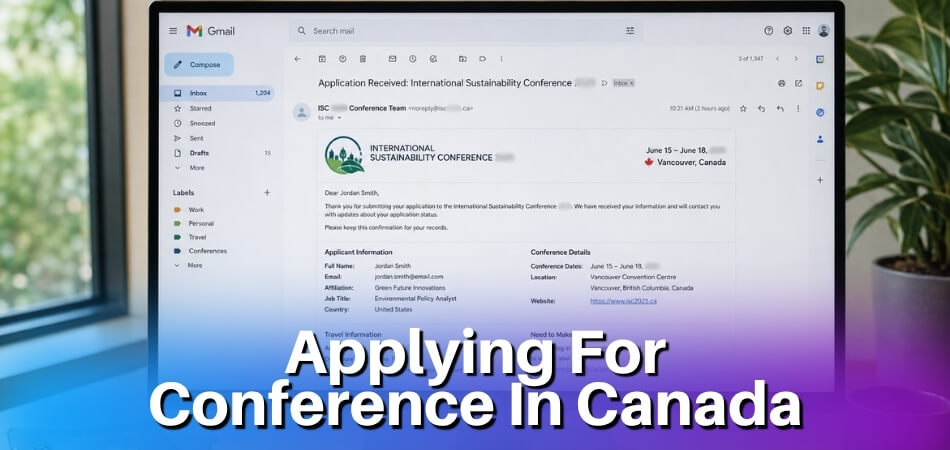
Complete the form on the official conference website, using the same name, spelling, and passport details you will use for your visa or eTA application.
Academic events can have two routes. Presenters submit an abstract or paper for review first and register after it is accepted, while attendees who are not presenting may register directly.
You may need to provide:
- Full legal name, email address, and phone number
- Country of residence
- Job title or academic status, and organization or institution
- Attendance type
- Paper title or abstract, if applicable
Review the form before you submit. An error in your name, date, passport number, or email address causes trouble later when the invitation letter is prepared.
Step 4: Pay the Registration Fee and Save Proof
Your place is often confirmed only once payment clears. Read the refund and transfer terms first, because some organizers keep fees even after a visa refusal, so be sure you can attend before you pay.
Keep copies of the registration confirmation, payment receipt, invoice, transaction record, and your attendee ID or registration number. Use secure payment methods, and be careful if an organizer refuses receipts, avoids official communication, or asks for payment through unclear channels.
Step 5: Request an Invitation Letter
After registration, ask for an official conference invitation letter, unless the organizer issues it automatically once payment clears. It confirms that you are expected at the event and may be asked for with a visitor visa application. What it should contain, and how to ask for it, is covered in the invitation letter section below. An invitation letter does not guarantee visa approval.
Step 6: Check Whether You Need a Visitor Visa or eTA
Confirm which travel authorization you need before you apply. Depending on your nationality and passport, you may need a visitor visa, an eTA, or no electronic authorization at all. IRCC has an online questionnaire on canada.ca that tells you what applies to you. Applying for a conference in the USA works differently: attendees generally need a B-1 or B-1/B-2 visa, or ESTA if their passport is in the Visa Waiver Program.
| Requirement | Usually For | Purpose |
| Visitor Visa | Travellers from visa-required countries | Temporary visit to Canada |
| eTA | Visa-exempt foreign nationals flying to Canada | Electronic travel authorization linked to your passport |
| No eTA or Visa in Some Cases | For example, U.S. citizens and U.S. lawful permanent residents | Entry with a valid passport, plus a green card for U.S. permanent residents |
Do not guess. Applying for the wrong document can delay your trip. Visitor visa applications are normally made online, and IRCC may also ask for your biometrics. When you get the instruction letter, book the appointment promptly. Pay only on the official Government of Canada site, and be wary of any website charging more to “process” an eTA.
These are the government fees IRCC lists for a conference visit (checked October 2026):
| Item | Government Fee |
| eTA | CAN$7 per person |
| Visitor visa | CAN$100 per person, or CAN$500 for a family of 5 or more |
| Biometrics | CAN$85 per person, or up to CAN$170 for a family |
IRCC can also apply temporary special measures that affect some applicants. Under its 2026 Ebola measures, for example, visitor visa and eTA applications from people whose last country of residence is the Democratic Republic of the Congo, South Sudan or Uganda are processed but not finalized until 27 November 2026.
Step 7: Prepare Your Visa or eTA Documents
Your application should show four things clearly: why you are going, how you will pay, where you will stay, and why you will return home. The full list of documents is in the documents section below. Your dates must match across all of them: the conference date, leave approval, hotel booking, and travel plan should support the same timeline.
Step 8: Book Travel After Approval
It is safer to book final flights and non-refundable accommodation after approval. A tentative itinerary is fine earlier, but avoid big payments while your application is pending.
After approval, arrange flights, accommodation near the venue, local transport, travel insurance, printed and digital copies of your documents, and any presentation materials. Choose accommodation that fits the event schedule and is easy to explain in your travel plan.
Step 9: Prepare for Arrival and Event Check-In
Put your passport, visa or eTA approval, invitation letter, registration proof, hotel booking, return ticket, proof of funds, event schedule, and any employer, school, or business letter in one folder. You may be asked for them at airline check-in, in transit, or at the border. IRCC advises business visitors to keep these papers with them rather than packed in checked luggage, along with 24-hour contact details for the Canadian host. At the venue, check in early, collect your badge, review the schedule, and attend the sessions that match your travel purpose.
Are You a Business Visitor When Attending a Conference in Canada?
You may be a business visitor if you come to Canada for a short professional or business activity without working for a Canadian employer. IRCC describes business visitors as people who stay a few days or weeks to attend meetings or events, and it lists attending conferences, conventions, and trade fairs as allowed activities. A conference visit is treated as a temporary visit and does not normally let you work for a Canadian employer or enter the Canadian labour market.

What Counts as a Business Visitor Activity?
Common activities include:
- Attending a conference, trade show, seminar, or convention
- Meeting business contacts and joining networking sessions
- Taking part in training related to your role outside Canada
- Giving a company presentation or presenting research
- Exploring business opportunities without working in Canada
IRCC expects your main place of business and your source of income to stay outside Canada, and your planned stay to be under 6 months.
What May Require a Work Permit?
You may need separate authorization if you will work directly for a Canadian employer, receive wages from a Canadian company, serve Canadian clients, or perform regular job duties in Canada. A conference invitation does not remove work-permit requirements. Your actual activities matter.
How to Prove Your Visit Is Temporary
Show a clear start and end date for your stay: a return travel plan, the conference agenda, a hotel booking, and proof of your ties at home such as an employer leave approval, student enrollment letter, business ownership papers, family responsibilities, or property. IRCC also lists letters of support from your employer and a letter of invitation from the Canadian host among the items to carry. Together they should make it easy to see that you are making a short conference trip and returning home.
How to Verify a Real Conference in Canada Before Applying
Before paying for a conference in Canada, confirm that the event is legitimate. A real conference has a traceable organizer, a confirmed venue, transparent fees, a clear agenda, and professional communication.
Check the Organizer’s Identity
Review the organizer’s website, business address, contact details, team information, past events, and online presence. A credible organizer does not hide basic information. Look for an official name, a professional email address, a phone number, an office or institutional address, previous event records, committee details, and mentions from universities, companies, or associations. Be careful if the organizer has no history, no verified contact details, or only vague event pages.
Review the Conference Website
A real conference website clearly shows:
- Event title, date, location, and venue details
- Registration fee, agenda or topic areas
- Speaker or committee information
- Refund policy, terms and conditions, and invitation letter policy
- Contact information
Warning signs include copied text, broken pages, unclear payment instructions, fake-looking speaker profiles, or unrealistic visa promises.
Confirm the Venue
If a hotel, university, convention centre, or meeting space is listed, contact the venue directly. Give the event name, organizer name, dates, and venue address, and ask whether the event is booked, including the room or hall if available. If the venue cannot confirm anything, pause before paying.
Verify Speakers, Sponsors, and Partners
Fake or weak events may list speakers, sponsors, or university logos without permission. Search speaker names on LinkedIn, university websites, company pages, or personal websites. If major speakers have not mentioned the event anywhere, check carefully before registering.
Watch for Red Flags
Avoid conferences that show signs such as:
- No verifiable organizer or confirmed venue
- No refund policy or no receipt after payment
- Poor website quality, or very broad topics with no clear focus
- Pressure to pay immediately
- Generic invitation letters
- Guaranteed visa approval claims
- An organizer who avoids direct questions
A real conference can support your travel purpose, but no organizer can guarantee visa approval.
Documents Needed to Apply for a Conference Trip to Canada
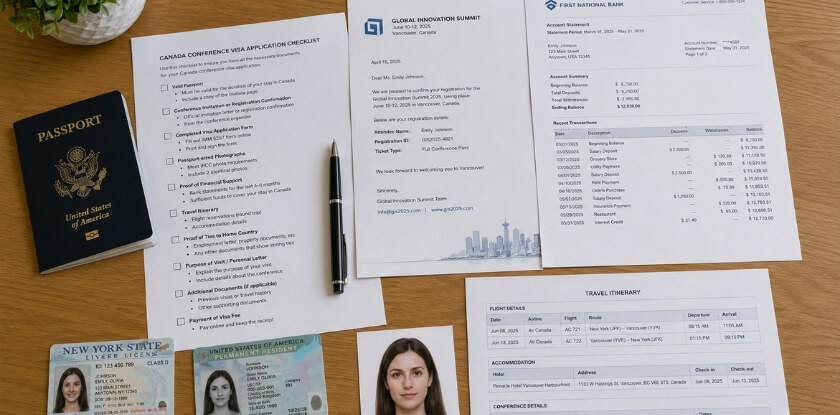
For a Canada conference visit, your documents should prove identity, event purpose, funds, accommodation, travel plan, and ties to your home country.
Passport and Identity Documents
Your passport must be valid and match all your application documents. For a visitor visa, IRCC advises a passport valid for at least 6 months from the date you plan to travel. Prepare a clear copy of the bio page and any previous passport that shows useful travel history. If your passport is close to expiry, renew it before registration so your documents do not end up mismatched.
Conference Documents
These connect your trip to a real event: registration confirmation, invitation letter, payment receipt, invoice, event agenda, and, if applicable, speaker or presenter confirmation and abstract or paper acceptance. The name and dates on them should match your passport and travel plan.
Travel and Accommodation Documents
Your travel plan should explain when you arrive, where you stay, and when you leave. Prepare a planned flight itinerary, a hotel booking or accommodation address, the conference venue details, a local transport plan if useful, and your return travel plan. Your stay should be reasonable for the event, because a very long stay after a short conference may need extra explanation.
Financial Documents
Your proof of funds should show that you can pay for the whole trip without working in Canada. Details on bank statements, income proof, sponsors, and budget are in the proof of funds section below. Your available funds should match the expected cost of flights, hotels, food, registration, transport, and insurance.
Employment, Study, or Business Documents
These documents help prove your current status and your reason to return home.
| Applicant Type | Useful Documents |
| Employee | Employment letter, leave approval, salary slips |
| Student | Enrollment letter, student ID, supervisor letter |
| Business Owner | Business registration, tax records, trade license |
| Researcher | Institutional letter, paper acceptance, research profile |
| Self-Employed Professional | Portfolio, client contracts, income proof |
Strong documents explain both your conference purpose and your home-country ties. IRCC suggests an employer letter dated no earlier than 3 months before you apply.
When Should You Register and Apply for a Canada Conference Visa?
Register for a Canadian conference as early as possible once you have verified the event, and start preparing your visa or eTA documents as soon as your registration and invitation letter are ready.
Best Time to Register
Register early enough to secure your seat, receive confirmation, request an invitation letter, and prepare your travel documents. Early registration may also give you a lower fee, if the organizer offers one. If you are applying as a speaker, first understand the submission and approval process, since some events require paper acceptance before final registration.
When to Request the Invitation Letter
Request the letter after you complete the organizer’s required steps, because organizers often issue it only after registration and payment. Issuing it can take several business days, so register before your visa deadline, not on it.
Your request should include your full name as shown on your passport, nationality, passport number if required, registration number, role at the event, travel dates, and email and phone number. Check the letter carefully before you use it.
When to Apply for a Visitor Visa
Apply for a visitor visa as soon as your core documents are ready. Processing time varies by country, season, biometrics, and document review. IRCC publishes current processing times on canada.ca, and says its estimates are not a guarantee, so leave a generous margin before the event rather than waiting until the conference date is close.
When to Apply for an eTA
If you are eligible for an eTA, IRCC says it is best to get it before you book your flight. Most applicants are approved by email within minutes, but some requests take several days when IRCC asks for supporting documents, and wrong passport details cause problems at the airport. Your eTA is linked to the passport you will use to fly to Canada and is valid for up to five years or until that passport expires, whichever comes first.
How to Get an Invitation Letter From a Canadian Conference Organizer
To get an invitation letter for a Canada conference, register first and then send a professional request to the organizer. The letter should be official, accurate, and tied to your confirmed participation.

What to Include in Your Request
Send your full name, passport details if required, nationality, country of residence, conference name, registration number, role at the event, expected travel dates, and contact information. Use the name exactly as it appears on your passport, with no nicknames or shortened names.
What the Invitation Letter Should Contain
A strong letter shows the participant name, conference title, event dates, venue name and address, the participant’s role, a registration confirmation, organizer contact details, and a signature or authorized sender details. It should not promise visa approval, employment, or entry into Canada. A vague letter with missing dates, no venue address, no role, or no organizer contact makes your purpose unclear, so ask for corrections before you submit it.
Sample Invitation Letter Format
[Organizer Letterhead]
[Organizer Name]
[Organizer Address]
[Phone Number] | [Email Address] | [Website]
[Date]To Whom It May Concern,
This letter confirms that [Participant Full Name], passport number [Passport Number], nationality [Nationality], is registered to attend [Conference Name] in [City, Province, Canada] from [Start Date] to [End Date].
The participant will attend as a [Attendee / Speaker / Presenter / Exhibitor / Delegate]. The event will include sessions, discussions, networking opportunities, and professional activities related to [Conference Topic].
The conference will take place at:
[Venue Name]
[Venue Address]
[City, Province, Canada]This letter is issued to support the participant’s travel purpose. It does not guarantee visa approval, entry to Canada, employment, or financial sponsorship unless separately stated.
For verification, please contact us at [Organizer Email] or [Organizer Phone Number].
Sincerely,
[Authorized Person’s Name]
[Title]
[Conference Organizer Name]
What Is an IRCC Event Code for Canadian Conferences?
An IRCC event code is a code linked to certain events registered with Immigration, Refugees and Citizenship Canada. If the conference has one, the organizer provides it with instructions so you can enter it on your visa application. IRCC says this helps identify you as an event participant. The code is not an approval code. It does not replace your documents and does not guarantee approval.
How to Use an IRCC Event Code
If the organizer gives you a code, enter it exactly as provided when the application asks about a special or registered event in Canada. Still upload your normal supporting documents: the invitation letter, registration confirmation, payment receipt, event agenda, travel plan, and proof of funds.
What If the Conference Has No Event Code?
Not every conference has one, and you can still apply without it. Make the application strong with clear conference documents, financial proof, travel details, and home-country ties.
How to Show Proof of Funds for a Canada Conference Visit
To show proof of funds for a Canada conference visit, provide documents that prove you can afford registration, flights, accommodation, meals, local transport, insurance, and emergency expenses.
Bank Statements
Bank statements should show your name, account activity, available balance, and regular income if applicable. IRCC suggests statements covering at least 6 months. Several months of statements are stronger than a single balance certificate because they show financial history. Avoid unexplained large deposits, and if there is a major recent deposit, explain its source.
Salary or Income Proof
If employed, include salary slips, an employment certificate, tax documents, or bank deposits showing salary payments. If self-employed, include business income records, contracts, invoices, tax files, or company documents.
Sponsor Documents
If someone else pays for your trip, include a sponsor letter and the sponsor’s financial proof. The sponsor should explain their relationship with you and list the expenses they will cover. Sponsor documents may include a signed sponsor letter, a copy of the sponsor’s ID or passport, bank statements, salary slips or business proof, and proof of relationship.
Travel Budget
A simple budget helps explain your expenses.
| Expense | Example Details |
| Conference fee | Registration or workshop fee |
| Flight | Round-trip airfare |
| Accommodation | Hotel or rental stay |
| Meals | Daily food cost |
| Transport | Airport transfer and local travel |
| Insurance | Travel or medical coverage |
| Miscellaneous | Emergency and personal costs |
Your available funds should be higher than your expected expenses.
Visa Application Templates for a Conference in Canada
Templates help you organize your documents, but every detail must be accurate and personal to your situation.
Sponsor Letter Template
Subject: Sponsorship Letter for [Applicant Full Name] to Attend [Conference Name] in Canada
Dear Visa Officer,
I, [Sponsor Full Name], holder of [Passport / National ID Number], confirm that I will financially support [Applicant Full Name] for their visit to Canada to attend [Conference Name], scheduled from [Start Date] to [End Date] in [City, Province].
I am the applicant’s [relationship]. I am currently employed as [Job Title] at [Company Name] / I operate [Business Name]. I have sufficient funds to cover the applicant’s travel expenses, including conference registration, airfare, accommodation, meals, local transport, insurance, and emergency costs.
I have attached my identity proof, bank statements, income documents, and relationship proof. This sponsorship is for a temporary conference visit, and the applicant intends to return to [Home Country] after the event.
Sincerely,
[Sponsor Name]
[Signature]
[Phone Number]
[Email Address]
[Date]
Employer Leave Approval Letter Template
[Company Letterhead]
Subject: Leave Approval for [Employee Full Name] to Attend [Conference Name] in Canada
Dear Visa Officer,
This letter confirms that [Employee Full Name], passport number [Passport Number], has been employed with [Company Name] since [Joining Date] and currently works as [Job Title] in the [Department Name] department.
We have approved leave from [Leave Start Date] to [Leave End Date] so the employee can attend [Conference Name] in [City, Province, Canada] from [Conference Start Date] to [Conference End Date].
The employee will remain employed with our company and is expected to return to work after the approved leave period.
Sincerely,
[Authorized Person’s Name]
[Designation]
[Company Name]
[Phone Number]
[Email Address]
Common Mistakes to Avoid When Applying for a Conference in Canada
Small details can weaken an application. These are the ones worth a last check:
- Paying before checking the event. A suspicious conference can weaken your stated purpose.
- Conflicting documents. Different name spellings, inconsistent dates, wrong venue details, or a leave letter that does not cover your travel dates.
- Leaving it late. Late applications risk missed conference dates, expensive flights, limited hotel options, and no time to fix document problems.
- Booking non-refundable travel before approval. Use tentative plans or refundable options.
- No explanation of ties. Say plainly why you will return home: employment, studies, business, family, or property.
What to Do If Your Canada Conference Visa Is Refused
If your Canada conference visa is refused, read the refusal reasons carefully before reapplying. Applicants in Ethiopia, for example, apply for a Canada conference visa from Ethiopia online through an IRCC account. Do not submit the same application again without fixing the weak points.
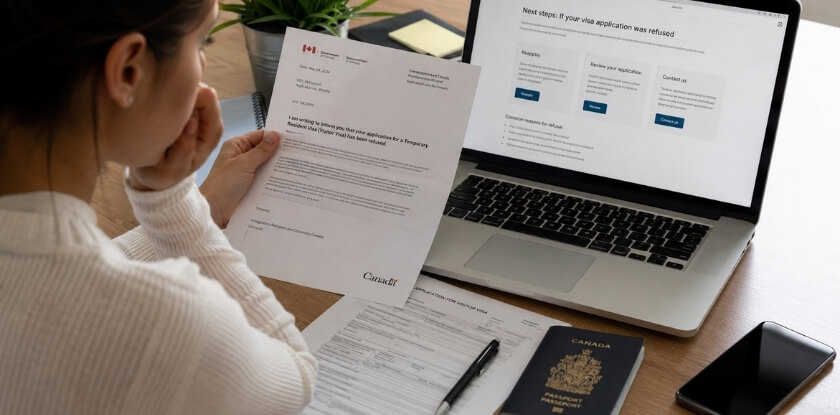
Common refusal concerns may include:
- Unclear purpose of visit
- Weak proof of funds
- Limited ties to home country
- Inconsistent documents
- Long stay without explanation
- Missing employment, study, or business proof
- Doubts about leaving Canada after the visit
Before reapplying, prepare a stronger file with corrected documents, updated financial proof, clearer travel dates, and an explanation letter addressing the concerns. If the conference date has passed or is too close, ask the organizer what its policy allows, such as a place at a later edition, since a refusal does not by itself bring a refund.
From our experience at MS International: the invitation letter process starts automatically once registration payment clears, with no separate request, and the letter is issued within 3 to 5 business days after payment clears. It is built from the name and passport details given at registration, so a typo there carries straight into the letter, and an administrative fee may apply to corrections requested after issue. Keep both a digital and a printed copy once it arrives. Event page fees are US$499 for Author Early Bird, US$599 for Author Regular and US$499 for Listener registration. Fees are non-refundable and non-transferable, including after a visa refusal, and all events are held in person in the Greater Toronto Area.
FAQ: Applying for a Conference in Canada
International attendees planning a Canadian event get stuck on the visitor visa fee, whether an invitation letter guarantees approval, travel insurance and booking flights before a decision.
Can I apply for a Canadian conference without a passport?
No. You need a valid passport before applying, because it is required for visa or eTA processing, flight booking, and identity checks. If it expires soon, renew it before registration so your conference documents and visa application use the same details.
Do I need a visa to attend a conference in Canada?
It depends on your citizenship. Conference attendees usually enter as business visitors, so citizens of visa-required countries apply for a visitor visa, visa-exempt travellers flying in need an eTA, and U.S. citizens need neither. Check canada.ca with your passport details before you apply.
How much does a Canadian visitor visa cost?
IRCC lists the visitor visa fee at CAN$100 per person, plus CAN$85 for biometrics when they are required, as of October 2026. An eTA for visa-exempt air travellers is CAN$7. Conference registration and travel costs come on top.
Does an invitation letter guarantee a visa?
No. IRCC states that a letter of invitation does not guarantee a visa. The officer decides on the whole application, and the letter only confirms that you are registered or accepted for the event. Do not trust anyone who sells a letter with a visa promise.
Do I need travel insurance for a conference trip to Canada?
It is strongly advised. IRCC says Canada does not pay for hospital or medical services for visitors and that you should get health insurance before you come. It is not on the visitor visa document list, but a policy covering emergencies and trip interruption also makes your travel plan more complete.
Can family members travel with me?
Yes, family members can travel with you, but each person must meet Canada’s entry requirements separately and may need their own visitor visa or eTA. Prepare separate passports, financial proof, travel plans, accommodation details, and relationship documents for each person.
Can I apply if I am unemployed?
Yes, you can apply while unemployed, but you must still show a clear conference purpose, enough funds, and strong reasons to return home. You may use sponsor documents, personal savings, family ties, property documents, freelance records, business background, or a clear explanation of your purpose.
Can I attend more than one conference during the same visit?
Yes, if your schedule, travel authorization, and documents support the full stay. Keep registration confirmations, invitation letters, agendas, and payment receipts for each event.
Do I need a Canadian phone number?
No, you do not need a Canadian phone number to apply for or attend a conference in Canada, but a local SIM card or roaming plan helps you use maps, contact hotels, receive updates, and reach organizers.
How early should I arrive at the conference venue?
Arrive at least 30 to 60 minutes before your first session, especially on the first day. This gives you time to check in, collect your badge, find the correct room, and prepare if you are presenting.
Is there a dress code for Canadian conferences?
There is no single dress code: business casual is a safe choice unless the organizer gives specific instructions. Choose neat, comfortable, and weather-appropriate clothing.
Can I present a paper or speak at the conference?
Yes, if the organizer accepts your submission or invitation. At MS International, presenting authors submit first, pass double-blind review with a decision in about 10 working days, and register after acceptance. You may need an abstract, full paper, biography, presentation title, or institutional affiliation.
Should I book flights before visa approval?
It is safer to avoid non-refundable flight bookings before approval. IRCC asks for copies of any travel plans you have, such as flight details, so a tentative itinerary can be shown; make final bookings after approval or with refundable, flexible options.
Conclusion
Applying for a conference in Canada is easier when you follow the order: verify the event, register through the official website, request the invitation letter, and then apply for the right visa or eTA with documents that agree with each other.
Before you submit, check that conference details, travel dates, accommodation, and financial documents are consistent. That is what shows your visit is temporary, genuine, and tied to a real conference.
Disclaimer: This guide is general information about conference travel, not legal or immigration advice. Rules and fees change, and each case is decided by the immigration authority. Check the current requirements on canada.ca or ask a licensed immigration professional before you apply.