

It’s the night before the conference. You’ve confirmed your registration on Eventbrite, mapped out the sessions you want to attend, maybe even rehearsed a few conversation starters — and then you open your closet and freeze. Nothing looks quite right. Everything either feels too formal, too casual, too uncomfortable for a full day of sitting, standing, and speed-networking between sessions. This moment of wardrobe panic is something almost every professional woman knows, and despite what anyone might say, it is absolutely not a trivial problem. What you wear to a business conference shapes first impressions before you say a single word — on the conference floor, at the cocktail hour, and yes, even in your LinkedIn profile photo from the event.
The stakes feel higher because the rules are genuinely unclear. A business formal dress code at a Davos-style summit looks nothing like the startup culture dress code at SXSW or CES. The blazer-and-sheath-dress combination that reads perfectly polished at an Ann Taylor-sponsored finance panel might feel stiff and out of place at a Cannes Lions creative session. Industry context matters, your role matters, and whether you’re sitting in the audience or stepping up to the podium as a speaker matters too. Getting it wrong doesn’t ruin a career, but getting it right gives you one less thing to think about — and one more thing working in your favor.
This guide covers all of it. You’ll find a straightforward method for decoding any dress code before you pack, outfit formulas that work across industries and body types including petite sizing, plus-size fashion, and tall women fashion, specific guidance for speakers and presenters, a day-one-versus-day-two planning strategy, and budget-smart picks from retailers like M.M. LaFleur, Universal Standard, Eloquii, Banana Republic, and J.Crew. Whether you’re heading to a hybrid conference with a ring light setup in your hotel room or working a trade show floor in block heel pumps for eight hours straight, there is a practical answer here.
A woman attending a business conference should build her outfits around a few reliable foundations: a well-fitted blazer, tailored trousers or a midi skirt in neutral tones, and shoes that balance professionalism with all-day wearability, such as pointed-toe flats or block heel pumps. A sheath dress or wrap dress in wrinkle-resistant fabric or ponte fabric travels exceptionally well and moves effortlessly from morning keynotes into evening networking without requiring a full outfit change. For a business formal dress code, stick to structured silhouettes and muted colors; for a business casual dress code or smart casual dress code, you have more room to introduce texture, pattern, and personality. A structured tote bag keeps essentials organized and reads as polished in any setting. Industry culture should always influence your choices — finance and legal conferences lean conservative, while creative and tech events leave room for more expressive styling. When in doubt, dressing one level up from the stated dress code is always the safer and smarter call.
What Should a Woman Wear to a Business Conference? (Quick Answer)
The short answer: a well-fitting blazer, tailored trousers or a sheath dress, and shoes you can actually walk in for six hours straight.
That’s the baseline. Everything else depends on three things — the industry, the dress code, and whether you’re attending, presenting, or networking at a cocktail reception after.
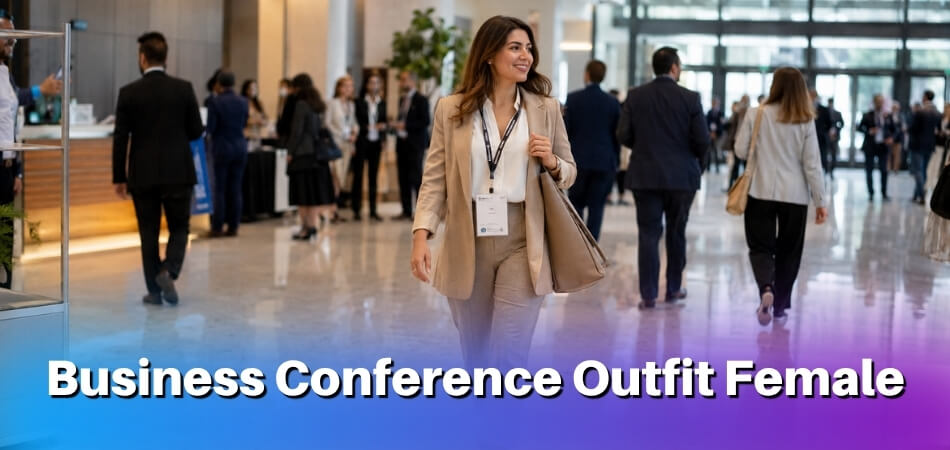
The One-Outfit Formula That Works Almost Everywhere
If you’re packing for a multi-day conference and want a reliable starting point, build around these pieces:
- A blazer in a neutral tone (navy, charcoal, camel, or black)
- Tailored trousers or a midi skirt in a complementary color
- A sheath dress or wrap dress as your alternate base
- Block heel pumps or pointed-toe flats — both are professional, both survive a full conference day
- A structured tote bag that fits your laptop, a notebook, and a water bottle
That combination covers most business formal and business casual dress code situations without requiring you to overpack.
But “Business Conference” Covers a Lot of Ground
A panel at TED Conference looks different from the trade show floor at CES. Davos is not SXSW. Cannes Lions has a completely different energy from a regional healthcare summit.
Dress codes matter here. Business formal means suits, structured dresses, and closed-toe heels. Business casual dress code gives you more flexibility — think blazer over a blouse, or a ponte fabric midi skirt with a tucked shirt. Smart casual dress code, which shows up a lot at tech and startup-culture events, means you can lose the blazer but you still want to look intentional.
Check the event’s LinkedIn page, Eventbrite listing, or Instagram account before you pack. Conference organizers almost always post photos from previous years. That’s your best research tool.
The Non-Negotiables
Comfort is not optional. It’s strategic. You’re shaking hands, standing at booths, walking between sessions, and possibly sitting on a panel. An outfit that pinches, gaps, or requires constant adjustment is a distraction — for you and for anyone watching you present.
Wrinkle-resistant fabric and ponte fabric are your best friends for travel. Merino wool is also worth considering — it regulates temperature, doesn’t wrinkle badly, and works across business casual and smart casual dress code settings. Pack pieces that survive a carry-on luggage situation without needing an iron.
One more thing: if you’re speaking, your outfit needs to read clearly on camera. Webcam-friendly colors — solid jewel tones, clean neutrals — photograph better than busy prints. That matters whether you’re on a main stage or joining a hybrid conference session from a hotel room with a ring light and a virtual conference background.
How to Research the Dress Code Before the Conference
Most outfit mistakes happen before you even pack a bag. Showing up in a tailored blazer and sheath dress to a SXSW side event where everyone’s in jeans isn’t the end of the world, but it’s avoidable. A little research beforehand saves you that awkward mental recalibration when you walk into the room.
Check the Conference Website and Invitation Wording
Start with the obvious. Pull up the conference website and look for any page labeled “Attendee Information,” “FAQ,” or “What to Expect.” Organizers for larger events like the TED Conference or Davos often include venue and attire notes because they know attendees are flying in from different contexts.
Pay close attention to exact wording on the invitation or registration confirmation. “Business formal” means suits, structured dresses, and closed-toe heels. “Business casual” gives you more room — tailored trousers, a blouse, ponte fabric separates. “Smart casual” or “resort business casual” (common at warm-weather events like Cannes Lions) signals you can drop the blazer but should still look intentional. Vague wording like “professional attire” usually defaults to business casual, and that’s a safe assumption.
If the event is through Eventbrite, scroll the full event description. Organizers sometimes bury dress code notes in the third or fourth paragraph.
Browse Previous Conference Photos on Social Media
This is genuinely the most useful research you can do. Search the conference hashtag on Instagram and LinkedIn — most major events have a consistent hashtag across years. Look at photos from the previous one or two conferences, specifically candid shots and panel photos, not just the sponsored branded content.
Notice what speakers are wearing versus what general attendees have on. At CES, for example, you’ll see a wide range — everything from business casual to trade show attire that leans more casual-tech. At a finance or legal industry conference, the room typically skews much more formal. The photos will tell you what the actual culture is, which often differs from what the website says.
LinkedIn is especially useful here because attendees post professional recaps with real photos. Search the conference name directly and filter by posts, not just people.
Ask the Organizer or a Past Attendee Directly
Don’t overthink this step. It takes two minutes. If you registered through a conference system, there’s usually a contact email for the event team. Send a short message asking what attire most attendees typically go with. Organizers get this question all the time and will give you a straight answer.
Past attendees are even better. Check LinkedIn for people who listed the conference as an event they attended or spoke at. A quick message like “I’m attending for the first time — any advice on what people usually wear?” gets responses more often than you’d expect. People who’ve been to Davos or a major industry summit usually remember exactly how overdressed or underdressed they felt the first time, and they’ll tell you.
This matters even more if you’re a speaker. A speaker outfit carries different visual weight than attendee attire, and someone who’s presented at that specific event before can tell you whether the stage is lit in a way that makes certain colors wash out or whether the venue runs cold.
Understanding Common Conference Dress Codes for Women
Dress codes aren’t just suggestions. They signal cultural fit, and showing up wildly overdressed or underdressed at a professional event can distract from the actual reason you’re there. Here’s how to read each one accurately.
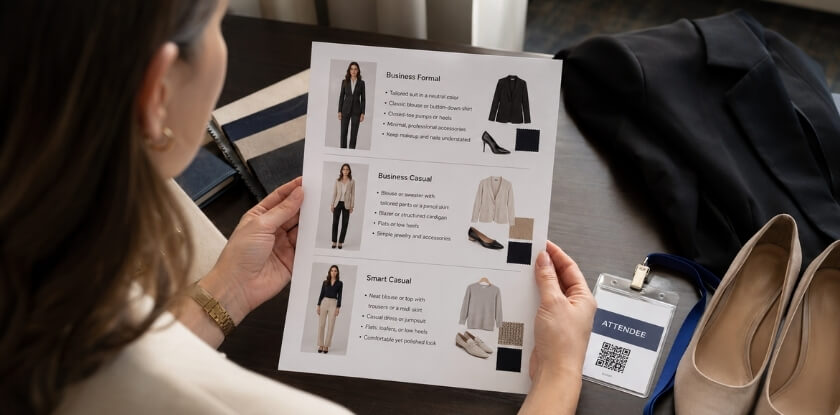
Business Formal — What It Means and What to Wear
Business formal is the strictest end of the spectrum. Think Davos, not SXSW. It typically means a tailored suit, a structured sheath dress with a blazer, or a sophisticated midi skirt paired with a matching jacket. Colors stay conservative — navy, charcoal, black, and deep burgundy are safe. Prints, if you wear them, should be subtle.
Fabric matters here too. Ponte fabric holds its shape all day, which is exactly what you want during a full conference schedule. Merino wool is another solid choice — it regulates temperature well, resists wrinkles after hours of sitting, and still looks polished by the evening reception.
Shoes should be closed-toe. Block heel pumps with a 2–3 inch heel are practical for full-day wear. Pointed-toe flats also work well if you’re covering ground between sessions.
Brands like Ann Taylor, Banana Republic, and M.M. LaFleur build specifically for this dress code. Their cuts are professional without being stiff, and the sizing tends to run true.
One thing to avoid: over-accessorizing. Business formal calls for restraint. A structured tote bag, simple stud earrings, and a watch are enough.
Business Casual — The Most Common Conference Standard
Most professional conferences — industry summits, corporate retreats, trade association events — land in business casual territory. It’s the most common standard, and also the most misread one.
Business casual does not mean jeans and a nice top. Not at a professional conference. What it actually means is polished separates without a full suit. Tailored trousers with a blouse and a blazer, a wrap dress, a midi skirt with a tucked-in knit — these all work. You’re dressing one level below formal, not three.
The TED Conference and mid-size industry expos often use this code. It gives you flexibility without losing credibility.
A few specific combinations that consistently work well:
- Dark tailored trousers + silk blouse + blazer you can remove
- Wrap dress in a solid or subtle print + pointed-toe flats
- Midi skirt in a neutral tone + fitted crewneck + blazer
Wrinkle-resistant fabric is your best friend here, especially if you’re traveling. A piece that looks great straight out of carry-on luggage saves you time and stress on conference morning.
J.Crew, ASOS, Universal Standard (for extended sizing), and Eloquii all have strong business casual options. Universal Standard and Eloquii in particular do well for plus-size fashion — cuts are actually designed for the silhouette rather than just scaled up.
Smart Casual and Resort Business Casual — When It Applies
These two codes show up at conferences that deliberately want a relaxed, creative, or destination-based atmosphere. SXSW, Cannes Lions, and creative industry meetups often sit here. So do conferences held at resorts or warmer-weather locations.
Smart casual means you’re still intentional about your outfit — but you can skip the blazer, wear a nice pair of slim trousers or dark jeans, and choose footwear that’s stylish rather than strictly formal. Startup culture dress code almost always falls here. If the conference is heavily LinkedIn-networked and the speakers are founders, smart casual is almost certainly the expectation.
Resort business casual leans slightly more relaxed — linen blends, softer silhouettes, maybe a sundress with structured sandals — but still polished enough to present yourself professionally. The key is fit. A well-fitted linen trouser looks intentional. Wrinkled, oversized anything reads careless regardless of the setting.
Color is more open in both these categories. You can introduce a bolder palette, a pattern, or interesting texture. Just keep the overall look cohesive. A neutral tones base with one statement piece still photographs well for LinkedIn or Instagram conference coverage, which is increasingly part of attending these events.
If you’re petite, tall, or shopping for plus-size fashion, smart casual is actually the easiest dress code to adapt. The silhouette rules are looser, so finding pieces that work for your body — rather than fighting a rigid formal shape — is more realistic.
Core Outfit Ideas for a Business Conference
You don’t need a completely new wardrobe. Most women already own pieces that can be pulled together into a solid conference outfit — it’s really about understanding which combinations work and why.
The Classic Blazer and Trouser Combination
This is the safest, most adaptable outfit you can build for almost any professional conference. A well-fitted blazer paired with tailored trousers in a neutral tone — black, navy, charcoal, or camel — covers everything from business formal to smart casual depending on how you style it.
The blazer does the heavy lifting. It signals professionalism even if the rest of your outfit is pretty simple underneath. Swap the blazer out for a cardigan at SXSW. Keep it on at Davos.
For trousers, fit matters more than brand. That said, Banana Republic, Ann Taylor, and M.M. LaFleur all do well-cut options in ponte fabric, which is a practical choice because it resists wrinkles on a long travel day and holds its shape through back-to-back sessions.
Footwear-wise, pointed-toe flats or block heel pumps both work here. If you’re going to be on your feet at a trade show for six hours, go with the flats — no question.
One practical note: if you’re speaking or presenting, choose a blazer with a pocket or a structured fit that allows a lapel mic to clip on easily. Thin, flowy fabric makes mic placement annoying for the AV team and for you.
Midi Skirt with a Structured Top
A midi skirt reads polished without being stiff, which makes it a good pick for conferences that sit somewhere between business casual and smart casual — industry events, marketing summits, creative conferences like Cannes Lions.
Pair it with a fitted blouse, a silk-look shell, or a tucked-in knit top. The structure comes from the tuck and the skirt silhouette, not necessarily from a blazer (though you can add one).
Fabric is where people go wrong with midi skirts at conferences. A flowy chiffon midi can look great at brunch but reads as underdressed in a conference room full of suits. Go for something with a bit of weight — ponte, crepe, or a heavier jersey. These fabrics also pack well in carry-on luggage without turning into a wrinkled mess by day two.
Heel height with a midi is worth thinking about. If you’re petite, a midi hem that hits just below the knee combined with pointed-toe flats can shorten your frame visually. Either size up the shoe heel slightly or look for midi skirts designed for petite sizing — brands like ASOS and Eloquii both offer length variations. Tall women, on the other hand, often find standard midis hit at mid-calf, which is still a clean look.
Sheath Dress or Wrap Dress — Versatile and Polished
These two dress styles carry a lot of conference duty for a reason.
A sheath dress in a neutral or deep color — navy, burgundy, forest green, black — is clean, structured, and doesn’t require much layering to look complete. Throw a blazer over it for morning panels, remove it for the networking lunch. That’s your whole outfit strategy solved.
The wrap dress is slightly more forgiving across different body types because the tie adjusts to your actual waist rather than a standardized size. It works well for plus-size fashion and for women who find structured sheath dresses uncomfortable across the bust or hips. M.M. LaFleur and Universal Standard both make wrap styles that photograph well, which matters if someone is capturing conference moments for LinkedIn or Instagram.
One thing to keep in mind with wrap dresses: the neckline can gap if the ties aren’t secured well. Use a small safety pin at the inside fold if you’re walking around or presenting. Small fix, but worth knowing.
For fabric, merino wool jersey versions of both styles are worth the investment if you travel to conferences regularly. Merino is wrinkle-resistant, temperature-regulating, and doesn’t hold odor — genuinely practical for a three-day event where you’re re-wearing pieces.
Can Women Wear Jeans to a Business Conference?
Yes — but the context has to be right.
Dark wash, well-fitted jeans with a blazer and structured top are acceptable at startup culture events, tech conferences like CES, and creative industry gatherings where the dress code leans smart casual or resort business casual. Nobody’s going to look twice at dark jeans at SXSW.
The problems usually come from the wrong type of jeans or the wrong conference. Light wash, distressed, or relaxed-fit jeans at a finance or legal conference will feel off — not because there’s a written rule, but because the room signals formal and you’ll feel underdressed the moment you walk in.
If you’re unsure, check the conference’s own social media. Search the event hashtag on Instagram or LinkedIn from the previous year. If you see attendees in jeans, you’re fine. If every photo shows suits and blazers, park the jeans for the evening dinner instead.
Pair dark jeans with block heel pumps, a tailored blouse, and a blazer and most people won’t clock that you’re technically in denim at all. The overall silhouette reads pulled-together. That’s what actually matters.
Day One vs Day Two Outfit Planning — Why It Matters
Most women pack for a conference the same way they pack for a vacation — grab what fits the vibe, throw in a backup option, done. The problem is that conferences have a social arc. What works on day one doesn’t always serve you on day two, and treating both days as identical is where a lot of outfit plans fall apart.
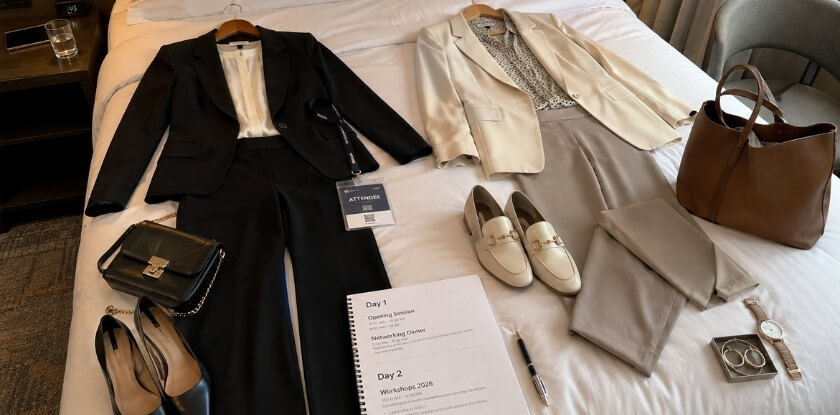
Here’s the basic reality: day one is about first impressions, and day two is about follow-through.
Day One: Dress for the Introduction
On the first day, you’re meeting people who have never seen you before. They’re forming an opinion in about seven seconds. That’s not hyperbole — it’s just how conferences work. You want your outfit to say exactly what you intend it to say before you open your mouth.
For most professional conferences — think Davos-adjacent industries, finance, law, or anything with a business formal dress code — day one calls for your sharpest, most polished look. A well-fitted sheath dress or tailored trousers paired with a structured blazer handles this reliably. Keep the color palette clean. Neutral tones like navy, charcoal, camel, or deep burgundy read confident and professional without trying too hard.
If the conference leans more creative — SXSW, Cannes Lions, or a tech-forward event like CES — a smart casual dress code gives you more flexibility on day one, but you still want intention behind the outfit. A polished wrap dress or a midi skirt with a fitted top and clean sneakers or pointed-toe flats works. The goal isn’t to underdress out of trying to fit in with a “casual” crowd.
Wear something you’ve already broken in. Day one involves a lot of standing in registration lines, awkward hallway conversations, and navigating a venue you don’t know yet. This is not the day to debut heels you bought last Tuesday.
Day Two: Dress for the Work
By day two, you’ve already made the first impression. Now it’s about comfort, function, and looking like you’re still engaged — not like you ran out of ideas.
This is where ponte fabric pieces earn their place. Ponte doesn’t wrinkle, holds its shape through a full eight-hour day, and looks intentional rather than casual. A ponte blazer or ponte trousers from somewhere like M.M. LaFleur or Ann Taylor pulls together without effort. Same goes for merino wool — it regulates temperature (critical when conference rooms swing between freezing and stuffy), resists odor, and looks polished even after hours of wear.
If you gave a presentation or had a major meeting on day one, you can afford to dial back slightly on day two. Not into sloppy territory — but if day one was full business formal, day two can land at strong business casual dress code and still be appropriate.
Also think about what’s on your schedule. Day two often includes workshops, breakout sessions, or trade show floor time. Trade show attire has a slightly different demand than panel attendance — you’re on your feet longer, you’re carrying things, and you’re stopping and starting constantly. A structured tote bag large enough to hold your laptop, a notebook, and a portable charger matters more on this day than on day one.
The Capsule Approach Makes This Easier
If you’re building a capsule wardrobe for a two-day conference, aim for three outfit-ready pieces that can rotate across both days. One blazer, two bottoms or dresses, a backup top. That’s it. Everything should work in the same color palette so you’re not managing clashing pieces under pressure.
Brands like J.Crew, Banana Republic, and Universal Standard (excellent for plus-size fashion and extended sizing) make capsule-friendly pieces that travel well and read as polished in most conference environments. ASOS and Eloquii are solid for budget-conscious packing without the cheap-fabric tradeoff.
For women dealing with carry-on luggage limitations, wrinkle-resistant fabric is non-negotiable. Silk wrinkles. Linen wrinkles. Cotton wrinkles if you look at it wrong. Pack accordingly.
A Note on Speaker Outfits Across Two Days
If you’re speaking on day one and attending on day two, flip the energy. Save the slightly bolder piece for the stage. Speaker outfit choices benefit from something that photographs well under bright lighting — webcam-friendly colors like cobalt, red, or forest green work better than pastels or all-white, which can wash out. Block heel pumps give you height and stability at the podium without the ankle-wobble risk of a stiletto on a slightly uneven stage floor.
Then day two, you’ve done the hard part. Comfortable, polished, done.
What to Wear If You Are a Speaker or Presenter
Speaking changes everything. When you’re in the audience, a solid blazer and tailored trousers do the job. When you’re on stage, those same clothes might completely disappear under harsh lighting — or worse, read as shapeless on a livestream.
Your outfit needs to work across three very different environments at once: the physical room, the camera, and whatever photos end up on LinkedIn or the conference’s Instagram recap two days later.
The Camera Changes the Rules
Certain colors and patterns cause real problems on video. Fine stripes create a strobing effect called moiré — it looks like your blouse is vibrating. Pure white blows out under stage lighting. True black can swallow your silhouette entirely against a dark background.
Rich jewel tones, muted earth tones, dusty rose, navy, burgundy. These read clearly on camera, hold up under a ring light or a stage wash, and photograph well whether the room is dim or bright. Think webcam-friendly colors even if you’re presenting in person, because someone in the audience is almost certainly filming you on their phone.
Avoid large busy prints. A simple, solid-color sheath dress or a structured top in a medium-toned color is almost always the right call.
Fit and Structure Matter More on Stage
Loose, drapey fabric looks relaxed and approachable in a networking setting. On a stage podium, it can look unfinished. You don’t need to be stiff or uncomfortable — but a little structure goes a long way.
A fitted ponte fabric blazer, a wrap dress that stays closed (pin it if you need to), or a tailored midi skirt with a tucked blouse all read intentional rather than casual. M.M. LaFleur’s blazers are particularly good here — they hold their shape after hours of wear, which matters when you’re doing three sessions in one day.
One practical thing a lot of speakers forget: mic placement. A lavalier mic clips somewhere near your collar or lapel. If you’re wearing a dress with no natural clip point, or a flowy open neckline, the sound crew will struggle. A blazer lapel, a button-down collar, or a structured neckline solves this immediately.
What to Do With Your Hands (and Your Outfit)
Nervous presenters tend to fidget with whatever they’re wearing — tugging a hem, adjusting a sleeve. Pick something that fits well enough that you won’t think about it once you’re up there.
Deep pockets are rare but worth hunting for. If you’re holding a clicker and have nowhere to put your phone, you’re managing more than you should be during a talk. Some blazers from J.Crew and Banana Republic have functional interior pockets — worth checking before you buy.
Shoes: block heel pumps are the standard speaker shoe for good reason. They’re stable enough that you’re not wobbling across a stage, and they give you a bit of height without requiring full attention to every step. Pointed-toe flats also work if heels aren’t your thing. What doesn’t work is anything that makes noise — avoid hard-soled mules or strappy sandals that clap against the floor with each step. It gets picked up by floor mics more than you’d think.
Petite, Plus-Size, and Tall Speaker Considerations
If you’re petite, avoid overwhelming proportions. A cropped blazer over a fitted midi skirt or a monochromatic outfit in the same color family visually lengthens your frame without you having to think about it while presenting.
If you’re shopping plus-size, Eloquii and Universal Standard both carry professional separates that actually fit at the shoulder — which is where structure matters most for a polished stage look. A blazer that pulls across the back or gaps at the chest is a distraction for you and the audience.
Tall women often find that standard-length blazers hit awkwardly at the hip. Ann Taylor and ASOS both offer tall sizing in suiting separates. A longline blazer or a midi skirt cut to actually land at the midi point (not the knee) makes a significant difference in how the overall silhouette reads from a distance.
TED Talks, Big Stages, and High-Profile Events
If you’re presenting at something like a TED Conference, Davos, or Cannes Lions, the stakes are different. These events get photographed professionally and your talk may be shared publicly for years. Worth investing in one outfit that genuinely fits you, rather than something you bought in a rush.
Color psychology matters here more than at a regular conference. Red reads as confident and assertive on camera. Navy reads as credible and calm. Studies on speaker perception consistently show that audiences assign more authority to speakers in solid, structured clothing versus anything overly casual or pattern-heavy.
That said — don’t dress like someone you’re not. If your entire professional identity is built on bold, creative style, wearing a beige blazer because you think it looks “professional” will feel off to you and read as off to the audience. Authenticity in your outfit actually matters when you’re the focal point of the room.
A Quick Pre-Talk Outfit Checklist
Before you go on stage, run through this:
- Mic clip point available? (lapel, collar, neckline)
- No fabric that wrinkles badly after sitting through a morning panel?
- Tested the color on camera (even just a phone selfie in similar lighting)?
- Shoes stable enough for a full stage walk?
- Nothing that requires adjusting mid-talk?
Two minutes of checking this the night before saves you from a fixable problem at the worst possible moment.
Conference Outfit Ideas by Industry
Not every business conference has the same energy, and the dress code shifts a lot depending on where you’re walking in. A finance conference in New York operates on completely different visual language than a startup expo in Austin. Getting this right isn’t about impressing anyone — it’s about not standing out for the wrong reasons.
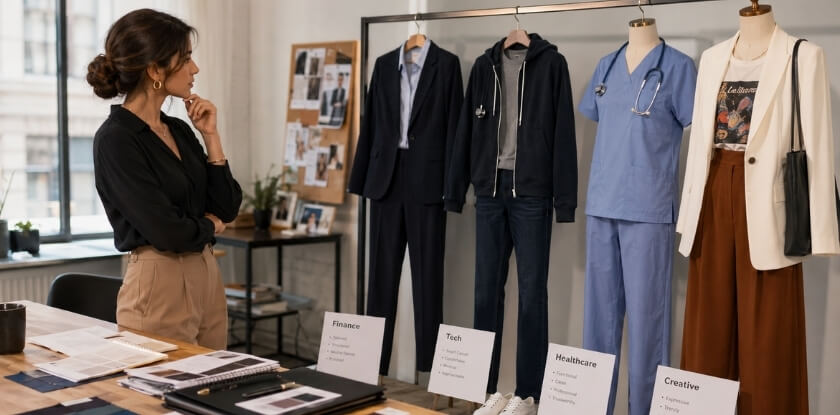
Corporate Finance or Law Conference
This is where business formal dress code still holds real weight. Nobody’s going to question you for being too polished here. The risk runs in the other direction.
Stick with a well-fitted sheath dress in navy, charcoal, or black, or go with tailored trousers paired with a structured blazer. Hemlines should sit at or just below the knee. Fabrics matter — ponte fabric holds its shape through a full day of sessions without wrinkling awkwardly, and merino wool is genuinely worth the investment if you’re attending something like Davos-adjacent events where temperatures vary between the venue and outside.
Shoes: block heel pumps or pointed-toe flats in black or nude. Both read professional without demanding you sacrifice comfort across eight hours of walking between breakout rooms.
Keep your bag structured. A structured tote bag in leather or faux leather works. Avoid anything with visible logos unless it’s genuinely high-end — overly branded bags tend to read as trying too hard in these rooms.
Minimal jewelry, natural nails, and a clean blowout will complete the picture without overshooting it.
Tech or Startup Conference
The startup culture dress code is genuinely confusing for a lot of women, because the rules are deliberately vague. Too formal and you look out of place. Too casual and you lose credibility in back-to-back investor meetings.
Smart casual is your target. Think tailored dark jeans or slim trousers, a clean top or lightweight blazer, and leather sneakers or pointed-toe flats. A midi skirt with a tucked-in blouse also works well here — it’s put-together without being stiff.
Events like SXSW or CES tend to involve a lot of walking, outdoor spaces, and temperature swings between freezing convention halls and warm outdoor areas. Layers are practical, not optional. A fitted blazer you can remove easily does double duty.
Color is fine. You don’t need to default to neutrals in a tech setting the way you might in finance. A bold top or an interesting print reads as confident in these rooms, not unprofessional. M.M. LaFleur has some strong options in wrinkle-resistant fabric that hold up through a full conference day — worth checking before you pack.
Skip anything overly precious. You’ll be on your feet more than you expect.
Creative Industry or Marketing Conference
At events like Cannes Lions, the dress code leans toward business casual dress code with a strong visual personality. This is one of the few conference environments where what you wear is almost an indirect portfolio piece.
That doesn’t mean costume. It means intentional. A wrap dress in a saturated color, interesting texture, or a considered print reads well. Tailored wide-leg trousers with a fitted blouse also hit the right note. Statement earrings are appropriate in a way they wouldn’t be at a law conference. Interesting shoes — a bold heel, a textured loafer — work here.
Brands like ASOS and Eloquii have strong options if you’re looking for more expressive pieces without a department store price tag. Nordstrom’s in-house styling services are useful if you want help building a coherent look quickly.
The one thing to avoid is anything that reads as costume or costume-adjacent. Creativity in this context means considered, not chaotic.
Trade Show or Expo
Trade shows are a different situation entirely. You’re on your feet for six, seven, sometimes eight hours straight. Comfort is non-negotiable. But you’re also representing your company or brand, often to dozens of people who’ll make quick judgments in a ten-second interaction.
Trade show attire should be professional but physical. Tailored trousers with a structured blazer and comfortable pointed-toe flats or low block heel pumps is the standard formula for good reason — it holds up. Avoid pencil skirts or anything restrictive around the knees if you’ll be standing, bending, or moving between booth setups frequently.
Stick to a consistent color palette that works with your brand or company colors if that’s relevant. Neutral tones photograph cleanly if your booth has any signage or visual material that’ll end up on LinkedIn or Instagram afterward.
Wrinkle-resistant fabric is non-negotiable at a trade show. You won’t have time to steam between the morning setup and the afternoon rush. Ponte fabric and technical blends are both reliable options for a full trade show day.
Bring a small crossbody or belt bag rather than lugging a full tote. Your hands need to be free. Universal Standard has some solid workwear basics in extended sizing if you need pieces that can take that kind of all-day wear without losing shape.
Outfit Ideas for Different Body Types — Inclusive Sizing Guide
Not every style guide accounts for the fact that women’s bodies are actually different from each other. A sheath dress that looks polished on one frame can feel completely wrong on another — and that’s not a personal failure, it’s just fit. Here’s what actually works for three common body types at a business conference setting.
Styling Tips for Petite Frames
The main challenge for petite women at conferences is proportion. Oversized blazers, wide-leg trousers, and maxi lengths can swallow a smaller frame and read as sloppy rather than professional.
Go for a monochromatic look whenever possible. Wearing the same color family from top to bottom — say, navy trousers with a navy blouse — creates an unbroken vertical line that adds visual height. A cropped blazer hits the right spot, usually just at or slightly above the hip, rather than a longline style that cuts you off at the thigh.
Midi skirts can work, but only if they’re tailored and hit closer to the knee. Anything that grazes the ankle tends to shorten the silhouette further. Pointed-toe flats are genuinely useful here — the elongated toe creates the same lengthening effect as a heel without the discomfort of standing all day.
Petite sizing exists for a reason. Ann Taylor, J.Crew, and Banana Republic all carry dedicated petite lines with proportioned inseams, sleeve lengths, and jacket cuts. M.M. LaFleur is also worth checking — their fit system lets you filter by height, so you’re not guessing.
Skip wide belts at the natural waist. A thin belt or no belt at all keeps the proportion cleaner.
Styling Tips for Plus-Size Attendees
Comfort and confidence are not separate things. If you’re constantly pulling at your hem, adjusting a waistband, or worrying about fit, that’s going to show — and a conference is not the place for distraction.
Ponte fabric is your best friend here. It has structure, holds its shape through a full day of walking and sitting, and doesn’t cling. Wrap dresses in ponte or a slightly stretchy jersey give you an adjustable fit and a flattering diagonal line across the chest. Eloquii and Universal Standard both build specifically for plus-size professional dressing — the tailoring is actually designed for these proportions, not scaled up from a straight-size pattern.
A well-fitted blazer changes everything. Not a boxy one. Look for a blazer that’s slightly nipped at the waist or has a single-button closure that sits at the narrowest point of your torso. Pair it with tailored trousers — a straight or wide-leg cut works well — rather than anything overly slim.
ASOS Curve carries a wide range of business-appropriate pieces at lower price points, and Nordstrom’s plus section has grown considerably with actual professional options. Don’t settle for whatever’s left after the straight sizes sell out.
Block heel pumps over stilettos. More support, less wobble, and you’ll be glad for it after hour six of a trade show floor.
Spanx has functional shapewear if you want that layer under a fitted dress, but don’t feel like you need it. It’s a personal call, not a requirement.
Styling Tips for Tall Women
The struggle for tall women is usually the opposite of petite — finding pieces long enough to actually fit, and avoiding looking like you’re wearing clothes that were designed for someone else.
Midi skirts and midi dresses are proportioned well for taller frames, especially when standard hemlines ride too high. Tailored trousers in a full-length or even slightly cropped style can work depending on your specific height and proportions — just confirm the inseam before you buy. Banana Republic and J.Crew both carry tall sizing online, and J.Crew’s Tall section goes up to a 35-inch inseam in many trouser styles.
Wide-leg trousers look genuinely good on taller frames. The volume is balanced by height in a way that doesn’t overwhelm. A longline blazer also works well — something that would look overwhelming on a petite frame reads as structured authority on a taller woman.
Don’t be afraid of color on top. A bold-colored blouse or printed top works well when you have the frame to carry it without it dominating the whole look.
Shoe-wise, you have more flexibility than most guides suggest. Flats are fine. Heels are fine. Neither is a political statement. If you love a block heel pump, wear it. If you prefer pointed-toe flats because you’re already the tallest person in the room and heels feel impractical, that’s equally valid.
For shopping, Universal Standard runs up to a 6XL and has strong tall options. ASOS Tall is another solid resource for trend-forward professional pieces that actually have the right sleeve and hem lengths.
Conference Outfit Ideas by Season
Season changes everything — not just the fabrics you reach for, but how many layers you’re juggling, whether your feet will survive a long exhibit hall day, and how much your outfit wilts by 3pm.
What to Wear to a Business Conference in Summer
Summer conferences are brutal. You’re dealing with heat outside, then aggressive air conditioning inside, and somehow you need to look polished through both.
The biggest mistake women make is dressing only for the outdoor temperature. Conference venues are almost always cold. Bring a blazer. Always. Even a lightweight unlined one in linen or a ponte fabric blend gives you coverage when the AC is cranked up and keeps your look structured for sessions.
Fabrics that actually work:
- Linen — breathes well but wrinkles fast. Stick to darker colors or textured weaves that hide it.
- Merino wool — sounds counterintuitive in summer, but lightweight merino regulates temperature better than most synthetics and doesn’t hold odor after a long day.
- Wrinkle-resistant fabric blends (look for polyester-viscose or stretch woven options at M.M. LaFleur and Banana Republic) are genuinely worth the spend in summer.
- Avoid matte jersey for full-day events — it clings by noon.
A sleeveless sheath dress with a tailored blazer thrown over it is probably the most efficient summer conference outfit. You can pull the blazer off during networking breaks, put it back on for a keynote. One outfit, two temperature zones.
If you run warm, a midi skirt with a tucked-in shell blouse gives more airflow than a dress without sacrificing the polished look. Pair it with pointed-toe flats rather than block heel pumps if you know it’ll be a high-step-count day — trade show floors and convention centers are not kind to heels in summer heat.
Color palette note: Light neutrals photograph well for summer conferences and look clean on camera for any hybrid conference components. But pale linen in cream or blush will show sweat marks. Stick to mid-tone neutrals — slate blue, warm taupe, soft terracotta — if you’re going light.
Keep your bag practical. A structured tote bag in a coated canvas or lightweight leather substitute holds up better in summer heat than real leather, which can soften and lose shape in humidity.
Shoes: your feet will swell. Wear shoes you’ve broken in. Save the new pointed-toe flats for day two if you must bring them.
What to Wear to a Business Conference in Winter
Winter conferences come with a completely different set of logistics problems: bulk, layering, and the fact that you’re carrying a coat that has nowhere to go once you’re inside.
The coat situation is real. Big conferences like Davos or large CES events have coat checks, but smaller ones don’t. Think about what you’re wearing as the outer layer before you even get to your conference outfit. A structured wool coat or a tailored camel overcoat works as part of your look rather than something you’re embarrassed to drag around.
Fabrics to prioritize in winter:
- Merino wool again — a merino turtleneck or fine-knit top under a blazer is warm, doesn’t add bulk, and stays neat under a structured jacket all day.
- Ponte fabric blazers and trousers are slightly thicker than their summer equivalents but still tailored-looking. They hold their shape in cold weather where lighter fabrics sometimes go limp.
- Heavier crepe or a lined sheath dress holds warmth better than unlined styles.
Layering is the actual skill in winter conference dressing. A blazer over a fine-knit turtleneck over tailored trousers is a complete outfit that handles a cold morning commute and a warm convention room with just the blazer removed. That’s the formula.
What to skip: Chunky knit sweaters look good in photos but read too casual for most business formal dress code or business casual dress code events. They’re also hard to layer cleanly under a blazer. A fine-gauge knit is almost always better.
Footwear is trickier. Block heel pumps in a suede finish look sharp in winter and give more grip than leather-soled heels on potentially wet surfaces. If the conference involves any outdoor movement — walking between buildings, outdoor venue components like SXSW tends to have — keep a pair of weather-appropriate flats or ankle boots in your bag. Don’t ruin your shoes or your day by committing to heels on icy pavement.
Tights and hosiery: opaque tights in 60-100 denier are a genuine functional choice with skirts or dresses in winter, not just a style one. Black opaques with a dark midi skirt and ankle boots is a clean, modern look that works for smart casual dress code events without feeling stuffy.
Retailers like Ann Taylor, J.Crew, and Nordstrom stock winter conference-appropriate pieces that photograph well and pack reasonably into carry-on luggage. Universal Standard and Eloquii both carry extended sizing in ponte and merino options that hold up across long conference days without requiring much maintenance.
One last thing: winter conference packing always runs heavier. Coats, boots, extra layers. Plan your capsule wardrobe around pieces that mix and match across two or three days, so you’re not checking a second bag just because it got cold.
Shoes and Accessories — Where Comfort Meets Professionalism
Best Shoe Choices for Long Conference Days
Conference days are brutal on your feet. You’re walking between sessions, standing during networking breaks, possibly doing a full venue tour, and then somehow expected to stay sharp for a cocktail reception at 6pm. The wrong shoes will derail your entire day by noon.
Block heel pumps are probably the most practical choice for professional events. A 2–2.5 inch block heel gives you height without killing your ankles on convention center tile. Look for styles with a cushioned insole — most off-the-rack options won’t have one, so grab a pair of Superfeet or Tacco insoles before you travel.
Pointed-toe flats are underrated at conferences. A sleek pointed flat in nude, black, or deep burgundy reads just as polished as a heel, especially paired with tailored trousers or a midi skirt. Brands like Sam Edelman and Everlane have durable options under $120 that won’t look tired by day two.
Avoid stilettos unless the event is a single evening gala. Avoid flip-flops, sneakers, or anything you’d wear to a grocery run — even at SXSW or CES where the dress code is relaxed, completely casual footwear reads as unprepared rather than cool.
If you’re speaking, wear your shoes at home for at least two full evenings before the event. New shoes on a stage are a gamble you don’t need.
A practical note on packing: bring two shoe options. One for walking-heavy days, one for sitting-heavy sessions or evening events. That’s not indulgent — it’s logistics.
Bags, Jewelry, and Accessories That Complete the Look
Your bag does a lot of work at a conference. It carries your laptop, charger, notebook, business cards, snacks, and probably a backup pair of flats. A structured tote bag in leather or faux leather is the workhorse option here. It looks professional, holds everything, and doesn’t scream “I packed for a weekend trip.”
Look for a tote with at least one internal laptop sleeve and a zip closure. Brands like Dagne Dover, Cuyana, and Lo & Sons make totes designed specifically for this kind of day. If you prefer a crossbody for hands-free movement between booths, that works too — just keep it structured rather than slouchy.
Avoid backpacks with too many straps or anything with heavy branding. At a conference like Cannes Lions or Davos-adjacent events, your bag is part of how people read you before you open your mouth.
Jewelry keeps it simple. Stud earrings, a small pendant necklace, or a delicate bracelet — that’s your range. Statement earrings are fine if they don’t move or catch light in a way that becomes distracting when you’re on a panel or being photographed. Skip anything that jingles. You will absolutely end up in a quiet breakout session.
A watch still matters in professional settings. It signals that you’re time-conscious, which is a subtle but real thing people notice. It doesn’t need to be expensive — a clean-faced watch in gold or silver tone reads polished at every price point.
One underused accessory: a silk or lightweight scarf. It covers you in an over-air-conditioned session, can dress up a simple outfit for an evening dinner, and takes up almost no space in your carry-on luggage. Pack one.
Keep your color palette cohesive between your outfit and accessories. You don’t need to match exactly, but a warm-toned outfit with a cold-toned silver bag creates a visual disconnect that’s hard to pin down but easy to feel. Neutral tones in your accessories mean they travel across every outfit in your capsule wardrobe without friction.
If you’re attending a hybrid conference and will be on camera during any part of it, check that your jewelry doesn’t catch the ring light in a distracting way. Matte finishes over high-shine for anything near your face.
Budget-Friendly vs Investment Pieces for Your Conference Wardrobe
Not every piece you pack needs to cost a fortune. But some things absolutely do. The trick is knowing which is which before you shop — because buying the wrong thing cheap, or spending too much on the wrong thing expensive, is how you end up with a closet full of stuff that doesn’t work.
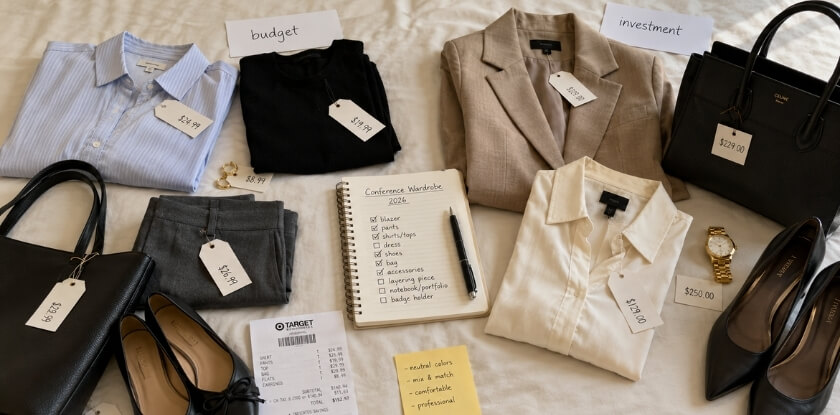
Where to Spend and Where to Save
Start with what gets seen least and touched most. Basics like camisoles, underwear, and hosiery? Save. Nobody at the conference sees your cami under your blazer. ASOS and Target both carry perfectly functional options for under $20.
Same logic applies to trendy pieces. If you’re chasing a color that’s hot right now — a cobalt blue midi skirt, an oversized belt, a statement necklace — don’t spend big on it. Trends cycle. Eloquii and ASOS carry on-trend pieces at prices that make more sense for something you’ll wear two seasons.
Wrinkle-resistant basics are another area where you don’t need to go premium. A simple ponte fabric sheath dress from a mid-range retailer performs just as well as a $300 version in a suitcase. Check Universal Standard or even Amazon Essentials before you assume you need to go higher.
Here’s where you can genuinely save across the board:
- Blouses and tops — H&M, ASOS, or Banana Republic Factory (not the main line)
- Scarves and belts — thrift stores are legitimately great here
- Tights and shapewear — mid-tier Spanx alternatives work fine
- Seasonal pieces — if you need something for one warm-weather conference, don’t buy merino wool at full price
One real tip: J.Crew and Ann Taylor both run sales constantly. If you’re not buying during a sale, you’re paying too much. Sign up for their emails, buy during a 40% off event, and your budget goes twice as far.
Key Investment Pieces Worth Buying Once
There are a few items where spending more actually makes financial sense over time. These are the things you’ll wear to every conference, every client meeting, every professional event for years.
- A well-fitting blazer. This is the piece. A blazer from M.M. LaFleur or the main J.Crew line, cut properly for your body, will go with nearly everything else you own. Petite, plus-size, and tall women especially benefit from spending here — fit matters more on a blazer than almost anything else, and cheap blazers show it. Budget: $150–$250 is a reasonable range. You’ll wear it 50+ times.
- Tailored trousers in a neutral. Navy, charcoal, or black. Properly hemmed. These anchor your entire capsule wardrobe for travel. A $40 pair from a fast-fashion retailer will bag out at the knees after a few wears. Nordstrom carries several options in extended sizing worth the price.
- Block heel pumps or quality pointed-toe flats. Your feet will take real punishment across a full conference day — registration, breakout sessions, networking dinners. A $35 pair of shoes will make you miserable by 3pm. Spend $100–$150 on something with real arch support. Sam Edelman and Cole Haan both hit that range without going ridiculous.
- A structured tote bag. It carries your laptop, your notebook, your charger, and your lanyard. It appears in every photo. It sits on conference tables. Buy one that looks professional and holds its shape. Cuyana and Dagne Dover make bags built to last, and you’ll use yours at every event for years.
- One wrinkle-resistant travel dress. This is the workhorse. Something in a wrap dress or sheath silhouette, in a neutral or a deep solid, that can go from day sessions to a dinner without looking worn. M.M. LaFleur built their entire brand around this concept. One dress that travels well is worth more than three that don’t.
The overall framework is simple. If you’ll wear it 20+ times over three years, spend properly. If you’ll wear it twice, don’t. A smart conference wardrobe isn’t about buying everything at once — it’s about buying the right five things well, and filling the rest in cheaply.
Travel-Friendly Packing Tips for Conference Outfits
Getting your outfits to the conference in good shape is half the battle. You’ve planned the looks. Now they need to survive a checked bag, a cramped overhead bin, or a two-hour drive — without arriving looking like a crumpled mess.
Fabrics That Resist Wrinkles on the Road
Fabric choice does most of the work here. Some materials spring back after being packed for 18 hours. Others don’t.
- Ponte fabric is probably your best friend for conference travel. It’s thick enough to hold its shape, doesn’t crease easily, and looks polished straight out of a suitcase. A ponte blazer or tailored ponte trousers can go from bag to boardroom with maybe a quick steam, sometimes not even that.
- Merino wool is another strong pick. It regulates temperature, resists odor (which matters on day three of a conference), and shakes out wrinkles surprisingly well. A merino midi skirt or a thin merino shell works across multiple outfit combinations without looking tired.
- Wrinkle-resistant fabric marketed as such — often a polyester blend or treated rayon — varies a lot by brand. M.M. LaFleur built much of their line around this idea, and their travel-friendly pieces genuinely perform. Banana Republic and J.Crew both offer wrinkle-resistant trousers and blouses that are worth checking before you pack.
Fabrics to avoid if you can: pure linen (wrinkles instantly), 100% cotton wovens, and anything with a heavy drape that folds into deep creases. Silk looks beautiful but requires a steamer at the hotel, which is a risk unless you know one will be there.
One practical test: scrunch a corner of the fabric in your fist for 30 seconds, then let go. If the wrinkles release within a minute, it’ll travel fine. If they stay, leave it at home.
How to Pack a Full Week of Outfits in a Carry-On
A full week of conference outfits in carry-on luggage sounds impossible. It isn’t, if you plan around a capsule wardrobe approach rather than packing complete, separate looks for every single day.
Start with a tight color palette — two neutrals and one accent color works well. Think navy, camel, and burgundy. Or black, grey, and cobalt. Everything mixes with everything else, which means a single blazer works across four different outfits instead of one.
Here’s a realistic packing list for a five-day conference in a standard carry-on:
- 2 blazers (one neutral, one accent or pattern)
- 2 pairs of tailored trousers or a mix of trousers and a midi skirt
- 1 sheath dress or wrap dress
- 3–4 tops or blouses
- 1 pair of block heel pumps, 1 pair of pointed-toe flats
- Undergarments, Spanx if you use them, and a compact belt
That’s nine to ten pieces that create 10–12 distinct outfits depending on how you mix them. The structured tote bag you’ll carry to sessions doubles as your personal item on the flight, saving you checked bag fees.
Rolling vs. folding is a real debate. For ponte and knit fabrics, rolling reduces creasing significantly. For anything with a sharp crease you want to maintain — like dress trousers — fold them flat along the existing crease line and lay them on top of everything else in the bag.
Use a packing cube system. One cube for tops, one for bottoms, one for shoes in a dust bag. It keeps things organized and compresses volume without crushing delicate pieces.
If your conference runs longer than five days, plan for a laundry stop or choose a hotel with in-room laundry. Trying to pack seven full days of conference-appropriate outfits into a carry-on is where the system breaks down. Three days of core outfits, access to laundry on day four — that’s a cleaner solution than overpacking.
One last thing: always pack your day-one outfit at the top of your bag or in your personal item if it’s small enough. Nothing worse than landing after a delayed flight, racing to your hotel room, and having to excavate your suitcase for the first look you’re wearing in two hours.
What to Wear to a Virtual or Hybrid Conference
Virtual conferences changed a lot of unspoken rules. You’re still being seen — sometimes by hundreds of people — but the framing is completely different. Nobody can see your tailored trousers or your pointed-toe flats. The camera sees roughly from your shoulders to the top of your head, and that’s your entire outfit as far as most attendees are concerned.
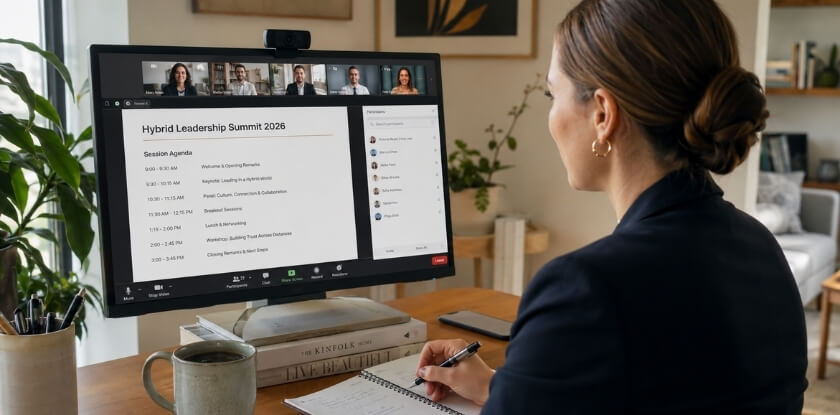
That doesn’t mean you can slack off. It means you need to think differently.
What the Camera Actually Sees
Your webcam captures a pretty tight window. Color, neckline, and fabric texture are the three things that will make or break how you read on screen.
Webcam-friendly colors tend to be solid, medium-toned shades — think dusty rose, cobalt, teal, forest green, or camel. Bright white can blow out under a ring light. Very dark navy or black can flatten your features, especially if your background is also dark. Busy patterns — thin stripes, tiny florals, high-contrast checks — often create a visual vibration effect on video called moiré. It’s distracting and makes you look unprofessional even if the blouse cost $180.
Stick to solids or very subtle texture. Ponte fabric works well because it holds its shape and doesn’t shimmer or reflect light oddly. Merino wool is another good option — it looks polished without being shiny.
Top Half Is Everything
Structured tops, blazers, and fitted blouses photograph well. A blazer over a simple top is probably the most reliable formula — it reads as put-together immediately, and blazers from Banana Republic or Ann Taylor hold their shape without looking stiff.
A wrap dress or wrap-style top also works well on camera because the V-neckline is flattering at webcam height and draws the eye upward. Just make sure the fabric isn’t too silky or reflective.
Avoid chunky necklaces that clink against microphones. If you’re wearing a lapel mic or using a built-in webcam mic, jewelry noise picks up easily and it’s annoying to edit out — assuming anyone even bothers.
Your Background and Lighting Matter More Than You Think
This isn’t strictly an outfit topic, but it directly affects how your outfit reads. A ring light positioned at face level, roughly three feet away, will make almost any color look better on camera. Without it, even a great blazer looks dull.
Your virtual conference background should be neutral — a plain wall, a bookshelf, or a simple branded backdrop if the event provides one. Busy backgrounds compete with your outfit visually. You want people looking at your face, not trying to read the titles on your bookshelf.
If the event uses a green screen background, wear something that doesn’t blend into it. Obvious advice, but it happens.
Hybrid Conferences Are a Different Problem
A hybrid conference means some attendees are in the room with you and others are watching on screen. You need to dress for both simultaneously.
The good news is that a solid business casual dress code outfit handles both. A blazer, a sheath dress in a camera-friendly color, or tailored trousers with a structured blouse will read well from across a room and on a webcam. Avoid fabrics that wrinkle badly because you’ll be moving between a physical seat and a camera-facing position throughout the day.
At events like SXSW, where hybrid formats have become standard for many sessions, presenters who wear mid-toned solids with strong silhouettes consistently read better on the recorded footage than those in complex prints or all-black outfits.
If You’re Speaking Virtually
Test everything 24 hours before. Put on exactly what you plan to wear, turn on your webcam, and sit in your actual conference chair at your actual desk. Look at how you appear on screen — not in a mirror, on the actual video feed.
Check for:
- Color washout under your lighting
- Any background color that clashes with your top
- Jewelry that might catch light or make noise
- Whether your neckline is appropriate at webcam angle
M.M. LaFleur and Universal Standard both have pieces that photograph consistently well because they’re designed with clean lines and non-reflective fabrics. If you’re building a virtual conference wardrobe from scratch, those are worth browsing specifically for webcam-friendly colors.
One practical thing many women overlook: you can wear whatever you want from the waist down. Comfortable joggers, no shoes, whatever helps you stay relaxed and focused during a long day of virtual sessions. Nobody will ever know.
Frequently Asked Questions
What is the most appropriate outfit for a women’s business conference?
It depends entirely on the event. A finance or legal conference typically calls for business formal — think a tailored blazer, sheath dress, or tailored trousers with a structured top. A creative or tech event like SXSW or Cannes Lions gives you more room to work with smart casual. The safest default across almost any conference is a polished blazer paired with trousers or a midi skirt. You’ll rarely be overdressed, and you can always remove the blazer if the room is more relaxed.
Can I wear jeans to a business conference?
Sometimes, yes. Startup culture and creative industries have made dark, well-fitted jeans acceptable at certain events. But standard blue or distressed jeans? Hard no for most professional conferences. If the dress code says business casual and you want to wear jeans, go for dark indigo or black, pair them with a blazer and pointed-toe flats or block heel pumps, and make sure they’re completely free of fading or wear. When in doubt, swap them for tailored trousers.
What should I wear if I’m speaking at a conference?
Wear something you’ve already tested. That’s the most important rule. Beyond that, avoid busy patterns, all-white, and anything with reflective detail — these don’t read well on stage lighting or camera. Solid colors in navy, burgundy, forest green, or blush work well. A well-fitted sheath dress or a blazer-and-trouser combo gives you a clean silhouette. If you’re being recorded, webcam-friendly colors matter even on an in-person stage. Check with the event team whether you’ll be mic’d — a lapel mic means you need a collar or lapel to clip it to.
What do you wear to a business conference in hot weather?
Lightweight ponte fabric and merino wool blends are your best friends — they breathe, they don’t wrinkle, and they still look sharp. A wrap dress in a natural fiber works well in summer heat. Avoid anything sheer or too sleeveless in a formal setting. A light blazer you can tie around your bag is useful if the conference rooms run cold (they usually do). Linen looks great but wrinkles badly, so plan around that.
Is a wrap dress appropriate for a business conference?
Yes, absolutely. A wrap dress in a solid color or subtle print is one of the most versatile pieces you can pack. It photographs well, travels without wrinkling much, and reads professional across a wide range of dress codes — from smart casual up to moderate business formal depending on the fabric and styling. Pair it with block heels and a structured tote bag and you’re done.
What brands are good for women’s conference outfits?
A few reliable ones depending on your budget:
- M.M. LaFleur — specifically designed for professional women, excellent wrinkle-resistant options
- Ann Taylor and Banana Republic — consistent quality for classic conference staples
- J.Crew — good for smart casual and business casual
- Universal Standard and Eloquii — strong options for plus-size fashion with genuinely professional styles
- ASOS — budget-friendly with a wide range; sizing varies so check reviews
- Nordstrom — worth browsing for petite sizing and tall women fashion in one place
What shoes should I wear to a conference if I’ll be standing all day?
Don’t sacrifice your feet for the sake of heels. Pointed-toe flats in leather or faux leather look polished and hold up for long days. If you want height, block heel pumps distribute weight better than stilettos and are significantly easier to stand in for hours. Whatever you choose, wear them around the house for a few days before the conference. Brand-new shoes at a conference is a painful mistake you only make once.
How many outfits should I pack for a 3-day conference?
Three outfits minimum, but pack four if your luggage allows. Day one usually calls for your sharpest look — first impressions matter at registration and opening sessions. Days two and three you can mix and match pieces from a small capsule wardrobe built around a consistent color palette (neutral tones work best for this). One backup outfit for spills or weather surprises is worth the extra space in your carry-on luggage. Check if your hotel has same-day pressing services — that can save you from overpacking.
What should I wear to a virtual or hybrid conference?
Focus on what the camera sees. Wear solid colors — bright jewel tones and soft neutrals show up better on screen than patterns or pastels. Set up decent lighting (a basic ring light helps more than you’d think) and think about what your virtual conference background says about you. For a hybrid conference where you might appear both in person and on screen, choose an outfit that works in both contexts — a blazer in a solid color usually covers both.
Do I need to dress differently for a trade show vs. a conference?
Yes, somewhat. Trade show attire leans practical — you may be on your feet for six to eight hours, moving between booths, carrying materials. Comfort is non-negotiable. But you still want to look professional. Prioritize supportive shoes, a structured tote bag with room for collateral, and an outfit that moves well. Avoid anything too fitted or formal that restricts movement. A blazer over a simple blouse and tailored trousers handles most trade show environments well.
Where can I find outfit inspiration for business conferences?
LinkedIn posts from women in your industry are genuinely useful — you can see what’s actually being worn at specific events. Instagram is good for broader styling ideas, though filter out anything that leans too influencer-y for your field. Eventbrite sometimes links to past event photos. If the event is a well-known one like the TED Conference, Davos, or CES, search for past year photos — you’ll get a realistic sense of the dress code in practice.
Final Thoughts — Dress with Confidence and Make Your First Impression Count
You’ve done the research, planned your outfits, packed your carry-on, and thought through everything from your speaker look to your networking-day shoes. Now the real work is just showing up — and doing it in clothes that don’t distract you from why you’re actually there.
Here’s the honest truth: no one is going to remember whether your blazer was from Banana Republic or whether your midi skirt hit exactly an inch below your knee. What people remember is whether you seemed confident, present, and like someone worth talking to. Your outfit is just the frame. You’re the picture.
That said, effort does read. Walking into a room dressed appropriately for the context — whether that’s a polished business formal dress code at Davos or a relaxed smart casual dress code at SXSW — signals that you took the event seriously. It’s a small thing that carries real weight.
A Few Things Worth Keeping in Mind
Don’t overthink neutral tones. A simple color palette built around two or three pieces you already feel good in will always outperform a rushed shopping haul the week before. Ponte fabric, merino wool, wrinkle-resistant fabrics — these aren’t just travel conveniences. They’re confidence tools, because you’re not spending mental energy fixing yourself in bathroom mirrors.
Comfort is not the enemy of professionalism. Pointed-toe flats and block heel pumps can both look polished. One might just keep you standing for six hours without pain. That matters. Your energy matters more than any single item in your suitcase.
If you’re speaking, presenting, or leading a session — your outfit carries extra weight, and you already know that. You planned for it. Stick with what you tested. Don’t wear something new for the first time on stage.
The Bigger Picture
The conference outfit conversation has changed. Petite sizing, plus-size fashion, and tall women fashion are finally getting real representation — from brands like Universal Standard, Eloquii, and M.M. LaFleur. You don’t have to squeeze yourself into a template that wasn’t designed for your body. Good options exist now, across most budgets and body types.
And if you’re heading to a hybrid conference or presenting to a webcam, your top half still counts. Webcam-friendly colors, a decent ring light, and a clean virtual conference background are the equivalent of walking into a room dressed well. People notice when you’ve made the effort, even through a screen.
One last thing. Scroll LinkedIn or Instagram before the event. Look at photos from last year’s conference. It takes ten minutes and tells you more about the actual vibe than any dress code description on Eventbrite ever will.
Dress like yourself — just the version of yourself that’s ready to be taken seriously.
