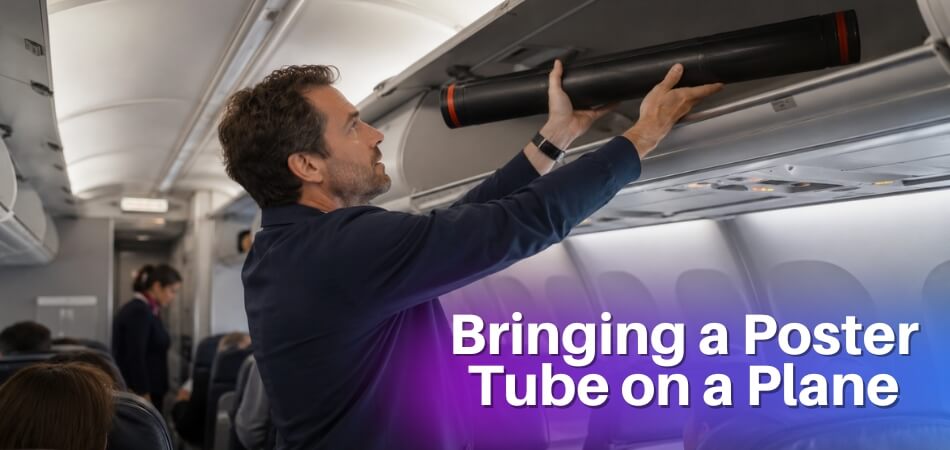
You’re standing at the airport security checkpoint holding a rolled-up poster or piece of artwork — and suddenly you wonder: can you actually bring a poster tube on a plane? Maybe it’s a vintage print you just picked up, a piece of custom art, or something irreplaceable you simply can’t risk losing in checked baggage. The clock is ticking, the line is moving, and you have no idea what the rules are.
Yes, in most cases you can bring a poster tube on a plane. The TSA has no specific ban on poster tubes, but the real challenge is your airline’s carry-on size limits and the available space in the overhead bin. Pass through security and you’re halfway there — but getting that tube onto the plane without extra fees or a forced gate check is a different story entirely.
Here’s the problem most travel guides skip over: Delta, United, American Airlines, Southwest, JetBlue, Spirit, Ryanair, and EasyJet all handle oversized carry-on items differently. Some will let a slender hard-shell tube slide into the overhead bin without a second glance. Others will flag it at the gate, charge you an oversized baggage fee, or refuse it outright. Throw in a connecting flight, an international route with customs and immigration, or a budget carrier with brutal size restrictions, and what seemed like a simple question gets complicated fast.
This guide covers everything — TSA screening, individual airline policies, tips for packing fragile items and rollable fabric posters, what IATA guidelines mean for international travelers, and how to protect your artwork when the worst happens. Whether you’re traveling with a lightweight cardboard tube or a reinforced Pelican Case, you’ll know exactly what to expect before you ever reach the checkpoint.
Can You Bring a Poster Tube on a Plane? (Quick Answer)
Yes, you can. Both as a carry-on and in checked baggage, a poster tube is generally allowed on commercial flights. The TSA doesn’t list poster tubes as prohibited items, so security screening isn’t where most people run into trouble.

The real complications come from size restrictions and individual airline policies — not the tube’s contents.
Carry-On vs. Checked Baggage
If your tube fits within your airline’s carry-on size limits, you can take it through security and stow it in the overhead bin. If it’s too long, it goes in the hold as checked baggage — and depending on its dimensions, you might get hit with an oversized baggage fee.
Most standard poster tubes run between 24 and 36 inches long. That’s the problem. A typical carry-on size limit is around 22 x 14 x 9 inches. A 30-inch tube doesn’t fit that math, no matter how you angle it.
Here’s a rough breakdown of what usually happens:
- Short tubes (under 22 inches): Likely fine as carry-on
- Mid-length tubes (22–36 inches): Usually need to be checked; some airlines allow gate check
- Long tubes (36+ inches): Almost certainly oversized; fees apply
Does the Airline Matter?
A lot. Delta Airlines, United Airlines, and American Airlines all follow similar size-based rules for oversized items, typically charging $150–$200 each way for items exceeding linear inch limits (usually 62 linear inches for standard checked bags). Spirit Airlines and Southwest Airlines have their own fee structures, and budget carriers like Ryanair and EasyJet in Europe are notoriously strict — they may refuse oversized items entirely or charge fees that rival the cost of the artwork itself.
Always check the specific airline’s oversized and fragile items policy before you book. Don’t assume.
What About Hard-Shell Tubes vs. Rollable Fabric Posters?
A hard-shell tube — think something close to a Pelican Case in rigidity — offers the best protection but adds length and weight. A rollable fabric poster changes the equation entirely: you can sometimes roll it tighter, slip it into a carry-on duffel, and avoid the whole oversized conversation.
If you’re transporting valuable artwork, a hard-shell tube with carry-on dimensions is the smartest play. If it’s a standard paper poster you picked up at a conference, a soft tube in checked baggage usually works fine.
TSA Rules for Poster Tubes — What Happens at the Security Checkpoint?
The TSA doesn’t have a specific rule that bans poster tubes. That’s the short version. But “not banned” doesn’t mean “no friction at the checkpoint.”
What TSA Officers Are Actually Looking For
TSA security is concerned with what’s inside the tube, not the tube itself. An opaque hard-shell tube — especially a long one — can obscure items on the X-ray scanner. If the officer can’t get a clear read of the contents, they’ll pull it aside for a physical inspection.
This is more common than people expect. Rolled posters, blueprints, and canvas prints don’t scan particularly cleanly. The material density shifts, the image looks ambiguous, and a cautious officer will want to open it.
A few things that will slow you down:
- Metal end caps that block X-ray penetration
- Tubes packed tightly with padding materials that look irregular on screen
- Very long tubes that don’t fit cleanly through the scanner belt
Carry-On vs. Checked — Does It Change the TSA Process?
If you’re carrying the tube through the security checkpoint, it goes through the X-ray machine like everything else. That’s true whether it eventually ends up in the overhead bin or you plan to gate check it later.
If it’s going in checked baggage, TSA may still inspect it. They have the authority to open checked bags, and they will if something flags in the scanner. They’ll leave a notice inside if they do.
How to Get Through Faster
Be proactive. When you place the tube on the belt, mention to the officer that it contains rolled artwork or printed materials. This isn’t required, but it cuts down on back-and-forth. Officers appreciate it when you make their job easier.
Keep the tube accessible. Don’t bury it at the bottom of a bag or wrap it in a way that makes opening it a production. If you’re using a hard-shell tube with a screw cap, the officer should be able to open and close it in under 30 seconds.
Transparent tubes are genuinely useful here. If the officer can see rolled paper inside without opening anything, inspections drop significantly.
One Thing People Get Wrong
There’s no TSA “fragile items” designation that protects your poster tube from being handled roughly. If they need to inspect it, they’ll handle it. Your best protection is to pack the contents so they can survive a quick inspection and re-roll without damage — which usually means a secure inner sleeve or cardboard core keeping the poster’s shape intact.
The TSA checkpoint is almost never where poster tubes become a problem. The real complications usually come from airline size policies, which is a different conversation entirely.
Carry-On vs Checked Baggage — Which Option Is Better for a Poster Tube?
The short answer: carry-on wins almost every time. But there are real situations where checking a tube makes more sense, and knowing the difference could save you money, stress, or a damaged poster.

Advantages and Limitations of Bringing a Poster Tube as a Carry-On
Keeping your tube with you means you control what happens to it. Nobody throws it onto a conveyor belt. Nobody stacks a suitcase on top of it. For anything irreplaceable — original artwork, signed prints, architectural drawings — this matters a lot.
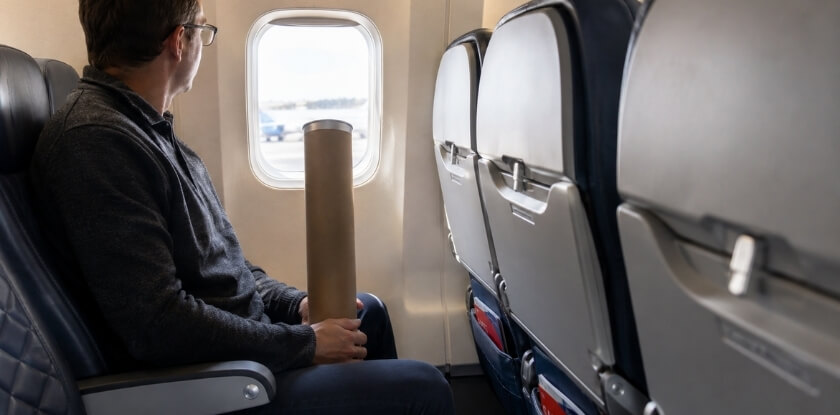
The practical upside is that most standard poster tubes fit in an overhead bin without any drama. A tube around 24 inches long and 3–4 inches in diameter typically slides in diagonally or lengthwise depending on the aircraft. Larger regional jets are tighter, so if you’re on a small CRJ-700 or similar commuter plane, you might get pushback at the gate.
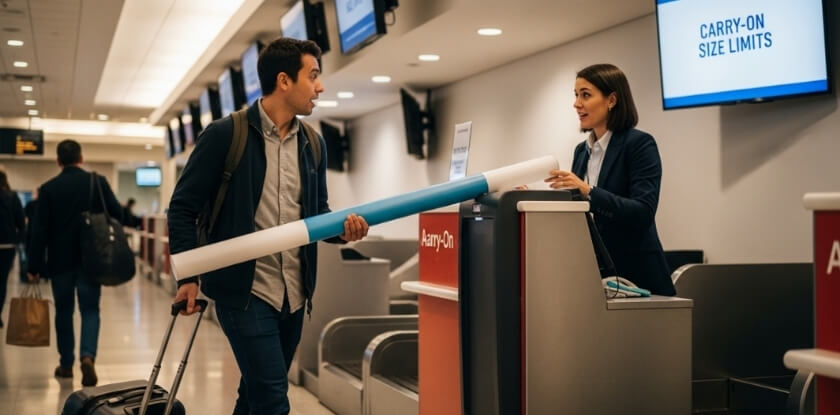
Airlines like Delta, United, and American Airlines don’t publish a specific “poster tube policy” — they apply standard carry-on size rules. The combined linear dimensions (length + width + height) usually cap around 45 inches total. A 30-inch tube is fine. A 48-inch mailing tube is not getting in the cabin. Full stop.
JetBlue and Southwest are generally relaxed about oddly shaped carry-ons as long as they fit without forcing. Spirit Airlines is stricter — they enforce size limits aggressively, and if your tube doesn’t fit cleanly, expect to pay an oversized baggage fee at the gate.
A few real limitations to know:
- Full flights are brutal. If overhead bin space runs out, the crew will gate-check your tube. You don’t get a choice. That’s fine on a domestic Delta flight, but riskier on a budget carrier that handles gate-checked items carelessly.
- Rigid hard-shell tubes are awkward to hold. On a long connecting flight through a busy hub, carrying a 36-inch tube through three terminals gets old fast.
- Soft or rollable fabric posters in a thin mailing tube are easy. A thick Pelican Case-style hard-shell tube is another story — technically carry-on legal by size, but crew members sometimes push back on bulky cylindrical items.
If your connection is tight, don’t risk it as a carry-on. A tube fumbled at security or pulled aside for inspection burns minutes you don’t have.
Risks and Precautions When Checking a Poster Tube as Baggage
Checked baggage handling is rough. That’s just reality. Tubes get tossed, stacked under heavier bags, and sometimes bent if the material isn’t rigid enough. A cardboard mailing tube in checked baggage is asking for trouble. A proper hard-shell tube — something with end caps that lock — has a much better survival rate.
The main risks:
- Crushing and impact damage — cardboard tubes crack. Thin plastic tubes crack too. If you’re checking a tube, it needs to be heavy-duty PVC or a purpose-built hard case.
- Lost or delayed bags — this is the one that hurts most with irreplaceable content. IATA data consistently shows checked bags go missing at a low but real rate. A missed connection in a busy hub multiplies that risk.
- Oversized baggage fees — a poster tube longer than 62 linear inches will trigger oversized charges on most carriers. On Ryanair or EasyJet, that can cost more than the flight itself if you didn’t pre-book it. American Airlines charges $200 each way for oversized items. Always pre-declare it.
If you do check a tube, here’s what actually helps:
- Use a hard-shell tube with threaded or locking end caps. Cardboard is not adequate for checked baggage.
- Pad the contents. Even inside a hard tube, rolled posters shift. Tissue paper or a thin foam insert stops internal movement.
- Label it clearly — name, phone number, destination — on the outside. Fragile stickers don’t guarantee gentle handling, but they don’t hurt either.
- Consider travel insurance that explicitly covers artwork or documents. Most standard policies exclude high-value paper goods unless you add a rider.
- Take photos of the contents before checking. If something gets damaged, you need documentation for a claim.
On Ryanair and EasyJet specifically, oversized checked items often go in the aircraft hold separately from standard luggage. That means more handling points, more chances for damage.
Bottom line: carry-on if the tube fits and the content matters. Check it only if you have no choice, and only if the tube itself is genuinely protective.
Airline-by-Airline Poster Tube Policy — What Does Each Carrier Allow?
TSA clears you through security, but once you’re past the checkpoint, each airline gets to make its own rules about what fits in the cabin and what gets checked. Poster tube policies vary more than you’d expect. Here’s what each major carrier actually says.
Delta Airlines
Delta allows carry-on bags up to 22 x 14 x 9 inches. A standard poster tube — the kind you’d pick up at an art supply store — typically runs around 24 to 36 inches long and 3 to 4 inches in diameter. That length alone puts most hard-shell tubes outside Delta’s carry-on size limits.
That doesn’t mean you’re stuck. Delta gate agents have some discretion, and a slim tube that fits lengthwise in the overhead bin often gets waved through without issue. That said, you can’t count on it. If your tube is obviously oversized, you may get asked to gate check it before boarding.
For checked baggage, Delta’s standard size limit is 62 linear inches (length + width + height combined). A 36-inch tube with a 4-inch diameter comes to roughly 44 linear inches, so it fits easily. Just make sure it’s well-padded — Delta’s fragile items policy doesn’t guarantee special handling unless you’ve paid for it or declared the item at check-in.
United Airlines
United’s carry-on limit is also 22 x 14 x 9 inches. Same problem as Delta for longer tubes. United is fairly strict at the gate on oversize items, especially on fuller flights where overhead bin space is already contested.
One thing worth knowing: United allows you to check items up to 115 linear inches on most routes before they start treating it as oversized baggage. A typical poster tube falls well under that. Standard checked baggage fees apply — currently $35 for the first bag on most domestic routes if you haven’t prepaid.
United doesn’t have a specific published policy for artwork transport or fragile items beyond their general liability disclaimer. If you’re flying with anything valuable inside that tube, document it, photograph it, and consider travel insurance that covers checked baggage damage. United’s liability cap for domestic flights is $3,800 per passenger, but proving damage and getting a payout is a different story.
American Airlines
American Airlines follows the same 22 x 14 x 9 inch carry-on rule. Long tubes don’t fit the spec on paper, but American’s enforcement at the gate can be inconsistent. Some travelers report getting thin tubes (under 2 inches diameter, under 26 inches long) into the overhead bin without any pushback. Others get stopped.
For checked bags, American’s limit is 62 linear inches and 50 pounds. Again, standard poster tubes fit this easily. American does have a fragile items sticker process at check-in — you can ask the agent to tag your bag as fragile. It doesn’t guarantee anything, but it sometimes means the bag gets placed on top rather than thrown underneath everything else.
If your tube is a Pelican Case-style hard shell container carrying valuable artwork, declare it at the counter. American’s agents are generally more careful with obviously expensive items that are clearly labeled.
Southwest Airlines
Southwest is a bit different from the others because they don’t charge for the first two checked bags. That changes the calculation significantly if you’re on the fence between carry-on and checked. Just check the tube. It costs nothing extra.
Southwest’s carry-on size limit is 24 x 16 x 10 inches. Slightly more generous than the others, but the length restriction still rules out most full-size poster tubes. Southwest is also known for stricter gate enforcement on oversize items because they board by group number and overhead bin space gets tight fast.
One practical note: Southwest doesn’t have assigned seating, which means overhead bin access depends entirely on your boarding position. If you’re in the last boarding group with a tube you’re hoping to squeeze in, you’re going to have a bad time. Check it instead.
JetBlue
JetBlue allows one carry-on up to 22 x 14 x 9 inches and one personal item. The carry-on size limit is the same as most major carriers, so long tubes face the same issue.
Where JetBlue stands out slightly is customer service consistency. Their agents tend to apply policies more uniformly than some budget carriers. If your tube is borderline, don’t assume you’ll get lucky at the gate — call ahead and ask. JetBlue’s customer service line is actually useful for this kind of specific question, and getting a confirmation in writing (even just a chat transcript) gives you something to reference if there’s a dispute at boarding.
For checked bags on JetBlue, the standard fee is $35 for the first bag on most Blue fares. The 62-linear-inch limit applies here too. JetBlue doesn’t have a specific artwork or fragile items policy beyond their standard liability terms, so the same advice applies — photograph everything, and if the contents are genuinely valuable, get them covered separately before you fly.
Poster Tubes on Budget Airlines — Spirit, Ryanair, and Other Low-Cost Carriers
Budget carriers are a different beast entirely. What’s a minor inconvenience on Delta or United can become a genuine headache — and an unexpected fee — on Spirit, Ryanair, EasyJet, or similar low-cost airlines.

Spirit Airlines
Spirit’s entire business model is built around charging for extras. Your carry-on bag? That costs money. A personal item that’s slightly oversized? Also money.
A poster tube is going to raise immediate questions at the gate. Spirit doesn’t have a published policy specifically for tubes or artwork transport, which means it’s subject to agent discretion and their standard size rules. Their personal item must fit under the seat (roughly 18″ × 14″ × 8″), and carry-on bags must stay within 22″ × 18″ × 10″. A standard 36-inch poster tube fits neither of those categories.
Realistically, Spirit will treat a poster tube as an oversized carry-on or a separate paid bag. Budget at least $79–$100 for that, depending on when you pay — at the gate it’s always more expensive than paying online in advance.
If you’re flying Spirit with a tube, check it in advance and declare it as an oversized item. Don’t gamble on gate agents being flexible.
Ryanair and EasyJet
European budget carriers are even stricter about dimensions, because their overhead bins are smaller and they enforce limits aggressively.
Ryanair’s priority boarding customers get a 10kg carry-on up to 55cm × 40cm × 20cm. A poster tube blows past the depth restriction immediately. Without priority boarding, you’re limited to a tiny 40cm × 20cm × 25cm bag. A tube has no place in either scenario.
EasyJet runs similar restrictions — 56cm × 45cm × 25cm for a carry-on, and they do physically measure bags at the gate in busy airports. They will charge you if the tube doesn’t fit.
Your only real option on these carriers is checked baggage, and even then you need to confirm the airline accepts oversized items on that specific route. Ryanair, for instance, caps checked bags at 158cm total linear dimensions. A 24-inch tube and its diameter easily fall within that, but a 36-inch or 48-inch hard-shell tube might push against the limit.
The Core Problem With Budget Carriers
They don’t make exceptions because they can’t afford to operationally. There’s no supervisor at the gate who’s going to wave through your art tube as a courtesy.
A few practical ways to handle this:
- Ship separately. For anything fragile or genuinely valuable, FedEx or UPS with a proper hard-shell tube is often cheaper than the sum of Spirit’s fees and the stress.
- Use a rollable fabric poster sleeve. If your artwork can roll tightly into a soft tube that fits inside a checked bag, that sidesteps the whole problem.
- Factor in travel insurance. If you’re transporting valuable artwork and the airline damages or loses it, standard travel insurance often covers it — but read the policy on artwork limits, because many cap claims at a few hundred dollars.
- Call ahead. Seriously. Call the airline’s customer service number the week before your flight and ask specifically about poster tube dimensions. Get a reference number for the conversation.
Connecting Flights Add Another Layer
If your itinerary involves a connection — especially one that mixes a full-service carrier with a budget leg — the carry-on rules reset at each airline. You might board your United flight with no problem, then face a gate agent at the connection who works for Spirit or EasyJet and has zero obligation to honor what the previous airline allowed.
Plan for the strictest carrier in your itinerary. That’s the standard your tube needs to meet across the board.
Rules for Bringing a Poster Tube on International Flights
International travel adds a layer of complexity that domestic flights simply don’t have. You’re not just dealing with one country’s rules — you’re dealing with two, sometimes three if you have connecting flights in between.
IATA Guidelines and How Rules Differ by Country
IATA sets baseline recommendations that most commercial airlines follow, but here’s the thing: IATA guidelines are not binding law. Individual airlines, airports, and national aviation authorities can — and do — deviate from them.
IATA’s standard carry-on size allowance is typically around 56 x 45 x 25 cm (22 x 18 x 10 inches). A poster tube doesn’t fit that box. Literally. Most tubes are long and narrow, which means they fall outside standard dimensional guidelines regardless of how light they are. Some airlines treat the total linear measurement (length + width + height added together) as the deciding factor rather than individual dimensions. That can sometimes work in your favor with a slim tube.
The country you’re flying into matters more than most people realize. Here are some concrete examples:
- United Kingdom (UK CAA): Airlines operating out of UK airports follow their own carry-on rules post-Brexit. EasyJet, for instance, has strict size limits and will charge you if your item doesn’t fit its defined bag dimensions — a tube almost certainly won’t qualify as a standard carry-on.
- European Union: Ryanair operates under EU aviation regulations but enforces its own extremely tight cabin bag policies. A hard-shell tube longer than 40–50 cm is almost always going to be treated as an extra item with an associated fee.
- Australia (CASA): Australian carriers like Qantas generally follow IATA-adjacent rules but are somewhat flexible with oddly shaped items if they fit in the overhead bin.
- USA to International: If you’re flying out of the US on Delta Airlines, United Airlines, or American Airlines, their international carry-on policies are essentially the same as domestic — but the destination country’s rules apply on the return leg.
The practical advice here is simple. Don’t assume that because your outbound flight allowed it, the return will too. Check the specific airline operating each leg of your journey, not just your booking confirmation.
Potential Issues at Customs and Immigration
This is the part most travelers don’t think about until they’re standing at a customs desk feeling slightly nervous.
If you’re carrying original artwork, signed prints, or high-value posters — think limited edition prints or anything with significant monetary value — customs officers in many countries have the authority to ask what’s inside the tube and what it’s worth. This happens more often than you’d expect at major international entry points.
A few real scenarios to be aware of:
Declaring artwork: Many countries have a threshold above which artwork must be declared on your customs form. In the US, anything over $800 in value that you’re importing must be declared. The EU has similar rules. If you bought a poster or print abroad and you’re bringing it home, and it costs more than that threshold, you may owe import duty.
Commercial vs. personal use: If you’re transporting posters for resale — say you picked up a batch of prints at a trade show — customs may classify that as a commercial shipment, not personal baggage. That triggers a completely different (and much more complicated) process.
Fragile items and documentation: If you’re transporting valuable artwork and something gets damaged during the flight, travel insurance with specific coverage for artwork transport matters here. Standard travel insurance policies often exclude high-value items or cap claims at low amounts. Check your policy before you fly.
Connecting flights through a third country: This one catches people off guard. If you’re flying London to Sydney with a stopover in Dubai, UAE customs rules apply at that transit point even if you don’t officially enter the country. Some items require documentation at transit hubs. Art pieces with certain subjects, materials, or origins can occasionally trigger additional scrutiny.
The straightforward way to protect yourself: carry any receipts, certificates of authenticity, or appraisal documents inside the tube or in your carry-on bag. If a customs officer asks what something is worth, you want a piece of paper to back up your answer rather than guessing out loud. That’s what separates a five-minute conversation from a two-hour delay.
Poster Tubes on Connecting Flights — The Hidden Risks You Need to Know
Connecting flights introduce a whole layer of problems that a direct flight simply doesn’t have. Your poster tube clears security at the origin airport, gets loaded onto the first plane, and then has to survive a transfer — sometimes through a completely different country with its own rules. A lot can go wrong in that gap.
Your Tube Gets Checked Separately at Each Leg
If you’re carrying the tube as a carry-on, you’re fine as long as it fits in the overhead bin on both aircraft. That’s the catch. A regional connector flight — the short hop that feeds into a major hub — often uses smaller planes with smaller bins. Delta, United, and American Airlines all operate regional partners (like SkyWest or Mesa) that fly Embraer 175s or similar jets. Those overhead bins are noticeably tighter than a full-size 737 or A320.
If the bin can’t accommodate your tube on the second leg, the gate agent will ask you to gate check it. That means it goes into the cargo hold with no padding, no protection, and often no fragile item handling. You don’t get a choice at that point.
Tight Connections Make Things Worse
Say you have 45 minutes between flights. You’ve gate-checked the tube on the first leg. You land, collect your carry-on at the jet bridge, and now you’re sprinting to the next gate. Theoretically fine. But what happens if the gate agent on the first flight forgot to tag it correctly, or the crew left it in the hold? It happens more than airlines admit.
A tight connection with a non-standard item like a poster tube is a genuine risk. If your tube gets misfiled or left behind, you’re looking at a delayed baggage situation — except unlike a suitcase, an unlabeled tube has almost no identifying information on it.
Label the inside of the tube. Put your name, phone number, and final destination on a piece of paper inside the cap. That takes 30 seconds and can save a serious headache.
International Connections Add Customs Complications
If your connection involves clearing customs and immigration — think flying into the US via a European hub, or transiting through Canada — you may need to physically collect your checked baggage and re-check it. That applies to your poster tube too.
This matters because at re-check, some airline staff will flag oversized or unusual items and apply fees that weren’t charged at the original departure. You can argue that you’ve already paid, and sometimes the original boarding pass helps, but not always. Document everything before you leave home. Screenshot your original baggage receipt. If you paid an oversized baggage fee on the first leg, keep that confirmation.
What About Connecting Through Budget Carriers?
Mixing airlines on a connection — say a Ryanair or Spirit flight connecting to a legacy carrier — creates a separate problem. These airlines don’t share baggage agreements with most other carriers. Your tube gets treated as a brand-new piece of luggage at each check-in. That means potentially paying separate fees at each carrier, and two entirely different sets of size restrictions applying.
IATA’s interline baggage rules cover many traditional airline pairings, but low-cost carriers frequently opt out of those agreements. Don’t assume continuity. Always check whether your specific combination of airlines has a baggage interline agreement before you book.
The Hard-Shell Tube Advantage on Connections
If you’re doing a multi-leg trip — especially involving checked baggage — a hard-shell tube like a Pelican Case is genuinely worth the weight and cost. Standard cardboard or plastic poster tubes take damage easily when they’re thrown into a cargo hold, shifted around during a transfer, and loaded again. A hard-shell tube survives that process far better.
It won’t prevent loss. But it will prevent your poster arriving crushed.
Travel Insurance Is Worth Considering Here
If the poster has real monetary value — original artwork, a limited print, something irreplaceable — standard airline liability is capped low. Most carriers limit checked baggage liability to around $3,800 domestically (US DOT figures) and roughly $1,700 on international routes under the Montreal Convention. If your item is worth more than that, you need a separate policy.
Travel insurance with a “valuables” or “fine art” rider covers the gap. Check the policy wording carefully. Some policies exclude items not declared before departure. Buy it before you travel, not after something goes wrong.
The Gate Check Option — When It Makes Sense and How to Do It
Gate checking is one of those things most travelers overlook until they’re standing at the boarding door with a poster tube that clearly isn’t fitting anywhere. It’s actually a legitimate option — and for oversized carry-ons, airlines use it routinely.

Here’s how it works: instead of checking your item at the ticket counter, you bring it all the way to the gate, then hand it off to the ground crew just before you board. It goes into the cargo hold for the flight, and in most cases, you retrieve it at the jet bridge the moment you land — not the baggage carousel.
That “plane-side retrieval” part matters a lot if your poster tube holds anything irreplaceable.
When Gate Checking Actually Makes Sense
If your tube is borderline on size — say, 36 inches long and you’re flying Delta or United — there’s a real chance it won’t fit in the overhead bin. You could wrestle with it and irritate everyone around you, or you could just gate check it voluntarily before boarding starts.
Gate checking also makes sense when the flight is packed. On a full Southwest Airlines flight, overhead bin space disappears fast. Proactively handing over your tube at the gate is better than having a gate agent force the issue mid-boarding — at least then you control the timing.
If you’re flying with a hard-shell tube or a Pelican Case style container, gate checking is usually fine. The cargo hold handles hard luggage all day. A flimsy cardboard mailing tube is a different story — the rough handling can crack it even in a short domestic hop.
When It’s a Bad Idea
Don’t gate check on connecting flights. Full stop. Items gate checked on the first leg don’t automatically transfer to your connection — they sometimes end up on the main baggage belt, or worse, misrouted. If you’re connecting through a busy hub, the risk simply isn’t worth it.
Also avoid gate checking anything valuable or irreplaceable without real protective packaging. The cargo hold isn’t brutal, but it’s not gentle either. If your tube contains original artwork or a signed print, either pay for a proper checked baggage slot with fragile items handling documented, or find a way to make it work as a true carry-on.
How to Actually Do It
The process is straightforward:
- Don’t check it at the counter. Carry it through security and all the way to the gate.
- Arrive at the gate early. Tell the gate agent you have an oversized carry-on you’d like to gate check. They’ll give you a gate check tag — it’s usually a bright colored paper tag.
- Leave it at the jet bridge entrance. Just before you step onto the plane, set it down with the other gate-checked strollers and car seats.
- Collect it plane-side when you land. After deplaning, check the jet bridge first. Your tube should be there before you even reach the terminal.
Some airlines charge for this. Spirit Airlines, for example, may apply their standard checked bag fee to anything gate checked — always ask before you assume it’s free. On most legacy carriers like American Airlines or JetBlue, gate checking an oversized carry-on that genuinely doesn’t fit is typically no additional charge, but policies shift, so confirm at the gate.
One practical tip: write your name, phone number, and destination directly on the tube itself with a marker, not just on the paper tag. Gate check tags fall off. Your handwritten info on the tube doesn’t.
How to Explain a Poster Tube to Airline Staff at the Airport
Most of the time, nobody at the airport will even ask about your poster tube. But when they do — at check-in, at the gate, or during boarding — being prepared with a clear, calm explanation saves you a lot of unnecessary stress.
Keep Your Language Simple and Direct
Don’t overthink it. When a gate agent asks what’s in the tube, just say: “It’s a protective tube carrying rolled artwork / a poster / architectural prints.” That’s it. You don’t need a full backstory.
Avoid words like “irreplaceable” or “extremely fragile” unless you want extra scrutiny. Airline staff hear those phrases constantly, and they can trigger additional inspection or a request to check the item. Accurate is better than dramatic.
What to Say at Check-In
If you’re checking the tube, tell the agent it contains rolled paper or artwork and ask whether it qualifies as an oversized item or fits within their checked baggage dimensions. Have the actual measurements ready — length and diameter — because they’ll likely ask.
Some agents will want to tag it as fragile. Accept that. It costs nothing and means handlers are at least told to be careful, even if reality doesn’t always match.
At the Gate, Be Ready for This Conversation
Gate agents focus on overhead bin space. If they question the tube, your goal is to establish two things quickly:
- The tube fits within carry-on size limits (or you can demonstrate this)
- You’re willing to gate check if needed
Say something like: “The tube is within your carry-on dimensions, but I’m happy to gate check it if space is tight.” That cooperative tone almost always defuses the situation. Gate agents deal with difficult passengers all day. Being easy to work with genuinely helps.
If You’re Asked to Check It at the Last Minute
This happens. Especially on full flights. If a staff member asks you to check the tube at the gate, stay calm and ask two quick questions:
- “Will it go in the hold with fragile items?”
- “Can I pick it up planeside at the destination?”
Planeside pickup means the tube comes back to you at the jet bridge, not the baggage carousel. That’s far safer for fragile contents.
International Flights and Customs Explanations
At customs and immigration, officers occasionally question tubes because they look unusual on X-ray. If asked, explain clearly that it contains personal artwork, prints, or documents. If you’re traveling with artwork that has commercial value, have documentation — a receipt, an appraisal, or even a photo on your phone of the contents — because customs officers in some countries will want proof it’s not for resale.
This is especially relevant if you’ve bought artwork abroad. Some countries have export restrictions on cultural items, and a poster tube with old prints can raise flags. Knowing what’s in it and being able to explain it confidently is your best tool.
One Thing That Actually Works
If you’re regularly traveling with a poster tube — say, for architectural work or art sales — a simple printed card inside a clear sleeve attached to the tube helps enormously. It can say something like:
“This tube contains rolled architectural drawings / fine art prints. Contents are fragile paper materials. Not a security risk.”
It sounds minor. It isn’t. Staff appreciate anything that speeds up their assessment, and it signals you’re an experienced traveler who knows the drill.
How to Pack a Poster Tube Properly — Best Options Including Pelican Cases
The tube itself is only half the battle. How you pack what’s inside — and how you protect the tube during transit — makes a huge difference between arriving with pristine artwork and arriving with a crumpled mess.
Hard-Shell Tube vs Soft Tube — Which Offers Better Protection?
Hard-shell tubes win. Full stop.
A soft cardboard or fabric tube has almost no crush resistance. Slide it into an overhead bin next to someone’s hard-sided carry-on, and there’s a real chance the contents get bent or creased. That’s fine for a poster you printed for $8. It’s not fine for a signed lithograph or a limited-edition art print worth a few hundred dollars.
Hard-shell tubes — usually made from ABS plastic or aluminum — absorb impact, resist crushing, and typically have a locking or screw-cap end that won’t pop open mid-flight. Many also have waterproof seals, which matters if your checked baggage ends up on a rain-soaked tarmac.
That said, soft tubes aren’t completely useless. A rollable fabric poster or a standard print from a tourist shop doesn’t need bomb-proof protection. For low-stakes items, a cardboard tube with end caps taped securely is perfectly adequate for carry-on use. Just don’t check it.
If you’re packing something you genuinely can’t replace, go hard-shell. If it’s something you could reprint for under $20, soft is fine.
A few practical packing tips regardless of which tube you use:
- Roll your poster loosely. Rolling too tight causes its own creasing over time.
- Insert a clean sheet of acid-free tissue or parchment between the poster and the tube wall. This prevents the image surface from sticking or scuffing.
- Add a foam insert or a rolled piece of bubble wrap inside the tube before inserting your poster. This cushions the contents against vibration and minor impacts.
- If using a cardboard tube, double-cap both ends with heavy tape. End caps on cheap tubes have a habit of falling off.
- Label the outside of the tube with your name, phone number, and destination. If it gets separated from your bags, you want it coming back to you.
Pelican Cases and Other Premium Protective Options for Poster Tubes
If you’re transporting artwork that has serious monetary or sentimental value, a Pelican Case is the gold standard.
Pelican doesn’t make a tube-specific case, but their 1750 long case — which measures roughly 53 inches (134 cm) internally — is the go-to option among photographers and artists for transporting rolled artwork, tripods, and long fragile items. It’s airline-approved for checked baggage, has a pressure-equalization valve (important at altitude), and the foam interior can be customized to hold a tube snugly. TSA-approved locks work with the built-in latches.
Yes, a Pelican 1750 is heavy and expensive — around $350 to $500 depending on where you buy. But if you’re flying with a piece of artwork worth $2,000, that math makes sense. It also qualifies as oversized baggage on most carriers, so factor in an oversized baggage fee when you budget.
Alternatives worth knowing about:
- SKB Cases make similar hard-shell long cases at a slightly lower price point. Quality is comparable to Pelican for most travel purposes.
- Seahorse Cases are another option — less well-known but genuinely waterproof and well-reviewed by photographers who travel frequently.
- Aluminum map tubes (sometimes called document tubes) are a middle-ground option. Not as protective as a full Pelican setup, but far better than plastic or cardboard. You’ll find them from brands like Alvin and Linex in lengths from 24 to 48 inches, typically for $30 to $80.
One thing to check before you buy: measure your poster’s rolled diameter, not just its length. Some tubes that look right for the length are too narrow internally, and forcing a poster into a tight tube causes its own damage.
If you’re checking a premium case as baggage, attach a “FRAGILE” tag and request fragile item handling at the check-in desk. Airlines vary on how seriously they take fragile items policy — some reroute fragile-tagged bags to manual handling, others don’t — but it costs you nothing to ask. Travel insurance that covers fine art or collectibles is also worth considering if the piece has significant value. Standard airline liability for lost or damaged checked baggage is capped well below what most original artwork is worth.
Travel Insurance and Protection — What to Do If Your Poster Tube Is Damaged
Airlines lose, crush, and mishandle luggage every single day. If you’re flying with a poster tube carrying anything valuable — original artwork, a vintage print, a signed piece — you need to think about protection before you get to the airport, not after.
Does Standard Travel Insurance Cover a Poster Tube?
It depends heavily on the policy. Most basic travel insurance plans cover checked baggage loss or damage up to a set dollar limit, often somewhere between $500 and $2,500. That sounds reasonable until you realize that limit applies to your entire bag, not individual items inside it.
High-value items are usually a separate category. Artwork, collectibles, and antiques frequently have sub-limits — sometimes as low as $100 to $250 per item — or are excluded from coverage entirely. Read the fine print on that. Don’t assume a $2,000 travel insurance policy will pay out $2,000 for one damaged poster.
If you’re traveling with a poster that has real monetary value, look for a policy that specifically covers fine art or valuables. Providers like Allianz, World Nomads, and AXA offer riders or add-ons for high-value items. You’ll declare the item and its value upfront, pay a slightly higher premium, and actually have meaningful coverage if something goes wrong.
What Airlines Actually Owe You
This is where most travelers get surprised. Under DOT regulations for domestic U.S. flights, airlines are liable for checked baggage damage up to $3,800 per passenger. For international flights governed by the Montreal Convention, that figure is roughly 1,288 Special Drawing Rights — which translates to approximately $1,700 USD depending on current exchange rates.
Here’s the catch: airlines routinely invoke what’s called a “fragile items” exception. If your poster tube is damaged and the airline decides your packaging was inadequate, they can deny your claim outright. Delta Airlines, United Airlines, and American Airlines all have clauses in their conditions of carriage that limit or exclude liability for fragile or improperly packed items. Document your packing. Photos before you hand it over matter.
Filing a Damage Claim — The Exact Steps
Don’t leave the airport if you notice damage. That’s rule one.
- Go directly to the airline’s baggage service office before exiting the baggage claim area. Most airlines require you to report damage before leaving the airport — sometimes within 24 hours, sometimes sooner.
- Fill out a Property Irregularity Report (PIR). Get a copy with a reference number.
- Photograph everything. The tube, the damage, the contents, the baggage claim tag still attached.
- Keep all receipts related to the item — purchase receipt, appraisal, shipping quotes for repair.
- Follow up in writing via email, not just phone calls. You want a paper trail.
Southwest Airlines, JetBlue, and Spirit Airlines all have online claim portals. Use them. Filing online creates a timestamped record that phone calls don’t.
The Declared Value Option
Most travelers don’t know this exists. On domestic U.S. flights, you can declare excess valuation on checked baggage — essentially telling the airline “this bag contains items worth more than the standard liability limit.” You pay a fee, typically around $1 to $2 per $100 of declared value above the standard limit, and the airline’s liability increases accordingly.
This isn’t insurance. It’s just raising the airline’s liability ceiling. But if your poster has real value and you’re checking a hard-shell tube, it’s worth the extra few dollars.
When a Pelican Case Changes the Conversation
If your poster tube is inside a Pelican Case or a similarly rated hard-shell container, your claim position is much stronger. You can demonstrate to an airline or insurer that the damage occurred despite proper packaging, which pushes liability back onto the carrier. It’s harder for an airline to argue inadequate packing when you show up with a case rated for ballistic protection.
Keep the Pelican Case model number in your documentation. It takes about 30 seconds to photograph it before you drop it at check-in, and that photo could be worth a lot in a disputed claim.
For International Travel Specifically
Customs and immigration add another layer of complexity if your tube contains declared artwork. If a damaged or destroyed item was declared at customs on arrival, you’ll need documentation showing its condition at the time of entry — which gets messy if the damage happened in transit and you didn’t report it immediately.
For connecting flights, things get trickier. If your tube was checked through to a final destination and you can’t prove which leg caused the damage, the operating carrier at your final destination typically handles the claim, even if the damage happened on a different airline’s flight. Document the tube at every opportunity — a quick photo when you collect and re-check at a connection point takes 10 seconds and eliminates a lot of ambiguity later.
Foldable and Rollable Fabric Posters — The Modern Alternative That Eliminates the Hassle
If you’re dreading the whole poster tube situation — the size restrictions, the overhead bin arguments, the oversized baggage fees — there’s a legitimate workaround worth knowing about: rollable fabric posters.
These aren’t the flimsy paper things you’d hang in a dorm room. Modern fabric posters are printed on polyester or canvas-like material that you can roll up tightly, slide into a regular backpack or carry-on bag, and unfold at your destination with minimal wrinkling. Some even hang straight without any curling at the edges.
How They Actually Work
The basic idea is simple. Instead of printing your artwork or image on paper and stuffing it into a hard-shell tube, you print it on a fabric substrate — typically a wrinkle-resistant polyester blend. Roll it up, secure it with a rubber band or velcro strap, and it fits inside almost any bag you’re already traveling with.
No separate tube. No arguments with gate agents. No oversized baggage fee.
The print quality has gotten genuinely good. You’re not sacrificing much compared to a high-quality paper print, especially for display purposes like trade show graphics, event signage, or decorative artwork.
Who Actually Uses These?
A few groups of travelers have quietly moved to this approach:
- Trade show exhibitors who fly frequently and got tired of battling airline policies with large-format banner stands
- Artists transporting prints to gallery shows or art fairs — especially those doing multiple connecting flights where the risk of damage compounds
- Event photographers delivering printed work to clients in other cities
- Interior designers carrying reference material or client-approved artwork samples
If you’re hauling something genuinely irreplaceable — an original signed piece, a limited-edition print — fabric probably isn’t the right call. But for anything that can be reprinted if something goes wrong, it removes a lot of friction from the travel process.
The Practical Limitations
It’s not a perfect solution. A few things to keep in mind:
Fabric prints don’t look quite right for everything. Photographic prints with fine detail or work that needs to be displayed under glass typically still needs to be on paper. The texture of the fabric can interfere with the visual at close range.
You also can’t fold them — you still roll them. So you need at least one dimension of your bag to accommodate the rolled length, which for a standard 24-inch poster means you need a bag that’s at least 24 inches long. That’s fine for a long duffel or a rolling carry-on stood on its side, but it won’t fit in a standard backpack.
Wrinkle recovery varies by material. Most quality fabric prints bounce back in a few hours of hanging. Some need a light steaming. If you’re walking into a presentation 20 minutes after landing, test your specific print beforehand.
Where to Get Fabric Posters Printed
You don’t need a specialty shop. Services like Printful, Gooten, and Spoonflower all offer fabric printing on various substrates. For trade show-quality material, companies like Vistaprint and 4imprint have fabric banner and poster options specifically designed for travel and repeated setup.
If you’re an artist working with a print studio, just ask whether they offer fabric or polyester canvas prints alongside their standard paper options. Many do.
Is This Right for Your Trip?
Ask yourself two questions. First, can this print be reprinted if it’s damaged? Second, does the final display context require paper?
If the answer to both is no, fabric is worth trying at least once. The convenience difference compared to managing a poster tube through TSA checkpoints, airline boarding, overhead bins, and baggage claim is significant — especially on longer trips or itineraries with multiple connecting flights.
5 Things You Must Do Before Flying with a Poster Tube
Most poster tube disasters at the airport are avoidable. They happen because someone assumed everything would be fine without checking anything first. Don’t be that person.
Here’s what you actually need to do before you show up at the check-in counter.

1. Measure Your Tube and Compare It Against Your Airline’s Size Rules
Pull out a tape measure. Right now, before you pack anything.
Airlines don’t all use the same size limits for carry-on or checked baggage, and poster tubes are awkward because they’re long and narrow — a shape that doesn’t fit neatly into standard baggage calculators. Delta Airlines, United Airlines, and American Airlines each have their own linear inch maximums for checked bags, typically capping oversized items at 62 linear inches (length + width + height combined). A standard 36-inch poster tube will almost always exceed that when you factor in diameter.
Measure the tube’s total length and its widest diameter. Then go to your airline’s website and look up their checked baggage size policy specifically — not just the weight limit. If your tube falls into oversized territory, you’ll be charged an oversized baggage fee at the airport. That fee is usually $100–$200 on carriers like United and American. Knowing in advance means you can budget for it or rethink your packing.
2. Call the Airline Directly If You’re Flying With Artwork
This one matters more than people think.
If what’s inside your tube has real monetary or sentimental value — original artwork, a signed print, an architectural drawing — call the airline before your travel date. Not the chat bot. An actual phone call. Ask specifically about their fragile items policy and whether artwork transport requires any special declaration at check-in.
Some carriers will note the item on your booking record. That won’t guarantee anything, but it creates a paper trail if something goes wrong later. Southwest Airlines, for example, has staff who can flag unusual items during check-in when asked. JetBlue’s customer support can clarify whether oversized tubes qualify for gate check at your specific departure airport.
A five-minute phone call can save you a serious argument at the gate.
3. Document Everything Before You Pack It
Take photos. Dated photos, ideally with your phone so the metadata is embedded.
Photograph the artwork or document itself. Photograph it inside the tube before you seal it. Photograph the exterior of the sealed tube. If you’re using a hard-shell tube or a Pelican Case, photograph that too. These images are your evidence if you need to make a travel insurance claim or file a lost/damaged baggage report with the airline.
Airlines require proof of condition at time of travel. Without photos, “it was in perfect condition when I checked it in” is just a statement. With photos, it’s documentation.
4. Check Customs Rules If You’re Crossing a Border
Carrying artwork or printed materials across international borders can trigger customs and immigration questions. This is especially true if the item has commercial value.
IATA guidelines don’t restrict poster tubes specifically, but individual countries have their own rules about importing artwork, printed materials, and commercial goods. If you’re carrying a poster or print worth more than a few hundred dollars, you may need to declare it. In some cases, you’ll need paperwork showing it’s for personal use, not resale.
Check the customs website for your destination country before you travel. The US Customs and Border Protection site, UK Border Force, and the EU’s customs portal all have searchable guidance. This takes 10 minutes and can prevent a serious delay at arrival.
5. Have a Backup Plan for Connecting Flights
This is the one most people skip entirely.
If your itinerary includes a connection — especially a tight one — your tube might not make it to your final destination on the same flight you do. Checked tubes are physically awkward to handle in baggage systems. They get misrouted. They miss transfers.
Before you fly, decide what you’d do if the tube didn’t arrive. Is the content replaceable? Do you have digital files you could reprint from? Is there a local print shop at your destination? If the answer to all of those is “no,” then the tube probably shouldn’t go in checked baggage at all on a connecting itinerary.
Carry it on, gate check it at the final boarding door, or ship it via a courier service to your destination ahead of time. FedEx and UPS both offer art-specific shipping options with better damage protection than most airline checked baggage processes. Sometimes that’s simply the smarter call.
Frequently Asked Questions (FAQ)
Can a poster tube go in the overhead bin?
Yes, but it depends on the tube’s length and the aircraft type. Most overhead bins accommodate items up to around 22–24 inches. A standard 36-inch poster tube won’t fit lying flat, and you can’t stand it upright. On regional jets with smaller bins, even shorter tubes can be a problem. If your tube is longer than 24 inches, plan for checked baggage or gate check instead of assuming the bin will work.
Do airlines charge extra for a poster tube?
They can. If the tube is your second carry-on item on a budget carrier like Spirit or Ryanair, you’ll pay for it. If it goes into checked baggage and exceeds the airline’s size limit — typically 62 linear inches total — you’ll hit oversized baggage fees, which usually run $75–$200 depending on the carrier. Delta Airlines and United Airlines both charge in that range for oversized checked items.
Does TSA have a specific rule about poster tubes?
Not a specific one. The TSA doesn’t list poster tubes as restricted or prohibited items. They’ll scan it through the X-ray machine like any other bag. The only real concern is if something inside the tube looks unusual on the scanner — in that case, a manual inspection. Pack it so it’s easy to open if asked.
What’s the maximum size poster tube you can check?
Most major carriers use 62 linear inches as the threshold before oversized fees kick in. That’s length + width + height (or circumference, depending on how they measure it). A typical 36-inch tube with a 4-inch diameter comes in well under that. A 48-inch architectural tube might push you close or over. Always measure before you go.
Can I bring original artwork or a valuable poster on a plane?
Yes. There’s no rule against it. The practical issue is protection, not permission. A hard-shell tube — or a Pelican Case if the piece is genuinely valuable — is the right move. Airlines don’t have a special fragile items policy that guarantees careful handling, so don’t rely on a “FRAGILE” sticker to do the job.
What happens if my poster tube is damaged during the flight?
If it was checked, file a claim with the airline before you leave the baggage claim area. Most carriers give you a narrow window — sometimes just a few hours — to report damage. Keep receipts, photos, and any documentation of the item’s value. Travel insurance with baggage coverage can help here, especially if the contents are expensive. Don’t assume the airline will pay out without a fight; document everything.
Are rollable fabric posters allowed on planes?
Yes, and they’re much easier to deal with. A rolled fabric poster fits in a carry-on bag, has no rigid tube to argue about, and skips the whole size restriction conversation. If you’re not attached to a specific rigid tube, this is the obvious solution.
Do international flights have different rules for poster tubes?
The tube itself follows the same general size and weight rules as domestic flights. The difference is customs. If you’re carrying artwork, antiques, or high-value prints across borders, customs and immigration may want documentation — proof of purchase, a valuation, or an export certificate depending on the country. Check the rules for both your departure country and destination before you travel.
Can I gate check a poster tube?
Usually yes, but it’s not guaranteed. Gate checking is at the airline staff’s discretion. If the plane is full and the crew decides your tube can’t go in the cabin, they may gate check it automatically anyway. If you’re proactive about it — ask at the gate before boarding — most staff are accommodating, especially for awkward-shaped items that clearly won’t fit in a bin.
Is it worth buying a hard-shell tube just for flying?
If you travel with posters or prints more than a couple of times a year, yes. A decent hard-shell tube runs $20–$50. A Pelican Case for larger artwork costs more, but the protection is serious. Compare that to the cost of reprinting or replacing a damaged piece, and it’s not a difficult calculation.
Final Verdict — Is Flying with a Poster Tube Actually Worth It?
Honestly? It depends on what’s inside.
If you’re carrying a mass-produced concert poster you picked up for $20, the stress, potential oversized baggage fees, and risk of damage probably aren’t worth it. Roll it up inside your checked luggage, use a cardboard tube padded with clothing, or better yet — look into rollable fabric poster alternatives before you even pack.
But if you’re transporting original artwork, a rare print, a signed piece, or anything genuinely irreplaceable, then yes — flying with a proper hard-shell tube is absolutely worth the extra planning. The value of what’s inside justifies the effort.
The Real Variables That Decide This
Three things determine whether this is a smooth experience or a stressful one:
Your airline. Delta Airlines and United Airlines tend to handle unusual carry-on items with more flexibility than budget carriers. Spirit Airlines, Ryanair, and EasyJet are stricter about size and will charge you for anything that doesn’t fit their dimensions cleanly. Know your carrier before you show up at the gate.
The tube itself. A standard cardboard tube is fragile and awkward. A proper hard-shell tube — or better, a Pelican Case if the contents justify the cost — survives overhead bin abuse, baggage handler tossing, and connecting flight transfers in a way cardboard simply doesn’t.
Your route complexity. A direct domestic flight is manageable. Multiple connecting flights across different carriers, international customs and immigration stops, or tight layovers all multiply the chances of something going wrong. The more legs your journey has, the more conservative your packing should be.
What the Numbers Tell You
Most tubes under 45 linear inches travel as standard carry-on with no extra fee. Go over that, and you’re looking at oversized baggage fees that typically run $75–$200 each way depending on the airline. On a round trip with a budget carrier, that’s potentially $400 in fees for a single tube. At that point, shipping via a specialist art courier starts looking very reasonable.
IATA guidelines don’t specifically regulate poster tubes, so there’s no universal rule — which means airline staff discretion plays a bigger role than most travelers expect.
The Bottom Line
If you’ve read through this guide and you’re still unsure, that uncertainty is your answer: simplify. Either ship the piece ahead using a tracked, insured specialist service, or switch to a high-quality rollable fabric poster that fits in your carry-on baggage without a second thought.
If you’re committed to flying with the tube, go in prepared. Know your airline’s policy in writing. Pack it right. Get travel insurance that actually covers artwork. And arrive early enough that a conversation with airline staff doesn’t turn into a gate crisis.
Flying with a poster tube isn’t complicated. It’s just one of those things where 30 minutes of preparation beforehand saves 3 hours of headaches at the airport.