The wrong keynote speaker can flatten the whole tone of a conference, so where do you start when you need the right one? Corporate conferences, leadership retreats and academic events all face the same problem: finding someone who fits your audience, your budget and your theme. Speakers bureaus, LinkedIn searches, booking platforms and word-of-mouth referrals give you plenty of names, but more choice does not make the decision easier. A clear set of selection criteria does.
Quick answer: To choose a keynote speaker, set your event goal, audience and budget first. Then shortlist five to eight candidates and score each one on topic fit, delivery on a full recording, references from similar events and practical fit. Interview two or three finalists, and pick the highest scorer you can afford. A written scorecard keeps the choice fair and easy to explain.
This article covers the selection side: the criteria, a scoring rubric, the red flags and the questions that separate a good fit from a famous name. Once you have chosen, you still need to book the keynote through a signed contract and ask the speaker with a formal invitation.
How to Choose a Keynote Speaker (5 Steps at a Glance)
Choosing a keynote speaker is one of the highest-stakes decisions an event planner makes. Get the fit wrong and attendees sit through an hour that could have been an email. The five steps below keep the comparison fair, and the table shows where each one is covered.
| Step | What you decide | Output |
|---|---|---|
| 1. Event objectives and audience | What the audience should think, feel or do afterwards | A one-page event brief |
| 2. Budget tiers | Your ceiling for fee plus extras | A realistic fee range |
| 3. Shortlist | Five to eight names from several sources | A ranked list with notes |
| 4. Vetting | Full recordings, references, expertise | A score for each candidate |
| 5. Interview and confirm | Two or three finalists and the questions to ask | One choice and one backup |
Step 1: Define Your Event Theme, Audience, and Goals
Start with what the event is meant to achieve, because every later decision is measured against it. Planners who skip this step chase big names that sound impressive but leave the room flat, or book someone qualified who talks at the wrong level for the audience.
What Kind of Event Is This?
The event format shapes the tone the speaker should carry, how long they will be on stage, and whether you need inspiration, instruction or provocation.
A corporate conference typically calls for a speaker who can hold a large, mixed-seniority audience: credible to the C-suite, yet engaging enough not to lose managers and individual contributors. Topic fit matters a lot here. If the theme is growth strategy or workforce transformation, the content needs to map directly onto it, not orbit it loosely.
A leadership retreat is smaller and more intimate. The speaker often opens a multi-day conversation rather than delivering a self-contained talk and leaving. Look for someone comfortable with dialogue who can respond to the group’s energy.
Organizational change events carry an emotional dimension. Audiences are often skeptical or anxious and will spot a generic “change is good” talk immediately. The speaker needs real credibility, either from leading a transformation or from deep research on it.
Academic events are their own category. Audiences are expert-level and have little patience for over-simplified frameworks. A thought leader who wows a sales conference can seem shallow to a room of researchers or faculty, so peer credibility and rigour count for more than charisma.
Knowing which type of event you run narrows “everyone who gives talks” down to a manageable shortlist.
Who Is Your Audience and What Do They Need to Take Away?
Get specific about the people in the seats: their seniority, industry background and reason for attending all affect which speaker will land.
Think about what the audience already knows. Experienced HR directors do not need a speaker explaining what employee engagement is. They need someone who advances the conversation. A cross-functional audience with no shared technical background needs someone who can make complex ideas accessible without talking down.
Then define the takeaway in concrete terms. “They’ll feel inspired” is too vague to judge speakers against. A usable version reads: “They should leave with a practical framework for leading their teams through the merger,” or “They should understand why the market is moving this way and what options they have.” That gives you a standard to compare candidates against instead of general impressions.
A speakers bureau can turn this picture into real candidates, and the conversation goes better with a written event brief. Four items are enough: event type, audience profile, the takeaway you want and the event date. The brief filters out wrong-fit speakers before you spend time on a single video demo or set of testimonials.
Step 2: Set Your Budget Before You Start Searching
Know your ceiling before you open a bureau catalogue or browse LinkedIn. Speaker fees sit on a wide scale that reflects demand, audience size, travel schedule and how many competing events want the same person, so a search without a number produces a shortlist you cannot book. A clear ceiling also stops you spending two weeks on a thought leader who is priced out of reach, and it shapes your negotiating room on extras such as travel.
Celebrity Speaker vs Thought Leader vs Emerging Expert: Understanding Cost Tiers
Budget tiers fall into three broad bands. The figures below come from one bureau price guide, the National Speakers Bureau 2026 cost guide, which publishes four tiers: entry-level, mid-range, professional and celebrity. Other bureaus publish different ranges, the sites that publish them sell speakers, and these are not MS International fees, so treat them as a starting point and ask for real quotes.
| Tier | Who | NSB 2026 tier and range | Best for |
|---|---|---|---|
| Celebrity speaker | Major athletes, former heads of state, well-known authors, media personalities | Celebrity: $30,000 to $100,000 or more | Large events where brand association matters |
| Thought leader or established expert | Senior executives, researchers with domain authority, recognized practitioners | Mid-range and professional: $5,000 to $30,000 | Most corporate and professional conferences |
| Emerging expert | Specialists and consultants still building a reputation | Entry-level: $1,500 to $5,000 | Academic events, smaller or regional conferences |
Celebrity speakers can make sense for a large event with a few thousand attendees where brand association matters. For a 200-person leadership retreat they rarely do. The name generates excitement, but the content is often general, and celebrity speakers are not built to address your audience’s specific challenges.
Thought leaders and established experts are where many planners find the best return. The content is usually more targeted, the speaker has done enough events to handle a room professionally, and the takeaway is often stronger than a celebrity name delivers.
Emerging experts may be a specialist with a fast-growing audience or a niche consultant whose work fits your theme in a way no one else’s does. For an academic event or a smaller regional conference, this tier often punches above its price. The trade-off is less proven performance on large stages, so a solid video demo and real testimonials matter even more.
Speakers bureaus usually earn their fee from a share of the speaker’s fee or on top of it, depending on the arrangement. If you book through one, confirm whether the figure you see is the speaker’s net fee or your total cost.
Hidden Costs to Factor In: Travel, Accommodation, AV, and Recording
The speaker fee is only part of the spend, and planners who budget for the headline number alone get caught by the costs around it.
Travel and accommodation are often the booker’s responsibility. For a celebrity or in-demand speaker that can mean business-class flights, ground transport, a hotel suite and an assistant. The total depends on origin city and event location, so ask for an itemized estimate instead of guessing.
AV requirements vary more than most planners expect. Some speakers have a standard rider specifying microphone types, clicker, confidence monitors, screen size, custom slide transitions or live switching between video feeds. A mismatch with your venue can mean last-minute rentals at premium prices, and learning about it after the venue is booked can mean expensive changes. Request the technical requirements early and run them past your AV team.
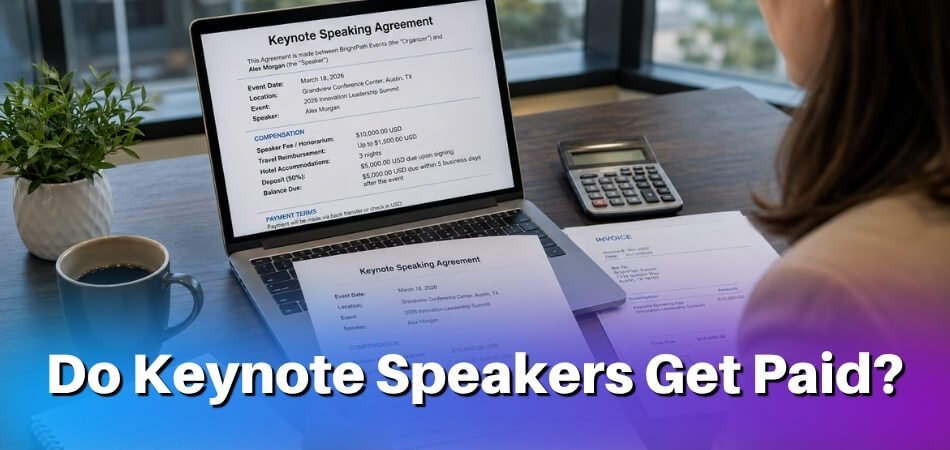
Recording rights often carry a separate fee, and some speakers do not allow distribution at all. Raise this before you commit if you plan to replay the session. The same bureau guide notes that a fee does not always include books for attendees or workshop materials, and it lists meals and incidentals, extra AV needs and deposit and payment terms as separate items, so ask what your quote covers.
Allow a buffer on top of the base fee for these variables, and decide its size once you have real quotes. The buffer is not padding, it is the actual cost of doing this properly. Exclusivity and cancellation terms, which can also change the total, are covered with the contract in Step 5.
Step 3: Build Your Speaker Shortlist
Pull candidates from at least two or three sources, aiming for five to eight names, and filter first for topic fit. Planners who cast too wide a net or rely on a single source both end up with weak options, so a focused multi-channel search gives you something real to compare.

Where to Search: Speakers Bureaus, Booking Platforms, LinkedIn, and Referrals
Each source has a different profile of speakers, price range and level of friction. Using two or three together covers both established names and overlooked options.
Speakers bureaus represent a curated roster of vetted professionals. They help most when you need a celebrity speaker or a well-known thought leader and have the budget to match. The bureau handles contracts and logistics, but you are choosing from its catalogue.
Booking platforms offer a broader, searchable pool that includes emerging and mid-range speakers who have not signed with a bureau. Many let you filter by topic, fee range and event type, so you can surface candidates for an academic event or a change initiative without a dozen phone calls.
LinkedIn is underused. Searching by industry, job title and recent speaking activity can surface experts who give excellent keynotes but are not listed anywhere formal, and their posts show whether their thinking is current.
Referrals from colleagues who ran similar events are often the most reliable source. If another planner hired someone for a leadership retreat and the response was strong, that beats a speaker’s own marketing. Ask about audience engagement, reliability and whether the talk matched what was promised. Conference programmes in your field are another good place to see who has already spoken to your kind of audience.
Relying on one bureau or one platform limits your view. Referrals and direct searches often surface people who are not heavily marketed but deliver consistently. Cast a wide net early, then narrow.
How to Use a Speaker Shortlist to Compare Your Options
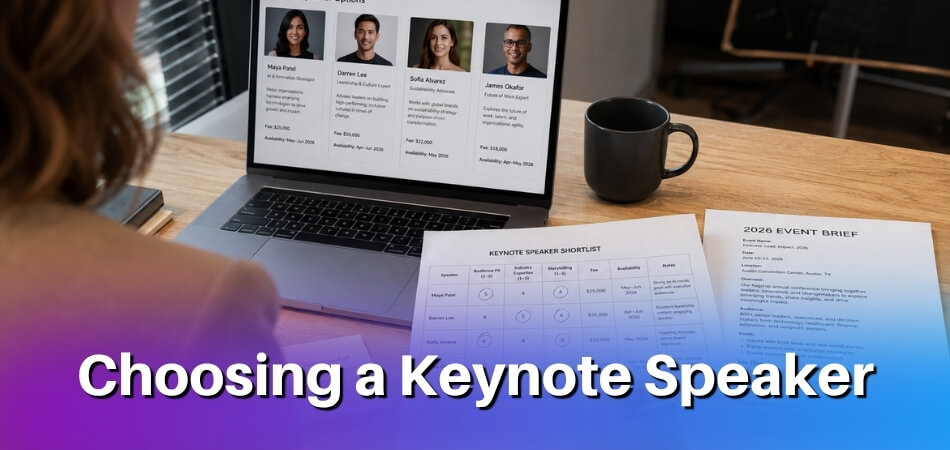
Treat the shortlist as a structured comparison, not a pile of links. With five to eight candidates in hand, the goal is to reach three or four who genuinely fit before you contact anyone.
Check each candidate against your theme and takeaway first. A strong talk on supply chain disruption is a poor fit for a wellness retreat however impressive the profile, and topic fit eliminates more candidates than price does. Then watch the recording, then read the testimonials, as Step 4 describes. Finally, note practical flags such as AV needs, fee tier and conflicting bookings, because these can disqualify a candidate as quickly as a topic mismatch.
A clean shortlist at this stage has three or four names ranked by fit, with notes on each. That is enough to move into outreach and vetting.
Step 4: Vet Each Speaker Thoroughly
Vetting means judging delivery, references and expertise, because a bureau roster entry or a polished LinkedIn profile tells you almost nothing about how someone will perform for your audience. This is where you separate real candidates from speakers who only look good on paper.

Watch Video Demos and Past Keynote Recordings
A bio and LinkedIn endorsements tell you what someone knows, while a recording tells you whether they can hold a room. Those are different skills. Established speakers usually have at least one public recording, so watch a full, unedited one from a real event, not only the demo reel. Reels are edited highlights that make everyone look compelling.
Ask for a long recording from a real corporate conference or leadership retreat, not a rehearsed TED-style talk of 18 minutes or less. At minimum, watch 15 to 20 minutes from the middle of a talk, since the polished opening tells you little. A long recording shows how someone manages energy over time, handles transitions, and whether the audience is engaged or just politely seated.
Pay attention to a few specifics. Does the speaker adapt content to the context, or does every story feel pre-packaged? Do they reference the host organization or theme, or is it a plug-and-play script? How do they handle a stumble or a moment of silence? Those moments reveal stage presence. Notice too whether stories and audience questions are woven into the talk or tacked on.
If a speaker cannot provide a full recording, ask why. It does not automatically disqualify them, but you should understand the gap before moving on.
Check Testimonials, Event Planner Reviews, and References
Testimonials on a speaker’s own site are always favourable, so use them to see how past clients describe the experience, then go further. Read them for specifics. “Fantastic speaker” tells you little, while a comment that names a talk, an audience type or how the speaker adapted to the room is more credible.
Ask for two or three references from planners who booked the speaker for events similar in scale and type to yours. For an organizational change summit, ask for people who booked them for change or leadership contexts. A glowing review from a trade association gala says little about a room of skeptical senior leaders.
Ask references specific questions. Did the speaker show up prepared? Did they customize content or deliver a stock presentation? How did the audience respond? Would you book them again? The last question is the most direct test.
You can also search LinkedIn for attendees of events where the speaker presented. A short message to someone who was in the room can bring unfiltered feedback. A speaker’s public posts and past talks also show how they come across and how they engage people.
Verify Expertise Alignment: Topic Fit Matters More Than Fame
Topic fit is about depth, not surface overlap. Fame fills seats and generates excitement, but the excitement fades if the content does not connect to what the audience needs.
For a conference on AI adoption, you need someone who knows the business context well enough to field real questions. At an academic event, the audience will notice immediately if credentials are thin or examples are dated. At a retreat on organizational change, a purely motivational speaker without frameworks or practical tools leaves attendees frustrated.
A keynote title that matches your theme is not the same as genuine expertise in the area. Look at what the speaker has published, built and worked on. An emerging expert with deep knowledge of your subject often outperforms a famous name whose expertise sits one step too far from your audience’s real concerns, and two years of hands-on work in exactly the right field can beat a celebrity covering the topic from 30,000 feet.
Red Flags That Should Lower a Score
These signs do not always rule someone out, but each should lower the score until it is explained.
- No unedited recording and no explanation for why.
- Testimonials that are vague, undated or all from one type of event.
- Reluctance to give references from planners.
- The same talk title everywhere, with no sign of customization.
- Expertise that is a few steps removed from your theme.
- Vague answers about how they research a new audience.
Step 5: Shortlist, Interview, and Confirm Your Speaker
Narrow to two or three finalists, score them against one rubric, interview them, and then decide quickly. Planners either close with confidence or hesitate and lose the speaker they wanted, so this step moves you from shortlist to a clear decision.
Having a genuine second choice is practical, not pessimistic. Speakers get double-booked, have emergencies, or turn out to be a poor fit once you speak with them.
A Simple Scoring Rubric
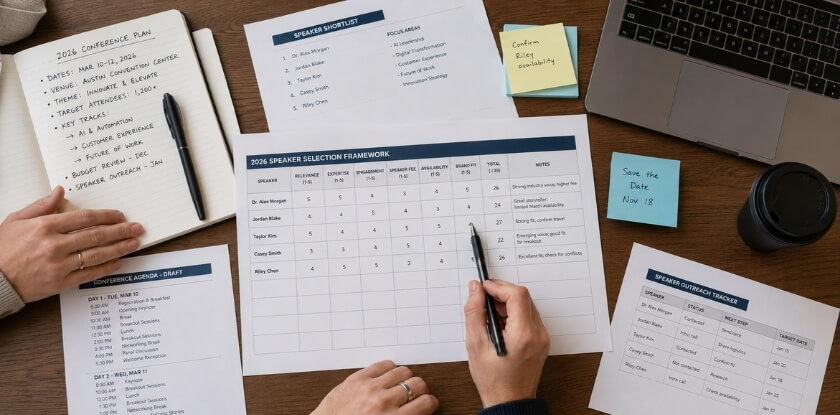
Score each finalist from 1 to 5 on every row, multiply by the weight, and compare totals. The weights below are an example, so adjust them to your event, but agree on them before you watch any recordings so a charming demo does not change the rules.
| Criterion | What to look for | Example weight |
|---|---|---|
| Topic fit and expertise | Depth in your subject, published or built work, relevance to your takeaway | 25% |
| Delivery | Holds the room on an unedited recording, handles surprises, adapts to context | 25% |
| Audience fit | Right level for seniority and background, credible with this group | 15% |
| References | Specific, recent feedback from planners with comparable events | 15% |
| Budget and logistics | Fee plus extras within your ceiling, AV needs you can meet | 10% |
| Programme balance | Adds a fresh voice or perspective next to your other speakers | 10% |
If two candidates finish close, let delivery and references break the tie. Subtract points for any red flag from Step 4 that the speaker could not explain.
Key Questions to Ask Before You Book
A direct conversation with the speaker, or their representative at a bureau or platform, tells you things no recording can. Plan a 20 to 30 minute call and come prepared. Ask every finalist the same core questions in the same order, so the answers can be scored side by side.
- Ask about audience customization. Find out how they will adapt the talk to your group. Someone doing their fourth corporate conference of the month should be able to describe exactly how they research a new audience. Vague answers are a warning sign.
- Ask about their experience with your event type. A thought leader who thrives at a leadership retreat may not translate to a formal academic event. Ask for comparable examples, not general claims about versatility.
- Ask about logistics early. Get specifics on AV requirements, room setup, and whether they need a green room or particular tech. Also confirm talk length: a speaker who needs a 90-minute set when you have allocated 45 creates a real scheduling problem. Learning that a celebrity speaker needs a 20-foot LED backdrop two weeks before the event is a budget problem you do not need.
- Ask about their process for understanding your audience. Will they review materials you send? Do they speak with a few attendees or stakeholders beforehand? On a topic like organizational change, surface-level preparation produces a forgettable talk.
- Ask about promotion and materials. Find out whether the speaker will share the event with their own audience, which bio and photos they need from you, and whether photos and recording are allowed.
- Ask who you will coordinate with on event day. Some established speakers send a handler, others manage everything themselves.
A bureau contact often sets up this call. Still push to speak with the speaker directly before signing, because even a short conversation shows how easy they will be to work with.
Contract Essentials: Cancellation Policy, Customization Rights, and Exclusivity Terms
Read the contract before anyone signs. A bureau or platform agreement covers the basics, but a few clauses deserve a closer look, and terms vary widely, so check the numbers in your own document.
- Cancellation policy on both sides. Understand what you owe if the event is postponed or cancelled, and what happens if the speaker cancels on you. Look for tiered deadlines, since a cancellation 90 days out may carry a different penalty than one 30 days out. Some contracts require full payment regardless, others offer partial refunds. If your event has any uncertainty, such as venue changes, funding gaps or date shifts, negotiate these terms before signing.
- Speaker cancellation protection. Ask whether the bureau offers a replacement guarantee. Booking directly, consider a clause that requires the speaker to source an agreed replacement or give a partial refund.
- Customization rights. If you expect a tailored presentation, put it in writing: what materials you will share, what topics to cover and any content that is off-limits.
- Exclusivity clause. It can stop the speaker from presenting the same content to a direct competitor, or appearing at a competing event, within a set window around your date. That protects your investment but can add fees if the speaker has to turn down other work. A bureau-represented speaker may also restrict you from booking competing speakers on the same topic within a time window, so find out whether that constraint exists before signing. Not all speakers agree to these terms, so raise it early for proprietary strategy topics. Some clauses go further and restrict a topic across your industry, which can complicate rebooking the same speaker later.
- Usage rights for recordings. If you plan to record, replay to remote attendees or share clips, make sure the contract allows it. Many speakers charge separately for recording rights, and some prohibit distribution.
- Travel and expenses language. Confirm whether the quoted fee is all-inclusive or whether flights, hotels and ground transport are billed on top.
If you regularly book speakers at a senior level, have a lawyer review your standard template once. After signing, send a confirmation email with the event date, venue address, run-of-show timeline, your main contact and the materials you will send. A clean paper trail protects everyone.
Common Mistakes Event Planners Make When Booking Keynote Speakers
Two mistakes are worth a separate warning, because they undo the scoring even when the earlier steps were done well.

Falling for the Name
It is easy to fall for a speaker’s reputation first and then work backward to justify the choice, especially with a celebrity or well-known thought leader who impresses stakeholders. If the core message does not map to your theme or produce a clear takeaway, you have paid for applause rather than impact. Some highly credentialed people are flat in front of an audience, and some emerging experts without big-brand logos are magnetic presenters, which is why delivery has its own score.
Waiting Too Long to Confirm
In-demand speakers book up months ahead. Bureau guidance on lead time varies, but six to twelve months before the event is a common rule for conference keynotes. One speaker bureau splits it by tier: one to three months for emerging speakers, six to nine months for established corporate speakers and nine to eighteen months or more for the most sought-after names. The same guidance says a date is not secure until the contract is signed and the deposit is received, and that a hold on a date is temporary, often about a week. Once vetting is done and references check out, move.
From our experience at MS International: Speaker selection at our conferences works differently from a corporate booking. For most applicants, the route to our in-person conferences in the Greater Toronto Area is the presenting-author track: submit work for review and register after acceptance. Keynote and invited roles are arranged separately with the organizing team, and buying an author ticket does not create one. Participation creates no entitlement to an honorarium, speaker fee or travel reimbursement unless agreed in writing, and speakers cover their own travel, accommodation, visa, transportation and personal expenses unless MS International has agreed otherwise in writing. If you invite speakers yourself, put every promise about fees and travel in writing too.
FAQ
Picking a keynote for your event involves judging stage skill before booking, setting a budget, weighing a celebrity name and having a plan if your first choice cancels.
How far in advance should I book a keynote speaker?
Six to twelve months ahead is the common speaker bureau advice for conference keynotes. One bureau lists one to three months for emerging speakers and nine to eighteen months or more for the most sought-after names.
Do I need a speakers bureau, or can I book directly?
No, a bureau is optional. A bureau gives you a curated roster, handles contracts and flags conflicts, but may add cost. Booking directly through a speaker’s website or LinkedIn can save on fees, though you handle more of the vetting and paperwork yourself.
What’s a reasonable budget for a keynote speaker?
It varies widely. The National Speakers Bureau 2026 cost guide lists $1,500 to $5,000 for entry-level speakers, $5,000 to $15,000 mid-range, $15,000 to $30,000 professional and $30,000 to $100,000 or more for celebrities. Other bureaus publish different ranges. Set your range before you search, and allow for travel and extras.
How do I know if a speaker is actually good on stage?
Watch a full, unedited recording, not a two-minute highlight reel. Ask for at least 15 to 20 minutes of footage from a real event and look at how the speaker handles the room, not only the content.
What should I check in a speaker contract?
Check the cancellation policy, any exclusivity clause, AV requirements, recording rights and what the fee includes, such as travel, accommodation and prep calls. Each can add cost or cause scheduling problems if you miss it.
Can I find good speakers without using a booking platform or bureau?
Yes. Referrals from other event planners are often the most reliable source. You can also search LinkedIn, review conference programmes in your field, and ask your network who made an impression. Vet anyone you find with video and testimonials before committing.
What if a speaker’s topic doesn’t perfectly match our event theme?
Ask how they would connect their content to your audience takeaway. Many speakers will adapt their material, and a short alignment conversation fixes most gaps. If they cannot explain the connection clearly, treat topic fit as a real concern.
Is it worth paying more for a celebrity speaker?
Sometimes. A celebrity speaker can drive registrations and buzz for a large conference. For a smaller retreat or academic event, a lesser-known expert with sharper topic fit often delivers more value at a fraction of the cost.
What if my first-choice speaker cancels close to the event?
Check the contract’s cancellation terms for refund rules and timelines, and ask whether a replacement is guaranteed. Keep one or two backup names from your shortlist active until you are past the cancellation window.
Making the Final Decision
Define what your audience should take away, set a realistic budget before you talk to anyone, and score speakers on substance rather than name recognition. A well-chosen speaker can anchor an entire event, and a poor fit can undermine months of planning. Allow enough lead time, ask the hard questions early, and keep a backup name until the contract is signed.