
Planning to attend a conference in the United States gets stressful when the event date is close and visa appointment slots are limited. It can happen after a late invitation, a research acceptance, a speaker confirmation, or a professional registration. That is why a common question is: Can USA conference visa be expedited?
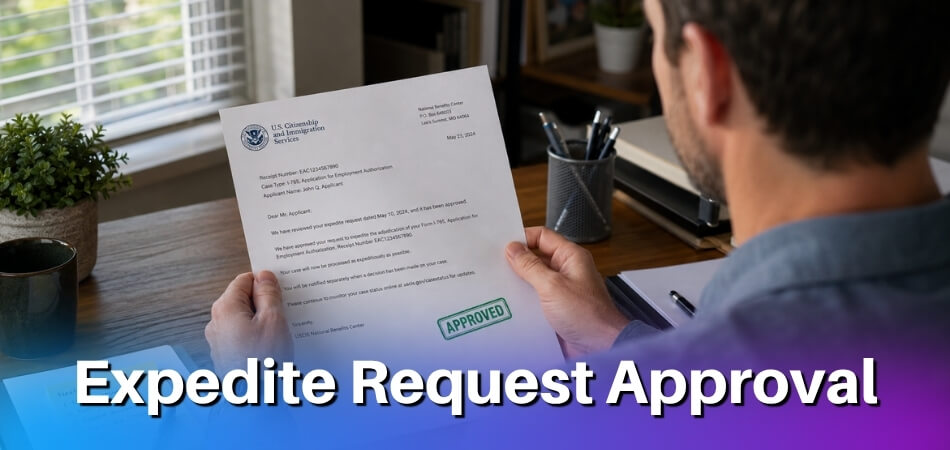
Quick answer: Only partly. The State Department says attending an annual business or professional conference does not qualify for a standard expedited appointment. A paid US$750 expedited B-visa appointment is being piloted at a few posts, starting with Mission Mexico, until December 31, 2026. Either way, you get an earlier interview, not a faster decision or guaranteed approval.
Fact-checked by the MS International Editorial Team. Last verified against official sources: October 2026.
For most conference travelers the visa is a B-1 business visitor visa or a B-1/B-2 visitor visa. This guide explains what an expedite can and cannot do, the two real routes, documents, delays, and how this differs from USCIS premium processing.
Can a USA Conference Visa Be Expedited?
A U.S. visa interview can sometimes be moved earlier, but the visa itself is not processed faster, and conference travel is usually not accepted as an urgent reason. The State Department’s wait-times page lists attending an annual business, academic, or professional conference among trips that do not qualify for an expedited appointment. It advises booking a regular appointment well in advance.
An expedite is not a shortcut around the normal rules. You still need the DS-160, the visa fee payment, an appointment, an interview, and eligibility. The request only asks for the interview to happen sooner than the regular slot.
What “Expedited” Really Means for a U.S. Visa
Expedited means asking for faster access to an interview appointment. The officer does not skip the interview or relax the eligibility rules, and the decision after the interview is not any quicker. The DS-160, fee payment, interview, decision, and passport return all stay the same.
When a Post May Move an Interview Earlier
Each embassy or consulate decides for itself. Standard expedite requests are generally for urgent, unforeseen situations such as a medical emergency, a funeral, or a fixed school start date. A conference with fixed dates is a real deadline for you, but the State Department lists annual conference travel among trips that do not qualify, so do not rely on this route.
Which U.S. Visa Type Is Usually Used for Conferences?
Most international attendees use a B-1 visa or a B-1/B-2 visa to attend a conference in the United States. The right type depends on the purpose of the trip and whether it includes limited tourism.

B-1 Visa for Business and Professional Conferences
The B-1 visa covers short-term business and professional activities such as meetings, conventions, academic presentations, and industry events. A B-1 visitor is expected to stay temporarily, avoid unauthorized employment, show enough funds, and prove an intention to return home.
B-1/B-2 Visa When Business and Tourism Are Combined
A B-1/B-2 visa fits a trip that mixes the conference with a few extra days of tourism. The conference should remain the main purpose, with tourism secondary and reasonable.
If You Are From a Visa Waiver Country
Citizens of Visa Waiver Program countries can travel to the United States for business or tourism for 90 days or less without a visa, and attending a conference is a listed permitted activity. You still need an approved ESTA before boarding, and payment from a U.S. source for work is restricted. If you qualify, there is no visa appointment to expedite. Check your eligibility on the official ESTA site.
Why the Category Matters Before Asking for Faster Access
Your DS-160, invitation letter, travel dates, event documents, and interview answers should all tell the same story. Inconsistent information causes delays in any review.
How Can You Expedite a USA Conference Visa?
There are two real routes: a standard expedite request at your post, and, where offered, the paid expedited appointment pilot for B visas. Both start the same way, by paying the visa fee and booking the earliest regular appointment.

| Route | Extra cost | Works for conferences? | Key limits |
| Standard expedite request | None | Usually not accepted | Decided by each post; urgent, unforeseen reasons only |
| Paid expedited appointment pilot | US$750 per appointment | Yes, for B visa applicants at participating posts | Interview within 10 business days, subject to availability; ends December 31, 2026; non-refundable; one booking, no rescheduling |
| Checking for earlier regular slots | None | Yes | Slots appear when others cancel or reschedule; not guaranteed |
Request an Expedited Interview Appointment
Complete the DS-160, pay the fee, book the earliest regular slot, and then look for an expedite option in your post’s appointment system. If a request is approved you can pick an earlier date. If it is denied, your original appointment normally stays as it is.
The US$750 Paid Expedited Appointment Pilot
The State Department runs a Nonimmigrant Visa Expedited Appointment Pilot Program for tourist and business (B) applicants at select posts until December 31, 2026. You still pay the US$185 visa application fee and book a regular appointment first. The extra US$750 only buys an earlier interview slot, and it does not speed up administrative processing or guarantee a visa. The pilot started at a few posts, with Mission Mexico first, so confirm in your own appointment account whether your post offers it. Where it is offered, a limited number of expedited slots are released each day, and you must pay the US$750 within 10 minutes of choosing a slot or it is released. The slot cannot be rescheduled, and missing it forfeits the fee. Consular officers can still grant a no-fee expedited appointment at their discretion in appropriate cases, and the pilot does not remove that option.
Prepare Proof Before You Ask
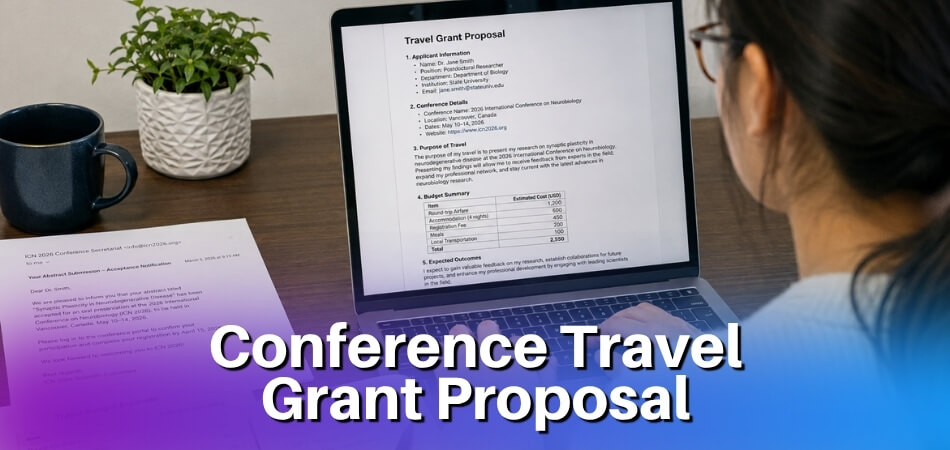
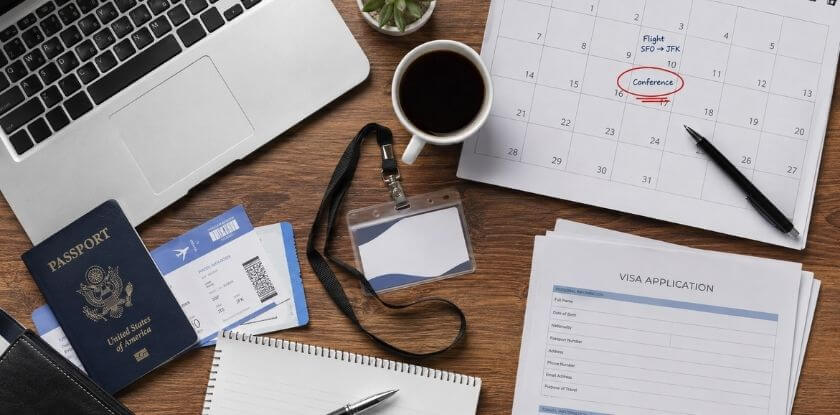
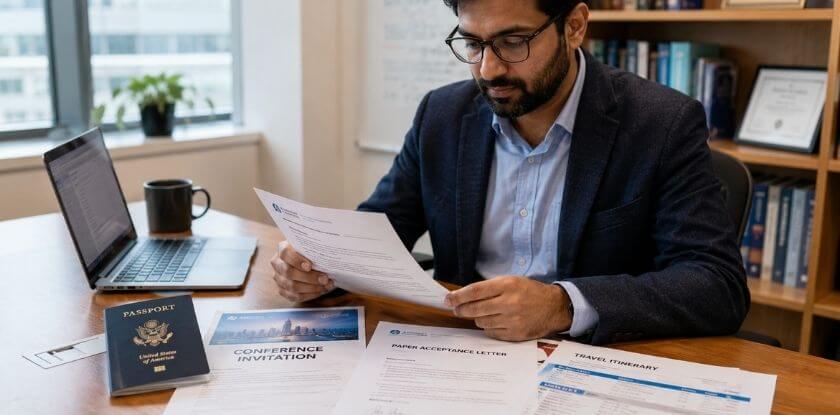
Have your official invitation letter, registration confirmation, paper acceptance or speaker confirmation, conference agenda, employer or university letter, itinerary, financial evidence, and home-tie documents ready. Keep both digital and printed copies. The goal is to show that your trip is real and consistent.
Is Premium Processing Available for a USA Conference Visa?
USCIS premium processing does not apply to a standard conference visitor visa. It is easy to confuse it with an expedited visa appointment request at an embassy or consulate, which is a different system.

Why Premium Processing Does Not Apply to Visitor Visas
Premium processing is a USCIS service for certain eligible petitions and forms. A conference visitor visa goes through the embassy: DS-160, fee payment, interview scheduling, and consular review. Do not pay anyone who sells premium processing for a B visa.
Difference Between USCIS Premium Processing and Embassy Expedite Requests
| Topic | USCIS Premium Processing | Embassy Expedite Request |
| Main purpose | Faster USCIS review | Earlier visa interview |
| Used for B-1/B-2 conference visas? | No | Sometimes, if the post accepts the reason |
| Guarantees approval? | No | No |
| Requires urgency proof? | No, it is a paid service | Yes |
| Decision authority | USCIS | Consular officer |
Valid Reasons That May Support an Expedited USA Conference Visa Request
A request is stronger when you can prove the trip is time-sensitive, professionally relevant, and tied to fixed event dates, though a post may still decline it. A preference for faster processing is never enough on its own. Because the State Department lists annual conference travel among trips that do not qualify, treat the points below as ways to make a request clear, not as grounds that qualify. General attendees can still ask, but they need clear proof that the trip cannot wait.
Presenting a Paper, Research, or Professional Work
An accepted paper, poster, or research presentation helps most when the conference has assigned you a slot or listed you in the program. Useful proof includes the acceptance letter, the presentation schedule, or an institutional letter.
Speaking, Moderating, or Attending as an Invited Guest
If you are a speaker, moderator, panelist, session chair, or invited delegate, the organizer letter should include your full name, conference title, dates, location, role, organizer contact details, and session title if applicable.
Time-Sensitive Business or Academic Participation
Business development, academic collaboration, training, or institutional representation can support a request when the event clearly relates to your work or study. An employer, university, or sponsor letter can explain your role, funding, and expected return.
Conference Dates That Are Too Close for Regular Availability
The main argument is that the earliest regular appointment falls after the conference. State your current appointment date, the conference start date, and your planned travel date. This works best together with real participation in the program.
Documents Needed to Request an Expedited USA Conference Visa Appointment
You need documents that prove your identity, application status, conference purpose, urgency, funds, and intention to return home. The exact list varies by post, so make your file easy to verify.
| Document | What it shows |
| Valid passport and DS-160 confirmation page | Identity; name, passport number, birth date, and travel details must match exactly |
| Visa fee receipt and appointment confirmation | You have entered the normal process; the appointment date proves urgency if it falls after the event |
| Official conference invitation letter | Your name, conference name, dates, U.S. location, organizer details, role, and registration or acceptance details |
| Registration or acceptance proof | Registration confirmation, payment receipt, paper acceptance, poster or speaker confirmation, or delegate approval |
| Itinerary and event schedule | How your dates connect to the program; a planned itinerary is enough without buying final tickets |
| Employer, institution, or sponsor letter | Your position, purpose, funding, approved leave, and expected return |
| Evidence of home ties | Employment, enrollment, business, family, property, or finances showing the visit is temporary |
Step-by-Step Process to Request an Expedited USA Conference Visa Appointment
Finish the standard application steps first, then submit the expedite request or pilot booking through your post’s official appointment system. The system differs by country, so follow your embassy’s instructions.
Step 1: Complete the DS-160 Form
Fill in the DS-160 accurately and make sure it matches your invitation, event schedule, and planned dates. Review it carefully before submitting.
Step 2: Pay the Visa Application Fee
Pay the fee by the method your country’s system offers and keep the receipt. The B visa application fee is US$185. Payment lets you continue, but it does not guarantee approval.
Step 3: Book the Earliest Available Regular Appointment
You must complete the DS-160, pay the fee, and book the first available appointment before a post considers any expedite request. Save the confirmation, because it supports your urgency argument. The State Department also notes that listed wait times are generally the maximum and new appointments are added continuously, so you may be offered an earlier date as slots open.
Step 4: Submit the Expedite Request or Choose the Paid Pilot
Look for the emergency or expedited appointment option in your account. Mention the conference name, date, location, your role, your current appointment date, and why that date is too late. If your post offers the paid pilot, you select a date and pay within the short window shown on screen.
Step 5: Upload or Provide Supporting Documents
Some systems allow uploads, while others review only the written explanation. Presenters should include acceptance or schedule proof, and invited speakers a letter confirming the role.
Step 6: Wait for the Decision
The decision arrives through the portal or email. The post may approve, deny, or ask for more information. If approved, select the earlier date quickly, though the offered date may not be your preferred day. Choose it only if you can attend and still get your passport back before travel. If denied, your regular appointment usually remains active.
Step 7: Attend the Interview With Complete Documents
Be ready to explain your conference purpose, role, funding, length of stay, and return plan. An earlier interview does not replace eligibility.
How Long Does an Expedited USA Conference Visa Take?
An expedite can shorten the wait for the interview, but the full timeline still depends on post availability, the interview result, and passport return. The pilot promises an interview within 10 business days of booking, subject to availability, and nothing more.
The review time for a standard request varies with workload and request strength. A complete request is easier to review, while vague or incomplete ones may be delayed or denied. After the interview, the visa may be approved, refused, or placed under additional review. If approved, the passport still needs printing and return, so leave time for delivery or pickup before you travel. An expedited appointment gives you an earlier interview opportunity only. The officer still evaluates your purpose, finances, home ties, and return intent.
2026 Rules an Earlier Appointment Cannot Change
An earlier interview does not change who is eligible, where you must apply, or what the officer can require. Several rules changed since late 2025, so check them before you pay for speed.
| Rule | What it means for your conference trip |
| Apply in your country of nationality or residence | From September 2025 the State Department directs nonimmigrant applicants to book at a post in the country where they live or hold citizenship. That means you cannot shop for a quicker slot in another country. |
| Interview waivers narrowed | From October 1, 2025, nearly all nonimmigrant applicants need an in-person interview, with limited exceptions such as certain B-1/B-2 renewals. Plan for an interview unless your post confirms otherwise. |
| Visa bonds | Since August 3, 2026 the visa bond program is permanent. Some B-1/B-2 applicants from countries State has listed may be required to post a bond of US$10,000, US$15,000, or US$20,000. An earlier appointment does not remove it. |
| Entry restrictions | Proclamation 10998 partially suspends B-1/B-2 visas for nationals of 19 countries from January 1, 2026. Check whether your nationality is covered before you pay any fee, because an earlier appointment does not change that. |
What Happens If Your Expedite Request Is Denied?
If your expedite request is denied, your visa application is not rejected. Usually only the request for an earlier date is declined, and your regular appointment stays active. Keep your confirmations and fee receipt, and keep checking for earlier regular slots, since cancellations free them up.
If your timeline becomes impossible, contact the conference organizer. They may confirm your session, allow online participation, reschedule your presentation, transfer your registration, or defer you to a later event. Do not repeat the same weak request; if another one is allowed, add stronger evidence such as a program listing or a revised organizer letter.
Common Mistakes That Delay Expedited USA Conference Visa Requests
Most requests fail because the application is incomplete, the urgency is vaguely explained, or the documents do not clearly support the conference purpose. Treat the request as a formal submission and give facts, not emotion.
Applying Too Late or Overstating the Emergency
If the conference is only days away, there may be no time for request review, interview, decision, printing, and passport return. Avoid claims such as “my career will be ruined” or “my visa is guaranteed”; they prove nothing. State the conference name, dates, current appointment date, expected travel date, and your role in a few factual lines.
Treating an Expedite as Guaranteed Approval
There are two separate steps: getting the earlier appointment, and then qualifying for the visa at the interview. Avoid non-refundable bookings until the visa is in your passport.
Incorrect DS-160 Details or a Weak Invitation
Wrong passport numbers, misspelled names, unclear U.S. contact details, and dates that do not match the conference create credibility problems. A generic invitation does not prove participation. Your DS-160, appointment profile, request, letter, and interview answers should all match.
Ignoring Local Embassy Rules and Unofficial Agents
Some posts require a regular appointment first, some limit the number of requests, and some review documents differently. Check slots only through the official system and avoid agents who promise guaranteed appointments.
Frequently Asked Questions About Expediting a USA Conference Visa
With a conference date in the United States approaching, the pressing issues are extra fees, whether a regular appointment comes first, applying at an embassy in another country and a passport not returned in time.
Can I expedite my USA conference visa without paying extra fees?
A standard expedite request has no extra fee, but the paid pilot costs US$750. You pay the US$185 visa application fee in both cases. The pilot fee is non-refundable and runs only at a few posts until December 31, 2026.
Do I need to book a regular appointment before requesting an expedited one?
Yes. You must complete the DS-160, pay the visa fee, and book a regular appointment before a post considers an expedite request or offers the paid pilot. This also lets the post compare your date with the conference date.
Does an expedited appointment mean my visa will be approved?
No, an expedited appointment does not guarantee visa approval. It only gives you an earlier interview. The officer still reviews your purpose, documents, finances, and home ties.
Can a conference invitation letter guarantee an expedited appointment?
No, a letter from the organizer cannot guarantee an earlier slot. It can support your request if it shows the event dates, location, organizer details, and your specific role.
How early should I apply for a USA conference visa?
Apply as soon as your participation is confirmed, and check your post’s current wait time on travel.state.gov. Because conferences are generally not accepted for standard expedites, waiting leaves you with only the paid pilot, if your post offers it.
Can I request another expedite if the first request is denied?
Only if your post’s system allows it, and only with stronger or updated evidence. Repeating the same explanation usually does not help.
Can I travel for a conference on a tourist visa?
Usually not on a B-2 alone, because a professional conference is a B-1 activity. A B-1 or a combined B-1/B-2 visa can cover it. Be honest if the conference is your main purpose, and mention tourism only if it is secondary.
Can I apply at a U.S. embassy in another country to get an earlier appointment?
Generally no. Since September 2025 the State Department directs nonimmigrant applicants to apply in their country of nationality or residence. Applying elsewhere can mean longer waits, and fees are not refunded or transferable.
Do I need a visa to attend a conference in the United States?
Not if you are a citizen of a Visa Waiver Program country. You can attend a conference for 90 days or less with an approved ESTA instead. Everyone else needs a visa, usually a B-1.
What should I do if my passport is not returned before the conference?
Track it through the official delivery system and contact the proper support channel. Also tell the organizer and ask about online participation, rescheduling, transfer, or deferral.
Final Thoughts on Expediting a USA Conference Visa
The most realistic way to speed up a U.S. conference visa is an earlier interview, either through a regular slot that opens up or the paid US$750 pilot at the few posts that offer it. A free expedite for a conference is unlikely, so apply early and plan for the chance of missing the event.
From our experience at MS International: Our conferences are held in person in the Greater Toronto Area, and our letters relate to those events. We issue the invitation letter within 3 to 5 business days after payment clears, so register early. A US$50 fee may apply to corrections after the letter is issued, so check your name and passport details first. Our Visa Expedite Request Letter (US$100, non-refundable) is a supporting document for eligible registered participants, and it does not guarantee that any embassy will move your appointment.
Disclaimer: This article is general information, not legal or immigration advice. Visa rules, fees, and expedite options change and differ by country and post, so confirm the details with the official U.S. State Department and embassy websites before you apply.