
Two people can sit in the same conference hall, wear similar badges and still be there for very different reasons. The words “attendee” and “delegate” are where that difference shows up.
Quick answer: The difference between an attendee and a delegate is representation. An attendee joins an event for personal learning, networking or interest and speaks only for themselves. A delegate is sent or chosen to represent an organization, institution, association or group, and may have duties such as joining official sessions, voting or reporting back. Some events use “delegate” loosely for any paid participant, so check the event’s own definition.

Attendee vs Delegate: Comparison Table
An attendee participates for themselves, and a delegate participates on behalf of others. For example, a person who joins a marketing seminar to learn new skills is an attendee, while an employee sent by a company to a trade conference to meet partners and report back to management is a delegate.
| Factor | Attendee | Delegate |
| Basic meaning | A person who attends an event | A person who represents a group or organization |
| Main purpose | To learn, observe, network, or participate personally | To represent, contribute, report, or make decisions |
| Representation | Represents themselves | Represents an organization, company, team, or institution |
| Responsibility | Usually limited to personal participation | Often has formal or professional responsibilities |
| Involvement | May attend general sessions and activities | May join discussions, meetings, panels, or official sessions |
| Decision-making role | Usually has little or no formal authority | May influence or communicate decisions |
| Preparation level | Often minimal or personal | Usually requires planning and organizational understanding |
| Example | A person attending a public seminar | A company representative at an industry summit |
What Is an Attendee?
An attendee is someone who joins an event as a participant, usually to learn, listen, observe, network, or enjoy the event experience. Attendees are not normally expected to speak for an organization or make formal decisions on behalf of others.
At conferences and seminars, attendees are the general participants. They register, attend keynote sessions, join workshops, visit exhibition booths, ask questions, and connect with other participants. Their involvement is valuable, but it rests on personal or professional interest rather than official representation. The Oxford Learner’s Dictionary defines an attendee simply as “a person who attends a meeting, etc.”, with no mention of representing anyone.
An attendee may be:
- A student joining an education fair
- A professional attending a training workshop
- A business owner learning about market trends
- A researcher listening to conference presentations
- A visitor attending a public event
- A company employee attending for personal skill development
- A participant joining networking sessions without formal duties
The role is flexible. Attendees can choose which sessions to join, which speakers to hear and which networking opportunities to explore, and they do not usually carry the responsibility of speaking for a larger group.
What Is a Delegate?
A delegate is a person chosen or sent to represent an organization, company, institution, association, country, team, or group at an event. Unlike a general attendee, a delegate usually has a defined purpose connected to representation, communication, decision-making, or reporting.
Delegates are common at business conferences, academic congresses, industry forums, association meetings, trade events, leadership summits, and formal assemblies. Their role may include joining discussions, presenting ideas, attending closed sessions, voting, negotiating, collecting insights, or sharing their organization’s position.
A delegate may be:
- A company employee sent to an international business conference
- A university representative attending an academic forum
- A student representing a school at a youth summit
- A member representing an association at a general meeting
- A government official attending an international event
- A business representative joining a trade delegation
- A professional sent to gather industry insights for an organization
The delegate role usually requires preparation. A delegate may need to know their organization’s goals, decide which topics to raise, collect relevant materials, and report back afterwards. Because their words and actions may reflect the group they represent, they are expected to act responsibly.
Dictionaries record two senses of the word. The Oxford Learner’s Dictionary defines a delegate as “a person who is chosen or elected to represent the views of a group of people and vote and make decisions for them”, and also lists the looser meaning “a person who attends a conference”. The first is the strict sense used at assemblies and association meetings, and the second is how many conference registration pages use the word.
Key Difference Between Attendee and Delegate
The key difference is that an attendee joins an event as a participant, while a delegate joins as a representative. That one point shapes purpose, responsibility, access, preparation and expected involvement.

An attendee comes because the topic interests them. A delegate comes because they have been selected, assigned, or authorized to represent a larger interest. That does not make a delegate more important than an attendee. The role simply carries a different type of responsibility. In plain terms, a delegate is one kind of attendee, but an attendee is not always a delegate.
Difference by Purpose
Attendees usually join events for personal learning, interest, exposure, or networking. Delegates join to represent a group and achieve a specific professional or organizational purpose.
An attendee’s purpose is self-directed: they decide what they want to learn and how to use the event. A delegate’s purpose usually connects to an organization. They may attend to gather information, share views, build partnerships, promote a company, or support a formal decision-making process, so their participation has value beyond personal learning.
For example, a healthcare worker attending a medical seminar to improve personal knowledge is an attendee. A hospital representative sent to a healthcare policy conference to discuss institutional concerns is a delegate.
Difference by Responsibility
Attendees usually have fewer formal responsibilities, while delegates often have duties before, during, and after the event.
An attendee’s main duties are to follow event rules, attend sessions and take part respectfully. They are not usually required to produce a report or represent anyone formally.
A delegate may have responsibilities such as:
- Preparing before the event and understanding organizational objectives
- Attending required sessions and joining formal discussions
- Speaking or voting on behalf of a group
- Meeting partners or stakeholders
- Collecting useful information and reporting outcomes after the event
This is why delegates often need briefing notes, company materials, presentation points, or instructions from their organization.
Difference by Representation
An attendee represents themselves, while a delegate represents others. This is the core distinction.
When an attendee asks a question, they speak from personal interest or individual experience, and the comment does not necessarily represent a company, school, association, or team. When a delegate speaks, their words may be understood as the view of the group they represent. Delegates therefore need to be careful, professional, and aligned with the expectations of the organization that sent them.
For instance, a person at an entrepreneurship event as an individual can freely explore ideas. A delegate attending on behalf of a business association may need to communicate the association’s priorities accurately.
Difference by Participation Level
Attendees may participate generally, while delegates are often expected to participate more actively.
Attendees may listen to speakers, visit booths, join public workshops, and take part in open networking, and their involvement is usually optional. Delegates may have scheduled obligations, such as official meetings, roundtable discussions, voting sessions, panels, meetings with specific contacts, or private sessions on behalf of their organization.
This does not mean attendees are passive. Many ask excellent questions and build valuable relationships. The difference is that delegates often participate with an assigned purpose.
Difference by Decision-Making Authority
Attendees usually do not have formal decision-making authority, while delegates may have the power to influence or communicate decisions.
Attendees are there to learn and engage, not to make official decisions. Their opinions usually affect only their own understanding or choices.
Delegates may be authorized to:
- Vote in meetings
- Support or oppose proposals
- Communicate organizational positions
- Negotiate partnerships
- Recommend actions and report decisions to leadership
- Influence event outcomes or future plans
Not every delegate has voting power or final authority. Some are sent mainly to observe and report. Still, the role often carries more influence than a general attendee role.
Difference by Event Access
Delegates may receive access to special sessions, meetings, or networking areas that are not available to all attendees.
Many events use different registration categories, and the pass or badge shows which one you hold. General attendees may have access to keynote sessions, workshops, exhibitions, and public networking. Delegate access may add:
- Private meetings and closed forums
- VIP networking sessions and delegate-only receptions
- Policy discussions
- Business matchmaking
- Official seating areas
- Special briefing sessions
This depends on the event. Some conferences treat “delegate” simply as a registration term for all paid participants. Others use it for official representatives with specific rights and responsibilities. Always check how the event defines the role. The CORESTA PSPT2025 conference terms, for example, define a delegate as “an individual who has completed the appropriate registration which entitles that individual to attend any of the talks and lectures”, and an attendee as “an individual who is either a delegate or an accompanying person”. There the delegate label is a registration type, and an accompanying person joins the social programme but not the talks.
Can One Person Be Both an Attendee and a Delegate?
Yes, one person can be both an attendee and a delegate if they attend general sessions while also representing an organization or group. This can happen at conferences, summits, association events, and professional forums.
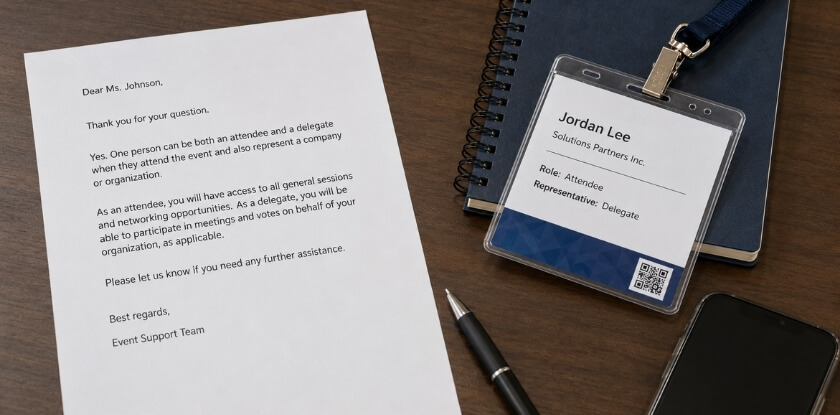
For example, a company employee may attend keynote sessions like any other participant, then join business meetings as the company’s representative. A student may attend workshops for learning while representing a university club in a competition or panel. A researcher may listen to academic presentations while also presenting findings for a research team.
In this situation the person has two layers of participation:
- As an attendee, they learn, observe, network, and join sessions.
- As a delegate, they represent a group, communicate interests, and complete assigned responsibilities.
The organizer may classify the person by registration type, access level, or role. If an organization formally sends them, “delegate” is usually the more accurate term. If they join for personal interest, “attendee” fits better.
Why Events Use Terms Like Attendee and Delegate
Events use these terms to define participant roles clearly. Large events may include attendees, delegates, speakers, sponsors, exhibitors, panelists, media representatives, VIP guests, and organizers, and without clear labels communication becomes confusing. Labels help organizers manage registration, access, seating and expectations.
To Define Roles Clearly
Role labels tell people what is expected from them. An attendee knows they are joining as a participant. A delegate knows they may have representational or professional duties. This avoids confusion at registration, check-in and in post-event communication.
To Manage Access Levels
A delegate may receive access to private meetings or official discussions, while an attendee may only have access to general sessions. Clear labels help organizers decide who can enter certain rooms, receive specific materials, or join certain programs.
To Plan Sessions and Seating
Formal events may reserve seating for delegates, panelists, organization representatives, or voting members, while general attendees have open seating. The right terms help organizers plan room layouts, badges, schedules, and session invitations.
To Support Networking
A person looking for partnerships may want to meet delegates who represent companies or institutions. Someone attending for learning may prefer speakers, trainers, or other attendees. Role labels help people find the right conversations faster.
To Improve Communication
Attendees may receive session reminders, event maps, and general updates. Delegates may receive meeting agendas, briefing notes, voting instructions, or representative guidelines.
Benefits of Being an Attendee
Being an attendee is valuable because it gives you flexibility, access to learning, and a lower-pressure way to experience an event. Not everyone needs to be a delegate. For many people, attending is the best option.
Easier Entry into Events
Attendee registration may be simpler than delegate registration. You may only need to register, pay the fee if there is one, and go to the sessions you want.
More Flexibility
Attendees can choose their schedule, skip less relevant sessions, and spend time networking or visiting exhibitions. This suits people who are still exploring a field.
Less Pressure
Attendees do not usually need to speak for a company, vote on issues, attend mandatory meetings, or prepare formal reports. That makes the role less stressful, especially for first-time participants.
Strong Learning Opportunities
Attendees can learn from speakers, panelists, trainers, exhibitors, and other participants by taking notes, asking questions and collecting resources. For students, early-career professionals, entrepreneurs, and independent learners, this can be highly valuable.
Good for First-Time Participants
If you are new to conferences, attending first helps you understand the format, learn the language, meet people, and build confidence before taking on a delegate role later.
Benefits of Being a Delegate
Being a delegate offers stronger professional visibility, deeper involvement, and the opportunity to represent an organization or group. It suits people who are ready for more responsibility.
Official Representation
A delegate speaks or participates on behalf of a company, school, association, institution, or team. Being trusted with the role can also show that the organization values the person’s judgment, communication skills, and professionalism.
Access to Formal Discussions
Delegates may be invited to discussions, meetings, or forums where industry trends, partnerships, policies, business plans, academic collaboration, or organizational decisions are addressed.
Better Networking Opportunities
Delegates can connect with decision-makers, executives, association leaders, and institutional representatives. Because they represent an organization, their conversations may carry more professional weight, which can help build partnerships and open future opportunities.
Opportunity to Influence Outcomes
Some delegates contribute to decisions, recommendations, or event outcomes. Even without final voting power, they may influence conversations by sharing their organization’s perspective.
Professional Recognition
Serving as a delegate can show leadership, trust, communication ability and subject knowledge, which may support career growth, confidence and reputation.
Stronger Post-Event Value
Delegates may return with information that helps their organization. They may prepare a summary, recommend actions, share contacts, or help apply lessons learned.
Attendee vs Delegate in Different Event Types
The meaning of attendee and delegate can change slightly depending on the type of event. Some events use the terms formally, while others use them more loosely.

Conferences
Attendees usually join sessions, listen to speakers, ask questions, and network. Delegates may represent organizations, join official meetings, or attend special sessions. In some registration systems “delegate” simply means a registered participant, although in a stricter sense a delegate has a representational role.
Seminars and Workshops
Attendees join to learn a specific topic or skill. Delegates may be sent by companies or institutions to gain knowledge and bring it back to their teams. For example, an employee sent to a leadership workshop by their employer may be considered a delegate if they are representing the company.
Business Summits and Trade Shows
The delegate role is often more formal here. Delegates may meet potential partners, explore deals, represent brands, or attend private meetings. General attendees may visit booths, attend public sessions, and network without official responsibilities.
Academic Conferences
Attendees may be students, researchers, or professionals joining to learn. Delegates may represent universities, research groups, academic departments, or student associations. A presenter may also be a delegate if they represent an institution or research team.
Association Meetings and Formal Assemblies
The term delegate can carry a strong formal meaning here. Delegates may represent chapters, branches, member groups, or committees, and they may vote, discuss policy, or report back to the group they represent. In these settings the difference matters most.
How to Know Whether You Should Register as an Attendee or Delegate
Register as an attendee if you are joining for personal learning or general participation. Register as a delegate if you are officially representing an organization, group, or institution. Then check the event’s own registration rules.
Identify Your Main Purpose
If your goal is to learn, explore, listen, and network for yourself, an attendee is likely the right role. If your goal is to represent a company, share an organization’s view, attend official meetings, or report back to a group, delegate is more accurate.
Check Whether You Represent an Organization
Representation is the strongest sign that you are a delegate. If a company, school, association, institution, or team is sending you, funding you, or expecting you to act on its behalf, you may be one. If you are paying for yourself and attending for personal interest, you are likely an attendee.
Review Your Expected Responsibilities
If you need to prepare talking points, join private meetings, present information, vote, negotiate, or submit a report, delegate is the better label. If you are free to choose sessions and have no formal duty, attending is more suitable.
Consider Your Experience Level
First-time participants may prefer attending before becoming delegates, so they can understand the event without pressure. People with more experience and organizational knowledge may be better prepared for delegate responsibilities.
Check the Event’s Registration Categories
Some events offer pass types such as attendee, delegate, speaker, exhibitor, sponsor, student, or VIP guest. Some events also add categories such as accompanying person or guest, and what each pass includes differs, so read the list before you pay. If the organizer uses “delegate” to mean any registered participant, follow that system. If the organizer separates attendees from delegates, choose the role that fits your purpose.
Compare Cost and Access
Delegate passes may cost more if they include special sessions, meals, private meetings, or networking access. Attendee passes may be less expensive but include fewer privileges. Choose based on what you need from the event, not just the title.
Common Mistakes When Using Attendee and Delegate
A frequent mistake is using attendee and delegate as exact synonyms. They can overlap, but they do not always mean the same thing.

Calling Every Participant a Delegate
Some people attend for personal learning, networking, or interest. They are better described as attendees.
Assuming Delegates Are Always More Important
Events need engaged attendees to create energy, ask questions, share ideas, and build community. The roles are different, not automatically better or worse.
Ignoring Event-Specific Definitions
Some events use “delegate” as a general word for paid participants and others only for official representatives. Check the event’s terminology before assuming the meaning.
Confusing Delegate with Speaker
A speaker presents to an audience. A delegate represents a group. One person can be both, but the terms are not identical.
Confusing Delegate with Exhibitor
An exhibitor usually displays products, services, or organizational materials at a booth. A delegate may attend meetings or represent a group without exhibiting anything.
Confusing Delegate with Guest
A guest may be invited without formal responsibilities. A delegate usually has a representational purpose.
From our experience at MS International: Our conferences are in-person events in the Greater Toronto Area, and a registered attendee (listener) is a valid category, so you can take part without presenting a paper. If an employer or university is sending you, agree on the registered name before paying, because registration fees are non-refundable and non-transferable. Once payment clears, the invitation letter is issued within 3 to 5 business days. It supports a visa application but does not guarantee approval.
FAQ: Attendees and Delegates
When a form asks for attendee or delegate, people wonder whether one ranks higher, costs more or involves speaking, and whether students or employees can take the delegate role.
Is a delegate higher than an attendee?
No. Delegate is a role, not a rank. A delegate usually carries more formal responsibility because they represent others, but that does not make them more valuable. The difference is representation and duty.
Can an attendee join networking sessions?
Yes, if the registration pass allows it. Some private networking events may be limited to delegates, sponsors, speakers, or VIP participants.
Do delegates always speak at events?
No. Some delegates speak during panels, meetings, or discussions, but others mainly listen, observe, gather information, and report back to their organization.
Do delegates pay more than attendees?
Not as a rule. A delegate pass costs more only if it includes extra access, such as meals, meetings or private sessions. Pricing depends on the event’s registration structure, so check what each pass includes.
Can students be delegates?
Yes, if they represent a school, university, club, association, or student organization. This can apply at academic conferences, youth forums, competitions, and model assemblies.
Can employees attend as delegates?
Yes. An employee is a delegate if an employer sends them to represent the company, attend meetings, build contacts, or bring back useful information.
Are conference delegates the same as speakers?
No. A speaker presents content to an audience, while a delegate represents a group. A person can be both.
What is the difference between a delegate and a participant?
A participant is anyone who takes part in an event, so the word describes involvement. A delegate is someone sent or chosen to represent a group, so the word describes who they speak for. A delegate can be a very active participant, but a participant is not always a delegate.
Can a delegate attend regular sessions?
Yes, usually, depending on the pass type. Delegates may also have extra obligations such as meetings, reports, or private discussions.
Can an attendee become a delegate later?
Yes. A person may first attend events for learning and later become a delegate after gaining experience, confidence, or organizational responsibility.
Which role is better for professional growth?
Both help. Attendees gain knowledge, confidence, and contacts. Delegates gain leadership experience, representation skills, strategic networking, and decision-making exposure.
Should I write attendee or delegate on a conference form?
Use the category the form offers. If it gives no definitions, write attendee when you join for yourself and delegate when you officially represent a company, school, association, or organization.
Final Summary: Attendee vs Delegate
An attendee is a general participant, while a delegate is an official representative. Use attendee when you join for personal learning or interest, and delegate when you speak for others or carry duties beyond personal attendance. Neither role is better; the right choice depends on the event, its registration categories and your level of responsibility.