
You have an invitation from an Australian conference in hand, and it feels like the hardest part is done. For the visa office, though, it is only one piece of the file. The rules below were checked against Home Affairs guidance in October 2026, and this guide shows how to build the rest of the file around your letter.
Quick answer: Apply for the Australian visitor visa that matches your passport; the letter alone does not get you a visa. Use the eVisitor (subclass 651, free) or the ETA (subclass 601, AUD 20) if your passport is eligible, and carry the letter when you travel. Most other passport holders apply from outside Australia for the Visitor visa (subclass 600) Business Visitor stream, which costs AUD 250 (from 1 July 2026), and upload the letter as evidence of why they are traveling. Add proof of funds, travel plans and ties to your home country.
Fact-checked by the MS International Editorial Team. Last verified against official sources: October 2026.
Your application has to show four things clearly: who you are, why you are visiting Australia, how you will pay for the trip, and why you will leave after the event. The invitation letter answers the second one, and the other documents answer the rest.
What a Conference Invitation Letter Proves in an Australian Visa Application
A conference invitation letter proves that your trip has a specific purpose tied to a real event in Australia. It does not prove that you can pay for the trip or that you will go home afterward.
In my view, a good letter supports three things:
- Purpose of visit: a conference, seminar, summit, workshop, or professional event.
- Event legitimacy: the host organization, venue, event dates, and contact details.
- Your role: attendee, presenter, speaker or another named role.
The letter should come from the event organizer, conference secretariat, university, company, or association hosting the event. An application can still be refused if the letter is incomplete, your funds are weak, your documents conflict, or your temporary purpose is not convincing.
The letter should also fit your background. A student can connect the event to study or research. An employee can connect it to their job. A business owner can show how it relates to partnerships or growth.
Australian Visa Options for Attending a Conference
Australia has three short-stay options for conference visitors: the eVisitor (651), the ETA (601), and the Visitor visa (600) Business Visitor stream. The right one depends on your passport and planned activities. For subclass 600 you upload the invitation letter with the application. ETA and eVisitor holders usually do not upload it.
| Visa | Who it suits | How you apply and cost | Validity and stay |
|---|---|---|---|
| eVisitor (651) | Citizens of listed European countries who hold a valid passport from that country | ImmiAccount, free of charge | Valid 12 months; up to 3 months each visit |
| ETA (601) | Passport holders of listed countries, including the USA, Canada, Japan, Singapore, Malaysia, South Korea, the UK and several European countries | Official Australian ETA app, AUD 20 service charge and no other charge | Valid 12 months, or until your passport expires if sooner; up to 3 months each visit |
| Visitor visa (600), Business Visitor stream | Everyone who cannot use the eVisitor or ETA | ImmiAccount, from outside Australia; AUD 250 since 1 July 2026 (AUD 205 for Pacific passport holders) | Usually up to 3 months; the grant notice sets your exact stay |
Confirm that your passport is on the eligible list and check the current charge on the Department of Home Affairs website before you apply. Charges are reviewed every 1 July, and unofficial websites often add extra fees. Australia has no visa on arrival: New Zealand passport holders usually do not need to apply before they travel, but everyone else needs a visa in advance.
Visitor Visa Subclass 600 Business Visitor Stream
The Business Visitor stream is the main option for conference attendees who cannot use the ETA or eVisitor. It suits short professional, academic, or business events, and you must be outside Australia when you apply.
Your documents, starting with the invitation letter, should show that you are not entering Australia for employment and that your stay is temporary.
Electronic Travel Authority Subclass 601
The ETA is only for eligible passport holders. It allows short visits and certain business visitor activities, including taking part in conferences, trade fairs, and seminars.
Applying is simpler than for subclass 600. You should still carry your invitation letter, registration confirmation, accommodation details, and return ticket details when you enter Australia.
eVisitor Subclass 651
The eVisitor is the short-stay option for eligible European passport holders. It allows conference attendance and business meetings, but no work.
You must be a citizen of one of the listed countries and hold a valid passport from it.
How to Choose the Right Visa
My advice: choose the visa on eligibility, activity, and stay length, not on which one looks fastest. Compare these points:
| Factor | What to Check |
|---|---|
| Passport | Are you eligible for the eVisitor, the ETA, or only subclass 600? |
| Purpose | Is your main reason conference attendance or presentation? |
| Role | Are you attending as a visitor, not working as an employee? |
| Stay length | Does your travel period fit the visa conditions? |
| Payment | Will you receive fees that could count as work? |
| Documents | Can you prove your purpose, funds, and return plan? |
| Criminal record | Do you have a conviction in any country? Home Affairs’ ETA guidance says to apply for subclass 600 instead of an ETA and give the details. |
If you have a previous refusal, expect to be paid, or need a longer stay, talk to a registered migration agent before you submit.
Eligibility Requirements for an Australian Conference Visa
You must show that your visit is genuine, temporary, affordable, and within the visa conditions. Below, I show where the letter helps with each requirement and where other documents have to carry the weight; for home ties and immigration history, the letter does not help at all.
Genuine Temporary Visitor Purpose
You need to show a genuine reason for the visit: a real event with confirmed dates and a venue, linked to your work, research, studies, or business. The letter carries most of this requirement, because it gives the event, its dates and your role.
Proof of Funds
You need enough money for flights, accommodation, meals, local transport, insurance, and personal expenses. Suitable evidence includes bank statements, salary slips, business or tax records, or institutional funding confirmation. If someone else is paying, include their financial documents and a sponsorship letter that says exactly which costs they cover. The invitation letter helps here only if the organizer covers some costs and says so; otherwise your own financial records have to carry this requirement.
Intention to Leave Australia
Show strong reasons to return: a job, a business, university enrollment, family responsibilities, property, or ongoing contracts.
Health, Character, and Immigration History
You may be asked for health checks, police certificates, or biometrics, and to explain earlier visa refusals. Be honest. Hiding a refusal, overstay, or cancellation can itself lead to a refusal. If something in your history needs context, write a short explanation and back it with evidence.
Documents Needed to Apply for an Australian Visa With a Conference Invitation Letter
Your documents should prove your identity, conference purpose, funds, travel plan, and ties to your home country.

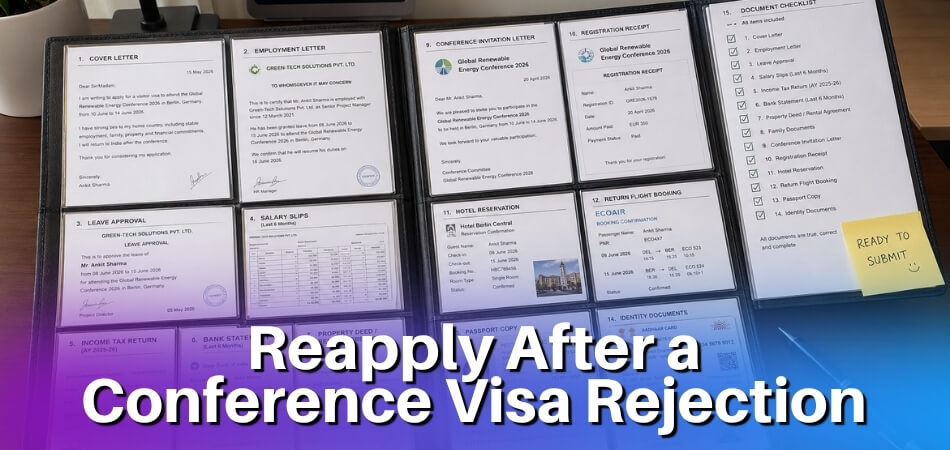
Prepare these where they apply. I have put the invitation letter second, right after the passport, because it explains why every other document is in the file:
| Document | What it shows |
|---|---|
| Valid passport | Identity. Check name, date of birth, number, nationality, and expiry date. |
| Conference invitation letter | Purpose, event details, and your role. Signed, recent, and verifiable. |
| Registration proof | Real participation: registration confirmation, payment receipt, abstract acceptance, speaker confirmation, or program listing. |
| Financial documents | Funds that look realistic for your trip: bank statements, salary slips, tax or business records, or sponsor documents. |
| Accommodation and travel plan | Hotel booking or host details, a tentative itinerary, and arrival and departure dates that match the conference. |
| Employer, business, or university letter | Your role, leave approval (Home Affairs’ visitor guidance lists a letter from your employer granting leave), enrollment, or business registration, and why the event matters to you. |
| Travel history | Past visas and entry or exit stamps. Helpful, but having none does not mean refusal. |
| Identity and family documents | National ID, photograph, and birth, marriage, or name-change certificates if your situation needs them. |
Before uploading, make sure every file is readable from top to bottom. Avoid cropped bank statements, blurry passport scans, and screenshots that do not show your name. If a document is not in English, prepare a proper translation. Label each file clearly so the officer can follow it without searching, and attach each one under the matching evidence type in ImmiAccount.
What Should Be Included in a Conference Invitation Letter for an Australian Visa?
The letter should clearly identify you, the event, the host, and the purpose of travel. It should look official and match every other document. Home Affairs’ own guidance on evidence of an invitation says the letter must give the nature, location and dates of the activity, so those three are the minimum. The rest of the list below is good practice that I recommend.
A strong letter includes:
- Your full name exactly as shown on the passport, plus passport number and nationality if requested
- Full conference name, event dates, venue, and the city and state in Australia
- Organizer’s legal name, address, email, phone number, and website
- Your role: attendee, speaker, presenter, delegate, panelist, or exhibitor
- Registration or participant ID, if available
- A statement that the visit is for short-term conference participation only
- Date of issue, signature, name and designation of the signer, and official letterhead
If you are presenting, the letter can mention your paper title, abstract approval, or session name. If the organizer covers any costs, it should say exactly what is included, such as registration, accommodation, or meals.
Do not describe your role as bigger than it is. An attendee should not be labeled a speaker, and a poster presenter should not be described as a keynote. Avoid unsigned, outdated, vague, or unfilled template letters; the guide on how to write a letter for a conference visa invitation shows what a complete one contains. If the letter has mistakes, ask the organizer to correct it before you apply.
When you request the letter, include your registration or payment confirmation, so the organizer can match you to the event record.
Step-by-Step Process to Apply for an Australian Visa With a Conference Invitation Letter
Choose the visa, complete the online form, upload documents, pay any charge, and wait for the decision. For subclass 600 the letter is checked in Step 1, has to fit the visa in Step 2 and is uploaded in Step 5.
Step 1: Review Your Invitation Letter
Check that your name, event title, dates, venue, role, and organizer details are correct and match your passport and registration confirmation.
Step 2: Select the Correct Visa
Choose the visa that fits your passport first. Then check that your role in the letter (attendee, presenter or paid speaker) is one that visa allows; a paid speaker may need a different visa.
Step 3: Use the Right Application Channel
You apply for the ETA through the official Australian ETA app. The eVisitor and subclass 600 are lodged online through ImmiAccount, where you can also upload documents, pay, receive messages, and track the application.
Step 4: Complete the Application Form
Enter your details exactly as shown on your passport. Take care with names, dates, travel history, employment details, health and character answers, and previous visa information.
Step 5: Upload Supporting Documents
For subclass 600 (and if an eVisitor case officer asks), upload your passport, invitation letter, registration proof, financial records, accommodation plan, and employer or university letter. I would upload the letter as one PDF rather than a photo of each page.
Step 6: Pay the Charge
Pay any visa application charge or service charge shown in your application. The eVisitor has no charge.
Step 7: Submit and Save Confirmation Details
Save your reference number, payment receipt, and confirmation email in one folder.
Step 8: Respond to Additional Requests
You may be asked for biometrics, health checks, updated bank statements, employment proof, or more conference details. Respond by the deadline in the request letter and upload only relevant documents.
How Long Does an Australian Conference Visa Take to Process?
Processing time depends on the visa type, your passport, the volume of applications, and the quality of your documents. Home Affairs says most ETA results come back immediately, and it publishes current processing times for subclass 600 and the eVisitor on its website. Subclass 600 usually takes the longest. Some processing locations have delays, and any request for more information makes the decision take longer.
Things that slow an application down:
- Missing or unclear documents
- Weak financial evidence
- Health or character checks
- Previous visa refusals
- Busy seasons and late submission close to the conference date
My advice is to ask the organizer for the letter as soon as you have registered, because some organizers take several business days to issue one, and to apply as soon as it arrives. That leaves time to fix errors, complete biometrics, and answer requests. If the conference is only weeks away, still check every answer before you submit, because a correction request costs more time than a careful first form.
Home Affairs suggests that you do not make travel arrangements until your ETA is granted, and the same caution fits the eVisitor and subclass 600, which are not usually instant. Do not buy non-refundable flights while you wait (a tentative or refundable itinerary can show your travel plans), and do not submit a second application while the first is still being processed. A submitted application is not a granted visa.
What to Do After Submitting Your Australian Conference Visa Application
After submission, watch your account and email and keep your documents ready.

Use your account to track updates, and check your inbox and spam folder for document requests, biometric instructions, health examination notices, and grant or refusal letters. Keep updated copies of your bank statements, invitation letter, registration proof, accommodation plan, and return evidence.
Ask the organizer whether the event is registered with the Department’s International Event Coordinator Network (IECN). For registered events, the IECN can confirm that participants have lodged their applications, give progress updates and liaise with visa offices if there is a problem, though it may not be able to help if you apply late. Outside that network, Home Affairs does not report on individual applications, so in my view there is no point chasing other offices for news.
Once the visa is granted, read the grant notice. Check the validity period, permitted stay, number of entries, and conditions. Your travel dates must fit inside the approval. Do not assume you can stay longer because the conference continues or a later flight is cheaper. After approval, contact the organizer to confirm the venue, badge collection, program updates, and any documents needed at check-in.
Common Mistakes That Can Delay or Weaken an Australian Conference Visa Application
The most common mistakes are incomplete documents, the wrong visa, weak financial proof, and details that do not match. The letter is involved in the first and last, so in my view it deserves one more check just before you submit.
Submitting an Incomplete Application
Do not leave form sections blank; if a question does not apply to you, answer it with “not applicable” rather than skipping it. Then check that every document in the table above is attached, because a missing registration proof or employer letter is the usual gap.
Choosing the Wrong Visa
A typical wrong-visa case is taking a paid speaking slot on a visitor visa; the visa process for attending conferences in Australia sets out which visa fits each role.
Providing Poor Financial Evidence
Old statements, unclear screenshots, low balances, or unexplained deposits make the officer question your funds. My suggestion is to use statements from the last three months and attach a short note for any large deposit.
Having Mismatched Details
A different spelling of your name, a role that changes between documents, or dates that do not line up are the usual mismatches; fix them at the source document before you upload.
What to Do If Your Australian Conference Visa Is Refused
Read the refusal notice carefully and fix the weak points before you decide whether to reapply. Do not send the same file again.
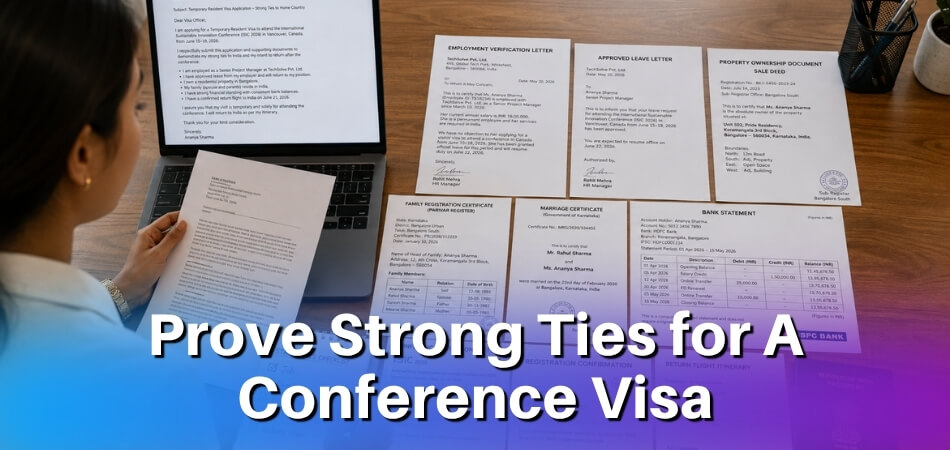
Common reasons include an unclear travel purpose, weak funds, poor home ties, inconsistent documents, an unverifiable invitation letter, or immigration history concerns. To strengthen the file before you reapply, add:
- A revised invitation letter and registration confirmation
- Recent bank statements and sponsor documents
- An employer or university letter
- A clear accommodation and travel plan
- An explanation letter that addresses the refusal reasons
- Proof of your responsibilities at home
In my view, reapply only if the conference is still ahead, your documents are stronger, and your plan is realistic. If the reason is complicated, consult a registered migration agent.
Can You Attend, Present, or Network at a Conference on an Australian Visitor Visa?
Yes, usually, if your activities stay within business visitor rules and nobody pays you to take part. The visit must remain short and linked to the event, and the role described in your letter should match what you will actually do.
Allowed activities generally include attending professional, academic, medical, business or industry conferences and their sessions, presenting research, joining panels and workshops, meeting other professionals, representing an organization, and exploring collaboration.
Activities that cause problems include working for an Australian company, providing paid services such as consulting or training, taking a temporary job, selling goods or services directly to the public, or running ongoing business operations. Home Affairs separates attendees from invited speakers: attendees who are not paid, other than being reimbursed reasonable expenses such as accommodation and meals, may be eligible for a Visitor visa. If you are presenting your own paper as a registered participant, the visitor route above usually fits. Invited speakers whose main purpose is to share information might be eligible for a Temporary Activity visa (subclass 408) as an invited participant. Ask the organizer which route fits your role before you accept a speaking fee or honorarium.
Can Family Members Travel With You for an Australian Conference?
Yes, but each family member needs their own visa and supporting documents. Your invitation letter supports your conference purpose. It does not cover your spouse, children, or relatives.
Each person should show identity documents, travel purpose, funds, accommodation, return intention, and their relationship to you. If they are also attending, include their registration or invitation. If they are only accompanying you, say so clearly; I would not ask the organizer to add them to your letter, because the letter should describe only the people taking part.
If one person funds the whole trip, include a sponsor letter, sponsor bank statements, hotel details for all travelers, and a family itinerary. The funds should be realistic for the number of people.
From our experience at MS International: Our conferences are held in person in the Greater Toronto Area, so our invitation letters are for those events. When we prepare a letter, we check that the name matches the passport and that the passport details are complete, and we may contact you if they are not. Our letter is issued within 3 to 5 business days after payment clears, and a US$50 fee may apply to corrections after it is issued. The letter supports a visa application but does not guarantee a visa, and registration fees are non-refundable, including after a visa refusal.
Frequently Asked Questions About Getting an Australian Visa With a Conference Invitation Letter
These are common short questions about an Australian conference visa: cost, timing, speaking fees, changed dates and staying on for tourism.
Can I get an Australian visa only with a conference invitation letter?
No. The letter supports your purpose, but you also need identity documents, financial proof, travel details, and evidence that your stay is temporary.
Is a conference invitation letter mandatory?
Not by law, but Home Affairs asks event participants to attach a registration confirmation or a letter of invitation. If your event issues no letter, a payment receipt, event emails, or a program listing can support your registration.
Which visa is best for attending a conference in Australia?
It depends on your passport. Eligible European passport holders can use the eVisitor (651), other eligible passport holders the ETA (601), and everyone else the Visitor visa (600) Business Visitor stream.
How much does an Australian conference visa cost?
The eVisitor is free, the ETA costs AUD 20, and subclass 600 costs AUD 250 (from 1 July 2026).
How early should I apply?
As soon as you have your invitation letter or registration confirmation. Processing times vary, and early applications leave room to fix documents and answer requests.
Can I book flights before approval?
Avoid non-refundable bookings until the visa is granted. Use a tentative or refundable itinerary if you need to show travel plans.
Can I receive payment for speaking?
Not on the ETA, eVisitor or Business Visitor stream. Organizers cannot pay you to take part, though reasonable expenses can be reimbursed. Paid or invited speakers may need another visa, such as subclass 408. Ask the organizer first.
Can I get an Australian visa on arrival?
No. You need a visa before you travel. The exception is New Zealand passport holders, who usually do not have to apply in advance unless they have health or character concerns.
What if the conference date changes?
Get an updated invitation letter and revise your travel plan. If your visa is already granted, check that the new dates still fit your validity and stay conditions.
Do I need travel insurance?
It is not a visa requirement, but it is worth having. Home Affairs says most visitors cannot claim Medicare and pay their own medical costs, unless their country has a reciprocal health care agreement with Australia. A policy can also cover delays, cancellations and lost baggage.
Should I include a cover letter?
A short one helps if your situation needs explanation. Summarize the conference purpose, dates, funding source, employment or study status, and return plan. Keep it factual.
Can I stay in Australia after the conference for tourism?
A short tourism stay may be possible within your visa conditions and approved stay. The conference should remain the main purpose, and any extra days should be explained.
What if my employer or university is paying for the trip?
Include a support or sponsorship letter from the organization. It should say which expenses it covers, why you are attending, and that you are expected to return to work or study after the event.
Final Checklist Before Applying for an Australian Conference Visa
Before you submit, confirm that your visa type, invitation letter, documents, and travel plan all support the same purpose.

- The visa type matches your passport and your role at the event
- The letter shows your name exactly as in your passport
- The dates in the letter, the form and your bookings agree
- Your funds and home-ties documents are attached (subclass 600) or ready to show (ETA, eVisitor)
- Every form answer was reviewed before you paid
After the grant, keep the grant notice with your passport, in print and on your phone, because airline staff and border officers may ask for the visa details.
Disclaimer: This article is general information, not legal or immigration advice. Visa rules, fees, and processing times change. Confirm the current requirements on the official Australian Department of Home Affairs website before you apply.