You know the moment. You are standing at the edge of a cluster of people during the keynote break, coffee in hand, and your mind goes blank. You have the badge, the cards and a rehearsed pitch, and still nothing comes out.
Quick answer: The best conference conversation starters are specific, low-pressure and tied to something you both just experienced. Ask what brought the person to this session, what they hope to take back to their team, or what surprised them most today. These questions invite an opinion, so the other person never has to recite a job title.
“What do you do?” tends to fall flat because it asks someone to rank themselves before any connection exists, and many people answer with a rehearsed pitch that ends the exchange. Below you will find openers for sessions, coffee and lunch queues, poster and exhibitor areas, social events and online rooms, plus ways to keep a chat moving and to leave it politely.
Most Effective Conference Conversation Starters
The strongest opener names something real and asks for a view on it. It shows you are paying attention and gives the other person a reason to keep talking.
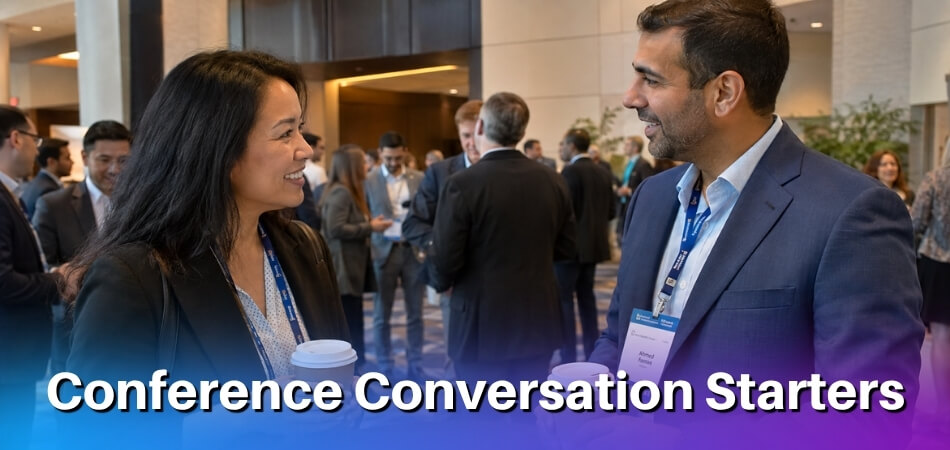
Most good starters fall into five types. Pick the type that fits the moment, then use your own words.
| Type | Example | Why it works |
|---|---|---|
| Shared experience | “I came in skeptical about [claim], but by the end I was not so sure. How did it land for you?” | You both just heard the same thing, so there is no wrong answer |
| Reason for being here | “What made you pick this conference over [other event in the field]?” | A specific answer shows what the person cares about |
| Test of a claim | “Did the figure they cited match what you see in your own work?” | Gives the person a real position to respond to |
| Event itself | “Is this your first year here, or do you come back every time?” | Returning attendees have opinions and first-timers have fresh observations |
| Current work | “What are you working on these days?” | Draws out projects and problems instead of a title |
The One Opener That Works Almost Everywhere
“What are you hoping to take away from today?” is role-neutral. It suits an attendee, a speaker or a sponsor, and it surfaces what the other person actually cares about, which is the quickest route to a real conversation.
Tie It to the Room Around You
The badge, the agenda, the room layout and the catering are all safe material. Anything grounded in the moment works better than a floating abstract question, and it lowers the pressure on both of you.
Why ‘What Do You Do?’ Usually Fails: What to Say Instead
“What do you do?” fails because it produces a closed answer and invites a quick ranking of the other person.
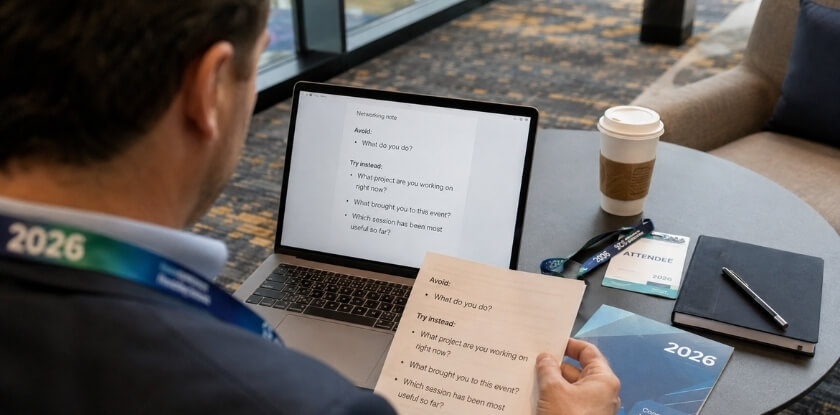
“I’m a product manager at a software company” gives you almost nothing to pull on, so both of you nod and then fall silent. The question also carries some status anxiety. Early-career attendees, people between roles and anyone whose title does not describe their work can feel put on the defensive before the conversation has started. At a conference, many people are there to explore something new, so a job title may not even be how they think about themselves right now.
Openers That Actually Open Something
Each of these aims at an answer you can follow up on.
- Ask about intention, not identity. “What brought you to this one specifically?” gets people to share what they are curious about or trying to solve.
- Use something from the event. “Did you catch the keynote this morning? I keep thinking about the point on [topic].” Shared context gives the person something concrete to answer.
- Ask for their perspective. “I’m trying to understand how practitioners are really handling [topic]. Has your team run into it?” This makes you sound curious rather than promotional, and people like being asked for an honest take.
- Offer what you are working on. “I’m here mostly because we are rebuilding our onboarding process and I wanted to hear how others approached it.” Being slightly open invites the other person to match it.
One Small Rewording
If you change only one thing, swap “What do you do?” for “What are you working on these days?” The answers shift from a title to a project, and the next question usually writes itself.
Adjusting for Who You Are Talking To
With a speaker, tie your opener to something they said. With an exhibitor, acknowledge that they are busy and keep your question short. With a peer in the lunch queue, the shared event is enough: “Have you been to this one before?” followed by “What has changed since last time?” The role-specific lines are in the next section.
Conversation Starters by Conference Role
Your role shapes what people expect from you and what they will give back, so the opener that suits a post-keynote hallway can be wrong at a booth.
If You Are an Attendee
You have the most freedom, because other attendees are there to learn and meet people. You do not need a pitch. Smaller settings such as workshops, shared lunch tables and hallways are easier places to start than a crowded mixer.
- Reference the session you just left: “That last speaker made a case I was not expecting. Did it work for you?”
- Ask about their goals: “Are you here for a particular track, or more for the people side?”
- Ask a mutual contact to introduce you: “Could you introduce me to [Name]? I liked their talk.” A warm introduction removes the need for an opener.
- Link the topic to their work: “Are you working on anything related to what they covered in there?” Many people like talking about their own projects.
You also do not have to start every conversation. Standing near a speaker you want to meet, or sitting next to someone at lunch and letting them open, is a perfectly fair approach.
If You Are a Speaker
After a talk, people arrive with compliments, clarifying questions and business cards. To go deeper you have to steer. When someone says “great talk,” thank them and redirect: “Thanks. Was there a part that connected with what you are working on?” One sentence turns a compliment into an exchange.
When you start the conversation yourself, do not lean on being a speaker, because it can feel like an odd dynamic. Begin from curiosity: “Did you get to any of the other sessions this morning? I missed the one in Hall B and wanted a read on it.” Prepare two or three real questions before your session ends, such as which industries are in the room or how people apply a concept you covered. They become easy openers when someone walks up.
The post-panel window is short. If a questioner raised something you want to explore, catch them on the way out: “Your question about [X] was the one I wanted more time on. What is the context behind it?”
If You Are a Sponsor or Exhibitor
Visitors are often guarded at a booth because they expect a pitch, so your first job is to break that expectation. Do not open with what your company does.
- Start with the visitor: “What is drawing you to this part of the expo floor?” or “Have you found what you were looking for today, or still looking around?”
- Connect the problem before the product: “We have been talking to people about [conference theme]. How is that changing in your area?” Once you understand their challenge, the talk about your solution comes naturally, while leading with the solution loses people early.
- If you host a session or side event, you already have a reason to talk to everyone in the room. Ask for honest feedback: “We tried something different from the usual sponsored lunch. What did you think?” It signals confidence and lets people talk to you as a person rather than a logo on a lanyard.
Have an exit that does not feel like a brush-off: “I would like to keep talking. Are you around later, or is it easier to connect on LinkedIn?”
If You Are Approaching a Speaker
Wait until the cluster around the speaker thins out, then be direct and specific: “Your point about [X] was the part I wanted to follow up on. We ran into that exact problem a few months ago.” It respects their time, shows you listened and gives them something concrete to engage with. Speakers hear “great talk” often, and a vague compliment is kind but forgettable, while a specific reference is easier to remember. If there is a Q&A, asking a clear question there gives you a reason to speak afterwards: “I was the one who asked about [X]. Could I ask one more thing?”
If You Are Approaching an Exhibitor or Sponsor
Exhibitors are there to talk, so you can skip the slow start. “Tell me about your product” gets tiring for them by hour two. Name their situation and ask about a specific use case instead: “I know you are meeting a lot of people today, so I will be brief. Does your product handle [scenario]? That is our main pain point.” Or: “We are a [type of team] with [short context]. Is that usually a fit for what you do?”
Situation-Based Openers (Lunch Line, Keynote Break, Session End, Hallway)
The right opener depends on where you are as much as on who you are talking to. A question that suits a roundtable falls flat when you are both juggling plates.
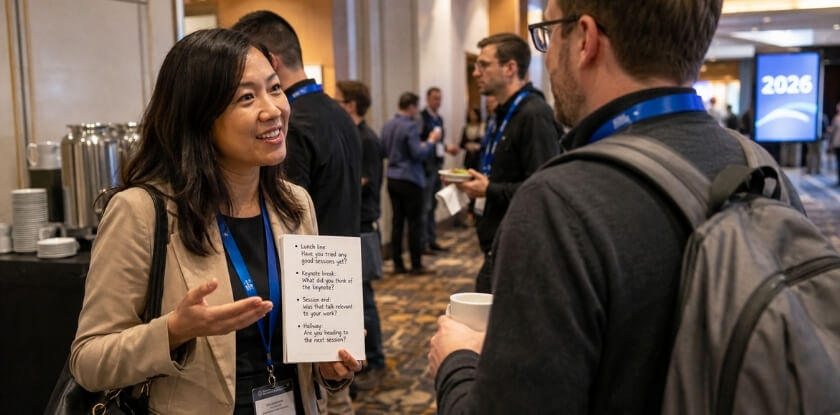
Lunch Line and Catering Stations
You will stand next to someone for a minute or two with nowhere else to be, so keep it light. “Did you catch the morning session, or did you come in later?” has no wrong answer and tells you at once whether you share a session. A short remark about the food, a local caterer or the overloaded dessert table can lead into “They went all out this year. Have you been to this one before?”, which moves from small talk to useful information in one sentence.
Leave the business card and the elevator pitch for later. Their hands are full, and the real networking can happen once you are both seated.
Keynote Break
Right after a keynote, many people have a reaction they have not yet put into words. “What did you make of [specific point]?” beats “Great talk, right?” because it asks for a real response. If something was surprising, name it: “I did not expect her to push back on the data that way. Did it land differently for you?”
This is also one of the few times when approaching someone standing alone feels natural, since they are simply thinking. “First time hearing [speaker]?” or “Did you get a chance to read their book before this?” is enough to begin.
Session End
When a breakout session finishes, everyone in the room has just shared the same session, which is stronger common ground than the conference itself.
- Refer to a moment in the session. “When the facilitator asked about [topic] and half the room disagreed, where did you land?”
- Ask about application. “Is any of this relevant to what you are doing right now?” You learn more from that answer than from a job title.
- Follow up on an audience question. “That was a good question you asked. Did the answer satisfy you?”
Hallway Conversations
Between sessions people are moving but rarely rushing, and the background noise means a short exchange does not feel like a big commitment. Directional openers work best: “Are you heading to the [track name] session next?” leads naturally to why they chose it.
If you have met before and are crossing paths again, say so: “We met at the opening reception, and I did not catch your name, actually.” Honesty tends to be welcomed. If the person you meet is a speaker between their own sessions, keep it short and specific: “The framing you used in the second half changed how I think about [topic]. Have you written about it anywhere?”
Coffee Breaks and Social Events
At a reception or coffee break, ask something that needs more than one word but costs nothing to answer. “What has been the best session for you so far?” or “Who should I make sure to hear tomorrow?” both work. Receptions are built for short conversations, so no one expects a long one.
Poster Sessions and Exhibit Areas
At a poster or display, the work itself is the opener. Look at it for a moment, then ask the person standing beside it: “What was the hardest part of getting this result?” or “What would you test next?” Presenters are usually glad to be asked about the thinking, not just the findings.
Follow-Up Questions After the Opener: Keeping the Conversation Going
To keep a conversation going, listen for the detail the person stresses and ask about that, rather than moving on to your next prepared question. The opener is only the door.
Listen for the Thread, Not the Summary
- Notice what they emphasise. If someone says “I’m mostly here for the supply chain sessions, we had a brutal year,” the word “brutal” is the cue. “What has been the hardest part to solve?” gets a real answer. “Which company are you with?” ends the moment.
- Ask about the decision, not only the fact. “What made you choose this one?” tells you more than “How long have you been coming?” Decisions show priorities, while facts show only history.
- Reflect back what you heard. “So you are trying to work out whether the new regulations change your workflow or just add paperwork?” proves you were listening, which is rarer than it should be.
Questions That Add Depth Without Sounding Like an Interview
One well-placed follow-up beats three quick ones, because rapid-fire questions feel like an intake form.
- “What is your take on it?” invites an opinion rather than a biography and fits nearly any moment.
- “Are most people in your area dealing with the same thing?” moves the topic from personal to industry-wide, which many people find easier to discuss.
- “What do you want to walk away with by the end of the day?” works well at lunch or early in the event, and gives you a chance to offer an introduction that helps.
- “Did you catch the session on [topic] this morning?” is simple, and a friendly disagreement over a speaker’s point often starts the conversation people remember.
Body Language While Starting a Conversation
Good words can still fall flat if your body says something different, and people read posture before they hear a sentence, especially in crowded halls.

| Habit | What to do | Why |
|---|---|---|
| Eye contact | Catch their eye and nod briefly before you speak. Keep it steady while they answer | Removes the surprise of an approach. Many people look away while listening, so holding eye contact when they speak reads as interest |
| Angle | Approach at a slight angle, about 45 degrees, then turn toward them as the chat settles | Standing square to someone’s chest on arrival can feel confrontational |
| Distance | Roughly an arm’s length. Lean in to hear, but do not close the gap for good | Noise is not a reason to stand too close |
| Joining a group | Step to the edge, catch one person’s eye, wait for a pause | Pushing into the middle gets you politely ignored |
| Hands | Hold a drink or notebook in your non-dominant hand and keep the other free | You can shake hands without fumbling, and nothing blocks you from the other person |
| Face and posture | Relaxed smile before you speak. Avoid crossed arms or a phone held in both hands | Looks approachable instead of closed off |
Mirroring and Listening Signals
Gentle mirroring of posture and energy builds rapport without words. If they are relaxed, ease your stance. If they are animated, bring a little more energy. Nod now and then, and add short acknowledgments such as “right” or “that makes sense,” so the conversation develops a rhythm.
Reading the Signal to Move On
If their body angles away, their answers get shorter or their eyes scan the room, the conversation has run its course. A clean exit beats a dragged-out goodbye, and the next section explains how to do it.
How to Exit a Conference Conversation Gracefully
The cleanest exit gives a short, honest reason, ties it to a next step and happens while the conversation is still warm. A clumsy ending can undo several minutes of rapport, and a clean way out is a kindness to both of you.
Signal Before You Leave
Give a brief verbal cue first: “I want to let you get back before the next session starts” or “I should grab a coffee while the line is short.” It gives the other person a soft landing. Do not fade out mid-sentence or edge backward while still talking, because people notice and the exchange feels unfinished.
Tie It to the Next Step
- Refer to what you discussed. “I will look up that report you mentioned” shows you listened and gives the chat continuity.
- Name a specific follow-up. “Let me connect with you on LinkedIn before we leave today” is better than a vague “we should keep in touch.” Send the request while you are still standing together.
- Exchange details before the goodbye, not after, so the exit feels purposeful.
- Hand them to someone else. “Have you met [Name]? She is working on exactly the supplier network you described.” The introduction becomes the exit, and you look like a connector.
Exits by Situation
| Setting | Easy exit line | Note |
|---|---|---|
| Hallway | “I am going to find a seat before the room fills up.” | The environment gives you a natural reason to move |
| Lunch table | “I am going to refill my water and check the afternoon schedule.” | You are seated, so use an errand. You can come back if you want to |
| Reception | “I want to meet a few more people tonight, but this was a great conversation.” | Short chats are expected, and honesty is welcomed |
| Online room | “I will let you go, I know there are other rooms open.” | With no physical movement, say the exit out loud and end with the same follow-up step |
When the Opener Does Not Land
If the reply is one word, do not repeat the question. Try one open question instead (“What was the best part of today for you?”), and offer your own answer first so the other person has something to react to. If they still seem distracted, close politely (“Good to meet you, enjoy the rest of the day”) and move on. Some people are tired, introverted or busy, and it is rarely about you.
When the Conversation Is Stuck
If a chat stalls but the other person does not seem ready to end it, introduce a third person nearby. If nobody is close, use the event: “I want to catch the exhibitor hall before it closes” or “I promised myself I would talk to the keynote speaker while she is still around.” A specific reason sounds like a normal conference priority, while a vague “I should go mingle” sounds dismissive.
Conversation Starters for Virtual and Hybrid Conferences
Online, you lose the coffee line, the room and the accidental eye contact, so be more direct but not more scripted.
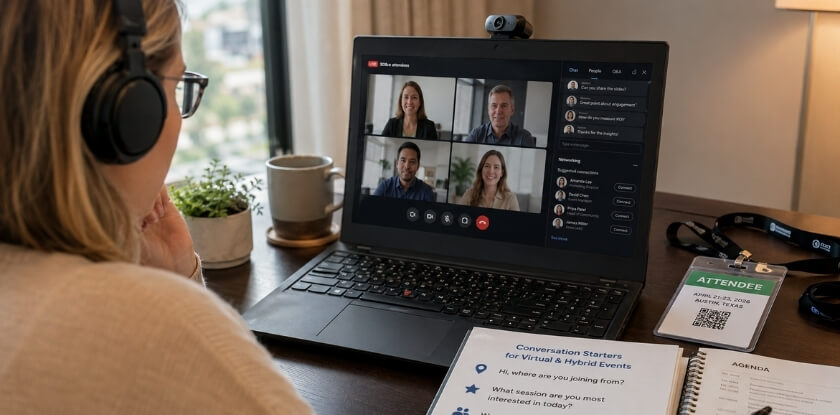
Why Virtual Networking Feels Harder
The awkwardness usually comes from the platform. Breakout rooms drop you in with strangers and a countdown clock, chat scrolls fast, and video lag makes overlapping speech feel rude. Naming that in your opener helps: “I always feel like I am cutting someone off on video, so I will just go first.” It gets a smile and relaxes the group.
Openers for Breakout Rooms
Breakouts are often short, so skip the weather.
- Start with a shared frame. “What is the one thing from that keynote you will actually take back to your team?” is concrete and avoids the vague “what did you think?” that earns a shrug.
- Ask a low-effort first question. “Is this your first [conference name], or have you been to earlier ones?” is easy to answer.
- Ask about context. “Are you joining this live, or is it a recording day for you?” shows whether they are fully engaged or multitasking.
- Name your reason for being there. “I came for the workshop on [topic]. Has it been useful for anyone here?” gives others an easy way to agree or push back.
- Admit the awkwardness. “I find these breakouts hard to start, so can I ask what brought you to this session?” can get a warm, honest reply.
Openers for the Chat Box
The chat is low-pressure for introverted attendees, but “Great session!” disappears in the scroll. Post a specific question that needs a real reply: “Has anyone tried what the speaker described for [topic]? I am curious what it looked like in practice.” You can also reply to a point a fellow attendee typed (“That point you raised about [X], I have been thinking the same”) and move it into a direct message.
If the platform has a participant list, keep a private message short, with one question and one clear ask: “I saw you work in [field] and I am curious how you handle [challenge]. May I ask you more at the networking break?”
Openers for Hybrid Events
In a hybrid event, in-person guests get the hallway talk and lunches, while remote guests get a tighter, more structured experience. Mentioning that gap is a good opener for either side.
- If you are remote: “I am joining from [city], so I am missing the hallway conversations. Is there anything from this morning I should know about?” To reach someone in the room: “You asked a good question in the session. I was watching the stream and wanted to follow up. I am [Name], I work in [area]. Would a short call this week suit you?”
- If you are in the room: Reaching out to remote participants during Q&A or in the main channel is unusual and memorable. Include your name and role, and refer to something from the session.
- After the session: “I saw your comment in the chat during the panel and wanted to follow up” is specific and easy to answer.
LinkedIn Follow-Up for Virtual Connections
Online events make follow-up slightly easier, because people are already on their screens. Send the request the same day, while the context is fresh, and write a note instead of leaving it blank. A blank request gives the person little to place you by, especially if they met many people that day.
We talked in the breakout room about [topic], and I would like to stay connected.
Mistakes to Avoid When Starting Conversations at Conferences
Many mistakes come from timing and intent, not wording. The points below add to the body language and exit advice above.
- Leading with your pitch. If your opening question is really a setup for your product, people can usually tell. Curiosity produces better outcomes than any scripted opener.
- Asking and then not listening. If you ask what brought someone here and then talk about yourself, the question is wasted. Let the answer land before you reply.
- Misreading availability. Someone alone by the coffee station may not want company. Headphones in, eyes on a phone or hunched posture mean “not right now,” and a speaker hurrying to the stage is not the moment for a ten-minute question.
- Treating the keynote break as the only window. It is the obvious networking time, which also makes it crowded and rushed. The slower moments, such as walking between sessions, waiting for a room to open or lunch, can give better conversations.
How to Remember Names and Details After Conference Conversations
Write down the name and one detail within a few minutes of each conversation, because recall fades fast when you meet many people in a day. A short system is what separates a pile of business cards from a network.
Say the Name Once, Right Away
Use it in your first reply: “Good to meet you, [Name].” Saying it aloud encodes it better than passively hearing it. If you missed it, ask at once: “Sorry, I did not catch that over the noise. Could you say your name again?” Nobody minds that, and everyone minds a wrong name an hour later. On a screen, the name is usually shown right there, so use it.
Write Notes Immediately
As soon as the conversation ends, jot two or three details on your phone or in a small notebook: what they work on, something that stood out, where you met and any follow-up either of you promised. Do not trust yourself to rebuild this in the hotel room that night. A card note such as “lunch line, launching new product line in Q1, will introduce me to a colleague” is what turns a later message from generic to personal.
Anchor the Name to Something Specific
Skip elaborate memory tricks. Attach the name to one concrete detail: “[Name], who works on hospital logistics” or “[Name], who sat near the back at the keynote break.” Specific professional details survive the day, while vague impressions do not.
Review Before Day Two
On a multi-day event, spend ten minutes the night before reading your notes and new connections. You can then build on yesterday’s conversations instead of restarting them, and you also catch any promised introductions or resources while the event is still running.
What to Do After a Great Conference Conversation (Follow-Up Strategy)
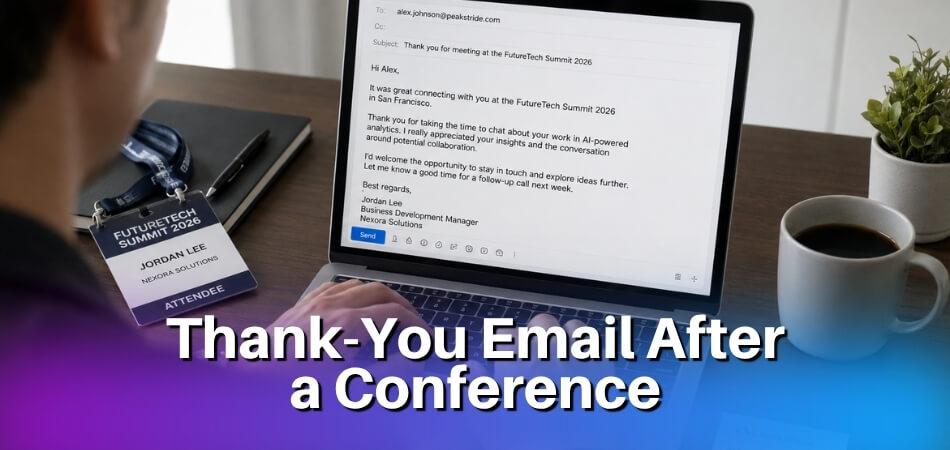
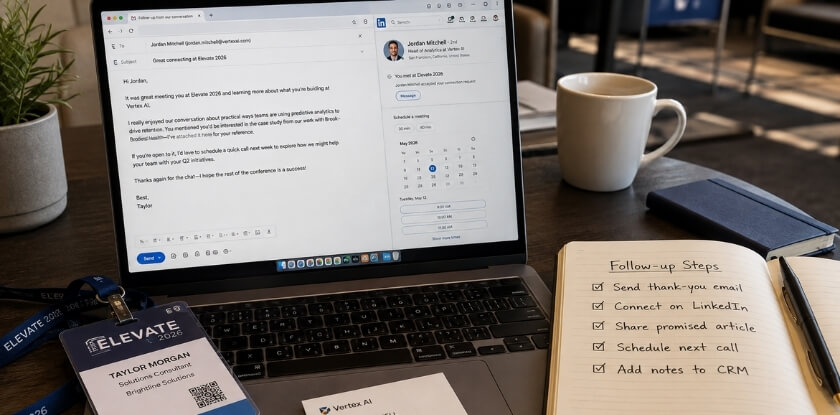
Send a LinkedIn request with a personal note within 24 hours, then follow up in more detail in the days that follow.
| When | What to send |
|---|---|
| Within 24 hours | LinkedIn request with a note that mentions a specific detail, such as the team’s approach to onboarding. If you also send an email, send the request on the same day as the email |
| Within a few days | For a strong exchange: a fuller message of two or three sentences that mentions the conversation and suggests a next step, if there is one |
| After a week | Still send it. Acknowledge the delay and mention your conversation specifically |
Connect on LinkedIn Before You Leave the Venue
Connecting while you are still at the event, or that evening, works better than tracking people down a week later. Search by name, company or the conference hashtag, and add a short note about where you met. Once someone is in your network with a photo and job title, it also reinforces the link between face, name and context.
Good to talk at the networking lunch today. I would like to stay connected.
What to Actually Say
Keep it short and personal. Mention something you discussed and, where it fits, offer something useful: an article you mentioned or a contact you promised to share. “Great meeting you at the conference” gets skimmed, while “Great talking through the pricing question, I found the article I mentioned” gets read. For example:
Hi [Name], I enjoyed talking about [topic] at the [Conference Name] lunch. I found the [article/resource] I mentioned and thought it might help with [their challenge]. I would be glad to stay connected.
If there is no clear next step, a plain close is fine: “It was good to meet you. I will keep an eye on what your team is working on.”
When a Conversation Leads Somewhere Real
If there is a possible referral, collaboration or client relationship, propose a specific next step such as a short call. Keep the ask in proportion: a long strategy call after a brief hallway chat is too much, while a short introductory call is a sensible first step.
Staying Visible After the Event
Comment occasionally on their posts when you have something real to add. This keeps the connection warm without a formal reason to write, and it helps most with contacts from a virtual event, where the original exchange may have been short. Relationships are more likely to last when you follow up and help, not when you simply hand out cards.
From our experience at MS International: Our conferences are held in person at venues in the Greater Toronto Area. People can take part as presenting authors or as registered listeners, and depending on the final agenda, speakers may attend other sessions, join scheduled discussions and take part in networking activities.
FAQ: Conference Conversation Starters
Walking up to a stranger with an opener is only half the job; what to do when it falls flat, how long to chat, approaching a speaker and forgetting a name matter just as much.
How many people should I try to meet at a conference?
There is no fixed number. Set a small goal, such as a few real conversations a day, because you can only follow up well with people you remember. A handful of good chats beats a pile of business cards.
What if someone doesn’t respond well to my opener?
Try one open question, and if the reply stays short, close politely and move on. Some people are distracted, introverted or simply not in the mood, so do not take it personally.
Is it okay to approach someone who’s alone and looking at their phone?
Yes, if you keep it light. Something like “Anything good in the app, or are you hiding from the coffee queue too?” works because it is self-aware and low-pressure. If they look hurried, leave them be.
How do I start a conversation with a conference speaker after their session?
Refer to a specific point from their talk, or ask about something they had no time to cover. “Your point about [X] challenged something I had assumed” gives them something real to answer, unlike “Great presentation.”
How long should a first conference conversation be?
A few minutes is plenty. A first chat opens a door and does not need to close a deal, so end it at a natural pause or with a clear next step, and let the follow-up do the heavier work.
What’s the best LinkedIn message after meeting someone?
Mention one specific thing from your conversation. “Enjoyed talking about [topic] at the [Conference Name] lunch, would love to stay connected” is far better than the default invitation text.
Do these openers work for virtual conference networking?
Many of them do. Online, a comment from the chat or a speaker’s specific point is the natural entry, since there is no physical closeness to rely on.
What if I blank on someone’s name right after they’ve told me?
Ask again straight away: “Sorry, I did not catch your name clearly.” Within the first ten seconds it is barely noticeable, whereas hiding it for twenty minutes is much harder.
Should I prepare conversation starters before the conference?
Yes, a few minutes is enough. Look through the speaker list and session topics, then pick two or three things you are curious about, so you have real material instead of forced small talk.
Final Thoughts
Many people leave conferences with a pile of cards and a vague memory of chats that went nowhere. The difference usually comes down to how you open, how you listen, and what you do in the first 24 hours afterwards. It takes a little preparation and a willingness to ask a better first question.