You have exactly 30 seconds — will you waste that moment or make it count? Picture this: you’re standing near the coffee station at a conference networking break, someone turns to you and asks “so, what do you do?” — and your mind goes blank. Or worse, you start talking and watch their eyes drift toward the exit. It happens to almost everyone, from first-time attendees to seasoned professionals. The problem isn’t that you lack something interesting to say. The problem is you haven’t built a reliable, confident self-introduction that works under pressure.
Quick answer: An elevator pitch is a 30–60 second structured self-introduction that combines your name, role, value proposition, and conversation goal. At a conference — during networking breaks, after sessions, or at the registration desk — it is your most powerful tool. A strong pitch answers four things: who you are, what you do, how you create value, and where you want the conversation to go — all delivered within 30–60 seconds.
Most advice on this topic is frustratingly vague. “Be authentic.” “Keep it short.” “Know your audience.” That’s fine in theory, but it leaves you standing there still unsure what to actually say when a VP of Engineering or a potential client gives you their attention for half a minute. Generic tips don’t account for the difference between a 30-second pitch at a crowded registration desk and a 60-second pitch after a breakout session, or the gap between how extroverts and introverts naturally handle cold introductions, or what changes when the whole conference is happening on Zoom.
This guide is different. You’ll get conference-specific strategies built around real scenarios — including tech industry pitch examples, finance industry pitch structures, and HR and talent acquisition pitch angles. You’ll find practical introvert tactics, virtual conference and online conference adaptations, guidance on body language and vocal delivery, and a clear framework for turning a single 30-second moment into a genuine follow-up conversation. Whether you’re polishing your personal branding, testing a call to action, or just trying to stop fumbling your self-introduction, this is the only resource you’ll need.
What Is an Elevator Pitch and Why It Works Differently at a Conference
An elevator pitch is a short, focused self-introduction — typically 30 to 60 seconds — that tells someone who you are, what you do, and why that matters to them. The name comes from the idea that you should be able to deliver it in the time it takes to ride an elevator. Simple enough concept.

But here’s the thing: most advice about elevator pitches is written for job interviews or investor meetings. A conference is a completely different environment, and if you treat it the same way, your pitch will land flat.
At a conference, you’re not selling yourself to one person with a fixed agenda. You’re moving through a room full of strangers during a networking break, standing next to someone at the registration desk, or bumping into a potential collaborator between sessions. The context shifts constantly. The person you’re talking to might be a potential client, a peer, a speaker, or someone who has absolutely nothing to do with your work. You often don’t know which until 30 seconds in.
That changes everything about how your pitch should be built.
The Goal Is Conversation, Not Performance
This is the part most people get wrong. They rehearse a pitch like it’s a monologue — polished, complete, finished. Then they deliver it and wait for applause that never comes.
At a conference, your pitch isn’t meant to close anything. It’s meant to open something. The real objective is a follow-up conversation, not a completed transaction. Think of it as an attention grabber with a built-in invitation to keep talking.
A good conference pitch ends with a question or a natural pause that pulls the other person in. A bad one ends with silence because you’ve said everything there is to say.
Why 30 vs. 60 Seconds Actually Matters Here
The 30-second pitch and the 60-second pitch aren’t just different lengths — they serve different moments.
Use 30 seconds at a crowded networking break where someone’s already scanning the room, or when you’re introduced in passing. It’s lean: who you are, what you do, one specific hook. That’s it.
The 60-second pitch works when there’s a natural pause — seated at a roundtable, waiting for a workshop to start, or when someone genuinely asks “so what do you do?” and leans in slightly. You have room to add your value proposition and a soft call to action, like suggesting you grab coffee later or connect on LinkedIn.
Misjudging the moment is one of the most common conference networking mistakes. Launching into a 60-second pitch when someone’s clearly mid-exit is how you become the person people avoid near the coffee station.
Conference Networking Has Its Own Social Rules
Professional networking at a general business event gives you a relatively predictable dynamic. Conferences are messier. Attendees are tired, overstimulated, and often processing information from four sessions in a row. They’re also, in many cases, already mentally categorising people they want to talk to and people they don’t.
Your self-introduction has about eight seconds before the other person has formed an impression. That’s not cynicism — that’s just how it works in a high-density social environment.
Personal branding matters here in a very practical sense. Not the “build your brand” buzzword version, but the simpler idea that your pitch needs to be consistent enough that people remember you accurately when they see your business card or your LinkedIn profile the next morning. If what you said in person doesn’t match what they find online, it creates a small but real moment of confusion that erodes trust.
The other thing that’s specific to conferences: everyone is pitching. Speakers, sponsors, attendees, recruiters. The room is full of people who’ve rehearsed some version of what they do. That means a pitch that sounds rehearsed actually sounds like everyone else. The pitches that work tend to feel specific and slightly unscripted — not because they are, but because they’re built around something real and concrete rather than a polished value proposition written for a slide deck.
What Every Conference Elevator Pitch Must Include — 4 Core Elements
A pitch that actually works isn’t improvised. It’s built. And it’s built from four specific pieces that do four different jobs. Skip one and the whole thing falls apart — either you ramble, or you sound rehearsed but forgettable, or you leave the other person nodding politely with no idea what to do next.
Here’s what goes inside every strong conference self-introduction.
Name and Role
This sounds obvious. It isn’t, because most people mess it up.
They either race through it (“Hi I’m Jake I work in tech”) or they over-explain before the other person even knows who they’re talking to. Neither works.
Say your name clearly. Pause for half a second. Then give your role in plain language — not your full job title, your function.
“I’m Sarah. I run growth at a mid-size fintech startup” lands better than “I’m Sarah Chen, Senior Vice President of Revenue Expansion and Strategic Partnerships.” One of those tells the person immediately what world you operate in. The other makes them wait.
Keep the name-and-role part to two sentences max. It’s a door opener, not an introduction letter.
Value Proposition — What Problem Do You Solve
This is the piece most people leave out entirely. They say what they are, not what they do for people.
Your value proposition isn’t your job description. It’s a one-sentence answer to “so why does your work matter to someone standing in front of you right now?”
In a tech industry pitch, that might be: “We help SaaS companies reduce customer churn in the first 90 days.” In a finance industry pitch: “I help family offices move cash into private credit without the usual legal drag.” In an HR and talent acquisition pitch: “I source senior engineering candidates that internal teams have already given up on.”
Notice those are all problem-first. Not “we build software” or “I’m in finance.” Each one names a specific pain that a specific person would recognise.
You don’t need to explain your entire business. One sentence that makes the right person think that’s exactly my problem is all you’re going for.
Conversation Goal — What You Want Right Now
Every good 30-second pitch or 60-second pitch has a purpose. Not a vague networking goal — a specific, immediate one.
Your conversation goal shapes how you end the pitch. Are you looking for a potential client? A collaborator on a specific project? Someone who knows a particular market better than you do? A hiring manager in a company you’ve been watching?
The goal doesn’t have to be stated out loud every time. But it shapes your call to action at the end — whether that’s “I’d love to hear how you’re handling X” or “could we grab ten minutes during the lunch break?” or simply exchanging a business card or connecting on LinkedIn before the networking break ends.
Without a clear conversation goal, your pitch just… stops. It doesn’t open anything. Two people stand there smiling and then drift apart.
Know what you want before you walk into the registration desk queue or step into a breakout room. That clarity shows.
Hook or Attention Grabber
The hook is optional in theory. In practice, it’s what separates a pitch that gets remembered from one that gets nodded at.
An attention grabber isn’t a joke or a gimmick. It’s a single line — usually a surprising number, a counterintuitive statement, or a sharp question — that makes the other person stop scrolling through their own thoughts and actually listen.
“Most onboarding tools track completion. We track regret.” That’s a hook. “We closed 40% of our pipeline from a single conference talk last year.” That’s a hook. “I help companies hire faster by telling them who not to interview.” That works too.
Good hooks are specific and slightly unexpected. They create a micro-moment of curiosity that pulls the other person into the conversation rather than through it.
Place it right after your name and role, or at the very start if the setting is competitive — like a speed networking session where everyone’s pitching in 90-second windows. In a quieter one-on-one at a conference coffee station, the hook can come a beat later, once you’ve made basic human contact first.
The goal isn’t to be clever. The goal is to give the other person a reason to ask a follow-up question. That’s when real professional networking actually starts.
Step-by-Step: How to Build Your Own Conference Elevator Pitch
You don’t need to be a natural networker to have a solid pitch. You just need a structure. Most people stumble through their self-introduction at a conference because they built it in their head five minutes before the networking break — if they built it at all. These four steps fix that.

Step 1 — Write Your One-Line Introduction
This is your opening sentence. It needs to answer two questions instantly: who you are, and what you do. That’s it.
Not your job title. What you actually do.
“I’m a software engineer at Acme” tells someone almost nothing useful. “I help fintech companies cut their API integration time in half” tells them exactly why they might want to keep talking.
The formula is simple: [Role or identity] + [what you do for whom]. One sentence. Under 15 words if you can manage it.
Try writing three versions and reading them out loud. The one that feels least awkward is usually the right one.
Step 2 — Add Your Value Statement
Your value statement is the one or two sentences after your opener that give it weight. Think of it as the so what — why does what you do matter to the person standing in front of you?
Be specific. Vague phrases like “I help businesses grow” are forgettable. A specific claim like “I reduced onboarding time by 40% for a 200-person HR team last quarter” is not.
Your value proposition doesn’t need to include metrics every time. But it does need to be concrete. If you work in talent acquisition, say something like: “I partner with early-stage startups that are hiring their first 10 engineers and have no internal recruiting process yet.” That’s a picture someone can place themselves in.
Three industries, three examples of what a value statement sounds like in practice:
- Tech: “I build backend infrastructure for SaaS products — mostly around authentication and data security when teams are scaling fast.”
- Finance: “I work with independent financial advisors who are moving their practices toward fee-only models and need help restructuring their service tiers.”
- HR and talent acquisition: “I design onboarding programs for companies post-acquisition — the messy 90-day window where new hires either stay or leave.”
Write yours like you’re answering the question: “What problem do you solve, and for whom?” Don’t overthink it. You can tighten it later.
Step 3 — Define Your Goal or CTA
Every conference elevator pitch needs a direction. What do you want to happen next?
This is your conversation goal — your call to action — and it’s where most people leave their pitch half-finished. They say what they do, then trail off. The other person nods politely. Neither of them knows what comes next.
You have a few options depending on the situation:
- Continue the conversation now: “I’d love to hear what you’re working on.” Simple. Opens the floor.
- Schedule a follow-up conversation: “If that resonates, I’d be glad to swap contact details and connect properly.” This works well at busy events.
- Reference a specific shared context: “I’m actually presenting tomorrow on this exact topic — happy to send you the deck afterward if you’re interested.”
Your CTA should feel natural, not like a sales close. At a registration desk or during a networking break, pushing hard for a commitment is the fastest way to end a conversation. Keep it low-pressure and pointed.
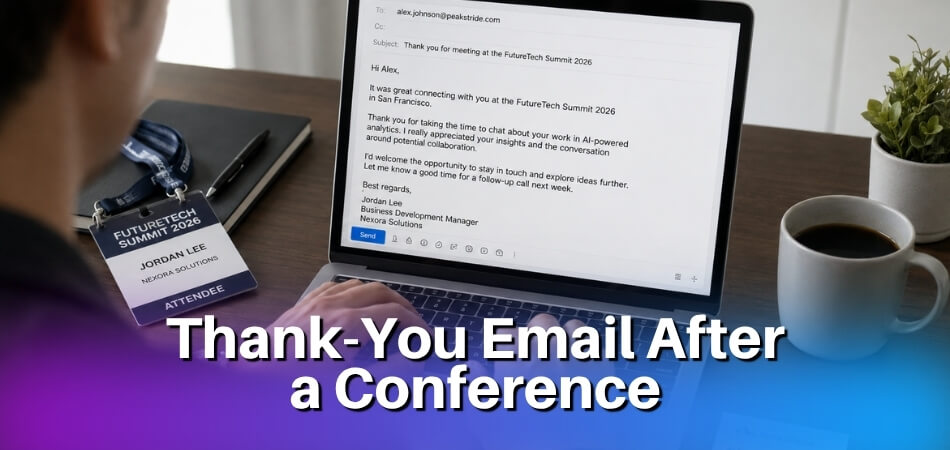
If you’re at a virtual conference, your follow-up ask often shifts to LinkedIn. Something like “I’ll send you a connection request with a note” lands better than asking someone to remember your name in a chat window.
Step 4 — Create Your 30-Second and 60-Second Versions
You need both. The context determines which one you use.
The 30-second pitch is built from Steps 1 and 2 only, plus a single light CTA at the end. It’s for introductions at the registration desk, passing conversations in hallways, or moments where you have someone’s attention for exactly as long as an escalator ride.
A 30-second pitch in writing looks roughly like this:
“I’m Dana — I work with mid-sized e-commerce brands that are losing revenue to cart abandonment. Most of my clients see a meaningful drop in abandonment rates within the first 90 days. Are you in the e-commerce space?”
That’s it. Around 45 words. Spoken at a natural pace, it takes about 25–30 seconds.
The 60-second pitch adds a little more — a specific example, a brief mention of a recent project, or a line that shows you understand the audience you’re talking to. This version is for structured networking breaks, roundtables, or any moment where you’ve been asked to properly introduce yourself.
A 60-second version of that same pitch might add: “Right now I’m working with a DTC brand that was doing everything right in their email flows but hadn’t addressed the checkout experience. We fixed three friction points in the first sprint and saw the results almost immediately. Happy to share what we found if it’s useful to you.”
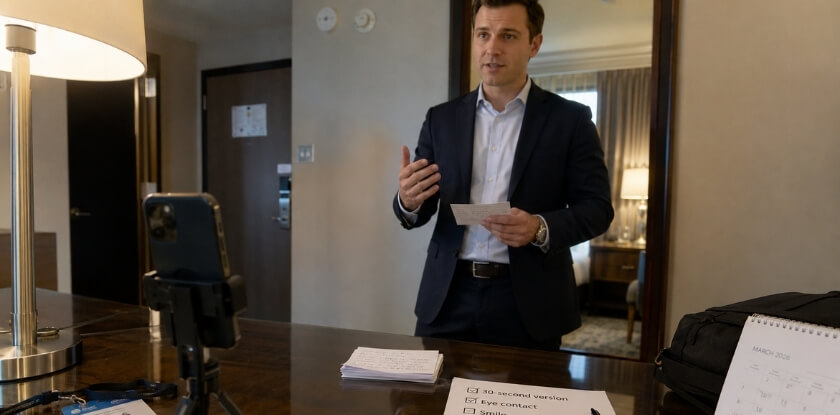
Do your pitch rehearsal out loud. Not in your head — out loud. Ideally in front of someone who will tell you where you started to sound scripted. Body language and vocal delivery matter even in a written script, because the words shape how you’ll move and sound when the moment actually arrives.
Time yourself. If your “30-second pitch” runs 55 seconds when you speak it, cut it down. There’s no shame in a shorter pitch. People remember concise introductions.
Industry-Specific Elevator Pitch Examples
The same four-element structure works across industries, but the language shifts a lot depending on your audience. A pitch that lands perfectly at a fintech summit will sound off at an HR conference. Here’s how to tune it.

Tech / Software
People at tech conferences hear a lot of pitches. They’re often skeptical, usually busy, and will tune out anything that sounds like a product demo disguised as a conversation.
Keep your pitch grounded in a specific problem. Don’t lead with your stack or your company’s funding round. Lead with what breaks without you.
Example:
“I’m a backend engineer at a mid-size SaaS company — we handle data pipelines for e-commerce clients. I spend most of my time making sure nothing falls apart when a client spikes to 10x their normal order volume. I’m here because I want to talk to people solving similar scaling problems. What does your infrastructure look like during peak load?”
Notice what’s not in there: no mention of which cloud provider, no job title inflation, no claim about being “passionate about innovation.” Just a real problem, a real context, and a question that opens the door.
Your conversation goal in tech networking isn’t to impress — it’s to find common ground fast. The attention grabber here is specificity. “10x their normal order volume” is more interesting than “high-traffic environments.”
For a 30-second pitch at a networking break, that example above works almost word for word. If you have a full 60-second pitch, you can add one concrete outcome: “We cut our incident response time by about 40% last year, and I’m still figuring out what we did right.”
Finance
Finance conferences — whether that’s asset management, corporate treasury, fintech, or lending — tend to attract people who are cautious with information. You’re not going to get much if you lead with “I work in finance.” That’s like showing up to a cooking class and saying you like food.
Your value proposition needs to be tight and credible without sounding like a compliance disclaimer.
Example:
“I’m a credit risk analyst at a regional bank. We focus on SME lending, which means I spend a lot of time on portfolio exposure when interest rates move unexpectedly. I came to this session specifically to hear how other analysts are stress-testing assumptions right now. Are you on the risk side, or more on the origination side?”
That last question matters. It signals that you know the difference — which immediately builds credibility. In finance, showing you understand the landscape of someone’s role is more valuable than any credential you could name-drop.
Your personal branding in finance networking isn’t flashy. It’s precise. Use the right vocabulary for the right sub-sector. Someone in private equity doesn’t want to hear language borrowed from retail banking, and vice versa.
At registration desk introductions or hallway conversations, finance professionals often respond better to questions than to statements. Your pitch can be shorter than you think — two sentences about yourself, one question back to them.
HR / Talent Acquisition
HR and talent acquisition conferences have a different energy. People are more openly collaborative. They share vendor horror stories, swap tools they actually use, and are generally more willing to help someone they just met.
That openness can actually work against you if your pitch is too vague. “I work in HR” tells someone nothing at a conference full of HR professionals.
Example:
“I lead talent acquisition for a manufacturing company — about 1,200 employees, high-turnover roles mostly on the production floor. My whole focus this year is reducing time-to-fill without just throwing money at job boards. I saw the session on internal mobility and thought there’d be people here dealing with the same thing. Are you mostly on the recruiting side, or do you also handle retention strategy?”
That pitch does three things well. It names the exact problem (time-to-fill, high-turnover roles). It shows intent (why you’re at this specific conference, at this specific session). And it asks a question that could genuinely branch the conversation in two directions depending on their answer.
For HR professionals who also manage LinkedIn recruiting, this kind of pitch often leads naturally into a follow-up conversation about sourcing strategy, employer branding, or even a business card exchange that actually gets followed up on — because you’ve given them a specific reason to remember you.
If you’re attending a virtual conference in this space, the same pitch works in a breakout room or a chat thread. Drop your name, your focus area, your problem, and your question. You don’t need the physical setting to make it land.
Pitch Practice and Rehearsal — How to Prepare Yourself
Most people write a decent pitch and then never actually say it out loud until they’re standing in front of someone at a conference. That’s where things fall apart. The words that read well on paper feel completely different when you’re speaking them under pressure, with noise in the background and someone staring at you.

Practice is the part nobody wants to do. Do it anyway.
Say It Out Loud — Not Just In Your Head
Reading your pitch silently doesn’t count. Your mouth needs to learn the words. There’s a real difference between knowing what you want to say and being able to say it fluently without thinking.
Start by reading your pitch out loud, alone, at normal conversational speed. Time it. A 30-second pitch should land somewhere between 60 and 80 words. A 60-second pitch sits around 120 to 150 words. If you’re rushing through 200 words in 30 seconds, cut it — don’t just talk faster.
Do this at least ten times. That sounds like a lot. It isn’t. Ten run-throughs takes about fifteen minutes, and after that it stops feeling like a script.
Record Yourself
Use your phone. Record a short video of yourself delivering the pitch standing up, not sitting at a desk.
Watch it back. Yes, it’s uncomfortable. Watch it anyway.
You’re looking for three things: filler words like “um” and “so,” whether you’re rushing through the important part, and whether you look engaged or like you’re reciting a grocery list. Most people are surprised by how flat their vocal delivery comes across on video. This is the point — fix it now, not mid-conversation at the registration desk.
Pay attention to body language too. Crossed arms, a tilted head, looking slightly off to the side — these small things undercut an otherwise solid self-introduction. You don’t need to be a TED speaker. You just need to look like you mean it.
Practice With a Real Person
At some point you have to get out of your own head and say the pitch to another human being. A friend, a colleague, a partner — it doesn’t matter who. Ask them to just listen and then tell you what they heard. Not whether it was good, but what they actually understood about what you do and why you’re at the conference.
If their summary back to you doesn’t match what you meant to communicate, your value proposition isn’t landing clearly. Adjust it.
If you can find someone who works in a different industry, even better. If they get it, a stranger at a networking break definitely will.
Prepare for the Messy Version Too
Conference conversations don’t start cleanly. Sometimes you get interrupted after ten seconds. Sometimes someone joins mid-pitch. Sometimes the fire alarm test goes off.
Practice stopping after your first two sentences and still having said something meaningful. The opening attention grabber and your core value statement should be able to stand alone if you get cut off. If those two things land, you’ve done enough to spark a follow-up conversation.
Also practice the transition out of the pitch — the part where you stop talking about yourself and ask them something. “What brings you to this one?” or “Are you here for a specific track?” takes you from a 30-second pitch into a real exchange. That handoff matters. Rehearse it as part of the pitch, not as an afterthought.
A Note for Introverts
If the idea of walking up to strangers and launching into a self-introduction makes you want to leave the building, you’re not alone.
The trick for introverts isn’t to fake extroversion. It’s to reduce the variables. Pick one or two moments in the day — say, right after a keynote or during a structured networking break — and commit to using your pitch just then. Two conversations done with intention beats twelve awkward half-attempts scattered through the day.
Some introverts find it helpful to rehearse with a specific scenario in mind: “I’m at the coffee station, someone asks what I do, here’s what I say.” Mental rehearsal tied to a concrete situation is more useful than abstract practice.
Also, you don’t have to initiate. Having your pitch ready means you can respond smoothly when someone asks about you — and that question always comes.
Virtual Conference Prep Is Different
At an online conference, you lose most of the natural cues. There’s no coffee line, no badge you can glance at, no room energy. The technical setup becomes part of your delivery.
Test your audio. Bad sound quality at a virtual conference is the equivalent of mumbling in person — people check out fast. Use a decent microphone if you have one, sit with light in front of you rather than behind you, and look at the camera, not the screen. Looking at the camera reads as eye contact. Looking at the participant grid reads as distraction.
Keep your pitch slightly shorter for virtual contexts. 25 to 40 seconds works better than 60 when you’re in a video chat. Brevity plays well when you’re one small box among many.
Some virtual conferences have structured networking rooms or breakout sessions — use those. They’re the closest equivalent to a networking break and they’re where your pitch will actually land. Drop a clean version of your professional branding into the chat when it’s appropriate, and follow up on LinkedIn the same day while the conversation is still fresh. Business card exchanges don’t happen online, so that LinkedIn connection is the follow-up conversation anchor.
The Goal of Rehearsal
You’re not practicing to be perfect. You’re practicing so that the pitch doesn’t take conscious effort anymore. Once it’s automatic, you can focus on the actual person in front of you — reading their reaction, deciding whether this is a real connection worth pursuing, figuring out your call to action for the next thirty seconds.
That’s the whole point of pitch rehearsal. Free up your brain for the conversation, not the words.
Body Language and Delivery — More Important Than What You Say
You can have a perfectly written pitch and still kill the conversation in the first ten seconds. How you show up physically — your posture, your eye contact, your pace — signals far more than your actual words. People decide whether they want to keep talking to you almost instantly, and that decision is mostly nonverbal.
The Basics That People Still Get Wrong
Stand tall but not stiff. Feet roughly shoulder-width apart. Arms at your sides or gesturing naturally — not crossed, not stuffed in your pockets. This isn’t about performing confidence; it’s about not accidentally signaling that you’d rather be somewhere else.
Eye contact matters more at a conference than in most other settings. You’re a stranger. Holding someone’s gaze for 3–4 seconds at a time tells them you’re present and interested. Breaking it every half-second suggests nervousness or disinterest, and either one makes the other person check out.
Smiling sounds obvious. It isn’t. A lot of people walk into a networking break with a face that says “I’m enduring this,” and then wonder why conversations don’t go anywhere.
Vocal Delivery — Pace, Tone, and the Pause
Slow down. Most people, when nervous, speed up. They fire through their self-introduction like they’re trying to get it over with. The person listening can’t keep up, doesn’t catch the key point, and nods politely while mentally moving on.
Aim for a conversational pace — roughly the speed you’d use explaining something to a friend over coffee. If you’ve rehearsed your 30-second pitch, you already know what it sounds like at the right pace. Trust that.
Vary your tone. A flat, monotone delivery turns even a strong value proposition into background noise. Emphasize the one phrase that matters most — your specific outcome, your unusual angle, whatever distinguishes you. Let that phrase land.
The pause is underrated. After your attention grabber or your core statement, pause for one full second before continuing. It feels long to you. To the listener, it’s what signals: this part mattered. It also gives them a moment to actually absorb what you said.
Introverts: Specific Tactics, Not Generic Advice
If you’re an introvert, the energy drain of conference networking is real. Working a room isn’t the goal — you don’t need to deliver your pitch to forty people. Three good conversations beat thirty shallow ones.
A few things that actually help:
- Position yourself near natural choke points. The registration desk, coffee station, or badge pickup area. People pause there. You don’t have to initiate from across the room — you can start with a simple observation about the space or the schedule and let it develop.
- Give yourself a specific exit point. Knowing you only have to network for 45 minutes before you can decompress makes each conversation easier to enter. You’re not committing to two hours of sustained performance.
- Write down your opening line in advance. Not your whole pitch — just the first sentence. For introverts, the blank-page moment of “what do I even say first?” is often what causes freezing. Remove that obstacle before you walk in.
Your quieter energy can actually work in your favor. You tend to listen better, ask better follow-up questions, and leave people feeling genuinely heard rather than processed. That’s a real advantage in professional networking — most people at a conference are so busy broadcasting their own pitch that they forget to actually connect.
Virtual Conference Delivery
The online conference environment changes almost everything about physical delivery, and most people don’t adjust.
Camera position first. If your webcam is below eye level, you’re looking down at everyone — which reads as disinterested or distracted. Raise your laptop on a stack of books or use an external camera at eye level. Simple fix, significant difference.
Look at the camera, not the screen. Your natural instinct during a video call is to look at the other person’s face on screen. But that means you’re actually looking slightly down and off-center. For the moments when you’re delivering your pitch, shift your gaze to the camera dot. It creates the illusion of direct eye contact on their end.
Your background is part of your personal branding whether you intend it or not. A cluttered, dim background undercuts a sharp pitch. A neutral, well-lit setup reinforces it. Natural light facing you is ideal.
In breakout rooms and virtual networking sessions, pace yourself even more deliberately than in person. Audio lag, accidental interruptions, and the awkwardness of talking over someone all make a slower delivery more effective. Keep your 60-second pitch closer to 45 seconds in virtual settings — less buffering room needed.
Follow-up in a virtual conference context happens fast. Have your LinkedIn profile or a short link ready to drop into the chat the moment a conversation clicks. Waiting until after the session to find someone often means the moment’s gone. A direct message during the session — “great talking with you, connecting now” — is the virtual equivalent of handing over a business card while you’re still standing together.
The One Delivery Mistake That Kills the Conversation Goal
Finishing your pitch and then going quiet, waiting to be assessed. It creates an awkward pause that shifts the entire dynamic. You’ve just delivered your self-introduction — now the other person feels like they’re supposed to grade it.
End with a question or a light observation that hands them the conversation. Something connected to what you just said: “What about you — are you here focused on the product side or more the strategy track?” It removes the performance dynamic and turns your pitch into the opening of an exchange, which is the whole point.
A call to action doesn’t have to be formal. It just has to give the other person somewhere to go.
Conference Introduction Tips for Introverts — Special Strategies
Networking events are genuinely exhausting if you’re an introvert. That’s not a weakness — it’s just how your brain works. The good news is that conference networking actually suits introverts better than most social situations, because there’s a built-in structure. Everyone expects to be introduced to strangers. The context does half the work for you.

Still, walking up to someone cold and delivering your self-introduction feels awful for a lot of people. Here’s how to make it less awful.
Reframe the Goal
Most introverts dread the pitch because they think the goal is to impress people. It isn’t. Your conversation goal is simply to find out whether this person is worth talking to more — and let them figure out the same about you. That’s it. Nobody owes anybody a follow-up conversation after a 45-second exchange at the registration desk.
When you stop trying to “nail” the interaction and just treat it as a quick filter, the pressure drops significantly.
Use the Environment to Start — Not Your Pitch
You don’t have to open with your elevator pitch. Seriously. Ask about the session, comment on the agenda, complain mildly about the coffee. Once a small conversation starts, the self-introduction slots in naturally rather than landing like a sales call.
Something as simple as “First time at this one?” buys you 20 seconds of small talk before your pitch ever comes out. By then you’re already talking — which is the hard part done.
Prepare Exactly Two or Three Openers
Don’t improvise the opener if that makes you anxious. Write down two context-specific lines before the event. Not scripts — just starting points. For a tech industry conference it might be “Are you more on the dev side or the product side?” For an HR and talent acquisition event, something like “Did you catch the morning panel on retention?” works fine.
Having these in your back pocket means you never have to manufacture a reason to approach someone.
Work the Edges, Not the Middle
Introverts burn out standing in the middle of a crowded networking break. The edges of the room — near the food table, the coffee station, the door — are where people stop moving. Those moments of physical pause are natural conversation windows. You don’t have to interrupt anyone. You just stand nearby and exist until an opening shows up.
One-on-one or two-person groups are also far easier than joining a cluster of five people mid-laugh. Target the person standing alone first. They’re usually grateful you approached.
Give Yourself Permission to Exit Early
You don’t need to stay for the full networking break. Decide in advance: you’ll have three conversations, then you’re done. Having a fixed number means you’re working toward a finish line, not endlessly grinding. After three solid 30-second pitch exchanges, you can recharge and come back for three more later.
Quality over volume. One good exchange that leads to a real follow-up conversation beats ten forgettable handshakes.
Use LinkedIn as Your Safety Net
If face-to-face conversation still feels like too much pressure, tell yourself this: your job isn’t to close anything in person. Your job is to make the interaction memorable enough that when you connect on LinkedIn tonight, they’ll remember who you are.
That reframe changes the whole thing. You’re not trying to build a relationship in 60 seconds. You’re planting a recognition flag so the real conversation can happen later, in writing, where many introverts are actually at their best.
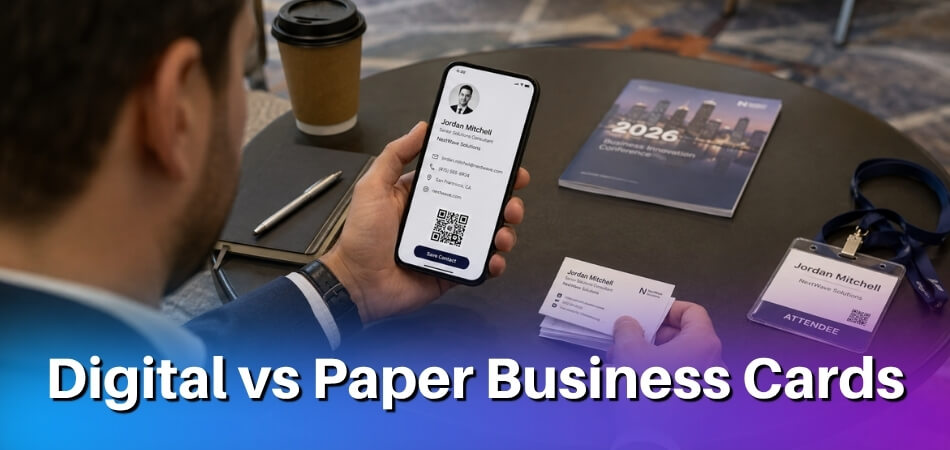
Keep a business card or your LinkedIn QR code ready so you can close the loop fast and get out cleanly.
Virtual Conference Tips for Introverts
Online conferences are genuinely more manageable for a lot of introverts — and not just because you’re at home. In a virtual conference setting, there’s usually a text chat running alongside video sessions. That’s a low-stakes way to introduce yourself. Drop a relevant comment in the session chat, reply to someone else’s point, and you’ve already made a connection before your camera or microphone is involved.
When virtual networking rooms or breakout sessions open up, join one with two or three people rather than the big main room. Smaller groups mean you actually get to talk, and your pitch lands instead of getting lost in crosstalk.
Your personal branding also carries more weight online. Your display name, your brief bio on the platform, your LinkedIn profile — these are visible before you say a single word. Make sure your headline does some of the self-introduction work for you so your verbal pitch just confirms what people already half-know.
One Thing to Do Right Now
If you’re preparing for an upcoming conference and the networking side worries you, do this: write your 30-second pitch down, say it out loud three times alone, then record yourself once on your phone. You don’t need a formal pitch rehearsal session. You just need to hear it come out of your mouth before a stranger does.
That’s usually enough to take the edge off.
How to Introduce Yourself at Virtual and Online Conferences
Virtual conferences changed the rules. Not completely — your core elevator pitch still needs a clear value proposition and a conversation goal — but the context is different enough that winging it the same way you would in a hotel ballroom will get you nowhere fast.
Here’s what actually changes online, and how to adjust.
The Biggest Difference: You Have Even Less Time
At an in-person conference, you can catch someone during a networking break, walk alongside them, let the conversation warm up naturally. Online, you’re dropping a message into a chat sidebar or unmuting yourself in a breakout room for 45 seconds before the moderator moves on. There’s no ambient social pressure keeping the other person in the room. They can — and will — simply close the tab.
Your 30-second pitch matters more here, not less.
Cut every filler phrase. “I’ve been in the industry for a while” is useless. “I run growth for a 12-person SaaS company focused on B2B retention” is not. Get to the point in your first sentence.
Chat-Based Introductions: Write It Like a Message, Not a Speech
A lot of virtual conference networking happens in Slack channels, event apps, or session chat boxes. You’re typing your self-introduction, not saying it. That changes the format.
Keep it to 3–4 lines maximum. Lead with who you are and what you actually do. Add one specific reason you’re at this event — not “to network,” but something real, like “I’m trying to understand how mid-market companies are handling compliance after last year’s SEC changes.” Close with a low-friction call to action: “Happy to connect here or on LinkedIn if you’re working on something similar.”
Don’t paste your full 60-second pitch into a chat box. It looks like a press release. Nobody reads it.
Breakout Rooms: Your Best Shot
Most virtual conferences run breakout rooms for small-group discussion. This is where real professional networking happens online. Five to eight people, a loose prompt, and usually a few minutes of open conversation before the facilitator kicks things off.
When someone asks “do you want to go around and introduce yourselves,” don’t panic and don’t over-prepare. Use the same structure you’d use in person: name, role, one specific thing you’re working on or thinking about, and a genuine question or hook that invites a response.
“I’m Priya — I lead talent acquisition at a fintech startup in Austin. We just hit 200 employees and I’m genuinely struggling with how to keep culture intact through that growth. Curious if anyone else is navigating that.”
That’s it. That’s a good HR and talent acquisition pitch for a virtual room. It’s honest, specific, and it ends with an opening for someone else to jump in.
Camera, Audio, and Background — They’re Part of Your Delivery
You spent time thinking about body language and vocal delivery for in-person events. The virtual equivalent is your setup.
Bad audio kills credibility faster than anything you say. A $30 USB microphone is a better investment for your personal branding than a new headshot. If people are straining to hear you or cutting through static, they’ve already mentally checked out.
Camera at eye level, not pointing up at your ceiling. Natural light in front of you, not behind. These aren’t aesthetic preferences — they’re attention grabbers. A dark, pixelated video makes you look unprepared even if your pitch is sharp.
Your background should be neutral or genuinely personal. A bookshelf works. A virtual background with your company logo is fine if it renders cleanly. A blurry, glitching green screen is worse than just sitting in your actual room.
Async Networking: The Feature Most People Ignore
Some online conferences — especially the larger ones — have async networking built in. You record a short video introduction, it goes into a directory, and attendees can reach out. This is an underused tool.
Treat it like a 30-second pitch on camera. State your name, what you do, one specific thing you want to talk about at this event, and how people should reach you (LinkedIn is usually the right answer). Keep it under 45 seconds. Smile. Don’t read from a script — you’ll look stiff.
If the platform lets you add a text bio, don’t just copy your LinkedIn headline. Write two sentences that tell someone why they’d want to talk to you at this particular event.
Following Up After Virtual Sessions
The follow-up conversation is where virtual networking either converts or disappears. Unlike in-person events where you exchange a business card and the social awkwardness of not reaching out is real, online it’s frictionless to do nothing. Most people do nothing.
Send connection requests on LinkedIn within 24 hours. Reference something specific — the session you were both in, the comment they made in chat, the question they asked the speaker. One sentence of context is enough. “Saw your question about retention benchmarks in the SaaStr session — I’m working through the same thing, would be good to compare notes.”
That’s not a pitch anymore. That’s a conversation starting. Which is what the pitch was always for.
After the Pitch: How to Start a Follow-Up Conversation
Your elevator pitch isn’t the destination. It’s the door. What happens in the 30 seconds after you finish talking determines whether this becomes a real professional connection or just two people awkwardly looking for an exit.

The most common mistake? Stopping cold after your pitch and waiting. Don’t do that. End with a question — and make it a genuinely curious one, not a formality.
End Your Pitch With a Question, Not a Period
A strong call to action at a conference isn’t “here’s my business card.” It’s a question that opens a thread for the other person to pull on.
Something like:
- “Are you here for the afternoon sessions on [specific topic], or more the networking side of things?”
- “What’s bringing you to this particular conference this year?”
- “I’ve been curious how other companies in [their sector] are handling [relevant challenge] — is that something you’re dealing with too?”
Short. Specific. Actually about them. That’s the whole formula.
The question does two things simultaneously: it takes pressure off you, and it gives the other person a reason to keep talking. People like being asked about their work. Let them.
Read the Signal Before You Push Deeper
Not every networking break conversation is going to catch fire. That’s fine. What you’re looking for is a signal — do they answer the question briefly and look away, or do they actually lean in and expand?
If they lean in, you’ve got a real conversation. Go deeper. Ask about the specific thing they mentioned. Connect it back to what you do. This is where personal branding stops being a concept and becomes something real — you’re showing genuine curiosity, and that’s memorable.
If they give a short answer and their eyes drift toward the coffee table, wrap it up gracefully. “I’ll let you grab a coffee — I’d love to connect later though. Are you on LinkedIn?” Clean. No awkwardness.
Bridge From Small Talk to Substance
The conference introduction got you in the room. Now the goal is to find the one or two things you actually have in common professionally.
Don’t force it. Just follow the thread. If they mention they’re struggling to find qualified candidates in their sector, and you work in HR and talent acquisition, that’s your bridge. “We ran into the exact same problem two years ago — what’s worked for us is…” That’s a conversation goal being met naturally.
The more specific you are, the more credible you sound. Generic observations (“yeah, the market’s tough”) don’t build connection. Specific ones do.
The Business Card and LinkedIn Moment
Timing matters here. Handing over a business card at the start of a conversation feels like a sales tactic. Doing it at the end, after you’ve actually talked, feels like a genuine exchange.
Same goes for LinkedIn. When you mention it, say something that makes the follow-up feel worthwhile: “I’ll send you that article I mentioned — remind me your LinkedIn handle?” Now there’s a reason to connect beyond just collecting contacts.
If you’re at a virtual conference, the mechanics are different but the principle holds. Drop your LinkedIn in the chat after you’ve had a real exchange in a breakout room — not before.
Don’t Over-Stay the Conversation
Conferences are built around movement. Sessions start, registration desk lines form, other people circulate. A 5-7 minute conversation that ends well beats a 20-minute one that outstays its welcome.
When it feels like a natural pause, close it intentionally. “This has been really useful — I hope we get a chance to continue this after the next session” is a confident exit. It also plants a seed for the follow-up conversation you actually want to have.
The pitch got you noticed. The question kept them talking. The specific exchange built the connection. That’s the whole sequence — and it works whether you’re naturally outgoing or you spent the first two hours of the conference hiding near the water station rehearsing your 30-second pitch in your head.
Common Mistakes That Kill an Elevator Pitch
Most elevator pitches don’t fail because the person is nervous or unprepared. They fail because of a handful of specific, repeatable errors. Here’s what to watch for.
Talking About Yourself Instead of Opening a Conversation
This is the big one. Your self-introduction isn’t a monologue — it’s an opening move. If your entire 30-second pitch is about you, your role, and your company, the other person has nowhere to go. They nod, smile, and start scanning the room for an exit.
Build your pitch toward a question or a shared problem. Give them something to respond to. That’s what turns a pitch into an actual conversation.
Cramming in Too Much
You’ve got 60 seconds, not a keynote slot. Yet somehow people try to fit in their full job title, three past employers, their current project scope, their company’s mission statement, and a future roadmap.
Pick one thing you want them to remember. One. The rest can come out naturally if the conversation continues.
Leading With Your Job Title
“Hi, I’m a Senior Product Manager at [Company].” Cool. So are 400 other people at this conference.
Your job title tells someone where you sit on an org chart. It doesn’t tell them why talking to you is worth their time. Lead with what you actually do — the problem you solve, the work you’re focused on — and the title can follow.
The Pitch That Sounds Rehearsed to Death
Pitch rehearsal is essential. But over-rehearsed pitches have a very specific dead quality to them. Every pause is in the same place. Every phrase comes out with the same inflection. It sounds like a voicemail recording.
People can tell. And it makes them trust you less, not more.
Practice until you’re comfortable, not until you’re scripted. You want to sound like you’re telling someone something, not reciting something.
No Clear Conversation Goal
Some pitches end and leave the other person genuinely unsure what you wanted from the exchange. Were you looking for a potential client? A collaborator? Just making a contact?
You don’t need a hard call to action in a casual networking break chat. But your pitch should have a quiet direction — a reason you’re talking to this particular person at this particular event. If you don’t know what you’re hoping to get out of the conversation, neither will they.
Ignoring the Context
A 60-second pitch you deliver at the registration desk is different from one you give during a structured speed-networking session. It’s different again from how you’d introduce yourself in a small breakout room of six people.
Rigid pitches fail context. The words that work at a large tech industry pitch event fall flat in an intimate HR and talent acquisition roundtable. Read the room before you open your mouth.
Forgetting the Other Person Entirely
This one’s subtle. You deliver your pitch, it goes well, and then… you keep talking. About yourself. More details, more context, more examples.
Stop. Ask something. The whole point of conference networking is to start a two-way exchange, not to extend your personal branding presentation indefinitely. As soon as you’ve landed your value proposition, turn it around. Show some genuine curiosity about what they’re working on.
Weak or No Follow-Through
You had a great 45-second pitch, the conversation went well, and then one of you got pulled away. No LinkedIn connection requested. No business card exchanged. No concrete next step.
That pitch just evaporated. The follow-up conversation is where the value actually gets created — but it only happens if you make a move before you part ways. Even a quick “Can I find you on LinkedIn?” takes five seconds and keeps the door open.
Trying to Be Too Clever
Attention grabbers are useful. A sharp opening line can do real work. But pitches built around a gimmick, a forced metaphor, or a joke that doesn’t quite land come across as trying too hard.
Especially at conferences where people hear dozens of introductions in a single day. Genuine and clear beats clever and confusing every single time.
FAQ
How long should a conference elevator pitch actually be?
Thirty to sixty seconds is the standard range. At a busy networking break, aim for 30 seconds — people are moving fast and you want to open a conversation, not deliver a monologue. If someone’s clearly engaged and has stopped walking, you can stretch to 60 seconds. Anything longer and you’re giving a speech nobody asked for.
What’s the single biggest mistake people make with their self-introduction?
Leading with their job title and company name, then stopping. “I’m a project manager at Acme Corp” tells the other person almost nothing useful. They don’t know if you’re relevant to them, and they have no reason to ask a follow-up question. Start with what you do or the problem you solve — the title can come second.
Do I really need a different pitch for different conferences?
Yes. The core stays the same, but your attention grabber and value proposition should shift based on who’s in the room. A pitch that lands well at a tech industry conference will sound off at an HR and talent acquisition summit. Spend five minutes before each event tweaking your opening line to match the audience.
What if someone asks what I do and I genuinely have a complicated answer?
Pick one thread. Most people with complex roles try to cover everything and end up explaining nothing. Choose the part of your work most likely to be relevant to people at that specific event, and lead with that. You can always add context later in the follow-up conversation.
Is it awkward to hand over a business card during a 30-second pitch?
Usually, yes. Cards work best as a close, not an opener. Finish your pitch, make sure there’s actual mutual interest, then offer the card — or suggest connecting on LinkedIn right there. Shoving a card into someone’s hand ten seconds in feels transactional and cuts the natural conversation flow short.
Can introverts actually get good at this?
Absolutely. The advantage introverts often have is preparation — they tend to rehearse more carefully and think before they speak. The challenge is usually the first three seconds of initiating contact, not the pitch itself. Having a scripted opening line ready removes most of that friction. The pitch rehearsal work pays off more for introverts than for anyone else.
How do I handle a virtual conference where there’s no natural stopping point in a conversation?
Structure matters more online. In a virtual conference breakout room or speed networking session, you don’t have the physical cue of someone walking away. Be explicit with your call to action: “I’d love to keep this conversation going — want to set up a quick call this week?” That closes the interaction cleanly and moves things forward rather than letting the conversation fade.
What if my elevator pitch gets zero reaction?
Don’t panic. Sometimes the chemistry isn’t there, or the person is distracted. The pitch didn’t necessarily fail. Move on, have two or three more conversations, and look for patterns. If you’re consistently getting flat reactions, the issue is usually either the opening line or the delivery — not the whole pitch. Record yourself once and watch it back. You’ll spot the problem quickly.
Should my pitch include a question at the end?
It helps, especially if your goal is genuine conference networking rather than broadcasting information. A short, open question — “What’s bringing you to this one?” or “Is that a challenge you’re seeing too?” — hands the conversation back to them. That’s usually what turns a 30-second pitch into a real exchange.
How often should I update my elevator pitch?
Any time your role changes, your focus shifts, or you’re heading into a new industry event. A pitch built around a project you finished eight months ago will feel stale — and you’ll feel it when you’re delivering it. Keep the structure, swap the specifics.
Final Thoughts: Is Your 30 Seconds Ready?
You’ve done the work. You know what goes into the pitch, you’ve seen how it looks across different industries, and you understand why delivery matters just as much as the words themselves.
Now the real question is simple: if someone walks up to you at a registration desk tomorrow morning and says “So, what do you do?” — are you ready?
Most people aren’t. Not because they don’t know their field, but because they’ve never actually said it out loud to a stranger under mild social pressure. That gap between knowing and doing is exactly where conference networking breaks down.
Here’s the honest reality. Your first few pitches at any conference will feel awkward. That’s normal. Even people who do this regularly have an off delivery in the first hour before they’ve warmed up. The goal isn’t to be perfect. It’s to be clear, genuine, and curious enough about the other person that the conversation has somewhere to go.
A few things worth keeping in mind as you head into your next event:
Your pitch will shift throughout the day. A 30-second pitch works fine during a busy networking break when people are moving fast. A 60-second pitch fits better in a roundtable setting or when someone’s genuinely leaning in. Read the room and trim or expand accordingly.
The conversation goal matters more than the pitch itself. Think of your self-introduction as the door, not the destination. Once it’s open, your job is to ask a good question and actually listen to the answer. That’s what turns a 30-second pitch into a 30-minute conversation.
Write your pitch down. Not to memorize it word-for-word, but to see whether your value proposition actually makes sense on paper. If you can’t write it clearly, you probably can’t say it clearly either.
Update it before each event. A pitch that worked six months ago might not reflect where you are now. New role, new project, new thing you’re trying to figure out — these make the best conversation starters.
One more thing about personal branding: your pitch is often the first data point someone has about you. It influences whether they connect with you on LinkedIn later, whether they introduce you to someone else at the same conference, and whether they remember you at all. That’s not pressure — it’s just useful context for why 30 seconds is worth taking seriously.
Keep a business card or a quick LinkedIn QR code ready, but don’t lead with it. Let the exchange happen first. The follow-up conversation is far easier when there’s already something real to reference.
You don’t need a flawless pitch. You need a ready one. Go practice it on a real person before the conference — not in the mirror, not in your head. Out loud, to someone who’ll actually respond. That single step will do more than any amount of reading about it.
Your 30 seconds can open real doors. Make sure they’re ready to open.