
Registration, flights, a hotel and a week away from your research add up quickly. Before you spend that money, it helps to know what a conference can realistically do for a career, and where it falls short.
Quick answer: The main career benefits of attending an academic conference are a stronger CV, a professional network you build yourself, feedback on your work before journal submission, possible collaborations, and practice for job talks. None of this is automatic. The gains come when you present, choose a credible event, and follow up with the people you meet within 48 hours of the event ending.
Does Attending an Academic Conference Actually Help Your Career?
Yes, but with conditions. A conference is a tool, not a career move by itself, and what you get depends on what you do before, during and after the event. Treated as a one-off trip, a conference gives little back. Planned as a professional development step, it can give a lot.
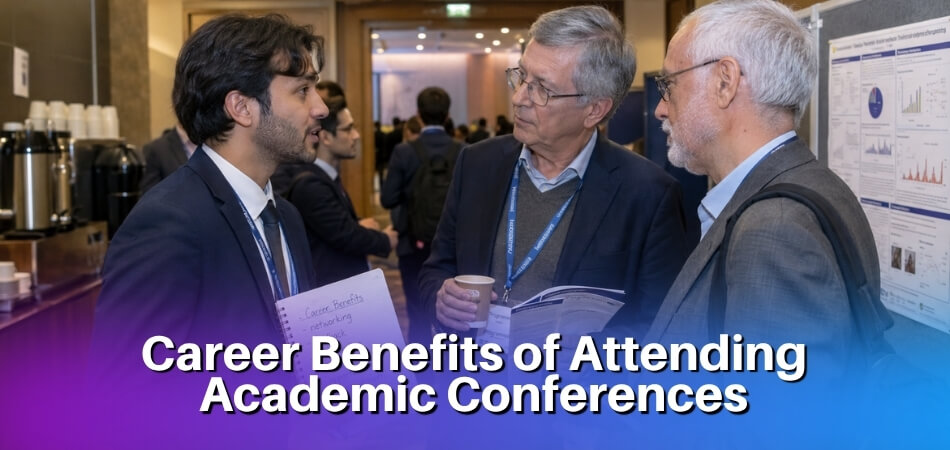
The networking benefit is real, but quieter than people expect
Everyone says conferences are about networking. The version most people imagine, where you walk up to a famous professor and land a collaboration, rarely happens. What does happen is smaller and more useful. You meet a few people doing work close to yours. One may become a co-author later. Another may mention a job opening before it is posted publicly.
Academic hiring partly depends on who knows your work. A conference talk can put your name and research in front of people who sit on search committees and review panels.
What a conference paper does for your CV
A peer-reviewed conference paper shows that your work passed outside scrutiny. If the proceedings are listed in a database such as Scopus, the paper is easier to find and cite. Non-indexed conferences still have value early on, but a long list of them will not replace journal papers on a serious academic CV once you are a few years in.
The best feedback often comes after the talk
Questions from the audience tend to be polite. The more candid feedback happens at lunch or in the hallway, when people tell you what was unclear, what your argument is missing and which related work you have not cited. That can reshape a paper before it reaches a journal. It is also why presenting unfinished work is worth it: you are stress-testing ideas in front of people who care about the topic.
Not every conference is worth attending
Predatory conferences accept almost everything, charge fees and offer little real review. They waste money and can raise questions about your judgment if they appear on your CV. Some institutions also refuse travel funding for events without genuine peer review. The checks for spotting them are in the indexing section below.
So does it move your career?
It can, when you pick an event with legitimate peer review, use the talk to collect feedback, follow up with the people you meet, and treat conference papers as a step toward journal papers rather than a substitute. The conference does not do the work. You do.
Key Career Benefits of Attending Academic Conferences
There are five benefits worth planning around: a network of your own, a clearer CV, feedback, collaboration and a stronger case in the job market. They are summarised below, with the limit that comes with each.
| Benefit | What it looks like in practice | Honest limit |
|---|---|---|
| Network | Colleagues you meet again at later events | Needs follow-up; cards alone do nothing |
| CV line | A dated, specific presentation entry | Weak if the event has no real review |
| Feedback | Reviewer comments, Q&A, hallway critique | Only useful if you write it down and act on it |
| Collaboration | A joint paper, grant bid or visiting arrangement | Happens more often at small, focused events |
| Job market | Visibility, job-talk practice, career panels and informal leads | Does not replace a publication record |
Building networking and professional relationships
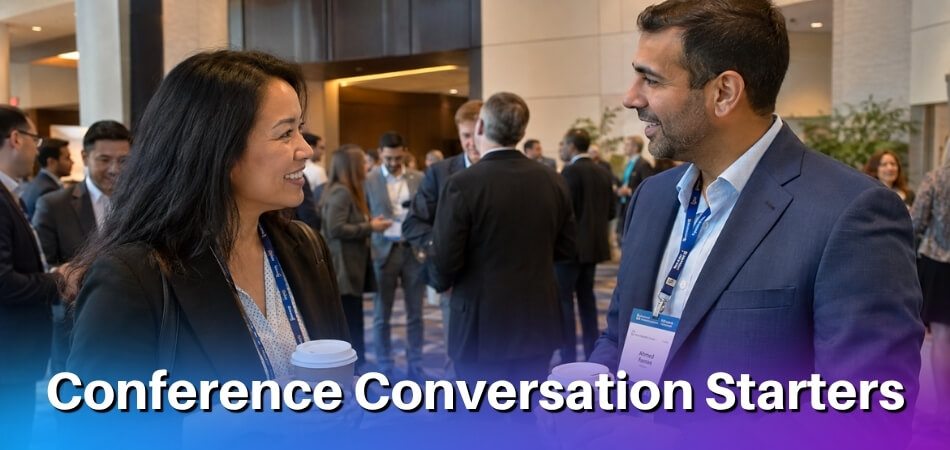
Career-moving conversations often start outside formal sessions. They can start at the coffee break, at dinner after the keynote, or in the hallway when someone says, “That is interesting, we are working on something similar.”
Networking is not about handing out business cards. You meet someone at one event, follow up by email, see them again two years later, and you have a real colleague. For graduate students this matters a great deal. Your supervisor knows people, but the network you build yourself is what carries you into the next career stage. A conference puts you in the same room as researchers you have only read in papers.
Strengthening your CV and academic profile
A conference presentation tells a reader three things: your work passed at least some review, you are active in your field, and you can present in public. Be specific about what you list. Give the conference name, the year, whether it was a peer-reviewed paper, an abstract or a poster, and whether the proceedings are indexed. An entry like “Conference Presentation, 2022” tells a hiring committee almost nothing.
An abstract at a small workshop carries less weight than a paper in indexed proceedings, but it still shows engagement. Choosing events with a real program committee and a clear affiliation is covered in the predatory conference checks below.
Getting peer feedback and improving your research
This benefit is easy to underestimate until you have used it. Reviewer comments on a submitted abstract or paper are peer feedback before full publication. The audience questions after your talk often point straight at weak spots in your argument or method. That is not always comfortable, but it is useful.
Treat the Q&A as a free consultation from people who have just watched you explain your work. Write the questions down and follow up on the ones that challenged you. Poster sessions work the same way, and the conversations there are often less formal and more candid than post-talk questions.
Opening doors to collaboration and new research opportunities
Some academic collaboration starts at conferences. You hear a talk that overlaps with yours, introduce yourself, and learn that the speaker has data you lack or a method that fits your project. Followed up properly, that conversation can become a co-authored paper, a joint grant application or a visiting researcher arrangement.
This is most likely at smaller, focused events. At a very large general conference you are one of thousands, while at a specialist workshop with a small group it is easy to talk to everyone. Postdocs looking for a next position can also signal availability there. Part of the academic job market is informal, and a good presentation can make your name familiar when a position opens.
The role of conferences in the academic job market
Conference activity is one signal a committee can read: it shows you are engaged with your field and can talk about your work in public. Some conferences also run career panels, job fairs or placement sessions, which help you explore postdoctoral, teaching or industry routes, and an informal chat there can lead to an invitation to apply. The skills you practise, such as presenting to mixed audiences and answering questions, carry over to careers outside academia too.
Presenting also prepares you for the job talk, one of the highest-pressure moments in academic hiring. The more times you have answered hard questions from specialists, the calmer you are on the day. One well-chosen conference in your core area is worth more to your profile than three marginal ones, so choose for quality rather than volume.
Conference Paper vs Journal Paper: Career Importance
A conference paper is quicker and more social. A journal paper is slower and usually carries more weight. This section covers only what matters for your career.
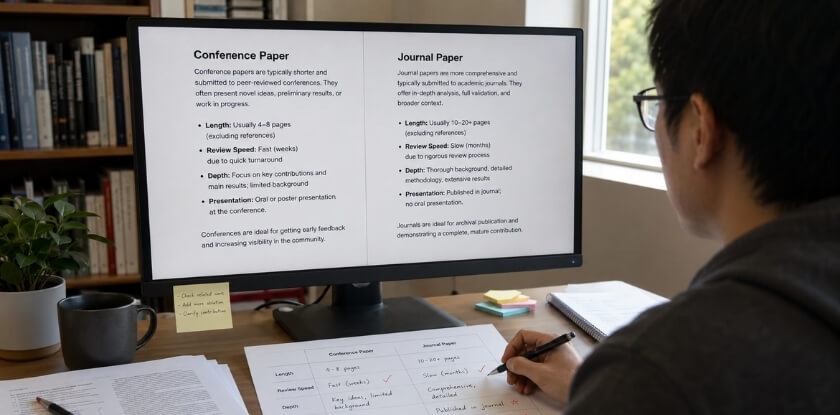
What each one is
A conference paper is a shorter output, submitted to a conference, reviewed to a degree that varies by event, presented in person or online and published in the proceedings. It has a faster turnaround and a lower barrier to entry. A journal paper is longer, goes through several rounds of peer review and can take many months to appear. The bar is higher, and so is the credibility.
Which one carries more weight?
It depends on your field. A 2012 Scientometrics study of computer vision researchers (Eckmann, Rocha and Wainer) notes that in computer science, papers in conference and workshop proceedings count as formal publications, unlike in many other disciplines. In many other fields, journal papers carry more weight and a conference paper is seen as preliminary work that is useful for feedback and visibility. Engineering practice varies by subfield, so check your own field’s norms and any criteria your hiring committee, funder or tenure guidelines set rather than assuming.
How conference papers feed journal papers
The most practical use of a conference paper is as a stepping stone. You present preliminary findings, collect feedback, spot gaps, and develop the work into a full journal paper. Some journals invite expanded versions of conference papers. Others expect you to disclose the earlier publication and show that the journal version adds substantial new content, so read the policy before submitting.
What to put on your CV
List conference papers and journal papers separately, or label each entry’s type clearly. Hiring committees read CVs carefully and notice blurred lines. For each conference paper, note whether it was peer-reviewed and whether the proceedings are indexed. “[Title], [Conference Series], [Year] (peer-reviewed, proceedings indexed in [Database])” reads very differently from “presented at International Conference on [Vague Topic].” If you have strong conference output but few journal papers, be ready to explain in interviews how that work is moving toward journal submission.
Conference Publications and Paper Indexing (Scopus, ResearchGate, and Others)
Indexing decides whether a conference paper can be found and cited later. A paper in proceedings covered by a database such as Scopus or Web of Science is discoverable and counts toward your record in a way a non-indexed paper does not. A non-indexed paper can effectively disappear after the event.
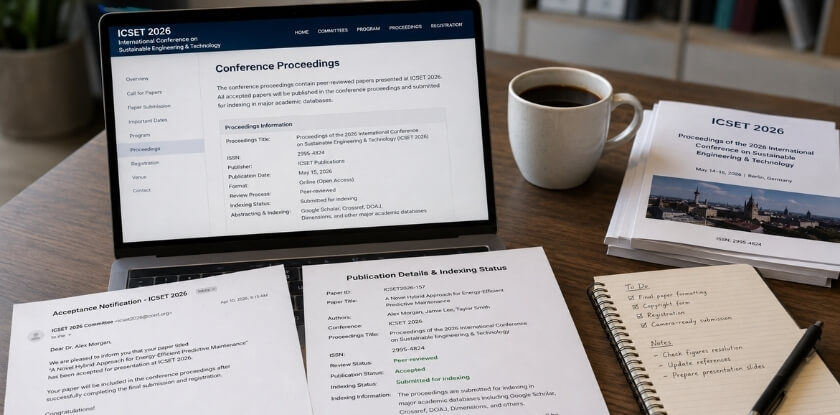
Why indexed conferences matter more
Reviewers may search a database rather than read a CV attachment. If your paper does not surface there, they may not find it. Conference papers usually move faster than journals, so they can give early-career researchers a citable output sooner.
ResearchGate is different. It is a research social network, not an indexing database. Uploading a paper there raises its visibility in fields where people use the platform, but it does not make the paper indexed.
Check indexing before you submit
| What to check | How |
|---|---|
| Is the proceedings series listed? | Search the Scopus source list or the Web of Science Master Journal List yourself; do not rely on the conference website’s claim. Elsevier’s Scopus content policy says conference series are reviewed on an ongoing basis, so a past listing is not a promise |
| Has any earlier volume been indexed? | “Proceedings will be submitted to Scopus” with no indexed past volume is a red flag, not a guarantee |
| Who publishes the proceedings? | Established publishers and societies are a good sign, though not proof of indexing |
| Do past programs list recognised researchers? | Look up earlier editions and see whether the speakers and committee include people you can verify in your field. Pick two or three listed names and check whether their own university or lab pages mention the event |
| What is the acceptance rate? | Accepting nearly every submission can signal weak peer review |
| Does the paper get a DOI? | Indexed proceedings usually do, which makes citing easier; proceedings without DOIs are harder to cite |
How to stay safe from predatory conferences
Predatory conferences are operations built to collect fees in exchange for the look of academic publication, with little or no peer review. They are often professional-looking, with fake editorial boards and promises of indexing. Some publish anything and vanish within a year, taking your paper with them. The warning signs are consistent:
- Unsolicited email that knows your name and research area, praises you, and sets a very short deadline. Odd enthusiastic wording or grammar errors can be a sign.
- Instant acceptance. Acceptance within a day or two of submission, with no reviewer comments. Real review takes time, and a decision within a day or two should make you cautious.
- No verifiable organiser. No physical address, no named committee with checkable affiliations, no history of earlier events.
- A program committee you cannot confirm. Names that do not exist when you search for them, or people whose expertise is far from the conference topic.
- Complaints online. Check the organiser or publisher against warning lists. Jeffrey Beall took his list down in January 2017, so any copy you find is frozen at an old date and may miss newer operators. Cabells publishes a subscription database called Predatory Reports; ask your library whether it has access.
- Invitation letters offered before registration. A conference that offers an official letter before you have registered or paid, with no review of your work, needs extra checking.
If you are unsure, ask your supervisor or a senior colleague in your area, or work through the Think. Check. Attend. checklist for judging a conference. A predatory paper does more than waste the fee: it can raise questions about your judgment on a CV, and withdrawing a paper from such proceedings is not always possible afterwards.
Are Conferences a Revenue Source for Organizers?
Yes, and that is normal. Conferences cost real money: venue, equipment, catering, printing, website and staff time. Legitimate organisers cover this through registration fees, sponsorship and exhibitor fees, and a well-run event might break even or make a small surplus for the next one. Fees alone are not a warning sign. What matters is whether the fee buys real review and a real event.
Virtual vs In-Person Conference: Which One Is Right for You?
It depends on your career stage, your goals and your budget. Neither format is better in every case, but they are not equal. Virtual events give more access per dollar, while in-person events give more networking per hour.
| Factor | Virtual | In person |
|---|---|---|
| Cost | Lower; no flights or hotel | Higher; travel and accommodation can cost more than the registration |
| Access | Across time zones, recordings, no visa | Needs travel and sometimes a visa |
| Networking | Harder; needs deliberate effort | Strong; unplanned contact is common |
| Feedback | Often typed comments | Back-and-forth conversation |
| CV value | Counts on paper if the event is legitimate; some committees still rate it lower | Signals commitment |
Advantages and limitations of virtual conferences
Virtual events lowered the barrier to presenting internationally. For graduate students and researchers with little travel funding they are often the only realistic option. Registration is often lower than in-person rates, and a researcher far away can present without a long flight or visa application. A presentation at a legitimate virtual event still goes on your CV, and the paper is treated like any other from that conference.
The limits are real. Networking is harder, because hallway conversations and dinners are hard to reproduce online. You can attend every session and leave with no new relationships. Attention also fragments when you attend from your desk with your inbox open, and some hiring committees still view a virtual talk as a lower-effort achievement. Weigh that if you are on the job market. To network online, join the chat or Slack space, message speakers after their sessions, use the attendee directory and take part in breakout rooms.
What in-person conferences offer that virtual cannot
Unstructured contact is the main thing. You meet the author you cited last month. You end up at lunch with someone running a lab you would like to join. Two people waiting for the same session start talking and a collaboration begins. For postdocs and early-career academics, a long coffee with an organiser putting together a special issue can matter more than the talk itself.
Feedback is also deeper in person. Someone can suggest a related dataset, sketch an idea on a napkin and keep the conversation going. Showing up also signals commitment, and people remember faces from shared rooms better than profile pictures from a webinar.
The downside is cost, and the answer is to pursue funding (next section) rather than skip the event. A sensible mix is one or two in-person conferences a year in your main field, chosen for the people who will be there, plus virtual events to fill gaps, test early work or stay visible in adjacent fields.
The Financial Side of Conferences: Costs, Funding, and Scholarships
Conferences are expensive, especially for students and early-career academics, but several funding sources exist. Plan by listing each cost, then check each funding source before ruling an event out.

What does it cost to attend a conference?
Prices vary enormously by event, city and career stage, so check the actual fee schedule instead of relying on averages. These are the cost lines to budget:
- Registration. Small regional events charge far less than large international ones. Many offer student or early-career rates, so check before assuming you cannot afford it.
- Travel. Often the biggest line. Venues are not always near low-cost airports.
- Accommodation. Conference-adjacent hotels cost more. Sharing a room or using a university guesthouse reduces it.
- Meals, ground transport and visa fees. These add up quietly. Visa processing can take weeks, so start early.
Presenting at a major in-person conference can leave you well out of pocket before any reimbursement. That is why finding funding is part of the process and not an optional extra.
Where to find funding and travel grants
Funding exists at several levels. The trick is knowing where to look and applying early.
| Source | What to know |
|---|---|
| Your institution | Departmental travel funds, graduate school grants or research office awards. Check internal deadlines early |
| The conference | Some offer travel grants or fee waivers for early-career researchers or those from lower-income countries, usually tied to acceptance. Check the “grants” or “awards” page, not only registration |
| Professional associations | Societies in your field often run travel awards for members attending affiliated events. Student membership is usually inexpensive |
| Research grants | Some research funders allow conference travel as a cost on an active award. If you work on a funded project, ask your principal investigator and your grants office what is allowed |
| Academic networks | ResearchGate and similar sites do not fund you, but colleagues there share calls for applications |
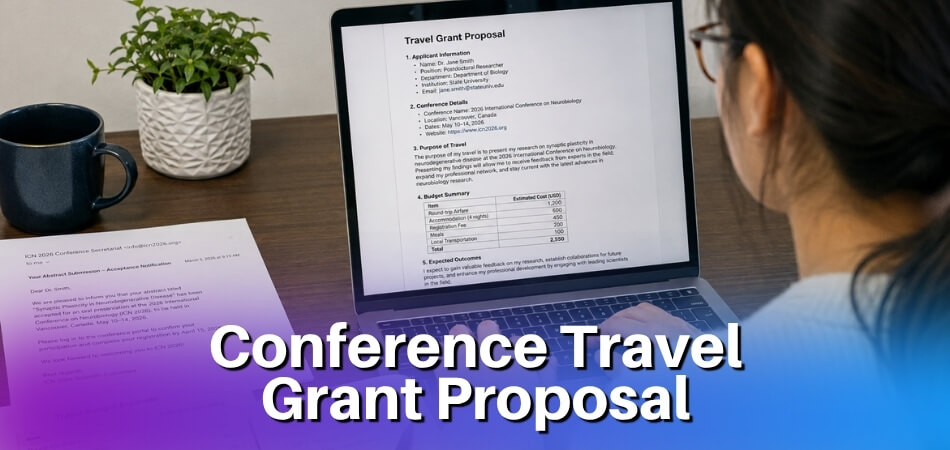
Eligibility differs by institution. Some funds support only students who are presenting a paper or poster, some cap how many awards one student can receive, and many run fixed funding rounds, so read your own institution’s rules and deadlines before you book. A few practical notes. Apply to several sources at once. Submit your abstract before applying, because many grants ask for proof of acceptance. Keep every receipt, boarding pass included, because reimbursement processes are bureaucratic. Virtual events can serve as a pragmatic stopgap while funding applications for a bigger in-person event are pending. If cost is the only barrier, email the organising committee to ask about fee waivers or reduced rates.
How to Prepare Before Attending a Conference
Most of the real work happens before you reach the venue or log into the session. Prepare in two parts: your presentation, and your networking plan.
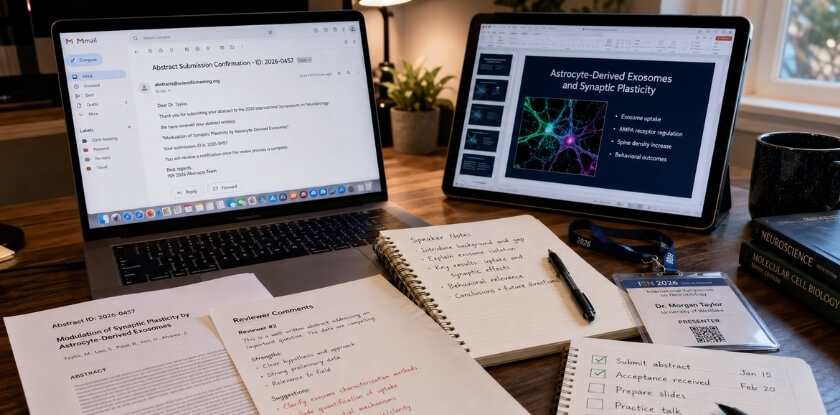
From abstract submission to presentation preparation
Start with a strong abstract. It is the first thing a program committee sees. Keep it focused on one contribution: the problem, what you did and what it means. Read the submission guidelines, because some events want structured abstracts and others free prose. Deadlines can fall many months before the event, so check the call for papers early. Submit early too, which leaves time to fix formatting.
After acceptance, build the talk for clarity rather than completeness. In a 15-minute slot with 5 minutes of questions, pick three things you want the audience to remember and structure everything around them. Practise out loud at least three times and time yourself, since chairs will cut off talks that run long.
For posters, your main finding should be readable from a short distance. Check the organiser’s poster size and format rules, use large headings and little text, add figures that carry the story, and treat the poster as a conversation starter rather than a document.
In the week before:
- Test your slide file on a different machine. Fonts can change and video embeds can break.
- Prepare a 2-minute version of your talk, because hallway conversations rarely give you longer.
- Print backup copies of slides, poster and abstract for an in-person event.
- Upload your paper to ResearchGate if it is allowed, so people who want to read it later can find it.
For a virtual event, test your microphone, camera, screen sharing and connection at least 48 hours ahead, keep the organiser’s contact and the platform link handy, and have a hotspot ready. Beyond logistics, think about the hard questions an expert would raise and prepare answers, because that is how peer feedback becomes something you can use.
Planning your networking strategy in advance
Networking works poorly if you arrive and hope. Download the program as soon as it is published and mark the talks you want, including adjacent areas where possible collaborators might work. From the speaker list, identify five to ten people you would like to meet and read a recent abstract or paper from each. You only need enough to hold an informed conversation.
Reach out before the conference. A short email a week before is not presumptuous, and the worst outcome is no reply.
Subject: Meeting at [Conference Name]
Dear Dr [Surname],
I will be at [Conference Name] next week and enjoyed your recent work on [topic]. I am working on [your topic] and would value five minutes to hear how you approached [specific point]. Please tell me if there is a time that suits you.
Best regards,
[Your Name], [Institution]
Decide what you want from each conversation, because that sets how long to spend and what to follow up with:
- Possible collaborators: a real conversation, not a card swap.
- People on hiring committees or at institutions you would like to join, if you are on the job market.
- People whose feedback on your work would help you improve it.
- Organisers, if you want to get involved in future events.
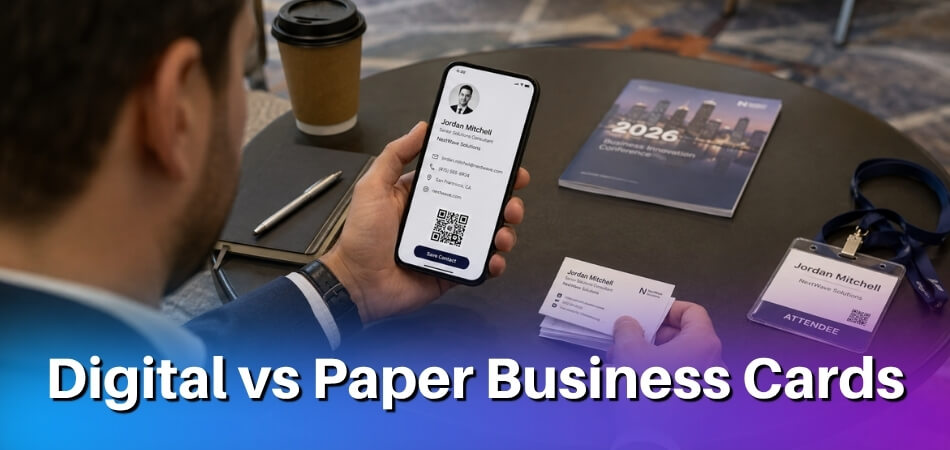
At in-person events, business cards still help. If your institution does not print them, simple ones with name, email, institution and research area are cheap to make online, or have your academic profile URL ready. At virtual events, use the session chat to ask or comment, which puts your name in front of the presenter, and actually use the networking rooms. Watching talks passively is the online equivalent of never leaving your hotel room.
Practical Strategies to Get the Maximum Benefit from a Conference
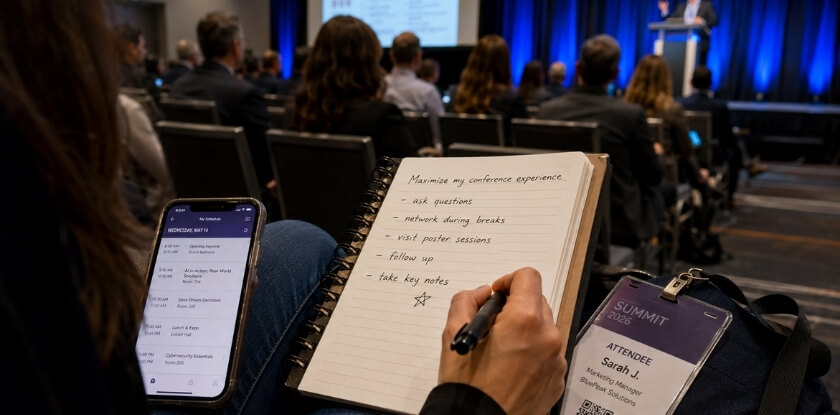
It is easy to treat a conference as a passive event: sit through talks, collect a badge and fly home. The difference between a conference that helps and one that does not usually comes down to what you do during and after it.
Present something, even if it is small
A poster, a short talk or a workshop slot all work. Presenting connects your name and face in people’s minds and gives strangers a reason to approach you, which removes much of the awkwardness of cold introductions. A poster can start more conversations than sitting silently through sessions. If a paper is rejected from one session, check whether another track fits.
Ask questions in sessions
Ask a question after one or two talks a day, keep it specific to the speaker’s work, and keep it short. A specific question gives you a natural reason to speak to the speaker afterward.
Take notes with collaboration in mind
During talks, flag anything that connects to your research: gaps, overlaps or methods that could become a co-authored paper or joint proposal. If something clicks, write it down before you lose it.
Have a one-sentence summary of your research ready
You will be asked “what do you work on?” many times. A clear sentence that a smart person outside your subfield can follow lets others remember you, recommend you and introduce you to others.
Use the social program
Dinners, receptions and lunch breaks are not filler. This is where people talk more candidly about research directions, jobs and funding. Stay present and keep your phone in your pocket.
Follow up within 48 hours
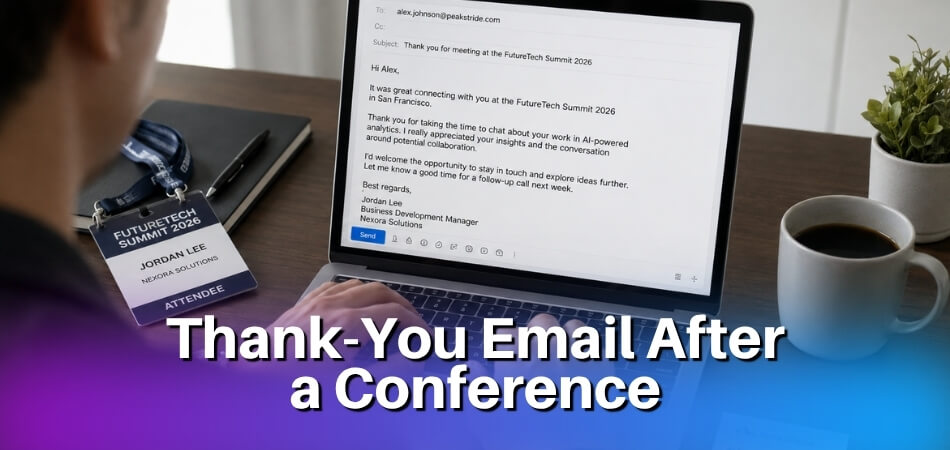
A conversation with no follow-up fades quickly. Each evening, spend ten minutes noting who you spoke with and about what. Then send a short email within 48 hours of the conference ending, referring to something specific. Attach your paper if it is relevant and suggest a concrete next step if one makes sense. You do not need something to ask: “I’ll look out for your upcoming paper” is enough.
Subject: Following up from [Conference Name]
Hello [First Name],
Thank you for the conversation after my session on [topic]. Your suggestion about [specific point] gave me something to test, and I have attached the paper in case it is useful. I would be glad to compare notes on [shared interest] if you have time in the coming weeks.
Kind regards,
[Your Name]
Update your academic profiles right after
Once home, add the presentation to your CV and ResearchGate profile with the full conference name, year and location. If the paper appears in indexed proceedings, note that clearly. Do it while the details are fresh, so people searching for your work can find it.
Know when a conference did not work out, and why
Sometimes you come back with nothing useful. Ask honestly whether it was the wrong audience, too large to network in, or a low-quality event. Not every conference earns a second visit. Noting one or two concrete outcomes from each helps you decide where to spend your time and funding next year.
From our experience at MS International: Our conferences are in person only, at venues in the Greater Toronto Area. Presenting authors submit their work for double-blind review, usually returned in about 10 working days, and register only after acceptance. Registered listeners can attend without presenting. A moderator introduces each speaker, and presenters receive a certificate after presenting. We do not promise any particular indexing: accepted papers may be considered for conference proceedings where applicable. If you need an invitation letter for a visa, it is issued within 3 to 5 business days after payment clears and supports your application but does not guarantee a visa. Fees are non-refundable and non-transferable.
FAQ: Career Benefits of Attending Academic Conferences
Whether conferences pay off for an academic career rests on several judgement calls, including indexing, spotting predatory events, how conference papers count on a CV and job applications.
Does attending a conference actually help your career, or is it just expensive networking?
It helps when you use it well. Presenting a paper, having real conversations with researchers in your area and following up afterward are what create value. Simply sitting through talks adds little. Planning matters more than the ticket: choose a credible event, present, and follow up.
How many conferences should I attend per year?
One or two a year is realistic for most PhD students and postdocs given funding limits. There is no magic number. One well-chosen event where you present and network actively is worth more than three where you only attend.
Do conference papers count the same as journal papers on my CV?
It depends on your field. In computer science, conference papers count as formal publications; in many other fields journal papers carry more weight. Either way, list the two types separately on your CV and say whether each was peer-reviewed.
What does it mean for a conference to be “indexed”?
It means papers from the proceedings appear in an academic database such as Scopus or Web of Science, so they can be searched and cited. ResearchGate is not an indexing database. Check indexing status yourself before submitting an abstract.
How do I know if a conference is predatory?
Look for a verifiable organiser, real peer review and past editions you can confirm. Warning signs include unsolicited flattering emails, acceptance within a day or two, and committee members whose own pages never mention the event. If you find no evidence of real attendees or published proceedings, walk away.
Is a virtual conference worth as much to my career as an in-person one?
For adding a presentation and paper to your CV, largely yes. For networking and spontaneous collaboration, no. Virtual events suit situations where budget or geography is the barrier, but they take more deliberate effort to build contacts.
What is the best way to fund conference attendance?
Start with your department or graduate school, then check the conference for scholarships or fee waivers and professional associations for travel awards. Some funds cover only presenters and run fixed deadlines, so apply early and to several sources.
Should I submit a paper or just attend?
Submit if you have work to present. Presenting gives you a CV entry, a reason to be there and a natural conversation starter. Attending without presenting is fine for scoping out a new conference or area, but it delivers less career value.
How do I network at a conference if I am not naturally outgoing?
Start with poster sessions, which are lower pressure than talks and let you ask specific questions about someone’s work. Prepare two or three genuine questions from the program beforehand, and follow up by email within 48 hours while the conversation is fresh.
Does presenting at a conference help with academic job applications?
Yes, as one signal among several. A consistent conference record shows you are active in your field. It will not replace strong publications, but in a competitive application it can matter.
What should I do with my conference paper after presenting?
Consider expanding it into a journal paper, which is a common path. Upload it to ResearchGate or your institutional repository if the conference allows it, and if the proceedings are indexed, check that your paper appears correctly.
Conclusion: Should a Conference Be Your Next Career Move?
Yes, if you choose the right event and go with a plan. Conferences are not automatically good for a career. An overpriced event with no real review and a vague “networking lunch” is not worth your time or your department’s money. A well-chosen event where you present, get useful feedback and meet people who later become collaborators can shift things.
The decision depends on your stage. Graduate students and postdocs should prioritise in-person events while scholarships and travel grants are within reach, because this is when your name is still being established. For early-career academics on the job market, a presentation signals activity and engagement. Virtual events keep you visible when travel is not possible and are good practice for abstracts and feedback, but should not fully replace in-person attendance early on.
No single conference will transform a career overnight. The effect is cumulative: you build a network talk by talk, your name appears in proceedings year after year, and you gradually become known in your field. If you have found a credible event in your field, have something to present and can offset the cost, go. The people in that room may become your collaborators, reviewers and colleagues.