Most researchers who need to withdraw a conference abstract do not know who to contact, what to say, or whether it will follow them through their career. The process is rarely explained clearly, and the stakes feel high enough that people freeze instead of acting. This guide gives the process, the email templates and the realistic consequences.
Quick answer: To withdraw a conference abstract, email the conference coordinator or program chair as soon as you decide, and use the portal’s withdraw option as well if it has one. Give your abstract title, submission ID and a one-line reason, confirm that all co-authors agree, and ask for written confirmation. Do it before the withdrawal deadline and keep every message.
Last verified against official sources: October 2026.
How Do I Withdraw a Conference Abstract
Notify the program committee in writing, before the withdrawal deadline, and only after every co-author has agreed. That is the core process at almost every venue, whether you were accepted or not.
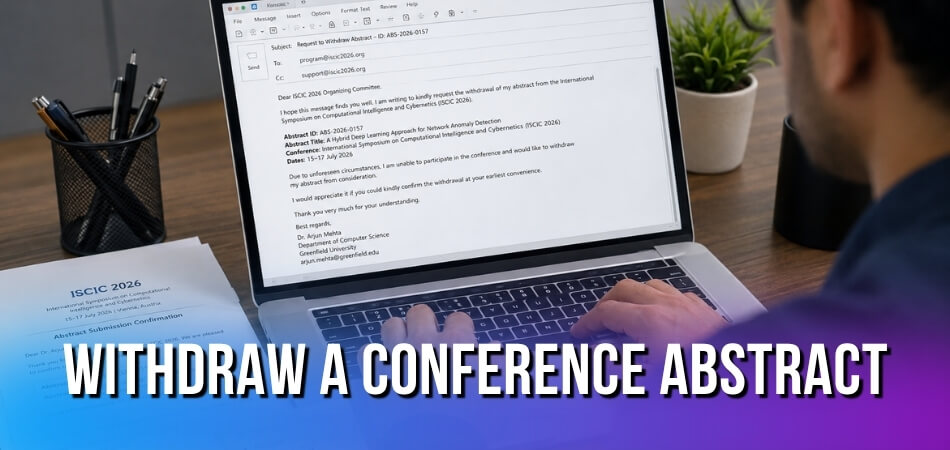
Most conferences handle withdrawals through one of three channels: the online submission portal (EasyChair, ConfTool, Microsoft CMT or Precision Conference Solutions are the most common), a direct email to the conference coordinator, or both. Check your acceptance or submission email first, because it usually names the right contact.
The Basic Steps
Here is the sequence that fits most conferences. Each step is explained in the step-by-step section below.
- Check the abstract withdrawal policy. It is in the call for papers or on the conference website. Deadlines vary: some close at camera-ready submission, others much earlier.
- Talk to your co-authors first. Get explicit sign-off, in writing if possible.
- Log into the submission portal. Platforms such as EasyChair and Microsoft CMT can have a withdraw option in the submission dashboard, and using it leaves a record in the system.
- Send a formal email to the conference coordinator. Even if the portal has a withdraw button, a brief email to the program committee confirming your intent protects you if there is a dispute later.
- State your reason clearly but briefly. “Scheduling conflict” or “the work is being redirected to a journal manuscript” is sufficient.
- Request a withdrawal confirmation email. If a future submission ban question ever comes up, that document is your evidence of a proper, timely withdrawal.
What Happens After You Send the Request
The program committee commonly acknowledges a request within a few business days. Once it is confirmed, your abstract is removed from the program schedule. If you had already registered, a registration fee refund is usually possible only before a specific cutoff, and that date is separate from the abstract withdrawal deadline, so check both.
If the conference had already planned a poster-to-oral conversion or a presenter change for you, tell the coordinator explicitly. Those schedule changes do not always update when an abstract is withdrawn through the portal alone.
Also tell anyone who relied on your presentation. If a travel grant, a funding approval or a visa invitation letter was tied to the talk, inform the funder or the issuer of the letter so that nothing is claimed for a presentation that will not happen.
A late or undocumented withdrawal can hurt your standing and, at some conference series, can lead to a ban on future submissions. Acting promptly and formally, rather than going silent, is the simplest way to avoid both.
When Can You Withdraw a Conference Abstract?
You can withdraw at any stage, but the stage decides how easy it is, who must approve it and whether there are lasting consequences. Before the decision it is routine; after camera-ready it needs direct contact with the committee.
| Stage | How to withdraw | Fee and record |
|---|---|---|
| Before the acceptance decision | Portal button or a short email with your submission ID | Usually no fee, no mark on your record |
| After acceptance, before the withdrawal deadline | Portal plus email to the coordinator (and the proceedings chair if there is one) | Refund possible if you are before the refund cutoff |
| Between the withdrawal deadline and camera-ready | Email with a written reason | Refund unlikely |
| After camera-ready | Direct contact with the program committee and possibly the publisher | The abstract may still appear in proceedings marked “withdrawn” |
Every conference runs on internal deadlines that decide what can still be reversed, and once you cross them your options narrow considerably. The exact stages differ by event. The dates to look for are the withdrawal (or “cancellation”) deadline, the camera-ready date and the early registration cutoff.
Before the Acceptance Decision
If acceptance notifications have not gone out, you are in the most flexible position. Most conferences treat a pre-decision withdrawal as routine administration. Log into EasyChair, ConfTool, Microsoft CMT or Precision Conference Solutions (PCS) and delete the submission or click “withdraw”. If there is no self-service button, email the coordinator with your submission ID and a short explanation. The abstract was never accepted, so the published program is not affected. If it is rejected instead, there is nothing to withdraw, and the usual steps after a conference abstract rejection apply.
After Acceptance but Before the Conference
Now your abstract may already be listed in the program, assigned to a session or included in preliminary proceedings, so withdrawing affects real logistics. Notify the conference coordinator and, where there is one, the proceedings chair or editor. Conferences that publish through a society or publisher usually have a formal post-acceptance process because the official record must be updated.
Check whether you have already submitted a camera-ready version. If so, the proceedings team must flag or remove that file before it is indexed. If the real problem is a presenter change or a co-author disagreement, ask whether a substitution is allowed. Many conferences allow it, and it is cleaner than a full withdrawal. Registration refunds at this stage are almost never automatic, so read the policy before you assume anything.
Deadlines and Policy Windows
The withdrawal policy is usually less visible than the submission deadlines, often buried in the author guidelines or the call for papers. Late withdrawal after camera-ready at conferences with a society or publisher pipeline can prompt a duplicate-submission review, or at least questions, about whether the same work was sent elsewhere, especially if no reason was given. Being open about the reason (journal manuscript, duplicate submission concern, co-author conflict) usually gets a better response than a vague request.
If you are unsure where you stand, email the coordinator and ask. A clear answer now is worth more than guessing wrong later.
What Stays Public After a Withdrawal
Timing decides whether a withdrawn abstract disappears or stays on record. Published policies show three patterns:
- Left out of the record: VSS says abstracts that are withdrawn or not presented are not published in its proceedings or in the Journal of Vision.
- Marked as withdrawn: ARVO’s 2026 policy removes the full abstract only if the withdrawal arrives before a set publication date. After that date the abstract is marked “WITHDRAWN”, but its full text still appears in the online planner and mobile app. Withdrawn abstracts are not published in its journal.
- Kept off IEEE Xplore: the ICASSP 2022 policy says a no-show paper is not published on IEEE Xplore, although attendees still receive it in the proceedings. The ICIP 2017 policy goes further and removes a no-show paper from the official proceedings.
Find the publication cutoff before you write. If the reason is an error in the data, say so in your email and ask whether the entry can be removed instead of marked.
Step-by-Step Withdrawal Process
Withdrawing a conference abstract is not complicated, but the order matters. Read the policy, align your co-authors, contact the coordinator, use the portal, then get written confirmation. Skip a step and you risk a miscommunication, a missed deadline or a withdrawal that is never formally recorded.
Check the Conference’s Withdrawal Policy First
Before you draft any email or log into any system, read the official withdrawal policy. It is usually in the call for papers, the author guidelines page or the submission FAQ. Find out whether there is a penalty for late withdrawal, whether a registration refund is possible and whether authors who withdraw without notice can be barred from later submissions. Some conferences tie the withdrawal deadline to the acceptance date, others to the camera-ready window.
Rules of a society are not always the rules of a given symposium or workshop run under its name, and a conference policy page can be stricter than you expect. The ICIP 2017 policy, for example, says IEEE strongly discourages withdrawals of papers once submitted, and that the request must come directly from the author, not a third party. If the policy is ambiguous, email the coordinator, ask directly and keep the reply. Vague policies get interpreted differently by different committee members, and written clarification protects you.
Talk to Your Co-authors First
A withdrawal sent without co-author agreement can create serious problems. Get explicit sign-off, in writing if possible, before you contact anyone (see the co-author section under Special Cases if there is a disagreement). Check who may file the request, too: VSS asks the first author to email, and some policies accept it only from the corresponding author.
Contact the Conference Coordinator or Program Committee
For most conferences the first contact is the conference coordinator or submissions chair, not the general chair. The program committee handles scientific review, while administrative matters such as withdrawals normally go through the coordinator.
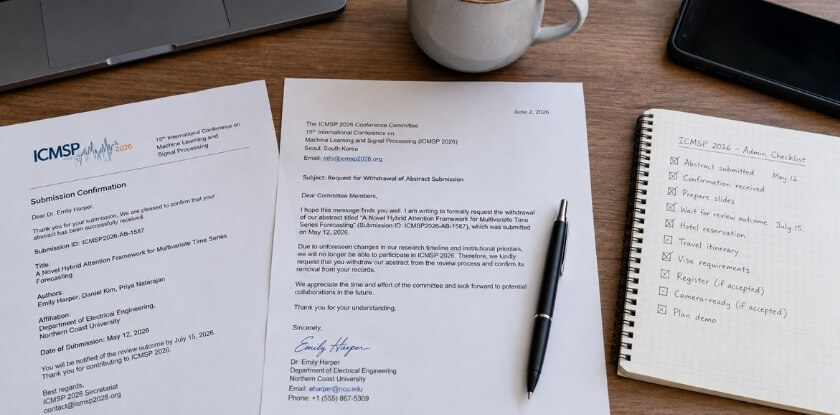
Keep the email brief. Include the submission ID, the paper title, all author names and a one-line reason. You do not owe a long justification, and “scheduling conflict” or “the work is being redirected to a journal manuscript” is enough. Even so, a clear reason (duplicate submission discovered, co-author conflict, work moved to a journal submission) helps the committee process the request faster and leaves a cleaner record. A vague or invented excuse can backfire if the real story surfaces later, so keep it short but true. The templates below cover the common situations. If a co-author opposes the withdrawal, settle that before you write, because a request contradicted by a co-author’s email creates a messy situation for the committee and can delay resolution significantly.
Submit via the Online Submission Portal (If Available)
Many larger conferences now handle withdrawals directly in their submission system rather than by email alone, so check the portal before or alongside your email. Author instructions for EasyChair conferences list a Withdraw link among the actions on the submission page, but organisers control the settings, so the option can be missing or switched off at your venue. Microsoft CMT, ConfTool and PCS also differ by conference. If no self-service button appears, write to the chairs.
Read the policy for the required channel first. Some venues take withdrawals only through their own online form and say email will not be accepted. ARVO’s 2026 policy is one example, and it also states that there is no charge to withdraw an abstract.
Unless the policy says email will not be accepted, send the email even when the portal has a button, because relying solely on a portal request without any email follow-up can leave it sitting in a queue. Some systems only mark the paper “withdrawal requested”, and a person on the committee must still confirm it. If you are past the deadline shown in the system, the portal may not let you start at all, and the direct email becomes your only route.
Get Written Confirmation
This step is skipped more often than it should be. Do not assume that clicking “withdraw” in EasyChair closed the matter. If you have heard nothing in three to five business days, send a short, polite follow-up that refers to your original request.
When the confirmation arrives, archive it. If questions later come up about duplicate submission, a poster-to-oral conversion that was never declined or a presenter change logged after your withdrawal, that email, saved somewhere you can find it, proves the withdrawal was submitted and accepted on a specific date. If registration was paid before the withdrawal was processed, ask explicitly about refund eligibility, because the registration team may reply separately.
Withdrawal Email Templates
These templates are starting points, not scripts to copy word for word. Adjust the submission ID, names and specific reason to match your situation before you send anything. Coordinators respond better to a direct, professional email than to a long apology.
Template 1: General Withdrawal (Personal Reason or Schedule Conflict)
Use this for a straightforward reason such as a scheduling conflict, lost funding, a visa issue or a personal circumstance.
Subject: Request to Withdraw Abstract: [Paper ID / Title], [Conference Name]
Dear [Program Chair’s Name / Conference Coordinator],
I am writing to formally request the withdrawal of my abstract titled “[Full Abstract Title]” (Submission ID: [XXXX]) submitted to [Conference Name].
Due to [brief, honest reason, for example “an unforeseen schedule conflict” or “a change in my institutional circumstances”], I am unable to proceed with this submission. I apologize for any inconvenience to the program committee.
Please confirm receipt of this request and let me know if any additional steps are required through [EasyChair / ConfTool / Microsoft CMT / the submission portal] or otherwise.
Thank you for your time and understanding.
Sincerely,
[Your Full Name]
[Institution / Affiliation]
[Email Address]
[Submission ID]
Keep the reason brief. You do not owe a detailed explanation, and a one-sentence reason is entirely sufficient.
Template 2: Withdrawal Due to Co-author Disagreement
Co-author disagreement is one of the more sensitive withdrawal situations. Do not air the internal dispute in the email. The committee only needs to know that the authors could not reach consensus.
Subject: Withdrawal of Submission After Author Discussion: [Paper ID / Title]
Dear [Program Chair’s Name],
I am contacting you regarding our submission titled “[Full Abstract Title]” (Submission ID: [XXXX]) to [Conference Name].
After discussion among the co-authors, we have been unable to reach agreement on proceeding with this submission at this time. On behalf of the author group, I am formally requesting that the abstract be withdrawn from consideration.
All listed co-authors have been informed of this request. If the committee requires written confirmation from additional co-authors or has a specific process for multi-author withdrawals, please let us know and we will comply promptly.
We appreciate the committee’s time and apologize for the disruption to the review process.
Sincerely,
[Your Full Name]
[Institution / Affiliation]
[Email Address]
[Co-author names and affiliations, if required]
[Submission ID]
Send this only when the authors really have settled the question among themselves. Submitting a withdrawal without co-author knowledge can cause serious problems, particularly where authorship disputes are handled at institutional level.
Template 3: Withdrawal of an Accepted Abstract
After acceptance, use a slightly more formal tone. The abstract may already be in a draft program, and the committee has spent time on scheduling and possibly camera-ready preparation, so acknowledge that.
Subject: Notice of Withdrawal (Accepted Abstract): [Paper ID / Title], [Conference Name]
Dear [Program Chair’s Name],
I am writing to notify you of my decision to withdraw my accepted abstract titled “[Full Abstract Title]” (Submission ID: [XXXX]) from [Conference Name].
I understand that this disrupts the program, and I sincerely apologize. [Optional one-sentence reason, for example “Unfortunately, a critical conflict has arisen that prevents my participation.”]
I would be grateful if you could confirm the withdrawal in writing and advise me on any remaining obligations, including whether the abstract will be removed from the proceedings or listed as withdrawn. I am also happy to discuss the registration fee or related arrangements.
Thank you for the opportunity to participate, and again, I apologize for the inconvenience.
Sincerely,
[Your Full Name]
[Institution / Affiliation]
[Email Address]
[Submission ID]
Follow up if there is no confirmation within three to five business days, quoting the date of your first email and the submission ID. Portals such as PCS or ConfTool may send an automatic acknowledgment, but many conferences rely on a manual reply from the coordinator. Until you have something in writing, treat the withdrawal as not processed.
Consequences of Withdrawing a Conference Abstract
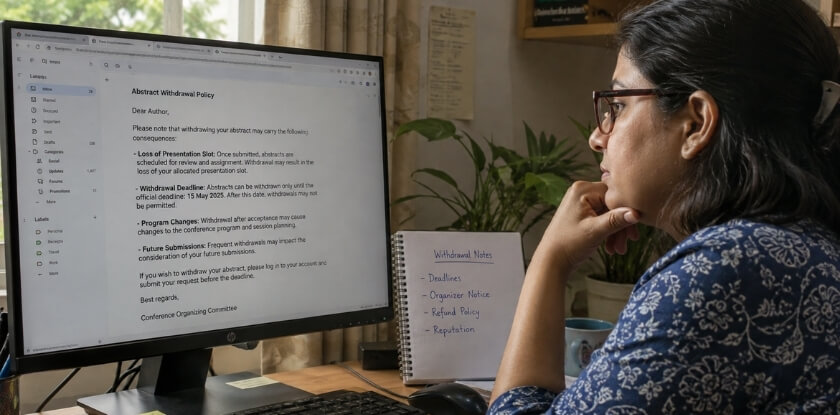
For most researchers a single, early, professional withdrawal has no lasting effect. The consequences grow with lateness, repetition and any sign of duplicate submission.
Will It Affect Your Reputation?
Committees see withdrawals regularly: research directions change, funding falls through and co-author situations get complicated. Handled professionally, one withdrawal is a known part of the process.
It looks worse when the real reason is a duplicate submission. If you sent the same abstract to two conferences, then withdrew from one after a better acceptance, and the committee works it out, that leaves a much worse impression than saying your research changed direction. The ICMJE recommendations state that authors should not submit the same manuscript simultaneously to more than one journal, and conferences usually follow the same logic.
Timing matters too. Withdrawing before the notification is less disruptive than pulling out after the schedule is published, and a withdrawal after camera-ready forces the committee to restructure sessions and leaves a gap that is hard to fill. A polite email with a clear reason leaves a far better impression than silence or vague excuses.
Risk of Being Barred from Future Submissions
Formal bans are uncommon. Most organisers will not blacklist an author for one withdrawal made early and communicated clearly, so understanding what is likely to happen lets you decide with open eyes. The situations that actually trigger bans involve repeated problems or clear misconduct:
- Confirmed duplicate submission: sending the same work to several venues at once and withdrawing from one after collecting reviews or an acceptance. Some conference policies state that this can lead to a ban from future submissions to that series.
- No-show without notice: failing to present an accepted abstract and never telling the organisers. This is treated more seriously than a formal withdrawal because it wastes session time. VSS says authors who neither present nor withdraw may forfeit the right to present the following year, and ARVO’s 2026 policy makes a first author ineligible for the next year’s abstract submission if the withdrawal is not filed through its form by the deadline.
- Repeated late withdrawals: pulling out after camera-ready at several conferences in the same community, especially without explanation, can lead to informal blacklisting even if no formal policy is invoked.
If you worry about a specific conference, read its withdrawal policy or ask the coordinator before you submit. Platforms such as EasyChair, Microsoft CMT and ConfTool often link the conference’s ethics and withdrawal policies inside the submission portal. If you have already withdrawn and are concerned about the impression, a brief professional email explaining the reason preserves goodwill.
Registration Fee Refund Policy
This is where many researchers get an unpleasant surprise. Abstract submission and registration are often separate transactions, but many conferences require registration at submission or shortly after acceptance, and those fees are frequently non-refundable. Withdrawing and getting money back are also separate requests: ARVO’s 2026 policy states that there is no charge to withdraw an abstract, which says nothing about registration fees, so read the registration terms too.
| Variable | What to check |
|---|---|
| Already paid? | If you withdrew before registering, there is nothing to refund. If registration was processed, read the refund schedule. |
| Time before the event | Refunds are often tiered. Months before may earn a full or partial refund, the last few weeks usually nothing. Some conferences offer credit toward a future year instead of cash. |
| Stated refund deadline | Many conferences give an exact cutoff in the registration terms. Read the terms of the specific event, not the parent organisation’s general policy. |
To ask for a refund, contact the coordinator or use the portal’s refund request process. Put the request in writing and attach the withdrawal confirmation. Some conferences require a written request within a fixed window, and missing it forfeits eligibility. If a co-author dispute is the reason for withdrawing, settle who paid the registration fee before making the request.
Abstract Withdrawal vs. Paper Withdrawal vs. Journal Manuscript Withdrawal
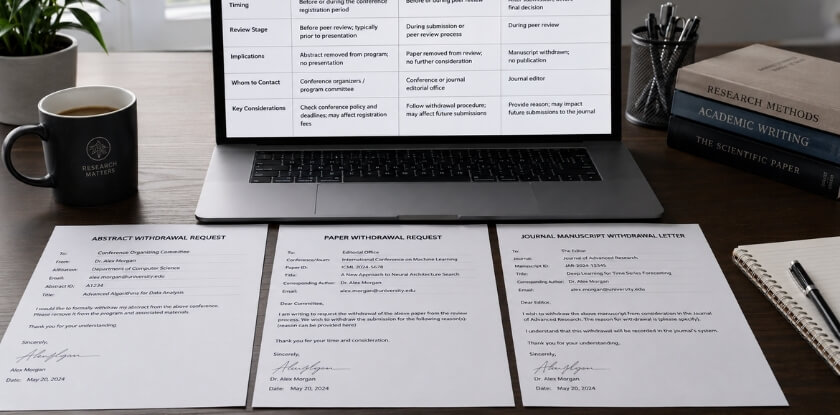
The stage of the publication process separates the three. Abstract withdrawal is the lightest, paper withdrawal is heavier and journal withdrawal is the most formal.
| Conference abstract | Conference paper | Journal manuscript | |
|---|---|---|---|
| What is withdrawn | A short summary, often 150 to 500 words (check the call for papers) | A full manuscript, often after peer review | A manuscript under editorial review or already accepted |
| Who handles it | Portal or conference coordinator | Program committee, sometimes the publisher | The journal’s editor |
| What is usually required | Short request, no formal justification | Reason, co-author agreement, sometimes a signed form | Written request, co-author sign-off, explanation |
| Risk | Low if done before the deadline | Moderate, higher after camera-ready | Highest, ethical review possible if already accepted |
The Key Differences at a Glance
The table sums up the differences. In short, abstract withdrawal is typically low-stakes and handled through the portal, paper withdrawal carries moderate risk and needs co-author agreement, and journal withdrawal is the most formal and needs direct editor communication.
Conference Abstract Withdrawal
This is the least consequential of the three, assuming you act before the withdrawal deadline. Most systems let authors withdraw an abstract through the portal without formal justification, and after the deadline you contact the coordinator. If the abstract has been accepted and scheduled as a poster or oral presentation, withdrawal is treated more seriously, and some conferences flag late withdrawals internally even when no public action is taken.
Conference Paper Withdrawal
A paper withdrawal comes after a full manuscript is submitted and often after peer review, so reviewers have already spent time on it and the committee may have scheduled you. Some conferences, particularly those with a publisher pipeline, ask for a signed withdrawal form, a stated reason and written agreement from all listed authors. After camera-ready the paper may already be in production, and withdrawal can prompt questions about whether the work went elsewhere at the same time. A registration refund is unlikely.
Journal Manuscript Withdrawal
This is a separate process run by the journal’s editorial office, not a conference committee. Journal peer review often takes months and reviewers are unpaid volunteers. Most journals want a formal request to the editor with co-author sign-off and an explanation. If the manuscript was already accepted, withdrawal can trigger an ethics review, and some journals publish a retraction notice in cases of suspected misconduct.
Withdrawing from a journal does not automatically clear the way to submit the same work to a conference, nor the reverse. Simultaneous submission to a journal and a conference venue is banned under many publication policies. If you withdraw from one to submit to the other, make sure the first withdrawal is fully confirmed before you proceed.
A withdrawn abstract does not usually stop you from publishing the full study later. ICMJE-based journal policies ask authors to disclose earlier reports, including meeting presentations, to the editor, and they generally allow a complete paper to follow an abstract or poster. Check the target journal’s own policy, and mention the withdrawn conference submission in your cover letter if you are unsure.
Co-author disagreement complicates all three cases equally. If one author wants to withdraw and another does not, the submitting author cannot safely pull the work alone. Tell the coordinator or editor about the conflict in writing.
Special Cases
Some withdrawals are not straightforward: a submission that ended up in two places, co-authors who disagree, or a problem that may not need withdrawal at all.
Duplicate Submission Problem: What to Do
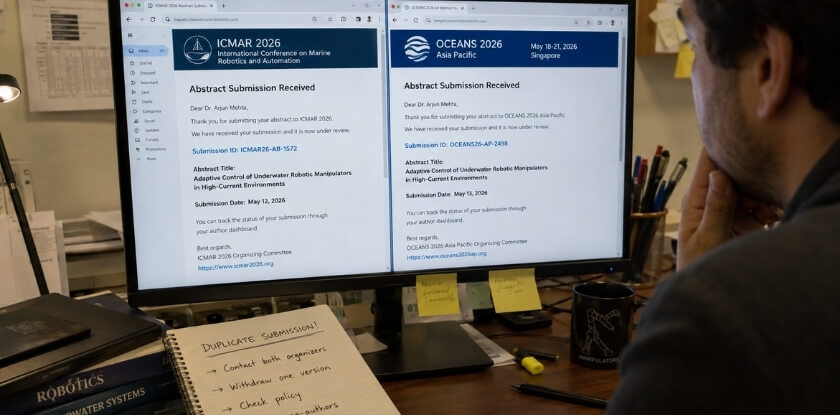
A duplicate submission means the same abstract, or a version close enough to count, is with two conferences at the same time. Most policies prohibit this, and it can come to light when the same reviewers serve more than one venue.
If you find the duplicate before either acceptance arrives, withdraw from one immediately. Choose based on fit, prestige and timeline, and email that coordinator without delay, because the longer you wait the worse it looks. If both have already accepted, you must withdraw from one and should say honestly why. A vague “scheduling conflict” will not hold up if a published version of the same work later turns up elsewhere. Acknowledging the overlap and withdrawing promptly is a much better outcome than a submission ban or an integrity complaint. If the violation is found after publication, consequences can include removal of the paper and limits on future submissions, depending on the policy.
If the two submissions differ substantially in scope, results and framing, check each conference’s policy before assuming a violation, because some venues allow clearly distinct related work.
Co-author Conflict and Withdrawal
Co-authors sometimes disagree over withdrawal, for example when one author wants to withdraw because of new competing results and another wants to present anyway. Resolve it internally before contacting the committee.
All named authors share responsibility. EasyChair, ConfTool, Microsoft CMT and PCS record who submitted the abstract, but the abstract belongs to every author listed. If you are the corresponding author and want to withdraw, message all co-authors first, give a clear reason and a deadline for replies (for example, the withdrawal deadline). If they genuinely disagree:
- If the majority want to withdraw, document that consensus in writing before you proceed.
- If you are unsure whether you can withdraw alone, tell the coordinator there is an authorship conflict and ask how that conference handles it.
- If the dispute is about the work itself, consider whether a presenter change or scope adjustment would satisfy both sides.
Keep a paper trail of the internal discussion, so a co-author cannot later contest the withdrawal without a record. Withdrawing without agreement and then having a co-author contest it with the committee is the situation to avoid.
Alternatives to Withdrawal
Withdrawal is permanent, and these options are not. Ask yourself whether the problem is the abstract itself or the circumstances around presenting it. If it is the circumstances, withdrawal is probably the wrong fix.
- Presenter change: if the presenter cannot attend because of a visa problem, illness or a clash, most conferences allow another author to present. Ask first: the ICASSP 2022 policy treats papers presented by substitutes without permission as no-shows, and ARVO’s 2026 policy accepts a substitute only if it is a listed co-author, approved in advance through its form, for illness, family emergency, change of employment or inability to obtain a visa. Contact the coordinator early, because after camera-ready some conferences charge a fee or require formal approval.
- Poster-to-oral conversion (or the reverse): if you were accepted for an oral talk but the work cannot yet withstand live Q&A, ask for a poster slot. This works in both directions at some venues, and committees often agree if you ask before the program is final.
- Scope or title update: if results changed but the core contribution stands, many conferences allow minor edits between acceptance and camera-ready.
- Extension request: if the work simply needs more time, ask for a short extension on the camera-ready date. It is not always granted, but it costs nothing to ask.
FAQ
Pulling an accepted abstract leaves a few loose ends, such as recovering the registration fee, a co-author who disagrees, whom to contact and how to confirm the withdrawal went through.
Can I withdraw after my abstract has been accepted?
Yes, in most cases, but the later you act, the more it costs. Accepted abstracts trigger scheduling work, so tell the program committee in writing as early as possible and check the policy deadline.
Will withdrawing hurt my chances at future conferences?
Rarely, if you withdraw once, early and in writing. Published penalties target authors who neither present nor withdraw: VSS says they may forfeit the right to present the following year, and ARVO makes them ineligible for the next submission.
Do I get my registration fee back if I withdraw?
Usually not, unless you withdraw before the conference’s stated refund deadline. Check the registration terms separately from the abstract withdrawal policy, because the cutoff dates often differ. Ask the coordinator in writing if the terms are unclear.
Who do I contact to withdraw: the program chair or the submission portal?
Usually both. Update the status in the portal (EasyChair, ConfTool, Microsoft CMT or PCS) and email the conference coordinator or program chair, unless the policy names one channel only. Relying on the portal alone is risky because notifications sometimes get missed.
What if a co-author disagrees with the withdrawal?
Resolve it among the authors before sending any request. Conflicting emails from co-authors create a serious problem for the committee. If the disagreement stays unresolved, involve your institution’s research office.
Is withdrawing a conference abstract the same as withdrawing a journal manuscript?
No. Journal withdrawal goes through an editor and can affect publication records, while conference abstract withdrawal is simpler with fewer formal consequences. Each organisation’s written policy is still worth reading.
Do I need to give a reason for withdrawing?
Not always, but a brief honest reason is good practice. Duplicate submission discovered, travel funding lost or a significant methodological error all help the committee and protect your reputation.
What happens to my submission slot after I withdraw?
The committee usually gives the slot to a waitlisted submission or removes the session from the schedule. At some conferences a poster-to-oral conversion may fill the gap.
How do I know the withdrawal actually went through?
When you receive a withdrawal confirmation email. If nothing arrives within a few business days, send a polite reminder. Do not assume silence means the request was processed.
Can I re-submit the same work to another conference after withdrawing?
Yes, once the withdrawal is complete and confirmed. Disclose the earlier submission if the new venue asks about prior submissions. Until you have written confirmation the abstract is still technically active, and submitting it elsewhere risks a duplicate submission violation.
Final Thoughts
Withdrawing a conference abstract is not a career-ending event, and most committees have seen it before. Check the withdrawal policy first, get written confirmation after you submit the request, and bring your co-authors in before the decision is final. Those three steps prevent most withdrawals from going wrong.
From our experience at MS International: Our submission rules say papers must not have been previously published or be under review by another conference, journal or publication, so check that before you send the same work anywhere else. Our review is double-blind, and authors receive an acceptance, revision request or rejection decision by email. Most review decisions are returned within about 10 working days, so keep that email and your submission details handy when you write to any organiser.