How to Write an Abstract for a Conference Without Results?

Your research isn’t finished, but the abstract submission deadline is staring you down. You have a methodology, a clear research question, maybe some preliminary findings — but no final results. So do you skip the conference entirely? Absolutely not. Writing a conference abstract without results is not only acceptable, it’s standard practice at many of the most respected academic conferences in the world. Organizations like the American Educational Research Association (AERA) and countless IEEE conference abstract calls explicitly welcome ongoing study submissions, particularly from graduate students, early-career researchers, and undergraduate researchers presenting work in progress.

The assumption that every abstract needs a tidy conclusion is one of the most common misconceptions in academic writing. A well-crafted abstract for in-progress research can be just as compelling — and just as credible — as one with finished data. You just need to know how to frame what you do have.

Quick Answer: Do Abstracts Need Results? How Do You Write One Without Them?

No, abstracts do not always require results. A descriptive abstract outlines the purpose, scope, and approach of a study without reporting outcomes — making it the right format for in-progress research. This differs from an informative abstract, which summarizes background, methods, results, and conclusions in full. For a conference abstract without results, combine three core elements: a background section that establishes context and significance, a clear statement of purpose that defines your research scope, and a methodology section that explains your approach. Together, these create a complete, credible abstract even when data collection is still underway. For language, use present progressive tense to describe active work (“this study is examining…”) and future tense to describe expected contributions and outcomes (“findings will contribute to…”). This framing signals that the work is live and intentional — not unfinished and scrambled. Following The Four C’s — Clear, Concise, Compelling, Complete — keeps the abstract tight within any abstract word limit while meeting reviewer expectations across STEM, humanities, and social science abstract formats alike.

What follows in this guide is everything you need to write a strong, submission-ready abstract for a conference before your results are in — including field-specific advice for STEM, humanities, and social science abstracts, a fill-in-the-blank template, and a breakdown of how different style guidelines from APA to MLA abstract guidelines handle preliminary work.

Can You Submit a Conference Abstract Without Results?

Yes, you can. And it’s more common than you might think.

Many conferences — especially in the social sciences, humanities, and education — explicitly accept abstracts for in-progress research. They’re not expecting a finished study. They’re evaluating whether your research question is worth a conversation.

Can You Submit a Conference Abstract Without Results

The short answer: check the call for papers. Some conferences require completed results. Others, like those organized by the American Educational Research Association (AERA), routinely accept abstracts describing ongoing studies with preliminary findings or even projected outcomes. IEEE conference abstract guidelines can be stricter depending on the track, so always read the submission criteria before you write a single word.

Why Conferences Accept Incomplete Research

Conferences exist to share ideas, not just announce conclusions. A graduate student six months into a dissertation study has something valuable to contribute — a new methodology, a gap they’ve identified, a theoretical framework nobody’s tested yet. That’s worth presenting.

The logic is simple. Research takes years. Conference cycles don’t wait.

For an undergraduate researcher presenting at a departmental symposium or a poster session, this is practically the default situation. You’re working with what you have. The abstract still needs to be tight, honest, and specific about where the research stands.

What Reviewers Actually Expect

Reviewer expectations shift depending on whether you’re submitting to a STEM abstract track or a humanities abstract panel. In STEM contexts, reviewers often want to see at least some preliminary findings — even early data, a pilot result, or a confirmed methodology. Vague promises don’t score well.

In humanities and social science abstract submissions, reviewers are generally more comfortable with a future tense or present progressive tense framing. Phrases like “this study examines” or “data collection is currently underway” are normal and accepted.

What reviewers at any conference want to avoid is an abstract that’s essentially a research proposal wearing a conference abstract costume. There’s a difference. A research proposal pitches what you plan to do. A conference abstract — even for an ongoing study — demonstrates that the work is real, structured, and producing something the field needs to hear.

The Honest Line You Have to Walk

You can’t fabricate results. That’s obvious. But you also can’t be so vague that the abstract says nothing.

The practical move is to be specific about your methodology section, clear about your research scope, and direct about your expected contribution. If your data collection is 70% complete, say so. If you’re using a specific analytical framework, name it. The abstract word limit — usually 150 to 300 words depending on the conference — forces precision anyway.

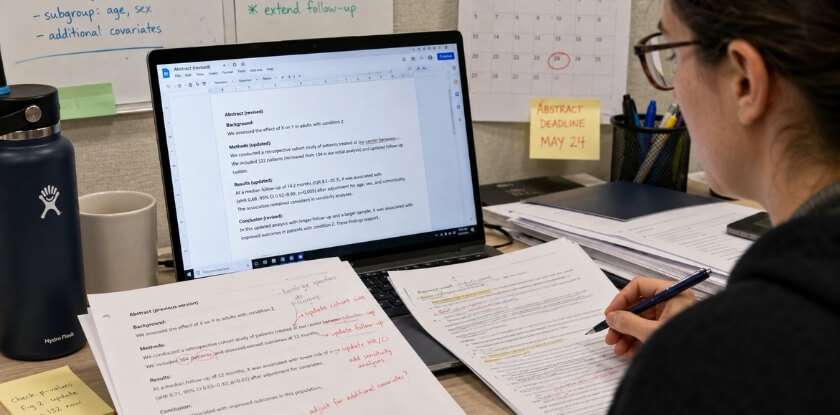
Some conferences have a data change policy that allows you to update your abstract after initial acceptance if your results shift before the presentation date. Worth checking. If that option exists, you have even more flexibility to submit now and refine later.

Bottom line: submitting without results isn’t a shortcut or a workaround. It’s a legitimate path — as long as you’re transparent about where your research actually is.

The Four C’s of a Strong Conference Abstract

Every strong conference abstract — whether you’re submitting to AERA, an IEEE conference, or a humanities symposium — lives or dies by four qualities: Clear, Concise, Compelling, and Complete. This framework works especially well when your research is still in progress, because it gives you a structure to follow when you can’t rely on a tidy results section to do the heavy lifting.

Clear

Clarity means a reviewer understands your research question after reading the first two sentences. Not after re-reading. Not after guessing.

This sounds obvious. It’s surprisingly hard to do.

When you’re deep in an ongoing study, you’re surrounded by jargon, internal shorthand, and theoretical nuance that feels essential but reads as noise to an outside reviewer. Strip it out. If your abstract requires background knowledge your audience might not have, add one sentence of context — not a paragraph.

For in-progress research specifically, clarity also means being upfront about where you are. Don’t bury “data collection is ongoing” at the end. State your research scope early, so reviewers know what they’re evaluating.

Quick test: Hand your abstract to someone in a related but different field. If they can tell you what question you’re asking and why it matters, you’re clear. If they can’t, you’re not.

Concise

Most conferences set an abstract word limit between 150 and 500 words. Some poster abstract submissions go even tighter — 100 to 250 words. You don’t get to exceed that limit because your study is complex.

Concise doesn’t mean shallow. It means every sentence earns its place.

Cut throat filler phrases like “this study aims to explore the possibility that…” — that’s 10 words for “this study examines.” Watch your methodology section especially. You don’t need to justify your entire research design in an abstract. Name the method, give one or two specifics, move on.

If you’re working from a fill-in-the-blank template, use it as a skeleton, not a script. Templates help you hit the required components without over-writing.

Compelling

Here’s where a lot of graduate students and early-career researchers lose reviewer interest — particularly when there are no results yet. Without data, the compelling work falls entirely on your framing.

Your abstract needs to answer: why does this matter now? What gap does your research address? What would change if your expected contribution holds up?

You’re not writing a research proposal, but you’re borrowing some of its energy. The stakes have to be visible.

One concrete move: use your background section to establish tension — a contradiction in the literature, a population underrepresented in prior work, a method that hasn’t been applied to this context. That tension makes reviewers want to know what you find.

Undergraduate researchers often skip this step. Don’t.

Complete

A complete abstract covers the essential components, even when results are absent. For most conference abstracts, that means:

  • A clear research question or problem statement
  • Relevant theoretical or disciplinary context
  • Your methodology (or proposed methodology)
  • Preliminary findings if you have them, or expected contribution if you don’t
  • The significance of the work

That last point carries extra weight in an abstract without results. Reviewer expectations vary by field — an STEM abstract reviewer may want methodological specifics, while a social science abstract reviewer for AERA may weight theoretical framing more heavily. Know your audience before you finalize.

Using future tense and present progressive tense appropriately also signals completeness. “Data collection is underway” (present progressive) and “findings will contribute to…” (future tense) tell reviewers you’re organized and thinking ahead — not just scrambling to submit before the abstract submission deadline.

A complete abstract leaves no obvious unanswered question about what the study is. It may leave open questions about what you’ll find — and that’s fine.

How to Structure an Abstract Without Results

Writing an abstract without results isn’t just possible — it’s actually a well-defined format once you know what goes where. The structure below works across disciplines, whether you’re submitting an IEEE conference abstract, an AERA education proposal, or a humanities abstract for a literature conference. Each part has a job. Do that job clearly, and reviewers will follow your logic even without a single data point.

How to Write an Abstract for a Conference Without Results

Background and Context — Setting Up Your Research Problem

This is where you earn the reader’s attention. Your first one or two sentences need to establish why this research exists — what gap, contradiction, or unresolved question motivated the study.

Don’t open with a broad claim like “Education is important.” That wastes your word limit and tells reviewers nothing. Start closer to the problem. If your study examines how bilingual students process metaphor in second-language writing, say that directly. Name the specific tension or gap in the existing literature.

For a conference abstract on in-progress research, the background section does double duty. It shows that you’ve read the field and that your work fits somewhere meaningful in it. Reviewers aren’t just evaluating your idea — they’re deciding whether it belongs at this particular conference. Give them the context to say yes.

Keep it tight. Two to four sentences is usually enough. You’re not writing a literature review; you’re signaling that you understand the conversation your research is entering.

Purpose and Objectives — Stating What Your Study Aims to Achieve

After the background, reviewers want one thing: a clear statement of what you’re actually doing.

Use direct language. “This study investigates…” or “This paper examines…” works fine. Some writers prefer present progressive tense here — “This study is examining the relationship between…” — which signals ongoing research without sounding incomplete. Both approaches are acceptable; pick one and be consistent.

Be specific about scope. If your research focuses on a particular population, time frame, or institutional setting, mention it. “Graduate students at research-intensive universities in the U.S.” is more useful than “students in higher education.” Specificity builds credibility, especially when you don’t have results yet.

Avoid listing five objectives when you really have one or two. Padding the objectives section with sub-questions you haven’t fully thought through will make your abstract feel unfocused. Reviewers notice.

Methodology — Writing About Your Ongoing Methods With Confidence

This section trips up a lot of early-career researchers and undergraduate researchers submitting their first abstract. They worry that saying “data collection is ongoing” makes the work sound unfinished. It does — but that’s fine. What matters is that your methodology sounds deliberate.

Describe what you’re doing, not what you hope to figure out. “This study uses semi-structured interviews with 20 participants, analyzed through thematic coding” is confident and clear. You don’t need the results to describe the design.

Use present tense or present progressive tense for methods that are active. “Participants are recruited through…” or “The study applies a mixed-methods design…” both work naturally for an ongoing study. Avoid future tense for methodology if you can — “will conduct” sounds like a research proposal, not a conference abstract. Most reviewers expect the work to be underway by submission.

If you’re submitting to a conference with specific methodological traditions — say, an AERA qualitative research division or an IEEE systems conference — mirror the language those communities use. Qualitative researchers talk about trustworthiness and positionality. STEM abstract reviewers want to see sample size, instruments, and analytical approach. Know your audience.

One practical note: if your abstract submission deadline is months before the conference, and your methods might shift slightly, check the conference’s data change policy. Some conferences allow you to update your abstract or submit a revised version closer to the presentation date.

Expected Contribution and Scope — Describing the Potential Impact of Your Work

Here’s where you tell reviewers what your work will add — not what it proves, because you don’t have that yet, but what gap it addresses and what the field gains if your study goes as planned.

Future tense is appropriate here. “Findings are expected to…” or “This research will contribute to…” are standard phrasing choices that signal confidence without overclaiming. You’re not inventing results. You’re explaining why the work matters if it succeeds.

Be realistic about scope. Don’t claim your study will transform the field. Do claim that it fills a specific gap, challenges a particular assumption, or produces a tool or framework that other researchers can use. Reviewers — especially experienced ones — trust modest, well-defined contributions far more than sweeping ones.

If you’re writing a descriptive abstract rather than a full informative abstract, this section might be brief — just a sentence or two summarizing the research direction. If the conference expects an informative abstract (more common at AERA or APA-affiliated events), give a fuller picture of the theoretical and practical implications.

End this section with something concrete. Name the population that benefits, the literature stream it advances, or the methodological gap it addresses. That specificity is what makes reviewers remember your abstract when they’re scoring 200 of them in a single weekend.

How and Where to Use Future Tense in a No-Results Abstract

Tense is one of those things that feels minor until a reviewer flags it. In a no-results abstract, getting your verb tenses right isn’t just about grammar — it signals to the committee that you understand exactly where your research stands.

The basic rule is straightforward: use present tense for what exists and what you’re currently doing, and future tense for what hasn’t happened yet.

That’s it. But the application is where people get confused.

What Gets Present Tense

Your background, the problem you’re addressing, and your methodology all belong in present or present progressive tense.

  • “This study examines the relationship between…”
  • “The research uses a mixed-methods approach…”
  • “Data collection is currently ongoing at three sites…”

The present progressive tense (“is ongoing,” “are being analyzed”) is especially useful for in-progress research. It tells reviewers your work is active, not hypothetical. That matters more than you’d think.

What Gets Future Tense

Anything you haven’t done yet — findings, conclusions, contributions — goes in future tense.

  • “Results will be presented and discussed in relation to…”
  • “This study will contribute to the existing literature on…”
  • “Findings will inform policy recommendations for…”

Your expected contribution section almost always lives here. You’re making a promise, not a report. Own that.

The Gray Area: Anticipated Findings

Some researchers write “the study will find” and some write “the study is expected to find.” Both are acceptable. But “is expected to find” is slightly more defensible for early-stage work — it acknowledges uncertainty without undermining your confidence.

Reviewers at conferences like AERA and IEEE are reading dozens of abstracts. Hedged but clear language (“results are anticipated to show”) reads as honest. Overclaiming with flat future assertions (“the study will prove”) can make preliminary findings sound like finished conclusions, which raises red flags.

A Quick Tense Map

Abstract ComponentRecommended Tense
Problem statement / backgroundPresent simple
Methodology / data collectionPresent or present progressive
Analysis (if complete)Past simple
Anticipated resultsFuture or “expected to” construction
Contribution / implicationsFuture simple

One Thing to Watch Out For

Inconsistency. Don’t flip between “this study examined” (past) and “this study will collect data” (future) in the same abstract. Past tense for your methodology implies the work is finished. If your abstract submission deadline hits before data collection wraps up, keep methodology in present tense even if some phases are complete.

A sentence like “Interviews were conducted with 40 participants, and survey data is currently being analyzed” is fine — it’s specific about what stage each component is at. That kind of precision is exactly what conference reviewers want to see from a graduate student or early-career researcher submitting ongoing study work.

Short version: future tense belongs to your outcomes. Everything happening now gets present tense. Don’t let tense drift undermine an otherwise solid abstract.

Field-Specific Differences — STEM, Humanities, and Social Science Abstracts

Not all conference abstracts follow the same unwritten rules. A physicist and a literary scholar are both writing abstracts without results, but the expectations reviewers bring to each are genuinely different. Knowing those differences saves you from structuring your abstract the way you were trained to in a different discipline — or worse, the way a generic writing guide told you to.

When and How to Update the Abstract Later

STEM and Natural Science Abstracts Without Results

In STEM fields, reviewers want to see that your methodology is sound before they care much about anything else. If you’re presenting in-progress research at an IEEE conference or a discipline-specific symposium, the abstract needs to make clear what you’re testing, how you’re testing it, and why the design is defensible. Results can wait. Method cannot.

Keep your problem statement tight. One or two sentences on the gap you’re addressing, then move directly to your approach. STEM abstracts tend to be highly structured even when they’re short — think background, objective, method, expected contribution. That four-part flow is almost assumed at this point in many natural science conferences.

For ongoing studies, preliminary findings are your friend. Even if your data collection isn’t finished, you can report what you’ve observed so far in your pilot phase without overstating it. “Initial trials suggest…” or “Preliminary data indicate a trend toward…” — that language signals to reviewers that the work is real and moving forward. Don’t make up findings. But don’t hide genuinely early data either.

IEEE conference abstract guidelines, for example, often specify a strict word limit between 150 and 250 words. That forces you to cut everything decorative. Be direct about your experimental design, the variables you’re measuring, and what you expect to find. If you have a hypothesis, state it plainly.

One practical note: STEM abstracts rarely spend more than one sentence on theoretical framing. If you find yourself writing three sentences about the intellectual tradition your work sits within, you’re probably borrowing habits from humanities writing. Cut it back.

Humanities and Arts Abstracts Without Results

Humanities abstracts operate on a completely different logic. Here, the argument is the result in many cases. You’re not waiting for data to come in — you’re developing a reading, an interpretation, a critical position. So “no results” looks different here than it does in a lab study.

What reviewers in humanities conferences want to see is that you have a clear thesis or central claim, even if the full argument is still being worked out. You don’t need to have finished the paper. You need to demonstrate that you have something to say.

This is where the research scope matters more than the methodology section. Instead of explaining your experimental design, you’re explaining what texts, archives, periods, or artifacts you’re engaging with — and why those choices are doing intellectual work.

MLA abstract guidelines and conference-specific expectations in fields like comparative literature or art history often allow for more theoretical framing than STEM does. But there’s still a limit. Abstracts that spend two-thirds of their word count on background theory and never get to the actual argument tend to get passed over. Reviewers want to know: what is this paper doing, not just what it’s in conversation with.

For an undergraduate researcher or graduate student presenting humanities work that’s genuinely not finished yet, be honest about the stage. You can frame it around a question you’re pursuing rather than a conclusion you’ve reached. “This paper examines…” or “This analysis argues…” works even when the full argument is still forming, as long as you give enough shape to it that a reviewer can tell you’re not just exploring blindly.

Arts-practice abstracts — think performance studies, creative writing conferences, studio art — sometimes blur the line between a research proposal and a project description. In those cases, describe the work itself concisely, then say something about the critical or theoretical questions it’s engaging. What’s the work doing that makes it worth a conference slot?

Social Science Abstracts Without Results

Social science sits in an interesting middle position. Depending on the subfield — sociology, education, political science, psychology — you might be expected to write more like a STEM abstract or more like a humanities one. Pay attention to where your target conference sits on that spectrum.

American Psychological Association (APA) formatting is common in psychology and parts of education research, and it carries an expectation of structured abstracts: background, purpose, method, results, conclusions. When you don’t have results yet, you acknowledge that directly and substitute expected outcomes or planned analyses. The American Educational Research Association (AERA), which runs one of the larger education research conferences, explicitly accepts proposals for work in progress — so you’re not hiding anything by framing your abstract around an ongoing study.

Qualitative social science research presents its own challenge here. Your “methodology section” might describe a grounded theory approach, ethnographic fieldwork, or a series of semi-structured interviews that are still being conducted. Be specific about your design and your sample, even if data collection isn’t complete. Reviewers can evaluate whether your approach is appropriate to your question; they’re not expecting you to have fully analyzed data yet.

For quantitative work, if you have preliminary findings from a pilot study or a first wave of data, include them. Even descriptive statistics or early effect sizes signal that the study is operational. If you have nothing yet, describe what you expect the analysis to show and why — frame it around your hypothesis and the logic of your design.

One thing that trips up social science writers specifically: the background section can balloon. Social science research often sits within big, contested literatures — inequality, learning outcomes, political behavior — and it’s tempting to contextualize heavily. Don’t. A sentence or two on the problem and the gap. That’s all an abstract needs before you get to what you are doing about it.

Undergraduate vs. Graduate Conference Abstracts — Key Differences

The expectations aren’t the same at every career stage. An undergraduate researcher submitting to a regional symposium and a doctoral candidate submitting to AERA are playing by different rules — even if they’re both writing about in-progress research without results.

Knowing which category you fall into matters before you write a single sentence.

What Reviewers Expect from Undergraduates

Undergraduate conference abstracts are typically reviewed with more latitude. Reviewers know you’re early. They’re not expecting a decade of methodological sophistication. What they are looking for is evidence that you understand your research scope and can articulate it clearly.

That means your background section needs to show you’ve read the relevant literature — even if only selectively. Your methodology section should be specific enough to be credible. And your expected contribution doesn’t need to shake the field. It just needs to be honest.

“This study will help instructors understand how first-generation students engage with online discussion boards” is a perfectly acceptable contribution statement for an undergraduate poster abstract. You don’t need to claim you’re rewriting educational theory.

One common mistake undergraduates make: writing an abstract that reads like a research proposal rather than a conference abstract. These are different things. A research proposal explains what you want to do. A conference abstract asserts what you are doing. Use present progressive tense to make the work feel active — “this study examines” not “this study will examine how feasible it might be to look at.”

Also, pay attention to the abstract word limit. Many undergraduate conferences cap abstracts at 150–250 words. That’s tight. Cut your background section to two sentences maximum and spend the remaining space on method and contribution.

What Graduate Students Need to Do Differently

Graduate and early-career researcher abstracts are held to a higher standard. Full stop.

A reviewer reading your submission for an IEEE conference abstract or an AERA panel isn’t thinking “well, they’re still learning.” They’re comparing your abstract directly against submissions from established researchers. That means your methodology section needs to be specific and defensible, not gestured at. If you’re using grounded theory, say so. If you’re running a between-subjects experiment with 80 participants, say that too.

The other big difference is stakes. Graduate students often submit to conferences where acceptance affects funding, job market positioning, or dissertation timelines. This raises the pressure, but it also gives you a useful frame: write the abstract as if your committee is reading it, because at some point, they probably will.

For ongoing study submissions, graduate abstracts need to handle the absence of results more deliberately. You can’t just say “results will be discussed.” Reviewers hate that phrase. Instead, articulate what your preliminary findings suggest directionally, or explain what kinds of outcomes the methodology is designed to detect. Something like “the analysis will identify whether X mediates the relationship between Y and Z” is specific without fabricating data you don’t have.

The Mentorship Gap — and How to Close It

Here’s a practical reality: most undergraduates don’t have anyone reviewing their abstract before submission. Most graduate students do — or should.

If you’re an undergraduate researcher, find someone. A faculty advisor, a writing center consultant, even a graduate student in your department. One round of feedback before the abstract submission deadline can catch framing problems that would otherwise lead to rejection.

Graduate students should treat abstract review as a non-negotiable step. Show your advisor. If your advisor isn’t available, use your department’s peer review channels or writing groups. A second pair of eyes on the fill-in-the-blank template you drafted isn’t a sign of weakness — it’s how good abstracts actually get written.

The American Psychological Association (APA) and MLA abstract guidelines both emphasize clarity and precision, but neither of them writes your abstract for you. That’s still your job, at every career stage.

Reviewer Expectations — What to Keep in Mind When Submitting an Early Abstract

Most conference reviewers have read hundreds of abstracts. They can tell within the first two sentences whether a submission is worth their time. That’s not a scare tactic — it’s just how review panels work, and knowing it changes how you write.

Here’s the key thing to understand: reviewers evaluating abstracts for in-progress research aren’t looking for finished answers. They’re looking for evidence that you know what you’re doing and that your work will be done — and presentable — by the time the conference happens.

What Reviewers Actually Score On

Most review rubrics, whether it’s an AERA panel or an IEEE conference abstract track, come down to a few consistent criteria:

  • Clarity of the research question — Is it obvious what you’re studying?
  • Appropriateness of methodology — Does your approach match the question?
  • Contribution to the field — Why should anyone care?
  • Feasibility — Can this realistically be completed by the conference date?

That last one matters more than people think. If your abstract submission deadline is in March and the conference is in November, reviewers will mentally calculate whether your ongoing study can actually produce something worth presenting. A vague methodology section kills feasibility fast.

They’re Not Expecting a Finished Study

This surprises a lot of early-career researchers. You don’t need results to get accepted. What you do need is a credible plan. Reviewers give genuine credit for well-framed preliminary findings, a clearly scoped methodology, and an honest statement of expected contribution.

What they don’t accept is a research question dressed up to look like a complete study. If you’re writing about in-progress research, be upfront about it. Use present progressive tense where your data collection is happening now, and future tense where appropriate for anticipated outcomes. Trying to obscure the fact that results aren’t in yet rarely fools anyone — and it can get your abstract flagged as misleading.

Reviewer Pet Peeves (Real Ones)

A few things that genuinely frustrate reviewers:

  • Overreach. Claiming your study will “transform” or “revolutionize” something. Skip it. State what you expect to find and why that matters. That’s enough.
  • Missing scope. If your abstract word limit is 250 words and you spend 150 of them on background, you’ve left almost nothing for methodology and contribution. Reviewers notice the imbalance immediately.
  • Fuzzy methodology. Phrases like “data will be collected from relevant sources” tell a reviewer nothing. Name your instruments, your sample, your analysis approach — even in brief.
  • No payoff sentence. Every abstract needs to answer: so what? Your expected contribution or the significance of the research scope needs to land clearly. Don’t leave reviewers to figure it out themselves.

What Helps Your Abstract Stand Out

A strong abstract for unfinished work does a few things well. It grounds the reader quickly with a tight background section — usually two to four sentences maximum. It describes a methodology specific enough to be credible. And it closes with a contribution statement that’s honest but confident.

Graduate students and undergraduate researchers sometimes undersell here. They hedge so much that the abstract reads like an apology for existing. You’re allowed to say “this study will contribute X to Y field” without having the data yet. That’s what a research proposal reads like, and many conference tracks explicitly welcome that framing.

The Data Change Policy Question

Here’s something that doesn’t get talked about enough: what happens if your findings shift between submission and presentation?

Most conferences — especially those following American Psychological Association (APA) or MLA abstract guidelines — allow reasonable updates to your content between acceptance and the actual presentation. Your abstract is a snapshot of the research at submission time. The poster or talk you give six months later can reflect where the work actually landed.

Check the specific conference’s data change policy. Some ask you to notify the program committee if your findings diverge significantly from what you described. Others are more flexible. Either way, getting accepted on an honest in-progress abstract and then presenting completed work is entirely normal. It’s how the system is designed to work.

One Practical Note on Reviewer Context

Reviewers are usually volunteers. They’re reading your abstract at 10pm between their own deadlines. Write accordingly — not dumbed down, but efficient. Every sentence should earn its place. If you’re using a fill-in-the-blank template to draft, go back afterward and cut anything that reads like boilerplate. Reviewers have seen every variation of “this study seeks to examine the relationship between X and Y in the context of Z” — make yours say something real.

What to Do If Your Data Changes After You Have Already Submitted Your Abstract

This happens more than people admit. You submitted your abstract describing a study in progress, and now — before the conference — your data looks different from what you expected. Maybe your sample size shifted, your methodology changed, or your preliminary findings pointed somewhere you didn’t anticipate.

Why Background and Context Matter More Without Results

First, don’t panic. It’s actually pretty common, especially for graduate students and early-career researchers working on ongoing studies.

Check the Conference’s Data Change Policy

Your first move is to read the conference guidelines again, specifically anything about abstract revisions or a data change policy. Some conferences — AERA is one example — explicitly acknowledge that research evolves and allow presenters to update their work between submission and presentation. Others say nothing about it at all.

If the policy is silent, email the program committee directly. Be brief and factual: explain that your research is ongoing, that your data has shifted, and ask whether a short revision is permitted before final program printing. Most coordinators are reasonable. What they hate is surprises on the day of your session.

Don’t assume silence means no.

What You Can Actually Change (and What You Can’t)

Generally, you can adjust:

  • Your preliminary findings or expected outcomes at the presentation stage
  • The framing of your conclusions
  • Specific numbers or sample characteristics in your talk or poster

What you typically cannot change after the abstract submission deadline is the submitted abstract text itself — that’s already in the program booklet or online proceedings. The abstract is a snapshot of your research at the time of submission. Reviewers accepted the project, not a guaranteed result.

This matters for poster abstracts in particular. Your poster can reflect your actual current findings even if the abstract in the printed program still uses future tense or describes expected contributions. Attendees understand this. Reviewers at the session will, too.

Be Transparent at the Actual Presentation

When you present — whether it’s a talk or a poster — just say it clearly at the start. Something like: “My abstract described this as ongoing, and in the months since submission, the data has developed in a direction I didn’t initially anticipate.” That’s not a weakness. That’s how research actually works.

Audiences at academic conferences generally respect honesty about process far more than a presenter who scrambles to fit changed data into the original framing.

If the Change Is Major

Sometimes the shift isn’t minor. Your study may have taken a genuinely different turn — different population, different variables, a methodology overhaul. In that case, you have a harder call to make.

Options:

  1. Present the original scope anyway, focusing on what you can still speak to — your background section, methodology section, and the reasoning behind your design choices. This works if the conceptual contribution still holds.
  2. Withdraw the abstract if the research is no longer related enough to what you submitted. Yes, withdrawal is an option. It’s uncomfortable, but submitting a paper that has almost nothing to do with your abstract is worse.
  3. Contact the program chair and explain the situation honestly. Some conferences will let you reframe your session title or description in the printed program if there’s time.

Graduate students especially tend to feel that withdrawal is a career-ending move. It isn’t. What damages credibility is presenting under false pretenses or visibly struggling to reconcile a mismatched abstract with your actual data.

Keep a Record of What You Originally Claimed

Save your original abstract. Save any correspondence with the conference. If questions come up later — from your advisor, from an IEEE conference abstract committee, from a co-author — you want to show exactly what you said and when you said it.

This is also useful if you’re writing up the research afterward for publication. The abstract you submitted is part of your research timeline, and knowing what your stated scope was at that point can actually help you write a cleaner introduction later.

The Bigger Picture

Abstract submissions for in-progress research are always a projection. You’re describing a study as it exists at one moment, knowing it will keep moving. Most experienced reviewers and conference organizers already know this. The abstract word limit doesn’t leave room for every caveat, and nobody expects your preliminary findings to be set in stone.

What they do expect is good faith. Submit what you genuinely believe to be true at the time, communicate changes when they’re significant, and show up prepared to talk honestly about where your research actually stands.

That’s it. That’s the whole standard.

Fill-in-the-Blank Abstract Template for Research Without Results

Templates get a bad reputation in academic writing. People assume they produce cookie-cutter results. But a good template isn’t a substitute for thinking — it’s a scaffold that keeps your structure sound while you figure out what to actually say.

The one below works for most conference abstract submissions involving in-progress research. It’s not field-specific, so you’ll need to adjust the language slightly depending on whether you’re writing a STEM abstract, a humanities abstract, or a social science abstract. Guidance on those adjustments follows the template itself.

The Core Template

Use brackets to mark what you fill in. Keep each section tight — most abstract word limits run between 150 and 300 words, so you don’t have room to ramble.

[WORKING TITLE OF YOUR PAPER OR PRESENTATION]

Background / Problem Statement

[Topic or field] has largely overlooked / struggled with / assumed [specific gap, problem, or contested claim]. This matters because [explain the real-world or theoretical consequence in one sentence].

Research Purpose

This [study / paper / project] examines [specific question or phenomenon] in the context of [your setting, population, or dataset].

Methodology

Data [are being collected / will be collected] through [method — e.g., semi-structured interviews, controlled experiment, archival analysis] with [sample size or scope, e.g., “40 participants drawn from three urban school districts” or “primary sources from 1945–1960”]. Analysis [follows / will follow] [your framework or approach — e.g., thematic coding, regression modeling, close reading].

Preliminary or Expected Findings

Early results suggest [preliminary finding, if any — or delete this sentence entirely if nothing is in hand yet]. This study anticipates [expected outcome or pattern], though findings remain subject to revision as data collection continues.

Contribution / Significance

This research contributes to [specific conversation in your field] by [what it adds — a new framework, an underrepresented case, a methodological approach, a challenge to existing theory]. Implications extend to [practitioners / scholars / policymakers / a specific audience].

That’s it. Six moving parts. Not eight, not two.

How to Fill It In Without Sounding Vague

The background slot is where most people go wrong. Writing something like “this topic is important and understudied” tells a reviewer nothing. Be specific about what’s missing. Name the gap. If your research scope is narrow — say, one city, one industry, one historical moment — say so upfront. Narrow isn’t a weakness. Undefined is.

For the methodology section, include at least one concrete detail. Sample size, data source, timeframe, analytical method — pick the most telling one. “Qualitative methods will be used” is not enough. “Discourse analysis of 120 op-eds published between 2018 and 2023” is.

The preliminary findings line is optional. If you genuinely have something early — even directional — include it. Reviewers for most conferences, including AERA and IEEE conference abstract submissions, respond well to phrases like “initial analysis points toward” or “early data indicate a pattern of.” If you have nothing yet, cut the sentence. Don’t manufacture a finding.

The contribution slot is the one most undergraduate researchers and early-career researchers underwrite. You’ve explained your study for three sentences and then written “this will add to the literature.” That’s not a contribution — that’s a placeholder. Say which literature, which debate, which assumption you’re pushing back on or extending.

Quick Adjustments by Field

  • STEM abstract: Lead with the problem, not the theory. Your methodology section should name equipment, conditions, or data type. Skip “theoretical framework” language entirely unless your conference specifically asks for it.
  • Humanities abstract: You have more flexibility with the contribution section — you can gesture at interpretive claims rather than measurable outcomes. The background section often carries more weight here than in other fields, since you’re establishing why a particular text, period, or cultural object warrants analysis.
  • Social science abstract: APA and MLA abstract guidelines diverge on formatting, but both expect a clear statement of research question and method. If you’re submitting to a conference that follows APA conventions, label your sections explicitly (Purpose, Method, Results, Conclusions) even if Results is partially speculative. For in-progress research, you can write “Results: Data collection is ongoing. Preliminary patterns suggest…”

A Filled-In Example

Here’s the template used for a real-sounding in-progress study. This is fictional, but it shows how the pieces connect.

Algorithmic Hiring Tools and Racial Bias in Entry-Level Recruitment

Automated resume screening tools are now used by an estimated 75% of large employers in the United States, yet most bias audits focus exclusively on gender. This study examines how algorithmic screening tools differentially rank résumés associated with racially distinct names across four industries — healthcare, finance, technology, and retail.

Résumés are being submitted in matched pairs through a correspondence audit design, with 600 applications per industry (2,400 total). Outcome variables include callback rate and initial interview offer. Analysis will use logistic regression controlling for job-posting characteristics.

Early data from the healthcare sector suggest callback rates differ by approximately 12 percentage points. Full cross-industry findings are expected by March. This research contributes to audit methodology literature by extending correspondence audit design to algorithmic — rather than human — reviewers, with direct implications for employers, regulators, and job-seekers navigating automated screening systems.

That abstract is under 180 words. It’s specific. The methodology section names a design, a sample size, and an analytical approach. The contribution is concrete. And it’s honest about where the research stands — ongoing study, partial data, expected completion date included.

That’s what a reviewer wants to see. Not polish. Not finished results. Just evidence that you know what you’re doing and why it matters.

Writing a Poster Abstract Without Results — Special Considerations

Poster abstracts are a different beast. They’re shorter, they live on a physical or digital board, and the people reading them are often skimming while holding a coffee. That changes what your abstract needs to do.

Most poster abstract word limits sit between 150 and 300 words — noticeably tighter than a 500-word paper abstract. That compression matters a lot when you’re writing about in-progress research, because you have less room to compensate for missing results with context or framing. Every sentence has to pull weight.

What a Poster Abstract Actually Does

A paper abstract tells reviewers whether to accept your submission. A poster abstract does that too, but it also has a second job: it gets printed on the poster itself, or posted in a conference program, and it becomes the thing that draws attendees to your table.

That dual function means your abstract needs to work for two audiences at once — the initial reviewer sitting on the selection committee, and the conference-goer who walks past your poster at 2pm on a Wednesday and decides whether to stop.

For no-results research, this raises the stakes. You can’t fall back on “we found that X.” You have to make the question itself compelling enough to stop someone mid-stride.

Adjust Your Structure for the Word Limit

With a tight abstract word limit, you typically can’t give equal space to all four sections. Prioritize like this:

  • One sentence on background — just enough context to establish why the problem matters
  • One to two sentences on methodology — what you’re actually doing and how
  • One strong sentence on expected contribution — what this will add to the field
  • One sentence on research scope or current status — where you are right now

That’s four to five sentences total. It’s tight. It’s supposed to be.

Don’t try to cram in your entire literature review. Reviewers on poster committees know how word limits work — they’re not expecting depth here, they’re expecting clarity.

Be Even More Direct About the Work Being In Progress

Some researchers get nervous about flagging that results aren’t in yet, and that nervousness often shows up as vague, hedged language. Vague language is the worst possible strategy on a poster abstract.

Say it plainly. Something like: “Data collection is ongoing; this poster will present preliminary findings from the first phase of analysis.” That sentence does several things at once — it tells reviewers you’re self-aware, it signals that there will be something to show at the conference even if the full dataset isn’t ready, and it uses present progressive tense naturally without feeling forced.

Conferences like AERA and many IEEE conference abstract tracks are accustomed to seeing in-progress research at the poster stage. It’s expected. Don’t bury the status of your project in euphemisms.

Visuals Don’t Save a Weak Abstract

One thing undergraduate researchers and early-career researchers sometimes assume: because it’s a poster, the visuals will do the heavy lifting. They won’t — not at the abstract submission stage. No one sees your poster design until you’re already accepted.

The abstract has to stand on its own. Write it as if there are no charts, no figures, no colorful infographics coming to rescue it later.

One Practical Note on Timing

Poster abstract submission deadlines often come earlier in the conference planning cycle than paper presentation deadlines. If your research is just getting started, a poster track might actually be the right venue — not a consolation prize. Many graduate students and early-career researchers deliberately aim for poster tracks when their ongoing study is at an early stage, because the format is genuinely suited to work that’s still in motion.

Check the conference program before you assume a poster slot is a lesser option. In a lot of cases, it isn’t.

Common Mistakes to Avoid When Writing an Abstract Without Results

Most rejection feedback on early-stage abstracts comes down to a handful of repeatable errors. Not structural problems — just avoidable habits that make reviewers skeptical before they even finish reading.

What to Include Instead of Final Results

Here are the ones that show up most often.

Overpromising What You Haven’t Done Yet

This is the big one. When you’re writing without results, there’s a natural temptation to sound more certain than you are. Phrases like “this study will prove” or “our findings will demonstrate” set expectations you can’t back up. Reviewers know in-progress research is speculative at this stage. They’re not penalizing you for that. They are penalizing you for pretending otherwise.

Use measured language. “This study aims to examine” or “preliminary analysis suggests” is honest and still sounds purposeful.

Being Vague About Methodology

Saying “qualitative methods will be used” tells a reviewer almost nothing. Which methods? Interviews? Discourse analysis? Content coding? The methodology section of your abstract is often what separates an accepted submission from a desk rejection — especially at conferences like AERA or IEEE where reviewers have deep field expertise.

Give specifics. Sample size, data collection approach, analytical framework. Even if numbers are preliminary, a concrete method signals you’ve actually started.

Writing a Research Proposal Instead of an Abstract

This happens constantly with graduate students and early-career researchers submitting for the first time. A research proposal explains what you want to do and why it needs funding or approval. A conference abstract explains what you are doing and what it will contribute.

The framing is different. An abstract assumes the work is happening. A proposal asks permission for it to happen.

If your abstract reads like a request for approval, rewrite it as a statement of ongoing work.

Neglecting the Expected Contribution

Some researchers spend 80% of their abstract on background and methodology, then tack on one vague sentence about contribution — something like “this research will add to the literature.” That’s not a contribution. That’s a placeholder.

Your expected contribution needs to be concrete. What specific gap does this address? What will practitioners or other researchers actually be able to do with your findings? Even for in-progress research, you can articulate this clearly. You knew the gap before you started the study.

Ignoring the Abstract Word Limit

Abstract submission deadlines often come with strict word counts — 150 words, 250 words, 300 words. Going over isn’t a minor formatting issue. Many submission systems hard-cut your text. Others flag you for manual review and reviewers notice the padding.

Cutting to fit isn’t just about word count, either. Tight abstracts tend to be stronger abstracts. If you’re at 340 words for a 250-word limit, the fix isn’t editing punctuation. It’s cutting a full idea that doesn’t belong.

Mixing Tenses Without a Logic to It

Present progressive tense and future tense both have a place in a no-results abstract. The problem is switching between them randomly. “Data is being collected” (present progressive — fine) followed by “the study proved” (past tense — where did that come from?) followed by “we will analyze” (future — okay, but now which is it?) creates a confusing timeline.

Pick a consistent approach. Use present progressive for what’s actively happening now. Use future tense for what comes next. Keep it clean.

Writing for a General Audience Instead of Reviewers

Your abstract is read by field specialists. You don’t need to define standard disciplinary terms, and you shouldn’t waste words doing it. An undergraduate researcher writing a social science abstract doesn’t need to explain what ethnography is. A STEM abstract submitted to an IEEE conference doesn’t need a sentence explaining what machine learning does.

Write at the level of your audience. They’re experts. Treat them like it.

Leaving Out a Clear Research Scope

Ambiguous scope is a quiet killer. If reviewers can’t tell from your abstract whether you’re studying five participants or five hundred, one organization or an entire industry, one country or a cross-national sample — that’s a problem. Undefined scope makes the research feel unplanned.

State it plainly, even if it’s still being finalized. “Approximately 80 semi-structured interviews across three urban school districts” is far better than “a substantial sample of educators.”

Forgetting That an Abstract Stands Alone

This sounds obvious, but it gets missed. Your abstract will be read without your paper, without your slides, and without you in the room to clarify. It has to make complete sense as a standalone document.

Read it cold after a day away. If you need any outside context to understand it, that context needs to be in the abstract itself.

Frequently Asked Questions

Can I submit a conference abstract if my research isn’t finished yet?

Yes. Many conferences explicitly accept abstracts for in-progress research, especially at the proposal stage. Check the call for papers carefully — if it says “work in progress welcome” or “preliminary findings accepted,” you’re good. Even when it doesn’t say that outright, submitting early-stage work is standard practice in most fields. Just be honest about where you are in the process.

How do I know if a conference accepts abstracts without results?

Read the submission guidelines word by word. Look for phrases like “proposed research,” “ongoing study,” or “work in progress.” If it’s unclear, email the conference organizers directly. A one-sentence question gets you a clear answer in 24 hours. Don’t guess.

What tense should I use if I have no results yet?

Use future tense for what you expect to find and what your study will contribute. Use present progressive tense (“this study is investigating…”) to describe ongoing work. Use simple present for established facts and background. Mix them correctly based on what part of the abstract you’re writing — not just one tense throughout.

Is it dishonest to submit an abstract without having results?

No. Abstracts are not publications. They’re proposals that summarize what your research is doing or intends to do. Conferences understand this. The American Educational Research Association (AERA) and many IEEE conference abstract submissions routinely include in-progress research. The key is that your methodology is solid and your research question is answerable — not that you’ve already answered it.

How long should a conference abstract be?

Most conferences set an abstract word limit between 150 and 300 words. Some go up to 500. Always check the specific submission page. Going over the limit by even 10 words can get your submission rejected automatically through an online system. Stay under, not at.

What if I’m an undergraduate researcher — will reviewers take my abstract seriously?

Yes, if it’s well-written. Reviewers see your abstract before they see your name or affiliation in a blind review process. A clear, focused abstract with a real research question and a defined methodology gets taken seriously whether you’re an undergraduate researcher or a tenured professor. The work speaks first.

Do I need preliminary findings to submit, or can the abstract be purely conceptual?

It depends on the conference. Some want at least a hint of preliminary findings — even a pilot result or early data trend. Others are fine with a purely conceptual or theoretical framework. Humanities and social science conferences tend to be more open to conceptual submissions than STEM conferences, which often prefer some empirical grounding. When in doubt, include whatever preliminary data you have, even if it’s limited.

Should I follow APA format for my abstract?

If the conference specifies American Psychological Association (APA) formatting, follow it — that means a single paragraph, no indentation, and a keyword list below. If they don’t specify, keep it clean: one paragraph, no headers, no bullet points. MLA abstract guidelines are less prescriptive but still expect a single cohesive block of text. Match the format to the field and the conference requirements, in that order.

What’s the difference between a descriptive abstract and an informative abstract?

A descriptive abstract tells readers what the paper covers — it describes the scope and approach but doesn’t summarize findings. An informative abstract gives the full picture: question, method, results, conclusion. For research without results, you’ll write something closer to a descriptive abstract by default, but you should still be as informative as possible about your methodology and expected contribution.

What happens if my research changes significantly after I submit?

Most conferences have a data change policy, though many don’t publicize it well. If your findings shift from what you projected, you’re generally expected to present what you actually found — not what the abstract said you’d find. That’s normal and acceptable. If your entire research direction collapses, contact the conference coordinator. Withdrawing is always an option. Presenting work that directly contradicts your abstract without acknowledging it is the one thing you want to avoid.

Can a poster abstract be shorter than a regular conference abstract?

Yes, usually. Poster abstracts often have a tighter word limit — sometimes as low as 100 words — because the poster itself carries the explanatory load. Get to the point faster. State the research question, the method, and what you expect to contribute. That’s it. Don’t try to fit everything into a poster abstract that your poster will explain anyway.

Is there a fill-in-the-blank template I can use?

Yes — earlier in this guide there’s a fill-in-the-blank template built specifically for research without results. It walks you through background, research question, methodology, and expected contribution in a structure that works across most fields. Use it as a starting point, then rewrite it in your own voice before you submit. Reviewers can spot a template that wasn’t personalized.

Conclusion — How to Present In-Progress Research With Confidence

You don’t need results to write a strong conference abstract. That’s the main thing to take away here.

What reviewers are actually evaluating is whether your research question matters, whether your methodology is sound, and whether your expected contribution is worth putting on a conference program. A well-framed abstract for in-progress research can do all three — even without a single completed data point.

The mechanics aren’t complicated once you understand them. Ground your abstract in a clear background section. State the problem you’re addressing and why it matters now. Describe your methodology with enough specificity that a reviewer can picture what you’re actually doing — not just that you’re “conducting a study,” but how, with whom, and under what conditions. Then be honest and direct about where the research stands. Use future tense and present progressive tense where appropriate. Own the fact that this is an ongoing study. Reviewers know what in-progress research looks like. They’re not expecting a journal article.

The confidence issue is really a framing issue. Undergraduate researchers and early-career researchers often hedge too much — softening every claim until the abstract sounds almost apologetic. Don’t do that. You can write “this study will show” or “results are expected to reveal” without overselling. Specificity is what builds credibility, not certainty.

A few things worth keeping close as you finalize your submission:

  • Know your abstract word limit and stay inside it. Going over rarely reads as thoroughness. It reads as poor editing.
  • Check the style requirements for your conference. APA formatting for a social science abstract looks different from what IEEE expects, and AERA has its own submission conventions. These details matter.
  • Save a copy before you submit. If your data changes after the abstract submission deadline, you’ll need to know exactly what you committed to — that’s your reference point for deciding what needs to be disclosed or updated.
  • Treat the abstract as a standalone document. Someone reading it knows nothing about your research. If a sentence only makes sense with context you haven’t provided, revise it.

The fill-in-the-blank template and field-specific examples covered earlier in this guide exist for one reason: to get you out of the blank-page paralysis and into a draft. A rough draft you can edit is infinitely more useful than a perfect abstract you haven’t started.

Submit the work. Present the research. The results will come — but the conversation starts now.

Leave a Comment

Your email address will not be published. Required fields are marked *

Shopping Cart
Scroll to Top