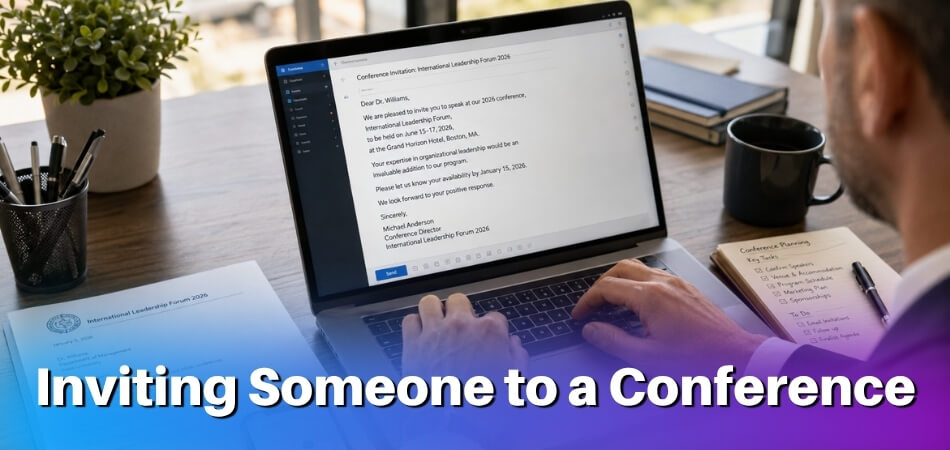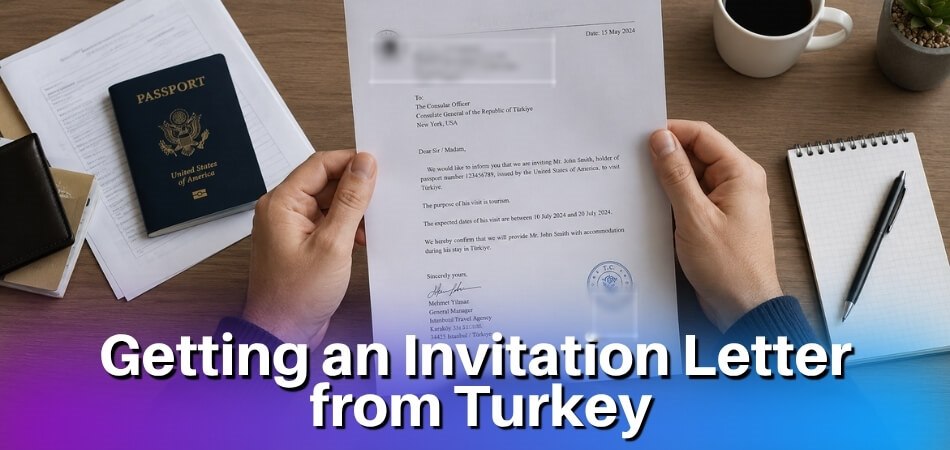

An invitation letter looks like a simple courtesy, yet people read it closely and act on it. A speaker decides whether to travel, an employer decides whether to approve the trip, and sometimes an embassy decides what to make of it. Writing it well saves everyone a round of follow-up questions.
Quick answer: A formal conference invitation letter names the recipient, the conference, the dates and venue (or online platform), the invitee’s role, who pays for what, an RSVP deadline, and a signatory with contact details. A visa-support version also needs the exact passport name and number. It can support a visa application, but it never guarantees approval.
Fact-checked by the MS International Editorial Team. Last verified against official sources: October 2026.
A wrong format or one missing detail can hold up everyone from a keynote speaker to a visa officer. This guide covers the structure of the letter, ready-to-use templates for each recipient type, the visa-support version, printed versus digital delivery, virtual and hybrid events, follow-up, and the mistakes that cause the most trouble.
What a Formal Conference Invitation Letter Must Include
A formal conference invitation letter must identify the event, the invitee’s role, the organizer and the RSVP method. In my view, it is more than a courtesy notice. Recipients use it to get travel approval from an employer, to apply for a visa, or to confirm participation at an institution, so every version needs the same core elements.

The Non-Negotiable Core Elements
These apply to a printed letter, an email, or a digital letter for a hybrid or virtual event.
| Element | What to write |
| Event identification | Full conference name (not an internal abbreviation), organizing body, dates, and location or platform, near the top |
| The specific invitation | What the person is invited to do. “We would like to invite you to attend” is too vague when someone needs to know their role |
| Organizer contact and authority | Full name, title, organization, email and phone of the signatory, so a consular officer can verify the source. A signature alone is not enough |
| RSVP instructions | A clear deadline and a clear response route (email address, online form, or both). “At your earliest convenience” causes delays |
| Reference number | A unique identifier. It helps consulates cross-check several letters and helps your team track responses without sorting names by hand |
Extra Details for a Visa-Support Letter
Consular officers read these letters to judge whether the conference is real and whether the applicant has a genuine reason to attend. On top of the core elements, add the conference website or institutional affiliation, a statement that the invitee attends in a defined official capacity (speaker, delegate, panelist or other), and what costs, if any, the organizer covers. The full list is in the visa section below.
Do not guess at consular requirements. Rules change and missions interpret documents differently, so point the recipient to the official embassy or immigration website for the country they are applying to. Your letter supports their application. It does not replace their own check of current requirements.
Format Considerations by Invitation Type
Business conference invitation. Use formal letterhead and a concise tone. Senior professionals get many of these, and a two-page letter is not read more carefully than a focused one-pager.
Keynote speaker invitation. Add a short description of the audience, the expected attendance and any compensation or reimbursement. Speakers judge partly on whether the event fits their profile.
Delegate invitation letters. These are often templated and issued in volume. Each one must still be individually addressed, correctly titled, and name the conference in full.
Hybrid conference invitations. Say clearly whether the invitee is asked to attend in person, remotely, or can choose. Ambiguity here needs a second round of emails to fix.
Standard Format and Structure of a Formal Conference Invitation Letter
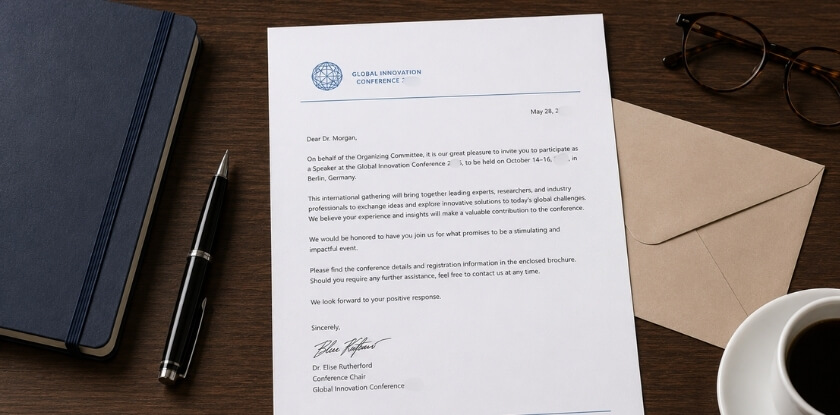
The letter follows a fixed order: header, opening line, conference details, the invitee’s role, RSVP, and closing. Recipients, particularly international delegates and visa officers, need to find specific information quickly, and knowing where each piece goes saves you from reorganizing later.
Header: Sender and Recipient Details
The header sits above the salutation. On the sender side, give the full name of the organization, the department if relevant, the mailing address, a direct email and a phone number. A printed letter usually carries this in the official letterhead. An email or digital letter still needs it at the top or in the signature block.
Below that, add the date of writing, then the recipient’s full name, title, organization and address. This matters most for a formal printed invitation or a letter that will be submitted to an embassy.
My advice is to get the name and title right. A letter to “Dr. Sarah Chen” that still says “Dear [Speaker Name]” in the body undermines everything else you wrote.
Opening Line and Purpose Statement
State the purpose plainly in the first sentence, without a paragraph of pleasantries. For a speaker, something like this works: “On behalf of [Organization Name], I am pleased to invite you to speak at [Conference Name], to be held on [Date] in [City].” That one sentence tells the recipient what the letter is, what the event is and why they are being contacted.
For a delegate or sponsor, the framing shifts to what you are inviting them to do or offer. A panelist letter might open by naming the panel topic and why the recipient fits it. Keep the opening to two or three sentences, then move to the details.
Conference Details: Date, Venue and Theme
Give the full conference name, the dates with the day of the week, the venue name and city, and the theme. For an international event, add the country, because a recipient in another region should not have to guess where your city is. For a virtual or hybrid event, say so directly and explain how the online part works.
If the conference runs several days, give the full span. Concrete dates cut back-and-forth: “early November” invites emails asking for the exact dates, while “November 6 to 8, 2026” does not.
The Invitee’s Specific Role
This is the part that makes the letter personal. The reader should understand exactly what is expected.
- Keynote: session name, length, and whether there is a Q&A period.
- Panelist: panel topic, other participants if confirmed, and format.
- Sponsor: the sponsorship tiers and what the organization receives in return.
Add the logistics: whether travel and accommodation are covered, whether there is an honorarium, and what materials (biography, headshot, slides) you need and by when. If you need a 45-minute keynote with slides two weeks in advance, say so here.
RSVP and Contact Information
Give the deadline, the response method (email, online form, phone) and a named contact with a direct email and phone number. For international guests, include the country code. If you have a registration portal or a reference code, include them. For a multi-day event with parallel sessions, ask which days or sessions the person plans to attend. “Please confirm your participation by [Date]” is clearer than “we hope to hear from you soon”, and for any event with limited capacity the deadline matters.
In an email the RSVP can be a button or form. In a printed letter, a reply card or a plain “please respond to” line does the same job.
Closing and Signature
Close briefly: one sentence saying you look forward to the person’s participation, then a standard closing such as “Yours sincerely,” or “With warm regards,”. The signature block repeats the sender’s full name, job title, organization and direct contact details. On a printed official letter, particularly a visa-support one, the signature should be handwritten, and the organization’s stamp or seal helps.
If you attach anything, list it as “Enclosures” at the bottom: the program, accommodation information, the travel reimbursement policy, or a separate visa letter.
Templates by Recipient Type
Different recipients need different letters. I would treat the templates below as starting points. Adjust the specifics to your event, your organization and the person you are addressing.
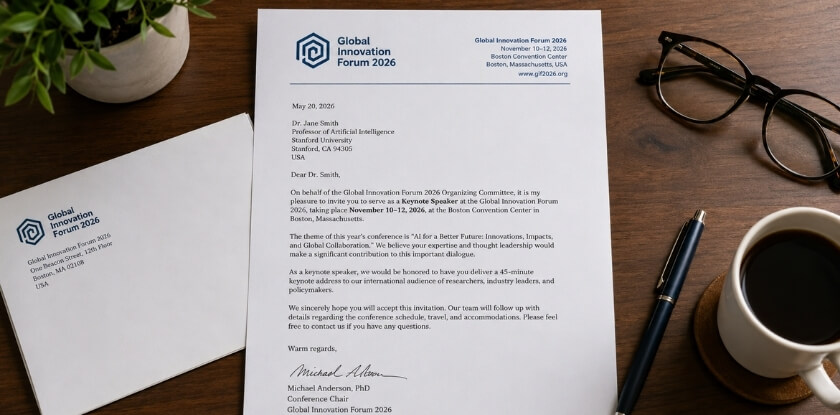
Invitation Letter for a Guest Speaker, Keynote or Panelist
A keynote or panel letter asks someone to commit time, often including travel and preparation, so lead with why you chose them specifically. The same template serves both roles. For a panelist, swap the keynote sentence for the panel line shown in brackets.
[Your Organization’s Letterhead]
Date: [Date]
[Speaker’s Full Name] [Title, Organization] [Address]
Dear [Dr./Mr./Ms. Last Name],
It is my pleasure to invite you to deliver the keynote address at [Conference Name], to be held on [Date] at [Venue, City]. [For a panelist, use instead: We would like to invite you to join a panel session titled “[Panel Title]”, which will bring together [brief description of the other panelists] and be moderated by [Moderator Name, if confirmed].] This year’s conference theme is “[Theme],” and your work on [specific area of expertise] makes you a natural fit for the conversation we are hoping to lead.
We expect approximately [number] attendees from [industries/sectors], and your session is scheduled for [time slot, e.g., 45 minutes including Q&A]. [Your organization] will cover [travel, accommodation, honorarium: list exactly what you are offering].
We would be honored to have you join us. Could you confirm your availability by [RSVP date]? I am happy to arrange a call to discuss the format and any questions you may have.
Yours sincerely, [Your Full Name] [Title] [Organization] [Phone / Email]
Invitation Letter for a Business Partner or Sponsor
A sponsor letter is part formal correspondence, part pitch. Lead with the opportunity, give the basic event details, and point toward a conversation rather than asking for a yes or no up front.
[Your Organization’s Letterhead]
Date: [Date]
[Contact Name] [Title, Company] [Address]
Dear [Mr./Ms. Last Name],
[Conference Name], scheduled for [Date] at [Venue, City], is [one-line description of the event, e.g., an annual forum for senior professionals in the logistics and supply chain sector]. We are inviting select organizations to partner with us for this year’s edition, and we would like to explore what a collaboration might look like with [Company Name].
Sponsorship opportunities range from [brief tier description, e.g., exhibition space and branding packages to exclusive session sponsorships]. A detailed prospectus is attached or available on request.
We would welcome the chance to speak with you directly about how this event aligns with your goals. Would you be available for a brief call the week of [proposed week]?
Kind regards,
[Your Full Name] [Title] [Organization] [Phone / Email]
Invitation Letter for General Attendees or Delegates
A delegate letter confirms the event details, explains how to register and, if needed, serves as supporting paperwork for a visa application.
[Your Organization’s Letterhead]
Date: [Date]
[Attendee’s Full Name] [Title, Organization] [Address]
Dear [Mr./Ms. Last Name],
On behalf of [Organizing Body], we are pleased to invite you to attend [Conference Name], taking place on [Date(s)] at [Venue, City / Online Platform]. The conference will focus on [one-sentence description of theme or subject area], and we look forward to having you participate.
Registration details and the full program are available at [website URL]. To confirm your attendance, please register by [registration deadline] at [registration link or contact]. If you require an official invitation letter for visa purposes, please contact [name/email] directly, and we will provide the necessary documentation.
Should you have any questions about logistics, accommodation, or the program, please do not hesitate to reach out.
We look forward to welcoming you to [Conference Name].
Sincerely,
[Your Full Name] [Title / Role] [Organization] [Address, Phone, Email, Website]
If it will support a visa application, follow the checklist in the next section.
What to Emphasize for Each Recipient
The core content stays the same: event name, date, venue, purpose and RSVP. What changes is the emphasis, the level of detail and the tone, so that the reader can tell you are writing to this person and not sending one letter to two hundred people with the names swapped.
| Recipient | Lead with | Also include |
| Guest speaker or keynote | Why you chose them: reference an actual talk, publication or position, not generic flattery | Session length and format (solo, panel, fireside chat), audience size, whether it is recorded, what you offer in return (travel, accommodation, honorarium, free registration), and a direct contact. Even “expenses covered but no fee” should be stated upfront |
| Panelist | The panel topic and why they fit it | Who else is on the panel, the moderator’s role, and whether questions are sent in advance |
| Sponsor | Reach: estimated attendance, industry mix, media coverage, past editions | The specific tier (logo placement, exhibition space, speaking slot, delegate list access), the investment or the prospectus. Sponsors want value before logistics |
| Delegate | Event details, registration process and deadlines | For international events: full conference name, venue address, dates, official contact details and a reference number, which a consulate can use to check the letter. For online events: the platform, whether links are unique, and whether sessions are live or on demand |
| International attendee | Practical detail domestic letters skip | Time zone references (a plain-text schedule in UTC, not only local time), currency in any fee, and whether remote participation is possible |
Relationship matters too. For a returning speaker or long-standing sponsor, one sentence about the previous edition adds sincerity a first-contact letter cannot have. For a first-time invitee, the letter must build credibility on its own with a brief line about the organizing institution, the conference’s standing in its field, or past attendee profiles.
Match the tone to the reader as well. “We would love for you to join us!” is fine in an email to general attendees. It is out of place in a keynote or sponsor letter to a corporate contact, and an overly stiff letter that reads like a legal document gives no sense of why the person was chosen.
Invitation Letter for Visa or International Travel Purpose
A visa-support letter is a formal declaration from the organizer that confirms the named person has been invited, the event is real and scheduled, and the host organization is legitimate. It is written for a government officer, who has no interest in your agenda and every interest in verification. Getting it wrong can delay someone’s application.
An invitation letter is also not always required. For Canadian visitor visas, IRCC says it sometimes asks an applicant to provide a letter of invitation from someone in Canada, and that such a letter does not guarantee a visa. Officers still decide whether the person meets the entry requirements. My advice is to write the letter as helpful evidence and never promise an outcome.
What the Letter Must Include
Most conference visa-support letters should cover the following.
- The host organization’s full details. Name, registered address, contact information, and ideally an official letterhead or stamp. Add a registration or tax identification number if you have one. An anonymous-looking letter raises red flags.
- The invitee’s full legal name, date of birth and passport number. Match them exactly to the passport. Any discrepancy between the letter and the travel document creates problems at the embassy.
- Conference name, website, location and exact dates. Include the full venue address. An event with a physical address is easier to confirm than “an international conference”.
- The invitee’s role. Delegate, panelist, speaker or keynote speaker. This clarifies why this particular person is being invited.
- Whether the organization is covering any costs. If you cover registration, accommodation or travel, say so explicitly. If the invitee funds the trip, state that too. Leaving it open creates questions the applicant must answer separately.
- An authorized signature. A named official such as a conference director or department head should sign, with title, direct contact information and date of signing visible. A generic stamp is not enough.
Financial and Sponsorship Declarations
Some applications need a separate financial guarantee or sponsor letter, particularly for attendees from countries facing stricter immigration scrutiny. If your letter also serves as a financial support document, state who bears which costs and specify the currency and scope.
A sponsoring organization may need to add bank letters, corporate guarantees or proof of funding. Check whether the consulate wants these as attachments or as standalone submissions.
One Letter per Applicant
For an international event with several nationalities, issue one letter per applicant rather than a group letter. Embassies process applications per person, and one letter naming twenty attendees is awkward for an officer reviewing one file.
What Immigration Authorities Say About the Letter
Official guidance treats the letter as supporting evidence, and it differs by country. Share these points with invitees, and tell them to check the current page for their own destination.
| Destination | What the official guidance says |
| Canada (IRCC) | Business visitors attending a conference are told to carry a letter of invitation from the Canadian host business or a letter of recognition from the Canada Border Services Agency. If the event is registered with IRCC, the organizer includes the event code in the letter and participants enter it on their visa application. There is no separate application for business visitors. IRCC also asks organizers to give their guests 24-hour contact details for a business representative. |
| United States (State Department) | A letter of invitation is not needed to apply for a visitor visa. If an applicant brings one to the interview, it is not one of the factors used to decide the visa. |
| United Kingdom (Home Office) | The supporting documents guide tells people attending a business event or conference to provide a letter of invitation from the organizer of the event. |
Rules beyond the letter also change. The US B-1/B-2 visa bond became a permanent program on 3 August 2026 and can apply to some applicants, with amounts of $10,000, $15,000 or $20,000, and US interview waivers have been narrower since 1 October 2025. An invitation letter does not replace those checks, so tell applicants to read the State Department’s current guidance.
A Sample Structure for the Visa Invitation Letter
This model suits a delegate or speaker attending in person. Adjust it to your organization, the recipient’s role and any consulate requirements.
[Organization Letterhead]
[Date]
To Whom It May Concern,
We write to confirm that [Full Legal Name of Invitee], born on [Date of Birth], holder of passport number [XXXXXXXXX], has been formally invited to attend the [Full Conference Name], to be held at [Venue Name and Full Address], from [Start Date] to [End Date].
[Invitee’s Full Name] will be participating as a [delegate / keynote speaker / panelist / presenter] at this event. The conference is organized by [Organization Full Name], a [briefly describe the organization, e.g., registered academic association / international professional body / research institute] based at [Organization Address].
[Select one of the following, as applicable:]
The full costs of the invitee’s registration, accommodation, and local transportation during the event will be borne by [Organization Name].
or
The invitee will be responsible for their own travel, accommodation, and subsistence costs for the duration of their visit.
We respectfully request that the relevant authorities give favorable consideration to this visa application. For any verification or further information, please contact the undersigned directly.
Yours sincerely,
[Full Name of Authorized Signatory] [Title] [Organization Name] [Direct Email] [Direct Phone] [Date]
Disclaimer: this article is general information, not legal or immigration advice. An invitation letter supports an application but does not guarantee a visa or entry. Always check the current rules on the official website of the embassy or immigration authority.
Digital vs. Printed Invitation Letters: Which to Send and When
Use a printed, signed letter when an embassy asks for an original or a senior recipient will rely on it, and a digital letter for everything else. In my view, choosing the right format saves back-and-forth and, for international travelers, real problems.

When a Printed Invitation Letter Is the Right Call
Visa and immigration purposes. Some embassies and consulates want a signed original on official letterhead, while others accept a signed PDF. A screenshot of an email will not do.
Formal senior-level invitations. A keynote invitation to a high-profile academic, a government minister or a CEO lands with more weight as a physical letter, especially when you are asking the person to travel internationally.
Sponsor and institutional recipients. A letter to a corporate partner’s executive office, or to a government or institutional body, often moves faster through internal approvals as a signed, printed document. Email can get lost or deprioritized.
When a Digital Invitation Letter Works Well
General attendees. A well-formatted email is the standard way to reach a broad delegate list. It is easy to track, simple to add RSVP instructions to, and can carry a formal PDF if a signed record is needed.
Virtual and hybrid events. The logistics are digital by nature, so a digital letter with clear RSVP instructions and a registration link is appropriate.
Panelists and session contributors. Once someone has expressed interest, a PDF on letterhead attached to an email is professional and efficient.
International events with a separate visa document. It is common to send the general invitation digitally and then issue a separate signed visa letter, printed if the embassy asks for one, only to attendees who need one.
Printed vs. Digital: A Quick Decision Guide
| Situation | Recommended Format |
| Visa invitation letter for conference | Signed, on official letterhead; printed original if the embassy asks for one |
| Keynote or guest speaker invitation | Printed preferred; digital acceptable if relationship is established |
| General delegate or attendee invitation | Digital (email + PDF attachment) |
| Sponsor invitation letter to corporate HQ | Printed preferred |
| Panelist invitation letter | Digital fine |
| Virtual or hybrid conference invitation | Digital; in-person international guests also need the visa letter |
| Follow-up after initial invitation sent | Digital (email) |
| International attendee needing proof of invitation | Signed PDF or printed copy, as the consulate asks |
How to Write a Short Invitation Email
A short invitation email must still answer four questions: who is inviting whom, what the event is, when and where it takes place, and what you want the recipient to do. If it skips one, the recipient ignores it or writes back for basics, which defeats the point of being brief.
Structure of a Short Email
Open with the ask. Put the conference name, the date and the role or action in the first two lines: “I’m writing on behalf of [Organization] to invite you to speak at [Conference Name], taking place on [Date] in [City].”
Keep the context tight. One short paragraph on the field, the expected audience size and why this person fits. Mention the specific session or topic you have in mind.
State the RSVP clearly. Give the method, the deadline and a contact, and keep them out of the signature.
Close in one sentence, then your name, title and organization. To me, five to eight sentences is a reasonable total. Beyond that, a proper letter is the better format.
For a digital letter or email campaign, recipients scan rather than read. Put the event name and date at the very top, use one short paragraph per point (what it is, who should attend, how to register), and make the RSVP a button, link or bolded address. For a virtual or hybrid event, state the format so people know whether to arrange travel.
If international attendees may need visa paperwork, add one line saying a formal letter for visa purposes is available on request. Keep that line the only visa mention: do not add passport details or visa-support wording to the email itself, because if the informal email gets submitted to an embassy it can cause confusion.
A Sample Short Email (Guest Speaker)
Subject: Speaker Invitation: [Conference Name], [Date]
Dear [Name],
My name is [Your Name], and I’m the [Title] at [Organization]. We’re hosting [Conference Name] on [Date] in [City/Online], focused on [brief topic description], and we’d like to invite you to deliver a keynote on [proposed topic or your area of expertise].
The event brings together approximately [number] professionals from [industry/region]. We believe your work on [specific subject] would be a strong fit for our audience.
Could you let us know by [RSVP deadline] whether this is something you’d be open to? I’m happy to share a full briefing document, including logistical details and any honorarium information, once you’ve confirmed interest.
Please feel free to reach me at [email] or [phone number].
Best regards,
[Full Name] [Title], [Organization]
Follow-Up After Sending a Conference Invitation
Follow up once about a week after the invitation for speakers and panelists, and once more shortly before the RSVP deadline. Most recipients are busy people with crowded inboxes, and a single letter rarely gets an immediate answer.
When to Follow Up
The timing depends on the lead time you gave. For a speaker or keynote invitation sent 8 to 12 weeks out, wait about 7 to 10 days. For sponsor invitations sent closer to the event, 4 to 5 days is reasonable. Anchor on your RSVP deadline and follow up 3 to 4 days before it, not after it passes. Delegate campaigns usually need only one follow-up near the registration deadline. International recipients who need a visa letter deserve a faster follow-up, because their travel and embassy timelines are tighter.
What a Follow-Up Should Say
A follow-up is shorter than the original. Reference your first message, restate the key date and the RSVP deadline, and offer a direct way to respond: a reply email, a booking link or a call. Three or four sentences are enough. Attach the original as a PDF instead of pasting it into the body. If the recipient is an international speaker, mention that you can send the visa letter promptly once they confirm.
For a virtual or hybrid event, remind non-respondents of the lower barrier, with no travel and no accommodation, since that sometimes persuades people who were undecided. A follow-up to a keynote speaker can be warmer, particularly if you have worked together before. A follow-up to a delegate or business recipient should stay formally professional.
How Many Times to Follow Up
In my view, after those two follow-ups you should move on and fill the slot. The exception is an ongoing relationship with a panelist or sponsor, where a phone call or a note through a mutual contact can be appropriate after two unanswered emails.
Tracking Responses
Use a simple spreadsheet or CRM. Record each recipient, the date sent, the date of each follow-up and the response status. With several recipient types this prevents double follow-ups and missed people.
Flag visa-related responses separately. Guests who confirm and need a visa letter should move to a priority list at once, since their paperwork has a hard external deadline tied to embassy processing.
Log each RSVP the day it arrives, whether it came by email or post. Reconciling the list only at the deadline creates unnecessary pressure.
If Someone Declines
Respond graciously when a conference invitation gets declined, and keep the door open for future events. For speaker slots, keep a short backup list so one decline does not leave a gap in the program. If the person is a speaker or panelist, ask whether they can suggest an alternative, since some of the best last-minute additions come from referrals. For visa-related declines caused by documentation or timing, note the reason, because it tells you how early to send international invitations next time.
Virtual and Hybrid Conference Invitation Letters
A virtual or hybrid invitation keeps the same structure as an in-person one: organization, event details, purpose and RSVP. What changes is the logistical content, and a generic template will create confusion if it ignores that.
What Changes in a Virtual Conference Invitation
Specify the platform (Zoom, Microsoft Teams or another), how the attendee receives the access link, and whether they must register separately on the platform. For an international audience, state session times in at least two time zones or link to a world clock. Do not assume everyone reads “9:00 AM” as 9:00 AM where you are.
Mention technical requirements only if they are non-standard, such as a software download, a specific browser or a pre-event tech check. Put key access details (platform, date, time, registration link) near the top of a digital letter so attendees can find their login without scrolling past three paragraphs of context.
A speaker joining remotely should also be told their allocated time, who their contact is for technical preparation, whether they are expected to share their screen or someone will handle their slides, and whether a rehearsal is scheduled.
What Changes in a Hybrid Conference Invitation
A hybrid letter is effectively two letters in one. The biggest mistake is sending the same text to in-person and remote attendees, when the details that matter to someone flying in are not those that matter to someone joining from a home office.
Either use clearly labeled sections (venue, accommodation and travel for in-person guests; platform access and time zones for virtual guests) or send separate letters. I prefer separate letters: they take more effort but cause less confusion on the day. The RSVP should ask how each person will attend, in person or online, because that drives your headcount, room capacity and streaming setup.
International Virtual Attendees and Visas
Remote attendees generally do not need a visa invitation letter. Some, however, want documentation for employer reimbursement or institutional records. In that case, issue a separate participation or confirmation letter, worded accurately, instead of a visa letter. For a hybrid event, in-person international guests still go through the embassy process, so they need the full visa-support letter described above.
Template Outline for a Hybrid Conference Invitation
Fill in the bracketed fields. The outline also works for a virtual-only event if you delete the in-person paragraph.
[Organization Letterhead / Event Logo]
[Date]
Dear [Recipient Name],
We are pleased to invite you to [Conference Name], to be held on [Date(s)]. This year’s conference will be conducted in a hybrid format, with in-person sessions at [Venue Name, City] and live virtual access for remote participants.
If you are attending in person: [Insert venue address, registration desk location, and any relevant accommodation or travel details.]
If you are attending virtually: Sessions will be hosted on [Platform Name]. You will receive your individual access link at [email address on file] following your registration confirmation. Sessions will run from [Start Time] to [End Time] [Time Zone]. If you are joining from a different region, please confirm your local equivalent at [time zone converter link or resource].
To confirm your attendance and participation mode, please RSVP by [RSVP Deadline] to [contact email or registration link].
If you have any questions about platform access or the in-person program, please contact [Name] at [email address].
We look forward to your participation.
[Signature block]
Common Mistakes and a Pre-Send Checklist
The mistakes that hurt most are vague details, a missing role, no RSVP route, a deadline that ignores visa timing, and spelling errors in the recipient’s name. To me, most are easy to fix once you know where to look.

Details, Role and RSVP
Leaving out the basics. Many letters fail to state dates, venue and session times clearly. Missing details bring a flood of follow-up emails.
Omitting the specific role. When the role is vague, recipients often decline because they do not know what they are agreeing to. Say whether it is a keynote, a panel seat or a workshop, and give the time commitment.
Ambiguous RSVP instructions. State how to respond, who to contact and by what date. For delegates and international guests, also say what you need back, such as dietary requirements, travel details or session preferences.
A deadline that ignores visa timing. Recipients who need a visa letter may need it weeks or months before the event. An RSVP deadline set too close to the event creates a problem no goodwill can fix.
Burying the call to action. The reader should know within the first two paragraphs what they are invited to and what you need from them. If the ask sits at the end after paragraphs of background, many people skim past it.
Hiding the format. A virtual or hybrid event with no technical details, or an invitation that lets someone discover later that the “conference” is a video link, wastes everyone’s time.
Tone, Template and Identity Errors
One template for everyone. A single generic letter sent to speakers, sponsors and delegates reads as lazy. A sponsor letter needs the value proposition and a visa letter needs organizational detail that a speaker letter lacks. The wrong format sent to the wrong person causes confusion and occasionally offense.
Missing identity. Letters without letterhead, a contact name, a direct email or a phone number are hard to verify, which matters most for recipients who need the letter for a visa.
Spelling the name or title wrong. It is the most avoidable mistake and one of the most damaging. Check names, honorifics, affiliations and titles, especially for senior guests.
Quick Dos and Don’ts
| Do | Don’t |
| State the purpose in the opening line | Send a generic letter that could have gone to anyone. Reference the speaker’s recent work or the sponsor’s relevant audience |
| Use official letterhead and a real signature. An unsigned letter on a plain template raises red flags at embassies | Use a casual tone for a formal occasion. Overly brief or informal wording can undermine how legitimate the event looks |
| Keep it to one page, with a second page only for program details that cannot be summarized | Write a four-page invitation. It suggests you have not prioritized the reader’s time |
| Send early: about six weeks ahead for domestic guests and at least three months ahead for international travel | Send a formal letter closer than that, which leaves recipients no time for visas, flights and scheduling |
| Confirm receipt of any visa letter, so there is a record if the applicant runs into problems at the consulate | Mix digital and printed formats carelessly. Ask whether the embassy wants a printed original or accepts a signed PDF |
Review Before Sending
Have one more person read every invitation before it goes out. Check the event details against your master schedule, verify each name and title independently, and confirm that the RSVP instructions match what your registration system supports. For international and visa-related letters, ask someone familiar with those requirements to review the content.
From our experience at MS International: at MS International Conferences Inc., the invitation letter for a registered participant is issued within 3 to 5 business days after payment clears, and a US$50 administrative fee may apply to corrections requested after the letter has been issued. Because our conferences are held in person in the Greater Toronto Area, the letter names a physical venue. Whichever organizer you use, collect passport details once, check them against the passport page, and ask the invitee to confirm the spelling before you sign.
Frequently Asked Questions (FAQ)
Writing formally to different recipients means deciding on timing, printed or emailed delivery, RSVP instructions, and whether one letter can double as visa support.
Do I need a different letter for each type of recipient?
Yes. A speaker letter focuses on the role, session topic and any honorarium or travel arrangement, a sponsor letter on tiers and brand visibility, and a delegate letter on registration and the program. One generic letter for everyone reads as impersonal.
How far in advance should I send the invitation?
Send it about six weeks ahead for domestic attendees and at least three months ahead for international guests who need a visa letter. Keynote speakers often need more notice because their calendars fill quickly.
Is an email invitation acceptable, or does it need to be a printed letter?
An email is acceptable for most recipients, including delegates and panelists. For keynote speakers, sponsors and anyone who needs a letter for a visa, send a signed PDF or printed letter on official letterhead. A plain email is unlikely to be accepted as visa support, so check the consulate’s rules.
Do I need an invitation letter to get a visa for a conference?
Not always. The US State Department says a letter of invitation is not needed to apply for a visitor visa, while IRCC and the UK Home Office guidance name a letter from the host or organizer among supporting documents for conference visitors. Check the embassy’s own checklist.
What should RSVP instructions include?
They should include a clear deadline, the name or email address to respond to, and what you need back, such as confirmation of attendance, dietary requirements or session preferences. Vague instructions mean guesswork for both sides.
Can one letter serve as both a conference invitation and a visa support letter?
Yes, if it carries the visa details: the invitee’s exact passport name and number, the full dates and venue, the role, who covers costs, and a signatory with contact information. A general invitation without those details is unlikely to work as visa support.
Do virtual conference invitations need the same level of formality?
Yes, the same professionalism applies. A virtual invitation should also give the platform, the time zone for all session times, and access instructions. A hybrid invitation must explain the in-person and online paths separately.
Is there a required length for a formal invitation letter?
No. A local delegate letter may be half a page, and a letter to an international keynote speaker with full program details may run to two pages. Include everything the recipient needs to decide and nothing they do not.
Can I use a conference invitation template as-is?
A template gives you the structure, but the content must be personalized. A letter with only the name swapped in rarely gets a strong response from senior speakers or sponsors, so customize the body to show what the invitation offers that particular recipient.
Who should sign the invitation letter?
The most senior person relevant to the invitation. For a keynote, that is typically the conference chair or the head of the organizing body. For delegate letters sent in volume, the event director is appropriate. For a visa letter, the signatory needs organizational authority and visible title and contact details.
Final Thoughts
A good formal invitation letter is clear, specific and respectful of the reader’s time. My advice: put the essential details first, tailor the tone to the recipient, and follow up if you do not hear back. Keep a clean template for each recipient type and update it for every event.