
Many aspiring speakers spend years waiting to be discovered. They sit in the audience at conferences, watch someone far less knowledgeable hold a microphone, and quietly assume their expertise will speak for itself. It rarely does. The people filling calendars with keynote speaking engagements are not always the most qualified in the room. They are the ones who built a system around getting booked.
Quick answer: To get keynote speaking engagements, choose a narrow niche, build a one-sheet, demo reel and speaker website, then speak at local events to collect footage and testimonials. Pitch organizers with short, specific emails, and approach bureaus once you have a track record. Keynote slots are usually decided by the organizing committee, so build a visible record first.
This article covers the whole path: defining your positioning, building your materials, getting your first stages, pitching organizers, collecting proof, setting a fee and handling contracts, joining a bureau, and moving to bigger stages.
How to Get Keynote Speaking Engagements
Getting booked comes down to three things working together: a clear positioning, visible proof of your expertise, and steady outreach to the right people.
Many speakers who struggle are not short of knowledge. Event organizers simply can’t tell quickly what the speaker does, who they serve, or why they belong on a particular stage. That is the problem to solve first.
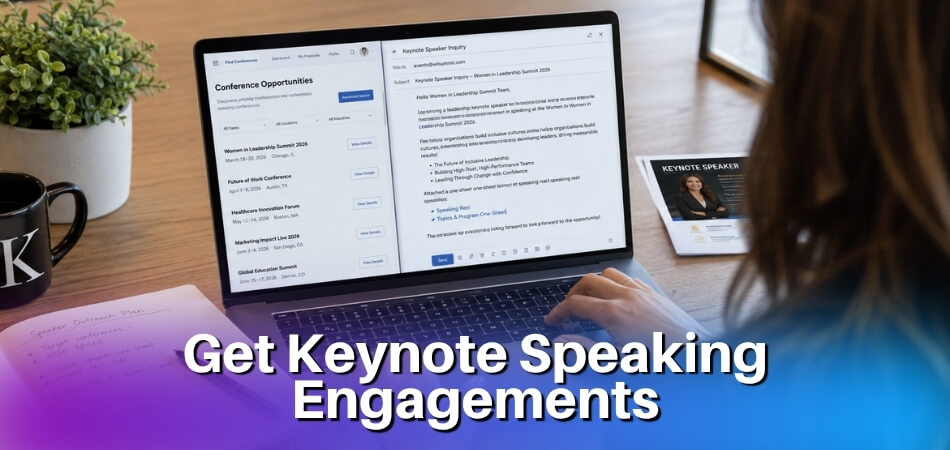
The Short Version of the System
Build four things before you pitch anyone. Each one has its own step below.
| Asset | Its job | Details in |
|---|---|---|
| A defined niche | Tells organizers exactly which audience problem you solve | Step 1 |
| A speaker website with a landing page | The place organizers go to vet you: topic, audience, bio, reel, testimonials, contact | Step 2 |
| A demo reel (sizzle reel) | Short video of you on stage with an audience reacting | Step 2 |
| A speaker one-sheet | One-page PDF of your website, easy for an organizer to forward internally | Step 2 |
Then You Need Bookings to Build From
You will probably start with free or low-fee local speaking. That is not a detour. It is how you generate footage, testimonials and the track record that bigger stages and bureaus look for. Local chambers, industry meetups, corporate lunch-and-learns and regional conferences are legitimate starting points, so treat each one as a professional engagement.
The Outreach Part
Once your materials are solid, outreach is simple, even if it takes time. Search LinkedIn for event organizers, conference chairs and association executives in your niche. Look at who spoke at the conferences you want, then at what other events those speakers did. Keep your first message brief, name the event, and point to your reel.
Bureaus come later, after you have momentum. The full route from first local talk to paid national stages varies a lot from person to person, but plan on a year or more of steady positioning and outreach rather than a few weeks.
Step 1: Define Your Niche and Speaking Topic
Pick one audience and one problem. Clarity on your niche is what makes you bookable, because no one can book a speaker when they can’t work out what that person speaks about.

Why Generalists Lose the Stage
Organizers don’t search for “a good speaker.” They search for someone who can solve a specific problem for a specific audience on a specific day. A website that says “I speak on leadership, mindset, sales and personal growth” puts you in the pile with everyone else.
A conference for women in financial services doesn’t want a general leadership speaker. It wants the person who speaks to women moving up in finance. “Leadership” is too broad. “Leadership transitions for mid-career women in financial services” is bookable.
How to Find Your Niche
Start with what you know deeply and have real results in, either your own or those you helped others reach. Ask yourself three questions:
- What industry or audience do you have the most credibility with?
- What problem do you solve that people actually pay to fix?
- Where does your experience meet a gap in the speaking market?
You are looking for the overlap between genuine expertise and an audience that needs it. A former ICU nurse who speaks on burnout prevention for healthcare teams has a niche. A generic “resilience speaker” does not.
Narrowing Your Topic Without Losing Opportunities
Many people fear that going narrow shrinks the pool of gigs. In practice the opposite tends to happen. With a specific, named topic, organizers can see where you fit on their program, sell you to their committee, and justify your fee.
A niche also travels. A speaker on psychological safety at work can book corporate conferences, health systems, education summits and government agencies from the same core topic. The niche is the message, and you adapt the examples to each audience.
Getting Your Positioning Right
Write one sentence that names who you speak to, what you help them do, and why it matters.
A weak version: “I help leaders unlock their potential.”
A strong version: “I help mid-market manufacturing companies reduce frontline turnover by building cultures where floor managers actually want to stay.”
The second gets you on a shortlist. The first gets you skipped. This sentence shapes your one-sheet, your pitches, your LinkedIn profile and how organizers describe you to their committees, so make it specific before you build anything else.
Step 2: Build Your Speaker Foundation
You need a one-sheet, a website and a demo reel before your first pitch. Organizers have many speakers to choose from, and without professional materials to evaluate, you give them nothing to judge you by. These assets do the selling when you’re not in the room.
Create a Speaker One-Sheet and Media Kit
A one-sheet is a single page that tells an organizer everything needed to decide whether to book a call with you. Include:
- your name, speaking topic and positioning
- a short bio in the third person
- two or three sample talk titles with brief descriptions
- a professional headshot and your contact details
- a few testimonials from people who have seen you speak
Keep it to one page. Organizers don’t read five-page PDFs from speakers they’ve never heard of.
The media kit goes a level deeper. It is the folder you hand over once someone is seriously interested: a longer bio, high-resolution photos, detailed topics, press mentions or past credits, a fee range if you have one, and technical or logistical needs. Host it as a downloadable PDF on your site or share it as a cloud-drive link. Both documents should look polished; hire a designer if you need to, because a poorly formatted one-sheet signals you’re not ready for a professional stage.
Build a Speaker Website or Landing Page
You need a dedicated speaker website or, at minimum, a focused landing page. Sending decision-makers to a general business site or a blog is a missed opportunity. Its one job is to turn a curious organizer into someone who contacts you, so every element should serve that.
At minimum include:
- A clear headline stating who you are, what you speak about and who your audience is
- A short clip or your full demo reel
- Your speaking topics with brief descriptions
- Past events or organizations you’ve spoken for, even small local ones
- Testimonials from organizers or audience members
- A simple contact or inquiry form
- A download link for your one-sheet or media kit
Ideally the domain is your name (yourname.com) or close to it. The page doesn’t need to be complex; a clean single page built on WordPress or a similar platform works. It must load fast, look credible and make action easy.
Create a Demo Reel (Sizzle Reel)
The demo reel is the most important asset in your toolkit. Organizers want to see you before they book you, and a well-cut video gives them that chance.
A strong reel runs about two to three minutes; BigSpeak, a speakers bureau, gives the same range in its demo reel guide. Open with your most compelling 15 seconds, a moment where the audience is visibly laughing, leaning forward or affected. Then cut through clips of you on different stages, with audience reactions, event branding and short testimonial soundbites.
If you have no large-stage footage yet, start with what you have: a chamber of commerce talk, a company training session, a TEDx event, a Rotary Club presentation. Venue quality matters less than your ability to command the room on camera. If you have nothing recorded, film your next local talk properly and use that. Dress for the camera at that talk as well, because solid colors and calm patterns film better than fine stripes, which can shimmer on video.
A few things sink an otherwise decent reel: talking-head footage with no audience visible, long unedited segments, poor audio, and opening with your name and credentials instead of a strong speaking moment. Organizers don’t need your resume in the first 30 seconds. They need to feel something.
Host the finished reel on YouTube or Vimeo and put it first on your website. A bureau will ask for it immediately, and any serious decision-maker will watch it before answering your pitch.
Step 3: Start Getting on Stages (Free and Local First)
Get in front of real audiences early, even unpaid ones. One live delivery teaches you more than a hundred rehearsals in your living room, and small stages build the reps, recordings and credibility that attract paid engagements later.
Free vs Paid Speaking: When to Speak for Free
Speaking for free isn’t a failure. It is a deliberate investment when the conditions make sense. The table shows how to tell the difference.
| Say yes when | Say no or ask for a fee when |
|---|---|
| You get usable video for your demo reel | The audience has no connection to your goals |
| You reach a new audience segment or a room full of your exact target clients | The organization has a budget but expects you to waive your fee because you’re new |
| A well-known organizer will give you a testimonial | The gig costs you time and builds nothing |
If you walk off stage with good footage and two solid testimonials, that gig has paid for itself in future bookings.
In your first six to twelve months, free speaking should be targeted, not reflexive. Once you have strong social proof, a polished reel and a record of solid talks, you can start naming a fee and hold to it. Many speakers begin with a modest amount at local or regional events and raise it as their profile grows. What matters is that you start the transition on purpose, not by accident. Step 6 covers fees.
Where to Find Your First Speaking Opportunities
Your first stages won’t come from a bureau or a cold pitch to a national conference. They come from networks already around you.
- Local professional associations. Chambers of commerce, industry associations, Rotary clubs and networking groups run regular events and need speakers. They aren’t glamorous, but the audiences are real and the organizers are often well connected.
- Meetups and community events. Scan platforms like Meetup.com. In tech, HR, finance, wellness, marketing and most other fields, active local groups host speakers every month.
- Podcasts. A guest appearance isn’t a physical stage, but it builds credibility, creates shareable content and puts your name in front of niche audiences. Many decision-makers listen to industry podcasts.
- Internal company events. If you’re employed, volunteer to present at an all-hands, a team training or an offsite. If you’re a consultant, ask clients whether their team would benefit from a talk. These are low-stakes rooms with real audiences.
- LinkedIn. Your main channel for finding local opportunities. Post about your topic consistently, engage with organizers, and message people who run industry events nearby. A short note on who you are, what you speak on and why it fits their audience takes two minutes and sometimes lands a date within weeks.
When you reach out, keep it short and share your one-sheet or website link. If you don’t have a recording yet, say so and offer to do the talk free in exchange for footage. Many local organizers understand and are happy to help.
The goal at this stage is volume of reps. Each live talk shows you what works in your material and pacing, which rehearsing alone does not. A speaking club such as Toastmasters is another place to get regular practice and feedback.
Speaking at a Conference Through a Call for Papers
Not every stage is reached by pitching. Many academic and professional conferences fill most of their program through a call for papers or call for speakers: you submit an abstract or proposal by a deadline, reviewers decide, and accepted authors present. Keynote and invited slots are usually decided separately by the organizing committee.
Some societies state in their committee rules that committee members propose the keynote speakers, so a keynote usually follows from a visible record, not from a submitted abstract. For a first stage at a research conference, the call-for-papers route is the realistic one.
Step 4: Pitch Event Organizers Directly
A targeted, specific pitch beats a mass email every time. Waiting to be discovered rarely works. Speakers with full calendars send pitches, and how you approach decision-makers matters more here than raw talent.
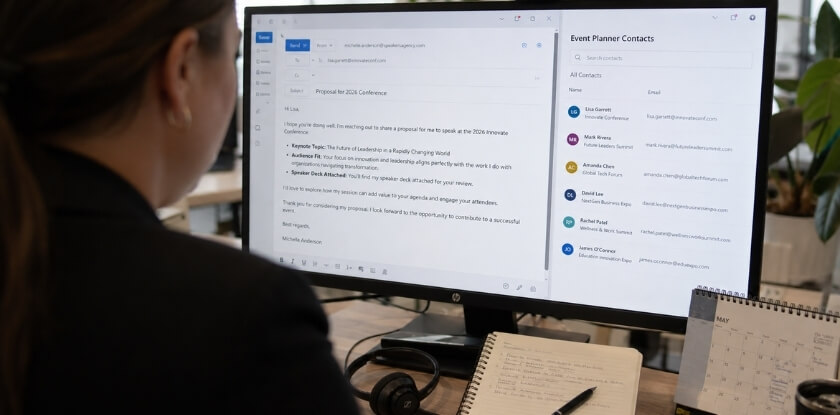
Research the Right Events First
Sending one pitch to a hundred random conferences gets you ignored. A short, targeted list of events that fit your niche will do far better.
Identify conferences where your topic fits the program naturally. If you speak on supply chain resilience, aim for logistics and operations events, not general business summits. Search industry associations, trade publications and LinkedIn event listings, and look at who spoke last year. If those speakers resemble you, the event belongs on your list.
Then read each event’s website closely. Many have a “call for speakers” or “submit a proposal” page, and some post deadlines months ahead. Note when submissions open, because pitching after the program is set is wasted effort.
When to Pitch: Lead Times
Timing decides whether a pitch can still be used. Two speaker-industry sources give booking windows, and both come from businesses that sell to speakers or organizers, so treat them as guidance rather than rules.
| Source | Lead time it gives |
|---|---|
| Axia PR (September 2026) | Big conferences typically confirm keynote speakers six to nine months out, sometimes a year. Local and virtual events confirm about three months or more ahead. |
| Futurists Speakers (a speakers agency, writing for organizers) | Outreach 6 to 12 months before the event, and 9 to 12 months for major events with large crowds. |
For you, that means a keynote pitch for a large conference belongs in the planning window well before the event, and each conference’s own call or website is the final word on deadlines.
Craft a Pitch That Actually Gets Read
Organizers receive many pitches for each slot, and a generic “I’d love to speak at your event” gets deleted. Your pitch should make their job easier.
Cover four things: who you are, the specific talk you propose, why it serves their audience, and proof you can deliver it. Keep the body to four to six sentences, with links to your website, reel and one-sheet so everything is in one place.
Specificity earns the reply. Name the event, mention a theme from last year’s program, and name the audience you would address. An organizer can usually tell quickly whether you read their details or just found their email address.
A formal call for speakers often asks for more than an email. One speaker guide (SavvyCal, 2022) breaks a proposal into five parts: the main idea, the problem it solves, the action you want the audience to take, three to five key takeaways, and your credentials. Write these once, then adapt them to each event’s theme.
A format that works:
Subject: Session proposal for [Conference Name] on [Your Topic]
Hi [Name],
I’m a [brief positioning line, e.g. “supply chain consultant who works with mid-market manufacturers”], and I’d like to propose a session for [Conference Name].
The talk is “[Session Title]”, a 45-minute keynote that gives attendees a practical framework for [specific outcome]. Your [Year] program focused on [theme], so I think it fits the [track name] audience well.
I’ve given this talk for [relevant event or organization]; a short clip is here: [demo reel link]. My one-sheet, with full bio and session details, is here: [link].
Glad to answer any questions. Thank you for your time.
[Your name]
Leave out the long biography, the list of every topic you cover and testimonials pasted into the body. Those belong on your website, where you link to them.
Follow Up Without Being Annoying
Wait two weeks after the first pitch, then send one follow-up of two sentences: acknowledge they are busy and ask directly whether the session fits their program. If a second follow-up brings no answer, move on. Chasing further damages the relationship, so leave the door open for next year’s event.
Use LinkedIn to Warm Up the Relationship
Warm contacts are easier than cold ones: SavvyCal’s guide advises starting with organizers you know or can reach through a mutual contact, and building rapport on social media before a cold message. Connect with the event director or program chair a few weeks before you write, and engage genuinely with something they posted, such as a recap of their last conference. When your email arrives, your name isn’t foreign to them. This takes longer, but it gives your email a better chance of being read.
Tailor Your Ask Based on the Event
| Event type | How to frame your ask |
|---|---|
| Small local events | Offer the session without a fee and say so upfront. It removes friction. |
| Regional or national conferences | Mention your fee without pressure. A line like “My standard fee is $X, though I’m open to discussing what works for your budget” keeps the conversation open. |
| Bureaus and international stages | Relationships come from referrals and track record, not cold outreach. Testimonials, audience survey results and strong reel footage weigh far more than anything you write about yourself. |
Track Everything in a Simple System
Pitching without tracking is chaotic. A spreadsheet is enough: event name, organizer contact, date pitched, follow-up date and status. Review it weekly. Over time you will see which subject lines get replies, which session titles draw interest and which conferences deserve a second try. That data is worth more than any template.
Step 5: Collect Testimonials and Social Proof
Testimonials turn a curious organizer into one who books you. A polished website, sharp reel and good pitch still leave decision-makers hesitating if nothing from real audiences or organizers confirms that you deliver.
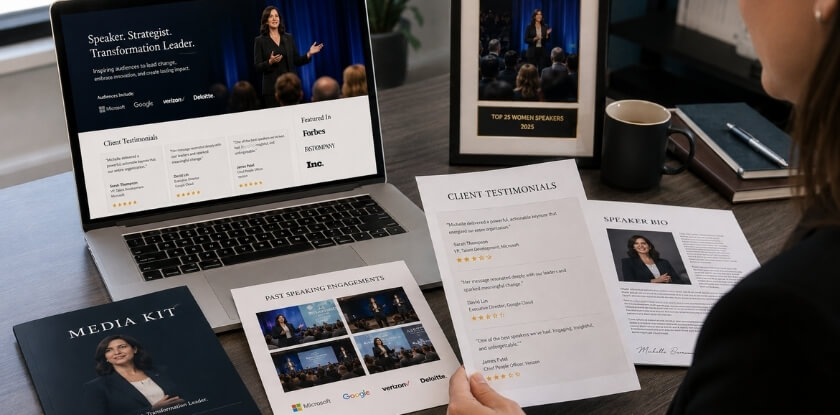
Ask Immediately After You Speak
The best window is within a day or two of the talk, while the experience is fresh. Send a brief message that thanks them, mentions a specific moment from the event, and asks for a short quote. Many people are glad to do it; they just need to be asked. After about two weeks the energy has faded and replies thin out. Ask organizers for a written testimonial and a referral to other organizers who book your topic at the same time. A quote signed “Director of Programs, XYZ Regional Conference” carries more weight than a line from someone’s personal profile.
Who to Ask
Not every testimonial weighs the same. Prioritize these sources:
- Event organizers and conference chairs carry the most credibility with other organizers. A quote from someone who hired you, describing what you delivered and how the audience responded, is what the next decision-maker wants to read.
- Audience members in positions of authority add another layer. A CEO or department head saying your talk changed how their team thinks about a problem is specific, powerful proof.
- Other speakers or emcees who shared a stage with you can vouch for your professionalism and stage presence, which matters to producers building a multi-speaker lineup.
What Makes a Useful Testimonial
“Great speaker, highly recommend!” does almost nothing. Push gently for specifics: the event context, a concrete result or reaction, and the person’s name and title. If you receive a generic line, reply with a follow-up:
Thank you, that means a lot. Would you be comfortable adding a line about how the audience responded or what shifted for them after the talk?
Many people will revise it if you ask kindly.
Where to Use Your Social Proof
Put strong testimonials to work wherever a decision-maker might look:
- Speaker website: two or three of your best quotes on the homepage and speaking page, not buried in a “testimonials” tab nobody clicks.
- One-sheet and media kit: at least one each, ideally from a named organizer with their organization, so it reinforces credibility just as someone reviews your materials.
- LinkedIn profile: post a testimonial as a featured item, or ask the organizer to write a recommendation directly on your profile. Those are public and visible.
- Pitch emails: a single relevant quote in the body is more persuasive than any adjective you could use about yourself.
Video Social Proof
Written quotes are solid; video is stronger. A 30-second clip of an organizer or audience member speaking to camera about your talk is a valuable addition to your demo reel. You don’t need a crew. A smartphone video recorded right after the event, with decent light and clear audio, works fine, and an on-the-spot reaction often reads better than something polished.
Building It Incrementally
You won’t have ten strong testimonials after your first few talks, and that’s fine. Start with what you have, replace weaker quotes as better ones arrive, and treat this as an ongoing habit. After enough events you will have quotes from local meetups, regional conferences and eventually national stages, and that progression tells its own story to the organizers you approach later.
Step 6: Set Your Speaking Fee and Negotiate Contracts
There is no standard rate card for speakers. Pricing is one of the most confusing parts of a speaking career: no public price list exists, and other speakers often give vague answers when asked what they charge. This section covers how to set a number you can defend and what to expect when a contract arrives.
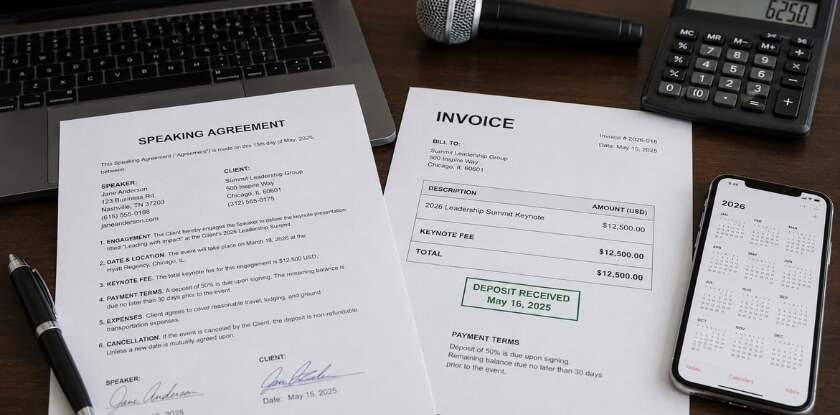
How to Set Your Speaking Fee
Your fee should reflect your positioning, your audience’s expectations and what the market will bear, not just how long you’ve been speaking. Newer speakers often work for free or for travel costs only. Once you have a solid reel, a few strong testimonials and a website with a real one-sheet, you can move into an entry-level paid range. Published figures for that range vary widely by industry, region and event type, so check current sources in your own niche instead of trusting a single number.
Research what the market pays in your niche. Organizers often know the going rate better than speakers do. Check bureau listings in your topic area and see how speakers at your level describe their fees on their own sites. Some bureaus show fee ranges publicly, which gives you a real anchor.
Set a fee you can grow into. Many speakers undercharge because they fear a “no” means no bookings. Underpricing doesn’t make you more bookable; it trains organizers to see you as the low-fee option. Price yourself on the value of your expertise and the events you want to be on in 18 months.
Consider the event type before quoting. A large corporation’s internal leadership conference has a different budget from a regional nonprofit summit, and corporate audiences generally pay more than association or academic ones. Adjust your anchor, and decide in advance whether you will discount for nonprofits, causes you care about, or events that offer real exposure.
Have a fee range, not just one number. Your base fee covers the keynote itself. Travel, hotel and A/V may be billed separately. Know the gap between your minimum and your ideal fee so you know where you can negotiate without dropping below what makes the engagement worthwhile.
Once you work with a bureau, expect it to take a commission. The National Speakers Association Colorado chapter’s bureau guide (copyright 2020) says commissions are typically 20 to 30%, with 25% the most common rate at the time of writing. Rates are negotiated, so ask early and build the commission into your pricing so the net payment doesn’t surprise you.
How to Negotiate Speaking Contracts
Organizers will usually send a speaking contract; if they don’t, send your own. Verbal agreements protect nobody, and professional speakers get everything in writing.
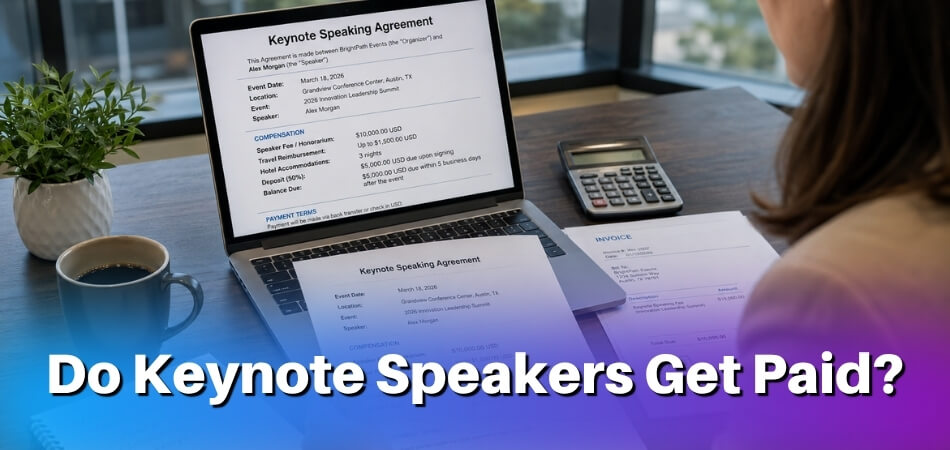
Know what belongs in every contract. The basics are your fee, payment terms (deposit amount and due date, balance due date), travel and accommodation arrangements, the event date and your expected on-site time, the length and format of the session, and any exclusivity clause.
Read exclusivity clauses closely. Some organizers want you to agree not to speak at a competing event within a set window. That is often reasonable, but check the scope. A clause blocking you from speaking in the same industry for six months in any city is a much bigger ask than one saying you won’t keynote a direct competitor in the same week.
Deposit terms matter. Terms vary: some speakers ask for a deposit at signing with the balance due on or before the event, and some larger organizations pay a set number of days after the event. If a client wants to pay everything afterward with no deposit, pause and ask why, and for higher fees protect yourself with a deposit before booking travel.
Don’t give away content rights unknowingly. Many contracts let the organizer record and distribute your keynote. That affects your ability to use the footage in your own reel or resell the content. You can negotiate. A common middle ground is that the organizer uses the recording internally and you keep the right to use a clip for promotion.
If a client pushes back on your fee, decide in advance what you would trade for a lower rate: national stage exposure, a high-profile recording, or guaranteed introductions to other decision-makers. A reduced fee in exchange for nothing is just a discount. Know the difference so you negotiate from a clear position instead of reacting in the moment.
When contract review starts eating real time, have an entertainment or speaker-focused attorney review your standard contract once. You won’t need a lawyer for every engagement, but a solid template gives you confidence in every negotiation after that.
Step 7: Get Listed on a Speakers Bureau
A bureau is a third-party booking agent, and it only lists proven speakers. Organizers planning large corporate conferences, association events and national or international stages often go to bureaus rather than searching alone, so being listed puts you in front of buyers already looking to hire.
Bureaus are selective, though. Many won’t list a speaker without a track record, a polished website, a strong reel and verifiable paid speaking history. Applying before those pieces exist usually gets you nowhere.
Know Which Type of Bureau to Approach First
Start with the right tier.
| Bureau tier | What it expects |
|---|---|
| Boutique and niche bureaus | The most accessible entry point. Many specialize by industry (healthcare, technology, leadership, education) and seek defined niche expertise over generalists. A strong positioning angle plus a few paid engagements can be enough. |
| Mid-tier bureaus | Regional and national stages. They expect a professional media kit, a reel of about two to three minutes, solid organizer testimonials and an established fee. If you’ve never charged for a talk, many won’t take you seriously. |
| Top-tier bureaus | Work with household-name speakers and need a public profile that sells you before you send an email: published books, major media appearances or a large following tied to your topic. A long-term target, not a starting point. |
What Bureaus Actually Evaluate
Bureaus earn a commission on every booking, so they list only speakers they believe they can sell. Reviewers look at a few specific things:
- Demo reel: probably the single most important item. It must show you commanding a room, not standing behind a podium.
- One-sheet: your topic, audience fit and fee range at a glance.
- Social proof: client testimonials, event logos and press mentions show other organizations have already trusted you.
- Realistic fee: bureaus generally want speakers whose established fees make a commission worth their time, which is why they rarely take on beginners.
How to Submit and Follow Up
Many bureaus have a submission form on their website. Fill it out completely instead of linking to a bare-bones page and expecting them to dig. Include your website URL, reel link, one-sheet as a downloadable PDF, and a short paragraph on your niche and target audience.
Don’t expect a fast reply, since bureau staff field many inquiries. A follow-up two to three weeks after submission is reasonable; anything more aggressive tends to backfire. If you get a rejection or silence, treat it as timing rather than a closed door. Keep building your track record, update your materials, and reapply in six to twelve months with stronger evidence of demand.
A Few Places Worth Researching
The National Speakers Association (NSA) offers education and community for professional speakers, and its local chapters often discuss how to work with bureaus. eSpeakers is a platform where speakers create profiles that bureaus and organizers search directly, and SpeakerHub lets you keep a profile visible to decision-makers internationally. Before signing anything, check that a bureau is legitimate and ask how it treats enquiries that reach you directly: the NSA Colorado bureau guide says bureaus expect leads to be booked through them. Watch for similar names too. The National Speakers Bureau in Canada, for example, states on its own site that it is not affiliated with the separate US entity of the same name.
Getting listed on one bureau rarely fills your calendar. Aim to be findable in several places, so your name comes up more than once when an organizer goes looking.
Bureau Listings Don’t Replace Your Own Outreach
A roster spot is a credibility signal and a distribution channel, but it is passive. Speakers who build sustainable careers usually keep pitching organizers while also being listed. The bureau relationship pays off over time as your LinkedIn visibility, media appearances and fee history grow. Treat bureau listings as one part of a larger system, not the system itself.
Step 8: Scale from Local to National and International Stages
Scaling means treating your speaking career like a business with a growth plan. Getting booked locally is a real achievement, but the speakers who make the jump aren’t always the most talented. They are the ones with a strategy.

Treat Every Stage as a Credential
Each engagement adds to a portfolio that opens the next door. After every talk, document it: update your website, add the event to your LinkedIn profile, and request a video clip for your reel. Decision-makers at larger events check your record before replying. A thin list of obscure local events won’t move them, but a clearly documented progression will.
Build a Deliberate Step-Up Path
| Move | How to do it |
|---|---|
| Target one tier above where you’ve been | After local meetups, pitch regional industry conferences. After two or three of those, approach national association events. Credibility compounds with each tier. |
| Map the conference calendar in your niche | Many industries have a predictable annual circuit of association conferences, trade shows and leadership summits. Build a spreadsheet of events you want within 18 months, find who books speakers for each, and track those contacts. That turns vague ambition into an outreach schedule. |
| Update your one-sheet as credits grow | A sheet listing a national conference gets you in front of international organizers in a way one with only local credits won’t. Your media kit should show where you’re headed, not just where you’ve been. |
Make Your Online Presence Do Outreach Work
Your website must signal the level you are targeting. If everything points to free talks at local chambers, that is the tier of inquiry you’ll get. Add national credits prominently, keep your reel showing the largest stages you’ve been on, and write your bio as if you already speak at the conferences you want.
LinkedIn is where many decision-makers quietly vet speakers before reaching out. Post consistently about your niche, share clips from recent talks, and engage with organizers in your space. Inbound interest from this channel is slow to start and then reliable once established.
Pursue International Stages with Precision
International keynotes take more preparation than pitching overseas events. You must show that your content travels, meaning your frameworks and examples aren’t so culturally specific that they miss in a different context.
- Research the audience before pitching. An international organizer who gets a pitch showing real understanding of their region’s professional context reads it differently from one that feels copied from a domestic pitch. Customize the outreach even if the core message stays the same.
- Get listed with bureaus that work internationally. Many place speakers at European, Asia-Pacific or Middle Eastern events. Once your fee and materials are in their system, organizers in those markets can find you when a cold pitch never would have.
- Plan the logistics of your fee structure. Your fee may need to account for international travel, time-zone conflicts on prep calls and longer lead times. Put those terms in your contract before negotiation starts. Experienced international organizers expect it.
- Check entry requirements early. Speaking in another country can involve visa or work-permit rules, and they differ by country and event, so confirm them with the organizer well before you travel.
Know When to Hire Help
At a certain volume, handling your own outreach, contracts and calendar slows your growth. A speaking agent or a bureau relationship absorbs a large share of that work, and some speakers hire a virtual assistant to research conferences, identify decision-makers and track follow-ups. You don’t need a high fee to justify support. If admin is eating the hours you should spend on content and relationships, offloading it makes sense earlier than most speakers expect.
From our experience at MS International: For most applicants, the route to our in-person conferences in the Greater Toronto Area is the presenting-author track: submit work for review and register after acceptance. A keynote or invited role is arranged separately with our organizing team, and buying an author registration does not create one. Speakers cover their own travel, accommodation, visa, transportation and personal expenses, and participation creates no entitlement to an honorarium, speaker fee or travel reimbursement unless it has been agreed in writing, so ask early and keep the written confirmation.
FAQ
Moving from free gigs to paid keynotes turns on a starting fee, a demo reel, a speaker one-sheet and the jump from national to international stages.
How long does it take to start getting paid keynote speaking engagements?
There is no fixed time; sources range from a few months to several years. One speaker-marketing guide (Axia PR, September 2026) advises committing to at least a year before judging results. Free local talks usually come first, so plan for months, not weeks.
Do I need a speakers bureau to get booked?
No. A bureau is one route, not a requirement. The Speaker Lab (August 2024) says a bureau does not replace the foundational work of building a speaking business. A bureau helps most once you have an established fee, so keep pitching organizers yourself.
What should my speaking fee be when I’m just starting out?
There is no standard figure. One speaker-marketing guide (That Company, updated May 2024) gives $500 to $2,500 for a single talk, but such guides come from sellers of speaker services, not surveys. Many beginners speak free or for expenses first, then add a modest fee once proof is strong.
Is a demo reel really necessary?
It is not strictly required, but it is a strong selling tool: BigSpeak, a speakers bureau, calls it one of the best selling tools a keynote speaker can have. Aim for about two to three minutes of real audience footage. If you have none, record your next local talk.
Should I build a speaker website or is LinkedIn enough?
LinkedIn is not enough on its own. It builds visibility, but a website gives organizers one place to check your topics, watch your reel, read testimonials, download your one-sheet and contact you. Use LinkedIn to send people there.
How many free speaking engagements do I need before I start charging?
There is no fixed number. Aim for enough local talks to fill your reel with genuine crowd footage and collect several strong testimonials. Your own proof matters more than a count, so start naming a fee once organizers regularly say yes to you.
What goes in a speaker one-sheet?
A one-sheet holds your topic, a short bio, a professional photo, key testimonials and your booking contact, all on a single page. Organizers compare many speakers, so a cluttered two-page document loses them. Add two or three sample talk titles.
Do speaking contracts really matter for small events?
Yes, even for small gigs. A basic contract confirms your fee, any travel arrangements, A/V needs and cancellation terms. Without one you have no protection if the event cancels or fails to pay. Many organizers send their own contract, and a speaker who sends one is not seen as difficult.
How do I move from national stages to international stages?
Target international conferences in your niche that already bring in outside speakers. Get listed with a bureau that has global reach, post video clips on LinkedIn, and make your website say you are available for international bookings. Organizers search for speakers the same way domestic ones do.
What’s the fastest way to get in front of event organizers?
A direct, specific pitch email. Name their event, say why your topic fits their audience, and link your demo reel. Mass emails get ignored. LinkedIn also works well for industry events where organizers are active, particularly if you engage with them first.
Where to Start This Week
Getting keynote speaking engagements is a process that compounds. Choose a niche, build your one-sheet, website and reel, take any fitting stage, and trade free talks for paid ones as your proof grows. The early unglamorous steps are the easiest to skip, and skipping them keeps people stuck.