

Many people hold back a conference certificate because they only attended and never spoke. Attending still takes time and money, and it can show up on a resume honestly if you handle it the right way.
Quick answer: Yes, you can add a conference certificate of participation to your resume when the event is relevant to your field or target role and the organizer is genuine. List it under Professional Development or Training, not under Certifications, because it proves attendance, not a tested skill. Entry-level candidates gain the most. Speaker or presentation certificates are stronger and can go higher on the page.
This article covers when a participation certificate helps, where it goes, how to word the entry, and how a speaker certificate differs.
Add a Conference Certificate of Participation to Your Resume
Yes, you can add it, but whether you should depends on where you are in your career and what the certificate actually shows.
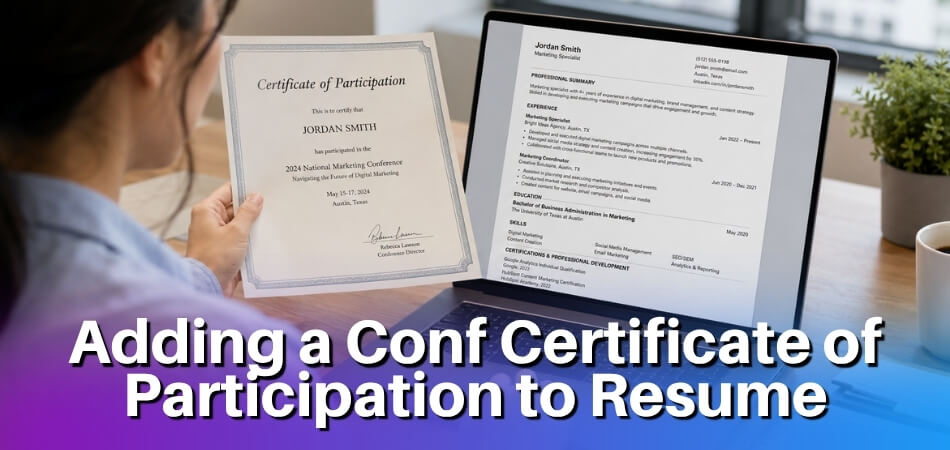
A participation certificate shows you attended a professional event. That is useful context for entry-level professionals building a track record, or for anyone in an industry where continuing education is publicly expected, such as healthcare or IT. For experienced professionals with years of credentials behind them, a basic attendance certificate rarely adds much.
The type of certificate also matters. A speaker or presentation certificate signals active contribution rather than attendance. If you presented at a recognized industry conference, that is worth listing. If you sat in on sessions, the bar is higher before it earns resume space.
The practical rule: include it if it is recent, relevant to the job you are applying for, and from a conference your target employer would recognize. Leave it out if it is old, generic, or if your resume already has stronger professional development entries that make it redundant. An online certificate from a credible organizer counts the same as an in-person one; one from a low-profile event with no industry recognition can raise questions rather than answer them.
What Is a Conference Certificate of Participation and What Types Exist
Conferences issue different certificates depending on your role at the event. Knowing what you actually received, and what it tells a hiring manager, helps you describe it accurately.
Participation Certificate vs Presentation / Speaker Certificate
A participation certificate (sometimes called a certificate of attendance) goes to attendees who registered and showed up. Many organizers send these automatically, and at large events every registrant may get one regardless of how engaged they were. It documents presence, not contribution.
Neither one is a certification. The Institute for Credentialing Excellence separates an assessment-based certificate program, where the assessment is linked directly to the learning event, from a professional certification, where the assessment is independent of any single course and recognizes competence against set standards. A plain attendance certificate has neither kind of assessment.
A speaker certificate or presentation certificate goes to someone who delivered a talk, ran a workshop, or led a session. It is usually issued separately and reflects an active role: you were vetted, scheduled, and placed in front of an audience. One confirms attendance, the other confirms delivery.
| Certificate | What it shows | Best place on a resume |
|---|---|---|
| Participation / attendance | You registered and attended | Professional Development or Training |
| Speaker / presentation | You presented, taught or led a session | Conferences & Presentations, or under the relevant job |
| Accredited CPE, CLE or similar credit | Credit hours recognized by a professional body | Continuing Education or Certifications |
| Auto-issued online certificate, no attendance tracking | Almost nothing on its own | Usually leave off |
Which Type of Conference Certificate Carries More Value
A speaker certificate carries considerably more weight than a standard participation certificate, and the gap widens the more experienced you are. Even a presentation certificate from a regional or niche event helps at any career stage, because it shows you were selected to contribute and not only to attend. It points to subject-matter knowledge and public speaking, which attendance cannot.
For entry-level professionals, a participation certificate still has a purpose. It signals that you are engaging with your field, attending events and building professional development habits. In fast-moving fields like marketing or IT, attendance itself shows awareness of current practice. For experienced professionals, a plain attendance certificate adds little, since hiring managers in healthcare, IT and other credentialed industries expect ongoing learning. It should not sit next to continuing education credits or licensed qualifications. The format makes no difference here. In-person or virtual, what matters is your role and the standing of the organizer.
Where and How to Place It on Your Resume
Knowing you can include it is one thing. Knowing where it goes and how to write the entry is what makes it useful.
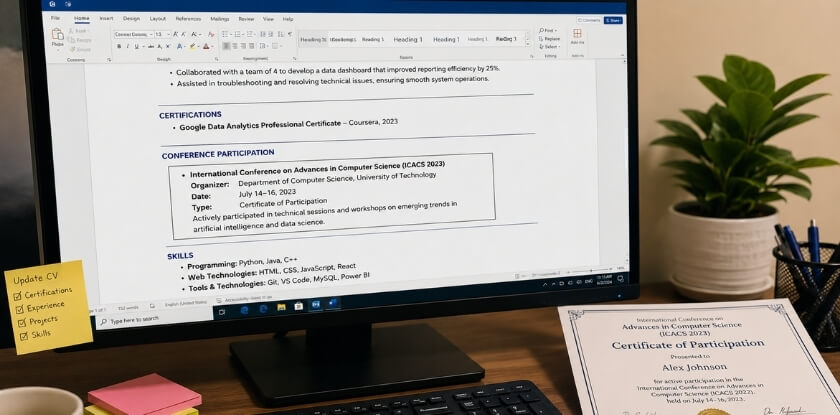
Which Section to Use: Certifications, Professional Development, or Somewhere Else
Professional Development (or Training, or Conferences & Training) is the default home for a participation certificate. It signals initiative without implying the credential equals a licensed certification. If you have no such section yet, start one. For people early in their careers it is the more honest and flexible heading.
A Certifications section fits only when the certificate carries real weight in your field, for example accredited continuing education credit in a regulated profession. If your resume already has a certifications section, keep plain attendance certificates separate so the two are not mixed up.
A speaker or presentation certificate belongs higher. You can list it in a Presentations section, or work it into the Professional Experience section when the talk relates to the role you are applying for.
One thing to avoid: burying a conference certificate under Education. Unless it was part of a structured continuing education program tied to an academic institution, or you are a recent graduate and the event relates to your degree, it does not belong there.
Keep it out of your resume headline and out of the letters you place after your name. Those spots are for earned certifications, and a participation certificate is not one.
Resume, Academic CV or Recent Graduate: Where Conferences Fit
ResumeCoach’s guide to adding conferences suggests the Education section for recent graduates whose events relate to their degree, and a dedicated heading such as Continuing Education or Career Enrichment for established professionals. In higher education, a list of attended conferences can help, especially for a first postdoc application. Whichever heading you choose, use the same one for every similar entry.
How to Format the Entry: Conference Name, Date, and Organizer
Keep the format clean and consistent with the rest of your resume. You do not need a long description. Three details are enough: the full conference name, the organizer, and the month and year.
A standard entry looks like this:
Certificate of Participation: [Full Conference Name], [Conference Organizer], [Month Year]
For a speaker or presenter role, adjust the label:
Presenter Certificate: [Full Conference Name], [Conference Organizer], [Month Year]. Talk title: “[Title of Your Talk]”
You can add the city and country after the organizer if space allows. ResumeCoach’s guide suggests keeping to events from the last five years. Be ready to say in an interview what you took from the event, because an entry you cannot talk about works against you. What you took from the event can also become a short LinkedIn post about the conference once it ends.
How Useful Is It Depending on Career Stage: Entry-Level vs Experienced Professionals
Its value shifts with your career stage. What strengthens an early-career resume can clutter a senior one.
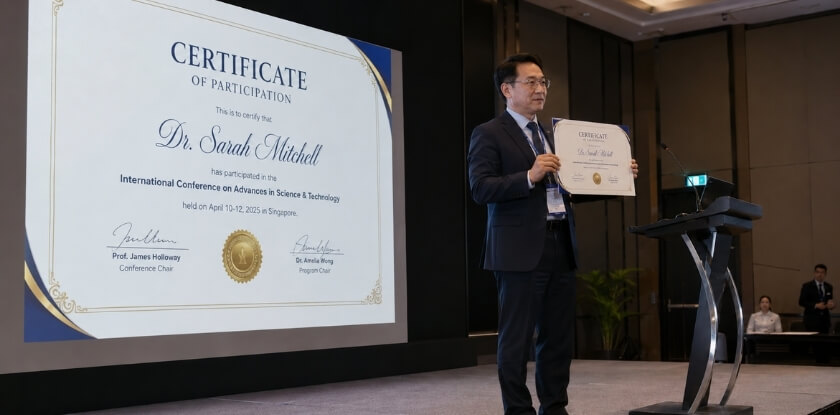
If You’re Entry-Level
With limited job experience, showing that you attended industry conferences signals genuine interest in your field and a proactive attitude. An entry-level candidate in IT who lists a recognized cybersecurity or cloud computing event shows familiarity with the sector beyond classroom training. A recent nursing or allied health graduate benefits similarly, because conference participation shows exposure to clinical standards and continuing education before formal employment begins. Presenting as an early-career professional is uncommon enough to stand out even more.
A few things increase its usefulness:
- The conference is well-known in your target industry. A regional marketing summit or a recognized IT security event adds credibility. A generic half-day webinar with a certificate probably does not.
- The topic connects directly to the role you are applying for. If the job description mentions a skill the conference covered, the link is obvious to a hiring manager.
- You have few or no formal professional credentials yet. A relevant conference entry fills real space while you build your credentials.
If You’re an Experienced Professional
Hiring managers at this level expect ongoing professional development, so attending a conference is assumed, not impressive. A standard participation certificate typically adds little.
There are cases where it still belongs. A speaker or presentation certificate shows you contributed. A certificate from a high-profile national or international event tied to a recognized professional body carries some credibility. And in fields like healthcare, where continuing education is tied to licensing, listing conference-based credit stays relevant at any seniority.
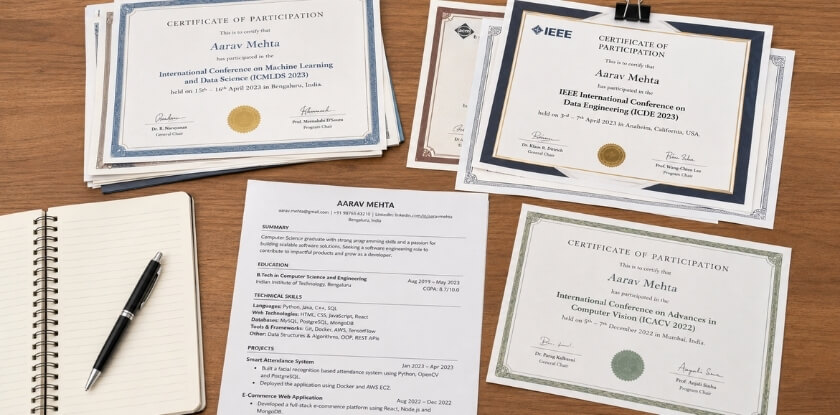
Avoid padding your resume with participation certificates from minor or low-barrier online events just to show activity. Listing several of them makes the section look thin rather than substantive.
The practical rule: keep the certificate if your participation meant something: you presented, the event is respected in your field, or it fulfils a continuing education requirement. If it was a routine attendance certificate and you have enough real experience, leave it off and use the space for stronger material.
How Much It Matters by Industry: IT, Healthcare, Marketing, and Beyond
A participation certificate does not carry the same weight in every field. In some industries it means almost nothing. In others it signals the continuous learning that employers and credentialing bodies expect. Knowing where your industry lands tells you how much resume space to give it.
| Field | How much a participation certificate counts | What helps more |
|---|---|---|
| IT and technology | Small; vendor and exam-based certifications rank higher | Niche event on a framework or security domain; speaker certificate |
| Healthcare | High if the event was accredited for continuing education | Accreditation details from the organizer |
| Marketing and communications | Low, because most people have one | Speaker certificate; clear event name |
| Finance, law, regulated fields | High only with accredited credit | Credit hours and provider named on the document |
| General business roles | Minor | A conference focused on a skill the job needs |
IT and Technology
The IT industry is credential-heavy, but the certifications that matter most tend to be vendor-issued or exam-based, such as AWS, CompTIA, Microsoft or Google Cloud. A participation certificate from a tech conference sits a notch below all of those.
Context changes things. If you attended a specialized event on a niche framework, a security domain or an emerging technology your employer cares about, listing it can signal active engagement. For mid-level and senior IT professionals these certificates rarely move the needle alone. For someone early in their career, relevant tech conference participation shows initiative and can support a conversation in interviews.
Healthcare
Healthcare is one of the industries where this matters most. Many licensing boards and employers require documented continuing education, and a certificate from an accredited medical or clinical conference can help satisfy those requirements. Here the certificate is a professional record with a functional purpose, not resume filler.
Nurses, physicians, allied health professionals and medical administrators often list conference participation as part of their continuing education record. The key is whether the event was accredited by a recognized body in your specialty. An accredited certificate carries real weight. A non-accredited one still shows development, but it may not count toward licensure hours, so check your own board’s rules.
Keep your original certificates organized. Employers and licensing renewals may ask for documentation, so the original from the organizer matters beyond the resume line.
Marketing and Communications
Marketing professionals attend many conferences, such as industry events, digital summits and brand strategy forums, so participation certificates are common. A basic one is unlikely to set you apart.
What can set you apart is a speaker or presentation certificate from a recognized event in your niche, for example a talk on a campaign strategy, a channel tactic or an emerging platform. In marketing the conference name often carries more signal than the certificate itself, so state the event name clearly and give the reader context to judge relevance.
Finance, Law, and Other Regulated Professions
Regulated professions often have formal continuing education requirements tied to licensing. CPE (Continuing Professional Education) credits for accountants, CLE (Continuing Legal Education) for attorneys and similar frameworks in financial advising give conference certificates tied to accredited programming direct professional value.
The document itself matters here. You need one that states the accreditation, credit hours and provider, not just a generic participation certificate. If the organizer provides that, it belongs on your resume or your professional development log. If the event was not accredited, treat it as supporting context rather than a formal credential.
Non-Technical and General Business Roles
For generalist roles such as project management, operations, HR and administration, a participation certificate is a minor signal at best. These fields are not credential-driven in the same way, so it will not change how a recruiter reads your profile.
Specificity helps. Listing an industry-specific conference focused on a skill the role needs shows intentional development. A certificate from a well-known professional organization lands better than one from a generic event, simply because the organization’s name adds credibility.
Can You Include an Online Conference Certificate on Your Resume
Yes. An online conference certificate of participation belongs on your resume under the same conditions as an in-person one. Virtual events are a regular part of professional life, so the rules matter.

When an Online Certificate Carries Real Weight
The format matters far less than who organized the event and what it covered. A certificate from a well-regarded industry association’s annual virtual summit is credible. One from a generic webinar hosted by a company nobody knows, with no clear agenda or credentialing body, is harder to defend. Recruiters look at the same things as always: the organizing body, the subject, and the link to the job.
What to Watch Out For With Virtual Events
Some online events issue certificates automatically at registration, with no attendance tracked. If you completed sessions, engaged with the content, and the organizer has a verifiable reputation, include it. If the “certificate” arrived minutes after you signed up and before the event even started, leave it off. A PDF from a one-time video call with no clear host affiliation carries no weight.
How to List It
List it in your professional development block the same way you would an in-person one. You do not need to flag that it was virtual unless the event is known as an online-only series. If it helps establish legitimacy, add the organizer’s name next to the event title.
For example:
[Event Name] (Virtual): Participation Certificate, [Organizer], [Year]
That is clear and honest without underselling the credential.
The Continuing Education Angle
Where continuing education hours are tracked, healthcare in particular but also many licensing-driven roles, online certificates are often accepted toward annual requirements by professional boards, though rules differ by board, so confirm with yours. If your board accepts it, the certificate carries regulatory legitimacy and belongs on your resume whatever the delivery format.
For everyone else the bar stays the same: include it if the content is genuinely relevant to where you are headed.
From our experience at MS International: We run in-person conferences in the Greater Toronto Area, and attendees can register as listeners without presenting. After the scheduled presentation, approved speakers receive a certificate recognizing their attendance and contribution as a conference speaker. It confirms your participation in the event. It is not an academic qualification, professional accreditation, publication certificate or guarantee of an award. Check that your name, organization, position and presentation title are correct before the certificate is prepared.
FAQ
Before a participation certificate goes on your resume, it helps to know how it compares with a certification, where it belongs, whether to add the date and how old is too old.
Is a conference certificate of participation the same as a certification?
No. A participation certificate records that you attended. A certification, like a PMP or a CPA, is awarded after assessment against set standards, independent of any single event. Keep a plain attendance certificate out of a section titled “Certifications.”
Does listing a participation certificate make you look desperate for credentials?
Only if it is the only thing on your resume or is obviously out of place for your experience level. For entry-level professionals building a profile, it is a reasonable addition. For a senior executive it adds little and can be quietly left off.
Can I list a certificate from a conference where I was a speaker?
Yes, and a speaker or presentation certificate carries noticeably more weight than an attendance certificate. If you presented, say so explicitly, either in the certificate entry or in a separate bullet under your work history.
Where exactly on the resume should it go?
Under a “Professional Development” or “Conferences & Training” heading. Keep it out of a Certifications section unless it carries accredited credit, and note that a recent graduate can use Education when the event relates to the degree.
Do online conference certificates count?
Yes, they count the same as in-person ones. What matters is whether the conference was credible. A well-regarded industry event with a recognizable organizer holds up; a generic webinar with no clear sponsor does not.
Should I include the date?
Yes. An undated certificate raises questions. Include the month and year so the reader knows it is recent and relevant.
How old can a conference certificate be on a resume?
A resume guide from ResumeCoach suggests listing only events from the last five years and moving older ones to LinkedIn or a portfolio. Keep an older entry only if the event is directly tied to the job.
What if I attended dozens of conferences over the years?
List only those directly relevant to the role you are applying for, or from well-known events in your field. A long list of generic participation certificates dilutes the resume rather than strengthening it.
Do healthcare or IT employers actually look at these?
In healthcare, conference attendance often ties into continuing education requirements, so it can carry real weight. In IT, recruiters tend to care more about technical certifications, but a major industry event still signals engagement. In marketing, participation is seen as normal professional development and is not a deciding factor.
Is an MS International speaker certificate an academic qualification?
No. The certificate confirms that you spoke at the conference, and nothing more. Do not describe it as a degree, accreditation, publication credit or award.
Final Thoughts
A conference certificate of participation belongs on your resume when it reflects professional development relevant to the role you want. For entry-level professionals it helps fill gaps and signals engagement. For experienced professionals it counts mainly when it is specific: a speaker certificate, a presentation certificate, or credit tied to a recognized event.
If it fits, put it under Professional Development with the conference name, organizer and date. If it adds nothing for a particular application, leave it off.