
Every conference has one spreadsheet that quietly decides whether badges are correct, emails arrive and the registration desk moves fast. It also holds other people’s personal details, which is why it needs more care than most event files.
Quick answer: A conference delegate list is an organized record of the people registered for a conference. It usually holds names, roles, organizations, countries and ticket types, and organizers use it for check-in, badges, communication and follow-up. It contains personal data, so access should be limited and sharing needs consent. Emails offering to sell such lists are a known scam.
Last verified against official sources: October 2026.
Conference Delegate List Meaning
A conference delegate list is a document, spreadsheet, database, or digital directory that records confirmed participants for a conference. It helps organizers identify delegates and manage event tasks in one place.

The Oxford Advanced Learner’s Dictionary gives two meanings of delegate: a person chosen or elected to represent the views of a group and to vote and make decisions for them, and a person who attends a conference. At conferences the word often means a person attending as a representative of a company, institution, association, government body, academic organization, or professional group. In many modern events, it is also used more broadly to describe registered conference participants.
A delegate list may be simple or detailed depending on the size and type of event. A small workshop may only need names, organizations, and emails. A large international conference may need delegate categories, session choices, country details, badge names, and special access information. It is more than an attendance sheet: it shows who is attending, in what role, and how they connect to the purpose of the conference.
Simple Definition of a Conference Delegate List
A conference delegate list is a structured list of registered conference participants used for event planning, communication, networking, and follow-up.
It may appear as:
- A spreadsheet
- A printed check-in sheet
- A registration database
- A secure file for event staff
- A delegate directory inside an event app
- A badge printing or attendance tracking file
The format depends on the conference setup. What matters most is that the list is accurate, updated, easy for authorized users to understand, and handled securely.
Official Delegate Lists and Registration Lists
The term is used in two ways. Formal intergovernmental meetings publish an official list. The International Labour Organization (ILO), for example, publishes a first provisional list of delegations on the opening day of its Conference, with a revised list and a final list at a later stage. That list covers member States’ delegates and advisers named in their official credentials, representatives of international organizations, and registered observers.
Academic, professional, and business events typically work from a registration list kept by the organizer. It is mainly an internal working file, and only limited details are shared, as the access and privacy sections below explain.
Why Delegate Lists Matter for Conferences
Without one clear record, organizers may struggle with duplicate registrations, incorrect badges, missed emails, wrong seating plans, or poor follow-up.
A well-prepared delegate list helps organizers:
- Know who is attending
- Prepare the right number of materials
- Send updates to confirmed participants
- Manage check-in and access
- Create name badges and certificates
- Support networking opportunities
- Follow up after the event
For attendees, a limited delegate list can make networking easier. It helps them find people from relevant industries, organizations, research areas, or countries before and during the conference.
What Is the Purpose of a Conference Delegate List?
The main purpose of a conference delegate list is to help organizers manage participants and deliver a smoother event. It supports planning, communication, logistics, networking, and post-conference follow-up.
A delegate list is useful throughout the event cycle. Before the conference, it helps with preparation. During the conference, it supports registration and coordination. After the event, it helps with feedback, certificates, resources, and continued communication.
Event Planning and Registration Management
Conference planning depends on accurate registration information. Organizers need to know how many people are attending, what type of delegates they are, and what resources are required.
A delegate list helps manage:
- Confirmed registrations
- Pending registrations
- Ticket categories
- Speaker, sponsor, VIP, student, or media status
- Workshop or session selections
- Cancellations and replacements
- On-site registrations
This information helps the event team prepare seating, meals, welcome kits, printed materials, name badges, and certificates. It also reduces confusion when attendees arrive at the venue.
Communication Before, During, and After the Event
A conference delegate list supports clear communication between organizers and participants. Before the conference, organizers may use the list to send registration confirmations, schedules, venue instructions, travel information, payment reminders, or session updates. During the conference, the list can help send urgent notices, room changes, timing updates, or check-in instructions.
After the event, organizers may use it to send thank-you emails, attendance certificates, feedback forms, presentation materials, receipts, or approved future event updates.
Networking and Professional Connections
A limited delegate directory can make networking more intentional by helping participants identify relevant contacts, such as people from similar industries, researchers in related fields, speakers, sponsors, or possible partners and mentors. The networking section below covers how to use it.
Logistics, Seating, Badges, and Materials
Delegate lists also support practical event operations. Common logistical uses include:
- Badge preparation
- Registration desk verification
- Room entry management
- Meal count planning
- Certificate printing
- Workshop attendance tracking
- VIP or speaker coordination
- Help desk support
For larger conferences, the list may be filtered by session, track, ticket type, or access level. This helps staff respond quickly and reduces delays during the event.
Post-Conference Follow-Up
A delegate list remains useful after the conference ends. Post-event use may include:
- Sending certificates
- Sharing presentation slides
- Sending event recordings
- Collecting feedback
- Sending invoices or receipts
- Thanking participants
- Inviting delegates to related future events, if they agreed
The list should only be used for purposes that match the event’s privacy policy and delegate consent.
Conference Delegate List vs Attendee List: What Is the Difference?
A conference delegate list and an attendee list are related, but they are not always the same. A delegate list usually focuses on registered participants with a professional or representative role, while an attendee list may include everyone present at the event.

In some events, these terms are used interchangeably. However, for formal conferences, academic events, government meetings, association programs, and corporate summits, the distinction can be important.
What a Delegate Means at a Conference
A conference delegate is usually a person attending with a defined professional, academic, institutional, or organizational purpose.
A delegate may attend to:
- Represent an organization
- Join discussions
- Present research or ideas
- Attend professional sessions
- Build partnerships
- Participate in meetings
- Share knowledge from their field
For example, a university may send a professor to an academic conference as a delegate. A company may send an executive to represent its business at an industry summit.
What an Attendee Means at a Conference
An attendee is anyone who attends the conference. This is a broader term.
An attendee list may include:
- Delegates
- General participants
- Guests
- Students
- Media representatives
- Speakers
- Sponsors
- Volunteers
- Exhibitors
- Observers
All delegates are attendees, but not all attendees are delegates in the formal sense. Some people may attend only to observe, learn, volunteer, or support event operations.
Key Differences Between Delegates and Attendees
| Point | Conference Delegate | Conference Attendee |
| Meaning | Participant with a formal or professional role | Any person present at the event |
| Scope | More specific | Broader |
| Representation | Often represents an organization or group | May or may not represent anyone |
| Purpose | Participate, connect, discuss, present, or represent | Learn, observe, network, or attend |
| List details | Often includes role, affiliation, country, and category | May include basic registration details |
Understanding this difference helps organizers create better registration forms, badge categories, email segments, and access levels.
What Should Be Included in a Conference Delegate List?
A conference delegate list should include only the information needed to identify, manage, communicate with, and support participants. The best list is complete enough for event use but not overloaded with unnecessary data.
The fields depend on the event type. An academic conference may need affiliations and presentation titles. A business conference may need job titles, industries, and organizations. An international conference may need country details and visa letter status for internal use. Typical fields look like this:
| Information Type | Examples |
| Identity details | Full name, preferred name, registration ID |
| Professional details | Job title, organization, department, industry |
| Location details | City, country, region |
| Event details | Ticket type, delegate category, session choice |
| Contact details | Email, phone number, professional profile link |
| Internal details | Payment status, check-in status, certificate name |
Not every version of the list should include all these fields. The internal organizer version may contain full operational details, while an attendee-facing directory should usually show only limited professional information.
Basic Identification Details
Every delegate list should include basic details that help confirm who registered and who attended: full name, preferred badge name, registration ID, delegate category, ticket type, check-in status, and certificate name.
A registration ID is useful because names can repeat or be entered differently. It gives each delegate a unique reference for registration, payment, attendance, and certificates.
Professional and Organization Details
Professional information makes the list useful for networking, reporting, and session planning. These fields may include:
- Job title
- Organization or institution
- Department
- Industry or field
- Academic affiliation
- Country or region
- Event role
This information helps organizers understand the audience and prepare relevant sessions. It also helps delegates identify people they may want to meet.
Contact Information
Contact details may be necessary for event communication, but they should be protected carefully. Contact fields may include:
- Email address
- Phone number
- Professional profile link
- Organization website
- Mailing address, when required
Emails are often needed for confirmations, reminders, certificates, receipts, and post-event resources. Phone numbers may be useful for urgent communication, but they should not be shared widely. A public or attendee-facing list should usually not show private email addresses or phone numbers unless delegates have agreed to share them.
Optional Information for Large or International Conferences
Large conferences may need extra fields for planning and support:
- Workshop selections
- Meal preferences
- Accessibility requirements
- Language preference
- Arrival date
- Accommodation status
- Visa invitation letter status
- Payment status
- Abstract or paper title
- Speaker or presenter status
- Sponsor, exhibitor, VIP, or media category
Sensitive details should only be visible to the team members who need them for a specific task.
Information That Should Not Be Shared Publicly
Private and sensitive information should remain internal. This usually includes:
- Personal phone numbers
- Personal email addresses without consent
- Home addresses
- Payment details
- Passport or visa documents
- Emergency contacts
- Accessibility notes
- Internal registration comments
- Cancellation reasons
A safe approach is to create separate versions of the list for different purposes.
Who Uses a Conference Delegate List?
A conference delegate list is used by organizers, speakers, sponsors, attendees, and event staff, but each group needs different information. Access should depend on role and purpose.

The organizing team may need a full internal list. Speakers may need an audience overview. Sponsors may need approved networking information. Attendees may use a limited directory to find relevant people.
Event Organizers
Organizers are the primary users of the delegate list. They use it to confirm registrations, track attendance, prepare badges, send event updates, arrange seating and meals, manage access to sessions, distribute certificates, and collect feedback. For the event team, the list acts as the central source of participant information.
Speakers and Session Chairs
Speakers and session chairs may use a limited list to understand their audience. This helps them adjust examples, presentation depth, and discussion points.
They may need to know:
- Who is attending a session
- Which organizations are represented
- What industries or fields are present
- Whether VIPs, panelists, or presenters are involved
They usually do not need private contact details.
Sponsors and Partners
Sponsors and partners may use approved delegate information to plan relevant engagement. They may want to understand the audience, prepare booth conversations, or arrange meetings with interested participants.
However, sponsors should not receive personal contact information unless delegates clearly agreed to that use. A sponsor-safe version may include professional categories, organization types, industries, or opt-in leads.
Registered Delegates and Attendees
Delegates and attendees may use a privacy-safe directory for networking. This version may include names, roles, organizations, countries, and professional interests.
It can help participants find relevant contacts, plan introductions, identify speakers or exhibitors, and follow up after the event. Private contact details should be shared only through consent-based systems or approved event tools.
On-Site Event Staff
On-site staff use delegate lists for real-time event support. They may need names, registration IDs, badge categories, check-in status, or room access information.
Their access should be practical and limited. A registration desk volunteer usually does not need payment notes, private emails, or sensitive attendee details.
Who Can Access a Conference Delegate List?
Access to a conference delegate list depends on role, purpose, privacy policy, and delegate consent. A full internal version should only be available to authorized organizers, while other groups should receive limited versions.
A delegate list should not be treated as an open public document. Organizers should decide who can see it, what they can see, and why they need access.
Full Access vs Limited Access
| Access Type | Who Usually Gets It | What It May Include |
| Full access | Core organizing team | Contact details, registration status, payments, session choices |
| Limited access | Speakers, sponsors, attendees, event staff | Names, roles, organizations, countries, approved details |
Full access should be restricted because it may include private information. Limited access is safer and should contain only what is needed.
Internal Access for Organizing Teams
The core organizing team may need the complete version of the delegate list. This can include registration managers, finance staff, program coordinators, speaker coordinators, and support teams.
Even inside the event team, access should be controlled. Finance staff may need payment status. Badge staff may need names and ticket types. Speaker coordinators may need presenter information. The best practice is to give each person access only to the fields required for their work.
Limited Access for Speakers, Sponsors, and Attendees
Limited access may include name, job title, organization, country, event role, professional interest, and a public profile link. It should not include private contact details unless delegates have chosen to share them.
One published example is the delegate list page of the AIEC conference. It says the list is not published on the website and is shared only with confirmed exhibitors and sponsors, four and eight weeks before the conference. Only delegates who consented and did not opt out at registration are included, and the list leaves out email addresses, phone numbers, and postal addresses.
Delegate List Privacy: PIPEDA and GDPR Basics
A delegate list is personal information, so privacy law can apply to it. In Canada, the federal law is PIPEDA, which the Office of the Privacy Commissioner says applies to private-sector organizations that collect, use, or disclose personal information in the course of commercial activity. Not-for-profits are generally not covered unless they carry on commercial activities that are not central to their mandate. Alberta, British Columbia, and Quebec have their own private-sector laws, which the Commissioner’s office describes as substantially similar to PIPEDA, and a conference with delegates from the EU may also fall under the GDPR. Check which rules apply to your event, because this section is a general guide and not legal advice.
Federal reform is under way. Bill C-36, which would replace Part 1 of PIPEDA, was introduced in June 2026, but as of October 2026 it is still a bill and PIPEDA remains the law.
What the Laws Ask For in Plain Terms
The Office of the Privacy Commissioner of Canada describes PIPEDA through ten fair information principles, and the GDPR sets out similar principles in its Article 5, including purpose limitation, data minimisation, and storage limitation. Several of them apply directly to a delegate list:
| Principle | What it means for a delegate list |
| Consent and stated purpose | Tell delegates why you collect their details and who will see them |
| Limit collection | Ask only for fields the event needs |
| Limit use, disclosure, and retention | Use data for the stated purpose only, and keep it no longer than needed |
| Safeguards | Protect the file with access controls and secure storage |
| Accuracy | Correct errors when delegates report them |
Privacy becomes especially important for international conferences because attendees may come from different regions with different expectations about personal data.
Consent in Practice
Delegates should understand what information is collected, why it is needed, and whether any part may be shared. Organizers should:
- Explain data use during registration
- Ask before sharing contact details
- Offer opt-in networking visibility
- Create internal and public versions separately
- Remove or archive data when no longer needed
A short opt-in line on the registration form is enough to start with. Here is one sample:
I agree to show my name, organization and country in the [Event Name] attendee directory. My email and phone number stay private. I can change this choice at any time by writing to [organizer email].
How Is a Conference Delegate List Created?
A conference delegate list is created by collecting registration information, reviewing entries, organizing the data, and updating it throughout the event cycle. The process should be consistent, accurate, and secure.

The goal is not only to collect names. The goal is to create a reliable event record that supports planning, check-in, communication, networking, and follow-up.
Step 1: Collect Registration Details
The process begins with a registration form, event website, ticketing system, or event management platform. The form should collect essential details such as:
- Full name
- Email address
- Job title
- Organization
- Country or city
- Delegate category
- Session choice
- Special requirements, when relevant
The form should be clear and not ask for unnecessary information. Clean data collection makes the final list easier to manage.
Step 2: Review and Verify Submitted Information
After collecting registration data, organizers should review the entries for misspelled names, invalid email addresses, missing organizations, incorrect ticket types, incomplete forms, and formatting issues. This step is important for badges, certificates, email updates, and registration desk accuracy.
Step 3: Remove Duplicate or Incomplete Entries
Duplicate and incomplete entries can create confusion. One person may register twice, use two email addresses, or leave important fields blank.
Organizers should:
- Merge duplicate records
- Contact delegates for missing details
- Remove canceled registrations
- Mark pending records clearly
- Separate confirmed delegates from waitlisted participants
A clean list prevents errors such as printing extra badges or sending updates to the wrong record.
Step 4: Organize Delegates by Useful Categories
Once the data is accurate, the list should be organized into helpful categories: delegate type, organization, country, industry, ticket type, session choice, presenter status, and sponsor, exhibitor, VIP, or media status. Categorization helps with planning, reporting, seating, session access, and networking.
Step 5: Format the List for Event Use
Different teams may need different versions of the list.
Common formats include:
- Internal master list
- Registration desk list
- Badge printing file
- Speaker briefing list
- Sponsor-approved list
- Event app directory
- Post-event follow-up list
Each version should include only the fields required for its purpose.
Step 6: Keep the List Updated Until the Event Ends
A delegate list changes often, so keep it updated until the last session. During the event, check-in status should also be updated for attendance records and certificates. The accuracy section below explains how.
Digital vs Printed Conference Delegate Lists
Digital and printed delegate lists both have value, but they serve different needs. Digital lists are better for updates and searching, while printed lists are useful for offline access and on-site backup.
Many conferences use both. A digital list acts as the master record, and printed copies support specific venue tasks such as check-in or room access.
Benefits of a Digital Delegate List
A digital delegate list is easier to update, search, filter, and protect. It is especially useful for large or changing events.
Digital lists can:
- Update in real time
- Reduce printing costs
- Support search and filters
- Connect with registration tools
- Control access through permissions
- Support badge printing and check-in
- Integrate with event apps or email tools
For large conferences, a digital master list is usually the most practical option.
Benefits of a Printed Delegate List
A printed delegate list is useful when teams need quick offline access. It can support registration desks, help counters, speaker rooms, or backup planning.
Printed lists can:
- Work without internet
- Help with manual check-in
- Support quick name verification
- Act as a backup if devices fail
- Fit small or formal events
However, printed lists become outdated quickly and can be misplaced. They should contain only necessary information.
Comparison Table: Digital and Printed Delegate Lists
| Feature | Digital Delegate List | Printed Delegate List |
| Updates | Easy to edit | Hard to change after printing |
| Search | Fast search and filtering | Manual checking |
| Cost | Lower printing cost | Printing and reprinting cost |
| Access control | Passwords and permissions | Harder to control physically |
| Reliability | Needs device or platform access | Works offline |
| Best use | Large, active, multi-track events | Small events, backup, check-in desks |
When to Use Both Formats Together
The digital version should remain the master list, while printed copies should be limited to specific operational tasks. For example, registration staff may use a printed check-in list, while the event manager uses the live digital version.
How Delegate Lists Support Conference Networking
A conference delegate list supports networking by helping participants identify relevant people before, during, and after the event. It helps attendees move beyond random introductions and plan more meaningful conversations. Networking is one of the main reasons people attend conferences. A well-organized delegate list makes it easier to find the right people.
Finding Relevant People Before the Event
Before the conference, delegates may review an approved directory to see who will attend.
They may look for:
- People from similar industries
- Researchers in related fields
- Representatives from target organizations
- Speakers or panelists
- Sponsors and exhibitors
- International participants
- Potential partners or mentors
This preparation helps participants arrive with clearer networking goals and less rushed conversations.
Planning Meetings and Introductions
A delegate list can support planned introductions and meeting requests. If the conference uses an event app, delegates may be able to message each other or schedule meetings through approved tools. This is useful for business matchmaking, academic collaboration, sponsor meetings, supplier discussions, career networking, and partnership development.
Supporting Sponsor and Partner Engagement
Sponsors may use approved delegate insights to prepare relevant booth conversations, demonstrations, or meeting invitations. Sponsors avoid irrelevant outreach, and delegates receive more useful interactions, as long as private contact information is shared only with delegates’ agreement.
Maintaining Connections After the Conference
After the event, delegates may reconnect through an event app, professional platform, or approved directory. This extends the value of the event beyond the final session.
How to Keep a Conference Delegate List Accurate
A conference delegate list stays accurate when organizers collect clear information, verify entries, update changes quickly, and maintain one reliable master record.
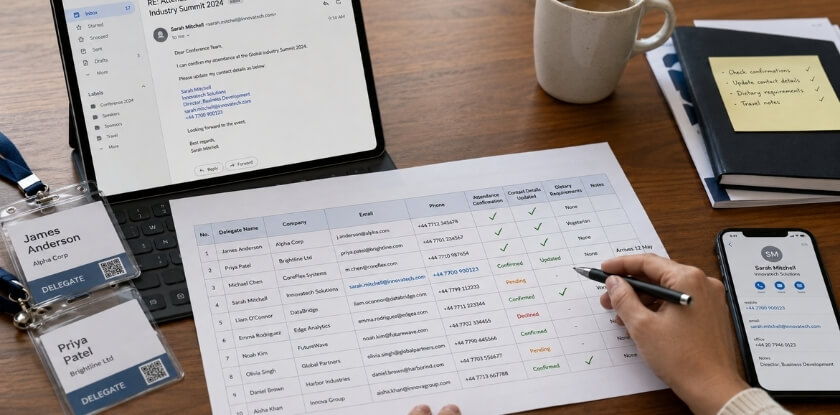
Accuracy matters because even small mistakes can affect emails, badges, certificates, seating, and check-in.
Use Clear Registration Forms
A clear registration form reduces errors from the beginning. It should use separate fields for names, organizations, titles, email addresses, and countries.
Good forms should:
- Mark required fields
- Avoid unnecessary questions
- Use dropdowns where helpful
- Allow delegates to review details
- Ask for the exact name for badges or certificates
Confirm Details With Delegates
Important details should be confirmed before the event. This is especially useful for badges, certificates, speaker schedules, presentation titles, or invitation letters. Organizers can confirm details through registration emails, reminder messages, or self-service profile updates.
Update Cancellations and Late Registrations
Organizers should update new registrations, cancellations, substitutions, payment changes, session changes, and on-site check-ins as they happen. Clear status labels such as confirmed, pending, cancelled, waitlisted, and checked in make the list easier to manage.
Standardize Names, Job Titles, and Organizations
The list should follow a consistent format. This makes it easier to search, sort, and report.
Organizers should review capitalization, organization names, country names, abbreviations, and job title formats. The goal is not to change someone’s identity but to keep the list clear and usable.
Use Event Management Software When Needed
For small events, a spreadsheet may be enough. For larger events, event management software can reduce errors and improve coordination. Event tools can help with online registration, duplicate detection, real-time updates, check-in tracking, badge printing, access permissions, and clean exports. The most important rule is to keep one master delegate list as the main source of truth.
How to Keep a Conference Delegate List Secure
A conference delegate list stays secure when access is limited, storage is protected, sharing is controlled, and team members understand how to handle attendee information responsibly.
Security matters because delegates trust organizers with their personal and professional details.
Limit Access to Authorized People
Only people who need the list should access it, and access should match the person’s role. For example, registration managers may need full records, badge staff may need names and ticket types, and sponsors may only receive approved opt-in information. Limiting access reduces the chance of accidental sharing or misuse.
Store the List in a Secure System
The list should be stored in a protected system, not on open desktops, personal devices, public computers, or unsecured links.
Secure options include event management software, password-protected cloud storage, encrypted files, access-controlled spreadsheets, or approved internal databases. The event team should avoid creating too many uncontrolled copies.
Avoid Public Sharing
A delegate list should not be posted on public websites, social media, open folders, or unsecured documents.
Even basic professional information can reveal where someone attended, what organization they represent, and what topics they may be interested in. A public directory should only be created with permission and limited fields.
Get Permission Before Sharing Delegate Information
Organizers should ask for permission before sharing delegate information with sponsors, partners, exhibitors, or other attendees. Consent options may include visibility in a networking directory, sponsor contact permission, event app profile sharing, or future event updates. Consent should be specific. Agreeing to receive conference updates does not automatically mean agreeing to sponsor marketing.
Train Event Teams on Responsible Data Handling
Everyone with access to the delegate list should understand what they can view, download, print, or share. Training should cover privacy rules, correct file handling, access limits, reporting errors, and disposing of printed copies after use. Temporary staff and volunteers need clear instructions because they may handle sensitive information at registration desks or help counters.
Beware of Emails Selling Conference Delegate Lists
Unsolicited emails that offer to sell the attendee or delegate list of a conference are a known scam, and you should not buy from them. Several conference organizations, including ACFE, AIChE, and the organizers of ECCV 2024, have published warnings about these offers. ACFE says it does not sell conference attendee lists to third parties and does not give full attendee lists to sponsors or exhibitors. AIChE says it does not rent or sell email lists to third parties and that no third party is authorized to sell lists related to its events. The ECCV 2024 organizers say that offers of delegate data are scams unless they come from the official organizing secretariat.
Organizers describe a similar pattern. A message arrives from a sender who claims to work for the event, quotes a price for a list of registered attendees, and pushes for quick payment. Some organizers say the contact details are often scraped from old event websites and public directories, and some warnings describe the emails as a way to phish for personal information.
Warning Signs
| Warning sign | What to do |
| Unsolicited email offering a “verified” attendee list | Do not reply, and delete it |
| Sender domain does not match the event’s official website | Treat it as suspicious and check the domain |
| Pressure to pay quickly or by an unusual method | Do not pay |
| Claim to speak for the organizer, with no way to confirm it | Contact the organizer through the official website |
| Sample “list” with outdated or public details | Do not open attachments or links |
Organizers who receive such an email should also check that nobody on their team shared a real list. If a delegate asks whether an offer is genuine, the safest answer is that a real organizer shares delegate details only with consent, through approved channels.
What Not to Do With a Conference Delegate List
A conference delegate list should never be shared, stored, or used in a way that violates attendee privacy or damages trust. It should support the event, not expose participant information.
Do Not Share Personal Details Without Consent
Delegate contact details should not be shared with sponsors, vendors, speakers, or attendees unless the person has agreed to it. This includes email addresses, phone numbers, mailing addresses, payment details, private notes, or special requirements.
Do Not Use the List for Unapproved Marketing
A delegate list should not be used for unrelated promotions or sales emails unless delegates clearly opted in. Event reminders, certificates, feedback forms, and conference resources are usually expected. Unrelated marketing or third-party outreach requires permission.
Do Not Keep Outdated Data Longer Than Needed
Old delegate data should not be stored indefinitely without purpose. After the event, organizers should decide what must be retained and what can be deleted, anonymized, or archived securely.
Do Not Store the List on Unprotected Devices
Avoid saving delegate lists on personal laptops, shared computers, public drives, or unprotected USB devices. If a copy is needed for event operations, it should be controlled, protected, and removed when no longer required.
Do Not Publish the List Online
A delegate list should not be uploaded to a public website, open document, or social media post. If the event needs a public participant directory, it should be created separately with limited details and clear delegate permission.
Common Mistakes to Avoid When Managing Delegate Lists
Common delegate list mistakes include collecting too much data, failing to update records, giving access to too many people, and using one version for every purpose. Avoiding these mistakes helps protect privacy and improve event operations.

Collecting Too Much Information
Long registration forms can create unnecessary privacy risks and discourage completion. If a detail will not support registration, communication, access, networking, documentation, or safety, it may not need to be collected.
Forgetting to Update the List
A delegate list becomes unreliable if changes are not recorded. One person should be responsible for maintaining the master version.
Giving Access to Too Many People
Not everyone needs the full list. Too much access increases the risk of accidental sharing, duplicate files, outdated versions, and unapproved use. Access should be based on task and responsibility.
Mixing Internal and Public Versions
One full list should not be used for every audience. The internal operations list may contain private information that should never appear in a sponsor file or attendee directory. Create separate versions for internal use, badge printing, speakers, sponsors, attendees, and post-event communication.
Ignoring Data Privacy Rules
Skipping the privacy basics above is a mistake in its own right. A privacy-aware process improves trust and encourages delegates to provide accurate information.
From our experience at MS International: We run in-person conferences in the Greater Toronto Area, and people register as authors, speakers, or listeners. Submissions ask for accurate author details and affiliation. Speakers collect a conference badge at check-in, and our speaker page asks them to check that their name, organization, position, and presentation title are correct before the certificate is prepared.
FAQ: Conference Delegate Lists
Handling a delegate list well means knowing who may see it, whether sponsors can receive one, which privacy law applies and how long to keep it once the event ends.
Is a Conference Delegate List Public?
It depends on the event, and private contact details should stay out of any public version. Formal meetings such as the ILO’s Conference publish an official list of delegations, while other events share limited details only through an event app or with consenting sponsors. A public version should only include approved professional details.
Can Sponsors Receive a Delegate List?
Sponsors may receive delegate information only with proper consent. Organizers should avoid sharing full lists automatically and provide limited, approved details based on the event’s privacy policy.
Can Attendees See Other Delegates’ Contact Details?
Attendees should not see private contact details without permission. A networking directory may show names, organizations, roles, and countries, while contact should happen through approved event tools.
Should I Buy a Delegate List From an Email Offer?
No. An unsolicited email is not a safe source for a delegate list. Conference organizations have warned that these offers are scams, and the lists may be scraped or outdated. Do not reply, delete the email, and check with the organizer through its official website.
What Privacy Law Applies to a Delegate List?
In Canada, usually PIPEDA, or a private-sector law in Alberta, British Columbia, or Quebec. A delegate list holds personal information, and the GDPR may apply to EU delegates. Which law applies depends on your event, so ask a privacy professional.
How Long Should Organizers Keep a Delegate List?
Only for as long as the event purposes require. After certificates, reports, receipts, and approved follow-ups are complete, unnecessary data should be deleted or stored securely.
What Happens If a Delegate List Has Errors?
Errors can affect communication, badges, certificates, seating, and check-in. Organizers should review registrations, remove duplicates, confirm important details, and maintain one updated master list.
Is a Digital Delegate List Better Than a Printed One?
A digital delegate list is usually better for large events. It allows quick updates, searching, filtering, and access control, while printed copies are useful for backup and on-site tasks.
Can a Delegate List Be Used After the Conference?
A delegate list can be used after the conference for approved follow-up. This may include thank-you emails, certificates, surveys, resources, receipts, or future event updates with consent.
Final Thoughts on Conference Delegate Lists
A conference delegate list helps planners manage registration, communication, logistics, networking, attendance, and follow-up in a structured way. The best lists are accurate, secure, useful, and purpose-driven: they hold enough information to run the event and nothing that exposes delegates unnecessarily. Keep the list updated, share it only with the right people, and ignore any email offering to sell someone else’s.