
You walk up to the stage with the microphone in your hand, and the audience starts judging within the first moments whether this part is worth listening to. That pressure is real, whether you are an experienced emcee or someone who was handed the job an hour ago. A welcome that stumbles out of the gate can leave the room restless before the guest speaker even reaches the podium.
Quick answer: A guest speaker welcome speech has six parts: a short greeting, a line on the event, a hook that ties the topic to this audience, two or three credentials, the topic itself, and a warm handover that ends on the speaker’s name. Keep it to about one or two minutes, rehearse it aloud, and confirm the speaker’s name, title and pronunciation beforehand.
What Goes Into a Guest Speaker Welcome Speech
A welcome speech has one job: make the speaker feel expected and the audience ready to listen. It is not a biography reading, and it is not a chance for the emcee to hold the stage. Keep it focused, keep it brief, and hand over cleanly. Some guides call this a speaker introduction. The difference is emphasis: a general welcome speech greets the audience and sets the tone for the whole event, while an introduction centres on the person at the podium. Here you are doing both in one short talk, so the speaker gets most of the time.
Aim for about one to two minutes. Toastmasters International’s tips on introducing speakers say 60 seconds or less is sufficient, so treat three minutes as the outer limit for a formal event. Anything longer eats into the speaker’s time.
The Core Components
Every guest speaker welcome speech, whatever the event, needs the same building blocks. The order below is a workable one.
| Component | What it does | Example |
| Opening greeting | Acknowledges the room and signals that things are starting | “Good morning, everyone” or “Welcome, and thank you for being here” |
| Context for the event | One or two sentences on why the gathering is happening | A product launch, a conference theme, Prize Day, a graduation |
| Audience hook | Ties the speaker’s topic to this specific audience | “Many of you are dealing with [X problem], and today’s speaker has spent [X years] working on exactly that.” |
| Speaker credentials | Two or three facts that matter to this audience | Research and affiliation, industry results, or ministry background |
| Topic relevance | Names the topic so the audience knows they are in the right room | “Today she will talk about [topic].” |
| Warm handover | Brings the speaker to the stage | “Please join me in welcoming [Name].” |
Opening greeting. Do not overthink it. A simple line settles the audience.
Context for the event. A corporate event might reference a product launch or annual summit. An academic event might acknowledge a research milestone or the conference theme. A school event might mention the occasion, such as Prize Day, a visiting lecture or a graduation ceremony. Keep it tight.
Speaker credentials. Choose what this particular audience values. A college audience cares about academic output and institutional affiliation. A corporate crowd cares about industry experience and measurable results. A church audience may respond more to personal testimony or ministry background. Do not read the full bio.
Topic relevance. This bridges the credentials to what the speaker is about to say, and it gives them a focused entry point.
Warm handover. On a virtual event you might say: “I’ll hand it over to [Name] now. Over to you.” Simple and clean beats elaborate every time.
General Guest Speaker Welcome Speech Sample (Copy-Ready)
Use this all-purpose template for almost any event. It follows the core structure, so you are not guessing what to include. Swap out the bracketed fields and you are ready to go.
Read it aloud before the event. A speech that looks fine on paper can still trip you up at the microphone if the rhythm is off.
The Sample Speech
Good evening, everyone. Welcome, and thank you for being here tonight.
My name is [Your Name], and I’m [your role, such as “your emcee for the evening”, “the event coordinator” or “a member of the organizing committee”].
We have an outstanding speaker joining us today, and I want to take a moment to properly introduce them before I hand over the stage.
[Speaker Name] has spent [X years] working in [their field]. They have [key credential, such as “led research teams at three international institutions” or “published extensively on behavioral economics”]. More recently, [he/she/they] [most relevant recent achievement or role].
What makes [Speaker Name]’s perspective particularly valuable for us today is [why their expertise connects to this audience’s interests or challenges]. You’ll hear [him/her/them] address [topic] from a standpoint that is [briefly describe the angle, such as “grounded in real case studies” or “informed by both policy and practice”].
Before I step aside, I want to say on behalf of everyone in this room that we’re genuinely glad you’re here. Please join me in welcoming [Speaker Name].
[Pause for applause]
More Samples for Different Event Types
Not every event calls for the same tone. A welcome that works at a law firm conference will fall flat at a Sunday church service. Find the sample closest to your event and adapt it. Every sample uses placeholders in square brackets, so replace each one with details the speaker has confirmed.
Corporate / Business Event
Professional audiences appreciate brevity and a clear reason the speaker is worth their time. Skip the long biographical recitation and get to the point.
Good morning, everyone. Thank you for being here today. We have a packed agenda, so I won’t take much of your time before we get into the main event.
Our guest this afternoon has spent the last [X years] working at the intersection of supply chain strategy and operational risk. As [Job Title] at [Company], [he/she/they] led a restructuring that reduced fulfillment delays by [X%]. [He/She/They] is here to share what actually worked, and what didn’t, and to help us think through how those lessons apply to our own operations.
Please join me in welcoming [Speaker Name].
Academic / School or College Event
School and college audiences range from nervous freshmen to senior faculty, so the tone should be warm but still carry some weight. Mention credentials in a way that matters to students, not just ones that look impressive on paper.
Good evening, and welcome to the [Department] Annual Lecture Series. We’re glad to see so many of you here, including students from across the faculty.
Tonight’s speaker completed [his/her/their] doctoral research at [University] and has since published widely on [research area]. [His/Her/Their] work has informed [policy or practice outcome the speaker has confirmed]. For those of you working on dissertations this year, this is exactly the kind of applied research thinking we want you to be exposed to.
It’s my pleasure to introduce [Title and Speaker Name].
Virtual or Online Event
Online events need a slightly different approach. You cannot rely on room energy, and attention wanders faster on a screen. Keep it tighter, acknowledge the format briefly, and give people a reason to stay focused. (MS International’s own conferences are held in person in the Greater Toronto Area, so this sample is for online events elsewhere.)
Welcome, everyone, and thank you for joining us from wherever you’re logging in. We have attendees joining from [number] countries, which says a lot about the reach of this topic.
A quick note before we begin: please keep your microphones muted during the presentation, and we’ll open the floor for questions through the chat at the end. Our emcee, [Emcee Name], will manage the Q&A queue so no one gets missed.
Our speaker today is a consultant and author whose work on remote team leadership has been cited in [Publication]. [He/She/They] has presented to [type of organization] in [number] countries, and today [he/she/they] will walk us through a framework you can take directly back to your teams.
Please give a warm virtual welcome to [Speaker Name].
Church or Religious Event
A religious event carries a different spirit. The tone is warmer, more communal and usually shorter. The speaker’s message and its relevance to the congregation matter more than credentials.
Good morning, and God bless each one of you for being here today.
We are grateful to welcome a very special guest into our fellowship this morning. [Pastor Name] has served [his/her/their] congregation in [City] for [X years], and [his/her/their] ministry has reached many people through outreach work and teaching. [His/Her/Their] message today focuses on the theme we’ve carried through this season, [season theme], and I believe those words will speak directly to where many of us are right now.
Let’s receive [him/her/them] with open hearts. Please welcome [Pastor Name].
Short Version (Under 2 Minutes)
Sometimes you do not need an elaborate introduction. A short welcome works when the event is informal, the audience already knows the context, or the speaker is well known enough that a long build-up would feel unnecessary.
Good afternoon, everyone. We’ll get straight to it.
Our speaker today is [Speaker Name]. [He’s/She’s/They’re] a data journalist with [X years] of experience covering [topic], and [his/her/their] recent piece in [Publication] drew a strong reader response. [He’s/She’s/They’re] going to talk to us about how to communicate complex data in a way that actually changes minds.
[First Name], the floor is yours.
How to Research and Write Your Own Welcome Speech
Writing your own welcome speech is straightforward once you break it into stages. Each step below handles one piece, so by the time you reach the microphone you are delivering something you built deliberately.
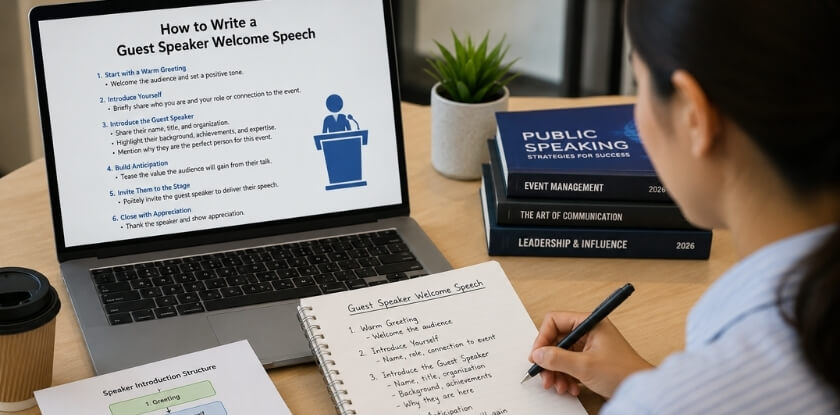
Step 1: Research the Speaker Before You Write
You cannot write a credible introduction without knowing who you are introducing. Collect the basics first: the speaker’s full name and correct pronunciation, their current title and organization, two or three relevant credentials, and any published work or recent projects worth a mention.
Email the speaker or their assistant and ask for a short bio and any points they would like highlighted. A speaker may already have a short bio prepared for introducers, and Toastmasters International’s 2023 magazine guidance notes that a speaker can ask to write their own introduction. Use it as a starting point, but trim it, because a welcome speech is not a résumé reading. Share your final wording with the speaker so they can approve it, check every detail, and leave out anything sensitive the speaker has not cleared.
Also ask how they prefer to be addressed on stage and which pronouns they use. “Dr. [Surname]” and “[First name]” land very differently, and getting it wrong in front of an audience is an awkward start for everyone. For a name you find hard to say, write it phonetically in your notes, and ask the speaker privately rather than from the stage.
Step 2: Draft the Opening Greeting
Your first sentence sets the room’s energy. For a corporate event, something clean and direct works: “Good morning, and welcome to [event name].” For a school or college event, warm it up slightly and acknowledge specific groups, such as faculty, students and guests, before moving on.
Two or three sentences is enough. The greeting should settle the room, not become a speech before the speech.
For an online event, add a practical line about the format, such as noting that attendees have joined from different locations. It makes people feel seen when half the audience is sitting alone at a screen.
Step 3: Introduce the Speaker’s Name and Credentials
Hold the name back until you have built some context. If you lead with it, people who do not know the speaker have no frame of reference. Give one or two sentences on what the speaker does and why it matters, then land on the name.
Pick credentials that connect to the event’s purpose. At an academic event, research and institutional affiliation matter. At a religious event, faith background or ministry experience is more relevant than an unrelated corporate award.
Two or three specific credentials beat a long list. “She has published [number] peer-reviewed papers on behavioral economics” tells the audience more than “she is a highly accomplished scholar with numerous accolades.” (That line is an illustration, so use only facts the speaker has confirmed.)
Step 4: Connect the Topic to the Audience
This is where the introduction becomes useful rather than merely polite. Explain briefly why the topic matters to the people in the room right now. If the organizers chose this speaker for a reason, say so. One sentence can do it: “At a time when our organization is rethinking its approach to leadership, his insights on team psychology are exactly the conversation we need to be having.”
Engagement starts before the speaker opens their mouth. When the topic feels relevant rather than abstract, people lean in. Think about what the audience already cares about and bridge from there.
At a large formal conference, tie the connection to the event’s theme. At a smaller gathering, it can be casual and personal. Either way, spell out the relevance. Do not assume the audience will make the link on its own.
Ready Opening Lines and Closing Handover Lines
Sometimes you only need a strong first sentence or a clean line to hand the microphone over. The opening and the handover are two easy moments to fumble: an opening that falls flat, such as “So, without further ado…”, or a handover that trails off before you gesture at the speaker. The lines below give you options for both, organized by event type.
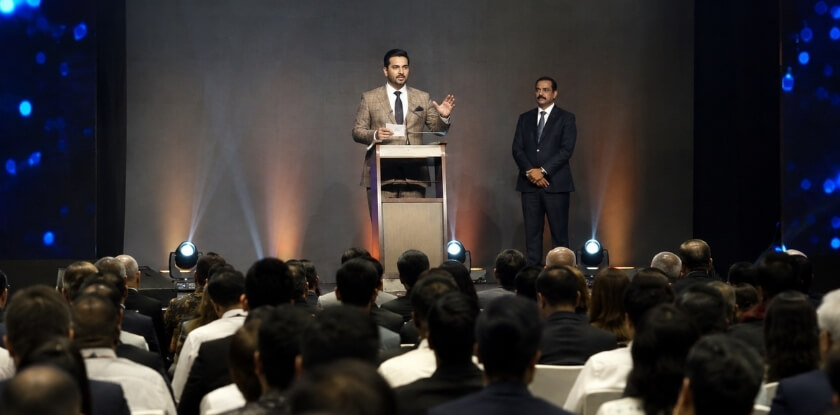
Opening Greeting Lines
These are your first words into the microphone. They set the tone immediately, so pick one that matches the room.
For a corporate event:
- “Good morning, everyone. It’s great to have so many of you here today, especially given how packed everyone’s calendars tend to be this time of year.”
- “Welcome, and thank you for making time for this. What we’re about to hear connects directly to the work most of you are already wrestling with.”
For an academic or college event:
- “Good evening, and welcome to what I think will be a genuinely thought-provoking session. We’ve been looking forward to this one for a while.”
- “On behalf of the faculty and students here, welcome. Tonight’s speaker has spent years in the exact field this program is preparing you to enter.”
For a school event:
- “Good afternoon, everyone. Students, teachers, parents, thank you for being here. We have a fantastic guest with us today, and I think you’ll leave this hall thinking about things a little differently.”
For a church or religious event:
- “It’s a blessing to have everyone gathered here this evening. We’ve invited someone whose work speaks directly to the values this community holds, and we’re honored by their presence.”
For a virtual or online event:
- “Welcome, everyone, wherever you’re joining us from today. We have attendees logging in from several time zones, which says something about the person we’re about to hear from.”
- “Good morning, or afternoon, or evening, depending on where your screen is. Thank you for carving out this time.”
For a short, informal welcome:
- “Right, let’s get started. We have a great guest here and I don’t want to take time away from what they have to say.”
For a formal welcome:
- “Ladies and gentlemen, distinguished guests, and colleagues, it is my pleasure to welcome you to this evening’s proceedings.”
Closing Handover Lines
The handover closes your introduction and passes control to the speaker. It should feel natural, not like a stage direction read off a card. Keep it brief, direct attention to the speaker by name, and skip “without further ado.” It has been used so often that it carries no weight.
Neutral, works for most events:
- “Please join me in welcoming [Speaker Name].”
- “I’ll hand things over now. [Speaker Name], the floor is yours.”
- “Let’s give a warm welcome to [Speaker Name].”
Slightly warmer, good for smaller or community gatherings:
- “We’re genuinely glad you’re here. Everyone, please welcome [Speaker Name].”
- “I’ve been looking forward to this one. Please put your hands together for [Speaker Name].”
- “I’ll leave it in her very capable hands. Please welcome [Title and Surname].”
For virtual events where applause does not land the same way:
- “Go ahead and drop a welcome in the chat, and [Speaker Name], whenever you’re ready.”
- “We’ll hand it over now. [Speaker Name], you’re live.”
For formal occasions:
- “It is my honor to introduce tonight’s speaker. Ladies and gentlemen, please welcome [Speaker Name].”
When you have blanked on your closing line: say the speaker’s name, pause, and start clapping. The audience follows. You do not need a perfect final sentence, only the name delivered with confidence.
Staging the Handover
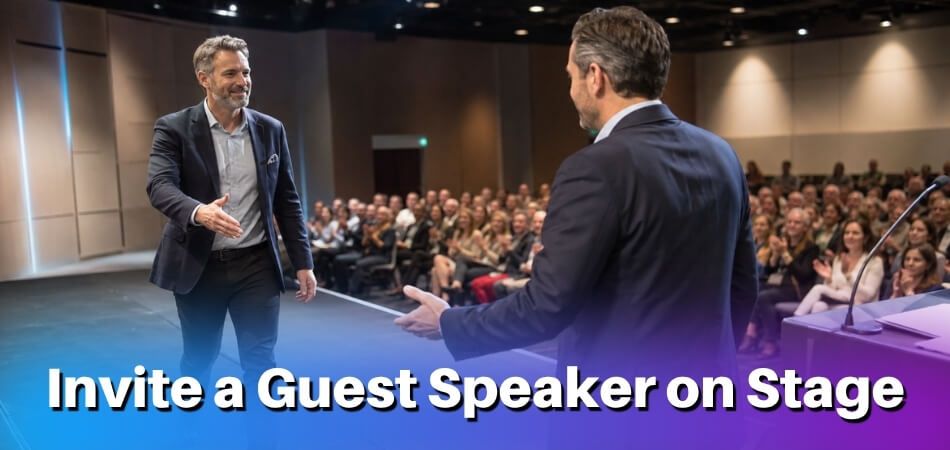
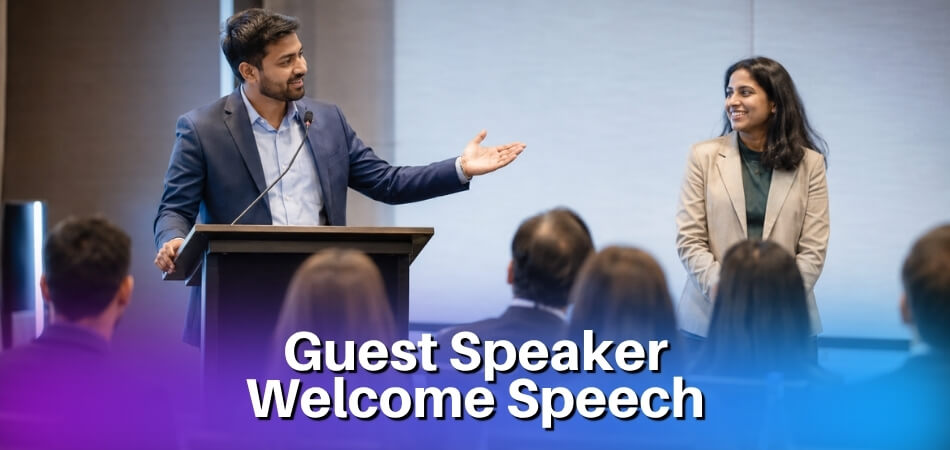
Let the speaker’s name be the last thing you say. Face the audience while you say it rather than turning toward the speaker mid-sentence, then gesture toward them, start the applause yourself if needed, and step away from the microphone. Do not add another sentence after the handover.
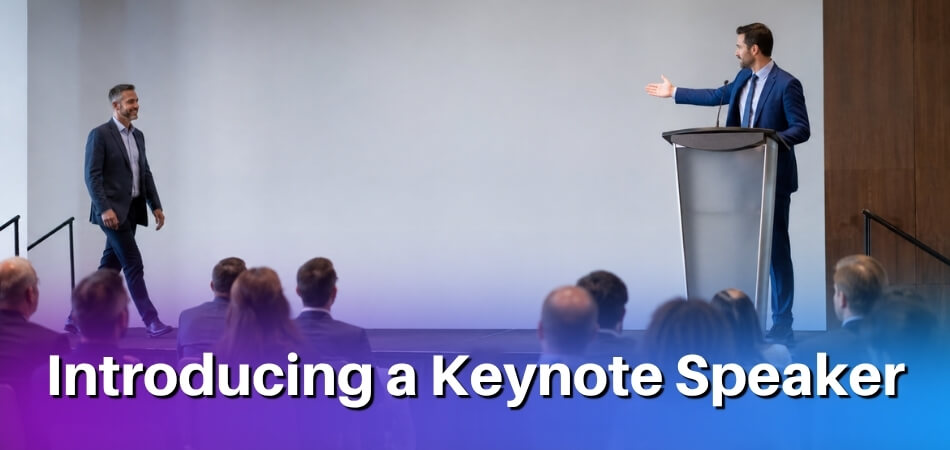
As emcee or master of ceremonies, your job ends the moment the speaker reaches the microphone. Step to the side, stay out of their stage space, and know in advance whether you return to the stage afterward. That bit of choreography prevents the awkward shuffle that happens when an MC is not sure where to go. Mark the handover line in bold or highlight on your notes, because it is the one line you cannot fumble.
Formal vs Informal Welcome Speech: Key Differences
The difference is register, not structure. Both versions need an opening greeting, the speaker’s name and credentials, the topic’s relevance and a clean handover. What changes is the language, the pacing and how much personality you bring to the podium.
Formal Welcome Speech
A formal welcome is structured, polished and deliberately professional. Use it for a corporate event, an academic conference, a graduation, a religious ceremony, or any setting where the audience expects a degree of ceremony.
Language stays elevated. Contractions are minimal. You address the audience as “Ladies and Gentlemen,” “Distinguished Guests” or “Honoured Members,” and you do not crack jokes in the opening line.
Speaker credentials get full treatment. You read out the title, institutional affiliation and relevant achievements in complete sentences. The audience expects to feel the weight of who they are about to hear.
The handover is deliberate. For example: “It is my honour to welcome to the stage Professor [Name], whose research in [field] has [achievement the speaker has confirmed].”
Pacing is measured. Pausing after the speaker’s name, before they walk up, is standard. It gives the applause a moment to build and tells the room this is a significant moment.
Informal Welcome Speech
An informal welcome is warmer, looser and more conversational. It suits team events, school assemblies, community workshops, casual online events and networking evenings, where the goal is to relax people rather than impress them.
You can open with a light touch. A quick observation about the room, a genuine compliment to the audience or a short anecdote tied to the topic all work. The hook does not need to be dramatic. It only needs to break the ice.
Credentials are still there, just delivered differently. Instead of a recitation, you might say: “Our next speaker has spent the last decade building businesses from scratch and failing spectacularly at a few along the way, and she’s here to tell you what she actually learned.”
The handover can reflect the speaker’s personality. If the speaker is known for being funny, a slightly playful transition fits. If they are approachable and direct, match that energy.
The Practical Differences at a Glance
| Element | Formal | Informal |
| Opening greeting | “Ladies and Gentlemen…” | “Good morning, everyone. Great to see you all here.” |
| Speaker credentials | Full title, affiliations, achievements | Selective highlights, conversational delivery |
| Audience hook | Factual, topic-driven | Anecdote, question or light observation |
| Handover line | “It is my great honour to introduce…” | “Please give a warm welcome to…” |
| Microphone and stage energy | Measured, composed | Warmer, more natural |
In a formal setting, slow down if you feel nerves creeping in. A steady, unhurried delivery reads as authority and gives you time to find your place without the audience noticing. Informal settings give you more room to recover if you stumble, because the audience is predisposed to be forgiving.
Delivery Tips for Any Welcome Speech
Knowing what to say and saying it well in front of a room are different skills. These tips apply to corporate, academic, church, virtual and school events alike.
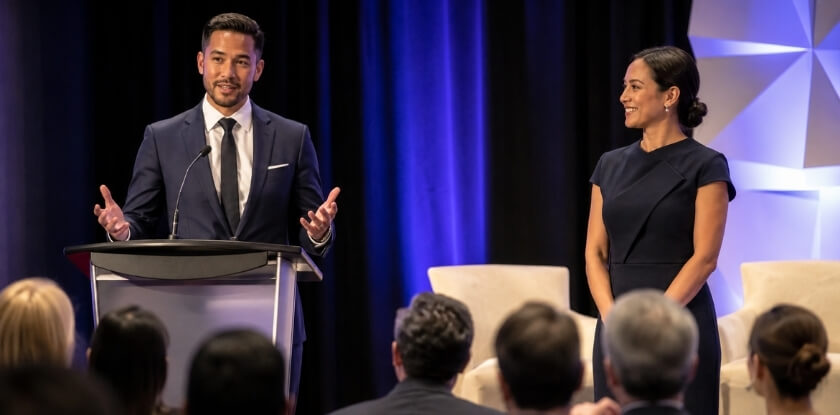
Practice Out Loud, Not Just in Your Head
Reading silently gives you a false sense of readiness. You need to hear yourself, because that is when you notice the sentence too long for one breath or the transition that sounds fine on paper and awkward spoken. Run through it at least twice, standing up, at the speed you will actually use.
Time yourself. A short welcome should run one to two minutes, and a formal introduction before a keynote rarely needs more than three. Pace varies by speaker, and coaches commonly suggest somewhere between 100 and 160 words per minute, so a one to two minute welcome is roughly 150 to 300 words. If you are over, cut. Do not speed up.
Record yourself once. You do not have to watch it in full. Skimming 30 seconds tells you whether you are looking down too much or rushing the credentials.
Work the Microphone Before Anyone Arrives
If there is a microphone, test it before the event starts. Handheld, lapel and podium mics all behave differently. A podium mic punishes you if you turn your head to look at your notes, and a lapel mic picks up every paper rustle. Speak across the mic rather than directly into it, and keep a consistent distance.
Manage Stage Nervousness Practically
Nervousness is normal, and trying to eliminate it usually makes it worse. What helps is giving it somewhere to go. Take two slow breaths before you walk up. Plant your feet at the front instead of swaying. Hold your notes or a single card rather than letting your hands float.
Slow down your opening. Nerves make people rush, and rushing makes nerves more visible. Speak the first sentence deliberately slowly and you will settle into a natural pace by the second or third line. Pause after the speaker’s name too, so the audience can absorb it.
Keep Your Eyes on the Audience
Eye contact does a lot for how confident you appear. Look at individuals, not “the room.” Pick one person per thought, finish the thought, then move to someone else. For an online event, look into the camera lens rather than at the faces on your screen. It feels unnatural, but to the audience it reads as direct eye contact.
Never read the speaker’s bio verbatim from a printed sheet. Audiences disengage the moment the emcee drops their gaze and starts reciting. Know the key points well enough to deliver them looking up.
Adjust Your Energy to the Room
A church welcome needs a measured, unhurried tone. A college event can carry more warmth and even a little humor in the hook. A corporate event usually calls for crispness over charm. Read the room before you start, because the same words delivered with the wrong energy land completely differently.
For informal speeches you can let some spontaneity in. For formal ones, stick closer to your prepared text. Either way, if something unexpected happens, such as a microphone issue, late arrivals or ambient noise, pause, address it briefly and carry on. Do not pretend it did not happen.
Bring a Physical Copy, Even If You Have Memorized It
Print your speech in a large, readable font and bring it. You might not need it, but having it removes the worry that you will forget something, which frees you to connect with the audience instead of performing recall. A single sheet or index card is enough for a short speech.
Common Mistakes to Avoid
Even experienced emcees make avoidable errors. Reading from a page, running long and rushing from nerves are covered in the delivery tips above. Here are the other mistakes to avoid.
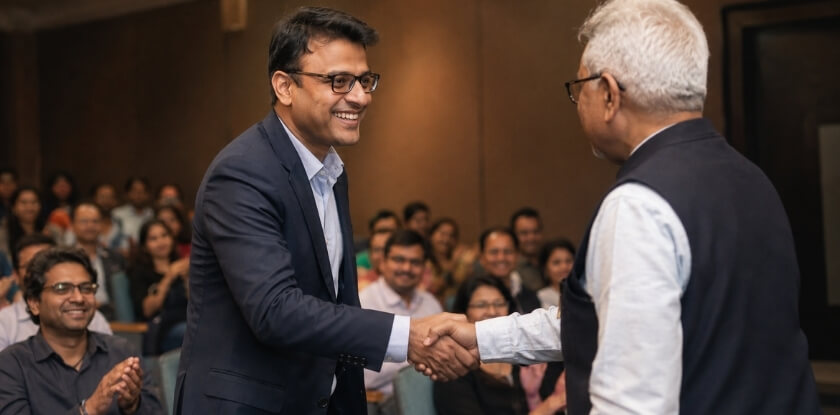
Getting the credentials wrong or overstating them. A mispronounced name, a wrong title or the wrong institution can leave the speaker feeling disrespected before they have said a word, and exaggerated achievements can embarrass them. Confirm the details with the speaker or their assistant and stick to what they have approved.
Summarising the whole career. A welcome introduces the speaker. It does not replace them. If you find yourself walking through every job they have held, cut it down.
Giving away the speaker’s key points. Some introducers get enthusiastic and start explaining what the speaker will cover in detail. Mention the topic’s relevance briefly, build curiosity and hand over.
Using a generic hook that means nothing. “We are very lucky to have our next speaker today” is heard at every event. If your opening could belong to any speech at any event, it will land flat. Tie the hook to this audience, this moment, or the question the speaker will address.
Forgetting the handover. An introducer may deliver a solid introduction and then just stop. An abrupt ending leaves an awkward silence. Close with a clear line that signals the applause and invites the speaker to the microphone.
Ignoring the event format. A script that works beautifully at a church can feel stiff and over-formal at a casual college event, and the reverse is also true. Match the register to the room. Online events need extra attention here, because there is no ambient live-audience energy to cover a tone mismatch.
From our experience at MS International: Our conferences are held in person in the Greater Toronto Area, and the moderator introduces each speaker before their presentation. For most applicants the route to the programme is the presenting-author track, and speakers may be asked for details such as professional title, organization and a short professional biography. Presentation lengths may vary, so the speaker confirmation and the final conference programme are the official sources for each schedule.
FAQ
Not knowing much about the speaker’s background is a familiar worry when writing this kind of welcome, along with mentioning nerves, the final line and who should deliver it.
How long should a guest speaker welcome speech be?
About one to two minutes, which is roughly 150 to 300 words spoken aloud. Toastmasters International’s tips on introducing speakers say 60 seconds or less is sufficient, so shorter is rarely a problem. The audience is there for the speaker, not for you.
Do I need to memorize the speech?
No. Reading from notes is completely acceptable for a welcome speech. Practice it enough that you are not staring down the whole time, but do not pressure yourself to go word for word from memory.
What if I don’t know much about the speaker’s background?
Ask the speaker or the event organizer for a short bio, and let the speaker approve your wording. Do not guess credentials. If you are unsure of a title or affiliation, either confirm it or leave it out.
Can I use humor in a welcome speech?
Only if it fits the event and you are genuinely comfortable with it. A light, warm tone works well at informal events. At a corporate or academic event, keep it professional and skip the jokes unless you know the room well.
What’s the difference between a welcome speech and an introduction speech?
A welcome speech greets the audience and sets the tone for the event, while an introduction speech focuses on the speaker’s credentials and topic. For a guest speaker you are usually doing both at once, and the introduction carries more weight.
Is it okay to mention stage nervousness during the speech?
Only briefly, and only at an informal event. A short acknowledgement can be endearing there, but do not linger on it. At formal events, skip it entirely. Your job is to project confidence so the audience feels settled before the speaker takes the microphone.
What should the last line of a welcome speech be?
A warm handover that ends on the speaker’s name and invites applause. “Please join me in welcoming [Name]” is clean and signals to everyone, including the speaker, that it is time. Do not add another sentence after it.
Do welcome speeches differ for virtual events?
Slightly. The structure is the same, but an online welcome has to account for the medium. Mention how questions will be handled, remind attendees to mute themselves if needed, and keep the energy a touch warmer, since screens create distance naturally.
Should the emcee or a separate person give the welcome speech?
Either works. At large events the master of ceremonies typically handles it, and at smaller gatherings any designated host can. What matters is that the person knows the speaker’s details and has practiced the handover so the transition feels smooth.
Final Thoughts
A guest speaker welcome speech does not need hours of work. Use the six-part structure, adapt a sample to your event, and keep the credentials short and relevant. Practice it aloud at least once, confirm the speaker’s name and title, and finish on a warm handover that ends with their name.