
“Resource speaker” and “guest speaker” are two terms that organizers often use as if they meant the same thing. They do not. Booking someone under the wrong label for a seminar, conference or training session sets up mismatched expectations for the speaker and the audience alike.
Quick answer: A resource speaker is an expert invited to teach a specific topic, usually in a workshop, training session or seminar. A guest speaker is any invited outsider who addresses an audience, often to share experience, inspire or add prestige. The terms overlap, since a resource speaker is also a guest, but not every guest is there to teach. Choose by what the audience should leave with.
Resource Speaker vs Guest Speaker
The difference is function. A resource speaker is booked for expertise and for passing it on. A guest speaker is booked because they are invited from outside the organizing group, and what they offer can be a story, a viewpoint, a name or all three.
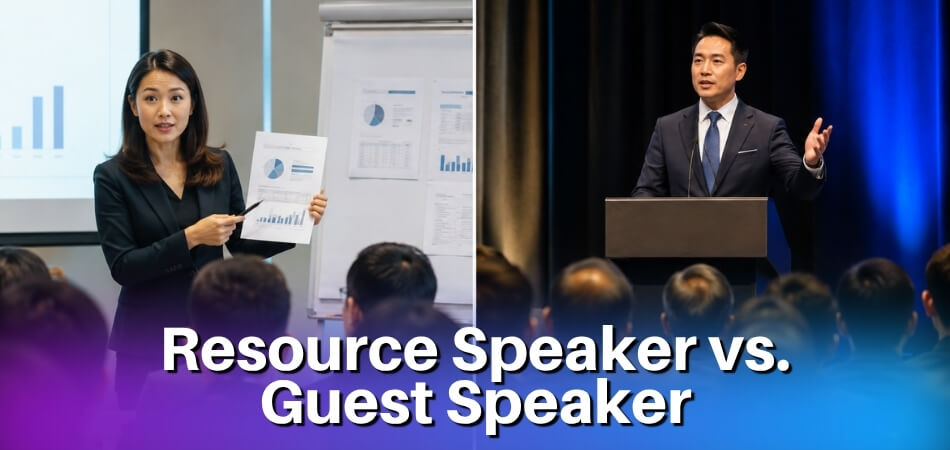
A resource speaker teaches, informs or transfers knowledge. Think of a subject matter expert leading a workshop on data privacy, or a trainer running a skills session at a corporate event. The label says it: this person is a resource the audience can draw from.
A guest speaker is the looser term. They might share a personal story, offer a professional perspective, or simply bring credibility and variety to a program. They are not necessarily there to train anyone.
A resource speaker delivers structured, content-heavy sessions where participants are expected to leave with something they can use. A guest speaker can do that too, but just as often the job is to inspire, connect with the room, or lend the event some standing.
| Factor | Resource Speaker | Guest Speaker |
| Primary role | Teach, train or transfer knowledge | Share perspective or experience, or inspire |
| Content style | Structured, instructional | Flexible, often narrative |
| Subject expertise | Deep, central to the role | Varies: industry figure, executive, public figure |
| Typical setting | Workshop, training session, seminar, academic event | Conference, corporate event, panel, ceremony |
| Audience expectation | Learn specific skills or knowledge | Gain insight or inspiration |
| Interactivity | High: Q&A, exercises, discussion | Varies: often a straight talk, fireside chat or panel |
| Preparation | High: often brings materials, modules or assessments | Variable: may deliver an existing talk |
| Status in the program | Functional role, booked for what they know | Can also be a keynote speaker or guest of honor |
| Who usually books them | Organizer focused on learning outcomes | Organizer focused on engagement or draw |
The same person can fill either role. A cybersecurity professional invited to open a corporate conference is a guest speaker. The same person running a half-day phishing-prevention workshop for your IT team is a resource speaker. The event structure and the learning objective decide the role, not the person.
What Is a Resource Speaker?
A resource speaker has deep knowledge or hands-on expertise in a subject, and the event needs that expertise passed to the audience in a structured, substantive way. The title signals the purpose: this person is a resource, not just a presence.
Role and Responsibilities
The job is to teach, inform or train. Expect them to prepare content around the audience’s learning needs, deliver it with enough depth to be useful, and handle follow-up questions where real subject knowledge gets tested.
That differs from giving a prepared talk and leaving the stage. At a workshop, a resource speaker might run group exercises, answer specific technical questions, or change the pace depending on how the room is taking in the material.
They are usually subject matter experts in the practical sense: people who have worked in a field, not only studied it. A labor law attorney at an HR compliance seminar, a data scientist explaining machine learning at a corporate training session, a licensed nutritionist at a community health workshop. The credential matters less than the depth.
Organizers typically brief resource speakers in advance with specific learning objectives, so that what is delivered matches what the audience came to learn.
How the Term Is Used
“Resource speaker” is common in training and seminar settings. Filipino trainers describe it as an expert whose job is to equip participants with usable knowledge and tools, as opposed to a motivational speaker whose job is mainly to inspire. “Resource person” is a close relative: training guides define resource persons as experts who contribute information and opinions to participants in a learning situation. These are practitioner usages, not official definitions, and no regulator or standards body defines either term. Check how your own institution or sponsor uses the words before you print them on a program.
The same trainer sources often set the resource speaker against the motivational speaker: the motivational speaker lifts energy and belief, while the resource speaker leaves participants with steps and tools they can use. One Philippine trainer’s article suggests combining the two when an event needs both, with motivation first and resources second. That is one practitioner’s advice, not a rule.
Where Resource Speakers Are Used
Resource speakers appear wherever knowledge transfer is the stated goal of the event.
Academic events rely on them heavily. A university symposium on climate policy might bring in a researcher with years on the topic, not to inspire the audience but to brief them on current findings and open a substantive discussion. Training sessions and workshops are a core setting: corporate learning programs, government agency training days, NGO capacity-building sessions.
Professional seminars and conferences use them too, often next to a keynote speaker. The keynote opens with vision and energy; the resource speakers take the breakout sessions and panels where technical depth happens. A nursing conference panel, for example, might have three resource speakers covering clinical protocols, regulatory updates and patient communication.
Designating someone a resource speaker tells both the speaker and the audience that preparation is expected, participation is likely, and the content will go beyond the surface.
What Is a Guest Speaker?
A guest speaker is invited to address an audience mainly because of who they are, what they have experienced, or the perspective they bring. The emphasis falls on presence and story, and the invitation itself often carries some prestige for the event.

Role and Responsibilities
The core job is to engage, inspire or inform, and the mix shifts with the event. At a graduation ceremony the weight is on inspiration. At a corporate conference it may be a personal narrative loosely tied to the theme. On a panel it is one distinctive viewpoint among several.
Unlike a resource speaker, a guest speaker is not usually expected to transfer a defined skill. There is no workbook, no hands-on exercise, no measurable learning objective. The value is experiential: a new way of thinking, a story that shifts perspective, or the credibility of having someone prominent in the room.
Preparation is lighter. They are usually asked for a prepared talk within a set time window, a few questions, and whatever ceremonial role the event assigns. Organizers rarely expect them to coordinate with facilitators or fit a training curriculum.
A keynote speaker is often a specific kind of guest speaker, brought in to open or close a major event. The difference is mostly positional: the keynote slot has more visibility, but the nature of the role is similar.
Where Guest Speakers Are Used
Guest speakers turn up across many event types, and the common thread is that their presence adds value beyond information.
At university convocations, alumni conferences and departmental seminars, a guest speaker might be a well-known researcher, a successful graduate or a public intellectual. The audience comes partly to hear this particular person.
Corporate events use them for annual kick-offs, leadership summits or team motivation days. A CEO from another industry, a former athlete or a recognized public speaker might be brought in to energize the room or signal the company’s values.
Conferences, industry and academic, often put guest speakers in the opening or closing session. The rest of the program may be workshops and panels, but the guest slot is treated as a centerpiece.
Award ceremonies, civic events and large fundraisers regularly feature a guest of honor who also speaks. There the line between guest of honor and guest speaker blurs, since the person lends weight to the occasion as much as they say anything specific. Guest speakers are chosen because their name, background or reputation draws attention. Content matters, but presence comes first.
Guest Speaker vs Guest Lecturer
In academic settings a third term appears. One speakers bureau describes a guest lecturer as a subject expert who gives a formal, structured lecture inside a university or college course and adds depth to the curriculum. It describes a guest speaker as someone who speaks at a conference, seminar or corporate event and is not tied to a curriculum. That is one organization’s description, not an official definition, and institutions use the words differently, so confirm the label with the department or host before you write the invitation.
Key Differences Between Resource Speaker and Guest Speaker
Picking the wrong type can leave attendees confused, disengaged, or without the practical value they came for. The roles differ along four lines.

Purpose and Audience Expectation
A resource speaker is brought in because the audience needs to learn, practice or solve something: a training session on data privacy compliance, a workshop on project management methods, a seminar on clinical procedures. The session is often interactive and task-oriented, and it is judged by whether participants leave with usable skills.
A guest speaker serves inspiration, broader perspective or ceremonial recognition. An academic event might invite a prominent alumnus to describe a career path. A corporate event might open with an industry veteran’s big-picture view of where the sector is heading. The audience listens and reflects, but nobody expects exercises or a knowledge check.
Role Definition and Authority
A resource speaker is a subject matter expert in the strict sense, with credibility rooted in operational or technical depth. Often a practitioner: a licensed clinical psychologist leading a mental health workshop, a senior software architect running a technical seminar, a certified financial planner training a sales team. The audience expects detailed answers and a defense of the material.
A guest speaker’s authority is broader and more reputational. A keynote speaker is there for their standing, their story or their ability to set a tone. A guest of honor carries symbolic weight. The value is tied to presence and perspective, not granular expertise in the session’s subject.
Structure and Format
| Dimension | Resource Speaker | Guest Speaker |
| Session format | Workshop, training session, seminar | Keynote, panel discussion, ceremony |
| Audience interaction | High: Q&A, exercises, case studies | Low to moderate: audience mostly listens |
| Session length | Often longer than about 45 minutes, up to a half or full day | Often 20 to 60 minutes; varies by event |
| Materials provided | Handouts, slides, workbooks common | Slides optional, no workbooks expected |
| Follow-up activity | Often includes assignments or evaluation | Rarely includes follow-up tasks |
A resource speaker owns a structured block of time built around their content: slides, exercises, group discussion, sometimes assessments. In a corporate setting they may deliver the same module again for different departments.
A guest speaker’s session is self-contained and shorter. A 45-minute keynote is a common format, and the schedule is built around them rather than the other way round.
Preparation and Deliverables
The preparation load is heavier for a resource speaker, who develops curriculum-level content: learning outcomes, a logical sequence, supporting materials and often a way to check comprehension. Expect real back-and-forth on content, audience profile and measurable outcomes before a day-long seminar.
A guest speaker prepares a talk, not a course. The work is crafting a coherent narrative or argument and rehearsing delivery. The deliverable is a strong, well-timed presentation.
How Each Fits Different Event Types
- Seminars and training sessions usually call for a resource speaker. The audience has a defined skill or knowledge gap and the event exists to close it.
- Conferences often use both. A keynote speaker opens or closes and sets the tone, then resource speakers fill the breakouts where attendees go deep.
- Panel discussions lean toward guest speakers, who share views and experiences rather than teach. A public speaker with real subject expertise can function as either, depending on how the session is built.
- Corporate events vary the most. An all-hands meeting might bring in a guest speaker for inspiration, while a compliance training day needs a resource speaker with verifiable expertise in the regulation being covered.
- Academic events blur the lines. A visiting professor giving a public lecture is a guest speaker even if their credentials match a resource speaker profile. The session format decides the role, not only the background.
How to Decide Which Type You Need (for Event Planners and Organizers)
Start with what the event must accomplish. The type of speaker shapes your program structure, session format, audience expectations and budget conversation.

Then ask what the audience walks in with. If they need answers, skills or structured knowledge, you want a resource speaker. If they need context, motivation or a strong outside voice to frame the conversation, a guest speaker fits better.
When to Choose a Resource Speaker
Choose one when your event has a learning objective and attendees should leave with skills, knowledge or practical tools.
- The event has a specific skill or topic gap to fill. A compliance training, a grant-writing workshop for nonprofits or a data literacy seminar for a university department needs an expert who can structure content, field detailed questions and adjust to the room.
- The session runs longer than about 45 minutes. A guest speaker can hold a keynote slot. A resource speaker is built for extended sessions where depth matters and participation is expected.
- Your audience is there to do something, not just hear something. Breakout workshops and hands-on training need a facilitator who knows the material well enough to go off-script when the room heads somewhere useful.
- You are being evaluated on outcomes. If a client or stakeholder measures whether participants learned anything, a resource speaker can supply pre-session materials, a structured agenda and post-session assessments.
When to Choose a Guest Speaker
Choose one when the goal is to energize, broaden perspective or add prestige.
- The slot is a keynote or an opening or closing address. Keynotes set tone and build enthusiasm, and a polished public speaker or well-known figure does that well. A subject matter expert delivering training in keynote format often falls flat.
- The audience is mixed. If departments do not share a technical background, a speaker with broad appeal beats a deep technical presenter.
- You want to draw attendance or media attention. A guest of honor or a recognizable industry name gives people a reason to register. That is a legitimate program goal, and a resource speaker rarely serves it.
- The event is celebratory or ceremonial. Commencements, award ceremonies and annual conferences often need someone who represents the occasion, not someone who runs an exercise.
A Simple Decision Framework
Use this as a quick gut-check before you finalize your speaker search.
| Your Situation | Better Choice |
| Running a skills-based workshop or training session | Resource speaker |
| Keynote slot at a conference or corporate event | Guest speaker |
| Audience needs to apply knowledge after the session | Resource speaker |
| Goal is inspiration, networking energy or prestige | Guest speaker |
| Session involves Q&A, exercises or group work | Resource speaker |
| Talk-style slot of about 45 minutes or less | Guest speaker |
| Academic event with a professional development focus | Resource speaker |
| Ceremonial, celebratory or general-audience event | Guest speaker |
One Last Consideration for Event Planners
Budget and lead time are real factors, and practice differs widely between organizers. A well-known guest speaker can cost more and book out further ahead. A resource speaker is often easier to source through professional associations, academic departments or industry networks, and fees vary widely by field. Whatever the arrangement, agree fees, honoraria and travel support in writing at the first outreach.
If your program includes both types, say a keynote guest speaker in the morning and breakout resource speakers in the afternoon, be clear about each role from the start. An expert who expects a 20-minute keynote slot and gets handed a three-hour interactive workshop will not deliver their best either way.
Sample Invitation Lines for Each Role
Whatever label you use, the invitation should state what the person will do, for how long, and what is and is not covered. These lines are starting points. Replace the placeholders and adjust the tone to your event.
Inviting a Resource Speaker
Dear [Speaker Name],
We are organizing a [half-day] workshop on [topic] for [audience description] on [date] at [venue]. We would like you to lead it as our resource speaker, covering [two or three learning objectives] and including a hands-on exercise. We can send the participant profile and a draft agenda this week. Please let us know if you can take this on, and tell us what materials and equipment you will need.
Inviting a Guest Speaker
Dear [Speaker Name],
Your work on [topic] has been widely discussed in our community, and we would be honored to welcome you as a guest speaker at [event name] on [date]. We are thinking of a [30 to 45 minute] talk at the [opening or closing] session, followed by a few audience questions. Please tell us whether this suits your schedule, and we will confirm the details, including what the invitation does and does not cover, in writing.
Listing Each Role on the Program
For a resource speaker, give the title and area of expertise rather than only the name. For a guest speaker, the introduction usually focuses on background or the angle of the talk, and the host’s welcome speech picks out the few facts that matter to the audience.
Resource Speaker: [Name], [Specialty or Topic]
Guest Speaker: [Name], [Position or Background], on [Talk Title]
Related Speaker Types: Keynote Speaker and Guest of Honor
Two more terms get used loosely once you have sorted out the first pair. They are distinct roles, and mixing them up can create awkward moments for a planner building a program. A keynote speaker is technically a type of guest speaker, headlining a conference or large event. A guest of honor holds a ceremonial or relational role and may give no formal content at all.

Keynote Speaker
A keynote speaker sets the tone for the whole event. At a conference or corporate event the keynote typically opens or closes the program and carries more weight than any single session. The person is chosen to inspire, challenge or reframe how the audience thinks about a topic, not necessarily to teach a skill.
The role overlaps with both guest speaker and resource speaker territory, depending on the event. At a large industry conference the keynote might be a well-known public speaker with no deep technical expertise in your field. At a specialized academic event or professional seminar, the keynote could be a subject matter expert who also delivers substantive content. The title signals position in the program, not a fixed delivery style.
One practical point: keynote and invited roles are usually arranged separately from ordinary speaking slots, and whether any fee or travel support applies is agreed case by case. If your budget treats a keynote like a panelist or workshop facilitator, expect friction.
Guest of Honor
A guest of honor is a ceremonial designation. The person is present because of their status, reputation or relationship to the host organization, not because they will deliver a presentation or run a session.
At an academic or formal corporate event the guest of honor might give brief remarks, but is not expected to teach, train or lead a panel. A guest of honor handed a 45-minute content slot is likely to be unprepared for it, and the audience ends up shortchanged.
To keep the roles straight, ask what the person is actually doing. Delivering structured content or leading a session makes them a resource speaker or guest speaker. Giving a big-picture address that opens or anchors the event is closer to a keynote. Being recognized and adding occasion to the gathering makes them a guest of honor. Each has different expectations, preparation and a different place in your program.
From our experience at MS International: The speaking routes at our conferences are the presenting-author track and keynote or invited roles, not “resource speaker” and “guest speaker” labels. For most applicants, the route to our in-person conferences in the Greater Toronto Area is the presenting-author track: submit work for review and register after acceptance. Keynote and invited-speaker roles are arranged separately with the organizing team, and buying an author ticket does not create one. Speakers cover their own travel, accommodation, visa, transportation and personal expenses, and participation creates no entitlement to an honorarium, speaker fee or travel reimbursement unless we have agreed otherwise in writing. The moderator introduces each speaker, and approved speakers receive a certificate after the scheduled presentation.
FAQ
Choosing a resource speaker or a guest speaker raises side issues: how each compares with a keynote or motivational speaker, a guest of honor, and how to list them on a program.
Is a resource speaker the same as a keynote speaker?
No. A keynote speaker opens or anchors an event with a broad, often inspirational message. A resource speaker is brought in to teach or explain a subject in depth. The goals differ, and so does the format.
Is a guest speaker the same as a keynote speaker?
Not always. A keynote speaker is the headline guest speaker who opens or closes an event and sets its tone. Other guest speakers usually appear in panels, breakout sessions or ceremonies and cover a narrower topic or perspective.
Can a guest speaker also be a subject matter expert?
Yes, and this is where the overlap happens. A guest speaker with deep expertise can function much like a resource speaker. The difference is what you ask them to do: present a perspective, or actively transfer knowledge and skills.
What’s the difference between a guest speaker and a guest of honor?
A guest of honor is recognized for achievements or status and may or may not give an address. A guest speaker is invited specifically to speak. The roles can overlap, but not automatically.
When should I use a resource speaker instead of a guest speaker?
Use a resource speaker for a training session, workshop or technical seminar where attendees must leave with actionable knowledge. Use a guest speaker at a conference or corporate event when you want to inspire, motivate or broaden perspectives.
What does a resource speaker do?
A resource speaker teaches or explains a subject in depth, usually in a workshop, training session or seminar. They prepare content around the audience’s learning needs, take questions and leave participants with knowledge or tools they can use.
What is the difference between a resource speaker and a motivational speaker?
A motivational speaker mainly inspires and energizes an audience, while a resource speaker equips it with practical knowledge, steps and tools. Some events use both, so confirm in the invitation which job you are asking the person to do.
Do resource speakers only work for academic events?
No. Resource speakers are common in corporate training, professional development and industry workshops. Academic events use them often, but they are just as relevant in business settings.
Can one person serve as both a guest speaker and a resource speaker at the same event?
Yes, though it is not common. An organizer might invite someone to give a motivational talk and then lead a breakout session on a specific topic, so the person acts in both roles at different points in the program.
How do I list a resource speaker on an event program?
Give their title and area of expertise rather than only a name, in the format shown in the sample program lines above.
Are resource speakers and guest speakers paid?
Sometimes, but not always: it depends on the organizer’s budget and policy. A one-time payment for a talk is usually called an honorarium. Some organizers pay one, some cover travel, and some offer nothing, so agree it in writing. At MS International, speakers cover their own costs unless an arrangement is confirmed in writing.
Choosing Between the Two
The choice comes down to one question: what should your audience walk away with? Learning, skills and applied knowledge point to a resource speaker. Inspiration, recognition and credibility point to a guest speaker. Neither is better, since they do different jobs.
Settle your event’s purpose before you book anyone. A seminar needs someone who can teach, and a gala or ceremony needs someone who can speak to the occasion.