
You want to attend an international conference, but your visa application, university or employer needs an invitation letter. How do you request one from the organizer?
Quick answer: Register and pay first, then check the registration portal for an automatic letter. If there is none, email the organizer’s registration or visa support contact with your passport name, registration ID, conference dates and the purpose of the letter. Follow up once after five business days. Ask as soon as registration is confirmed, because many organizers issue letters only after payment.
Fact-checked by the MS International Editorial Team. Last verified against official sources: October 2026.
This guide covers the process: when to ask, what the organizer needs from you, how portals and manual requests differ, how long to allow, and what to do if the organizer goes quiet or says no.
How to Request a Conference Invitation Letter
Most organizers expect this request and have a routine for it. The five steps below are the common path.
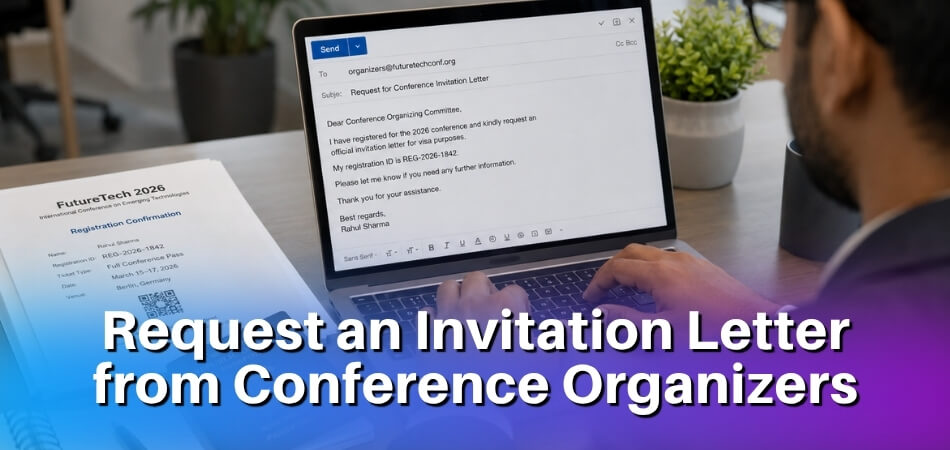
| Step | What to do | When |
|---|---|---|
| 1 | Check that the conference issues letters | Before you pay |
| 2 | Gather your details | While registering |
| 3 | Find the portal or the right contact | Right after payment |
| 4 | Send or submit the request | As soon as registration is confirmed |
| 5 | Follow up once | After five business days |
Step 1: Confirm the Conference Issues Invitation Letters
Look on the conference website for a “Visa Support,” “Attendee Resources” or “FAQ” page. Wording such as “invitation letters are available upon request” or “issued after registration” means you can go ahead. Not every conference issues them, and policies differ by event type and organizer.
Read the policy before you pay if you can, because it tells you whether the letter is automatic, on request or not offered at all. If the website says nothing, that does not automatically mean no. It may just mean you need to ask. For fully remote events, say clearly what you need the letter for, since some organizers decline when there is no travel involved.
Two more points are worth finding on that page. The first is whether you can ask before you register. Most organizers issue the letter only after registration and payment, but a few large societies run a pre-registration request form for people who cannot register yet. They screen each request, and not every request is approved. The second is whether the letter carries a fee or conditions: some organizers charge a non-refundable processing fee for it, others issue it free to registered participants.
Because payment usually comes first, read the refund policy too. Some organizers do not refund a registration after a visa refusal or delay, and an invitation letter does not change that.
Step 2: Gather the Information You Need Before Writing
A complete request is processed faster than one that triggers follow-up questions. Have these ready:
- Your full legal name as it appears on your passport
- Your passport number and expiration date
- Your nationality and country of residence
- Your institutional affiliation (university, employer or organization)
- The country you are applying to enter, if the letter is for a consulate or embassy
- Your registration confirmation or registration ID
- The exact conference name, dates and venue
- Your role (presenter, attendee, session chair and so on)
- The type of letter you need, since some visa applications or approvals need specific wording
Give passport details only through the portal, form or contact address the conference lists for visa support. If a university or employer has its own requirements, note them. A university might need the organizer to confirm the conference’s academic standing, while an employer might need your role and the relevance of the event.
Step 3: Find the Right Contact or Portal
Sending the request to the wrong address is a common cause of delay. Look first for a registration portal. Many mid-size and large conferences let you request the letter from your attendee dashboard after payment, often receiving a PDF within minutes. If that option exists, use it, because it needs no back-and-forth with staff.
If there is no portal, look for a contact labeled “Visa Support,” “Registration Support” or “Conference Secretariat.” Avoid writing to the program committee or keynote speakers, who handle content, not logistics. A request that reaches the wrong person can sit for days, and one addressed to a named team (for example, “Registration Team”) is more likely to be routed correctly. For smaller academic conferences, the right contact is often the host institution’s administrative office rather than a generic info address.
Step 4: Write and Send Your Request Email
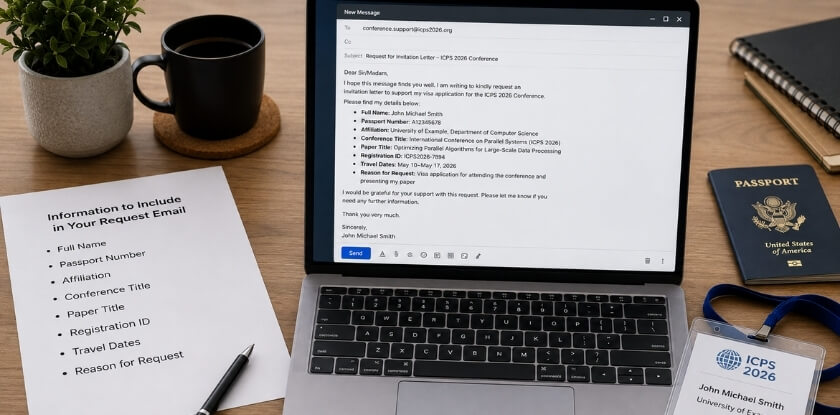
Keep it short and specific. The organizer does not need your reasons for attending, only your details and a clear ask. Use the conference’s official contact address and send it as soon as your registration is confirmed. One example is enough:
Subject: Invitation Letter Request – [Your Full Name] – [Conference Name]
Dear [Conference Name] Registration Team,
I am registered to attend [Full Conference Name], taking place [dates] in [city and country]. My registration number is [XXXXXX].
Please issue an official invitation letter for my [visa application / university approval / employer approval / sponsorship approval]. Details for the letter: full name as on passport [Name], passport number [XXXXXXX], nationality [Country], affiliation [University / Employer], role [Presenter / Attendee].
I would be grateful to receive it by [date]. Please tell me if you need anything else.
Best regards,
[Your Name]
[Email address]
If the organizer uses a web form instead, fill in every field. Incomplete submissions are usually returned rather than processed. Ask for the letter only: many organizers say they cannot contact an embassy for you, and you submit your own visa application. Tailoring the wording to a visa, a university or an employer is covered further down. To write a request email for the letter, start from a ready template for speakers, students, employers or groups and replace every bracketed field.
Step 5: Follow Up Once
If you have heard nothing after five business days, send one polite follow-up. Reference the date of your original request, repeat your registration number and state your deadline if you have one:
Subject: Follow-Up: Invitation Letter Request – [Your Full Name] – [Conference Name]
Dear [Conference Name] Team,
I am following up on the invitation letter request I sent on [date]. My registration number is [XXXXXX]. My visa appointment is on [date], so I would be grateful for any update.
Thank you,
[Your Name]
Organizers running large events get buried in email, and a deadline in your message helps them prioritize. Keep a copy of every message with its date, so you can show that you asked in good time if a consulate or approver questions the delay. If the follow-up also goes unanswered, see the escalation steps in the section on unresponsive organizers below.
What Is a Conference Invitation Letter (and When Do You Need One)
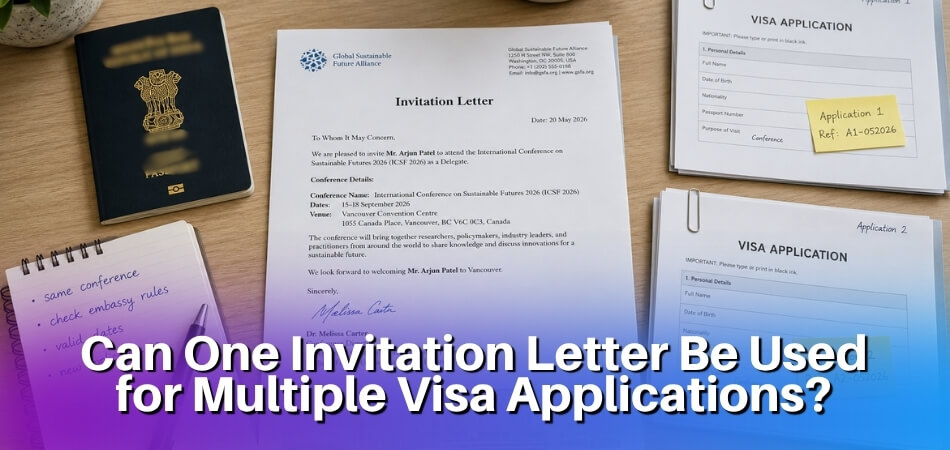
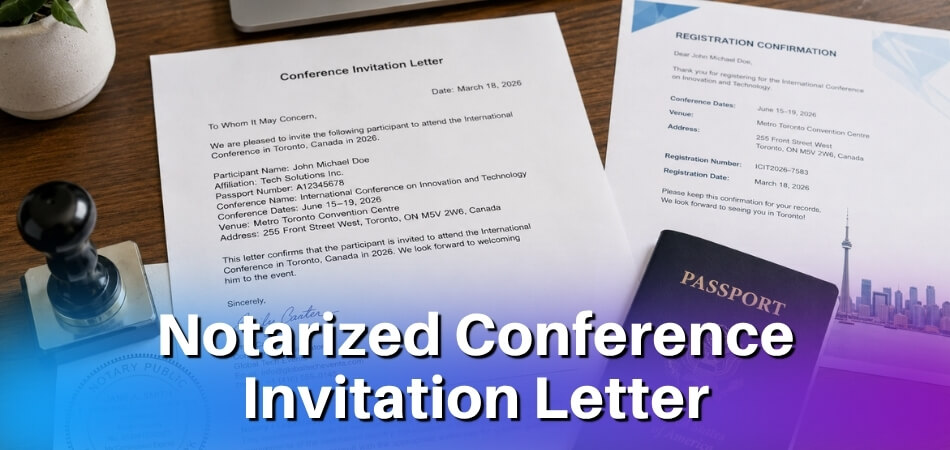
A conference invitation letter is an official document from the organizers confirming that you are registered for, accepted at or invited to their event. It is not the same as your registration confirmation email, though both may end up in the same application.
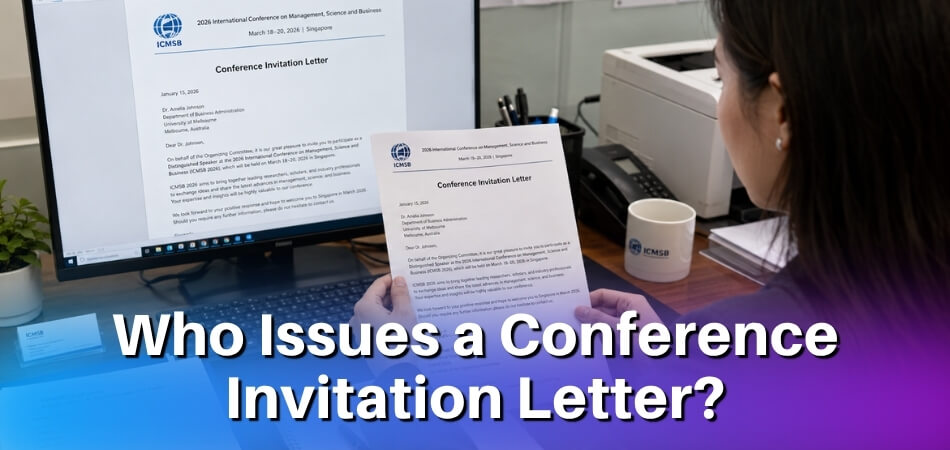
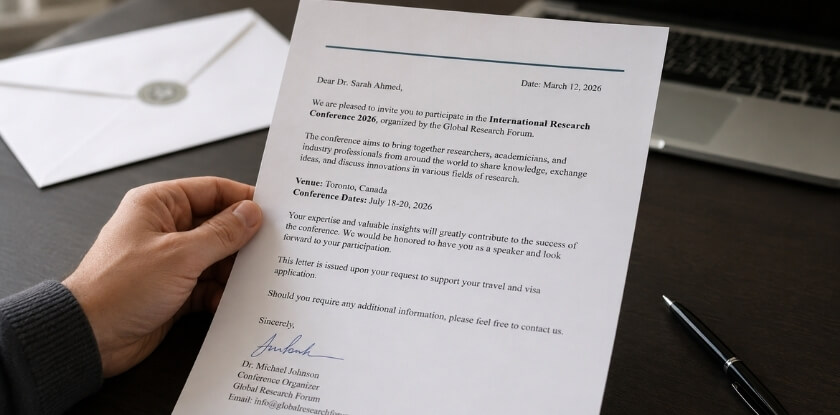
It usually comes on letterhead, signed by the program chair or a designated organizer, and states your name, the conference name, dates, location and your role. Some conferences generate it automatically after payment, others issue it manually on request.
Why You Might Need One
The most common reason is a visa application, because a consulate or embassy wants documents showing the purpose of your trip. Other reasons are below, and the table shows what to ask the letter to state for each.
| Purpose | Who reads the letter | Ask the letter to state |
|---|---|---|
| Visa application | Consulate or embassy | Your name and passport details, conference name, dates, venue address, your registration or role, organizer contact details |
| University approval | Department, supervisor, grants office | Your name and affiliation, registration or paper acceptance, dates and venue, and the organizing body’s contact details |
| Employer approval | Manager, HR, finance | Conference name, dates and venue, the nature and professional relevance of the event, your registration status |
| Sponsorship or travel grant | Funder | Confirmed participation, your role (presenter, invited speaker), dates and location, and the sponsor’s name if the organizer will include it |
Graduate students and postdocs often need institutional sign-off before travel, and a formal letter carries more weight than a screenshot of the conference website. Funders often list an invitation or acceptance letter as a required document.
Invitation Letter vs. Acceptance Letter: What Is the Difference
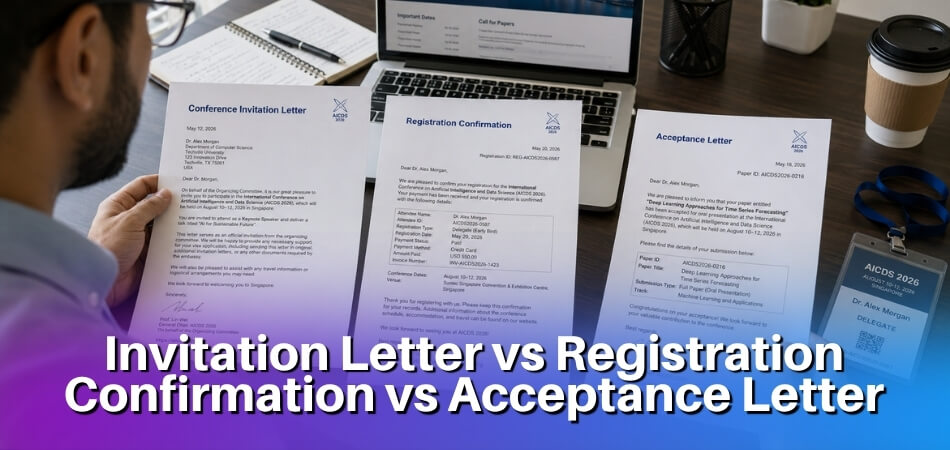
An acceptance letter says your paper, abstract or poster was accepted. An invitation letter says you are registered and invited to attend or present, and it is written for an outside reader such as a consulate, a university or an employer. Attendees who submitted nothing have no acceptance letter, and that is normal.
Some conferences state that their acceptance letter can be used for a visa application, so read what yours says. Presenters often need both: the acceptance letter for the university or funder, the invitation letter for the embassy. If a portal gives you only an acceptance letter and your consulate wants an invitation, tell the organizer you already have the acceptance letter and need a separate invitation document.
Some organizers issue one document called an “acceptance and invitation letter” or just an “official letter.” Read the content, not the title. Some embassies ask specifically for a letter that uses the word “invite” or “invitation,” so check your consulate’s requirements before you ask the organizer for anything. If the document has your name, the conference name and dates, the venue and your registration or participation, it will usually serve both purposes.
Adjusting Your Request for a Visa, University or Employer
The email in Step 4 works for all four purposes. What changes is the extra detail you add, so the organizer includes the right wording the first time.
- Visa. Name the visa type and the consulate, give your appointment date, and ask the letter to include the venue address and the organizing institution. If a sponsor pays your costs, ask whether the letter can say so.
- University or institutional approval. Give your department and position, say whether you registered or had a paper accepted, and name what the letter will be used for (travel approval, grant application, departmental sign-off). If you also hold an acceptance letter, check with your grants or travel office whether it is enough before asking for a second document.
- Employer or sponsorship approval. Give your company and job title, state your attendance category (delegate, speaker, workshop participant) and your approval deadline. Ask whether the portal has a dedicated option for employer or sponsorship letters.
Online Portals and Automated Invitation Letter Systems
Many conferences now handle letters through a registration portal instead of individual emails. If you do not know this exists, you can wait days for a reply to an email nobody is expected to answer.
How to Check Whether a Portal System Exists
Spend five minutes on the conference website, looking for “Visa Support,” “Attendee Resources,” “Registration” or “FAQ.” Large academic societies often have a visa support page that explains how their system works. If you have already registered, log back in and look for a “Request Invitation Letter” or “Visa Letter” button, which many portals add after payment is confirmed. The PDF may appear instantly or within a day or two. If the confirmation email exists but no letter came, check for a link inside that email, because some systems send the letter only on request.
What These Systems Typically Require
- Registration with payment confirmed. Unpaid or pending registrations usually return an error or show no option.
- Your full legal name as on your passport. Name mismatches can cause problems in a visa review.
- Your institutional affiliation and role (presenter, attendee, session chair), so the letter reflects your status.
- Your country of residence or the embassy you will apply through. Some systems tailor the wording to the destination.
When the PDF arrives, save it and check your name, passport number (if requested), dates and venue before attaching it to anything. If the button is missing, the download fails or the letter has a typo, contact the registration support team rather than the general inbox. Give your registration ID, the exact field that is wrong and what it should say.
Invitation Letter for Virtual and Online Conferences
For a fully virtual event you will not need a letter for a visa, because there is no travel. You may still need one for other reasons, and organizers handle these requests differently.
When You Would Still Need a Letter
- University or institutional approval. A registration receipt alone often is not enough for a finance or grants office.
- Employer reimbursement. An acceptance letter or official invitation works far better than a payment receipt.
- Sponsorship applications. Funders usually ask for a letter from the organizing body even when the event is online.
- Academic records. Some researchers want a signed record of participation or presentation for annual reporting.
You will not need a consulate letter, a Schengen support document or a US B-1 letter for a purely online event. Some embassies may accept a virtual-event letter for institutional purposes, so ask before assuming it will satisfy a visa application.
What the Letter Looks Like and How to Ask
It confirms your name, the event name, the dates (with time zone when the event spans regions), your role and the organizer’s contact details. It will not include venue or accommodation details, although some organizers reuse an in-person template, which is usually fine for institutional approval.
Check the portal first, since many virtual platforms issue a participation letter or a certificate of registration automatically. If not, email the organizer, confirm your registration and say what the letter is for, for example “my department’s professional development fund.” Employers in particular can be skeptical about the value of online events, so ask the letter to confirm the professional nature of the conference. Virtual teams are sometimes small, so follow up once after a week if you hear nothing, with your registration number in the message.
Country-Specific Visa Requirements for Conference Invitation Letters
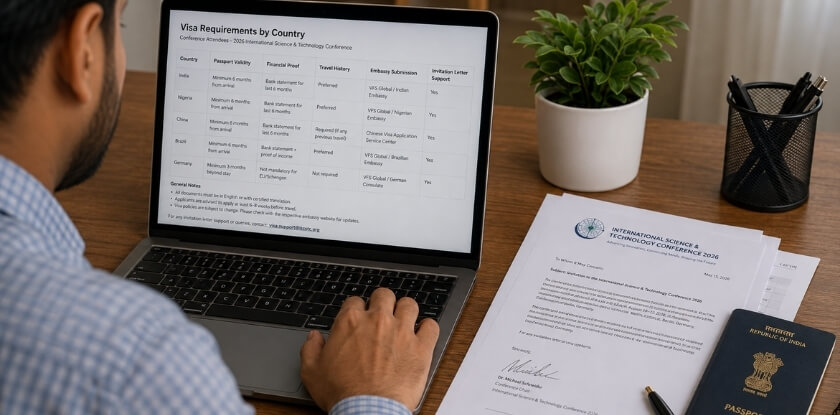
What a letter should say depends on where you are going, and consulates decide what they accept. The table summarizes what the official sources say. Always check the current rules on the destination’s government website. For a destination outside this table, such as Turkey, the invitation letter from a Turkish host should usually come from the conference organizer and state the same purpose as your visa application.
| Destination | What the official guidance says | What to ask the organizer for |
|---|---|---|
| Schengen area | Requirements are set by the consulate of the member state you apply to, and they differ. Some member states ask the invitation to give the purpose and length of stay and who pays. Sweden’s official invitation form for private visits, for example, asks for the host’s and visitor’s personal details, the visit itself and who pays for the stay, so ask your consulate what it expects for a conference. | Full name and passport details, conference name, dates, venue, your registered status and, if relevant, who covers your costs |
| United States | Attending a scientific, educational, professional or business convention or conference is a permitted visitor-visa activity. Conference attendees may not receive a salary from a US source. | Conference name and location, dates, your role, organizer contact details. Ask the consulate if you will be paid an honorarium |
| United Kingdom | Attending conferences is permitted for Standard Visitors. GOV.UK’s supporting-documents guide says you should provide a letter of invitation from the organizer for a business event or conference. Paid speaking has separate rules. | Event name, dates, location, your role, and who pays your costs if someone other than you |
| Canada | IRCC says a letter of invitation does not guarantee a visa, and the officer assesses each applicant. Writing a letter does not make the writer legally responsible for the visitor. For business guests, IRCC tells event organizers to give each guest 2 copies of the letter of invitation, and to include the event code if the event is registered with IRCC. | Event details, your participation status, dates and location. Ask whether the event is registered with IRCC and whether the letter can carry its event code. Check the checklist for your own application |
Beyond the standard details, a few situations need a mention in the letter:
- Sponsorship coverage. If an organizer, university or employer pays your registration, travel or accommodation, the letter should say so plainly. “We welcome your attendance” is too vague. Automated letters sometimes leave out the statement on who covers costs, so if yours does, ask the organizer for a short supplementary letter.
- Speaker or presenter status. Say if you are presenting, because this can affect which supporting documents a consulate expects.
- Hybrid events. Visa rules do not apply to a fully virtual conference, but an in-person event with a hybrid component is different. Ask the letter to state that your attendance is physical and at the named venue. “Online or in-person” can confuse a consular officer.
Current Measures a Letter Does Not Change
An invitation letter proves the purpose of your trip. It does not lift country-wide measures that are in force in 2026:
- United States. The B-1/B-2 visa bond program has been permanent since 3 August 2026, with bonds of $10,000, $15,000 or $20,000 for applicants from listed countries. Proclamation 10998 partially suspends B-1/B-2 visas for nationals of 19 countries, including Nigeria, from 1 January 2026. Interview waivers have been narrower since 1 October 2025.
- Canada. IRCC’s temporary Ebola measures apply to people whose last country of residence is the Democratic Republic of the Congo, South Sudan or Uganda, and run to 27 November 2026.
Check the destination’s official visa page for your nationality before you pay for registration. Supporting documents should also tell one consistent story. A letter that conflicts with your bank statements or employer letter will draw questions.
How Long Does It Take to Get an Invitation Letter
Timing is one of the few parts of the visa process you do not fully control, so ask early. The table shows realistic ranges by type of conference.
| Type of conference | Typical wait | Notes |
|---|---|---|
| Automated portal | Minutes to 24 or 48 hours | Needs payment confirmed and details entered correctly |
| Manual request | Organizers publish anything from a few days to about three weeks | Longer in the weeks after acceptance notices go out |
| Small workshop run by volunteers | Can be longer | Follow up once after five business days |
During busy periods, such as the weeks right after acceptance notices go out, response times stretch because organizers are answering many similar requests at once. A few things slow requests down: small teams, an unpaid registration (some organizers will not issue a letter until payment is confirmed), vague emails that force follow-up questions, and time zones if the committee works in another region. If your institution must approve travel before reimbursing fees, ask whether a pro forma invoice or registration confirmation is enough for initial approval, to avoid a circular delay.
Visa appointments often have to be booked weeks or months ahead, and processing adds more time, so check current estimates on the embassy or consulate website. Request the letter as soon as registration is confirmed and hold it before your visa appointment, since appointment waits differ by embassy. If the event is only a few weeks away, say so in the first message and give your hard deadline, because organizers tend to prioritize requests with a date attached. Getting the letter first also gives you something concrete to attach to a university or employer approval request.
What to Do If the Organizer Does Not Respond or Refuses
Most of the time the organizer is not unwilling, just overwhelmed by registrations or using a system you have not found. Go back to the portal first (see Step 3), send the single follow-up from Step 5, and then escalate.

Escalation Steps
If the conference lists both a general contact form and a dedicated visa support contact, write to both. If your follow-up still produces nothing after about another week, try other channels:
- Program chairs. Their names and institutional emails are usually on the conference website. A brief professional message often gets faster attention than a general inbox.
- Your network. If you know a presenter or committee member, ask them to flag your request internally.
- Social media or community channels. A direct message asking where to send visa support requests is appropriate and often gets a quick reply.
- Other channels. Look for the conference on LinkedIn, find a phone number for the organizing institution, or contact a named person listed on the website. For academic conferences, the hosting department is often reachable by phone.
- Your own institution. Your grants office, international office or travel coordinator may already have a contact for this conference.
If the Organizer Refuses or Says They Do Not Provide Letters
This happens, mostly with smaller or fully virtual events. Some organizations decline because an invitation can imply responsibility for your costs or stay. If that is the reason, ask for a confirmation of participation that makes no promise about money. Also check that your embassy actually asks for an invitation: GOV.UK, for example, says you should provide one, and treats its document lists as guidance. Ask whether they can provide a written confirmation of registration or acceptance on official letterhead, an acceptance letter for your paper or poster, or a registration confirmation showing the conference name, dates, location and your full name. Some consulates may accept a formal registration confirmation in place of an invitation letter, but this varies by country and visa type, so check before relying on it. If the organizer is a university or research institution, ask whether its international office can issue a letter instead.
If there is genuinely no letter coming, assemble a backup package: your registration confirmation, any acceptance letter, the official program showing your name or session, and a short personal statement. If your deadline is hard, contact the consulate, explain the situation and ask what alternative documents it will take. That is far better than submitting an incomplete application and hoping.
How to Use the Invitation Letter for University or Employer Approval
Getting the letter is only half the job. Each approver has different expectations, and a letter that suits the consulate will not necessarily suit your department chair.
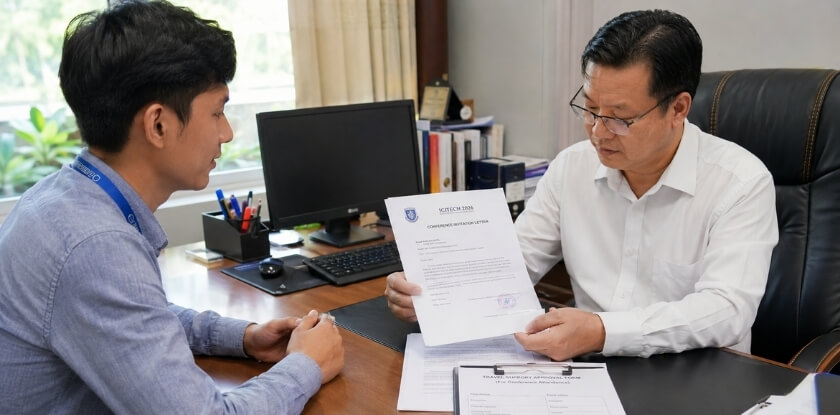
University Approval
- Submit it with your acceptance letter. If you are presenting, the acceptance letter is usually the primary document and the invitation letter reinforces it.
- Make your role explicit. If the letter does not say whether you are a presenter, panelist, chair or audience member, attach a short cover note that does.
- Fill your institution’s forms from the letter. Conference name, dates, location and costs should match, because discrepancies cause delays.
- For funding, the letter signals credibility. A letter on letterhead with a named organizer carries more weight than a printout of the website.
Employer Approval
- Lead with the professional value. Open with a short explanation of why the event matters for your work, then attach the letter.
- Spell out travel and time-off implications. The letter gives the exact dates, so you can state the days away and the costs.
- Use it for legitimacy. If the organizer is a recognizable body in your field, make sure that is visible to the approver.
Sponsorship Approval
Sponsors often want proof that the conference is peer-reviewed or professionally recognized, your confirmed role, and the dates and location. The letter usually covers the first two, and your registration confirmation covers the rest. If the letter does not name the sponsor or the funding arrangement, add a separate cover letter that connects them.
From our experience at MS International: You do not send a request for an MS International conference, because the process starts once an eligible registration is paid. The letter is then issued within 3 to 5 business days after payment clears. The standard letter is free of charge to registered participants. A US$50 fee may apply to corrections after it is issued, so enter your name exactly as on your passport. Registration fees are non-refundable, including after a visa refusal or delay, and the letter supports a visa application but does not guarantee one. Our conferences are held in person in the Greater Toronto Area.
FAQ
Asking an organizer for a letter is usually simple, until it is not: no letter offered, only an acceptance letter received, a virtual event, or a fee charged for the document.
Does every conference provide an invitation letter?
No. Smaller workshops, regional meetups and some symposia have no formal system for issuing them, while larger international conferences usually do, often through a registration portal. Check the conference’s visa or attendee support page before emailing.
Can I request an invitation letter before I have registered?
Usually not. Most organizers issue the letter only after registration and payment. A few large societies offer a pre-registration request form and screen each request, and approval is not guaranteed. Check the conference’s visa page.
Is a conference invitation letter a visa guarantee?
No. The letter supports your application, but the consulate or embassy makes the decision. It is one document among many, not a pass.
What if I only got an acceptance letter, not an invitation letter?
You may still need an invitation letter. An acceptance letter confirms your paper or presentation was accepted, while many consulates want a letter addressed to you confirming your registration and inviting you to attend. Ask the organizer for both.
Can I get an invitation letter for a virtual or online conference?
Yes, many virtual conferences issue one, mostly for university, employer or sponsorship approval. It confirms the dates, your registration and the official nature of the event. Check the registration portal first.
What details must the invitation letter include for a visa application?
Your full name, passport details, conference name, dates and venue, the organizer’s contact details and a statement that you are invited. Some consulates also want the length of stay and who pays, plus letterhead and a signature. Check the embassy’s checklist.
Is there a standard format organizers use?
No single format exists. Most organizers use a professional letter on institutional letterhead. What matters is that it is signed, dated and contains the key details about you and the event.
What if the organizer refuses to issue one?
Ask why, and ask whether a registration confirmation or an acceptance letter on letterhead can replace it. Some embassies and institutions accept these. Check the consulate’s official guidance for what alternative documents it takes.
How early should I request the letter?
As soon as your registration is confirmed. Organizers publish waits from a few days to about three weeks, and embassy times vary by country and season, so hold the letter before you book a visa appointment.
Does MS International Conferences issue invitation letters?
Yes, with no separate request. Registered authors, presenters and listeners receive it automatically, within 3 to 5 business days after payment clears. A US$50 administrative fee may apply to corrections requested after the letter is issued.
Do I have to pay for an invitation letter?
Not always, but some organizers charge a non-refundable processing fee, so check the visa page before you pay. MS International’s standard letter is free of charge to registered participants, while corrections after issue may cost US$50.
Can the organizer contact the embassy or apply for my visa?
Usually not. Many organizers say they cannot contact an embassy for you. MS International states that each participant prepares and submits their own visa application.
Final Thoughts
Getting a conference invitation letter is rarely complicated, but it needs planning. Register, ask early, give the organizer everything in your first message, and keep a copy of what you receive. Then confirm with your embassy or consulate what it will accept, since that can differ from general guidance.
Disclaimer: This article is general information, not legal or immigration advice. A letter does not guarantee a visa. Always check current requirements with the embassy, consulate or government immigration authority that handles your application.