
Not sure what belongs in a conference invitation letter, or worried you have left something out?
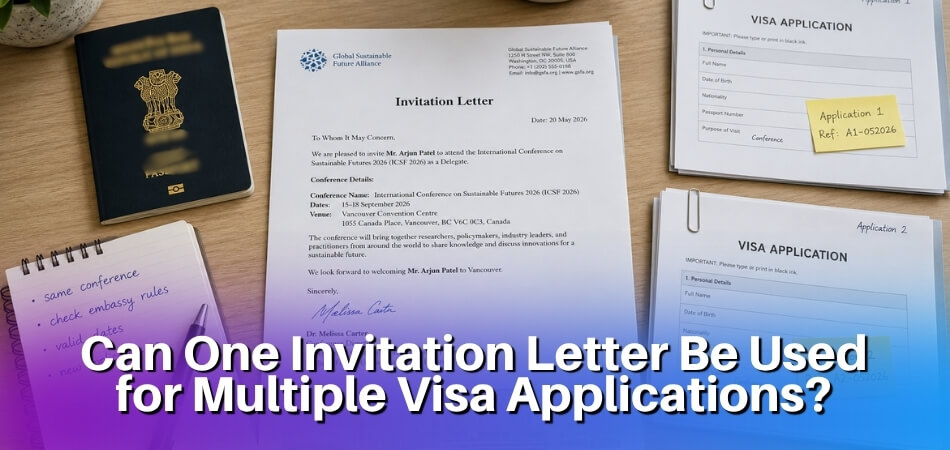
Quick answer: A conference invitation letter should include the conference name, dates, and venue (or online platform), the invitee’s full name and role, the organizer’s name and contact details, who pays for what, a response deadline, and an authorized signature on letterhead. For visa use, add passport details and arrival and departure dates. The letter supports an application but never guarantees a visa.
Fact-checked by the MS International Editorial Team. Last verified against official sources: October 2026.
The exact contents change with the reader: a speaker needs session and honorarium details, an attendee needs registration steps, an embassy needs confirmed dates and who pays, and a university needs proof the event is genuine. Below you will find a required-fields table, what to add for each letter type, tone guidance, ready-to-use templates, and the mistakes that get letters sent back.
What a Conference Invitation Letter Must Include
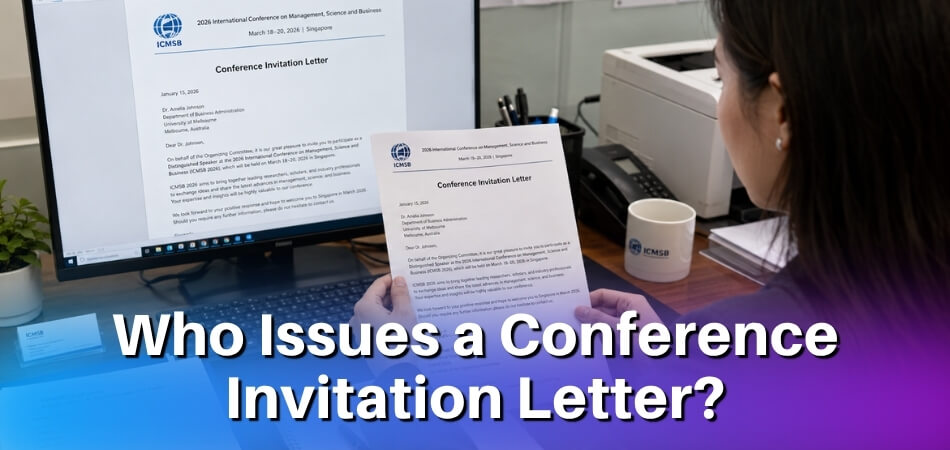
Every conference invitation letter needs the same core facts: who is inviting, what the event is, who is invited and in what role, what the organizer will and will not pay, and how to reply. Leave one out and the reader has to write back, or the letter fails when an embassy or employer reviews it.
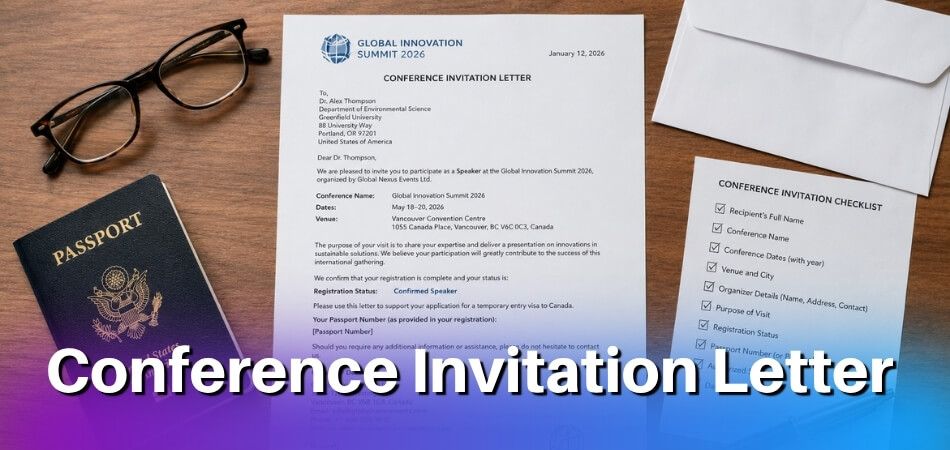
Required Elements at a Glance
| Element | What to write | Why the reader checks it |
| Organizer identity | Full legal name of the organizing body (all partners if joint), official address, letterhead | Shows the sender is real and traceable |
| Event identity | Full conference name, theme, year, exact start and end dates | Dates and event name are what officers and approvers match against the application |
| Venue or platform | Full address and whether the event is in person, online or hybrid; for online events, the platform, time zone and access method | Confirms where the invitee will be |
| Invitee and role | Name as in the passport, plus speaker, chair, presenter or attendee | Role changes how an institution classifies the trip |
| Purpose | One clear sentence on what you are asking or confirming | A buried purpose loses the reader |
| Financial terms | What is covered, what is not, and who pays the rest | Immigration offices and employers may want to know who bears the cost |
| Response deadline | A specific date, for invitations that need a reply | Gives the reader a timeline to plan leave, travel and visa |
| Contact person | Name, job title, email, ideally a phone number | Lets a reviewer verify the letter directly |
| Signature | Printed name, title and handwritten or authorized signature | An unsigned or anonymous letter looks untrustworthy |
Where the Core Details Go
Put the organizer and event identity in the first lines. State the conference name in full, with the year, so the reader never has to guess what “our annual event” means. Add the theme as a specific description: “a two-day symposium on antimicrobial resistance in clinical settings” tells the reader far more than “a conference on health sciences”, and it explains why this person was invited. For multi-day events, mention pre-conference workshops or a gala dinner that requires attendance on specific days.
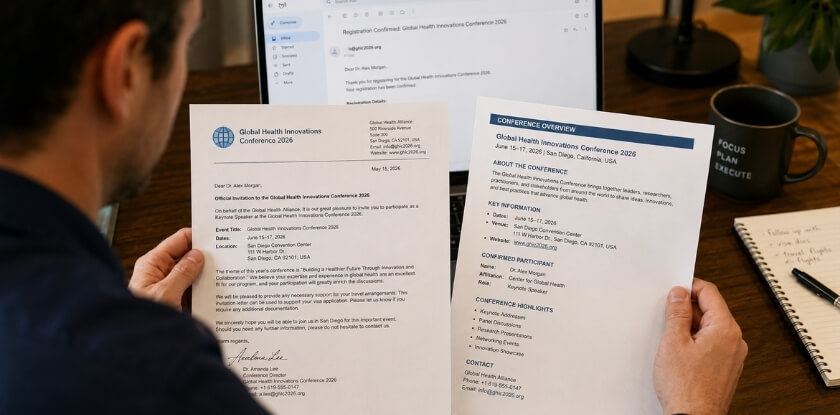
Address the recipient by name and say why they are invited. For a speaker, name the task (keynote, panel, paper) and the session. For an attendee, say how the conference relates to their field. A targeted invitation also helps when the invitee has to ask an employer for leave.
Extras That Depend on the Letter Type
- Speaker letters: session date, time, format and length, any honorarium, and accommodation arrangements.
- Visa support letters: registration status, arrival and departure dates, nationality, date of birth and passport details where the issuer collects them, and who covers travel, accommodation and conference fees. Officers may check these points, and a vague letter can cause delays.
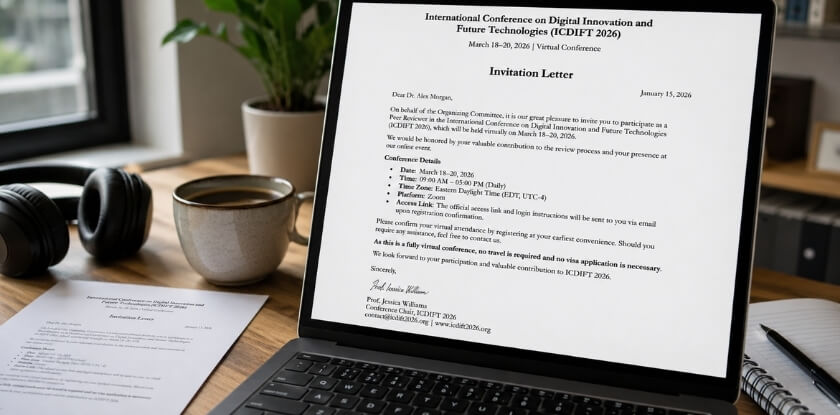
- Virtual conference letters: platform, time zone and access instructions instead of a venue. The tone can be lighter, but the functional information is the same.
- Institutional or university approval letters: these confirm to an employer or faculty that the event is genuine, the dates are fixed, and what the employee or student will do there.
If the Letter Supports a Canada-Bound Visitor
IRCC’s guidance on business letters of invitation lists the details the inviting side should state. A conference letter is not a company invitation, but the same details help a visa office understand the trip:
- The invitee: complete name, date of birth if known, employer and position, and contact details.
- The trip: the purpose, the length of the visit and the intended departure date if known.
- Costs: the accommodation and living expenses the host will cover.
- The signer: complete name, job title, address, telephone number and work email.
- The organizer: complete legal name, headquarters address, website if available, and date of registration or incorporation.
IRCC also tells event hosts to give each business guest 2 copies of the letter and, if the event is registered with IRCC, to include the event code in it. Visa offices may ask for more, and what visa officers check in the letter differs by country, so the applicant should follow the instructions of the office that handles the application.
Formal vs Informal Conference Invitation Letters
Use a formal letter whenever the document may be shown to an embassy, employer or funder, and an informal one only for colleagues you already know. When unsure, go formal: a formal letter to a friend is rarely a problem, while a casual email submitted as visa paperwork can be.
Formal Letters
Formal letters suit keynote speakers, institutional partners, government events and anyone who needs documentation for a visa, approval or reimbursement.
- Letterhead. Use the organizing institution’s name, logo, address and contact details. Visa and HR offices may question anything that looks unofficial.
- Full title and name. “Dear Dr. Miriam Schultz” carries more weight than “Dear Miriam”.
- Written commitments. Put travel support, accommodation and funding terms in the letter itself, so the invitee has something concrete to show their administration.
- Precision. Vague wording in a formal letter signals poor organization.
A formal speaker invitation to a keynote presenter might look like this:
Dear Professor Elena Torres,
On behalf of the Organizing Committee of the 12th International Symposium on Environmental Policy, to be held on 14–16 September 2026 at a conference hotel in Copenhagen, Denmark, we are pleased to invite you to deliver the opening keynote address.
The symposium theme is “Climate Governance in Transition,” and your recent work on transboundary regulatory frameworks makes you an exceptionally well-suited speaker for this session. Your keynote is scheduled for the morning of 14 September and is expected to run approximately 45 minutes, followed by a 15-minute Q&A.
The Organizing Committee will cover your economy-class return airfare, three nights’ accommodation at a conference hotel, and provide a speaker honorarium of €800. A formal financial support disclosure form will be sent upon confirmation.
Please confirm your participation by 30 August 2026 by contacting our event organizer, Ms. Katrine Holm, at [email protected].
We look forward to your positive response.
Sincerely,
Professor Jens Lund Chair, Organizing Committee 12th International Symposium on Environmental Policy
Informal Letters
An informal letter fits workshops, internal team events and early outreach to someone you already work with. It can use first names and run two or three short paragraphs, but it still needs the date, venue or platform, the person’s role and a response deadline. A missing reply date is an easy slip.
The same invitation in an informal register:
Hi Elena,
I hope you’re well. I’m writing on behalf of the organizing team for the 12th International Symposium on Environmental Policy, taking place 14–16 September 2026 in Copenhagen.
We’d love to have you deliver the opening keynote on climate governance, since your recent work on transboundary regulation is exactly what we want to open the conversation with. The talk would run about 45 minutes with a Q&A after. We’re covering flights and accommodation, and there’s an €800 honorarium.
Could you let us know by 30 August whether this works for you? Happy to send over full details once you confirm.
Best, Jens
Matching Tone to the Letter
- Speaker invitations: professional and warm, with full titles and no contractions. Explain why this person’s participation matters.
- Attendee invitations: slightly warmer and more direct. Short, clear sentences work better than formal constructions.
- Visa support letters: neutral and factual. State dates, venue, role and organizer contact plainly, with no persuasive language.
- Institutional approval letters: neutral. Administrators need dates, roles and organizational details, not persuasion.
- Virtual invitations: lighter in structure, but lead with the date, time zone, platform and how to register rather than paragraphs of enthusiasm.
Avoid gushing phrases such as “we are incredibly honored and delighted to extend this most gracious invitation”. They add length, not meaning. At the other extreme, a letter that reads like an administrative form gives the recipient no reason to care, so add one genuine sentence on why the event or their contribution matters. Be direct about the ask: “Please confirm your attendance by 15 March” works better than “at your earliest convenience”, and “Dear Colleague” in a speaker invitation reads as impersonal.
Speaker Invitation Letter vs General Attendee Invitation Letter
A speaker letter is a request with terms attached, while an attendee letter is a welcome with a call to action. The two need different detail, so do not reuse one for the other.
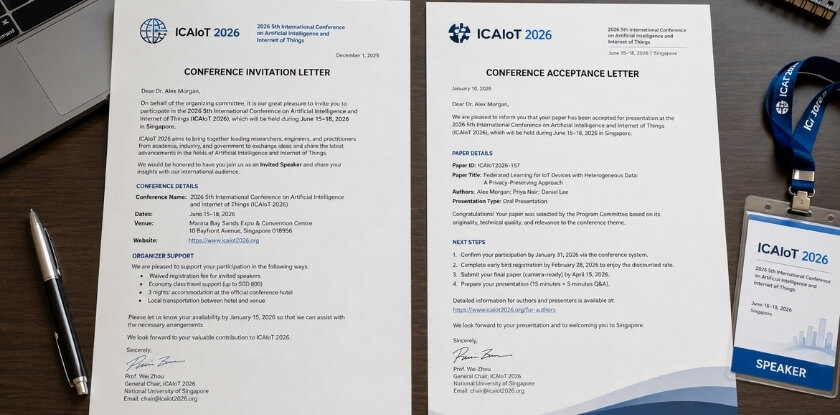
Speaker Invitation Letter
You are asking someone to commit time, prepare content and often travel, so the letter has to justify that ask.
- Session and context. Give the session type (keynote, panel, workshop), the proposed topic and the length of the slot, so the speaker knows what to prepare.
- Event details. Add expected audience size and discipline so the speaker can judge fit.
- Support offered. State travel, accommodation and any fee waiver in the letter, not in a later email.
- Reply date. Speakers juggle several invitations. Allow at least two to three weeks for local speakers and longer for international ones who may need a visa support letter. If the speaker deadline differs from the general attendee deadline, state it separately.
- Named contact. A specific person, not a generic inbox.
A ready-made speaker template appears in the templates section below.
General Attendee Invitation Letter
An attendee letter gives the reader everything needed to register, plan and attend.
- Lead with the basics. Conference name, date, venue or platform and theme in the first paragraph, plus one line on what attendees get, such as keynotes, paper sessions or networking.
- Say who it is for. One sentence on the target audience, such as academics, industry professionals or postgraduate students, helps people decide quickly.
- Registration route. State the deadline and add the registration link if there is one. If attendance needs a university approval letter, mention it so people allow processing time.
- Visa help. For international attendees, say that visa support letters are available on request. This prevents a flood of individual questions later.
Key Differences at a Glance
| Element | Speaker Invitation | Attendee Invitation |
| Session/role details | Specific and required | Not applicable |
| Financial support disclosure | Always include if applicable | Mention if scholarships are available |
| RSVP deadline | Firm, early | Standard registration deadline |
| Visa support mention | Often needed for international speakers | Include for international attendees |
| Tone | Formal request | Informative and welcoming |
| Contact person | Named individual | General organizer contact is acceptable |
The difference is commitment level: a speaker is asked to do something for you, while an attendee is invited to benefit from something you organized.
Virtual and Online Conference Invitation Letters
A virtual invitation letter keeps the same structure as an in-person one, but swaps the venue for platform, access and time zone details. These replace hotel and directions information, so they must be exact.
What Changes in a Virtual Format
- Platform and access. Name the platform (Zoom, Microsoft Teams, a conference portal) and explain how participants get their link, through the registration system or by email closer to the date.
- Time zones. Give session times in your main zone plus one or two reference zones, for example “10:00 AM EST (3:00 PM GMT / 4:00 PM CET)”. A bare timestamp confuses international participants.
- Registration and login. If people must register on a separate portal first, say so and give the link. A registration deadline is different from a reply deadline, so state both where they differ.
- Technical needs. A short note on stable internet, a webcam for presenters or any software download saves last-minute support emails.
When the platform needs a final participant list before generating join links, tell invitees that their reply triggers that step. It gives the deadline real meaning. For virtual speakers, offering a technical rehearsal or noting that recording is available shows you have thought about presenting online. A full virtual template is in the templates section below.
Do Virtual Invitees Still Need a Letter?
An online-only event usually removes the need for a visa support letter, because no one travels. A short written confirmation that the conference is fully online, with the platform and access details, normally answers an employer or university who asks. Some participants still want a formal letter for their records, to justify time away or to apply for internal funding. In that case, issue a standard letter on letterhead, confirm the event is virtual, and include the dates. Mention honoraria or stipends if you offer them, as you would for an in-person event.
Invitation Letters for University or Institutional Approval
A letter for institutional approval proves to a department head, HR office or faculty board that the event is genuine and the dates are fixed. It is submitted by the invitee, so a reviewer who knows nothing about the conference must be able to understand it on one page.
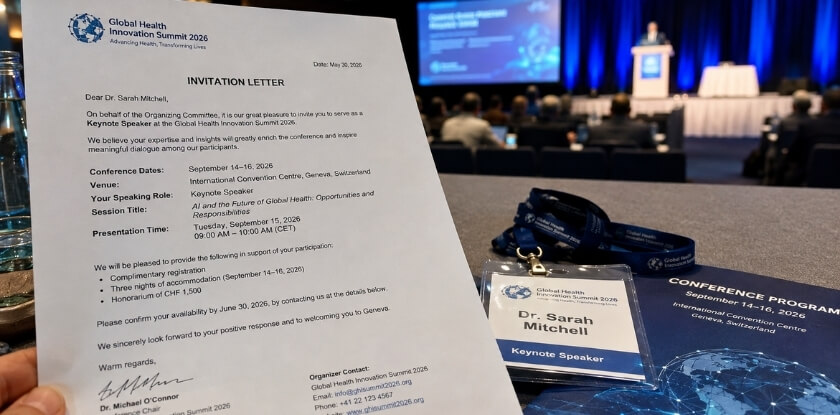
What Institutional Reviewers Need to See
- Legal name of the organizer. Exactly as it appears on official documents, not just “conference committee”.
- Opening and closing dates. Not “late March”. For virtual events, say so and add the platform, since some institutions treat travel and non-travel events differently.
- Role. Speaker, panelist, session chair or attendee. A speaking engagement may follow a different approval path than passive attendance.
- Relevance. One or two sentences linking the event to the invitee’s field help a department head justify the approval.
- Funding. What the conference covers and what it does not, so reimbursements and conflicts of interest can be processed.
- Contact details. Name, email and ideally phone, because some institutions call before approving international travel.
Invitation Letter vs Institutional Approval Letter
The two documents run in opposite directions. The invitation letter comes from the conference, while the institutional approval letter comes from the employer or university and confirms they support the person’s attendance. Organizers should tell applicants clearly that the second one must be obtained from their own institution. A university approval letter, issued by a dean, department head or administrative office, typically confirms the person is a registered student or staff member in good standing and, sometimes, that the institution backs the costs.
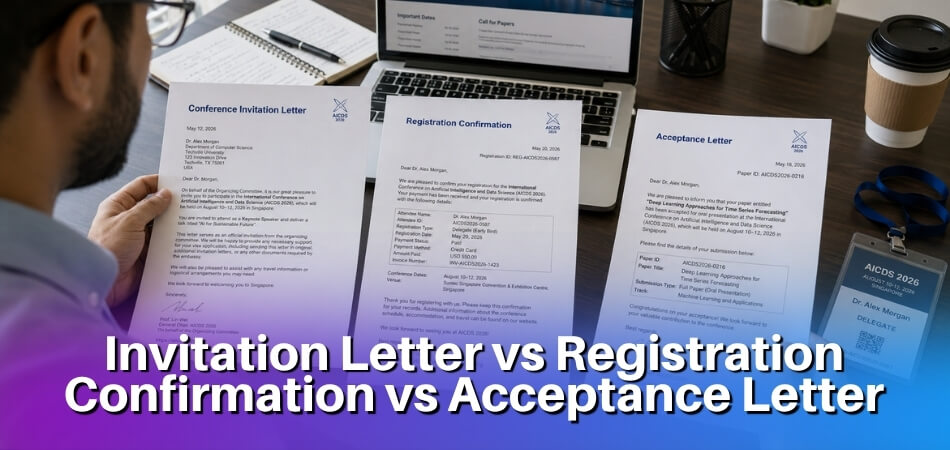
For students presenting, some universities want this letter before the conference issues a visa support letter. Ask your own institution which order it expects. Take the invitation, the program and the abstract acceptance notice to whoever signs off on travel. A complete approval-oriented template is in the templates section below.
Funding and Financial Support: How to Mention It Correctly
State exactly what the conference pays for, what it does not, and any conditions. Funding is easy to get wrong: vague wording creates false expectations or leaves people unsure whether they can attend.
Full, Partial or No Funding
| Situation | Wording that works | Avoid |
| Full funding | “The organizing committee will cover your round-trip economy airfare, hotel accommodation for the conference dates, and full registration fee.” Add conditions such as receipts, an airfare cap or limited nights. | “We hope to provide some support” |
| Partial funding | “The conference will cover your registration fee and two nights of hotel accommodation. Travel costs will need to be arranged independently.” A concrete figure helps: “a travel stipend of up to USD 400”. | “We may be able to assist with some costs” |
| No funding | “The conference is unable to provide travel or accommodation support for this event.” | Saying nothing, since attendees may assume support is coming |
Funding in Visa Support Letters
Immigration authorities may want to see who is responsible for the costs of the visit. If the conference funds the trip, say: “The conference will cover all travel and accommodation costs for [Name] during their participation from [dates].” If the applicant is self-funded, say: “[Name] will be responsible for their own travel and accommodation expenses.” A letter that leaves financial responsibility unclear can delay or complicate an application. If the conference pays nothing, say so, because an invitation letter does not by itself commit the organizer to cover any cost.
Where Funding Belongs
Place financial terms in the body of the letter, after the conference name, dates, venue and nature of the invitation, and before the response deadline. Tie them to the organizer’s name and institution near the top so the commitment carries credibility. Keep the wording factual: this is not the place for warm or ceremonial language.
Ready-to-Use Templates
The five templates below cover the most common scenarios. Replace the bracketed fields, match the tone to your context, and check every date against the conference website before sending.
Formal Attendee Invitation Letter (In-Person)
Use this for registered participants, delegates or guests attending an in-person academic, professional or government-affiliated event.
[Conference Letterhead / Institution Name] [Date]
Dear [Recipient’s Full Name],
We are pleased to invite you to [Conference Full Name], to be held on [Date(s)] at [Venue Name, City, Country]. The conference is organized by [Organizing Institution/Body] and will bring together researchers, practitioners, and policymakers working in [Conference Theme/Field].
The program includes keynote addresses, paper presentations, and panel discussions. Full details regarding the schedule, registration, and accommodation options are available at [Conference Website URL].
We kindly ask that you confirm your attendance by [RSVP Deadline]. Please direct your response or any questions to [Event Organizer Name] at [Email Address / Phone Number].
We look forward to welcoming you to [City/Venue].
Sincerely,
[Name]
[Title] [Institution] [Contact Details]
Speaker Invitation Letter
This template conveys what is being asked (session topic, time allocation, support) so the invitee can decide.
[Conference Letterhead] [Date]
Dear [Speaker’s Full Name],
On behalf of [Organizing Committee / Institution], we would like to invite you to speak at [Conference Name], scheduled for [Date(s)] at [Venue, City]. Given your expertise in [specific area], we believe your contribution would be of considerable value to our delegates.
We are inviting you to deliver a [keynote address / panel presentation / workshop session] on [Proposed Topic or Theme], with a time allocation of approximately [X minutes]. The session is currently scheduled for [Date and Approximate Time Slot], though we will confirm the final program in advance.
[If travel support applies: The organizing committee is able to offer [travel reimbursement / accommodation / registration waiver] as outlined in the attached speaker agreement.]
Please let us know whether you are available and willing to participate by [Response Deadline]. We are happy to discuss any aspect of the proposed session before you confirm.
We hope very much that you will be able to join us.
Yours sincerely,
[Name]
[Title / Role] [Conference Name, Organizing Body] [Email / Phone]
Visa Support Invitation Letter
Immigration authorities will read this one, so precision matters. Include full institutional details, the invitee’s passport information if you have it, and a clear statement of the conference’s official status.
[Official Letterhead with Full Institutional Address] [Date]
To Whom It May Concern,
This letter is issued to confirm that [Invitee’s Full Name], [Nationality], [Passport Number], has been formally invited to attend [Conference Full Name], to be held from [Start Date] to [End Date] at [Venue Name, Full Address].
The conference is organized by [Institution/Organization Name], a [registered academic body / professional association / government-recognized organization] based in [City, Country]. The event will focus on [Conference Theme] and is expected to draw [approximate number] participants from [number] countries.
[Invitee’s Name] is expected to arrive on or around [Arrival Date] and depart on or around [Departure Date]. [Optional, if applicable: The organizing institution will provide [accommodation / financial support / registration] for the duration of the event.]
We respectfully request that the relevant visa authority give this application due consideration. Should you require any further documentation or clarification, please contact [Event Organizer Name] at [Email] or [Phone Number].
Yours faithfully,
[Name]
[Official Title] [Institution Name] [Full Address, Phone, Email, Official Stamp if required]
Virtual Conference Invitation Letter
Platform access details replace venue information, and time zone clarity is non-negotiable.
[Letterhead or Official Email Header] [Date]
Dear [Recipient’s Full Name],
We are delighted to invite you to [Conference Name], which will be held online on [Date(s)]. The conference is hosted by [Organizing Body] and will take place via [Platform Name, e.g., Zoom / Microsoft Teams / conference portal], with sessions running from [Start Time] to [End Time] [Time Zone, e.g., UTC+0 / CET / EST] (equivalent to [Time] GMT / [Time] CET).
The conference will address [Conference Theme], and registered participants will have access to all live sessions, recorded presentations, and downloadable materials through the event portal at [Website URL].
Registration is [free / open at the following link / by confirmation only]. To secure your place, please register or confirm attendance by [RSVP Deadline]. Login credentials and session links will be distributed to confirmed participants no later than [X days] before the event.
If you have any questions, please contact [Organizer Name] at [Email].
We look forward to your participation.
Kind regards,
[Name]
[Title] [Organizing Institution] [Email / Conference Website]
University / Institutional Approval Invitation Letter
When a participant’s university or employer must approve attendance, the letter has to justify the trip, not just describe the event.
[Conference Letterhead] [Date]
Dear [Department Head / Dean / HR Manager / Approving Authority],
This letter is issued to confirm that [Participant’s Full Name], [Department/Faculty], has been formally accepted to participate in [Conference Full Name], scheduled for [Date(s)] at [Venue, City, Country / Online Platform]. The conference is organized by [Full Name of Organizing Institution or Body] and focuses on [Conference Theme].
The program includes [keynote sessions / workshops / paper presentations], and [Participant’s Name] has been [invited to present a paper titled “X” in the session “[Session Title]” on [date and time] following peer review of the submitted abstract / accepted as a delegate / invited as a session chair].
We believe this conference offers a meaningful opportunity for professional and academic development in [relevant field]. The conference registration fee [will be / will not be] covered by the organizing committee. [Travel and accommodation support is / is not] provided. Any additional costs, including [travel / accommodation / subsistence], would be the responsibility of the participant’s institution or sponsor.
We respectfully request that your institution grant [Participant’s Name] the necessary leave and logistical support to attend. Should you require any additional documentation, including a formal institutional approval letter, we are happy to provide it. Please direct any queries to [Organizer Name] at [Email / Phone], and kindly respond by [RSVP deadline].
Yours sincerely,
[Name]
[Title] [Conference Name, Organizing Body] [Contact Details]
Common Mistakes That Weaken an Invitation Letter
The mistakes that sink a letter are small ones: a missing date, a name that differs from the passport, or an unsigned page. Each of the items below adds something not covered above, and each can lead to a returned letter, a confused recipient or a delayed visa application.
- “To be confirmed” dates or venue. Visa officers and approval committees need exact dates and a real or verified virtual address. If a detail is still pending, say so and give a date by which you will confirm it.
- A theme that is too broad. “A conference on science and technology” tells the recipient nothing. Name the discipline and the scope (regional, national or international).
- Copy-pasted openers. Starting every letter with “We are pleased to invite you to attend” signals a mass send. For speakers, add one sentence on their actual work.
- Name or passport details that do not match. For letters used with a visa, the name must appear exactly as in the passport, with no nicknames or extra titles.
- Missing signatory information. A signature on letterhead without a printed name, title and contact details may be returned. Add all three.
- A letter that is too long. A letter is not a brochure. If a standard attendee letter runs past one page, move the extra detail to the website or program.
- No subject line or reference number. For letters that will be filed or shown to authorities, these make follow-up easier to track.
- Inconsistent formatting. Mixed fonts, uneven spacing or a misaligned letterhead hurt credibility, especially on quickly produced virtual-event PDFs.
FAQ
When drafting a letter for an invited guest, the open points are its length, whether to mention financial support or a response deadline, who signs it, and how to handle requested changes.
Do I need a separate invitation letter for every attendee?
Not always. For large events, organizers usually send one standard letter with only the recipient’s name and details changed. Individual letters are normally needed when someone requires documentation for a visa, institutional approval or travel funding.
How long should a conference invitation letter be?
One page is usually enough. A speaker, attendee or visa support letter can usually cover everything needed in a single page. If it runs longer, it probably carries detail that belongs on the website.
Can I send an invitation letter by email instead of on letterhead?
Yes, for most invitations an email works. For a visa application or a university approval letter, the recipient will typically need a signed PDF on official letterhead, attached to the email or sent separately.
Is a response deadline necessary?
No rule requires one, but include it for any invitation that needs a reply. Without a date, replies can drift and planning stalls. Make the date specific and place it near the end of the letter.
Does an invitation letter guarantee a visa?
No. The letter supports an application, but the visa officer still decides. IRCC says an invitation letter does not guarantee a visitor visa. The US State Department says a letter is not needed to apply for a US visitor visa and is not a factor in the decision.
Should I disclose financial support in the letter?
Yes, if the conference offers any. A brief, factual line avoids confusion and helps recipients who must declare outside funding to an employer or grant body. If nothing is offered, say that too.
Does the letter need the full conference program?
No. State the date, venue or platform and theme, then point to the conference website for the agenda. That keeps the letter focused.
What if the invited speaker asks for changes to the letter?
Accommodate reasonable requests. Speakers sometimes need specific wording for institutional records or a visa application, such as their exact title or the session name. Change only what is accurate, and reissue the full signed letter rather than a separate note.
Who signs the invitation letter?
The event organizer, conference chair or an authorized institutional representative. For visa or university use, the signatory should have an official title and the letter should be on letterhead.
Final Thoughts
Write the letter so a stranger could act on it: identity, dates, role, money, reply date and a named contact. Pick the tone that fits the reader, adapt one of the templates above or a conference invitation letter sample, and have a second person check names and dates before sending.
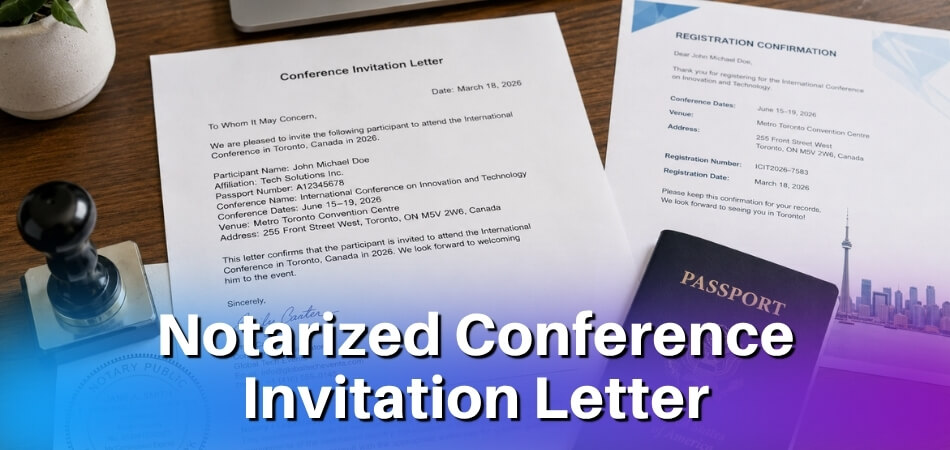
From our experience at MS International: our letter is prepared on MS International Conferences Inc. letterhead and normally includes the participant’s name, conference title, event date, location, registration category, organizer contact information and an authorized signature. It is issued automatically within 3 to 5 business days after payment clears, so give the exact name as it appears on the passport when you register. We may contact you if details are missing or names do not match. A correction after the letter has been issued may cost US$50. A notarized letter is optional, a separate paid service (US$100, up to 10 business days, non-refundable). The letter does not mean the organizer is providing sponsorship or paying travel costs, and our conferences are held in person in the Greater Toronto Area.
Disclaimer: This article is general information, not legal or immigration advice. Visa rules, fees and document requirements change, so confirm them with the embassy, consulate or official government website that handles your application.