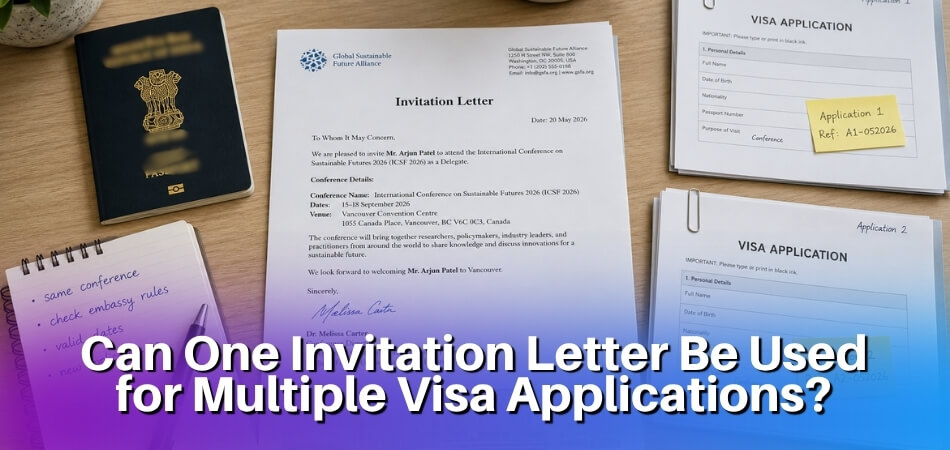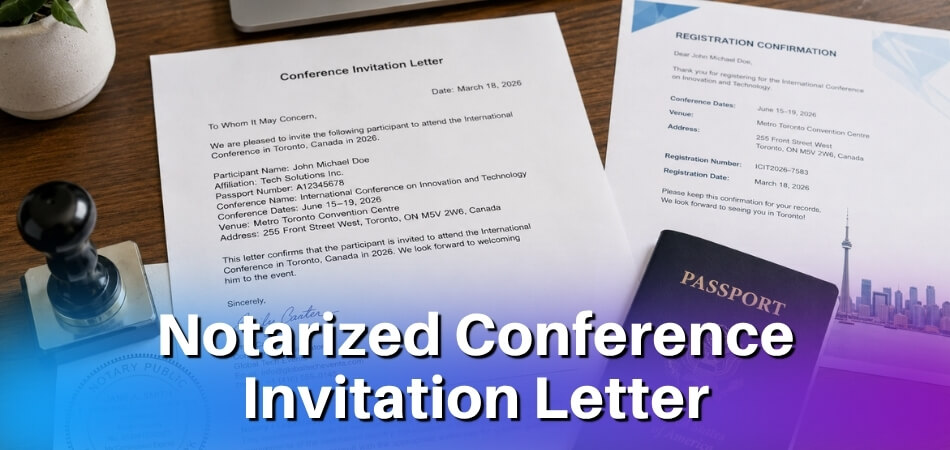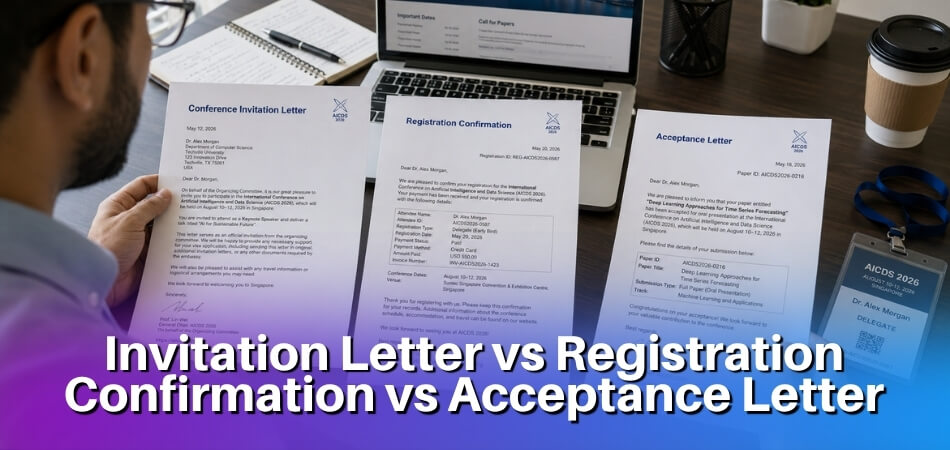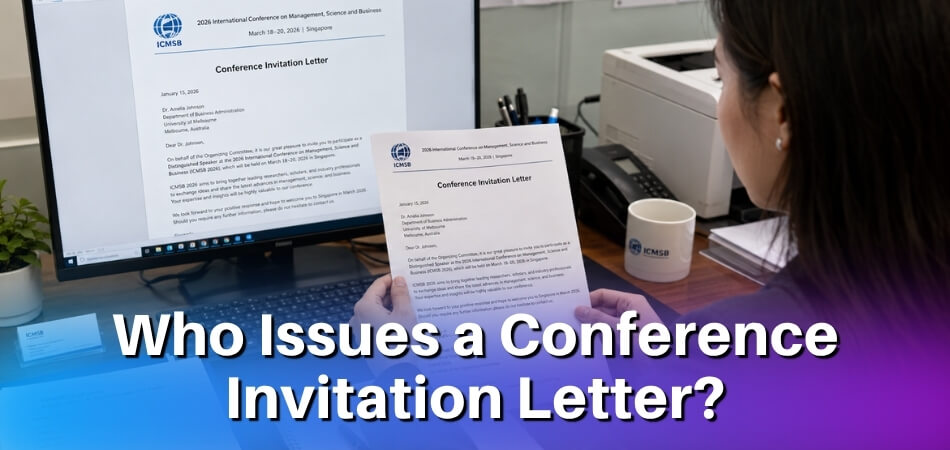

A visa application can stall over one mismatched detail, and the organiser’s letter is often the document people think about least. A weak one can cost you time you did not plan to lose.
Quick answer: A conference invitation letter for a visa should be on the host’s letterhead, signed by a named authorized signatory, and state your exact name, the conference name, dates and venue, your role and that your registration is complete. The visa officer mainly checks that every detail matches your passport, itinerary and registration papers. It supports your application but never guarantees approval.
Fact-checked by the MS International Editorial Team. Last verified against official sources: October 2026.
Visa applications can run into trouble over small things: a name spelled differently from the passport, conference dates that do not match the itinerary, or a letter signed by someone with no title. This guide looks at the letter through the eyes of the person reviewing it: what they look for, what raises doubt, which documents must match it, and how the checks differ for Canada, the United States, the Schengen area and the United Kingdom. It also gives two complete sample letters.
What Must a Conference Invitation Letter for a Visa Include?
A visa letter must show who you are, which event you are attending, who invited you and who pays. A conference invitation letter is one of the supporting documents an embassy or consulate uses to confirm that your reason for travel is real. It does not guarantee a visa, but a vague or inconsistent letter can contribute to a refusal.
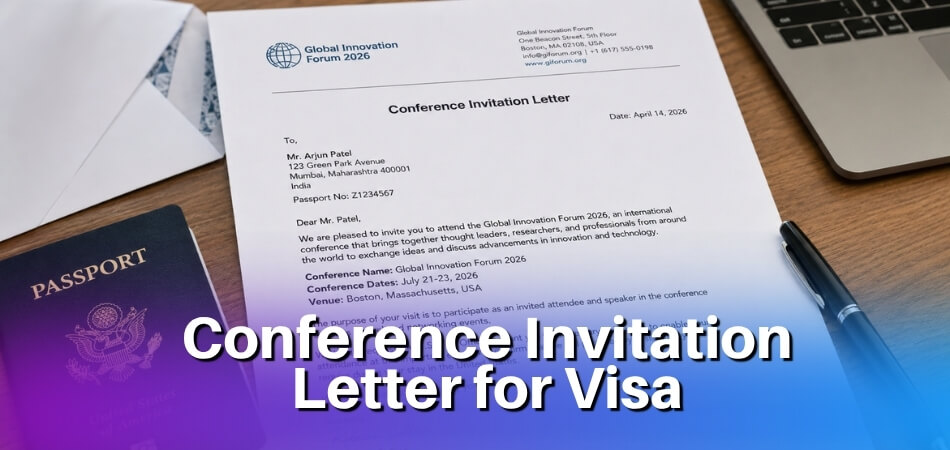
Most missions look for the same core information, whether you apply for a Schengen visa, a US B-1/B-2 visa or a UK visitor visa. The table shows each element and what the officer is really checking.
| Element | What the officer checks | Common problem |
|---|---|---|
| Your full name and passport number | Matches the passport exactly, including middle names | Nickname, missing middle name, “Dear Participant” |
| Conference name and dates | Full official name and exact start and end dates | “Our upcoming annual summit” or dates that differ from the itinerary |
| Venue and city | A real, physical address | City only, or an online-only event |
| Host organization | Full legal name, address, phone, working email | Free webmail address, no phone number |
| Your role | Speaker, presenter, session chair or attendee | No role stated |
| Registration status | Registered, with fee payment if applicable | Letter issued before registration is complete |
| Who pays | Self-funded, employer, or host-sponsored costs | “Expenses may be covered” with no detail |
| Signatory | Name, title, signature and contact details of someone with authority | Unsigned, or signed by an unnamed staff member |
Personal and Conference Details
The letter must name you exactly as the passport does and state your nationality, passport number and role. A generic letter addressed to “Dear Participant” carries much less weight than one written for you. The event name, exact dates, venue address and the organizer’s contact details must all be stated plainly. Some organizers also list your intended arrival and departure dates; if yours does, they must match your itinerary.
Invitation Status and Costs
The letter should say you have been invited to attend or speak and that your registration is processed. If the host covers accommodation, travel or an allowance, say exactly what and for which dates: “accommodation at [venue] for [dates] and a daily allowance” helps an officer; “we will cover expenses” does not. If you pay yourself, a line saying attendance is self-funded avoids guesswork.
Conference Invitation Letter Format and Structure
A good letter is one page, on letterhead, in a fixed order, and easy to scan. Poor structure can raise questions even when the conference is genuine.
Formatting Requirements
The letter needs official letterhead with the organization’s legal name, address and contact details, a date, and a signature block with the signatory’s full name, title and organization. A letter signed by a junior staff member with no listed title often raises questions. If the signature is digital, make sure it actually appears in the PDF, because a blank signature field reads as unsigned.
Many organizers add a line such as “This letter is issued at the request of [Your Name] for the purpose of supporting their visa application to [Country].” If you already know which embassy or consulate will handle your application, ask the organizer to address the letter to it; “To Whom It May Concern” is acceptable when you do not. Keep the letter to one page where possible, in formal English or the official language of the destination with an English translation where required.
The Closing and Signature
The letter should close with a direct request, such as asking the consulate to give favorable consideration to the application. This is not legally required, but it frames the document as formal support rather than a confirmation note. The signature block gives the full name, title and organization, and the signatory should be reachable by email and phone.
What the Letter Should Not Do
It should not promise that a visa will be issued or speak on behalf of the embassy, and it should not contain details that conflict with your other documents. If the conference runs March 10-13 and the letter says March 10-14, expect questions.
Emphasis by Applicant Type
The emphasis shifts slightly with who is applying.
Speakers and presenters need the letter to state the role, the title of the talk or session and, ideally, the date and time of the slot. General attendees need confirmation that the registration was received and, where possible, the professional relevance of the event to their field. Sponsored attendees need a specific financial statement, as described above.
If the Letter Is Missing Something
If a required element is missing, such as the passport number, the venue or a financial statement, ask the organizer for a corrected version before you submit. A cover note from you is less reliable than a complete letter. A short, specific email listing what the embassy requires, with the corrected detail written out, makes the request easy to act on.
What Do Visa Officers Check in the Letter, Country by Country?
Every mission has its own checklist, so the same letter is read slightly differently depending on where you apply. The table sums up what the official sources say, and what they leave to the individual embassy.
| Destination | What the official guidance says | What to do with your letter |
|---|---|---|
| Canada | IRCC guidance for event attendees points to a letter from the conference organizer confirming registration. If the event is registered with IRCC, the organizer includes the event code in the letter, and applicants who need a visa add the code to their application. Event organizers give visiting guests 2 copies of the letter, and IRCC guidance for business guests describes one for the visa application and one to present when entering Canada. The letter does not guarantee a visa. IRCC adds that some visa offices may need business invitation letters notarized. | Ask whether your conference has an event code, keep both copies, and check whether your visa office asks for notarization. If you are visa-exempt, you apply for an eTA instead of a visa. |
| United States | The State Department lists attending a scientific, educational, professional or business conference among B-1 purposes, provided you receive no salary from a US source. The passport generally must be valid six months beyond the stay, unless your country has an agreement that exempts its citizens from that rule. | Plan for an interview, and bring the letter and registration proof to support your stated purpose. |
| Schengen area | The EU asks for documents on the purpose of the stay, financial means and accommodation, and intention to return. The passport should be valid at least three months after you leave the Schengen area. Each state sets its own detail. | Apply at the consulate of the main destination and follow its checklist for invitation letters. |
| United Kingdom | Requirements depend on your nationality and the visitor route. GOV.UK says Standard Visitors can attend conferences and seminars. Being paid to speak is allowed only as a permitted paid engagement, which needs a written invitation from a UK-based organization. | Use the same letter and make it plain whether you are an unpaid delegate or a paid speaker. Confirm any extra document on GOV.UK. |
Passport validity differs by destination: Schengen asks for three months after departure, the United States six months beyond your stay unless your country is exempt, and other countries differ again. Check the exact figure on the destination’s official page, because it depends on your nationality.
Canada: What to Carry on Arrival
IRCC’s list of documents for business visitors at the border includes a passport valid for your whole stay, your visa (or the same passport you used for your eTA), a letter of invitation from your Canadian host, and proof that you can pay for your stay and your return home. IRCC says to keep them with you, not in checked luggage. For a conference, the organizer’s letter is the invitation document.
2026 Rules a Letter Cannot Change
A letter proves your purpose, but it cannot lift a country-wide restriction. Three current rules matter most for conference travellers.
| Destination | Current rule | What it means for you |
|---|---|---|
| Canada | IRCC’s Ebola temporary measures apply to people whose last country of residence is the Democratic Republic of the Congo, South Sudan or Uganda, until 27 November 2026. Applications are still processed but not finalized, and existing visas and eTAs are suspended for travel. | Citizenship alone does not decide this; residence does. A conference letter does not change it, so check the IRCC page before booking. |
| United States | The B-1/B-2 visa bond became a permanent program on 3 August 2026, with bonds of $10,000, $15,000 or $20,000 for nationals of designated countries. A presidential proclamation (Proclamation 10998) also partly suspends B-1/B-2 visas for nationals of 19 countries, Nigeria among them, from 1 January 2026. | Check your passport country on the State Department pages first. A letter does not remove a bond or suspension. |
| United States | Since 1 October 2025 the State Department has narrowed who may skip the visa interview. | Plan for an interview and book it early. |
Rules like these change quickly, so read the current IRCC and State Department pages before you pay for travel.
What Is a Conference Invitation Letter and Why Do You Need One?
It is an official document from a conference organizer, host institution or professional body that confirms your participation in a specific event. Embassies use it to verify that your trip has a documented purpose, not only a stated one on the application form.
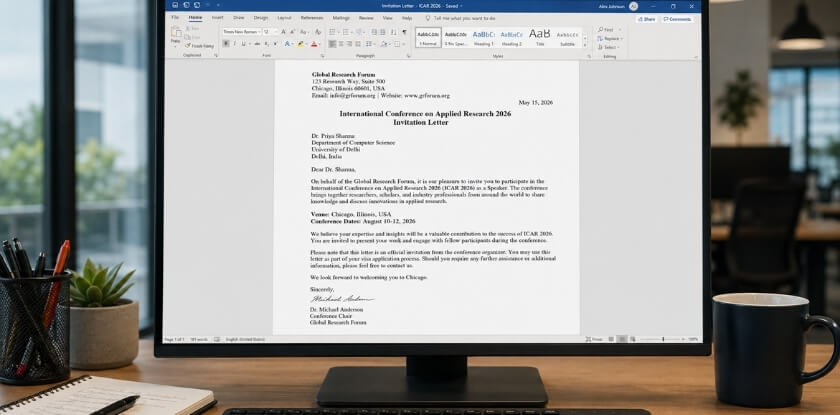
It is not always required, but it ties your dates, your role and your link to the host together in one record.
Initial Invitation Letter vs. Visa Support Letter
The two terms are used loosely, and many organizers use them for the same document. Where they differ, the initial invitation letter is the first confirmation you get after acceptance or registration, mainly for your records and your employer. The visa support letter is the formal version for an embassy: on letterhead, signed by an authorized signatory, addressed to the visa authority, and often referencing your registration confirmation and payment receipt. If a consulate wants something more formal than your first email, ask for the full visa support letter once you know you are applying.
Conference Invitation Letter vs. Tourist Invitation Letter
A tourist invitation letter is written by a private person, usually a friend or relative, for a personal stay. A conference invitation letter comes from an institution and documents a professional or academic purpose. A tourist letter alone does not support a conference trip, and submitting one where an institutional letter is expected can contribute to a refusal. If you combine the conference with a private visit, you may need both, as separate documents.
How to Request a Conference Invitation Letter, Step by Step
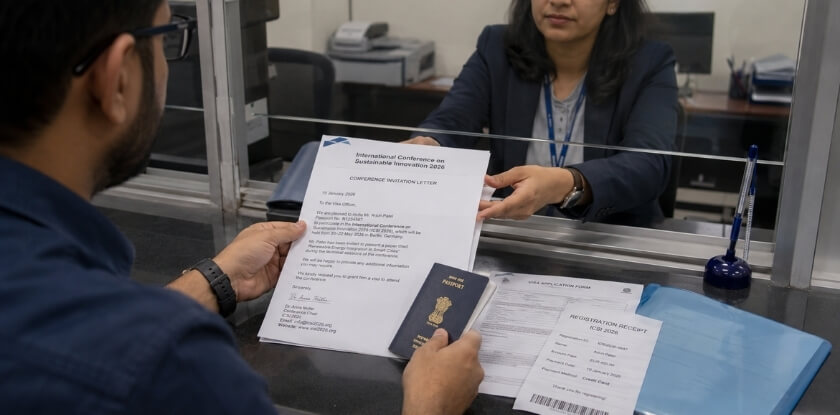
Request the letter only after your registration and payment are complete, give the organizer your exact passport details, and check the result against your other papers before you submit. Organizers normally issue letters only to registered participants, so a pending payment usually means waiting.
Step 1: Confirm Registration and Payment
Have your registration confirmation, your fee payment receipt and your role (speaker, presenter or attendee) ready. If your employer or a sponsor pays, get that confirmation in writing before you ask, since some consulates also want a sponsorship statement.
Step 2: Send a Short Request
Look for a visa contact on the confirmation email or the conference website; otherwise use the general registration inbox. A short request is enough:
Subject: Visa Support Letter Request – [Your Full Name] – [Conference Name]
Dear [Organizer’s Name / Visa Support Team],
I am registered to attend [Conference Name], scheduled for [Conference Dates] in [City, Country], under the name [Your Full Name]. I have attached my registration confirmation and fee payment receipt.
I am applying for a [Schengen visa / US B-1 visa / UK Standard Visitor visa] and need a formal invitation letter on the host organization’s letterhead, showing the conference name and dates, the host’s details, my role [speaker / presenter / attendee] and an authorized signatory.
My visa appointment is on [date], so I would be grateful to receive the letter by [date]. Please tell me if you need anything else from me.
Thank you,
[Your Full Name]
[Institution / Affiliation]
[Phone / Email]
[Registration Reference Number]
Step 3: Check the Letter Before You Submit
Compare the letter line by line with the table above, your passport and your itinerary: name, passport number, dates, venue, role, signatory and letterhead. If anything is wrong, send the organizer a short list of the exact corrections and ask for a revised version with a delivery date. Some missions want a printed original rather than a scan, so check the embassy’s own instructions.
From our experience at MS International: Our invitation letter process begins automatically once payment clears, and the letter is issued within 3 to 5 business days. It is open to registered authors, presenters and listeners who have completed full payment, and it goes as a PDF to the registered email. Give your name exactly as it appears on your passport, because our team may contact you if details are missing or names do not match. A US$50 fee may apply to corrections requested after the letter is issued. The letter supports your application but does not guarantee a visa. If an embassy asks for a notarized letter, ours is optional, costs US$100, takes up to 10 business days and is non-refundable. Our events are held in person in the Greater Toronto Area.
Sample / Template: Conference Invitation Letter for Visa
The two samples below cover two common cases: a paying attendee and a speaker. Replace every bracketed placeholder with real details before sending.
Sample for General Attendees
Use this for anyone attending as a registered participant, with no speaking role.
[Host Organization Letterhead]
[Organization Name]
[Full Address]
[City, Country]
[Phone | Email | Website]Date: [DD Month YYYY]
To: The Visa Officer
[Embassy / Consulate Name]
[City, Country]Subject: Visa Support Letter for Conference Attendee – [Applicant Full Name]
Dear Visa Officer,
We are writing to confirm that [Applicant Full Name], holder of [Nationality] passport number [XXXXXXXX], has been officially registered to attend the [Full Conference Name] scheduled to take place from [Start Date] to [End Date] at [Venue Name and Address, City, Country].
The conference is organized by [Host Organization Name] and focuses on [brief description of the field or topic, for example “advances in renewable energy policy and technology”]. It brings together researchers, practitioners and industry professionals from [number] countries.
[Applicant Full Name] registered as a general attendee on [Registration Date]. Registration confirmation number [XXXXXX] and the fee payment receipt are on file with our organization. The applicant’s attendance is entirely self-funded.
We respectfully request that the relevant authorities give favorable consideration to [Applicant Full Name]’s visa application to attend this event. Should you require additional documentation or wish to verify the registration details, please contact us at [email address] or [phone number].
Sincerely,
[Authorized Signatory Full Name]
[Title / Position] [Department]
[Organization Name]
[Signature] [Date]
Sample for Speakers and Presenters
Speakers need a stronger letter because they have a defined role. It should say what they present, when, and why they were invited.
[Host Organization Letterhead]
[Organization Name]
[Full Address]
[City, Country]
[Phone | Email | Website]Date: [DD Month YYYY]
To: The Visa Officer
[Embassy / Consulate Name]
[City, Country]Subject: Official Invitation Letter, Speaker / Presenter – [Applicant Full Name]
Dear Visa Officer,
We are pleased to extend this official invitation to [Applicant Full Name], [Professional Title], affiliated with [Applicant’s Institution or Organization, Country], to attend and present at the [Full Conference Name], to be held from [Start Date] to [End Date] at [Venue Name and Address, City, Country].
[Applicant Full Name] has been selected by the [Conference Name] Scientific / Program Committee to deliver a [keynote address / oral presentation / invited talk] titled “[Presentation Title]” on [Scheduled Date and Session Time]. Their expertise in [relevant field] makes them a valued contributor to this program.
The [Full Conference Name] is organized by [Host Organization Name] and is attended by approximately [number] delegates from [number] countries. This year’s edition focuses on [topic or theme].
Travel and accommodation expenses for [Applicant Full Name] will be [covered by our organization / covered by the applicant / partially supported, please specify clearly]. A formal travel itinerary has been provided to the applicant alongside this letter.
We respectfully request that the visa application submitted by [Applicant Full Name] receive favorable and timely consideration. Their presence is an integral part of the official conference program.
For any verification or further correspondence, please contact [Name, Title] at [email] or [phone].
Yours sincerely,
[Authorized Signatory Full Name]
[Title / Position]
[Conference Organizing Committee / Host Organization]
[Signature] [Date]
How to Verify Whether an Invitation Letter Is Fake
Check the letterhead, the contact details and the organizer’s own website: a genuine letter can be confirmed by anyone who contacts the host through official channels. Embassies can check a letter with the host, and a fabricated one can lead to refusal or a ban on future applications.
Red Flags in the Letter Itself
- No verifiable contact information. Only a free webmail address (Gmail, Yahoo, Hotmail) and no phone or physical address is a warning sign.
- Vague or inconsistent event details. “An upcoming international event” or dates that differ from the conference website.
- No role or registration reference. A copy-pasted text with your name dropped in rarely has this detail.
- Quality and authority issues. Poor grammar, mixed fonts, a stretched logo, or a signatory who appears nowhere on the official site.
How to Cross-Check the Organization
Find the conference through an independent search, not through a link in a suspicious email, and confirm that dates, venue and host match the letter. Then contact the organizer using details from that official site and ask whether the letter was issued and the signatory is authorized. For academic events, confirm that the university department or professional body exists; a corporate host should have a verifiable presence of its own.
What Embassies Check
Officers may contact the host directly, compare the conference against public records, or check that your registration confirmation and payment receipt match the letter. If nobody at the organization can be reached, or the number and address lead nowhere, the letter will likely be dismissed. If you doubt your own letter, ask the organizer to reissue it on official letterhead with a named signatory before you apply. A refusal for document fraud is a serious record that can affect future applications in several countries.
Common Mistakes in Visa Applications That Lead to Rejection
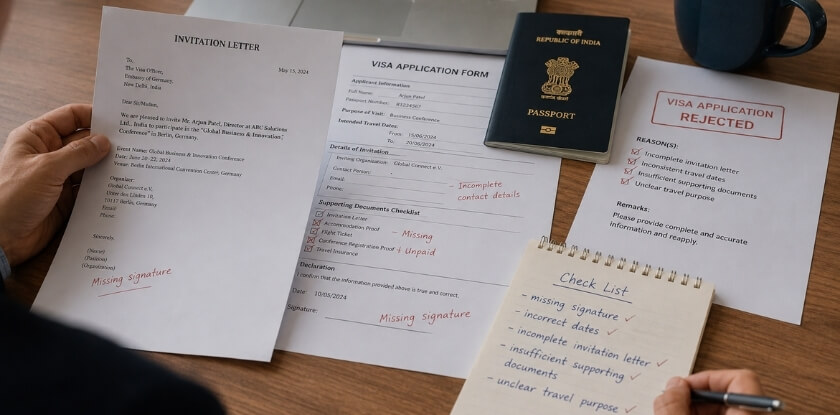
A mismatch between the letter and the rest of the application is a classic cause. Even a well-written letter cannot save a file with other problems.
The Letter Does Not Match the Application
If the letter says June 10-14 but you request a visa for June 8-20, the officer will want to know why. Check every detail against your other documents: the name against the passport, the conference name and dates against your registration confirmation. A letter is stronger when your registration confirmation, payment receipt and an itinerary with the same dates travel with it.
Passport and Document Issues
A nearly full or damaged passport can be refused outright, so renew before applying if in doubt. Expired supporting papers, such as a bank statement from six months ago, raise flags. For the validity rules, see the country table above.
Weak Financial Evidence
Officers want to be confident you can fund the trip and will not overstay. Sparse or inconsistent bank statements, or a sudden large deposit just before you apply, draw scrutiny. If you self-fund, bank statements, an employment letter and payslips should tell a consistent story. If the host sponsors you, the letter or a separate sponsorship statement should spell out who pays which costs and for how long.
Unclear or Inconsistent Purpose
Problems arise when someone applies for a tourist visa to attend a professional conference without saying so, or applies as a business visitor with documents that look like tourism. Say plainly on the form that you are attending a conference and support it with the right documents. Be consistent whichever visa you choose.
Applying Too Late and Ignoring Visa History
Processing times vary by mission and season, so check the official site for your nationality and leave a buffer for a request for extra documents. Disclose any previous refusal where the form asks; leaving it blank can be treated as misrepresentation. A clean record of previous trips, with visible stamps and no overstays, helps.
Problems With the Letter Itself
Missing authorized signatory, no official letterhead, and missing key details (full conference name, exact dates, venue, role, a reference to your visa application) are the usual letter-side causes. Go back to the organizer with a specific written request. Most have handled it before and can send a corrected letter quickly.
What to Do If Your Visa Is Rejected
Read the refusal notice first, fix the specific reason, and reapply with stronger documents rather than resubmitting the same file. A second application works best when it fixes the stated reason.
Read the Notice and Find the Cause
The refusal notice normally states a reason, though the detail varies. The reason tells you whether the problem was the invitation letter, the financial documents, your travel history or something else. A weak letter and a missing sponsorship statement need different fixes.
Letter-related causes include a missing signatory or letterhead, unclear conference name and dates, no statement that you were registered or invited to present, contact details that could not be verified, and a generic template that looked unofficial. If the notice says “insufficient documentation” or “unable to verify conference participation,” ask the organizer for a corrected, more detailed letter and tell them what the embassy expects.
Strengthen the Supporting Documents
- Registration confirmation and fee payment receipt. Proof that you paid to attend.
- Proof of your role. Speakers and presenters can attach the abstract acceptance email or the conference program listing their name.
- Travel itinerary. A dated plan showing you intend to stay only for the event.
- Financial evidence. Bank statements, employer letters or a sponsorship statement from the host.
Appeal or Reapply
Some systems allow a formal appeal and others require a new application. For a Schengen visa you can typically appeal in the issuing country, though the process is slow. For a US B-1/B-2 visa you normally reapply with stronger documentation. For the UK, the refusal notice explains whether any review or appeal exists. The refusal notice itself usually says whether an appeal exists and its deadline, so follow that and the official site.
When reapplying, address the stated reason directly, disclose the earlier refusal honestly and allow extra time. A reapplication that looks identical to the rejected one is unlikely to succeed. The same goes for the letter: whether you can reuse one invitation letter depends on its dates and on what the refusal questioned.
If the Conference Has Already Happened
Contact the organizer. Some can provide a supporting letter that explains the circumstances, which may help future applications. For recurring conferences, start the process much earlier next time with a stronger package.
Special Cases: Virtual Conferences and Visa Waiver Programs (ESTA)
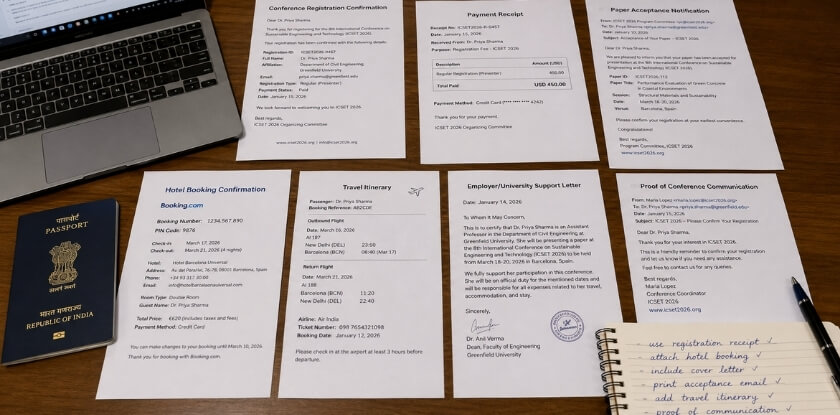
A fully virtual conference needs no travel visa, while a visa waiver or ESTA changes the paperwork but not the value of the letter.
When the Conference Is Virtual or Hybrid
If you attend remotely, there is no travel and no embassy will issue a visa for it, so a visa letter has no use for a virtual-only registration. Hybrid events are different: if you travel to attend in-person sessions, you still need a visa if your passport requires one, and the letter must confirm on-site participation. If you plan to travel, confirm with the organizer that the event is in person and that the letter states the physical venue.
ESTA and the Visa Waiver Program
ESTA is an electronic pre-authorization under the US Visa Waiver Program, not a visa, and it covers tourism or business stays of 90 days or less for eligible passports. Attending a conference as an attendee or speaker with no US income can fall within permitted business activity. A letter is not required for ESTA, but it gives you a clear, documented answer if a border officer asks why you are visiting. If you are not eligible for ESTA or your ESTA is denied, you apply for a B-1/B-2 visa and the letter becomes part of that file.
Visa-Free Travel to Schengen and the UK
Visa-free access depends on your passport, the destination and the length of stay. A conference of two weeks may still exceed an allowance already partly used, so count your days. For the UK, check the official GOV.UK guidance for your nationality, because rules differ and have changed in recent years. Global Entry, a US expedited-clearance program, does not replace ESTA or a visa, though the letter is still useful at entry.
FAQ
From who issues the letter to why a visa can still be refused with one in hand, this part also touches on ESTA, PDF copies, notarized versions and a paid letter that did not show up.
Do I need a conference invitation letter to get a visa?
Not always. Whether you need one depends on the destination, your passport and the embassy checklist. Even when it is optional, the letter documents the purpose of your trip, and without one the officer has only your word.
Who issues the conference invitation letter?
The conference organizer or host organization issues it, not the embassy. It should be on official letterhead and signed by an authorized signatory, such as the conference chair, program director or administrative head.
What is the difference between an invitation letter and a visa support letter?
Often nothing: many conference organizers use both names for one document. Where they differ, the initial invitation letter is a first confirmation, and the visa support letter is the formal version addressed to the embassy. A tourist invitation from a friend is a different document.
Can a general attendee request an invitation letter, or only speakers?
Yes, both can, once registered and paid. Your registration confirmation and payment receipt establish your eligibility. At MS International, registered authors, presenters and listeners who have completed full payment are eligible.
How long does it take to get a conference invitation letter?
At MS International Conferences Inc. the letter is issued within 3 to 5 business days after payment clears. Other organizers set their own timing, so ask early and request it well before your visa appointment.
Will an invitation letter guarantee my visa?
No. The letter supports your application, but the embassy decides on your full file: finances, travel history, passport validity, ties to your home country and more. It does not guarantee entry either; the border officer decides that.
My visa was rejected even though I had an invitation letter. Why?
Usually the cause lies beyond the letter: insufficient funds, weak ties to home, incomplete documents or inconsistencies. Check the refusal notice for the stated reason and address those points when you reapply.
Can I use an invitation letter for ESTA?
You do not submit one with an ESTA application, because ESTA is an online authorization, not a visa. A letter is still useful to show a border officer. If you need a B-1/B-2 visa instead, the letter becomes relevant to that application.
Does the letter need to be posted, or is a PDF acceptable?
It depends on the mission. Some may ask for a printed original. Check the embassy’s own instructions before assuming a scan is enough.
Can a visa office ask for a notarized invitation letter?
Some can. IRCC says some Canadian visa offices may need business invitation letters notarized, so ask the visa office for your country before paying for it. At MS International the notarized letter is optional, costs US$100 and takes up to 10 business days.
What if I paid but never received a letter?
Check the registered email first, then contact the organizer with your registration confirmation and payment receipt. If nobody replies, keep a record of your attempts, which helps when explaining delays to the consulate.
Final Thoughts
A good letter on proper letterhead, with a named signatory and details that match your other documents, removes a real point of doubt for the officer. Start early, check every detail against your passport and itinerary, and ask the organizer for fixes before you submit, not after.
Disclaimer: This article gives general information, not legal or immigration advice. Visa rules, fees and processing times change and vary by nationality and mission, so confirm current requirements with the relevant embassy, consulate or official government website before you apply.