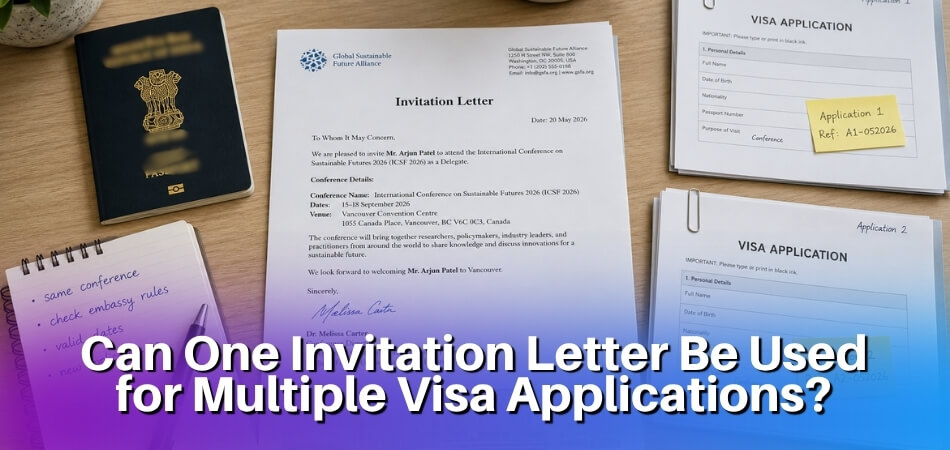

Got accepted to a conference in Canada but not sure how to get the visa? You are not alone. Many international attendees receive their acceptance email, start celebrating, and then hit a wall: which documents do they need, do they need a Temporary Resident Visa or an eTA, and how do they submit everything through the IRCC portal before the event date?
Quick answer: You attend as a business visitor. Register for the event, get the organizer’s invitation letter (and the event code, if the conference has one), check on the IRCC tool whether your passport needs a visitor visa (TRV) or an eTA, and apply online. Give biometrics if asked, then carry the letter to the port of entry. The letter supports your case but does not guarantee a visa or entry.
Fact-checked by the MS International Editorial Team. Last verified against official sources: October 2026.
This guide follows the process in order, from registration and the letter itself to processing time, fees and what to expect when you arrive in Canada.
How to Get a Canadian Conference Visa
Canada has no special conference visa. Most visitors who need a visa apply for a Temporary Resident Visa (TRV), also called a visitor visa, on the IRCC portal, and citizens of visa-exempt countries such as the UK, Australia or most EU nations usually need only an eTA (Electronic Travel Authorization), a simpler online process.
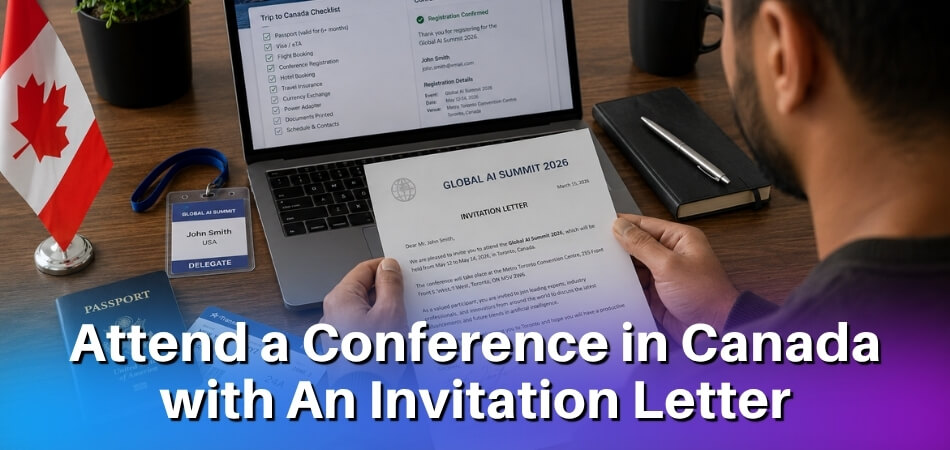
The core path looks like this:
- Register for the conference and get your confirmation
- Request an official invitation letter from the conference organizer
- Find out whether you need a TRV or an eTA
- Gather your supporting documents and submit the application through the IRCC portal
- Attend the conference and leave Canada within your authorized length of stay
You Enter as a Business Visitor
IRCC treats people who come to Canada for a few days or a few weeks to attend meetings or an event as business visitors, and going to conferences is on its list of permitted activities. To qualify, you must plan to stay less than six months, not enter the Canadian labour market, and have your main place of business and source of income outside Canada. You also need the basics every visitor needs: a valid travel document, enough money for your stay and your return, and a plan to leave at the end of the visit.
What the Invitation Letter Does
The invitation letter is your main evidence that the trip has a legitimate, time-limited purpose. It tells the visa officer why you are coming, for how long, and who is hosting you. IRCC says it may ask for a letter of invitation from someone in Canada, and that a letter does not guarantee a visa, because officers assess each applicant against Canadian immigration law.
The Application Process at a Glance
You apply online through the IRCC portal at ircc.canada.ca, upload your documents, pay the fee, and in most cases give biometrics. Processing times vary, so apply well before the conference date. Cutting it close is how people miss the event after paying the registration fee. The details of each stage follow in the steps below.
Step 1: Register for the Conference and Request an Invitation Letter
Register and pay first, then ask the organizer for the letter. Before you touch the IRCC portal you need two things locked in: proof that the conference exists and proof that you are attending it, and the invitation letter ties those two facts together for a visa officer.
What to Tell the Organizer and Where to Find the Event Code
Once you have registered and paid, contact the organizer through the official conference email or registration support address. Say that you are an international attendee who needs an invitation letter for a Canadian Temporary Resident Visa application. Many organizers handle this request routinely and have a template ready. Canada’s government charges nothing for the invitation letter itself.
Be specific. Give your full legal name exactly as it appears in your passport, your passport number, your country of citizenship, your affiliation, and the dates you plan to be in Canada. A vague request gets a vague letter, and a vague letter can get your application flagged.
Some conferences carry an event code. Organizers can register an international event with IRCC, and registration is voluntary. A registered event gets a unique special event code that the organizer shares with participants who need a visa. IRCC says that entering it on your visa application identifies you as a participant of a registered event. You will usually find it in your registration confirmation email, your attendee dashboard or the letter itself. Not every event is registered, so if you do not see one, ask the organizer whether one exists. A missing code is not a problem in itself, and IRCC says registering an event cannot expedite applications or overturn refusals.
Keep a copy of the letter in digital and printed form. You will upload it with your IRCC application and carry a printed copy to the port of entry.
What to Do If the Organizer Does Not Provide an Invitation Letter
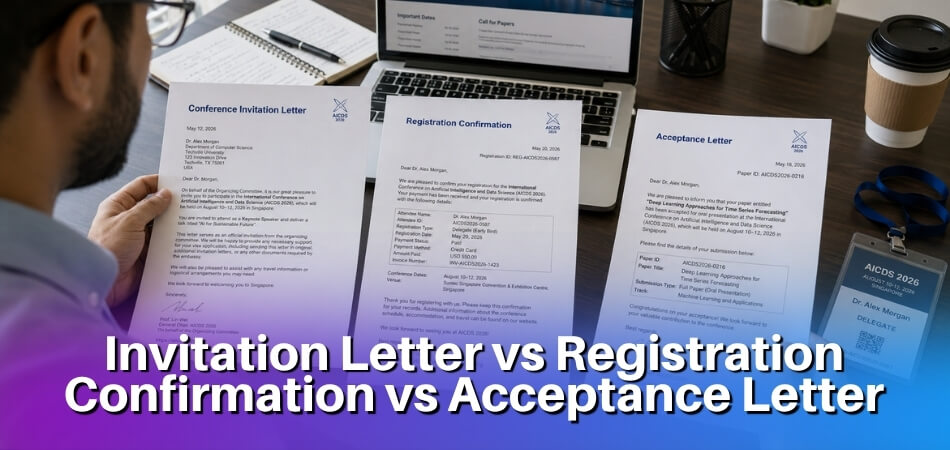
Some smaller conferences and workshops do not issue formal letters, and very large events sometimes send only a bulk registration confirmation. Ask again first, and ask what the organizer can send. A registration confirmation that shows your name, the event, the dates and the payment is worth uploading even if it is not a full letter.
An invitation letter comes from the host in Canada, so you cannot write one in the organizer’s place. What you can add is your own signed letter of explanation addressed to the visa officer, which is a supporting document, not a substitute. Keep it truthful and verifiable, and think of it as a signed declaration rather than a cover letter or an essay.
Structure it roughly like this:
- Opening paragraph: State your name, nationality, occupation, and that you are applying for a Temporary Resident Visa to attend a specific conference in Canada. Name the conference, its dates and its location.
- Supporting details: Give your registration confirmation number, the organizer’s name and website, and the professional relevance of attending, such as presenting a paper or attending sessions in your field.
- Length of stay and ties to home country: State the exact dates you plan to enter and leave Canada. Briefly mention your job, family, property or other obligations that confirm you will return.
- Closing: Sign and date the letter, add your contact information, and attach your registration confirmation as supporting evidence.
If you can get any written message from the organizer, even a short email confirming your registration, print it and include it. It adds third-party corroboration that an officer will appreciate. A letter of explanation works best alongside strong supporting documents and does not replace them.
From our experience at MS International: The invitation letter process begins automatically once your payment clears, and the letter is issued within 3 to 5 business days after payment clears. The standard letter is free of charge for registered participants, and a US$50 fee may apply to changes requested after the letter is issued, so register with your name exactly as it appears in your passport. The team may contact you if details are missing or names do not match. A notarized letter is an optional separate service for US$100, takes up to 10 business days and is non-refundable once submitted. Fees are non-refundable, and the letter supports your application but does not guarantee a visa or entry. Our conferences are held in person in the Greater Toronto Area.
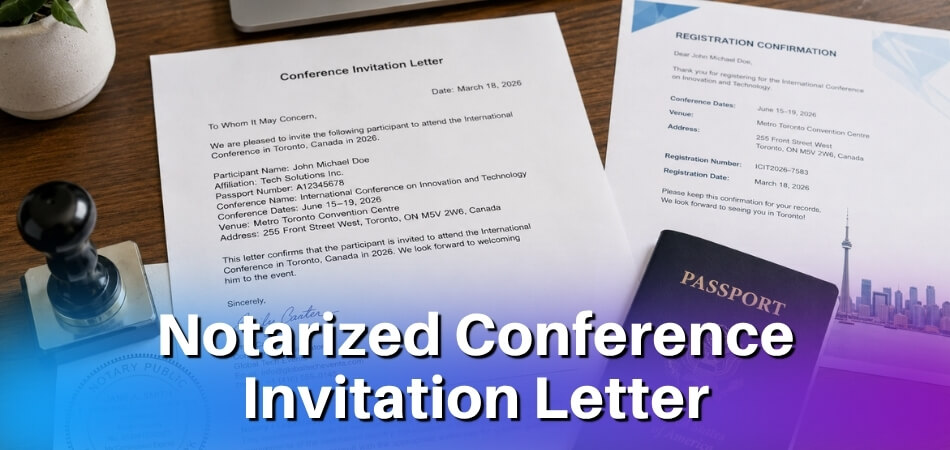
What a Conference Invitation Letter Must Include
A good letter names you, the event, the dates, the venue and a verifiable sender. Officers use it to confirm that your trip has a clear purpose, so a vague or incomplete letter can raise doubts even when everything else is in order.
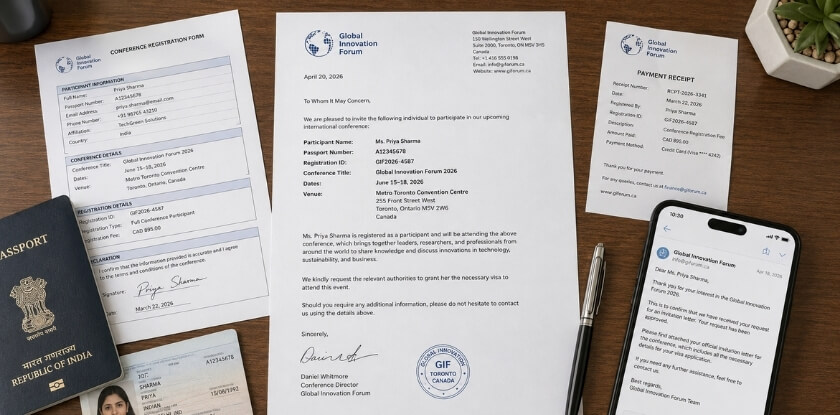
Not every organizer knows what Canadian immigration needs to see, so check the letter you receive against this table before you apply.
| Element | What to check |
|---|---|
| Your full name and passport details | Name must match your passport exactly; the passport number is a bonus |
| Conference name, dates and location | Official name, exact dates and the venue address in Canada, not “our annual event” |
| Your role | Delegate, presenter, session chair or workshop participant; speakers should have the session title or topic |
| Organizer contact details | Official name, address, phone and an email on the conference domain, not a free Gmail address, plus letterhead and a signature |
| No salary from the Canadian host | A line stating that no pay is offered helps show you are a temporary visitor; ask for it if it is missing |
| Event code | Include it if the conference has one |
Step 2: TRV or eTA, Which One Do You Need Based on Your Nationality
Your passport decides which application you make, and IRCC’s online tool gives the official answer. Get this wrong and you could spend weeks preparing the wrong application.
| Traveller | What you need |
|---|---|
| Citizens of visa-required countries (for example much of South Asia, Africa, the Middle East and Southeast Asia) | Temporary Resident Visa, by air, land or sea |
| Citizens of eTA-eligible countries (for example the UK, Australia, Japan and most EU nations) | eTA to fly to Canada; no eTA is needed to arrive by car, bus, train or boat |
| US citizens | Neither, but carry proper identification such as a valid US passport |
| US lawful permanent residents | Neither, but carry a valid green card or equivalent proof of status and a valid passport |
| Citizens of some listed visa-required countries who held a Canadian visitor visa in the past 10 years or hold a valid US non-immigrant visa | May be able to apply for an eTA instead of a visa, for air travel only; land, rail or sea arrivals still need a visa |
Rules and country lists change, so use the official IRCC “Check if you need a visa or eTA” tool rather than a colleague’s advice or an old list. Getting this wrong can mean a refused boarding.
Temporary Resident Visa (TRV)
Citizens of countries without a visa exemption need a TRV. The application goes through the IRCC portal, requires supporting documents including your invitation letter, and takes considerably longer than an eTA. Plan well ahead of your conference dates.
Electronic Travel Authorization (eTA)
An eTA is a simple online application linked electronically to your passport. The fee is CAD 7, and an approved eTA is valid for up to five years or until the passport expires, whichever comes first. IRCC says most applications are approved within minutes, but some take longer if documents are requested, so apply before booking flights. Dual Canadian citizens cannot use an eTA and need a Canadian passport.
Dual Citizens and Timing
If you hold dual citizenship, travel on the passport that you used for your application, because the document you present at the port of entry is the one that counts. TRV applicants should start as soon as they hold the registration confirmation and invitation letter, because the visa is the hard part and the timeline is longer than for the letter.
2026 Special Measures: Ebola
Check this before you apply. IRCC has temporary measures in place from 27 May 2026 until 23:59:59 ET on 27 November 2026 for people whose last country of residence is the Democratic Republic of the Congo, South Sudan or Uganda. The test is where you lived when you applied, not your citizenship, and anyone who lived elsewhere is not affected.
- IRCC keeps processing applications from affected residents but does not finalize any decision until the measures end.
- Existing visas and eTAs of affected residents are suspended and cannot be used to board a plane. They reactivate automatically when the measures end, and the suspension does not extend their expiry date.
- Affected applicants should not send their passport to a Visa Application Centre until the measures end.
- Exemption requests are considered case by case. You must explain why you should be exempt and give evidence, and approval is not guaranteed.
Anyone who has recently been in these countries faces extra entry rules, so read the IRCC page before you book travel. If your conference falls near or after the end date, check the page again, because IRCC can change the dates.
Step 3: Submit Your Visa Application on the IRCC Portal
Create an account on the IRCC portal (ircc.canada.ca), answer the questionnaire, upload your documents and pay online. The portal then generates the correct form list for your situation, so follow its prompts carefully.
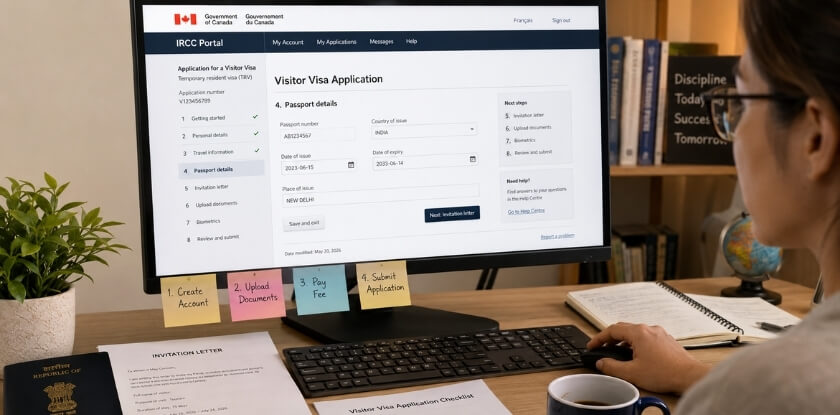
What Documents Are Required
The exact list varies slightly by country of residence and circumstances, but most conference attendees prepare the following:
- Valid passport: IRCC says it should be valid for at least 6 months from the date you plan to travel, and a visitor visa cannot be issued beyond your passport’s expiry date, so renew an expiring passport before you apply
- Conference invitation letter confirming your participation, the event dates and the venue
- Conference registration confirmation as proof that you actually registered, not just that you were invited
- Proof of financial means such as bank statements, pay stubs or a sponsorship letter; IRCC says at least 6 months of account details, including balances, helps it understand your finances
- Employment or enrollment proof such as a letter from your employer or institution confirming you will return
- Travel itinerary with flight bookings and accommodation details
- Recent photographs that meet IRCC specifications
- Biometrics if required for your nationality, collected at a Visa Application Centre
A short personal cover letter on the purpose of the visit, your length of stay and your ties to home is not always mandatory, but it can help the officer. If the organizer gave you an event code, enter it on the application. For the current checklist, rely on the portal itself, because requirements get updated.
Application Fee and How to Pay
Fees are paid online at submission by credit or debit card, and the confirmation receipt is your proof of submission. Check the amounts on the IRCC fee list before you pay.
| Item | Fee (CAD) |
|---|---|
| Visitor visa (TRV), per person | 100 |
| Biometrics, per person | 85 |
| eTA | 7 |
The biometrics fee is separate from the visa fee and is normally paid with your application if you are giving biometrics for the first time. Family fees differ: IRCC lists CAD 500 for a family of five or more on the visa and up to CAD 170 for biometrics, though most conference attendees apply alone. The eTA fee is non-refundable. Do not rely on third-party sites for fees, because they change.
Processing Time: How Long It Takes by Country
There is no single processing time. It depends on where you apply from, the volume at your visa office and whether you need biometrics, so check IRCC’s live processing time tool and plan around that number.
Why Processing Times Differ
IRCC bases its estimate on how many applications it has in its inventory, how many staff process that type of application and how many applications it expects to receive. Your processing time starts the day IRCC receives your complete application, so a missing document or an unclear invitation letter delays the start of that clock.
How to Find the Current Processing Time for Your Country
On the IRCC website, choose your application type (Temporary Resident Visa) and your country of residence to see the current estimate. It changes with application volumes, so the figure you see today may not apply when you submit next month. Do not rely on what someone saw in a forum three months ago.
General Patterns to Know
- The IRCC estimate already includes the time it takes to give your biometrics, so do not add a separate biometrics window on top of it.
- Estimates differ by country of residence, and the tool shows a different figure for each, so look yours up instead of using a friend’s number from another country.
- Applicants whose last country of residence is under the Ebola measures above cannot get a final decision until those measures end.
- eTA applicants usually get a decision within minutes, though it can take several days if IRCC asks for documents.
Biometrics and What It Does to Your Timeline
If you must give biometrics and have not enrolled within the current validity window, IRCC sends a Biometric Instruction Letter (BIL) after you submit. You then book an appointment at a VAC or Application Support Center for fingerprints and a photo. IRCC says biometrics are valid for 10 years, so you may not need to give them again if you have done so recently.
The officer cannot move your file forward until your biometrics are done, so act on the letter quickly. Slot availability differs by location, so check the appointment calendar as soon as you receive the letter.
A Realistic Planning Window
Apply as soon as your invitation letter arrives, since letters are usually issued after registration is confirmed. There is no promised fast lane for visitor visas, so a conference that is only a few weeks away is a risk even if the estimate looks short. Confirm the current estimate and local biometrics availability before you book non-refundable travel.
After Getting Your Visa: How Long Can You Stay in Canada
The border services officer decides your authorized length of stay when you arrive, not the visa itself. A TRV lets you travel to Canada, but it does not set your departure date, and the visa expiry date is separate from your permitted stay.
Your Visa vs. Your Authorized Stay
The officer decides how long you may remain, based on the purpose of your visit and your documents. For a conference visitor that is usually the event plus a reasonable buffer. If you plan to stay a few extra days before or after, say so at the border and give your conference dates and departure date.
If no date is stamped in your passport, IRCC says you can stay until the earliest of six months from entry, your passport expiry or your biometrics expiry. The officer can allow less or more, and the decision is made each time you enter. A visitor visa itself can be issued for up to 10 years or until your passport or biometrics expire, and its date is the date by which you must arrive, not the date you must leave. Confirm against current IRCC guidance, since rules can be updated.
Extending Your Stay
If your circumstances change, you can apply for a visitor record to extend your stay before your status expires, and IRCC advises applying at least 30 days before your authorized stay ends. A visitor record is not a visa, and approval is not guaranteed. Do not overstay while waiting for a decision, because once your status expires your options narrow significantly. Most conference travelers never need this: plan your dates accurately and make sure the dates on your application match your actual plan.
What to Show at the Port of Entry
Carry the conference documents in your hand luggage and be ready to explain your purpose briefly. A visa or eTA does not guarantee entry, because the border services officer makes the final call.
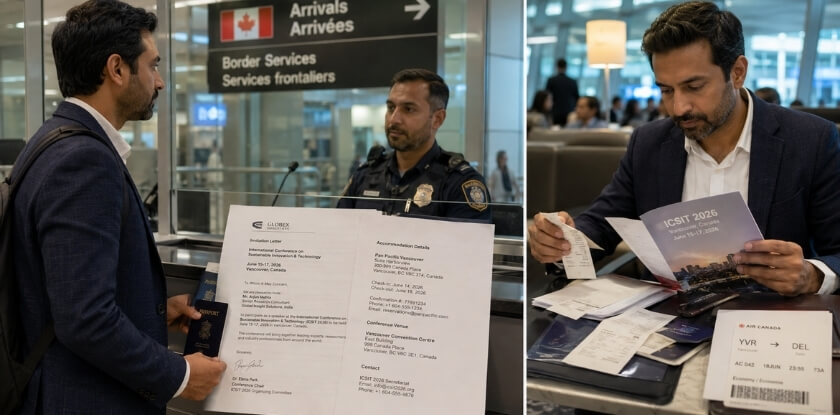
Documents to Have Ready
IRCC tells business visitors to keep their documents with them and not pack them in a suitcase. Have these in your carry-on:
- Your valid passport (the one your visa or eTA is linked to), valid for your entire stay
- Your conference invitation letter or official registration confirmation
- The agenda, program schedule or an event website printout
- Your return or onward ticket
- Proof of accommodation for your stay
- Evidence you can cover expenses for your stay and your return home, such as a bank statement or employer letter
- Contact details for your Canadian host or the organizer, since IRCC lists 24-hour contact details of the host among the documents business visitors should carry
- An employer or institution letter if you are attending on their behalf
You do not need to hand over everything at once. The officer asks questions first, so organize the papers to pull out whatever is requested. Also carry copies of everything you submitted with your visa application, in case the officer asks to see it. If the organizer gave you an event code, keep it on hand too.
What the Officer Will Ask
The standard questions are predictable: What is the purpose of your visit? Where are you staying? How long will you stay? Who is paying?
Answer directly and briefly with the conference name, city, dates and accommodation. If your employer sponsors the trip, say so, and if you are presenting or speaking, mention it. Avoid over-explaining unprompted.
If You Are Asked About Working in Canada
As a business visitor you must not enter the Canadian labour market. Canadian regulations allow a guest speaker to make a speech or deliver a paper at a convention or similar event without a work permit, but whether your activity fits depends on the details. If a Canadian organization is paying you to appear, the situation may differ. Know the specifics of your arrangement before you travel, and check with IRCC or a licensed immigration consultant if anything is unclear. If an officer asks whether you receive compensation from a Canadian entity, a clear, honest answer is always right.
What to Do If Your Visa Is Rejected
A refusal is frustrating but not always final: read the refusal letter, fix the stated problem and reapply. IRCC says you can apply again at any time unless your decision letter says you cannot, but reapplying with the same information will likely not change the result.
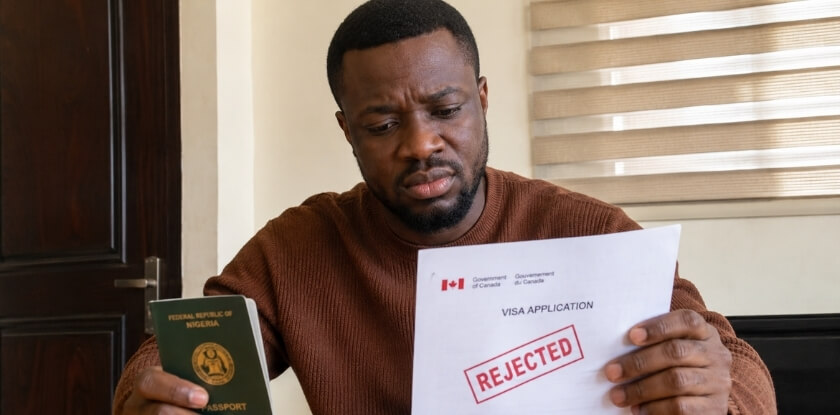
Read the Refusal Letter Carefully
The letter usually points to a category: insufficient ties to your home country, incomplete documentation, concerns about the purpose of travel, or financial inadequacy. Each has a different fix. Since 29 July 2025, IRCC includes an officer decision note with the refusal letter for most temporary resident applications, visitor visas among them. The note shows what the officer found unconvincing, though IRCC may remove parts of it to protect sensitive information.
Address the Actual Reason Before Reapplying
IRCC advises reapplying only if your situation has changed or you have significant new information, and any new application should answer the reasons in the refusal letter.
- Ties to home country: Add a letter from your employer confirming your leave and return date, proof of property ownership, family documents or ongoing contracts.
- Weak conference justification: Ask the organizer for a more detailed letter addressed to you, with the event name, dates, venue, your role and the event code. If you have only a generic bulk letter, add the letter of explanation described in Step 1.
- Financial concerns: Include bank statements covering at least six months, not just a recent balance. If someone sponsors you, add a sponsor letter with their financial documents.
- Purpose of travel unclear: Write a clear, factual personal statement on who you are and why this conference matters to your work.
When to Get Professional Help
If you have reapplied once with better documents and been refused again, consider a regulated Canadian immigration consultant (RCIC) or an immigration lawyer, who can review your application history. In Canada only RCICs and lawyers may give immigration advice for a fee, so check the CICC (College of Immigration and Citizenship Consultants) registry before hiring anyone. IRCC says hiring a representative does not increase the chance of approval, so be wary of anyone who promises it.
One Practical Note on Timing
A refusal close to the conference date may leave no time for a new visa. There is no formal appeal for a visitor visa refusal, and the only review route is an application for leave and judicial review at the Federal Court of Canada. Some applicants instead ask the organizer whether sessions are recorded or whether virtual attendance is possible. Apply early enough that a refusal still leaves you time to respond.
Frequently Asked Questions (FAQ)
Heading to Canada for a two or three day event? Practical doubts involve an eTA versus a TRV, writing your own letter, the event code, and a conference canceled after your visa is approved.
Do I need a separate visa just for a conference, or can I use a tourist visa?
No separate visa exists. Canada has no “conference visa”, so you apply for the standard visitor visa (TRV), or an eTA if your passport allows it, and state that you are attending a conference. IRCC treats conference attendance as business visitor activity.
Can I write my own invitation letter if the conference organizer doesn’t provide one?
No, an invitation letter comes from the host in Canada. You can add your own signed letter of explanation with your registration confirmation, but it supports your application and does not replace the organizer’s letter. Ask the organizer again first.
What if my conference is only two or three days? Will that look suspicious to IRCC?
No, short stays are common for conferences and are not a red flag on their own. What matters is that your requested length of stay matches your itinerary, so do not apply for three months when the conference runs for three days.
Is an eTA enough, or do I need a full TRV?
It depends on your passport. Citizens of visa-exempt countries flying to Canada need an eTA (CAD 7), while citizens of visa-required countries need a TRV, except some listed countries whose citizens can use an eTA to fly if they held a Canadian visitor visa in the past 10 years or hold a valid US non-immigrant visa. Check the IRCC tool for your passport.
What happens if IRCC asks for additional documents after I apply?
You will receive a request through your IRCC online account. Respond promptly with whatever is asked, usually proof of funds, travel history or employment clarification, because delays in responding slow down processing.
Will my visa be denied if I don’t have a letter from the conference organizer?
Not automatically, but a missing organizer letter weakens your application if nothing else supports the conference purpose. Add your registration confirmation, proof of payment, the event program and a signed letter of explanation, and ask the organizer again for the letter.
Can I extend my stay after the conference ends?
Possibly, through a visitor record. File before your current status runs out, and do not count on approval, because IRCC decides each request. A visitor record does not allow you to work.
How early should I apply before the conference date?
As soon as you hold your registration confirmation and invitation letter. IRCC’s processing time tool shows the estimate for applications received today, and your own wait may differ, so check it for your country of residence before you book non-refundable travel.
What if the conference gets canceled after my visa is approved?
Do not travel until you have checked your plans. You told IRCC that your visit was for the conference, and at the border an officer will ask why you are coming. Contact the organizer, and contact IRCC if you plan any other purpose.
Is there an event code I need to include in my application?
Only if your conference has one. Organizers of events registered with IRCC receive a special event code, and IRCC says entering it identifies you as a participant of that event. If there is none, your registration confirmation and invitation letter are your evidence.
Does the Ebola measure affect my conference trip?
Only if your last country of residence is the Democratic Republic of the Congo, South Sudan or Uganda. IRCC does not finalize decisions for those residents until the measures end on 27 November 2026, and their existing visas and eTAs are suspended until then. Residents of other countries are not affected.
Final Thoughts
Register early, get a proper invitation letter, work out whether your passport needs a TRV or an eTA, and apply on the IRCC portal with complete documents. If you live in the DRC, South Sudan or Uganda, read the Ebola measures first. At the border, carry your conference materials and explain your purpose clearly. Most refusals can be addressed and reapplied.
Disclaimer: This article is general information, not legal or immigration advice. Fees, processing times and entry rules change, so confirm every detail with IRCC before you apply or travel.