
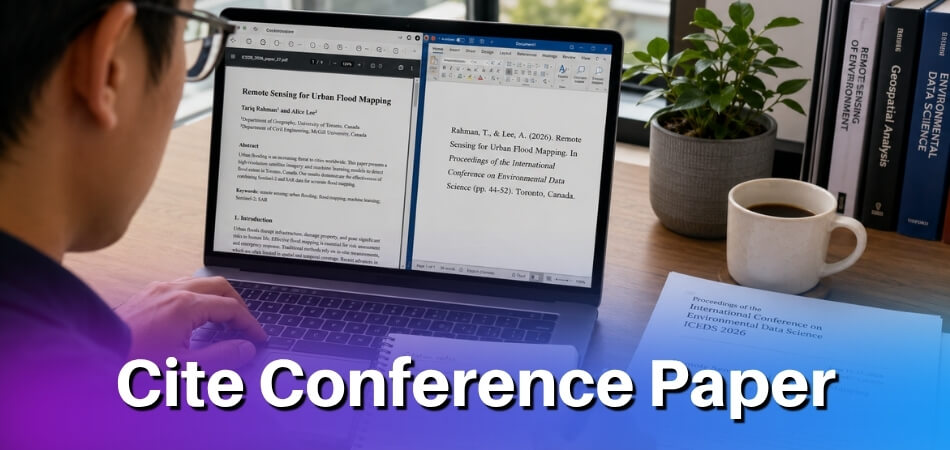
Confused about how to cite a conference paper? APA, MLA, IEEE and the rest each change just enough to cause real headaches. The author order shifts, the title capitalization rules flip, and whether a paper was published in proceedings or only presented can change the whole structure of the reference.
Quick answer: To cite a conference paper, collect the authors, year, paper title, proceedings title, pages and DOI, then arrange them in the style you must use. APA 7 treats a published paper like a book chapter (“In Editor (Ed.), Proceedings title“), MLA 9 puts the paper title in quotation marks, and IEEE uses initials and “in Proc.“. A paper that was only presented gets a presentation label instead.
Last verified against official sources: October 2026.
This guide covers APA, MLA, Chicago, IEEE, Harvard and Vancouver, with examples for published proceedings, presented-only papers, symposium papers and workshop papers. It also shows how to format single, multiple and organizational authors, how to find a DOI, and which mistakes to avoid.
How to Cite a Conference Paper (APA, MLA, IEEE at a Glance)
The table below shows the same paper in every major style. Each style has its own logic, and knowing the basic pattern saves you from avoidable errors before you start. The full templates and examples follow in the sections below.
| Style | Author format | Paper title | Proceedings title | Key extras |
| APA 7th | Last, F. M. | Sentence case, no quotes | Italicized, after “In Editor (Ed.),” | DOI as https://doi.org link when available; author-date in-text |
| MLA 9th | Last, First (first author only inverted) | “Quoted,” headline case | Italicized, then “edited by” | Editor listed after the proceedings title; author-page in-text |
| Chicago | Last, First in the bibliography; First Last in a footnote | “Quoted” | Italicized, after “In” | Two systems: footnotes plus bibliography, or (Author Year) with a reference list; your instructor or journal chooses |
| IEEE | F. M. Last | “Quoted,” sentence case | Proc. Abbreviated Name | Numbered list in order of first appearance; in-text [1] |
| Harvard | Last, F.M. | ‘Single quotes’ | Italicised, full name, location and date | Year right after the author; wording varies by institution |
| Vancouver | Last FM (no periods) | No quotes | Written in full, with conference date and place | Numbered; the limit on listed authors depends on the journal or guide |
Which style you use is decided by your journal, conference template or instructor, not by personal taste. The sections below follow the order of the table.
What Information Do You Need Before Citing?
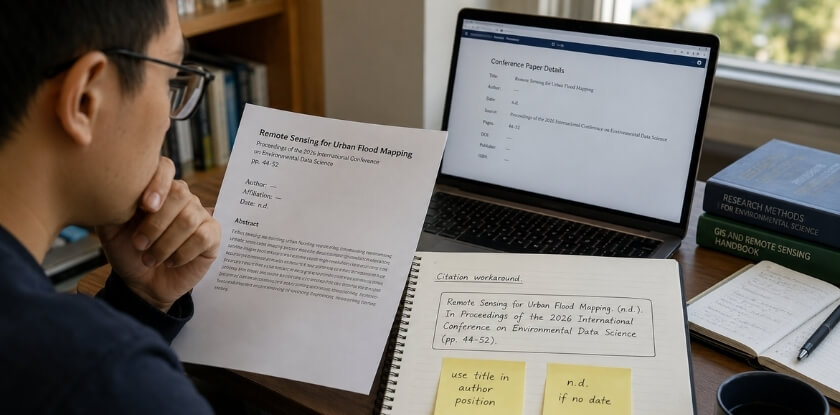
Gather the same core details for every style: authors, titles, event, pages, identifiers and publication status. A missing field leaves you with an incomplete reference that editors or professors will flag.
Author Information
Collect full names as they appear on the paper itself, not a shortened version from a database profile. Note every author in the listed order, because the sequence on the paper is part of the citation. If a government body, research institute or working group is the credited author, write out its full official name. You will need it for the in-text citation too. The exact limits on how many authors to list differ by style and are given in each style section below.
Paper and Conference Details
This is where gaps appear. Conference papers are not like journal articles: the publication structure is more variable, and databases do not always fill in every field.
| Detail | What to collect |
| Paper title | Full title, including any subtitle |
| Conference name | The complete, official name of the conference or symposium. IEEE style abbreviates the name (see the IEEE section below), but you still need the full name as a starting point. |
| Proceedings title | The published collection the paper appears in, for example Proceedings of the 12th Example International Conference on Data Systems. This is separate from the conference name. |
| Year, month and dates | MLA wants the date for presentations; Vancouver puts the conference dates after the title and the publication year after the publisher |
| Location | City and country, or city and state for US conferences |
| Pages, volume, issue | The pages your paper occupies in the proceedings. Volume and issue are not always present, but check, because some proceedings are published in numbered volumes. |
| Editors | Needed for book-style proceedings in APA, MLA, Harvard and Vancouver |
| Publisher and place | Who published the proceedings and where: IEEE, ACM, Springer, a university press or the organiser |
| DOI or URL | Use the DOI whenever one exists, written as a full link: https://doi.org/10.xxxx/xxxxx. If there is no DOI, note the direct URL. A ResearchGate or personal-page URL is a last resort because it can disappear. |
| Access date | Needed by some Harvard versions when you cite a URL. MLA 9 treats it as optional, so follow your instructor. |
Publication Status
A paper presented at a conference but not yet published in formal proceedings is cited differently from one in a published volume.
- If the paper was presented but the proceedings are not published, APA, Chicago, IEEE, Harvard and Vancouver each have a pattern for a presented-only paper, shown in the sections below.
- If the paper was later published as a journal article, cite the journal version unless you have a specific reason to cite the original conference presentation.
- Symposium and workshop papers follow the same general structure but may have their own proceedings titles. Make sure you capture the right parent publication.
- A missing DOI does not by itself mean a paper is unpublished. Check the proceedings publisher’s page before you label it a presentation.
Before you open your citation manager, run through this checklist: authors in the order listed, full paper title, proceedings title, conference name, year, location and dates, pages, editors, publisher, DOI or URL, access date if required, and published or unpublished. If you pull metadata from Google Scholar or Semantic Scholar, cross-check it against the actual paper. Auto-generated citations can get the proceedings title wrong, drop editor names or use an outdated format.
How to Cite a Conference Paper in APA Format
In APA 7th Edition, a published conference paper is cited like the type of publication it appeared in, and a presented-only paper gets a bracketed label. APA is widely used in the social sciences, education and psychology, and MS International asks authors to prepare submissions in APA format.
APA 7th Edition: Published Conference Paper (Proceedings)
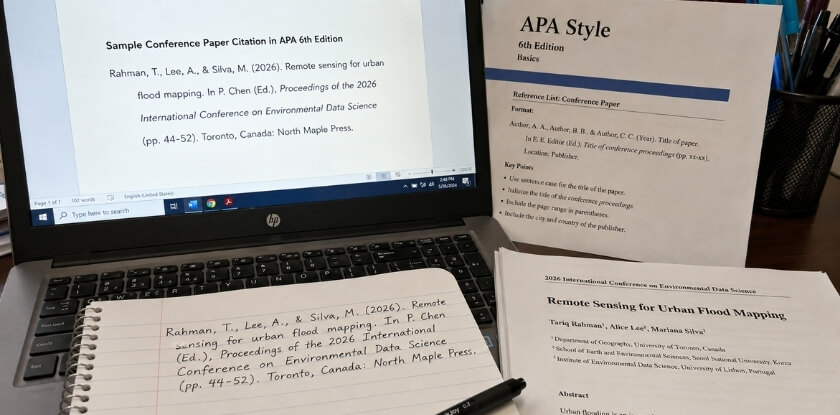
A published conference paper appears in a proceedings volume, whether that is a physical book, an online database like ACM Digital Library or IEEE Xplore, or a proceedings journal. On APA Style’s conference proceeding page, proceedings published as a chapter in an edited book follow the book-chapter format, with the proceedings as the “container,” and proceedings published as a whole book follow the whole edited-book format, with the editors in the author position.
The basic format for the book-chapter case is:
Author, A. A., & Author, B. B. (Year). Title of the paper. In E. E. Editor (Ed.), Title of Conference Proceedings (pp. page–page). Publisher. https://doi.org/xxxxx
An invented example:
Nguyen, T. H., & Park, S. J. (2021). Robust text classification in example settings. In M. L. Cohen & R. A. Singh (Eds.), Proceedings of the 12th Example International Conference on Data Systems (pp. 412–421). Example Press. https://doi.org/10.xxxx/xxxxx
A few things to keep straight:
- Italicize the proceedings title, not the paper title.
- Include page numbers when available.
- APA 7 book references do not include the publisher location.
- Include the DOI if one exists. If there is no DOI but there is a stable URL, include that instead.
- If no editor is listed, skip the “In E. E. Editor (Ed.)” part and go straight to the proceedings title.
If you found the paper through Google Scholar or ResearchGate, still track down the original DOI from the publisher’s site. Citing the repository URL is less stable and less professional.
APA 7th Edition: Unpublished or Presented Paper
An unpublished conference paper was delivered at a conference but never formally published in proceedings. This includes posters, symposium papers and workshop papers that exist only as slides or manuscripts. The paper title is italicized here, unlike published proceedings where the proceedings title gets the italics, and a bracketed descriptor tells the reader what kind of contribution it was. Common labels are [Paper presentation], [Poster presentation] and [Conference session]. Use the label that matches how the conference program or website describes the session, and give the full dates of the conference, not only the day of your session. If you cite only a printed abstract, add “abstract” to the label.
The format is:
Author, A. A. (Year, Month Day–Day). Title of the paper [Type of contribution]. Conference Name, City, State/Country.
Okonkwo, F. I. (2022, August 14–18). Measuring example bias in hiring tools [Paper presentation]. Example Association Annual Convention, Sampletown, IL, United States.
Reyes, C. M. (2023, May 5–7). Green space and example health outcomes [Poster presentation]. Example Society Biennial Meeting, Sampletown, CA, United States.
If the paper is online, for example on the conference website, add the URL at the end. If it is not publicly available anywhere, leave the URL out. Some APA guides treat a talk with no recoverable paper, slides or recording as a personal communication that appears in the text only, so ask your instructor or journal how they want it handled.
Author Formatting in APA (Single, Multiple, Organization)
Single author. Surname first, a comma, then initials only: Smith, J. R.
Multiple authors. List up to 20 authors in the reference list, separated by commas, with an ampersand before the last: Garcia, L. M., Tanaka, R., & Osei, B. For 21 or more, list the first 19, insert an ellipsis (…), then the final author’s name. Because APA 7 lists up to 20 authors, do not shorten a shorter list with “et al.” in the reference list.
In-text citations follow a different rule. With one or two authors, name them every time: (Smith & Garcia, 2020). With three or more, use the first author plus “et al.” from the very first citation: (Garcia et al., 2020).
Organizational author. Use the full organization name in place of a personal name: World Health Organization. (2022). In text, you may abbreviate after the first use: (World Health Organization [WHO], 2022), then (WHO, 2022). Only abbreviate if the acronym is well known and unambiguous in your field. If the organization is also the publisher, omit it from the publisher position to avoid repeating it.
How to Cite a Conference Paper in MLA Format
In MLA 9th Edition, a published conference paper sits inside the proceedings, which act as the container: paper title in quotation marks, proceedings title in italics. If you are used to APA, the author names will throw you off, because MLA inverts only the first author’s name.
MLA 9th Edition Example
The basic structure for a published paper is:
Last Name, First Name, and First Name Last Name. “Title of the Paper.” Title of the Conference Proceedings, edited by Editor Name, Publisher, Year, pp. page range. DOI or URL.
Nguyen, Thi Lan, and David Okafor. “Adaptive Learning Models for Example Tasks.” Proceedings of the 12th Example International Conference on Data Systems, edited by Anna Editor, Example Press, 2023, pp. 1142–58. https://doi.org/10.xxxx/xxxxx
For an unpublished or presented paper with no formal proceedings, library guides note that the MLA Handbook has no dedicated model, so the entry below adapts the pattern for a lecture or speech. Ask your instructor if they want a different form:
Osei, Kwame. “Predictive Maintenance in Example Power Systems.” Example International Symposium on Energy Engineering, 14 Mar. 2023, Sample University, Sampletown. Conference presentation.
Keep these points consistent: abbreviate months longer than four letters (Jan., Feb., Mar.), include page numbers when available, and include a DOI if the paper is on a platform like IEEE Xplore or ACM Digital Library. In-text, MLA uses the last name and page number, such as (Nguyen and Okafor 1145), and the last name alone when there is no page number.
Author Formatting in MLA
MLA inverts only the first author. Every later author is written in normal order, separated by commas, with “and” before the last name.
Single author: Rodriguez, Maria.
Two authors: Rodriguez, Maria, and James Whitfield.
Three or more authors: Give the first author followed by “et al.”: Rodriguez, Maria, et al. This applies to both the Works Cited list and in-text citations: (Rodriguez et al. 45).
For an organizational author, such as the IEEE Standards Association with no individual authors named, use the organization name exactly as it appears, without inversion.
Do not drop the editor, even for workshop and symposium papers. The MLA Style Center says to cite a paper from proceedings the way you would cite an essay in a collection, so “edited by” follows the proceedings title when editors are credited. Check the cover or title page, or Google Scholar or Semantic Scholar, if you are not sure who edited the volume.
How to Cite a Conference Paper in Chicago Style
Chicago treats a paper in published proceedings like a chapter in an edited book, and a paper that was only presented gets a “paper presented at” entry. Chicago has two systems, notes-bibliography (footnotes plus a bibliography) and author-date (a reference list with (Author Year) in the text), and your instructor or journal decides which one applies.
Published Proceedings
Follow the book-chapter pattern: author, paper title in quotation marks, “In” and the proceedings title in italics, the editors, the page range, then the publisher details and a DOI or URL if there is one. University guides for the 18th edition also point to the book-chapter pattern for this case.
Rivera, Elena, and Samuel Cho. “Sensor Networks for Example Monitoring.” In Proceedings of the Example Symposium on Applied Computing, edited by Priya Editor, 301–12. Sampletown: Sample Press, 2023. https://doi.org/10.xxxx/xxxxx.
Presented but Not Published
The entry gives the conference, location and date after the title, with a URL if the paper is online. In a footnote the author’s name is written First Last; in the bibliography it is inverted:
Okafor, David. “Learning Methods for Example Tasks.” Paper presented at the Example Conference on Learning Systems, Sample University, Sampletown, March 14, 2023.
Older guides based on the 17th edition put the conference details in parentheses, so check which edition your instructor or journal requires. The Chicago Manual of Style, 18th edition (2024), gives the full rules and examples in chapters 13 and 14, and the exact punctuation above is a template to check against it. In author-date, the year follows the author in the reference list and the text citation reads (Okafor 2023).
How to Cite a Conference Paper in IEEE Format
IEEE style numbers references in the order they first appear in your text, and the numbered list is not alphabetical. It is used heavily in engineering, computer science and electronics, and in-text citations are bracketed numbers: [1], [2].
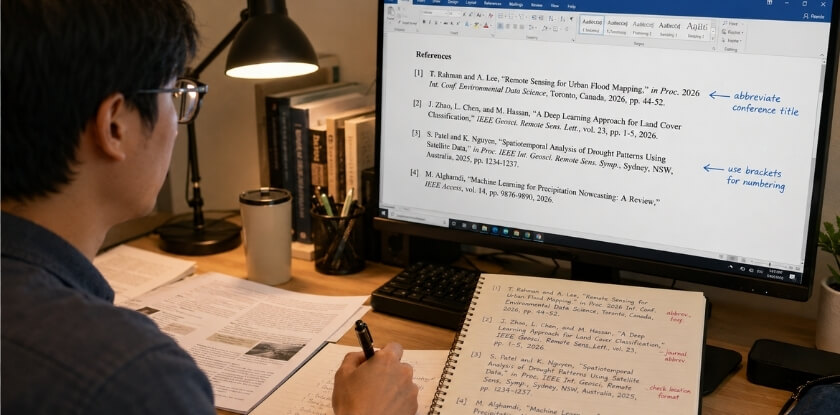
Each entry follows a strict order: author initials before the surname, paper title in quotation marks, proceedings in italics, location, date and pages, with a DOI or URL at the end when available. The word “in” signals that this is a conference paper, not a stand-alone journal article.
IEEE Example with DOI
B. Kumar and J. T. Reyes, “Adaptive load balancing in example cloud networks,” in Proc. 12th Example Int. Conf. Cloud Comput., Sampletown, IL, USA, Jun. 2022, pp. 45–52, doi: 10.xxxx/xxxxx.
Breaking that down:
- Authors are initials plus surname, joined by “and” for two. The IEEE Reference Guide says IEEE publications list all authors up to six, and use the first author plus et al. when there are more than six. In the text, it uses et al. when three or more names are given.
- Paper title goes in quotation marks, with only the first word and proper nouns capitalized.
- Proceedings title is italicized and abbreviated.
- Location is optional in the IEEE guide. When given, US venues use city, state abbreviation and USA, and other venues use city and country.
- Date uses an abbreviated month and a four-digit year.
- Pages take “pp.” for a range or “p.” for a single page.
- DOI is written as doi: 10.xxxx/xxxxx near the end.
The DOI is usually on the paper’s landing page on IEEE Xplore or the ACM Digital Library. Google Scholar and Semantic Scholar may also show it, but confirm against the original source.
For a paper presented but not in proceedings, use “presented at” in place of the proceedings title:
L. Nakamura, “Sensor drift correction in example systems,” presented at the Example Int. Workshop Embedded Syst. Design, Sampletown, Germany, Sep. 2023.
Conference Name Abbreviations in IEEE
IEEE abbreviates the proceedings title instead of writing it out. The IEEE Reference Guide gives this example: “Proceedings of the 1996 Robotics and Automation Conference” becomes Proc. 1996 Robot. Automat. Conf.
- “Proceedings” becomes Proc., “International” becomes Int., “Conference” becomes Conf. and “Symposium” becomes Symp.
- “Workshop” keeps Workshop in full.
- Common content words are shortened too, for example Comput., Vis. and Netw.
- The remaining words are written out, most articles and prepositions such as “of the” and “on” are left out, and ordinal numbers use numerals (“1st”, not “First”).
The full word list is in the IEEE Reference Guide on the IEEE Author Center website. Some IEEE examples add the conference acronym in parentheses, such as (ISLPED), and others leave it out.
How to Cite a Conference Paper in Harvard Style
Harvard has no single governing body, so details vary by institution, but the core stays the same: author(s), year, paper title, conference name, location, date and pages or DOI. Always check your university’s own Harvard guide.
Basic Harvard Format for a Conference Paper
Author Surname, Initial(s) (Year) ‘Title of paper’, in Name of Conference Proceedings, Location, Date, pp. page range.
Nguyen, T.H. and Park, S. (2021) ‘Deep learning approaches for real-time traffic prediction’, in Proceedings of the Example International Conference on Data Science, Berlin, 14–16 September, pp. 203–211.
The paper title goes in single quotation marks, not italics, and the proceedings title is italicised. The year sits right after the author, which is the mark of the author-date system. If a DOI is available, append it after the pages, for example: doi: 10.xxxx/xxxxx.
Author Formatting and In-Text Citations
- Single author: Santos, R. (2020)
- Two authors: Santos, R. and Liu, W. (2020)
- Three or more: list all authors in the reference list; in text use the first surname plus et al.: (Santos et al., 2020).
- Organisation: World Health Organization (2019). Do not abbreviate on first use.
In text, a specific point is cited as (Nguyen and Park, 2021, p. 205) and a general reference as (Nguyen and Park, 2021). For two works by the same author in the same year, add a lowercase letter in both the in-text citation and the reference entry: (Santos, 2020a) and (Santos, 2020b).
Citing an Unpublished or Presented Paper
Author Surname, Initial(s) (Year) ‘Title of paper’, paper presented at Conference Name, Location, Date. Available at: URL (Accessed: date).
Okafor, J. (2022) ‘Ethical dimensions of algorithmic decision-making’, paper presented at Example Annual Symposium on Technology and Society, Toronto, 3–5 June. Available at: https://www.example-conference.org/papers (Accessed: 12 January 2023).
“Paper presented at” is the standard Harvard wording for work that did not go through formal proceedings, including workshop and symposium papers without an official volume.
Finding the Details and Avoiding Harvard Mistakes
Google Scholar usually shows the proceedings title and year under the paper title. For engineering and computer science, IEEE Xplore and the ACM Digital Library give the full record with DOI, pages and exact conference name. Copy the name precisely, because Harvard uses the full conference title.
- Swapping the title formatting. Paper titles get single quotation marks and proceedings titles get italics. Flipping them is an easy error to make.
- Omitting location and date. Unlike APA 7th, Harvard typically expects the city and date range.
- Abbreviating the conference name. IEEE encourages abbreviations; Harvard does not.
- Forgetting the accessed date. If you link a URL instead of a stable DOI, add “Accessed:” and the date.
How to Cite a Conference Paper in Vancouver Style
Vancouver is used mainly in medicine, nursing and the health sciences, so it is likely your format if you submit to a biomedical journal or clinical proceedings. In-text citations are numbers, either in parentheses or as superscripts, and the reference list follows order of appearance, not alphabetical order.
Basic Format for a Published Conference Paper
Author(s). Title of paper. In: Editor(s), editor(s). Title of Conference Proceedings; Date of Conference; Location. Place of publication: Publisher; Year. p. page range.
Martínez R, Chen L, O’Brien P. Predictive modeling in example recovery outcomes. In: Kapoor S, editor. Proceedings of the 14th Example International Symposium on Surgical Innovation; 2022 Sep 8–10; Sampletown, Austria. Sampletown: Example Press; 2023. p. 112–9.
Notice that the conference name is written in full and the conference date and publication year can differ. Many Vancouver guides also shorten the second page number, so pages 112 to 119 become “p. 112–9”. That differs from APA, where both numbers are written in full, so follow your journal’s instructions. If the proceedings have a DOI, add it at the end: doi:10.xxxx/xxxxx
Author Formatting
Surname first, then initials without periods or spaces.
- Single author: Smith JA.
- Two authors: Smith JA, Nguyen BT.
- The NLM guide Citing Medicine says to give all authors, regardless of the number, and shows an optional version that lists the first six followed by “et al.”
- Many journals set their own limit, so use the number your target journal states.
Organizational authors are written as they appear officially. If no author is named, start the reference with the paper title.
Citing an Unpublished or Presented Paper
Author(s). Title of paper. Paper presented at: Name of Conference; Date; Location.
Okonkwo AA, Patel SR. Early markers of example conditions in intensive care. Paper presented at: Example Annual Symposium on Critical Care; 2023 Mar 15–17; Toronto, Canada.
Citing Medicine uses the words “Paper presented at:” for a paper presented at a meeting. This works for workshop and symposium papers that were not formally published. If you found the paper on a preprint server, ResearchGate or Semantic Scholar, check whether proceedings exist before defaulting to the unpublished format.
In-Text Citation and Common Mistakes
Insert the number right after the relevant claim, before any punctuation: elevated troponin levels were shown to correlate with extended recovery time (3), or as a superscript: recovery time³. Both are acceptable, and some journals use square brackets. Stick to whichever your target journal specifies.
- Confusing conference date with publication year. The conference may be in 2022 and the proceedings published in 2023. Both belong in the citation: the conference date after the title, the publication year after the publisher.
- Ignoring your journal’s author limit. Citing Medicine gives all authors, but many journals cut the list and add “et al.” Use the number your journal states.
- Omitting the editors. Leaving out “In: [Editor name], editor.” is an easy gap to leave.
How to Cite a Symposium or Workshop Paper
A symposium or workshop paper is cited like a conference paper, using the event’s own proceedings title when it has one. A symposium or workshop may publish its own proceedings volume, or its papers may sit inside a larger conference’s volume. That decides which source you list.
When the Symposium Has Its Own Published Proceedings
If the event produced a standalone proceedings volume, cite it almost like a standard conference paper. The proceedings title replaces the conference name.
APA 7th Edition:
Chen, L., & Patel, R. (2022). Learning at the example network edge. Proceedings of the 14th Example International Symposium on Wireless Systems, 45–52. https://doi.org/10.xxxx/xxxxx
If the paper came from IEEE Xplore or the ACM Digital Library, no retrieval URL is needed. The DOI is enough.
MLA 9th Edition:
Chen, Lin, and Rohan Patel. “Learning at the Example Network Edge.” Proceedings of the 14th Example International Symposium on Wireless Systems, 2022, pp. 45–52.
IEEE:
L. Chen and R. Patel, “Learning at the example network edge,” in Proc. 14th Example Int. Symp. Wireless Syst., 2022, pp. 45–52.
Abbreviate every entry the same way, and check the IEEE abbreviation list if you are unsure.
When the Workshop Is Part of a Larger Conference
Some workshops publish no independent proceedings. Their papers appear inside the main conference volume or are listed as a co-located event. Cite the parent proceedings and name the workshop where it helps.
Harvard:
Kim, J. and Okafor, N. (2023) ‘Attention methods for example languages’, in Proceedings of the Example Workshop on Language Technology (EWLT 2023), co-located with Example Conference 2023, Toronto, Canada, pp. 102–110.
“Co-located with Example Conference 2023” is not always required, but it gives readers enough context to find the paper.
Vancouver:
Kim J, Okafor N. Attention methods for example languages. In: Proceedings of the Example Workshop on Language Technology (EWLT 2023); 2023 Jul 9–14; Toronto, Canada. p. 102–10.
Location and date of the event appear after the semicolons.
Unpublished or Never-Published Workshop and Symposium Papers
Some workshop papers are working papers, position statements or extended abstracts shared only with attendees. If you got one from ResearchGate, Semantic Scholar or an author’s page with no DOI or publisher record, treat it as an unpublished conference paper. The same applies to a symposium paper that was never collected into proceedings. All major styles handle it by emphasizing event name, date and location and making clear it was not formally published. The in-text citation stays the same as for any other source; only the reference entry loses the proceedings title, pages and publisher.
APA 7th:
Vasquez, M. (2023, November). Bias auditing in example models [Paper presentation]. Example Workshop on Responsible Machine Learning, Sampletown, LA, United States.
The square brackets are where APA signals the format when there is no proceedings citation to anchor the reference. Add a retrieval URL only if the content is stable enough for readers to open.
MLA 9th:
Vasquez, Maria. “Bias Auditing in Example Models.” Example Workshop on Responsible Machine Learning, 11 Nov. 2023, Sampletown. Unpublished manuscript.
If Google Scholar links the paper to an institutional repository or preprint server, that URL is worth including. If the link goes to a landing page that needs institutional access, a DOI is better. If neither exists, cite what you have.
Conference Paper vs Journal Article: When to Cite Which
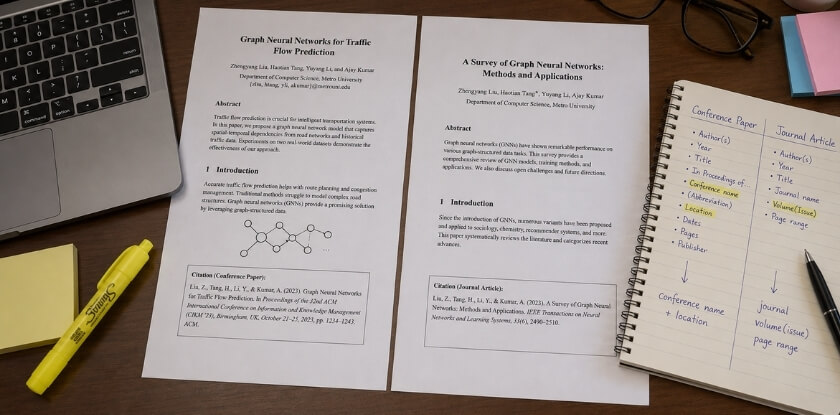
Cite the version you actually read, unless a fuller journal version exists and you can draw on it. The two can be different documents: a conference paper can be shorter than a later journal version with extra data and analysis. Citing the wrong one misrepresents what the source says.
What Actually Distinguishes Them
A conference paper is a contribution presented at a specific event and published in that event’s proceedings. A journal article goes through a separate peer review cycle and appears in a periodical with its own volume and issue numbering.
Which One Should You Cite?
Use the version you read and drew from. If you used the findings in the IEEE Xplore proceedings, cite that. If you read the expanded journal article, cite that. When one version is significantly more complete, ask your supervisor or journal which version they want cited. If you need both because they differ in meaningful ways, cite both and be clear about which point comes from which.
| Cite the conference paper when | Cite the journal article when |
| The journal version does not exist yet, or you read only the conference version. | You read the journal version, or your instructor or journal asks for it. |
| It contains something the journal version dropped, such as early results, extended abstracts or methodological notes. | The journal version holds the data or analysis you rely on and the conference version does not. |
| Your field or reading list already cites the conference version. | Your department or journal guidelines say to cite journal articles where an equivalent exists. |
How to Find Citation Information for a Conference Paper
Start with the paper itself, then a publisher database, and use aggregators only to fill gaps. Conference papers are not always as neatly catalogued as journal articles, so knowing where to look saves a lot of time.
Check the Paper Itself First
Most published conference papers carry the full conference name, year, location, page numbers and DOI on the first page or in the header or footer. If there is a DOI, use it. It is permanent and machine-readable, and APA, MLA, IEEE, Harvard and Vancouver all either require it or prefer it over a URL.
Google Scholar
Search the paper’s title in quotes, click the citation icon (the small quotation mark below the result), and you will see pre-formatted citations in APA, MLA, Chicago and other styles. Its output can contain errors in author names, conference names and page numbers, so treat it as a first draft and check it against the paper or the official proceedings.
IEEE Xplore and the ACM Digital Library
For IEEE-sponsored conferences, IEEE Xplore holds the publisher’s own record, including the DOI when one exists, and its paper pages offer citation tools. For computing papers, the ACM Digital Library has a citation export tool on each page. Button labels on these sites may change, and exported citations still need a check against the paper and your style guide.
ResearchGate and Semantic Scholar
These are useful when a paper is not in a publisher database. ResearchGate often hosts author-uploaded preprints or accepted manuscripts, and Semantic Scholar aggregates metadata from several sources. Semantic Scholar also has a Cite button under each paper title that offers BibTeX, MLA, APA and Chicago, so treat the result as a draft. Those copies are often not the final published version, so cross-check against the official proceedings on IEEE Xplore, the ACM Digital Library or Google Scholar before building your citation. If page numbers or the conference name differ, defer to the official proceedings. Citing a preprint when the published version exists is not wrong in every context, but you should indicate that it is a preprint.
When the Paper Was Presented but Never Published
Older symposium papers, workshop papers and papers from small regional events may have no DOI or page numbers. Cite what is available: author names, paper title, conference name, date and location. Check the conference program booklet if you can. Even a PDF scan of an old program often has the details you need. Do not force an unpublished paper into a proceedings template just because you cannot find the DOI.
Finding Conference Name Abbreviations
IEEE style uses abbreviated conference names, so use the word list in the IEEE Reference Guide rather than guessing. For other styles, use the full name as it appears in the proceedings.
Common Mistakes When Citing Conference Papers
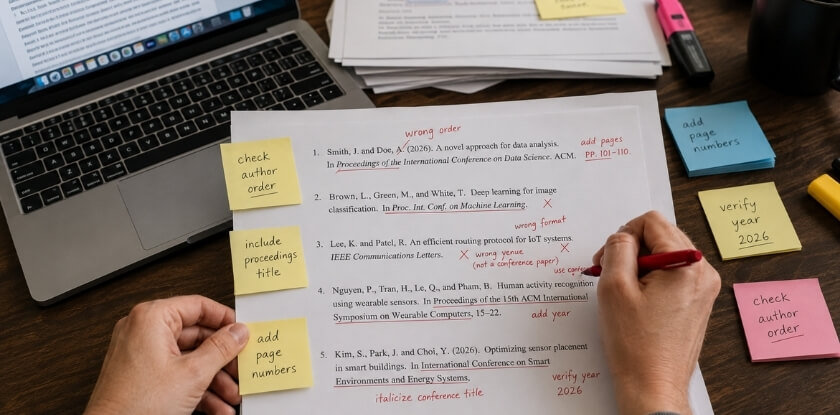
Typical mistakes are treating proceedings like a journal, dropping the editors, mishandling the DOI and mixing up published and presented papers. They share a cause: conference citations have more moving parts than a journal article reference.
| Mistake | What goes wrong and how to fix it |
| Treating proceedings like a journal | The proceedings title is the name of a book or collection, not a periodical. Cited as a journal, you lose the editors, publisher and “In”. Check whether the paper is in a stand-alone volume or a journal-affiliated proceedings, because they are formatted differently even within one style. |
| Wrong or missing “In” | APA and Harvard need “In [Editors] (Eds.), Proceedings title“. Without it the paper looks stand-alone. In APA editors appear as initials-surname with “(Ed.)” or “(Eds.)”; in MLA they follow “edited by” in natural order. |
| Omitting the DOI | A paper on IEEE Xplore or the ACM Digital Library often has one, and APA 7 and IEEE ask for it when available. |
| Using a URL instead of a DOI | Google Scholar, ResearchGate and Semantic Scholar URLs break, redirect or need a login. Use the DOI; a stable repository URL is a fallback only where the style allows it. |
| Wrong DOI format | APA 7 shows DOIs as full links (https://doi.org/10.xxxx/xxxxx), not bare numbers or an old “doi:” prefix. IEEE has its own pattern (doi: 10.xxxx/xxxxx), so follow the style’s current edition, not an old template. |
| Mixing up published and presented papers | A presented-only paper needs the presentation label and event details. Otherwise the reference implies it can be retrieved from published proceedings when it cannot. Cite the one you actually read. |
| Copying author strings between styles | The rules differ: APA lists up to 20, MLA gives first author plus et al. for three or more, and IEEE lists up to six before et al. Pasting one style’s author string into another almost always introduces errors. |
| Wrong conference name form | IEEE abbreviates; APA and Harvard expect the full name. APA 7 book-chapter references have no publisher location, while a presentation reference gives the conference location. |
| In-text and reference list do not match | If the entry starts with an organization, the in-text citation must use the organization name (often abbreviated after first use in APA). |
| Trusting auto-generated citations | Google Scholar, IEEE Xplore and similar tools can mistake a preprint for published proceedings, miss the DOI or format the title wrongly. Use them to gather raw data, then format against the style guide yourself. |
From our experience at MS International: Authors who submit to our conferences are asked to prepare their papers in APA format, and full papers should normally be between four and twelve pages including references. Review is double-blind and typically takes about 10 working days. Accepted papers may be considered for conference proceedings where applicable, which is not a guarantee. Until the published volume details are confirmed with the organisers, cite your own paper as a presentation, using the APA [Paper presentation] pattern, and switch to a proceedings format only once those details exist.
FAQ
Citing a conference paper gets tricky with a missing DOI, a copy found on ResearchGate, an unknown location or date, Chicago or IEEE style, and the choice between the paper and the whole proceedings.
Do I need to include a DOI for a conference paper?
Yes, include the DOI whenever one exists, because APA 7 and IEEE both ask for it when available. If there is none, use a stable URL from a database like IEEE Xplore or the ACM Digital Library, or omit the link. A missing DOI does not make a paper unpublished.
How do I cite a conference paper I found on ResearchGate or Semantic Scholar?
Cite the original source, not the repository. Use the proceedings details from the paper itself, because ResearchGate and Semantic Scholar are not the publisher. Semantic Scholar’s Cite button gives a draft you should check against the paper.
What is the difference between a published and an unpublished conference paper?
A published paper appears in an official proceedings volume. An unpublished one was presented but never formally published, so styles such as APA 7 cite it like a presentation, with a label like [Paper presentation], rather than proceedings.
Can I cite a conference paper the same way as a journal article?
No. A journal citation has volume and issue numbers, while a conference paper citation has the proceedings title and often the location and dates.
How do I handle a paper with more than two authors?
Three or more authors shorten to “first author et al.” in APA 7 and MLA 9 text citations. The reference list differs: APA 7 lists up to 20 authors, MLA 9 gives the first author plus “et al.”, and IEEE lists up to six.
What if I cannot find the conference location or date?
Use what is available and leave out the rest. In APA, write “(n.d.)” if there is no date; in MLA, omit the missing element. Do not guess, because an incomplete citation is better than an inaccurate one.
Is a symposium paper cited differently from a regular conference paper?
The format is essentially the same. Only the label differs: for an unpublished APA entry, use a bracket such as [Paper presentation] or [Conference session]. The core elements of authors, year, title, event name and location stay consistent for conference, symposium and workshop papers.
How do I cite a conference paper in Chicago style?
Treat a paper in published proceedings like a chapter in an edited book: author, paper title in quotation marks, “In” and the proceedings title, editors, pages and publisher details. If it was only presented, the entry names the conference, place and date after the title.
How do I cite an IEEE conference paper in a non-IEEE style?
Use the style your institution or publication requires and apply its rules to the paper’s details. IEEE Xplore can export formatted citations in several styles, which you can use as a starting point and then check against your required style guide.
What counts as the conference name in a citation?
Use the full official name of the proceedings, not an abbreviation, unless your style says otherwise. IEEE permits standard abbreviations for well-known conferences, but most other styles expect the full title as printed on the proceedings.
Do I cite the whole proceedings or just the paper?
Cite the individual paper when you used one paper. The proceedings title is the container, but the paper has its own authors, title and page range. Cite the whole volume only when you refer to the volume itself, with the editors in the author position in APA and MLA.
Final Thoughts
Gather the details first, match the style your journal, conference or instructor demands, and check any auto-generated citation against the paper itself. When a paper was only presented, say so with the right label instead of forcing it into a proceedings template. The same rule applies when you add a conference paper to your CV.