
Do a keynote speaker, a presenter and an attendee need the same invitation letter? Not really. Each of them reads the letter for a different reason, and each uses it for something different: a speaker checks the terms, a presenter checks the accepted session, and an attendee often needs it as proof of registration for a visa or an employer. Sending one template to all three leaves some of them with a letter that does not fit.
Quick answer: Yes, each role gets a different letter. A speaker letter confirms the talk slot and usually the honorarium and travel terms. A presenter letter confirms an accepted abstract, the session and the format. An attendee letter confirms registration only. For a visa, officers look first at the role, the dates, the venue and who pays, and no letter guarantees approval.
Fact-checked by the MS International Editorial Team. Last verified against official sources: October 2026.
Speaker, Presenter, and Attendee: Understanding the Difference Between the Three Roles
The three roles carry different expectations, different levels of involvement and different logistical needs. A keynote speaker who receives an attendee-style letter may assume the event is not serious about them, and a general attendee who gets a formal honorarium clause will be confused at best.
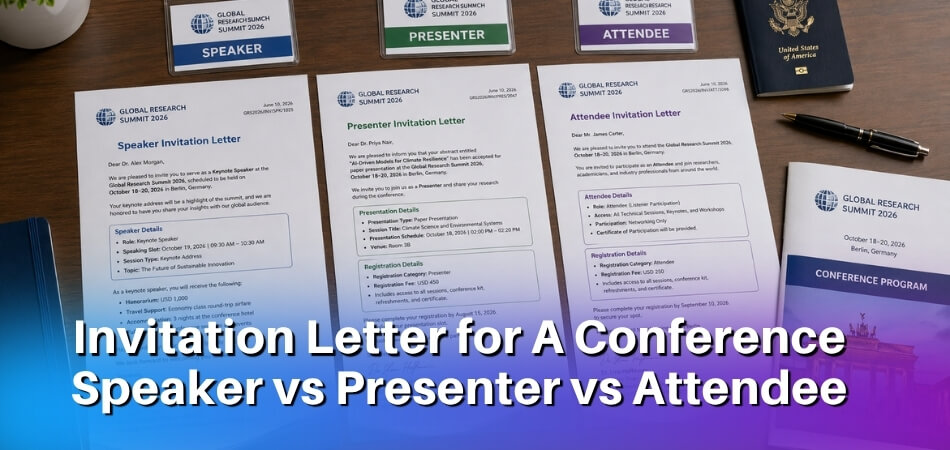
Speakers
A speaker is someone invited to address the audience, often on a topic the organizer chose or approved in advance.
A keynote speaker anchors the event. They are usually a recognized name in the field, invited to set the tone. Their letter confirms the session slot and their role in the program, and it covers travel, accommodation and honorarium terms upfront. Leaving those out signals that the organizer has not thought through the engagement.
A regular speaker delivers a scheduled talk, often in a breakout track or panel. The letter confirms topic, timeslot and technical requirements, and the tone can be more collegial than a keynote invitation.
An invited speaker sits between the two. The term means they were sought out rather than having submitted a proposal, so the letter should say that plainly without being over-flattering.
Presenters
A presenter is usually someone who submitted an abstract or paper and was accepted. Their participation depends on that acceptance, so the letter they receive doubles as formal confirmation of it.
The key difference from a speaker is that presenters drive their own content. The organizer manages a program slot rather than curating what is said. The letter confirms logistics and expectations: presentation format, session length, AV needs and deadlines for slides or proceedings. At a virtual conference, presenters also need the platform, the technical rehearsal schedule and how Q&A will be handled.
Attendees
Attendees come to learn, network and take part, not to present formally. Their letter is the simplest of the three, but it often does the most practical work: it proves registration to an embassy, an employer or a funder. A form letter that reads like a mass email is a broadcast, not an invitation, so even a short personal line helps when you invite a prospective delegate, a VIP guest or a sponsor.
Why the Role Distinction Shapes Everything
A speaker letter negotiates or confirms a commitment. A presenter letter confirms an accepted submission and sets expectations. An attendee letter confirms registration and prompts action. Treating all three the same produces letters that fit none of them.
| Role | How They’re Typically Included | Key Letter Content |
| Keynote Speaker | Directly invited by organizer | Session details, honorarium, travel/accommodation |
| Regular Speaker | Invited or nominated | Topic, timeslot, technical requirements |
| Invited Speaker | Sought out for specific expertise | Explicit acknowledgment of the invitation, logistics |
| Presenter | Abstract/paper accepted | Acceptance confirmation, format, submission deadlines |
| Attendee | Open registration or personal invite | Event overview, registration details, value proposition |
The Three Types of Conference Invitation Letters: How They Differ in Tone, Content, and Format
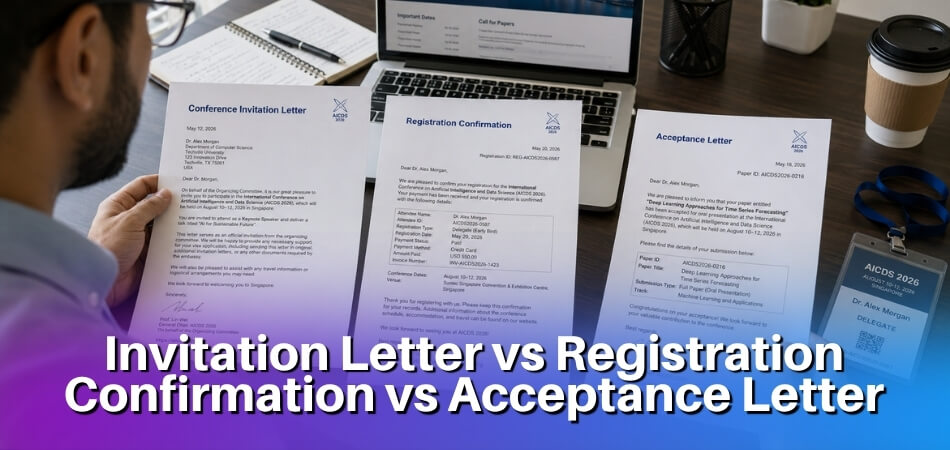
The three letters differ in tone, content and purpose, and the table below puts them side by side. A speaker letter says “we want you and here are the terms”, a presenter letter says “your work is accepted, here is the slot”, and an attendee letter says “you are registered, here are the details”.
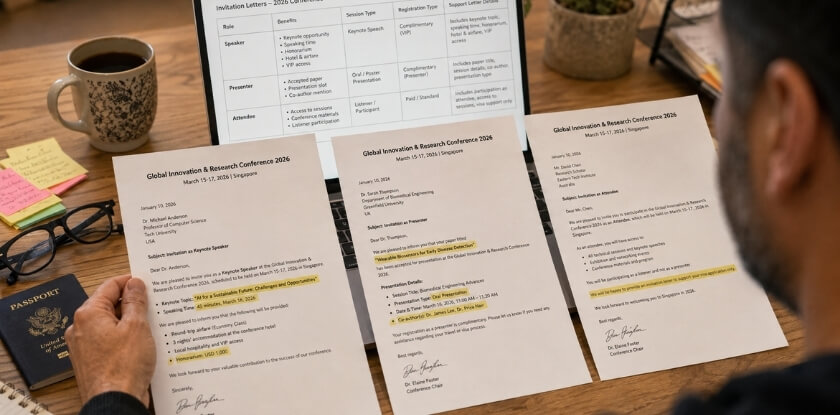
| Element | Speaker / Keynote Letter | Presenter Letter | Attendee Letter |
| Primary tone | Formal, persuasive | Professional, confirmatory | Informative, promotional |
| Honorarium / payment terms | Required | Mention if applicable | Not applicable |
| Session details | Detailed (length, format, theme) | Confirmed (title, slot, format) | General (session tracks, schedule) |
| Reason for writing | Invite and negotiate | Confirm acceptance | Confirm or drive registration |
| Typical length | 3-4 paragraphs | 2-3 paragraphs | 2-4 paragraphs |
| Response deadline | Yes, essential | Yes, for logistics | Yes, registration cutoff |
| Virtual conference specifics | Platform, recording policy | Platform, technical requirements | Access details, time zone |
In practice, a speaker letter is the most formal and runs three to four paragraphs: the invitation and event details, the specific role and logistics, compensation and practicalities, and a clear next step with a response deadline. A presenter letter names the accepted title, the session format and what the presenter gets in return, such as a registration waiver, a reduced fee or a certificate. An attendee letter opens with what the conference delivers, with specific focus areas or sessions, and puts registration details and deadlines where the reader cannot miss them.
What Does Each Role’s Letter Do for a Visa or Employer?
The role on the letter decides what an embassy, border officer or employer can read from it. The letter helps show a real reason for the trip, but it never guarantees a visa. Canada’s immigration department (IRCC) says the same: a letter of invitation can support an application, and the officer still decides on the whole file.
Attendee. The letter proves registration for a named event, with dates, venue and organizer details. For Canada, IRCC says that if your event is registered with it, the organizer gives you an event code to enter on your visitor visa application. Business visitors may also be asked to carry a letter of support from their employer and a letter of invitation from the host.
Presenter. The letter adds an accepted abstract or paper. That shows a clear academic or professional purpose and is often what a university or funder needs for leave and travel approval.
Speaker. The letter may mention payment, and that matters. For the United States, conference attendance is a permitted B-1 business visitor activity, but pay is limited. Under INA section 212(q), a B-1 visitor may accept an honorarium and related incidental expenses only for a usual academic activity that lasts no more than nine days at one institution or organization, from an institution or organization described in INA section 212(p)(1), for services that benefit it, and not from more than five such payers in the last six months (9 FAM 402.2-5(F)(2)). A paid speaker should check the current State Department wording before applying, or ask an immigration lawyer.
For Canada, the Immigration and Refugee Protection Regulations (paragraph 186(j)) let a guest speaker work without a work permit only when the sole purpose is making a speech or delivering a paper at a dinner, graduation, convention or similar function, or delivering a seminar that lasts no longer than five days. A letter that says “honorarium” without stating the source, amount and number of days can cause delays.
Organizer policy. Some organizers issue a visa letter only to people who hold a formal acceptance notice and have paid the registration fee, and some print the role (speaker, presenter or attendee) on the letter. Say which applies on your visa page, so nobody applies on the wrong assumption.
| Role | What the officer or employer wants to see | Watch out for |
| Attendee | Event name, dates, venue, registration status, who pays | Name or passport mismatch with the registration |
| Presenter | Accepted title, session, event details, what is covered | Letter says “attendee” when the person is presenting |
| Speaker | Role, session slot, payment and expense terms | Unclear honorarium wording on a visa that bars paid work |
Current rules a letter cannot change. The United States has partially suspended B-1/B-2 visas for nationals of 19 countries since 1 January 2026, and a permanent visa bond program, set out in a rule dated 3 August 2026, can require a bond of $10,000, $15,000 or $20,000 from some B-1/B-2 applicants. In Canada, the temporary Ebola measures run until 27 November 2026 and make visas and eTAs temporarily invalid for people whose last country of residence was the Democratic Republic of the Congo, South Sudan or Uganda. Check the government page for the traveller’s country before booking.
From our experience at MS International: Registered authors, presenters and listeners are all eligible for an invitation letter once full payment is made. The name must be entered exactly as it appears on the passport, and we may contact you if details are missing or names do not match. The letter names the participation type and registration category.
Keynote Speaker vs Regular Speaker: How Their Invitation Letters Should Differ
The keynote and regular speaker letters differ in what you ask each person to commit to, what you offer in return and the relationship the letter sets up. A keynote letter is courtship, and a regular speaker letter is confirmation.
Writing to a Keynote Speaker
Keynote speakers carry the event. Their name often appears on promotional material before the program is final, and they are typically paid an honorarium plus travel and accommodation.
- Lead with why this person specifically. A keynote speaker gets dozens of invitations. A generic “We would be honored to have you speak” reads like a mail merge. Name their work or a contribution that connects to your theme. One precise sentence beats a paragraph of flattery.
- Be transparent about the scope. Keynote addresses often run 45 to 90 minutes, and the speaker may be expected to join a panel, attend a dinner or take part in a Q&A. Put this in the letter, not in a follow-up two weeks later.
- State the honorarium and payment terms clearly. Avoid “we offer a modest honorarium”. Name the amount or range, say when payment is issued and confirm which expenses are covered.
- Match the tone to the seniority. Formal without being stiff. The invited speaker should feel that the organizer understands their world.
Writing to a Regular Speaker
A regular speaker, such as someone presenting a paper, leading a breakout session or giving a 20-minute talk, is usually confirmed through an abstract or selection process. The letter works as a formal confirmation more than an outreach pitch.
- Keep it structured and practical. Session time, format, room setup and AV needs belong in the body of the letter, not in a separate PDF they might miss.
- Tone down the courtship. They have already shown interest or been selected. Three paragraphs on how important they are reads as filler.
- Address honorarium honestly, or say there is none. Many conferences do not pay regular speakers. A line about a waived registration or available travel grants is better than silence.
- Confirm the details explicitly. Name the accepted paper or talk title, the session and the date and time slot.
The Table That Matters
| Element | Keynote Speaker Letter | Regular Speaker Letter |
| Tone | Formal, personalized | Professional, practical |
| Opening approach | Explain why this speaker was chosen | Confirm selection or acceptance |
| Session length | State explicitly (often 45-90 min) | State explicitly (often 15-30 min) |
| Honorarium detail | Required, name the amount or range | Include if applicable; note if none |
| Payment terms | Specify clearly in the letter | Not usually applicable |
| Scope of duties | Full outline (panels, dinners, Q&A) | Session only unless otherwise noted |
| Tone of ask | Courtship: you want them to say yes | Confirmation: they’re already in |
How to Write an Invitation Letter for a Speaker: Rules and Samples
Two samples cover the most common speaker cases: a keynote speaker and a regular or invited speaker. Get the dates, session format and honorarium terms right, because a busy professional will notice immediately if they are vague. The names, dates and amounts below are examples only.
Sample Invitation Letter for a Keynote Speaker
This one is formal, specific about expectations and open about compensation from the start.
Dr. Sarah Mitchell Professor of Organizational Behavior Example University, 1 Example Street, Edinburgh, United Kingdom
Date: July 14, 2026
Re: Keynote Speaker Invitation, International HR Leadership Summit 2026
Dear Dr. Mitchell,
We are writing on behalf of the organizing committee of the International HR Leadership Summit 2026, scheduled for October 9-11, 2026, at the Example Grand Conference Centre in Chicago, Illinois.
We would be honored to invite you to deliver the opening keynote address on Day 1, October 9, 2026. Based on your published research on workforce resilience and your recent work with cross-industry leadership teams, we believe your perspective would set exactly the right tone for this year’s theme: “Building Organizations That Last.”
Your keynote slot is 45 minutes, followed by a 15-minute audience Q&A moderated by our committee chair. You will have full flexibility over your presentation format and content within the session’s theme.
Honorarium and Travel: We are pleased to offer a speaker honorarium of $3,500, paid within 14 business days following the event. We will also cover economy-class return airfare from Edinburgh to Chicago, two nights’ hotel accommodation (October 8-10), and ground transportation to and from the venue. A formal speaker agreement outlining all payment terms will follow upon your confirmation.
For virtual attendance: If travel is not possible, we are fully equipped to host your keynote as a live virtual session. Our platform supports real-time Q&A and high-quality audio/video broadcast, and we extend the same honorarium for remote delivery.
We would be grateful for your response by August 1, 2026. If you need any further information before deciding, including a full conference program or details about past editions, please contact our speaker coordinator, James Okafor, at [email protected].
We sincerely hope you will consider joining us. Your contribution would make a meaningful difference to this year’s program.
Yours sincerely,
Dr. Linda Ferreira
Conference Chair, International HR Leadership Summit 2026
Email: [email protected] | Tel: +1 312 555 0178
Sample Invitation Letter for a Regular or Invited Speaker
A step down in formality, but not in professionalism. The tone is slightly warmer, the letter is shorter, and it handles the lack of an honorarium honestly.
Mr. Daniel Reyes Senior Data Analyst, Example Analytics Ltd [Street Address], Toronto, ON [Postal Code], Canada
Date: July 14, 2026
Re: Speaker Invitation, Data & Analytics Forum 2026
Dear Mr. Reyes,
We are pleased to invite you to speak at the Data & Analytics Forum 2026, taking place November 13-14, 2026, at the Example Convention Centre.
Your recent article on predictive modeling in supply chain operations caught the attention of our program committee, and we’d love for you to bring that work to our audience in a dedicated 30-minute breakout session on November 14. The session title and abstract would, of course, be developed with your input.
The forum draws approximately 400 professionals from across the data science, operations, and technology sectors. It’s a strong audience for the kind of applied, industry-facing work you’ve been doing.
Speaker benefits: We are unable to offer a speaker honorarium for breakout sessions, but all speakers receive complimentary full-conference registration (valued at $850 CAD), priority access to networking events, and recognition in all conference materials and our post-event publication.
We’d also like to invite you to submit an extended abstract or short paper for our conference proceedings, which are distributed to all attendees and archived online.
Please let us know by August 15, 2026 whether you’re available and interested. You can reach our program coordinator, Amara Diallo, at [email protected] with any questions.
We look forward to hearing from you.
Warm regards,
Ms. Priya Nair
Program Director, Data & Analytics Forum 2026
Email: [email protected]
How to Write an Invitation Letter for a Presenter: Rules and Samples
A presenter letter confirms that original work, such as a paper, case study or project, has been accepted for a slot. Presenters often use it for institutional approval, funding applications or travel reimbursement claims, so the details have to be exact. Student presenters may need extra lines on enrollment and who pays, as set out in a conference invitation letter for students.
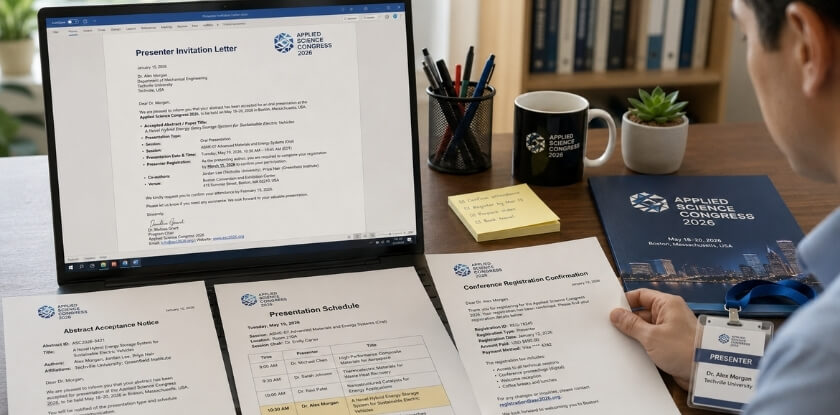
What a Presenter Invitation Letter Needs to Include
- The presentation slot details. Date, time, session title and length, including whether Q&A is inside or outside the slot. A presenter who plans 20 minutes and finds out on the day that Q&A eats into it is not a happy presenter.
- The format. In person or virtual. For online sessions, name the platform and the technical requirements: slide upload deadlines, AV checks, screen-sharing setup.
- Submission requirements. If you need an abstract, biography or slide deck by a certain date, put the deadline in the letter.
- What’s covered and what isn’t. Registration, accommodation and travel, even if the answer is “none”. Institutions processing approval forms need that clarity. A registration waiver, a reduced fee or a certificate of participation counts too, so name it. If an honorarium applies, include the amount and basic payment terms.
- Contact information. A named person, not a generic inbox.
Presenter Invitation Letter Sample: In-Person Conference
Replace the bracketed fields with your actual details.
Subject: Invitation to Present at [Conference Name], [Date]
Dear [Presenter’s Full Name],
On behalf of the organizing committee of [Conference Name], I am pleased to invite you to present your work titled “[Presentation Title]” at our upcoming conference, to be held on [Date] at [Venue Name], [City].
Your presentation has been scheduled for [Day, Date] at [Time], in the session “[Session Title].” Your allotted time is [X] minutes for the presentation, followed by [X] minutes for questions from the audience.
To confirm your participation, please respond by [RSVP Deadline]. We will also need your final presentation slides submitted by [Slide Submission Deadline].
Registration for presenting participants is [complimentary / at a reduced rate of X]. [Travel and accommodation costs are not covered by the conference / We are able to offer accommodation support. Please contact us to discuss.] [If applicable: A presenter honorarium of [amount] will be issued within [X] days of the conference, subject to completion of our payment form.]
For any questions, please contact [Name] at [email address].
We look forward to your contribution to [Conference Name] and to welcoming you in [City].
Yours sincerely,
[Your Name]
[Title] [Organization]
[Conference Website]
Presenter Invitation Letter Sample: Virtual Conference
An online conference needs extra detail on access and technical logistics.
Subject: Your online session at [Conference Name]
Dear [Presenter’s Full Name],
It is our pleasure to invite you to present “[Presentation Title]” at [Conference Name], taking place virtually on [Date].
Your session is scheduled for [Day, Date] at [Time, specify time zone]. The conference will be hosted on [Platform Name], and login details will be sent to you one week before the event. We ask that you join a technical check session on [Date] at [Time] to test your audio, video, and screen-sharing setup.
Please submit your final slides in [format] by [Deadline]. Your presenting slot is [X] minutes, followed by [X] minutes of live Q&A moderated by the session chair.
[Registration details, costs covered, honorarium or no honorarium, same structure as above.]
If you have any questions about the technical requirements or logistics, please reach out to [Name] at [email address]. We will also send a presenter information pack closer to the date.
We’re glad to have your work included in this year’s programme and look forward to seeing you online.
Warm regards,
[Your Name]
[Title]
[Organization]
How to Write an Invitation Letter for an Attendee: Rules and Samples
An attendee letter is short, but it is the one most often shown to an embassy or an employer. A weak one can contribute to a visa refusal, a rejected leave request or confusion about what the conference actually is.
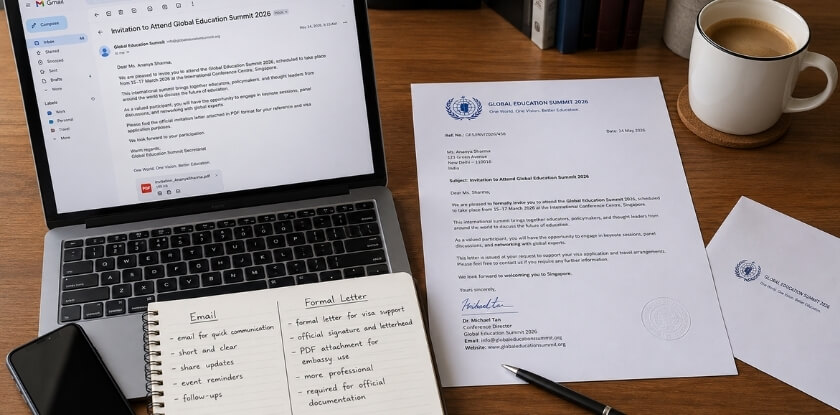
The audience is broad: general registrants, sponsored delegates, corporate nominees and people who need a formal letter for employer approval or a visa. Each situation pulls the letter in a slightly different direction.
What an Attendee Invitation Letter Actually Does
It serves one or more of three purposes: it confirms registration, it supports a visa or travel grant application, or it gives the recipient something to show an employer or institution when requesting leave or funding. A visa letter needs conference dates, venue address and organizer contact details. An employer letter has to make the conference sound credible and professionally relevant. A plain confirmation can be shorter and more welcoming. Know the purpose before you write the first line.
At MS International Conferences Inc., a letter is issued to an eligible registered participant. The standard letter is provided free of charge to registered participants. It is prepared automatically once payment clears and arrives within 3 to 5 business days. If something must be corrected after it has been issued, a US$50 administrative fee may apply. A notarized version is optional, is a separate request at US$100, usually takes up to 10 business days and is non-refundable once submitted.
What to Include
- Conference identification. The full official name, dates and location (or platform and time zone for a virtual conference). Do not abbreviate or assume the reader knows what “the conference” means.
- The recipient’s registration status. Confirm that the person is registered or invited, and whether it is a paid registration, a complimentary invitation or a sponsored place.
- Logistical information relevant to travel. Venue name and full address for in-person events, and whether the organizer can provide supporting documents for visa purposes. For an online conference, the access instructions or a note that they will follow.
- Contact information. A real person or a staffed email address.
- For a visa letter, the name exactly as on the passport. Collect it, the role and the travel dates when the person registers, so the letter matches the registration record.
- The organizer’s name and credentials. A line identifying the organizer, the host institution and any affiliations adds legitimacy, especially when the letter will be shown to an embassy or an employer.
Sample: General Attendee Invitation Letter
[Date]
[Recipient’s Full Name] [Recipient’s Institution/Organization] [Address]
Dear [Name],
We are pleased to confirm your registration for the [Full Conference Name], to be held on [Dates] at [Venue Name and Address] in [City, Country].
The conference will bring together professionals and researchers from [relevant fields] to discuss [brief description of theme or focus areas]. We believe your participation will add to the richness of the discussions taking place across the two days.
Your registration has been received and processed. A confirmation with your attendee ID and schedule information will be sent to you separately ahead of the event. If you require any additional documentation for travel or institutional purposes, please contact us at [email address] and we will respond within [X] business days.
We look forward to welcoming you in [Month].
Sincerely,
[Name]
[Title]
[Conference Name]
[Organization]
[Email | Phone]
Sample: Attendee Invitation Letter for Visa or Travel Support Purposes
Attendees traveling internationally often need a more detailed version they can submit with a visa application.
[Date]
[Recipient’s Full Name] [Passport Number, if required by organizer policy] [Recipient’s Institutional Affiliation] [Address]
Dear [Name],
This letter is issued to confirm that [Full Name] has been accepted as a registered attendee at the [Full Conference Name], organized by [Organizing Institution/Body].
Conference details: Full name: [Conference Name] Dates: [Day Month Year] to [Day Month Year] Venue: [Full Venue Name, Street Address, City, Country] Website: [Conference URL]
[Recipient’s name] has completed registration for this event. The conference registration fee [has been paid / is included as part of a sponsored delegation / is being covered under the following arrangement: specify]. All accommodation and transportation costs are the responsibility of the attendee unless otherwise stated.
The [Conference Name] is an [annual / biennial / inaugural] event organized by [Name of Organizing Body], a [description: professional association, academic institution, etc.]. The conference focuses on [brief description], and attendance is open to qualified professionals in [relevant field].
We respectfully request that the relevant authorities consider this letter as part of [Recipient’s Name]’s visa application. Should further information or verification be required, please contact us at [email] or [phone number].
Sincerely,
[Name]
[Title]
[Organization]
[Full Address]
[Email | Phone]
Sample: Attendee Invitation Letter for a Virtual Conference
Online attendees may still need a letter for employer approval or professional development records.
[Date]
Dear [Name],
We are pleased to confirm your registration for [Conference Name], a virtual conference taking place on [Dates]. Sessions will be hosted on [Platform, e.g., Zoom Webinar / a dedicated conference platform] and are scheduled across [time zone, e.g., Central European Time / UTC+1].
The conference will cover [brief description of topics]. Your registration grants access to all plenary sessions, breakout discussions, and the post-event recording library where available.
No travel is required. You will receive login credentials and a full schedule approximately [X] days before the event. If you need this letter for employer approval or continuing professional development purposes, we can provide an official certificate of attendance following the event on request.
For questions, contact [name or email address].
We look forward to your participation.
Sincerely,
[Name]
[Title]
[Conference Name]
[Email]
How to Include Honorarium and Payment Information in a Conference Invitation Letter
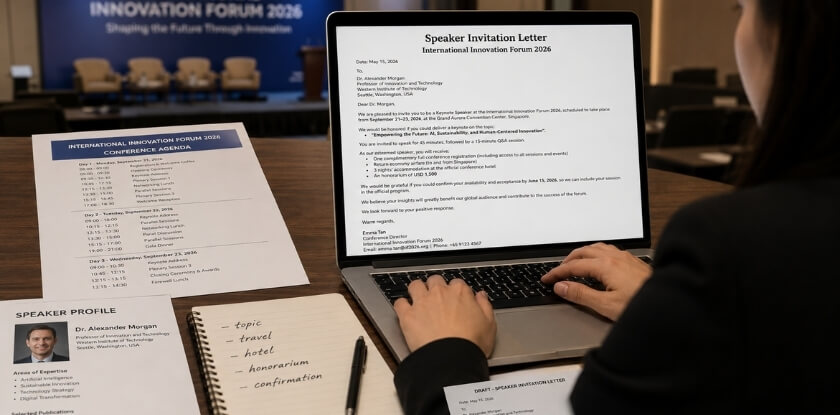
Only speakers, and sometimes presenters, need a payment section. Leaving it vague creates more problems than raising it directly, and payment information is simply part of a complete, respectful invitation.
Who Gets Payment Information and Who Doesn’t
Keynote speakers almost always expect compensation details in the first letter. Sending a vague invitation signals inexperience on the organizer’s side.
Invited speakers, those recruited by the conference rather than selected from a call, also warrant upfront payment information, because “invited” carries an implicit promise that the invitation is worth something.
Regular speakers and presenters who came through an open call typically receive expenses coverage at best and no honorarium. That is fine, but state it clearly. A line saying no honorarium is offered but registration is waived prevents misunderstandings.
Attendees get no payment discussion at all. Their invitation is about access.
What to Include When an Honorarium Is Being Offered
State the amount or range early in the letter, not in a PDF attachment or a contract that appears later.
- The honorarium amount. “An honorarium of $500” is useful. “A competitive honorarium” tells the speaker nothing.
- Payment timeline. On the day, within 30 days after the conference, or on receipt of an invoice. For speakers joining from other countries, the timeline matters more because international transfers take longer.
- Payment method. Bank transfer, check or PayPal each affect international speakers differently. Flag any requirements, such as a W-9 form for U.S. tax compliance.
- Currency. A $500 honorarium paid in USD lands differently for a speaker in Europe than for one in Southeast Asia. It takes one word to specify.
- Tax documentation. If tax forms are needed before payment, say so in the letter to avoid delays after the event.
How to Handle Travel, Accommodation, and Other Expenses
Honorarium and expenses are separate and should be treated separately. A speaker with a $1,000 honorarium who pays for transatlantic flights has a very different deal from one whose flights and hotel are covered.
Covered expenses should be listed: return airfare (economy or business class), hotel nights (how many, which hotel or a capped rate) and ground transportation. If you reimburse rather than pre-book, say so and give the cap. Expenses not covered should be named too, such as meals beyond the conference dinner. For virtual conferences the section is shorter, typically a technology allowance, if anything.
When No Honorarium Is Being Offered
Plenty of legitimate conferences, particularly academic and nonprofit events, do not pay. That is not a problem if it is communicated honestly. A line such as “We are unable to offer an honorarium for this presentation, though your conference registration and [lunches/materials] will be covered at no cost to you” is clear and respectful. Silence leads the speaker to assume a fee, and then to awkward conversations later. For keynote speakers at no-honorarium events, be even more direct, acknowledge that their time has value and explain the constraint briefly. Many accept unpaid invitations for the right event.
A Short Sample: Payment Paragraph for a Keynote Speaker Invitation
Adjust the figures and method to your organization’s actual arrangements.
We are pleased to offer an honorarium of USD 1,500 for your keynote address, payable by bank transfer within 30 days following the conference. We will also arrange and cover your return economy-class airfare and two nights’ accommodation at the conference hotel (check-in [date], check-out [date]). Prior to payment, we will ask you to complete a brief payment details form and a standard tax declaration. If you have any questions about these arrangements before confirming your participation, please do not hesitate to contact us directly.
Common Mistakes to Avoid
- Vague language about “compensation”. “We will take care of you” or “compensation will be discussed upon acceptance” feels like a stalling tactic.
- Mixing honorarium and expenses in one sentence. The speaker should know what is a fee for time and what is reimbursement.
- Skipping payment terms for virtual events. An online paid speaker still needs the amount, method and timeline.
- Sending payment details after acceptance. By then the speaker has committed, and new terms damage trust.
Writing Invitation Letters for Virtual and Online Conferences
A virtual conference letter keeps the same role-based structure, with a different set of logistical details inside it. A letter written for an in-person event with “via Zoom” added at the bottom causes confusion and looks careless.
What to Add When the Conference Is Online
- Platform and technical requirements. Name the platform (Zoom or Microsoft Teams) and the requirements: stable connection, camera, headphones, a pre-conference tech check.
- Time zone. Always state it with the session time, and for an international audience give two or three: “The session is scheduled for 10:00 AM EST / 3:00 PM GMT / 4:00 PM CET on [date].” A speaker in London who reads “10:00 AM” with no zone assumes local time.
- Session format. A live talk, a pre-recorded video with live Q&A, a webinar with moderated questions or a panel. Say which.
- Recording and consent. If sessions are recorded, say so and how the recording will be used (attendee-only access, public upload, archive). It is a courtesy and often a legal requirement.
- Pre-recorded option. Offer it explicitly. Speakers in difficult time zones often need it.
- Online attendees and technical failure. Include the registration link, platform name and how to access sessions, plus one sentence on recordings or a backup technical contact.
A Sample Paragraph for a Virtual Speaker Invitation
This replaces the travel and accommodation section of an in-person letter.
The conference will be held entirely online via [Platform Name] on [Date]. Your session is scheduled for [Time] EST / [Time] GMT. A 30-minute technical run-through with our AV team is available the day before, and we encourage all speakers to use this. Sessions will be recorded for post-event distribution to registered attendees only; we’ll send a separate consent form along with your confirmation. If a pre-recorded session would work better for your schedule, we’re happy to accommodate that. Please let us know by [date].
How to Politely Decline a Conference Invitation Letter
Decline quickly, briefly and warmly. Conference organizers invest time in finding the right people, and a prompt answer lets them find a replacement. Going silent or giving a vague non-answer is inconsiderate, and in professional circles people remember it.
- Respond as soon as you know. Do not wait for the RSVP deadline.
- Be direct but warm, and give a one-line reason such as a prior commitment or travel constraint.
- Leave the door open if you would like to be considered for a future edition.
- Do not over-apologize. One sincere expression of regret is enough.
- Put it in writing. A verbal decline is not a formal one, and a late decline from a virtual conference is still late.
Declining as a Speaker or Presenter
A speaker invitation often comes with commitments attached, such as honorarium, travel arrangements and a scheduled slot. If payment terms were already discussed, acknowledge them briefly. The earlier you decline, the more options the organizer has.
Sample decline letter: Speaker or Presenter
Dear [Organizer’s Name],
Thank you very much for inviting me to take part in [Conference Name] on [Date]. I was genuinely pleased to be considered for this role, and I have great respect for what your team has built with this event.
Unfortunately, I have a prior commitment on those dates that I’m unable to reschedule, and I wouldn’t be able to give your conference the preparation and attention it deserves. I hope you’ll consider me for a future edition. I’d welcome that conversation when the time comes.
Thank you again for thinking of me. I wish you and your team a very successful event.
Warm regards,
[Your Name]
Declining as an Attendee
An attendee decline is shorter and less formal. If you already paid, also ask the organizer about the refund or cancellation process.
Sample decline letter: Attendee
Dear [Organizer’s Name],
Thank you for the invitation to attend [Conference Name]. I regret that I won’t be able to join this year due to [brief reason: schedule conflict, budget constraints, etc.].
I hope it’s a great event, and I’d love to be considered for future editions.
Best regards,
[Your Name]
Do not use a decline to criticize the format, topic or terms. If feedback is wanted, offer it separately and only if asked.
Common Mistakes to Avoid When Writing Conference Invitation Letters
Most letter problems come from using the wrong template for the wrong person or leaving out details the recipient needs. The points below add to the payment and virtual mistakes above.
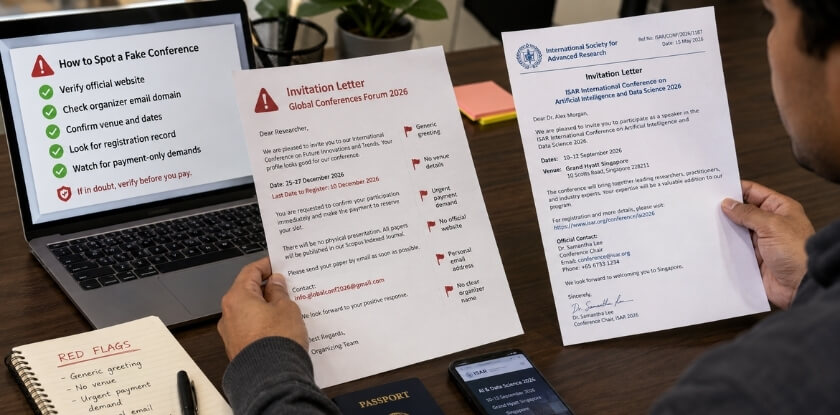
- One letter for everyone. A keynote speaker who receives a mass attendee invite notices immediately. A keynote letter names their expertise and covers honorarium and travel. An attendee letter needs none of that.
- Vague subject lines and openers. “Invitation to Our Event” tells a busy professional nothing. “Invitation to Speak at [Conference Name], [Date], [City]” does. State the invitation in the first line, not after three sentences about your organization.
- Buried logistics. Date, location, session length, format and honorarium belong in the body. Otherwise the recipient emails back or declines.
- Wrong tone for the role. An attendee letter should not read like a contract, and a chatty tone is wrong for a distinguished keynote speaker you have reached out to cold. If you have never met the person, err formal.
- No deadline. Every letter needs a response date and a clear ask: a yes or no, an abstract or a session title.
- Wrong names and titles. A misspelled name, “Mr.” for someone who uses “Dr.” or a first name for a stranger signals carelessness. Confirm spelling, title and affiliation before sending, and check a mail merge carefully.
- Confusing a presenter with a speaker. Asking a presenter with a 15-minute panel slot to “deliver a keynote-style address” misaligns expectations.
- No easy way to decline. A single line works: “If you’re unable to join us this year, we’d appreciate a brief reply so we can confirm your availability.”
FAQ
Organizers sending letters to speakers, presenters and attendees weigh how formal to be, whether honorarium details belong in the first letter, and how a speaker’s honorarium might affect their visa.
Do I need a separate invitation letter for each role, or can I send one general letter?
Yes, use a separate letter for each role. A keynote speaker and a general attendee have different expectations and logistics, and one letter cannot answer both without becoming confusing.
Does a presenter get the same visa letter as an attendee?
It depends on the organizer, but usually not exactly. A presenter letter names the accepted paper or session as well as the registration, while an attendee letter confirms registration only. Some organizers issue visa letters only after full payment and a formal acceptance, so check the visa page.
What’s the minimum information a conference invitation letter must include?
The event name, date, location (or platform if virtual), the recipient’s specific role and a clear next step such as a registration link, RSVP deadline or acceptance request. Everything else builds on that.
Should I send a speaker invitation letter before the program is finalized?
Yes, often you have to. Speakers need time to prepare and arrange travel. Send the invitation early with the confirmed details you have, and follow up once the full schedule is set.
Is it acceptable to include honorarium details in the initial invitation letter?
For keynote and invited speakers, yes, put it in the first letter. For regular speakers and presenters it depends on your structure, and if no payment is involved you can say so in one line.
How formal should the tone be?
Match the conference. An academic conference letter should be formal and precise, a professional industry event can be slightly warmer, and a community or niche online conference can be conversational.
What’s the right length for a conference invitation letter?
For speakers, one to one and a half pages. Attendees need a few clear paragraphs with the key details. Presenters fall in the middle.
Can I send invitation letters by email, or does it need to be a formal printed letter?
Email is standard and widely accepted, including for keynote speakers. A PDF on official letterhead adds a professional touch for senior or high-profile speakers.
What if the speaker or presenter doesn’t respond to the invitation?
Send one polite follow-up after a week or ten days, reference your original message and give a response deadline tied to your planning. If there is still no reply, move on to the next candidate.
Is it rude to include a deadline for accepting a speaker invitation?
No. It is practical and experienced speakers expect it. Try: “We’d appreciate your response by [date] so we can confirm the program.”
What should I do if a speaker declines after I’ve already announced them?
Never promise a speaker is confirmed before written acceptance. Do not list names in promotional material until you have written confirmation, so a late decline costs you nothing publicly.
Can an honorarium affect a speaker’s visa?
Yes. A US B-1 visitor may accept an honorarium only under INA section 212(q) conditions, and Canada’s guest-speaker exemption covers only a speech or paper at a convention or similar function, or a seminar of up to five days. Check the official rules before you promise payment.
Does an attendee invitation letter need to be personalized?
For open-registration events a polished template is fine. For invitation-only conferences, yes: include the recipient’s name, why they were selected and any access details specific to their invitation.
Final Thoughts
Keep the tone matched to the role, be specific about what you are asking the person to do, and include the practical details (dates, deadlines, honorarium terms, virtual access links) before they have to ask. If a visa is involved, make sure the role, name and passport details on the letter match the registration record exactly.
Disclaimer: This article is general information, not legal or immigration advice. Visa rules change, and a conference letter never guarantees a visa. Check the current requirements with the official immigration authority of your destination.