
It sounds like an easy question until you have to put the answer into a form, an email to your manager or a short interview. You probably know why you want to go; saying it clearly in a few lines is the hard part.
Quick answer: To answer “Why do you want to attend this conference?”, name one clear goal, link it to a specific session, speaker or theme, and say what you will do with the learning afterward. Keep it honest and short. A line such as “I want to learn more” only works if you add what you want to learn and why it matters now.
What Interviewers or Organizers Want to Know From This Question
People ask this question to check your motivation, your preparation and how well you fit the event. They want to see whether you have a real reason for attending or a general one that could apply to any conference.
A strong answer shows that you:
- Understand the conference purpose
- Know how the event connects to your goals
- Have looked at the sessions, speakers or themes
- Can say what you hope to learn
- Plan to use the experience afterward
The question also tests whether you are serious and likely to benefit. If the answer goes to a funder, sponsor, employer or visa officer, it may need to show how the conference supports your studies, work or organization. “It will be a good experience” says none of that. A better answer names a real goal, such as improving a skill, meeting people in your field, presenting research or bringing ideas back to your team.
How to Answer “Why Do You Want to Attend This Conference?”
Give one clear reason, tie it to your goals, and mention one or two specific parts of the conference. That shows you are attending on purpose, not at random.
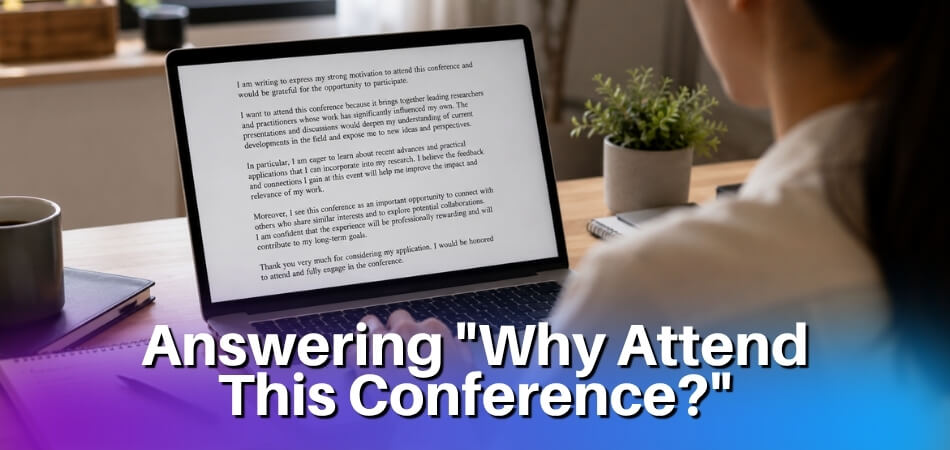
Build the answer in five short moves:
Give a Clear Main Reason
Start with your strongest reason: professional growth, academic development, research exposure, a new method or technical skill, understanding industry trends, meeting experts or bringing knowledge back to your organization.
Example:
I want to attend because the conference connects directly with my current work in [field/topic].
Connect the Conference to Your Goals
Say how it supports your career, study, research or business, and why it matters at this stage of your work or studies. This is what makes the answer personal.
Example:
The sessions on [specific topic] will help me strengthen my knowledge and apply new ideas to my current projects.
Mention Specific Sessions, Speakers, or Themes
A keynote, workshop, panel, theme or audience group from the program shows that you read about the event before answering. Pick something real, not a general claim that fits any event. If the program is not published yet, use the topics or tracks on the event page, the previous edition’s program or the speakers announced so far, and say you will check the final schedule.
Example:
I am especially interested in the workshop on [topic] because it matches a skill I am trying to build.
Explain the Networking Value
Networking is a fair reason when it is specific. Instead of “meet people,” say who you want to talk to and why.
Example:
I also hope to speak with researchers working on similar questions, so I can compare approaches and learn from their experience.
Show How You Will Apply What You Learn
Finish with what happens after the event: improving your work, sharing notes with your team, trying a new method or planning future research.
Example:
Afterward, I plan to share the main takeaways with my team and use them in our next project.
A complete answer does not need to be long. It needs to be specific, honest and linked to this conference.
Simple Answer Formula You Can Use
The formula is: goal + conference detail + benefit + outcome. Fill in the brackets, then read it aloud and cut anything that does not sound like you.
I want to attend this conference because [main goal]. I am especially interested in [session, speaker, topic or theme] because it relates to [your work, studies, research or role]. I plan to use what I learn to [practical outcome].
Each part is one short sentence. The goal can be growth, research exposure, networking or learning about trends; the detail must be something real from the program; the outcome is what you will do next. Here is the same formula with the brackets filled in:
I want to improve my understanding of [topic] and hear from people working in this area. The session on [specific session] fits my current work because [reason]. I also hope to meet professionals in the field and use what I learn to [specific outcome].
Short Sample Answers for Different Situations
Your reason as a student will differ from your reason as an employee, researcher or presenter, so match the sample to your situation. Replace every bracket with your own details.
Sample Answer for Professional Development
This conference will help me deepen my knowledge of [field/topic] and see current practice from experienced professionals. The sessions on [specific topic] fit my present role closely. I expect to bring back ideas that improve my work on [project or task].
Sample Answer for Networking
The event brings together professionals and organizations from [industry/field], which is hard to find in one place. I would like to meet people facing similar challenges, swap ideas and keep in touch afterward. Those conversations could lead to future collaboration.
Sample Answer for Students or Early-Career Professionals
I am still building experience in [field/topic], and I want to see how professionals apply these ideas in real work. Hearing the sessions and joining the discussions should give me clearer direction and help me make better choices about my next step.
Sample Answer for Employees Attending on Behalf of an Organization
The program lines up with what our team is working on right now, especially [specific topic]. I would like to collect practical tools and strategies from those sessions. When I return, I will write a short summary for the team and suggest what we could try.
Sample Answer for Speakers, Presenters, or Researchers
I would like to share my work on [topic] with a relevant audience and use their feedback to improve it. I also want to hear related presentations and meet other researchers in this area, which should shape my next study.
What to Include in Your Conference Motivation Answer
Include a clear goal, one detail that belongs only to this conference, and a practical outcome. The table shows what to say for each part and where to find the detail.

| Part | What to say | Where to find it |
| Learning goal | The method, trend, skill or research update you want | Your own role, study plan or project list |
| Conference detail | One session, keynote, workshop, panel or theme | The program or event page |
| Networking plan | The kind of people you want to meet: researchers, industry leaders, peers, speakers | Speaker list and topic tracks |
| Career, academic or business value | The next step this supports, such as research connections or business ideas | Your own plan for the next year |
| Benefit to your team or sponsor | What you will bring back: notes, a short talk, contacts, a new strategy | Your manager’s or funder’s priorities |
If your company, school or institution supports your attendance, say what you will bring back, such as notes, a short talk or useful contacts. Finish in a natural tone. You do not need dramatic language; a simple, confident reason is enough.
What to Avoid When Answering This Question
Avoid vague, careless or unsupported answers. These five mistakes weaken a reply the most.
Giving a Generic or Unprepared Answer
“I want to learn new things” or “It seems interesting” could be said about any event. Add what you want to learn and one detail, such as a session or theme, that proves you looked at the program.
Focusing Only on Travel or Social Reasons
If the answer sounds like sightseeing or casual socializing, readers will doubt your purpose. Networking is valid when it is tied to professional, academic or business value.
Listing Too Many Unrelated Reasons
Mentioning everything makes the answer confusing. Pick one or two strong reasons and explain them well.
Using Complicated Language
Long formal phrases do not make you sound more serious. A plain, honest answer reads as more convincing than a long one full of formal wording.
Making Claims You Cannot Support
Do not say the conference will help you achieve something unless you can explain how. Do not exaggerate your goals or use phrases that do not sound like you. A sincere answer that shows preparation, purpose and realistic expectations reads better than a polished but empty one.
How to Stay Focused While Preparing Your Answer
Pick one main message and build everything else around it. It can be learning, networking, career growth, research development or ideas for your team.

Choose One Main Message
Decide the main point before you write or speak. A strong answer does not need every possible reason for attending; it needs one clear goal, linked to the conference, and a plan for what you will do afterward.
Use a Simple Outline
Avoid memorizing a full script. Keep a three-line outline instead:
- Reason: why you want to attend
- Detail: the part of the conference that interests you
- Outcome: how you will use the experience
Support It With One Specific Example
One clear example from the program, such as a session, speaker or workshop, makes the answer more convincing without making it long.
Practice a Natural Response
Say the answer out loud once or twice until it sounds smooth. Focus on the idea, then explain it in words that come easily, so it does not sound recited.
Common Challenges Applicants Face When Explaining Their Reason
Wanting to go and explaining why are different skills. These are the sticking points to expect and how to get past them.
Not Knowing Where to Start
Some people begin with broad ideas and never reach a point. Start with one direct reason, such as learning from particular sessions or applying new ideas to your work.
Being Too Formal or Too Careful
A stiff answer can sound memorized. Stay polite and professional, but use simple words to give your real motivation.
Lacking Confidence
You may worry that your reason is not impressive. A modest reason is still strong when it is specific: improving one skill, learning from experts or supporting your team’s goals.
Struggling With Language or Clarity
If English is not your first language, use short, direct sentences. A clear answer beats a complicated one every time.
How to Customize Your Answer for Different Contexts
Keep the same structure, but change the emphasis to match who is reading. A conference application, an interview, an employer request, a funding form and an academic submission all ask the same question and expect a different focus.

| Where it appears | Main focus | Tone |
| Conference application | Fit between the event and your goals | Formal, short |
| Interview or visa interview | Clear purpose, honest facts about your role | Plain, conversational |
| Employer approval | What the organization gains | Practical, business-like |
| Scholarship or funding form | Need, merit and what you will do with the support | Formal, factual |
| Academic or student conference | Research exposure and feedback | Academic |
| Business or networking event | Trends, partners and market insight | Direct |
For a Conference Application
Focus on why the event fits your goals, and name the topic, session or speaker that makes it relevant.
Example:
The sessions on [topic] match my professional goals. I hope to pick up practical ideas, meet others in the field and apply what I learn to my future work.
For an Interview or Visa-Related Question
Be clear, honest and brief. Say why you are going, what you will do there and how it relates to your background. Describe your role exactly as it is: if you are registered as an attendee, say attendee; do not call yourself a speaker unless your paper has been accepted. An officer or interviewer decides what to make of your answer, and an invitation letter does not guarantee a visa.
Example:
I am attending to gain knowledge in [field], join the sessions on [topic] and meet professionals connected to my work. [My employer / I] will cover the cost, and I will return to [job/studies] afterward.
For Employer Approval or Sponsorship
Show how the organization benefits and what you will bring back: contacts, industry updates, tools or strategies. Give a rough cost and the dates early, so your manager can decide quickly, and say who will cover your tasks while you are away. Offer a one-page summary or a short team talk after you return.
Example:
The topics are directly related to our current work. I will collect practical strategies and share the key points with the team within a week of returning.
For a Scholarship or Funding Form
Funders compare many applications, so a specific answer stands out. Read the exact question: if the form asks whom you want to meet, answer that; if it asks what you hope to gain, lead with learning and mention networking briefly. Name the conference, the dates and your role, then say what the conference will give you that you cannot get locally, why now, and what you will share afterward, such as a short report or a talk to your department. Keep to the word limit, and be truthful about your other sources of funding.
Example:
I am a [student/researcher] in [field]. The conference offers feedback on my work on [topic], which I cannot get at my institution. With your support, I will attend, then present a short summary to my department.
For Academic, Research, or Student Conferences
Focus on learning, research exposure, feedback and academic growth. If you are presenting, say how the event helps you share your work and test it against other views.
Example:
I want to learn from current research in [field] and see how other scholars approach similar topics. It should sharpen my academic direction and strengthen my future research.
For Business, Industry, or Networking Events
Focus on trends, partnerships and market insight. Explain how the event helps you understand the industry better and what decision it could support.
Example:
I want to see where the industry is heading, meet people working in similar areas and test ideas that could support future business decisions.
From our experience at MS International: Our conferences are in person at venues in the Greater Toronto Area, and you can join as a presenting author or as a registered attendee (listener). Presenting authors submit first, go through double-blind review (about 10 working days) and register after acceptance, so describe yourself as a presenter only once you are accepted. Registration fees are non-refundable and non-transferable, so get employer or funder approval before you pay. Once payment clears, the invitation letter is issued within 3 to 5 business days; it supports a visa or sponsorship request but does not guarantee approval.
Common Follow-Up Questions You May Be Asked
After your answer, expect questions about your goals, expectations and plans. Short prepared replies help you answer with confidence.
What Do You Expect to Learn From the Conference?
I expect practical ideas, current trends and expert views on [topic/field], and I want to see how they apply to my work, studies or goals.
Which Session or Speaker Interests You Most?
The session on [specific topic] interests me most because it connects with my goals. I would also like to hear [speaker name], whose experience in [field/area] could give me a useful perspective.
How Will This Conference Help Your Career or Studies?
It will build my knowledge, show me new developments and connect me with people in my field. Those gains support my career direction, academic growth or project planning.
How Will Your Organization Benefit From Your Attendance?
My organization gets the insights, contacts and practical ideas I bring back. I can share the key points with my team and suggest strategies for our current work.
Who Is Paying for Your Trip?
Answer plainly: you, your employer, a scholarship or a mix. Give the same answer you gave on your forms, because inconsistent details raise doubts in interviews and visa applications.
What Will You Do After the Conference?
I will review my notes, pick the most useful lessons, follow up with relevant contacts and apply the main ideas to my work, studies or team projects.
Would You Attend Similar Conferences Again?
Yes, if they match my goals and offer real learning or networking. Regular participation helps me stay current and keep growing in my field.
Tips to Make Your Answer More Memorable
A memorable answer does not repeat the brochure; it shows a personal link between the event and your goals.

Add a Personal Link
Explain why your chosen detail matters to you. Connect it to your current project, research topic, career goal, team challenge or skill gap.
Keep the Tone Natural
Speak in a way that feels confident and real. A natural answer is easier to trust and to remember.
Avoid Overpraising the Event
You can show interest without calling the conference “the best” or “life-changing.” Say why it is relevant to you instead.
FAQ: Answering Why You Want to Attend a Conference
When an application form asks why you want to attend, the hard part is length, mentioning networking or skills, avoiding a generic reply and whether one answer suits several events.
What Is the Best Answer to “Why Do You Want to Attend This Conference?”
The best answer connects the conference to your goal. Say what you want to learn, which part of the event interests you, and how you will use the experience afterward.
How Long Should My Answer Be?
There is no single rule: keep to the word limit on the form. Spoken, stay under about two minutes. With no limit in writing, one short paragraph is enough.
Should I Mention Networking in My Answer?
Yes, if you are specific. Name the kind of people you want to meet and why. If a form asks what you hope to gain, lead with learning and mention networking briefly.
Can I Say I Want to Learn New Skills?
Yes, learning a skill is a strong reason. Name the skill, topic or workshop that links to your goal.
Should I Mention the Conference Speakers or Sessions?
Yes. Naming a speaker, session, panel or workshop proves you read about the event and are not giving one answer for every conference.
How Do I Answer If I Am Attending for My Company?
Focus on what the organization gets back: insights, contacts, tools or strategies. Add the cost, the dates, who covers your work while you are away and how you will share what you learned.
How Do I Avoid Sounding Generic?
Replace broad phrases with details. Instead of “I want to grow professionally,” say which area, why this conference helps and what result you expect.
Can I Use the Same Answer for Every Conference?
No. Reuse the structure, not the wording: change the session, topic, speaker, goal and expected benefit for each event.
Can I Attend as a Listener Without Presenting?
At MS International conferences, yes: a registered attendee (listener) is a valid role. Say that you are attending to learn and network, and do not describe yourself as a presenter.
Does an Invitation Letter Guarantee a Visa?
No. IRCC’s letter of invitation page (read October 2026) says a letter “doesn’t guarantee” a visa, and officers assess whether you meet the terms of Canada’s immigration law.
Conclusion
A good answer to why you want to attend a conference is short, honest and specific. Pick one reason, back it with a detail from the program, and end with what you will do afterward. Then adjust the emphasis for the person reading, whether that is an organizer, a manager, a funder or an officer.